Updated on April 8, 2026
90+ Resume Examples That Actually Get Interviews (2026)
Get inspired with +90 of our top resume examples for 2026. How-to guide, examples, and well-designed resume samples all included.


Novorésumé got people hired at






Most resume examples online show you what a resume looks like. They don't tell you why it works.
That's the difference between browsing templates and actually understanding what recruiters are looking for. According to Novoresume's survey of HR professionals, 74% skim a resume in 20 seconds or less, and 79% go straight to the work experience section first. If your resume doesn't lead with the right signals in the right place, it doesn't matter how clean the layout is.
We've helped 18 million+ people build their resumes. Below, you'll find 90+ resume examples across industries and career levels, each broken down by what the candidate did right and why those choices matter to a recruiter reviewing 50+ applications a day.
Best Resume Examples (Top 16)
#1. Architect Resume Example
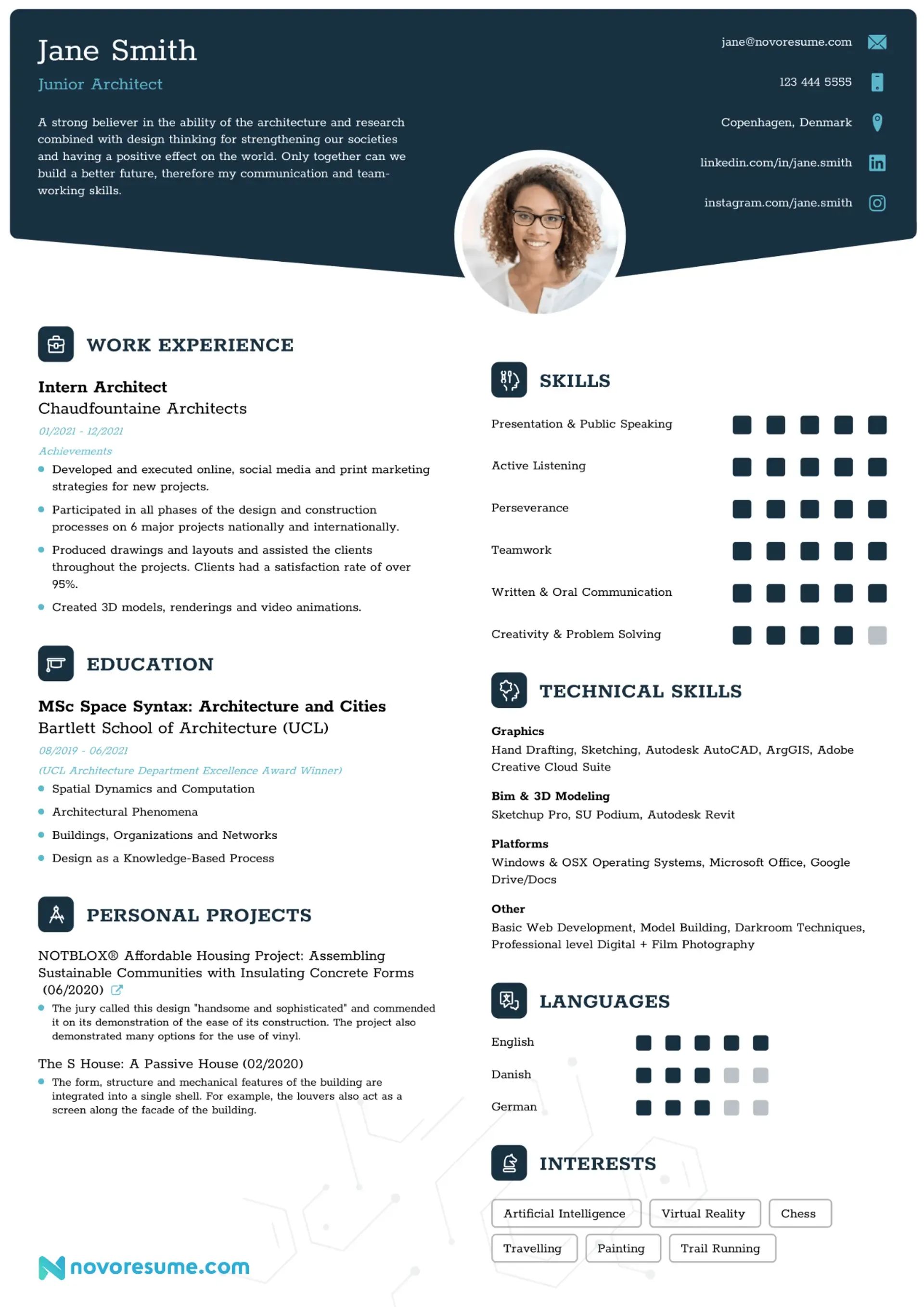
Here’s what this architect resume example does right:
- Lists related experience. This resume highlights the relevant professional experience the candidate gained in the field during their internship.
- Mentions achievements and responsibilities. The candidate backs up their claims by going into detail about their achievements and responsibilities.
- Focus on personal projects. By dedicating a section to their personal projects, this candidate makes up for their lack of work experience and shows off their dedication to the industry.
#2. Business Resume Example

Here’s what this business-related resume example does right:
- Prioritizes work experience. The work experience section is arguably the most important section in every resume, which is why this candidate has given it a priority by giving it enough resume space and going into detail about their previous positions.
- Highlights accomplishments. To make their professional experience even more impactful, this candidate has supported all their claims with quantifiable achievements.
- Lists the right optional sections. The candidate adds more value to their resume by including the organizations, honors, and conferences as optional sections.
#3. Computer Science Resume Example
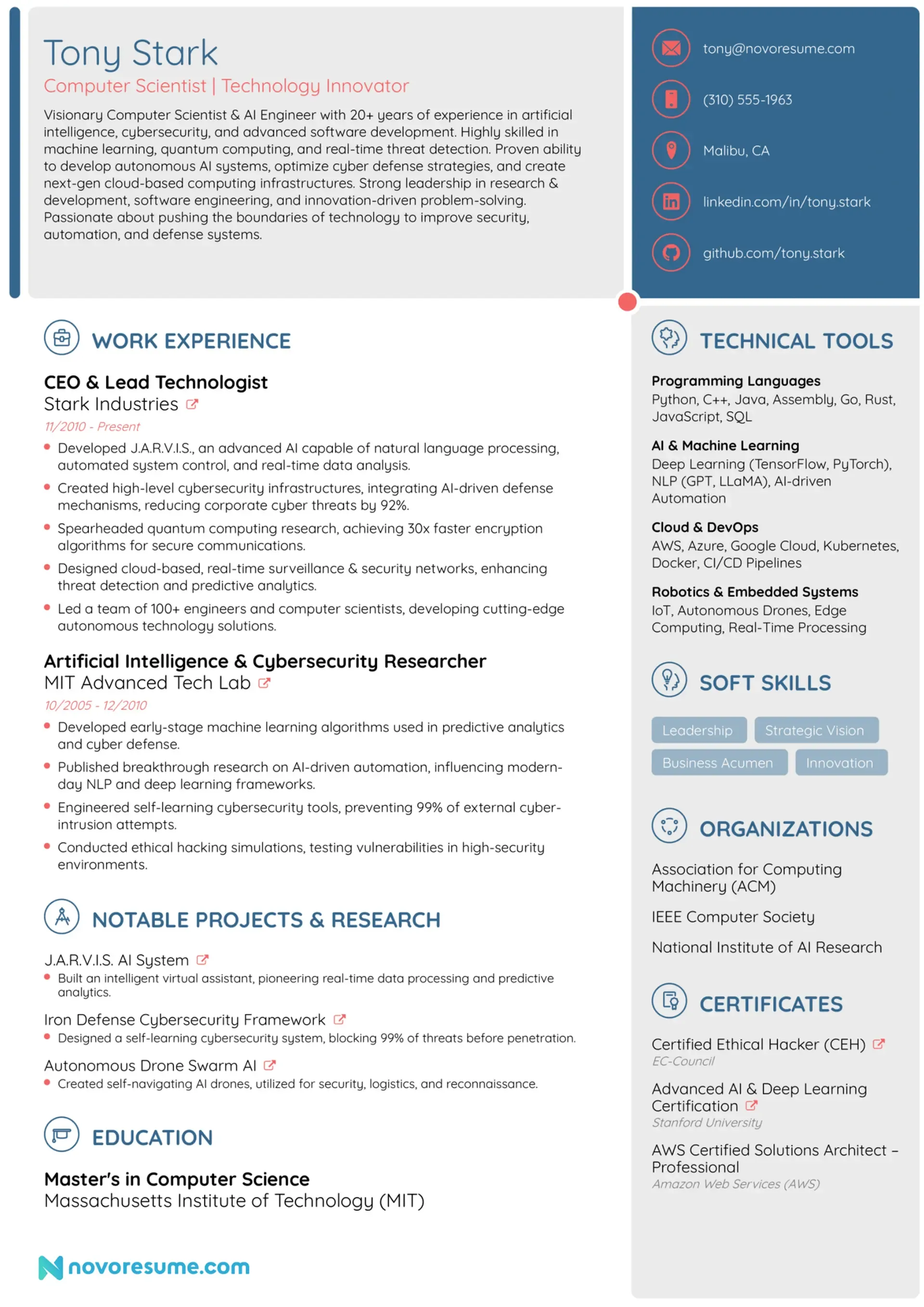
Here’s what this computer science resume does right:
- Prioritizes technical skills. Technical skills are essential when it comes to IT-related roles, which is why this candidate has prioritized them over soft skills.
- Keeps the education section concise. With such extensive professional experience in the field, the candidate has opted to keep their education section short.
- Lists relevant social media profiles. Listing websites like GitHub and LinkedIn is a great way to provide recruiters with additional information about your skills.
#4. Data Analyst Resume Example
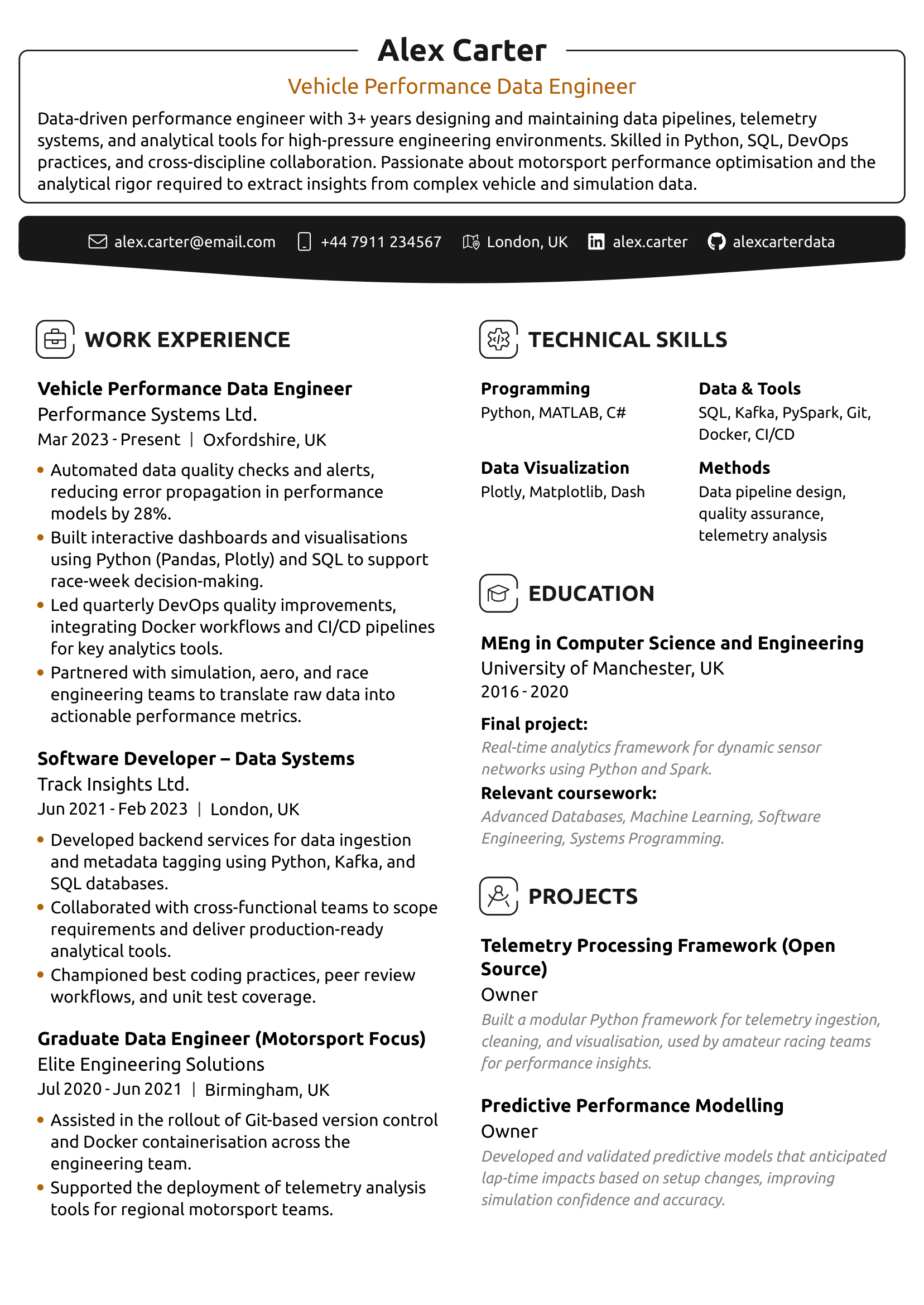
Here’s what this data analyst resume does right:
- Includes a strong resume summary. This candidate showcases their key skills and qualifications from the get-go, which is much more likely to get recruiters to read their resumes from start to finish.
- Highlights technical skills. Data analysts work with “Data Vizualization” so this candidate prioritizes their quantitative and technical skills over other resume sections.
- Lists relevant professional certifications and Projects. The resume lists the candidate’s most noteworthy professional certificates.
#5. College Resume Example

Here’s what this college resume example does right:
- Lists relevant social media profiles. By including their Medium and LinkedIn accounts, this candidate gives the hiring manager a chance to know them more professionally.
- Highlights achievements. Although they lack work experience, the candidate has listed everything they’ve achieved during their academic career, thus showing they’re a promising candidate.
- Mentions the right optional sections. Adding hobbies and interests and foreign languages to a resume is a huge plus for a candidate with no work experience.
#6. Customer Service Resume Example

Here’s what this customer service resume does right:
- Includes both soft and hard skills. Customer service roles require a mix of soft and hard skills, so this candidate has listed both.
- Mentions quantifiable achievements. To make their achievements more impressive, the candidate has backed up their work achievements with data and numbers.
- Lists foreign language skills. Foreign languages are a huge plus when you’re working in customer service and this resume does a good job highlighting the candidate’s foreign language skills.
#7. Digital Marketing Resume Example

Here’s what this digital marketing resume does right:
- Follows the reverse chronological format. This format is the most popular one worldwide and is easily the safest choice.
- Grabs attention with a resume summary. In a single glance, the recruiter can tell that the candidate is a digital marketing professional with the right amount of experience.
- Lists relevant skills. The digital marketing specialist resume above lists in-demand marketing skills like Google Ads, SEO, and others.
#8. Graduate Resume Example

Here’s what this graduate resume example does right:
- Starts off with a well-written resume objective. The resume objective does a great job of showing off the candidate’s promise and industry-related experience.
- Includes work experience. The candidate has gained professional experience while they were a student and they’ve made sure to include that in their resume.
- Takes advantage of optional sections. Sections like volunteer experience, and personal projects and achievements can help make up for the lack of extensive experience in the industry.
#9. HR Resume Example

Here’s what this human resources resume example does right:
- Follows the right format. The reverse chronological format lists the candidate’s latest experience and achievements first, which is exactly what recruiters want to see.
- Highlights professional experience. With so many years in the industry, this candidate has dedicated the biggest part of their resume to their work history.
- Includes courses and certificates. To make their achievements even more impressive, the candidate has included all their courses and certifications.
#10. Medical Assistant Resume Example

Here’s what this medical assistant resume example does right:
- Starts off with a memorable resume summary. The candidate lists their years of experience, skills, and passion for the industry, making it more likely for the hiring manager to read the rest of their resume.
- Lists the candidate’s certificates. There are many certifications one can obtain in the medical field, and this candidate proves how professional they are by listing theirs.
- Highlights the candidate’s extensive work experience. Experience speaks louder than a thousand words, which is why this resume example provides the work experience section its due space.
#11. Project Manager Resume Example

Here’s what this project manager resume example does right:
- Uses bullet points. The candidate uses bullet points to organize and present the information which makes this project manager resume example look neat and structured.
- Keeps their education section relevant. The candidate only includes their key education details, such as their Bachelor’s degree and a field-related minor.
- Takes advantage of additional sections. The candidate takes advantage of the extra space on their project manager resume by including relevant additional sections, such as their industry-related certifications and academic achievements
#12. Bar Manager Resume Example

Here’s what this bar manager resume example does right:
- Includes relevant social media profiles. Details such as your LinkedIn profile or Instagram handle make you look more professional (as long as they’re work-related).
- Mentions industry-related skills. Instead of listing a bunch of unrelated skills, the bar manager resume example above only lists industry-relevant skills.
- Quantifiable achievements. This applicant quantifies their achievements as much as possible, showing the bar owner how they stand out amongst other candidates.
#13. Supervisor Resume Example

Here’s what this supervisor resume example does right:
- Lists relevant contact details. The supervisor resume example above leaves out redundancies like marital status or age and includes relevant information, like a LinkedIn URL.
- Features as many accomplishments as possible. To really highlight their candidate’s professional experience, the supervisor example lists achievements over responsibilities.
- Lists the right kind of skills. This supervisor's resume example doesn’t list every skill under the sun. Instead, they keep the section relevant by only listing skills required from a supervisor.
#14. Teacher Resume Example

Here’s what this teacher resume example does right:
- Mentions industry-relevant skills. The candidate lists all the soft and hard skills a teacher should have.
- Includes hobbies and interests. By including hobbies and interests, the hiring manager will see the candidate as more than just a resume.
- Lists volunteer experience. The candidate reinforces their teaching experience by including their teaching volunteer gigs and experience.
#15. Writer Resume Example

Here’s just what this writer resume example does right:
- Impressive resume summary. The resume includes a brief but effective resume summary that highlights the candidate’s skills and top achievements.
- Relevant contact details. This writer resume example contains relevant contact information, including the candidate’s name and surname, email address, phone number, location, professional website URL, and LinkedIn URL.
- Short education section. A writer’s skills and experience matter more than their education. For this reason, this candidate kept their writer resume’s education section short and sweet.
#16. Web Developer Resume Example

Here’s what this web developer resume example does right:
- Focuses on technical skills. Technical skills are essential for web development, which is why this candidate has prioritized theirs.
- Grabs attention with their work experience. Their rich work experience, listed in reverse chronological order, shows the candidate is a promising professional.
- Keeps their education section minimal. With such extensive work experience and training, the candidate has kept their education section concise.
What Makes a Resume Example Worth Studying
Not all resume examples are created equal. The ones worth your time share a few specific traits.
They show achievements, not duties. "Managed a team" tells a recruiter nothing. "Led a 6-person team that reduced customer churn by 18% over two quarters" tells them everything. In Novoresume's HR survey, the most common recruiter complaint was candidates listing job responsibilities instead of results.
They're formatted for how recruiters actually read. Most hiring managers don't read resumes top to bottom, they scan. A strong resume uses white space, clear section headers, and bullet points to make the important stuff easy to find in under 20 seconds.
They're tailored to the role. A generic resume sent to 50 jobs performs worse than a targeted resume sent to 10. Every example below is built around a specific role and shows how to align your experience with what that industry expects.
Keep those three principles in mind as you go through the examples below.
65+ More Resume Examples and Guides
Couldn’t find a resume example for your field? Worry not!
Below you can find a number of other resume examples for different fields and industries:
- Accountant Resume
- Administrative Assistant Resume
- AI Engineer Resume
- Animator Resume
- ATS Resume
- Babysitter Resume
- Banking Resume
- Bank Teller Resume
- Barbie's Resume
- Barista Resume
- Bartender Resume
- Bookkeeper Resume
- Business Analyst Resume
- Career Change Resume
- Caregiver Resume
- Cashier Resume
- CEO Resume
- College Application Resume
- College Freshman Resume
- Consultant Resume
- Construction Project Manager
- Cybersecurity Resume Example
- Creative Resume Examples
- Data Entry Specialist Resume
- Data Scientist Resume
- Dentist Resume
- DevOps Engineer Resume
- Digital Marketing Manager Resume
- Editor Resume
- Electrical Engineer Resume
- Elon Musk's One-Page Resume
- Engineering Resume
- Esthetician Resume
- Europass CV
- Event Planner Resume
- Executive Assistant Resume
- Federal Resume
- Financial Analyst Resume
- Flight Attendant Resume
- Fresher Resume
- Game Designer Resume
- Graphic Designer Resume
- High School Resume
- Illustrator Resume
- Interior Designer Resume
- Internship Resume
- IT Resume
- Java Developer Resume
- MBA Resume
- Military to Civilian Resume
- Marketing Executive Resume
- Minimalistic Resume Examples
- Nanny Resume Example
- Nurse Resume
- Office Assistant Resume
- Office Manager Resume
- Operations Manager Resume
- Paralegal Resume
- Pharmacist Resume
- Photographer Resume
- Program Manager Resume
- Real Estate Agent Resume
- Receptionist Resume
- Recruiter Resume
- Research Assistant Resume
- Restaurant Manager Resume
- Retail Manager Resume
- Return to Workforce Resume Example
- Richard Branson's One-Page Resume
- Sales Resume
- Sales Associate Resume
- Satya Nadella's One-Page Resume
- Server Resume
- Social Worker Resume
- Software Engineer Resume
- Stay-at-home Mom Resume
- Student Resume
- Student Resume Templates
- Taylor Swift Resume
- Video Editor Resume
- Volunteer Resume
- Waiter/Waitress Resume
- Warehouse Worker Resume
- Web Developer Resume
- Welder Resume
Common Resume Mistakes (According to Recruiters)
After surveying 5000+ HR professionals in the last 10 years, these are the mistakes that come up most often.
Listing duties instead of achievements. "Responsible for customer service" is a duty. "Resolved 40+ customer tickets per day with a 97% satisfaction score" is an achievement. Recruiters want to see the impact, not the job description.
No numbers anywhere. Quantifiable results make claims credible. If you improved something, grew something, or built something, put a number on it.
Generic phrases. "Team player," "hard worker," and "results-driven" are filler. Every candidate says these things. Use specific examples instead.
Resume and LinkedIn don't match. Recruiters check. If your dates, titles, or responsibilities tell different stories across platforms, it raises red flags.
Obvious AI-generated content. Recruiters can tell. If your resume reads like a template prompt, it works against you. Use AI to help structure and edit, not to write from scratch.
Missing employment dates. Gaps aren't automatically a problem, 69.5% of recruiters say it "depends on the explanation." But missing dates look like you're hiding something. Always include them.
5+ Examples of Resume Templates
Your resume template can play an important role in helping you make a great first impression on the hiring manager.
Specifically, your industry, work experience, or skills all impact how your resume should look, so make sure to choose the right template when making your resume:
#1. Traditional Resume

A straightforward format that gives equal importance to all resume sections, emphasizing skills and work experience.
#2. Creative Resume

Land your dream job in the creative industry by using this creative resume template.
#3. Minimalist Resume

A simple and easy-to-follow resume template. Perfect for more conservative industries which prefer less flashy templates.
#4. Basic Resume

This easy-to-personalize basic resume layout can be ready in under ten minutes through our resume builder.
#5. IT Resume

One of the best resume layouts to choose when you wish to showcase your IT expertise.
#6. Modern Resume

It can be hard to stand out from the crowd, but this modern resume sample will take care of this.
#7. General Resume

5+ Resume Examples by Career Level
#1. No Experience Resume

Are you a student with no experience? Learn how to write a compelling resume with our guide!
#2. College Freshman Resume

Learn how to ace your college freshman resume with our comprehensive guide!
#3. Graduate Resume

Fresh out of college? Write an impactful graduate resume to land your first gig after college.
#4. Career Change Resume

Going through a career change? Perfect your career change resume to make the transition as smooth as possible.
#5. Manager Resume

#6. Executive Resume

The Perfect Resume Structure

Not sure how to structure your resume?
Here’s our tried-and-tested resume layout:
- Choose the right resume format or pick a template. If you’re formatting your resume yourself, follow the reverse-chronological format and make sure to follow the right layout rules. Alternatively, you can use one of our premade resume templates and not have to worry about formatting your resume one bit.
- Add relevant contact details and make sure they’re mistake-free. You shouldn’t be missing information such as your full name and job title, e-mail address, and where you’re based. Optionally, you can also include some relevant social media profiles, such as your LinkedIn.
- Include a resume summary or a resume objective. Done right, a resume summary will show the hiring manager you’re a relevant candidate from the get-go and have them read the rest of your resume.
- List your work experience, placing special focus on your achievements. Your work experience becomes more meaningful if you include your achievements in your past roles and manage to make them quantifiable.
- Mention your top soft and hard skills. List any skills you have that are relevant to the job you’re applying for in a seperate section.
- Keep your education section short and concise. Unless you’re an entry-level candidate with little-to-no work experience, keep your education section short and to the point.
- Leverage optional sections like “Languages,” “Certifications,” or “Hobbies and Interests.” Fill up the rest of your resume space with optional sections that can highlight your strengths and qualifications as a candidate (e.g. foreign languages you speak, certifications you’ve obtained over the years, or your hobbies and interests).
3 Examples of Resume Formats
#1. Reverse Chronological Resume Format

This resume format highlights your experience and key professional achievements by listing your latest position and acquired skills first. It’s the most popular resume format among recruiters and the one we advise job seekers to use in 99% of cases.
#2. Functional Resume Format

A functional resume, also known as the skill-based resume, is a resume format that focuses on your professional skill test as opposed to work experience. You’re better off using a functional resume if you’re a recent graduate with no work experience, if you’re switching careers, or if you have a long employment gap.
#3. Hybrid Resume Format

A combination resume combines the two traditional resume formats: the reverse-chronological resume and the functional resume.
As such, this format places emphasis on a candidate’s skills and work experience.
Frequently Asked Questions About Resume Examples
Conclusion
And that’s a wrap!
We hope the examples and guides provided in this article can help you create a powerful and effective resume that highlights your unique qualifications and experiences.
Whether you're a recent graduate, a mid-career employee, or a seasoned professional, there are tips and templates here to help you create a compelling resume for any job.
For more career advice, make sure to check out our career blog.
 Add Novorésumé as a preferred source on Google
Get more resume writing tips, career insights, and job search advice in your personalized Google search results.
Related posts

Examples
15 short cover letter samples under 150 words each, ready to copy and adapt, plus the skeleton template and survey data on why brief cover letters win.

Examples
Learn how to make a convincing flight attendant resume with our guide. Tips, tricks, resume templates, and samples included!

Examples
Learn how to make a convincing marketing executive resume with our guide. Tips, tricks, resume samples and examples included!