
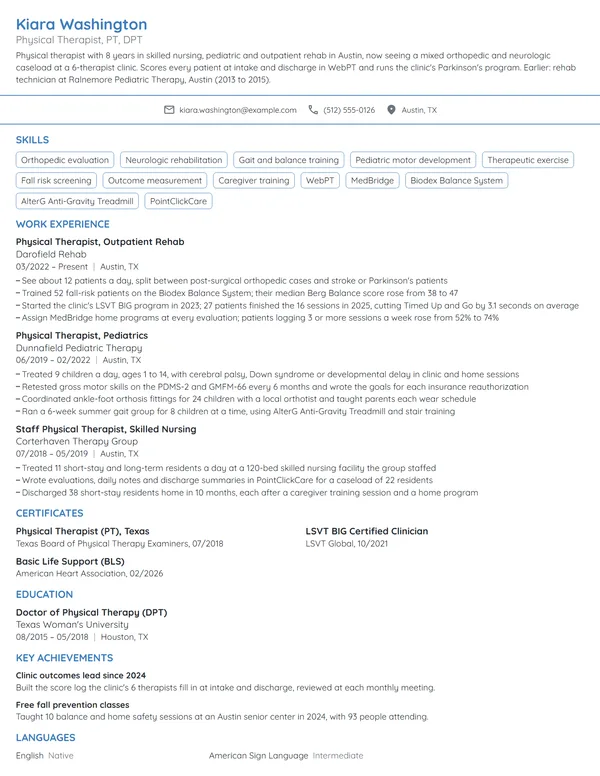
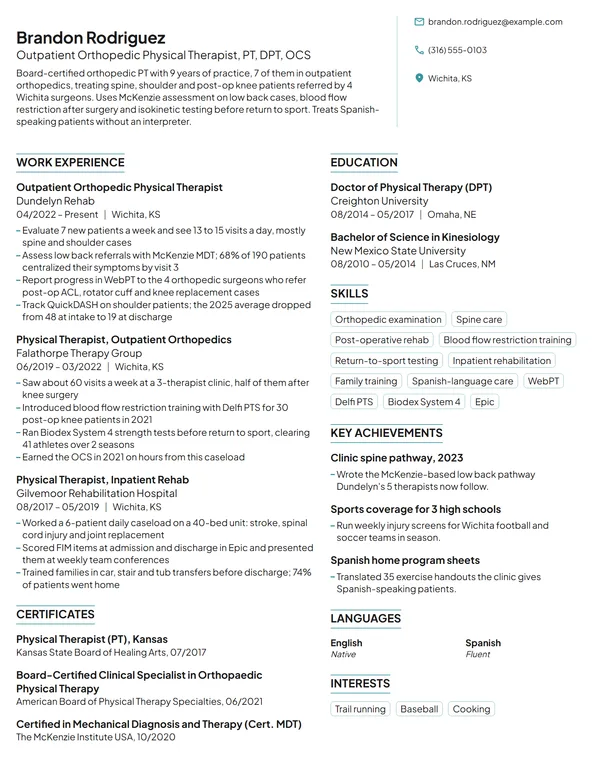
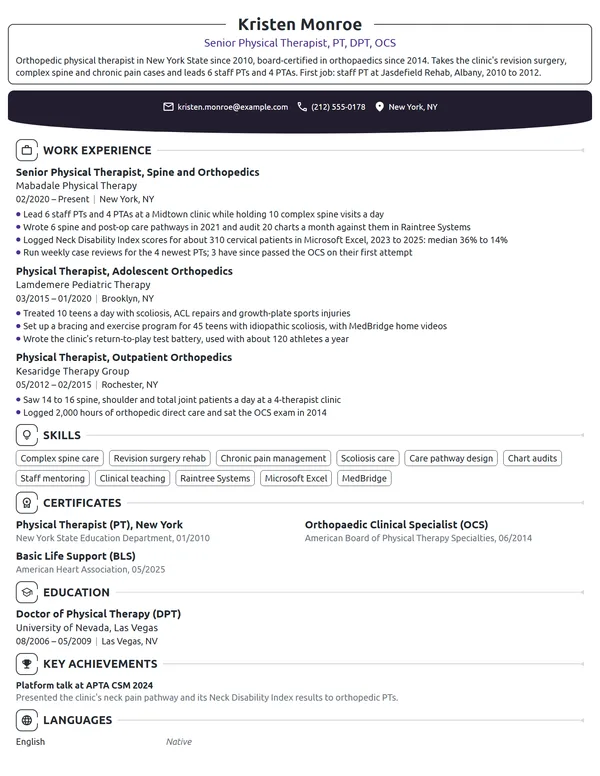
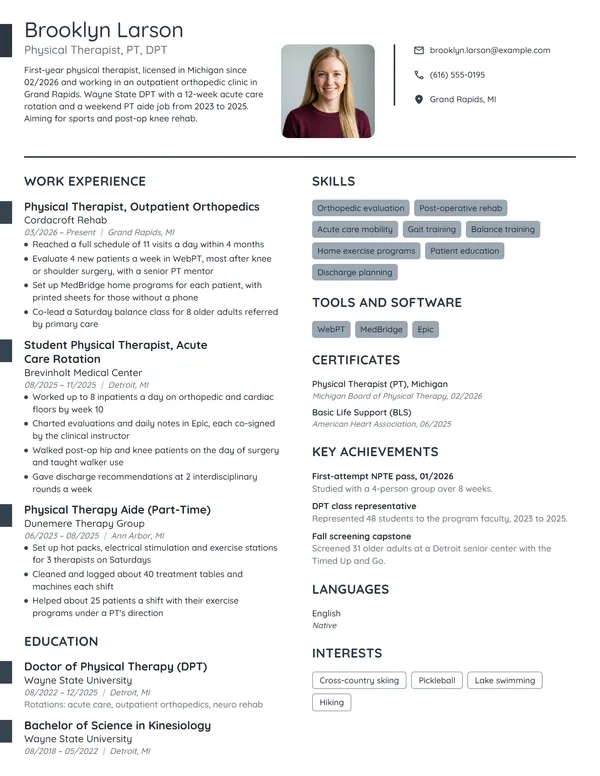
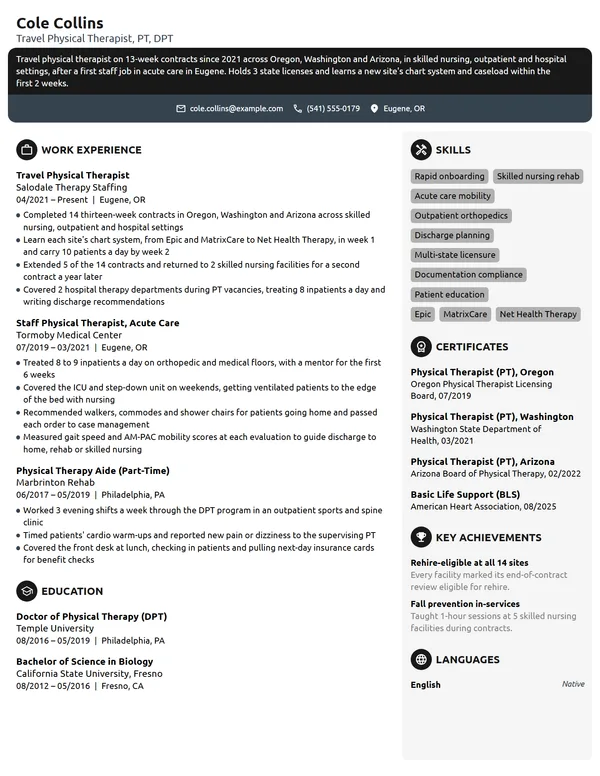
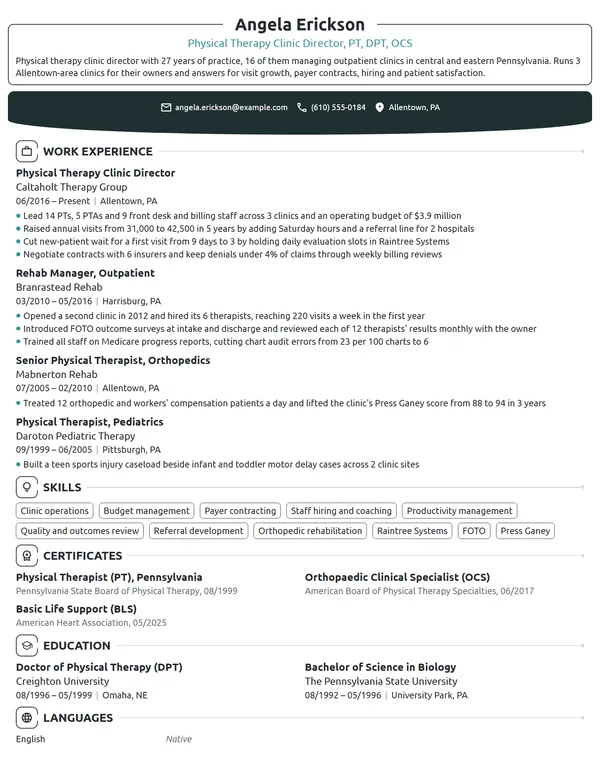
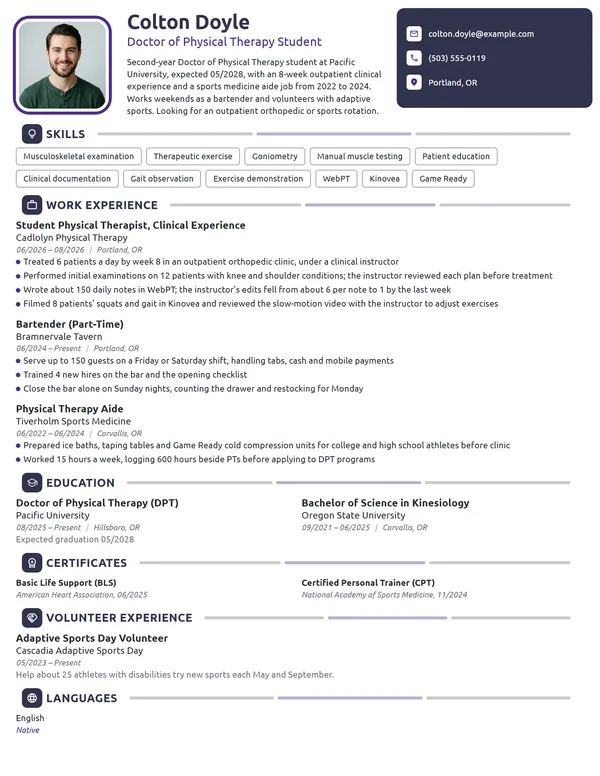
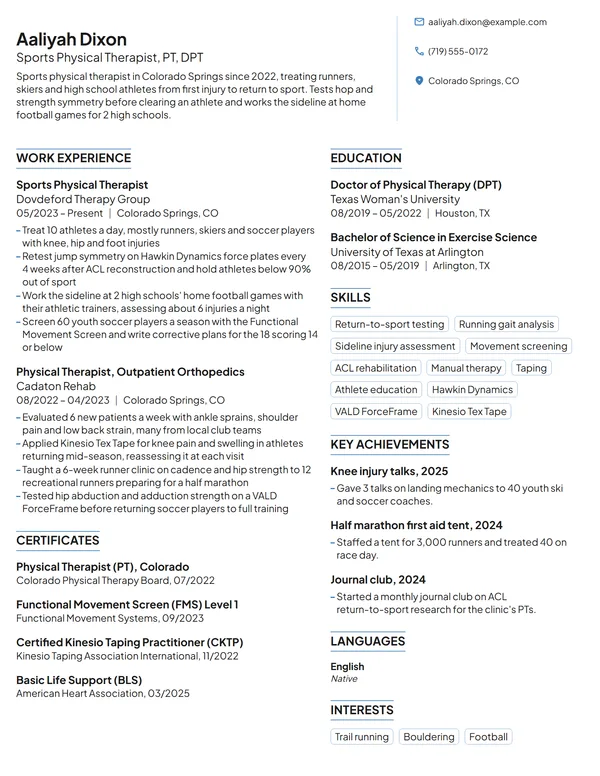
Physical therapy helps patients move with less pain, and a good resume shows you can deliver that. In practice, it means a current state license, the settings and patients you have treated, the visits you handle in a day and outcomes that show patients improving with you. Most PTs have plenty to say, but fitting years of treatment into a few bullets that still sound like you takes work. Your license and your numbers lead; for new grads, clinical rotations carry the experience.
How to Write a Physical Therapist Resume - Key Takeaways
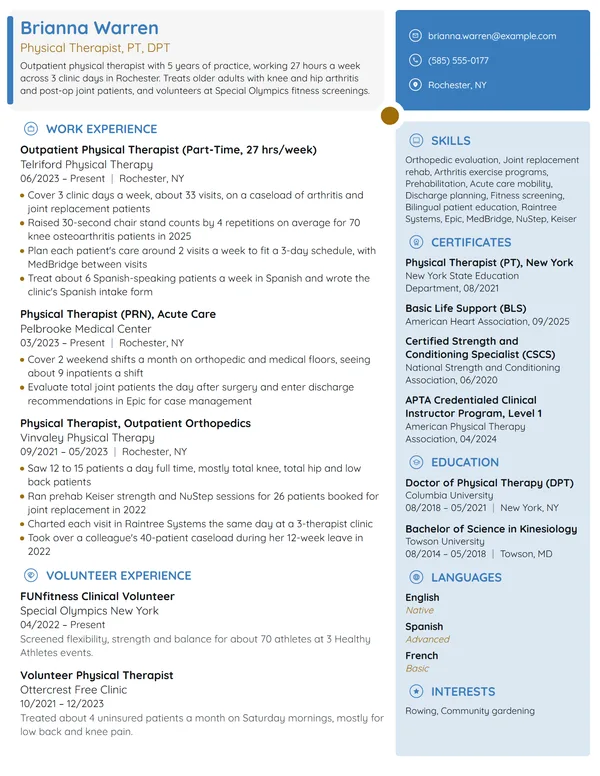
- Pick a reverse-chronological layout and keep it to 1 page, moving to 2 only with 10+ years, a residency or teaching work.
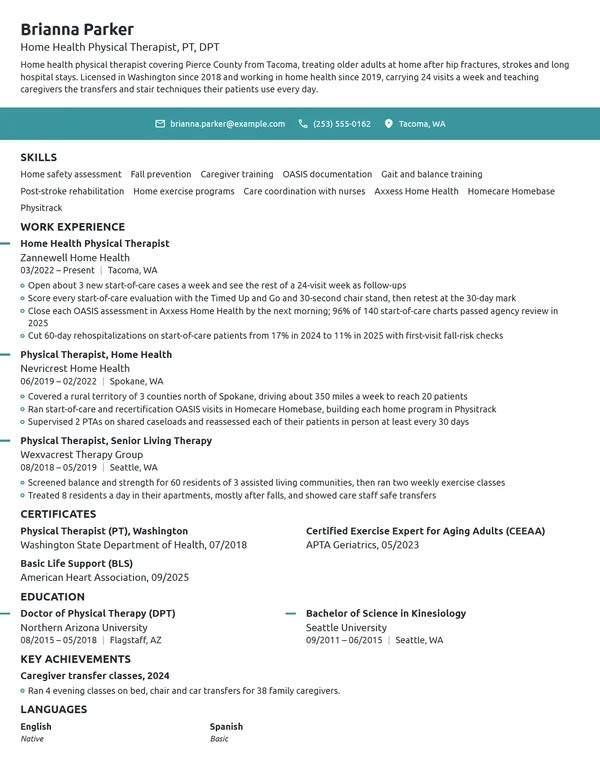
- Write the setting into every job title, such as Physical Therapist, Acute Care, and open each job with your visits a day.
- Prove results with scores your clinic already collects, such as LEFS, Oswestry or Berg Balance, plus plan-of-care completion.
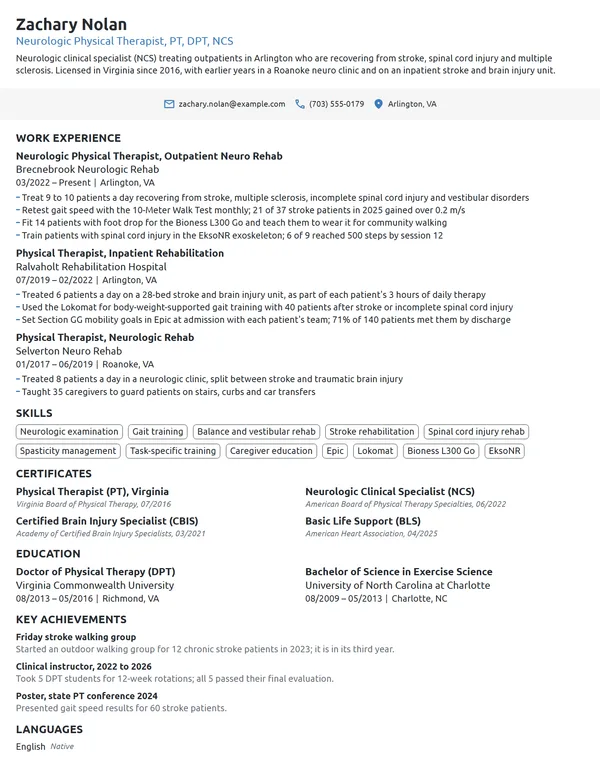
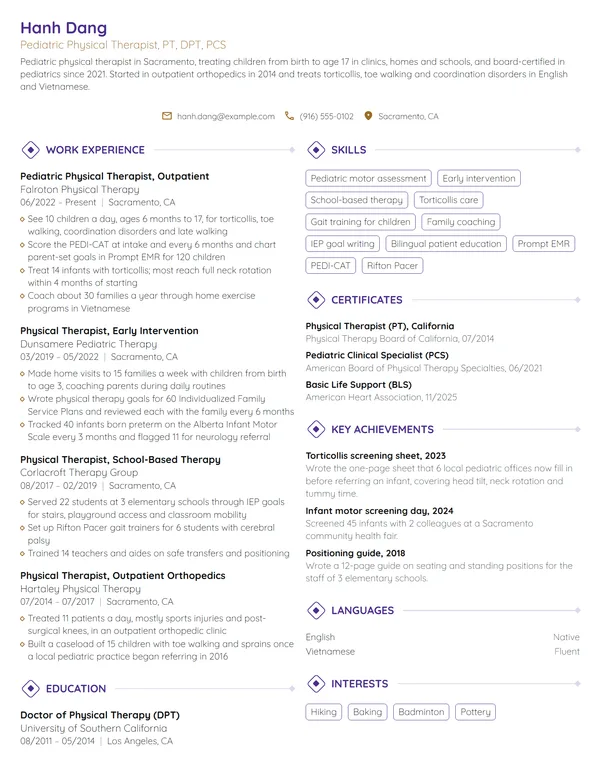
- Put PT first after your name, then DPT, then any board certification letters such as OCS, the order APTA's policy sets.
- List your state license first under Certificates with its board and month, then board certification, CCIP and BLS.
- Before uploading to a health system portal, test your file with an ATS resume checker, since the portal copies your headings into its own fields.
What clinic and rehab directors check on a physical therapist resume
A rehab director reads your resume for 4 things: a license in their state, time in a setting like theirs, a caseload you can carry, and evidence that your patients get better. The Bureau of Labor Statistics lists reviewing referrals and medical history, diagnosing movement by watching patients stand and walk, building individualized plans of care and recording progress among core PT duties. O*NET adds teaching patients and families the exercises to continue at home and supervising support staff, which on a resume means the PTAs and aides you oversaw.
Settings differ more than job titles do. The BLS counts 36% of physical therapists in therapy offices and clinics, 26% in hospitals and 11% in home healthcare, and a manager in each one reads for different numbers. Give every job its setting and patient mix, and organize the page into these sections:
- Your name and contact details, plus a headline carrying your designations (for example, Physical Therapist, PT, DPT, OCS)
- A short summary under the headline, which prints without a heading of its own
- Work Experience, with the setting written into each job title
- Certificates, starting with your state license
- Skills, including the documentation system you chart in
- Education, with the DPT first
- Languages if you treat patients in more than one, then a Key Achievements section or a Volunteer Experience section if room is left
Best format for a physical therapist resume
Use the reverse-chronological resume format, with your newest job first and its title, setting, employer, location and dates in MM/YYYY form. Many PTs change settings over a career, from acute care to outpatient or from a clinic into home health, and putting the newest first lets a director see each move and how recent it is. A residency or fellowship can take its own Work Experience entry under the program's name.
- Best for most physical therapistsReverse-chronologicalYour jobs, newest first, with your results under each one.Best for: A steady work history in your field
- FunctionalSkills grouped up top, with a short work history below.Best for: Gaps or very little experience
- CombinationA skills section first, then your full work history.Best for: A career change with strong skills
1 page holds most therapists through their first 10 years. Go to 2 pages once a residency, board certification, clinical teaching or clinic management needs the space, and keep your license and current setting on page 1.
| Element | What to use |
|---|---|
| Length | 1 page for most PTs; 2 with 10+ years, a residency, teaching or management work |
| Headline | Your name, then PT, then DPT, then any ABPTS letters: PT, DPT, OCS |
| Job title line | Title plus setting: Physical Therapist, Outpatient Orthopedics |
| Dates | MM/YYYY for each job, with Present for the one you hold now |
| Personal details | Most US and Canadian PT resumes skip the photo; leave off age, marital status and Social Security details too |
| File type | PDF, or Word if a hospital's application portal asks for it |
Most US and Canadian resumes carry no photo. Hospital systems and large outpatient groups often take applications through a portal that copies your resume into its own form, so plain section headings and text help more than design touches.
Physical therapist resume summary vs. objective
Licensed and working as a PT? Write a resume summary with your years, settings, patient population and 1 outcome. Still in a DPT program, waiting on the NPTE or coming from another field? A resume objective fits better: the setting you want, your license status and your strongest rotation. Either way, write it last and take its number from a bullet further down.
Physical therapist resume summary formula
Designations physical therapist with X years in settings, treating patient population. 1 outcome with the measure and a number. Board certification, residency or clinical teaching role.
Example
Physical therapist (PT, DPT, OCS) with 7 years in acute care and outpatient orthopedics, treating post-surgical knee, shoulder and spine patients. Raised the average LEFS gain at discharge from 14 to 19 points in a 2-therapist clinic. APTA-credentialed clinical instructor.
Don't
Dedicated physical therapist passionate about helping patients reach their goals and improve their quality of life.
Do
Outpatient PT with 5 years in sports and spine care, carrying 12 visits a day. Cut no-shows on the caseload from 15% to 8% with home exercise check-ins. Sitting for the SCS in 2027.
The second version gives the setting, the caseload, a result and the next credential.
How to write physical therapy work experience bullets with numbers
Your current job takes 3 to 4 bullets; each earlier job takes 1 to 3. Open with your caseload, since a director reads every other figure against it, then add results measured the way your clinic measures them: a standard outcome score, plan-of-care completion, falls or readmissions. Writing achievements on your resume follows the same pattern in every field: what you did, the number, and the base it moved from.
| Area | What to count | Example bullet |
|---|---|---|
| Caseload | Visits a day, evaluations a week, length of each visit | Carried 14 visits a day in 40-minute slots, with 5 new evaluations a week. |
| Functional outcomes | LEFS, Oswestry, NPRS, Berg Balance or Timed Up and Go change | Cut average Oswestry Disability Index scores for 60 low back patients from 42% to 21% by discharge. |
| Visit adherence | Arrival rate, late cancellations, plans of care completed | Lowered late cancellations on the schedule from 14% to 7% with a reminder call 2 days ahead. |
| Acute care | Evaluations a shift, mobility on the day of surgery, discharges home | Got 82% of total hip patients walking on the day of surgery under the joint replacement pathway. |
| Home health | Visits a week, territory, OASIS items, rehospitalizations | Made 28 home visits a week across 2 counties, with 30-day rehospitalization on the caseload at 9%. |
| Supervision and teaching | PTAs and aides overseen, DPT students instructed | Supervised 3 PTAs and 2 aides and taught 4 DPT students as their clinical instructor. |
The entry below puts those numbers to work. Caseload comes first, the outcomes follow, and the older acute care job is cut to 1 line.
Work Experience
- Treat 11 to 13 visits a day on a post-surgical and spine caseload, about 40% knee and shoulder rehab after surgery.
- Raised 6-week plan-of-care completion from 61% to 78% by booking the full plan at the initial evaluation.
- Built a return-to-run program for 34 post-ACL patients; 29 met the clinic's hop test criteria by 9 months.
- Teach 2 DPT students a year as an APTA-credentialed clinical instructor.
- Evaluated and treated 8 to 10 inpatients a day across 3 medical and orthopedic floors, with a discharge recommendation for each.
Don't
Provided physical therapy to patients with various conditions.
Do
Treated 9 to 11 inpatients a day after joint replacement, with 85% walking 150 feet with a walker by day 2.
Here the patients, the load and a result the hospital tracks are all on 1 line.
Don't
Responsible for documentation and billing.
Do
Closed 98% of daily notes within 24 hours for 2 years, with 0 claim denials for missing documentation.
Physical therapy skills and documentation software for your resume
Pick 6 to 8 hard skills for your resume that match the posting and that a bullet already backs up. Manual therapy and therapeutic exercise belong on nearly every PT resume; vestibular rehab, pelvic health or wound care only if you have treated those patients.
Hard skills for physical therapists
- Musculoskeletal evaluation
- Manual therapy
- Therapeutic exercise prescription
- Gait and balance training
- Post-operative rehabilitation
- Neuromuscular re-education
- Transfer and mobility training
- Home exercise programs
- Fall risk assessment
- Standardized outcome measures
Soft skills rehab directors value
- Motivating patients through pain
- Clear exercise teaching
- Patience with slow progress
- Coordination with physicians and case managers
- Supervising PTAs and aides
- Managing a full schedule
List the system you document in under Skills and show it in a bullet as well, such as notes closed on time. O*NET flags eClinicalWorks and MEDITECH as hot technologies for physical therapists, alongside Microsoft Office, and its list also names therapy systems such as Clinicient Insight. Write the name the clinic uses, whether that is WebPT, Epic or a home health platform, so a search for the posting's term finds you.
PT license, board certification and other credentials on a resume
The BLS states that all states require physical therapists to be licensed, including a qualifying exam, and that some also require a law exam and a background check. That exam is the National Physical Therapy Examination (NPTE), which the Federation of State Boards of Physical Therapy (FSBPT) develops and administers. Wisconsin, for one, adds an open-book jurisprudence exam with an 85% pass mark. List certifications on your resume below the license, each with its issuer and month.
| Credential | Issued by | What it takes |
|---|---|---|
| Physical therapist license | Your state's physical therapy board | A DPT from an accredited program and a pass on the NPTE, plus any state law exam. |
| ABPTS board certification (OCS, NCS, SCS and others) | American Board of Physical Therapy Specialties | The minimum for every specialty: a current, unrestricted US license and 2,000 hours of direct care in the specialty in the last 10 years (500 in the last 3), or an APTA-accredited residency in it. |
| Clinical residency | Program accredited by ABPTRFE | About a year of mentored practice after graduation, according to the BLS; it can stand in for the hours toward board certification. |
| APTA Credentialed Clinical Instructor Program, Level 1 (CCIP) | American Physical Therapy Association | The course and a pass on every Assessment Center station; PTs and PTAs earn the credential and 1.6 CEUs. |
| Basic Life Support (BLS) | American Heart Association | A provider course; list it with the month you completed it so a reader can see it is current. |
How to write PT, DPT and OCS after your name
APTA's policy on designations, amended in 2025, sets the order: PT first, then your highest physical therapy degree, then credentials for other regulated jobs such as ATC, then other academic degrees, then ABPTS certifications in alphabetical order. So your headline reads PT, DPT, OCS, never DPT, PT. Use PT once your license is issued, and leave the license number off, since employers verify it with the state board.
Certificates
- Physical Therapist (PT), Wisconsin, Wisconsin Physical Therapy Examining Board, 07/2019
- Board-Certified Clinical Specialist in Orthopaedic Physical Therapy (OCS), American Board of Physical Therapy Specialties, 06/2025
- APTA Credentialed Clinical Instructor Program, Level 1, American Physical Therapy Association, 03/2024
- Basic Life Support (BLS), American Heart Association, 01/2026
How to list a DPT degree and clinical rotations
The BLS states that physical therapists need a Doctor of Physical Therapy (DPT) degree from an accredited program, that programs typically last 3 years, and that they ask for prerequisites such as anatomy, chemistry and physics. CAPTE, the accrediting agency recognized by the US Department of Education, accredits more than 300 physical therapist programs. If you earned an MPT or MSPT instead, write that degree exactly as your diploma shows it.
Follow the general rules for listing education on a resume: the degree, the school and its city, and the month you graduated, with your bachelor's degree below the DPT. For your first 2 years in practice, add 1 line naming your clinical rotations and their settings; after that, the degree, school and date are enough.
Education
Clinical rotations: acute care, outpatient orthopedics, inpatient rehab and pediatrics, 36 weeks in total.
New grad and career-change physical therapist resumes
As a new graduate, open with an objective that gives your NPTE status (scheduled, passed or license issued, with the month) and the setting you want. Some states issue a temporary license while you wait for scores; Wisconsin's lets you practice only under the direct supervision of a fully licensed PT, so call it a temporary license if you list it. Put your rotations where a director can count the weeks, and borrow the entry-level resume layout if your paid experience is thin.
- Full-time clinical rotations: the setting, the weeks, and the caseload you carried by the final week.
- PT aide or rehab tech jobs: a Work Experience entry with the patients you helped a day and the equipment you set up.
- Student-run pro bono clinics: under Volunteer Experience, with the sessions or patients you saw.
- Coaching, athletic training room or fitness work: 1 entry showing injury screening or exercise teaching, with a number.
Don't
Recent DPT graduate seeking a position where I can grow my skills as a physical therapist.
Do
DPT graduate (05/2026) who passed the NPTE in 07/2026, seeking an outpatient orthopedic or sports role. Completed 4 full-time clinical rotations, including 10 weeks in a sports medicine clinic.
Even a new grad objective needs evidence: an exam date, a setting and a count of weeks.
Moving into physical therapy from athletic training, fitness, a PTA role or an unrelated job, keep reverse-chronological order and put your DPT and license at the top. From earlier jobs, hold on to bullets that carry over: exercise teaching, injury screening, documentation or patient contact. The physical therapist assistant resume shows which PTA bullets carry over, and the career-change resume layout suits other fields. Save the reason for the switch for your letter to the employer; our healthcare cover letter examples do it in a few lines.
Physical Therapist resume FAQ
What order do PT, DPT and OCS go in after my name?
PT comes first, then your highest physical therapy degree, then any ABPTS certification. That gives PT, DPT, OCS. APTA's designation policy sets this order, places credentials for other regulated jobs such as ATC after the degree, and lists more than 1 board certification in alphabetical order.
Can I write PT after my name before I pass the NPTE?
No. Write DPT once your degree is conferred, and add PT only when your state license is issued. Until then, give your NPTE status in your objective, such as NPTE scheduled for 01/2027, so a director knows when you can start.
Should I put my physical therapy license number on my resume?
No. Write the license, the state, the issuing board and the month it was issued. Employers look the license up with the board themselves, and keeping the number off means it does not travel through every job portal your resume passes through.
How long should a physical therapist resume be?
1 page for new graduates and most staff therapists. Use 2 pages once you have 10+ years, a residency, a board certification with teaching or research, or a clinic director role, and keep your license and current setting on page 1.
Which outcome measures should I name on a physical therapy resume?
Name the ones your clinic scores at intake and discharge. LEFS and the Oswestry Disability Index suit outpatient orthopedics and spine, Berg Balance and Timed Up and Go suit balance and falls work, and OASIS items suit home health. Give the before and after figures and the number of patients.
How do I list clinical rotations on a new grad PT resume?
Give your strongest full-time rotation its own entry with the setting, the weeks and the caseload you reached, and list the rest in 1 line under your DPT. A line of settings and total weeks shows range without repeating the same tasks under each one.
How do I list a part-time or PRN physical therapy job?
List it as its own Work Experience entry and write Part-Time or PRN in the job title line, with its own dates. Give it 1 or 2 bullets with your visits a week and the setting, so a director sees the extra range, such as weekend acute care alongside an outpatient job.
Do I need board certification to get hired as a physical therapist?
No. A license is what every employer requires; the BLS describes board certification as something some therapists choose after gaining experience. If you hold one, put its letters in your headline and list it under Certificates, since it tells a specialty clinic you have been tested in its area.
Should I mention PT Compact privileges on my resume?
Yes, when you apply outside your home state. Compact privileges are linked to your home state license and let you work in participating compact states without a new license, so list each privilege state under Certificates, below the license it depends on.
What is the average physical therapist salary?
The BLS puts the median pay for physical therapists at $102,760 a year as of May 2025. Your pay depends on the state, the setting, your caseload and any specialist certification. Keep salary off your resume and discuss it once you have an offer.
Next steps
Start from the example nearest your setting and experience, then trade its caseload, outcome scores and credentials for your own. Our resume builder and templates handle the layout, so your time goes into the numbers. Send it along with a short letter naming the setting you want and the patient outcome you are proudest of.