
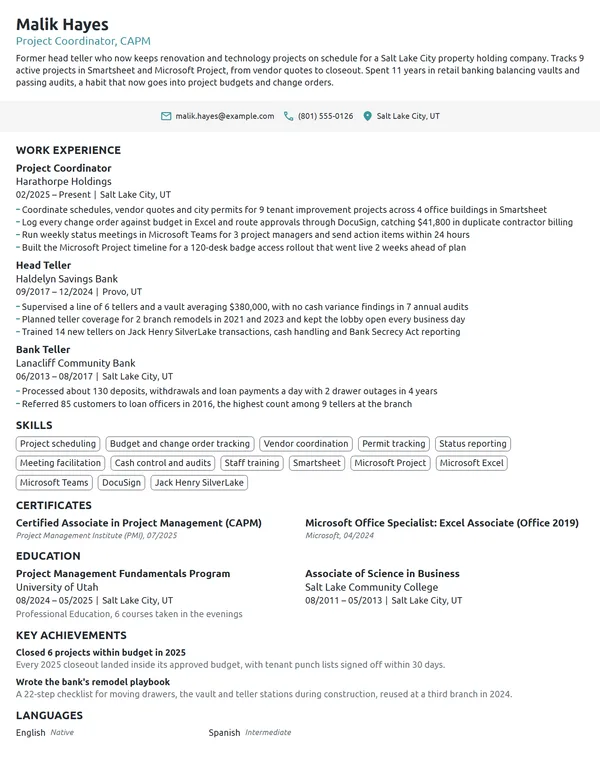
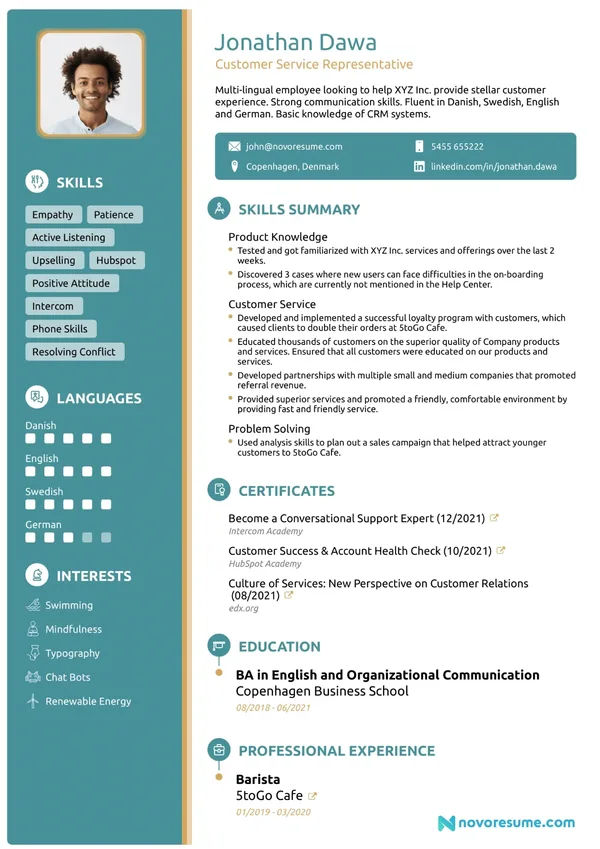
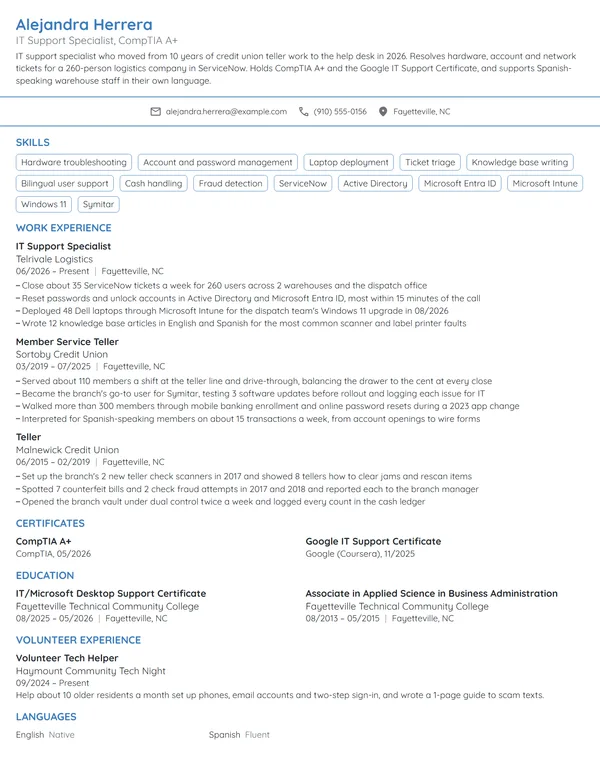
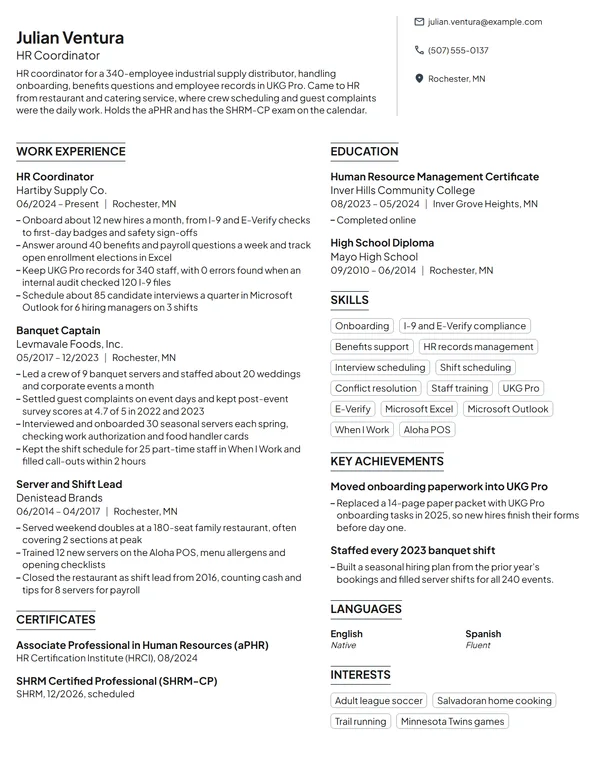
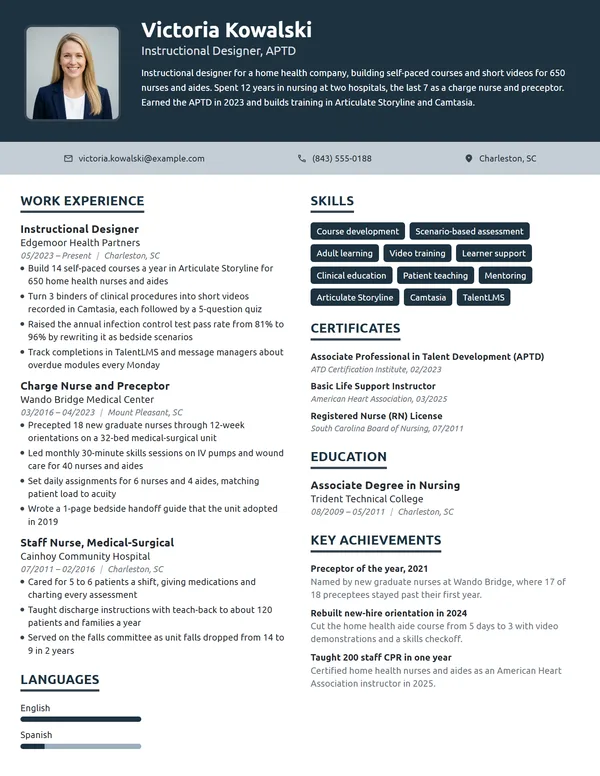
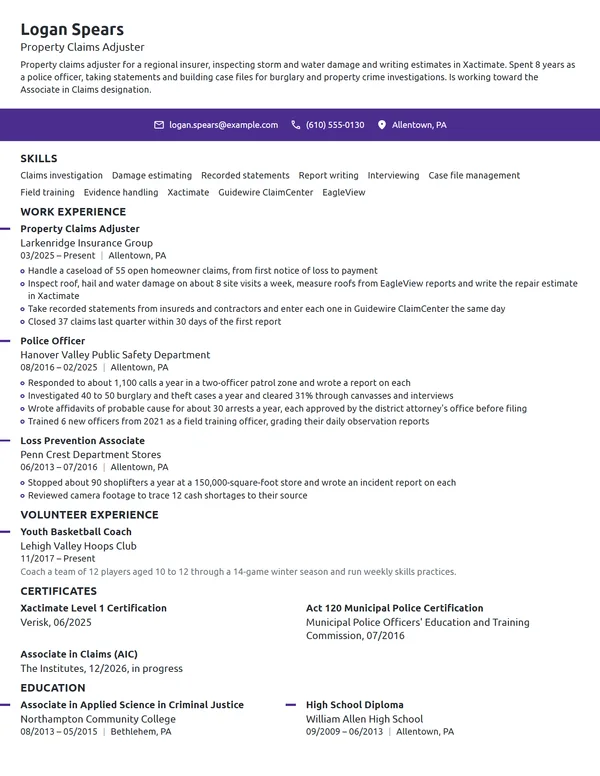
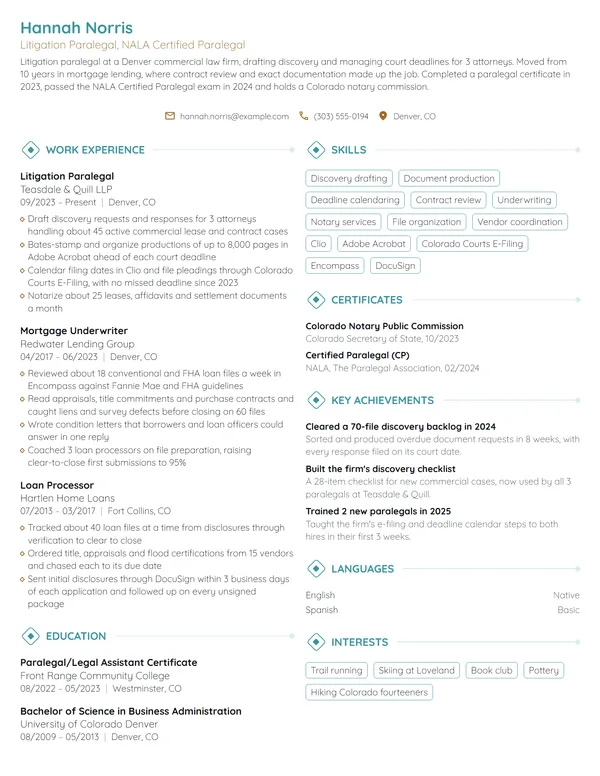
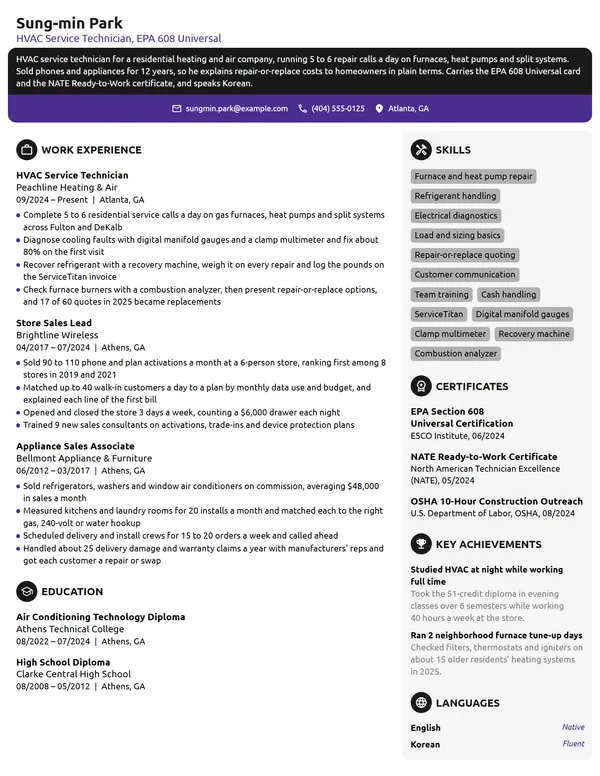
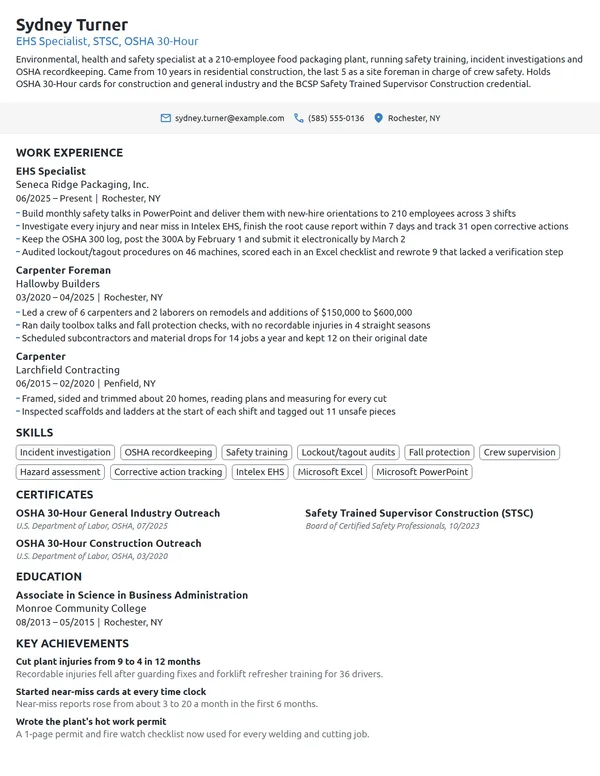
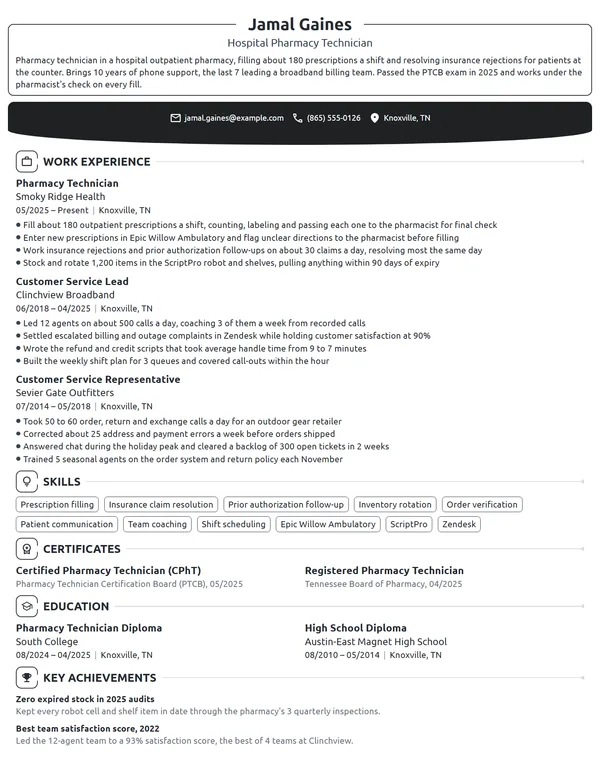
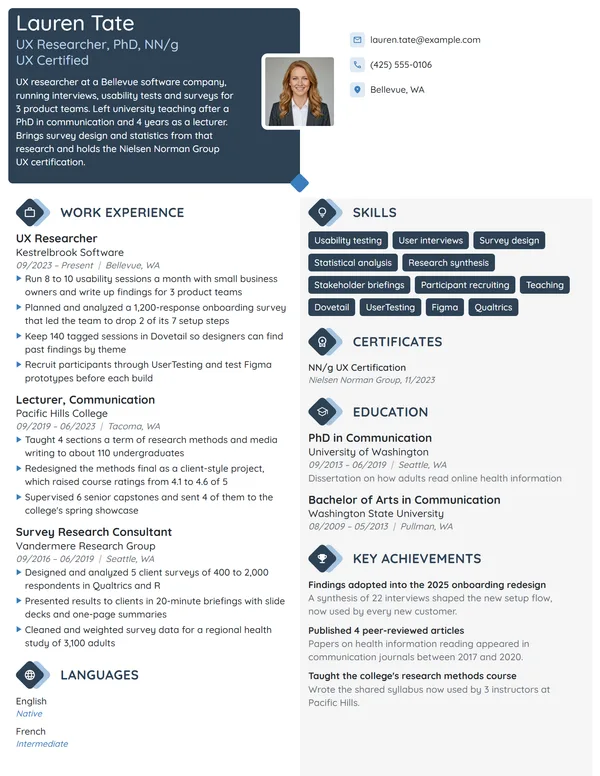
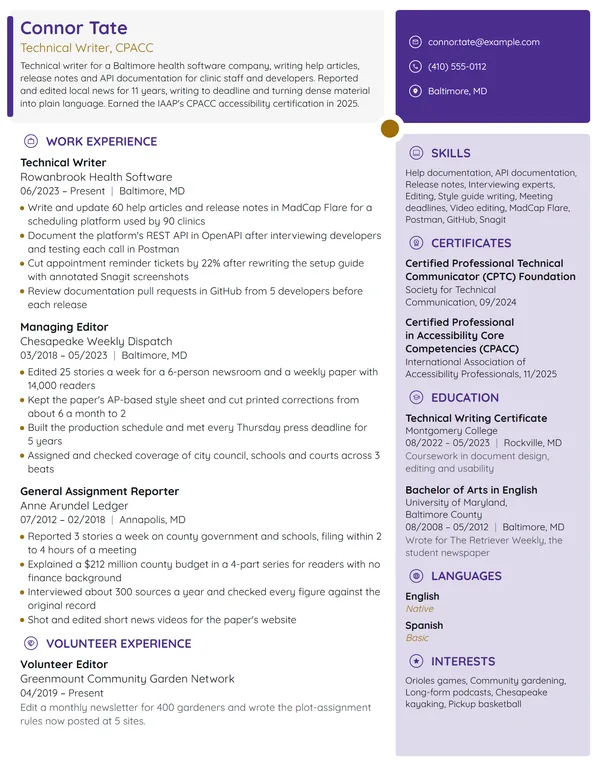
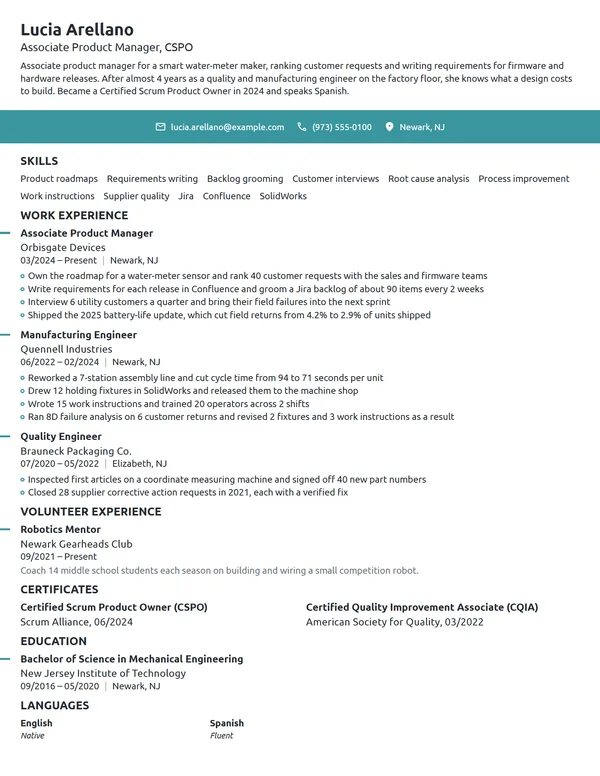
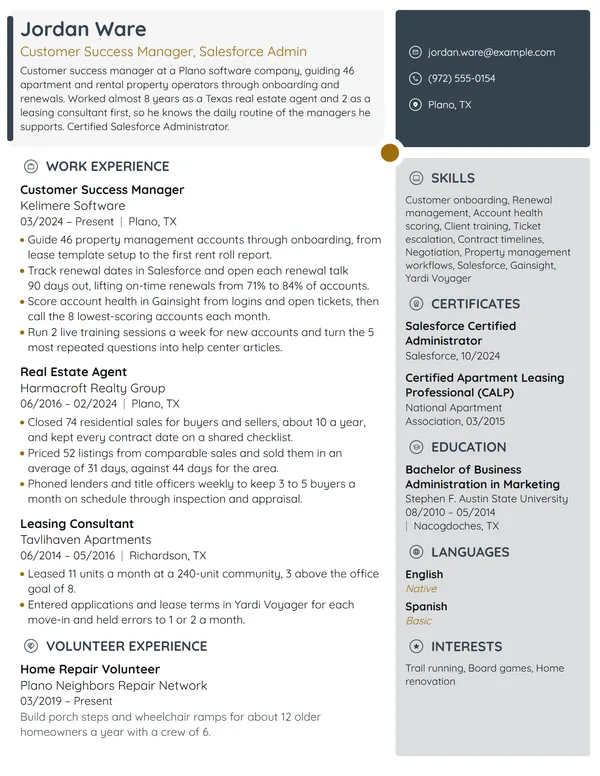
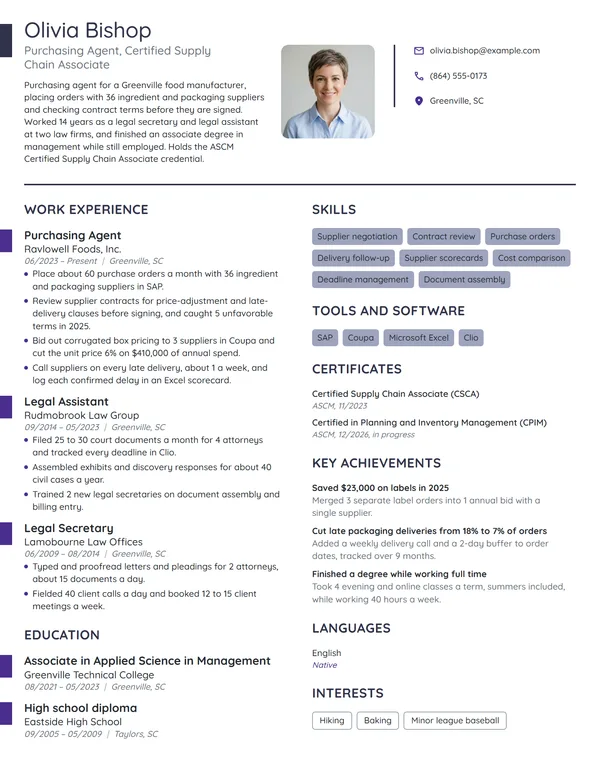
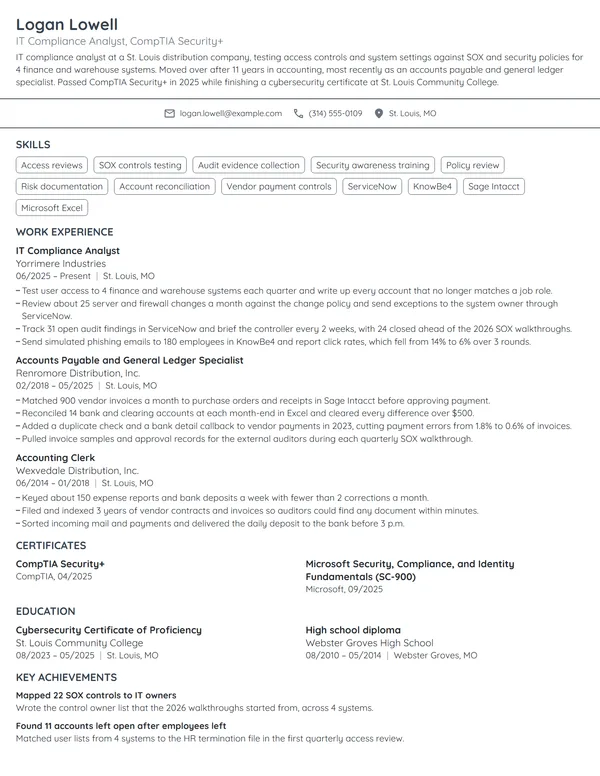
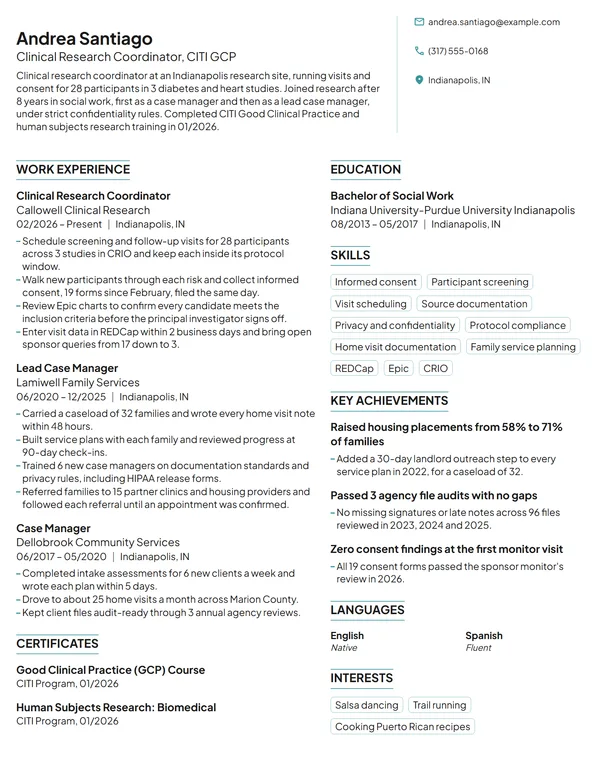
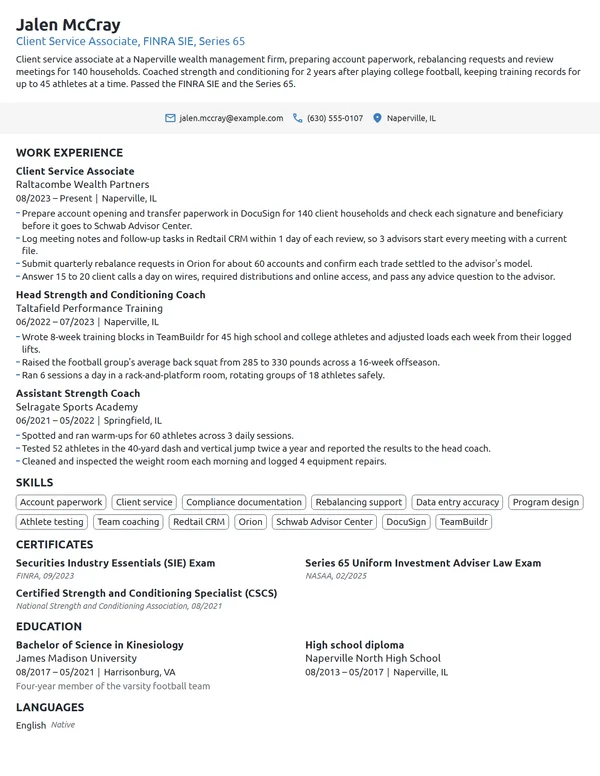
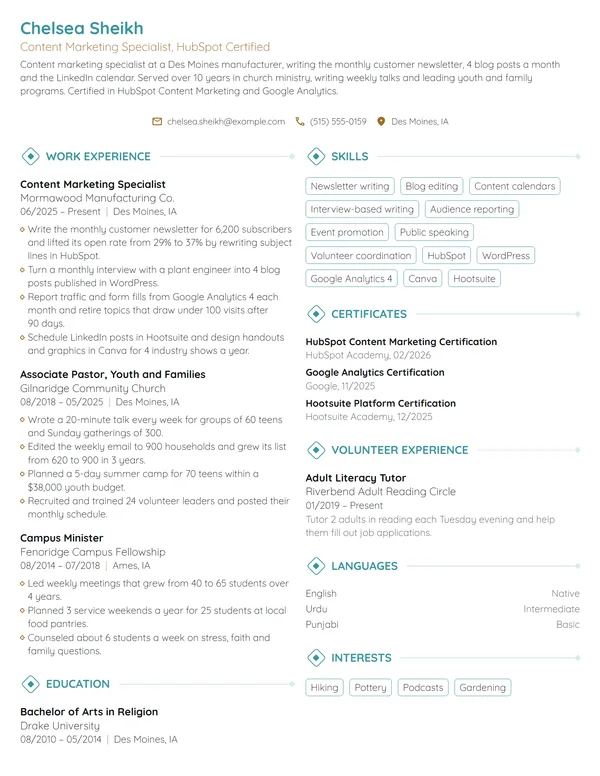
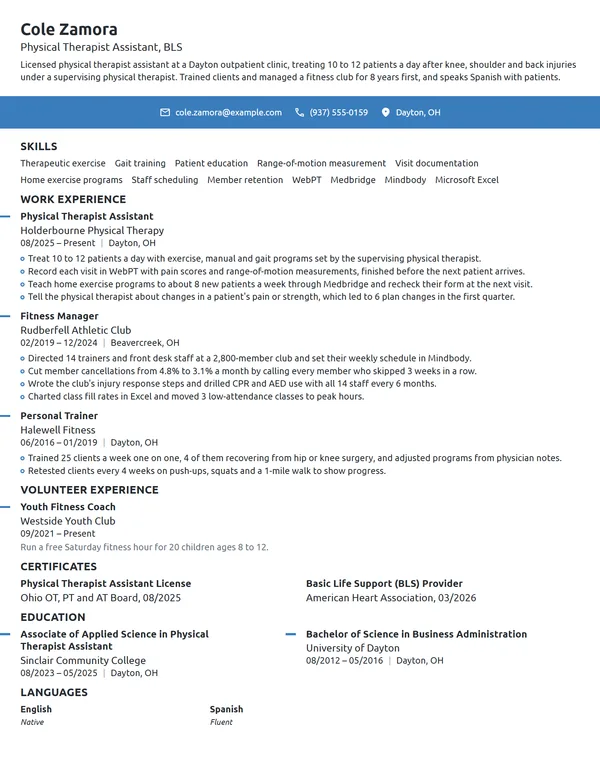
Changing careers means asking someone to hire you for work you have not yet done under that job title. You do have years of real results, but they were earned in another field, with its own words and its own numbers. A busy recruiter will not translate them for you, so your resume has to: name the new role at the top, show the training you finished for it, and restate your old wins in the new field's terms.
How to Write a Career Change Resume - Key Takeaways
- Keep your jobs in reverse-chronological order on 1 page, so your training or first role in the new field sits on top.
- Put the job you want in your headline and open with 2 to 3 lines that name it, your years in your old field and 1 result that carries over.
- Rewrite old bullets in the new field's vocabulary: keep the number, change the words, and cut tasks the new job will never use.
- List each new certificate under Certificates with its issuer and date, including one still in progress with its expected month.
- Choose 6 to 8 skills from the job ad that a bullet on your page backs up, and name the new field's software by its exact name.
- Save the reason for the switch for 1 or 2 sentences of the cover letter, then run the file through an ATS resume checker before you apply.
What hiring managers look for in a career change resume
A hiring manager reads a career change resume with 3 questions in mind: which parts of this job can you already do, what have you done to learn the rest, and does your history add up. Changing jobs is common. In its August 2025 release, the BLS reported that people born from 1957 to 1964 held an average of 12.9 jobs from ages 18 to 58. What the reader needs from you is proof, not an apology.
Before you write a line, decide which job you are aiming at, since a change of career works on paper only when the target is specific. Then build the page from these sections, in the order your template prints them:
- Name, a headline with the job you want (for example, Operations Analyst) and contact details
- A 2- to 3-line opening summary or objective, which needs no heading
- Work Experience: your newest role first, then your earlier career with its numbers
- Skills, with the new field's software
- Certificates, for training finished or in progress
- Education, including any college certificate program
- Optional: Volunteer Experience in the new field, Key Achievements or Languages
Best format for a career change resume
Use the reverse-chronological resume format for most career changes: newest role first, each with its title, the employer and its location, and MM/YYYY dates from first month to last. Once you have finished training or started a first role in the new field, this order puts that step at the top without hiding anything below it. If you have no training or work in the new field yet but strong skills that carry over, a combination resume with a skills section above your full history is the better fit. Avoid a purely functional layout: without dates, a reader can only guess what you did and when.
- Best for most career changersReverse-chronologicalYour jobs, newest first, with your results under each one.Best for: A steady work history in your field
- FunctionalSkills grouped up top, with a short work history below.Best for: Gaps or very little experience
- CombinationA skills section first, then your full work history.Best for: A career change with strong skills
Keep it to 1 page in most cases. A switch rarely needs more space, because older jobs shrink to the 2 or 3 bullets that matter to the new role. With 15+ years behind you, 2 pages can work, as long as page 1 carries the new-field role, the training and the summary.
| Setting | What to use |
|---|---|
| Length | 1 page; 2 only with 15+ years and the new-field material on page 1 |
| Headline | The target title, plus a new credential if you hold one: Operations Analyst, Google Data Analytics Certificate |
| Order | Newest first, so a first role or training in the new field leads |
| Older, unrelated jobs | Keep the title, employer and dates, with 2 or 3 bullets that carry over |
| Dates | MM/YYYY on every entry, Present on your current role |
| Photo, age and SSN | A photo is rare on resumes in the US and Canada; your age, family status and SSN stay off too |
| File type | PDF, unless the posting or portal asks for a Word document |
Most US and Canadian resumes carry no photo, so give that space to the training and results that make the switch believable.
Career change resume summary vs. objective
Use 1 test: do you already have something in the new field to point to, such as a finished certificate, a first role or freelance work? If yes, write a resume summary that opens with the target title and joins your old experience to that new step. If not, write a resume objective: the role you want, the result from your old career that matters most to it, and the training you have started.
Career change resume summary formula
Target title with X years in previous field and new certificate or first role. Your strongest result that carries over, with a number. The new field's tools or skills you use now.
Example
Operations analyst with 9 years in retail store management and a Google Data Analytics Certificate earned in 2025. Ran a 38-person store with $6.2M in annual sales and cut shrink from 2.1% to 1.4% of sales. Builds weekly dashboards in SQL and Tableau.
Don't
Hardworking professional looking for a fresh start in a new industry where I can apply my transferable skills and grow.
Do
Sales development representative with 4 years as a fitness club membership manager. Booked 35 tours a month and converted 41% of them to paid memberships, tracking every lead in HubSpot.
The second version names the new role, the old one, a sales number and the CRM the new employer will ask about.
How to rewrite old work experience for a new career
Your earlier jobs stay on the page, but each bullet now has to answer a question from the new field. Keep the number and swap the vocabulary: a store's labor schedule becomes workforce planning, a classroom becomes training design, a dispatch log becomes data. List your transferable skills first, then find the bullet that proves each one, and drop tasks the new job will never ask about.
| Moving from | What carries over | Example bullet |
|---|---|---|
| Retail management to operations | Staffing, forecasting, inventory | Built weekly labor schedules for 22 staff against the sales forecast, holding labor cost at 11% of sales. |
| Teaching to corporate training | Lesson design, assessment, groups | Designed 14 units a year for 120 students and measured progress with quarterly assessments. |
| Restaurant service to sales | Upselling, repeat customers, pace | Averaged $1,450 in sales a shift and a 30% wine attach rate across a 6-table section. |
| Military to logistics | Accountability, inventory, leading a team | Accounted for $3.4M in vehicles and radios across 4 inventories with 0 losses. |
| Call center to customer success | Ticket volume, resolution, retention | Handled 60 calls a day and raised first-call resolution from 78% to 86% in 2 quarters. |
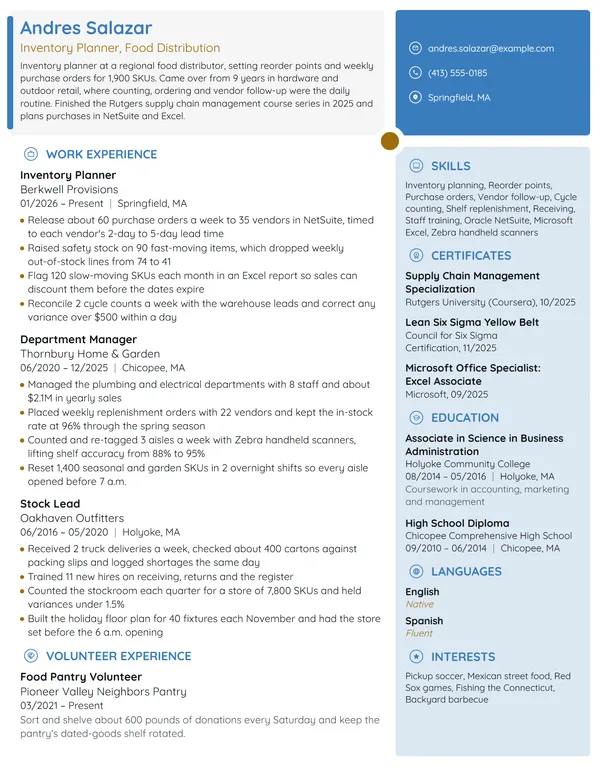
Here is a career changer's entry. The new role leads with 3 bullets in the new field's terms, and the store job below it keeps the 2 results an operations team would value most.
Work Experience
- Built an on-time delivery dashboard in Tableau for 14 terminals, which dispatch supervisors now use in every morning meeting.
- Traced late loads to 2 dock scheduling rules and helped cut the late-load rate from 8.6% to 5.1% in 9 months.
- Replaced 26 weekly Excel reports with 1 SQL-fed report, saving the team about 11 hours a week, and trained 3 dispatch supervisors to use it.
- Managed 38 staff and held labor at 10.5% of sales by matching shifts to hourly traffic data.
- Raised inventory accuracy from 91% to 98% across 4,200 SKUs with weekly cycle counts.
How much of your old career to keep
Keep every job from the last 10 to 15 years, even the unrelated ones, so your timeline has no unexplained holes. Give the most recent old-field role 2 to 4 bullets and earlier ones 2 or 3, chosen for what carries over. Jobs older than that can go, unless one of them was in the field you are moving into.
Don't
Managed a team of cashiers and kept the front end running.
Do
Trained and scheduled 16 cashiers and cut the average checkout wait from 6 to 3 minutes by opening a second express lane at peak hours.
The rewrite shows training, scheduling and a process fix, which travel to almost any field.
Don't
Responsible for handling customer complaints.
Do
Resolved about 25 escalated account issues a week and kept 92% of those customers on their plans.
Transferable skills and new-field software for your resume
Pick 6 to 8 skills for your Skills section, and take them from the job ad you are answering, not from your old job description. Mix 2 kinds: skills you bring from your previous career, and skills you built for the new one through training. Every skill you list should show up again in a bullet or in your summary, which tells the reader where you used it.
Hard skills that carry across fields
- Budgeting and cost control
- Scheduling and workforce planning
- Inventory and supply tracking
- Data analysis and reporting
- Process improvement
- Vendor and contract management
- Training and onboarding
- Customer escalations
- Written procedures and documentation
- Sales forecasting
Soft skills hiring managers value in career changers
- Learning new systems quickly
- Clear communication
- Adaptability
- Leading without authority
- Customer focus
- Problem solving
Software is where a switch shows fastest. Look up your target job on O*NET OnLine, whose Technology Skills list for each occupation flags its hot technology, and compare it with the posting. Name the tools you have used by their exact names, such as SQL, Tableau, Salesforce or Workday, and say where you used them: a certificate course, a freelance job or your current role.
Certificates and training that prove a career change
A certificate tells the reader you have already started learning the new job. List certifications on your resume in their own Certificates section, each with the issuer and the month and year, and put the most relevant one in your headline. Many entry credentials are built for people coming from another field, and several ask for no experience at all.
| Credential | Issued by | What it takes |
|---|---|---|
| Google Data Analytics Certificate | Google, on Coursera | No experience or degree required; Google estimates about 240 hours across 8 courses, covering spreadsheets, SQL, Tableau and Python. |
| Google IT Support Certificate | Google, on Coursera | No experience or degree required; Google says learners can prepare in 3 to 6 months. |
| CompTIA A+ | CompTIA | Pass 2 exams: Core 1 (hardware and networking) and Core 2 (operating systems and security). |
| SHRM-CP | SHRM | No degree or previous HR experience needed to apply; SHRM recommends a basic working knowledge of HR practices. |
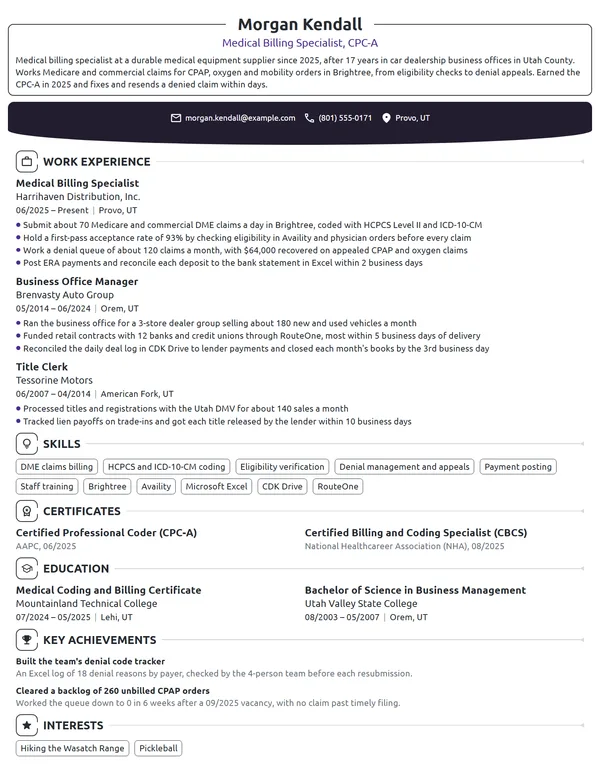
| CPC (Certified Professional Coder) | AAPC | Pass the CPC exam; without 2 years of coding experience, the credential carries an A for apprentice (CPC-A) until you meet AAPC's requirements. |
How to list a certificate still in progress
Write the certificate's full name, the issuer and the word expected with a month and year. Only list one you are actively working on and can finish by that date. If the program includes hands-on work, such as a capstone dashboard or a practice lab, describe it in 1 bullet under the certificate's own entry or in your summary.
Certificates
- Google Data Analytics Certificate, Google (Coursera), 03/2025
- Google Advanced Data Analytics Certificate, Google (Coursera), expected 12/2026
How to list education when your degree is in another field
Keep your degree even if it has nothing to do with the new job. Apply the standard advice on listing education on a resume: the degree name, the school and its location, and the month you finished, placed below Work Experience. Leave the GPA off once you have a few years of work behind you, and add 1 line of coursework only if it ties to the new field, such as statistics for an analyst role.
A college certificate program you completed for the switch, such as a 1-year program at a community college, goes under Education as its own entry, newest first. A short online course or exam-based credential goes under Certificates. A licensed field, such as nursing or teaching, has its own education rules, so check your state's requirements before you plan the move.
Education
Coursework in statistics and research methods.
Career change with no new-field experience, at mid-career, or into tech
With no paid work in the new field yet, an objective and an entry-level resume layout help: Certificates and Education move up, and everything you have done toward the new job gets its own entry and its own numbers. Look for evidence in these places:
- Freelance or contract work: its own Work Experience entry with dates, clients served and what you delivered.
- Unpaid work in the new field: a nonprofit's website, books or events, listed under Volunteer Experience with hours or results.
- New tasks in your current job: the reporting, training or software rollout you took on, written as bullets under your present title.
- Certificate coursework: a capstone or lab, described under its Certificates or Education entry, with what you built.
Don't
Seeking an opportunity to transition into the medical billing field and learn new skills.
Do
Medical office receptionist with 2 years checking in about 90 patients a day and verifying insurance for each visit, seeking a medical billing specialist role. CPC exam scheduled for 01/2027.
Even an objective needs proof: a workload from the old job that the new one uses, and a dated next step.
At mid-career, the risk is too much history rather than too little. BLS figures put the median time with a current employer at 4.1 years in January 2026, so a run of 10 years or more with one employer stands out: give it 3 or 4 bullets with its scale, and let the earlier roles shrink. Moving into tech, lead with the certificate and any hands-on lab or help desk work, and use the IT resume conventions for the Skills section.
Your resume shows that you can do the new job; the cover letter is where you say why you want it. Keep to the standard layout for writing a cover letter, and give the switch its place in the first paragraph, next to your strongest number.
Career Change resume FAQ
Should I use a functional resume for a career change?
Usually not. A functional resume groups skills and drops or hides dates, which makes readers wonder what you are leaving out. Keep a dated work history and bring your transferable skills forward through your headline, summary and Skills section, or use a combination layout if you have no training or work in the new field yet.
How do I explain a career change on my resume?
Briefly, in your summary or objective. Name the job you want, your years in your old field and the step you have taken toward the new one, such as a certificate. Leave the story of why you are switching for the cover letter and the interview.
What job title should I put on a career change resume?
Put the job you are applying for in the headline under your name. Under Work Experience, keep every past title exactly as your employer used it, since a background check will show the real one, and let your bullets do the translating.
How far back should a career change resume go?
About 10 to 15 years in most cases. Keep every role in that window so your timeline is complete, and cut older jobs unless one of them was in the field you are moving into, in which case it earns a short entry.
Should I list unrelated jobs on a career change resume?
Yes, if they fall within the last 10 to 15 years. Leaving them out creates gaps that raise more questions than the jobs themselves. Give each one 2 or 3 bullets that carry over, such as a budget, a team size or a customer number.
Do I need a new degree to change careers?
Not always. Many entry credentials ask for no degree at all: Google says its Data Analytics and IT Support certificates need no experience or degree, and SHRM accepts SHRM-CP applicants without HR experience. Licensed fields such as nursing, teaching and CPA work do have degree rules, so check your state's rules first.
How long should a career change resume be?
1 page for most people. Your older jobs only need the bullets that carry over, which keeps the page short. With 15+ years of experience, 2 pages can work if page 1 holds your headline, summary, training and newest role.
Is it common to change careers at 40 or 50?
Job moves continue well into mid-career. The BLS found that people born from 1957 to 1964 held an average of 2.9 jobs from ages 35 to 44 and 2.2 jobs from ages 45 to 54, according to its August 2025 release. Not every move was a change of field, but a later switch is far from unusual.
Next steps
Start from the example nearest to the field you are leaving or the one you are entering, keep its order of sections, and rewrite every bullet with your own numbers in the new field's words. Put it together in our resume builder, with one of the resume templates as a base, then add a short letter that gives your reason for switching in 1 or 2 sentences.