
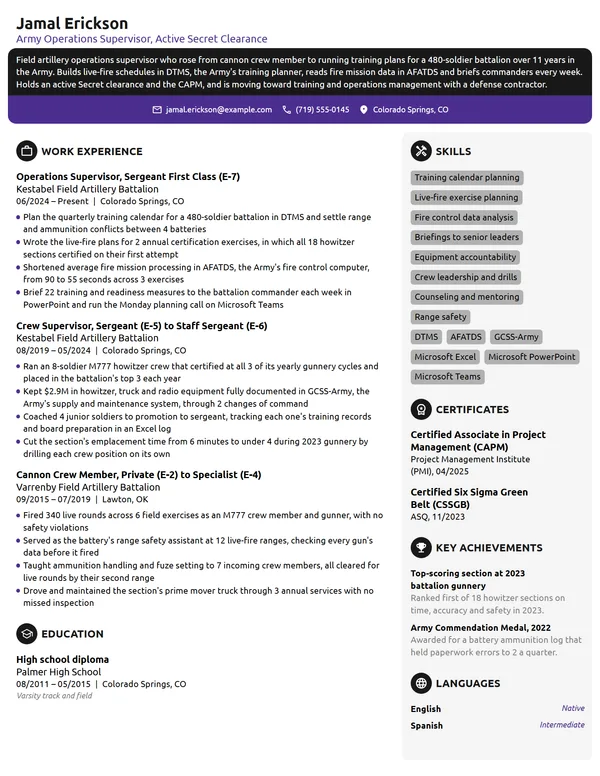
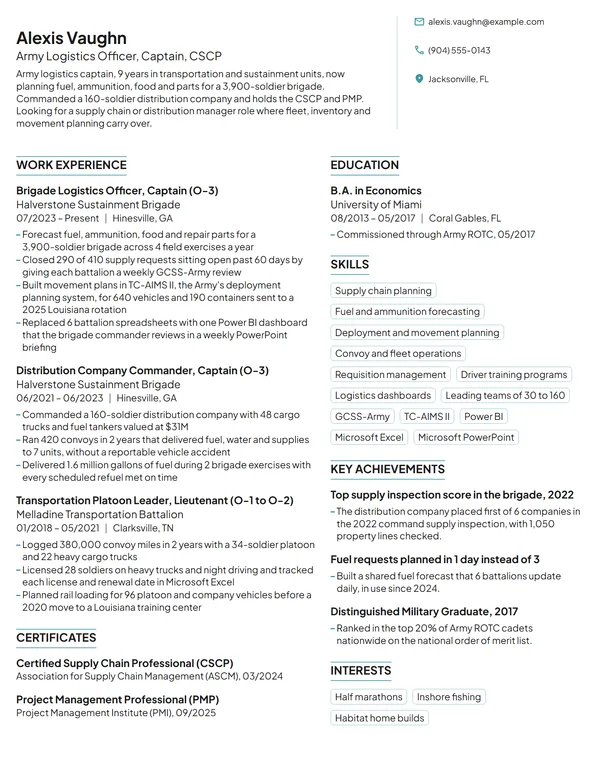
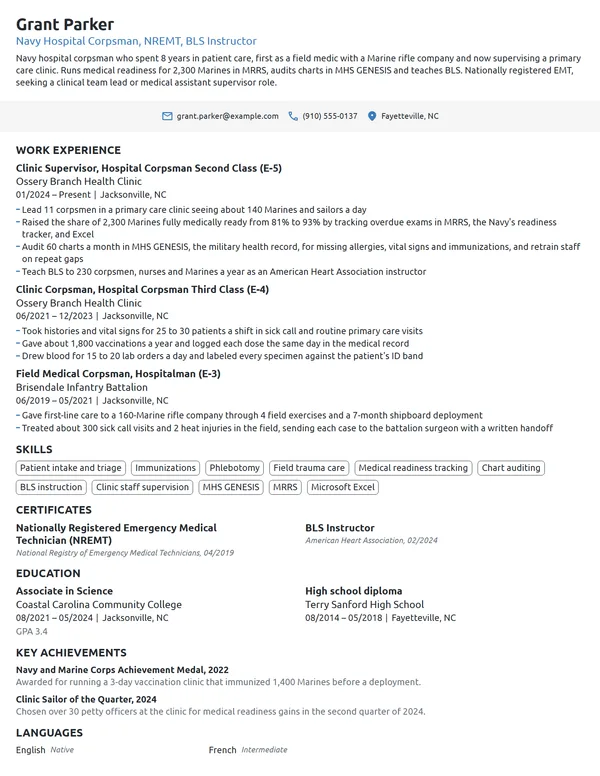
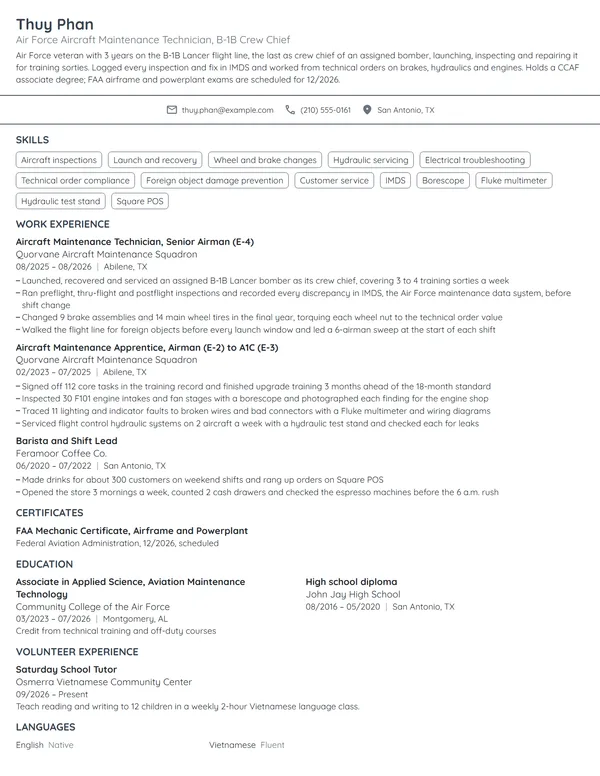
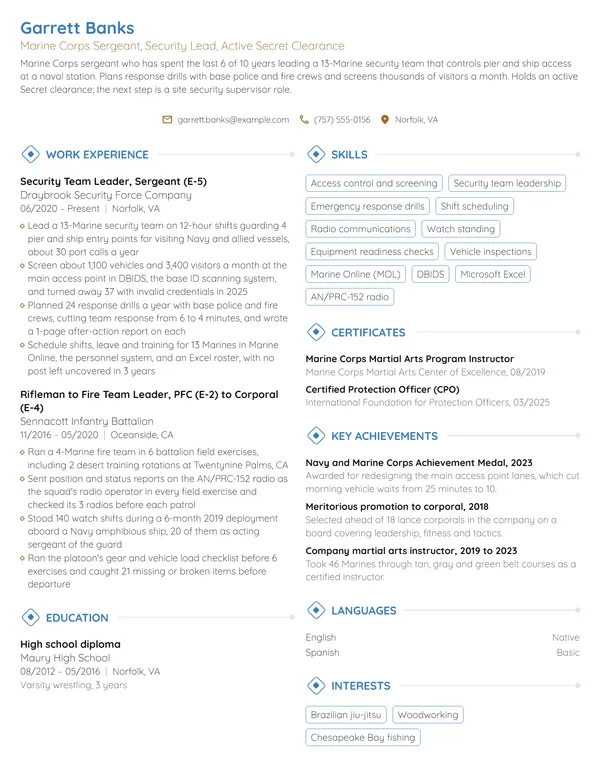
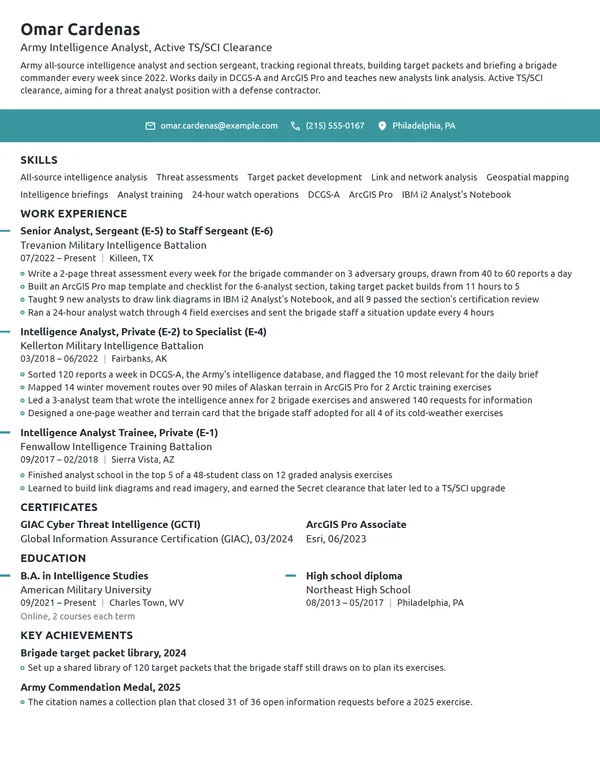
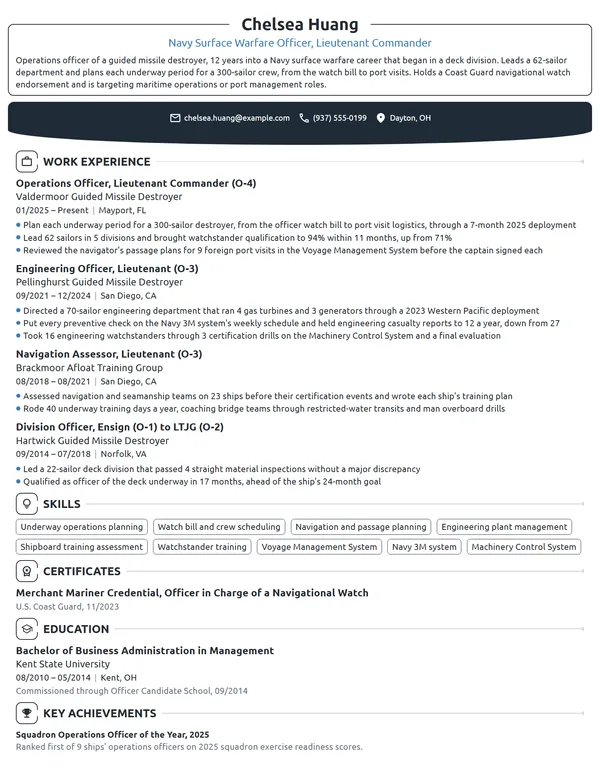
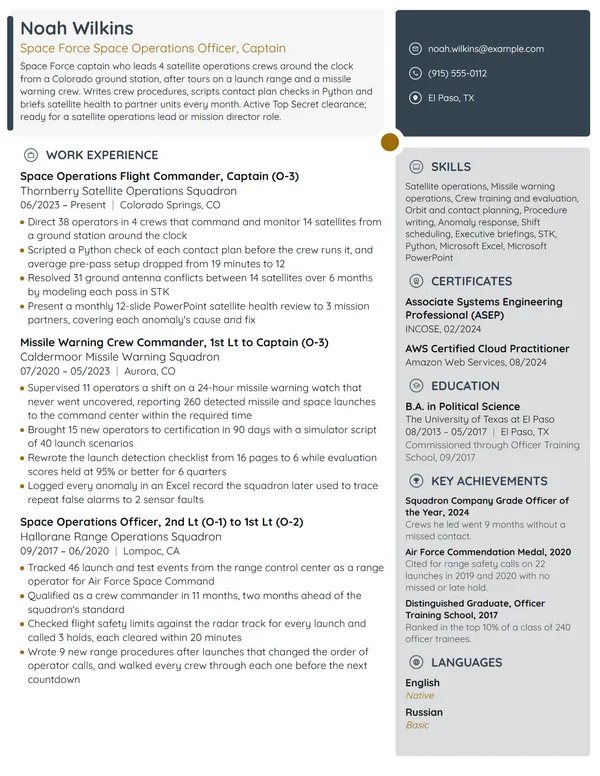
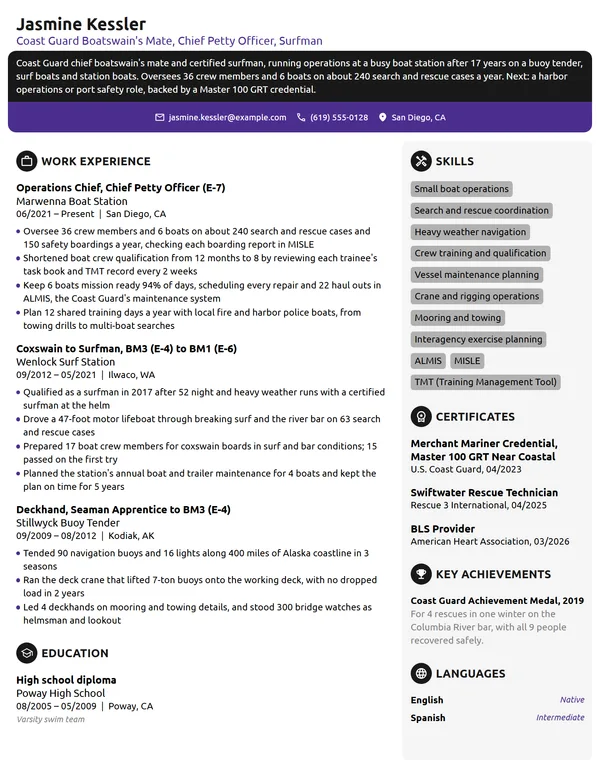
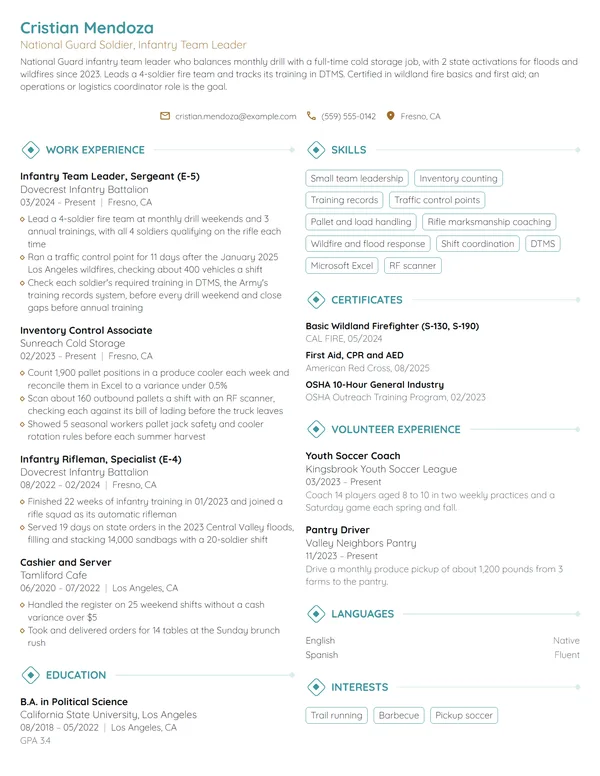
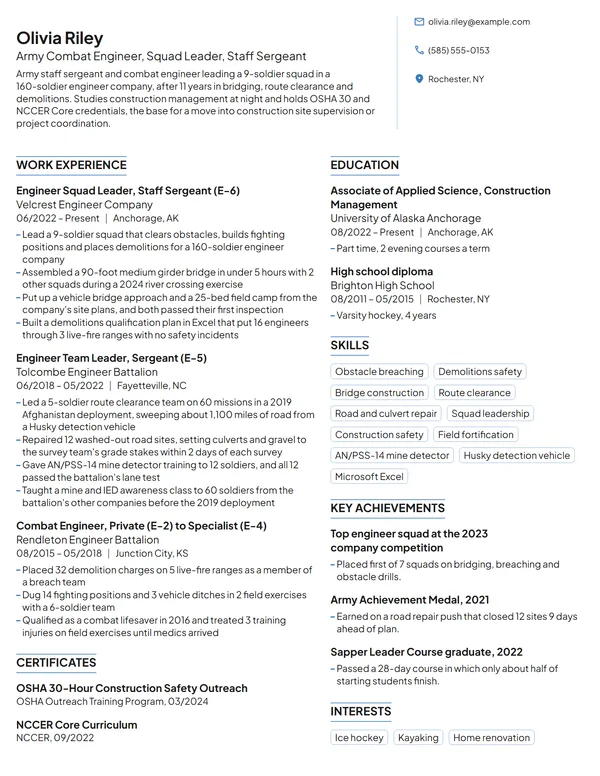
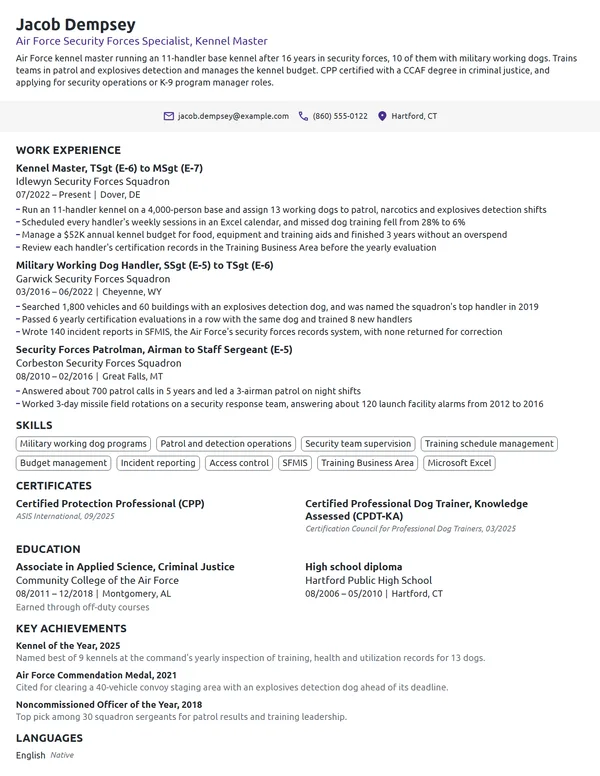
For years, your rank, your evaluations and your training record spoke for you. Now a resume has to do that job for readers who have never worn a uniform. Civilian employers want to know how many people you led, what equipment and money you were trusted with, which training you hold and what improved because of your work. Most of that sits in military terms they don't use, and putting it in plain words can make a big role sound smaller than it was.
How to Write a Military Resume - Key Takeaways
- Pick reverse-chronological order on 1 page, or 2 if you have 10+ years or apply for federal jobs, where 2 pages is the limit.
- Write each job title as the work in civilian words, then your rank and pay grade, such as IT Support Supervisor, Staff Sergeant (E-6).
- Give every bullet a number a civilian manager can weigh: people led, equipment value, readiness rates, people trained or budget managed.
- Swap military shorthand for plain words, so NCOIC becomes supervisor and PCS becomes relocation, unless the posting itself uses the term.
- Put an active security clearance in your headline or summary with its level and status, and list civilian certifications under Certificates.
- Copy the keywords from each job ad into your bullets, then run the file through an ATS resume checker before you apply.
What hiring managers look for in a military resume
A military resume lands with 3 kinds of readers: defense contractors, federal HR specialists and civilian managers in your field. All of them want proof of scale (people, equipment, money), proof of skill (the work you did and the training behind it) and proof of results. Many service members, the BLS points out, work in occupations that also exist in the civilian workplace, so your job is to show the overlap in terms the reader already uses.
Rank alone tells a civilian reader little. The BLS describes enlisted members as the ones who carry out military operations and officers as the leaders who manage them, but a hiring manager still needs to see what that meant in your unit. Build the page from these sections:
- Name, headline (for example, Logistics Supervisor, Secret Clearance) and contact details
- A 2- to 3-line summary at the top; it needs no heading
- Work Experience, newest assignment first, with your branch or unit as the employer
- Skills, with the systems and equipment you used
- Certificates, for civilian credentials and job-related military training
- Education, including degrees and college credit you earned in service
- Optional extras: Languages, Volunteer Experience, Key Achievements
Best format for a military resume
Use the reverse-chronological resume format: your current or last assignment first, each with a title, the branch or unit, the installation or base city, and its start and end month. A military career already moves in clear steps, from team member to team leader to supervisor, and this order lets a reader see each promotion. Choose a combination format only if you are moving into a field your service did not touch, and lead it with the skills that carry over.
- Best for most service membersReverse-chronologicalYour jobs, newest first, with your results under each one.Best for: A steady work history in your field
- FunctionalSkills grouped up top, with a short work history below.Best for: Gaps or very little experience
- CombinationA skills section first, then your full work history.Best for: A career change with strong skills
Keep it to 1 page with under 10 years of service. With 10+ years, several specialties or a senior leadership post, 2 pages are fine if page 1 holds your last 2 assignments. Federal jobs set a hard limit: OPM's guidance says that from September 27, 2025, USAJOBS restricts all resumes to 2 pages, and an applicant whose only resume runs longer is ineligible. The federal resume page covers that format in full.
| Setting | What to use |
|---|---|
| Length | 1 page under 10 years of service; 2 with more, and never over 2 for USAJOBS |
| Job title line | Civilian role first, then rank and pay grade: IT Support Supervisor, Staff Sergeant (E-6) |
| Employer and location | The branch or unit, then the installation, home port or base city: U.S. Navy | Naval Station Everett, WA |
| Dates | MM/YYYY for each assignment, with Present for the current one |
| Language | Plain words for every acronym a civilian would not know |
| Photo and personal details | A photo is rare in the US and Canada; leave off your birth date, Social Security number and service number |
Most US and Canadian resumes carry no photo, and that holds for every military, defense and federal application. Save the file as a PDF unless the portal asks for Word, and use a plain layout that screening software reads top to bottom.
Military resume summary vs. objective
Use a resume summary when the job you want uses the same skills you used in uniform, such as an IT specialist moving to a systems administrator role. Use an objective when you are changing fields or applying for your first civilian job after a short enlistment: name the role you want and the strongest evidence you have for it. Either way, name your branch and your years, then 1 counted result.
Military resume summary formula
Branch role in civilian words with X years of service, scope: people, users, equipment or budget. Best counted result, with its base. Clearance or credential, seeking target role.
Example
Army IT support supervisor with 10 years of service, leading help desk and network support for 520 users. Cut help desk tickets older than 5 days from 74 to 9 in 4 months. Active Secret clearance and CompTIA Security+, seeking a systems administrator role.
Don't
Dedicated veteran with 10 years of honorable service, seeking a position where I can apply my leadership skills.
Do
Coast Guard machinery technician with 7 years maintaining diesel engines, generators and pumps on 2 patrol boats and leading a team of 5. Seeking a marine diesel technician role on the Gulf Coast.
The rewrite names the branch, the equipment, the team size and the job the reader is filling.
How to write military work experience bullets with numbers
Under your current assignment, write 3 to 4 bullets that open with a verb and end with a result; older assignments get 2 to 4. Your evaluation reports and award write-ups are the best place to find the numbers, since they already record what you led and what changed. The general rules for listing work experience on a resume apply here too: one entry per assignment or promotion, with the branch or unit on the employer line.
| Area | What to count | Example bullet |
|---|---|---|
| Leadership | People led, their qualifications, turnover | Led a 12-person maintenance section and kept 11 of 12 fully qualified on every required task. |
| Equipment and property | Dollar value signed for, inventories, losses | Signed for $3.2M in vehicles and generators and closed 3 inventories with 0 losses. |
| Readiness | Equipment or units ready, for how long | Kept 18 trucks at 90% or higher operational readiness for 14 straight months. |
| Training | People trained, courses run, pass rates | Built a 30-day onboarding plan that brought 45 new arrivals to full duty status on schedule. |
| Supply and budget | Annual budget, orders, back orders | Managed a $450K annual supply budget and cut back-ordered parts from 60 to 15. |
| Safety and compliance | Inspections, findings, days without incident | Ran 26 safety inspections a year as the unit passed 400 days without a lost-time injury. |
How to write the job title line with rank and MOS
Put the role a civilian would recognize first, then your rank and pay grade, so the line reads like a promotion path. The occupation code (MOS, rating, AFSC or SFSC) matters most to defense contractors and federal HR, whose postings often name it, so add it in your summary or skills for those applications and drop it for other employers. If you held 2 ranks in one assignment, show the span: Specialist (E-4) to Sergeant (E-5).
Work Experience
- Supervise 6 IT specialists who support 520 users and 780 computers, radios and network devices across 5 buildings.
- Cut open help desk tickets older than 5 business days from 74 to 9 in 4 months with a daily triage rotation and a shared fix log.
- Patched and reimaged 780 devices before a 2025 network security inspection, which closed with 0 critical findings.
- Set up field networks for 3 training exercises a year, bringing 150 users online within 6 hours of arrival.
- Managed accounts and email for 300 users and kept 210 laptops at 97% patch compliance.
- Trained 14 new arrivals on help desk procedures within their first 2 weeks.
Don't
Responsible for the training and welfare of soldiers.
Do
Led a 9-person squad through 2 field rotations and raised its first-time weapons qualification from 6 of 9 to 9 of 9.
A team size, a time frame and a before-and-after result turn a duty into an achievement.
Don't
Served as platoon sergeant and maintained 100% accountability of all sensitive items and OCIE.
Do
Led a 32-person platoon and accounted for $2.6M in weapons, optics and radios across 4 monthly inventories with 0 losses.
Dollar value and headcount mean something to any employer; OCIE and sensitive items do not.
Translate as you write. The table below covers terms that show up on almost every military resume; keep the original only when the job ad uses it, as defense contractors often do.
| Military term | Civilian wording |
|---|---|
| NCOIC, OIC | Supervisor, manager, officer in charge of a named team |
| Platoon, squad, section, shop | Team or department, with its headcount |
| Hand receipt, property book | Equipment accountability, with the dollar value |
| PCS, TDY, deployment | Relocation, business travel, overseas assignment |
| Mission | Project, operation or assignment, with its result |
| Evaluation report | Performance review; quote its numbers, not its rating |
Military skills and software for your resume
Pick 6 to 8 hard skills for your resume that the job ad asks for and your bullets prove. Leadership belongs on nearly every military resume, but name the kind: running a shift, training new staff or managing a budget says more than leadership alone.
Hard skills for military resumes
- Team supervision and scheduling
- Equipment accountability and inventory
- Supply and logistics management
- Training design and delivery
- Risk assessment and safety programs
- Operations planning
- Preventive maintenance programs
- Information security procedures
- Emergency response
- Written reports and briefings
Soft skills employers value in veterans
- Decisions under pressure
- Ownership of results
- Clear, short briefings
- Fitting into new teams fast
- Discipline with deadlines
- Mentoring junior staff
List your systems with your skills, then name each one again in a bullet that shows what you did in it. Civilian tools need no explanation: Microsoft Excel, SharePoint, Microsoft Teams or a ticketing system read the same everywhere. A military-only system needs 3 or 4 words saying what it does, such as a supply, maintenance or medical records system, because a civilian reader will not know its name.
Security clearance and civilian certifications on a military resume
The BLS says officers and some enlisted members must be able to obtain a security clearance, and for defense contractors an active one can decide who gets the interview. Write the level and the status in your headline or summary, such as Active Secret Clearance, and nothing else about it. Then list certifications on your resume under Certificates, each with its issuing body and date. Federal rules let some military jobs count toward civilian credentials.
| Credential | Issued by | What it takes |
|---|---|---|
| Mechanic certificate (airframe, powerplant or both) | Federal Aviation Administration | At least 18 months of documented practical experience for 1 rating, or 30 months working on both, which military aircraft maintenance can supply; then the FAA's tests, all passed within 24 months, at age 18 or older. |
| Commercial driver's license (CDL) | Your state, under FMCSA rules | A state may waive the knowledge test for listed military drivers, such as Army 88M or Marine Corps 3531, in the year before applying, and may waive the driving skills test for drivers who operated a commercial-size vehicle in service in the last year. |
| CompTIA Security+ | CompTIA | Pass the CompTIA exam; write the version you passed if the posting asks. |
List the job-related military course behind each credential in the same section, with the school that ran it and the month you finished. Basic training stays off: every service member has it, so it takes a line without telling the reader anything new.
Certificates
- CompTIA Security+, CompTIA, 03/2021
- CompTIA Network+, CompTIA, 10/2018
- CompTIA A+, CompTIA, 05/2017
Education, academies, ROTC and military training on a resume
The armed forces typically require enlisted members to be high school graduates or hold an equivalent credential, the BLS reports, while officers are usually expected to hold a bachelor's degree in any field. The federal service academies award a Bachelor of Science, and ROTC students take regular college courses plus 3 to 5 hours of military instruction a week. When listing education on a resume, name the degree, the school, its city and the month you graduated.
Many service members finish a degree online while serving; list it like any other degree, with no note that you studied on active duty unless the posting values it. Air Force and Space Force enlisted members can earn an associate degree through the Community College of the Air Force, so copy its exact name from your transcript. Mention ROTC or an academy commission in the degree line, and list only college credit a school has actually awarded you.
Education
GPA 3.6.
Junior enlisted, Guard and Reserve, and career-change military resumes
With 1 enlistment behind you, your strongest material is often what you did beyond your core duties. Before you separate, the Department of Labor's Employment Workshop, part of the Transition Assistance Program, can help you write the resume, and SkillBridge lets members in their final 180 days of service train with approved civilian employers through internships or apprenticeships. List a SkillBridge internship as its own Work Experience entry under the host company's name.
- Extra duties: safety, training or supply roles held alongside your main job, each with its numbers.
- Licenses earned in uniform: military driving, equipment or medical qualifications that match a civilian credential.
- Guard and Reserve drill: a separate Work Experience entry next to your civilian job, with drill dates and any activations.
- Off-duty study: a degree, certificate or coursework, under Education or Certificates.
- Community work: coaching, mentoring or relief work, under Volunteer Experience.
Don't
Recently separated veteran seeking an entry-level opportunity with growth potential.
Do
Army motor transport operator separating in 03/2027 after 4 years and 60,000 accident-free miles on tactical trucks, seeking a Class A CDL driver role.
Even a 2-line objective carries proof: a role, a time frame and one figure the employer cares about.
Moving into a field your service never touched calls for a different layout: the military-to-civilian resume examples lead with transferable skills, and a career-change resume shows how to order bullets so the relevant ones come first. To find civilian titles that match your specialty, search your code in O*NET's Military Crosswalk; for Army 25B it returns computer user support specialists, network and computer systems administrators and information security analysts. When you are ready to apply, the jobs for veterans list shows where military skills are in demand.
Military resume FAQ
Should I put my military rank on my resume?
Yes. Put it after the role in each job title line, with the pay grade, such as Logistics Supervisor, Sergeant First Class (E-7). Rank shows level and promotion speed at a glance, while the civilian role in front of it tells the reader what you did.
Should I list my MOS, rating or AFSC code?
Only where the reader uses it. Defense contractors and federal HR specialists often search for the code, so add it once in your summary or skills on those applications. For a civilian employer, write the specialty in plain words and leave the code off.
Should I put my security clearance on my resume?
Yes, if it is active and the job could need it. Write the level and status in your headline or summary, such as Active Top Secret Clearance. Leave out investigation dates, case details and anything about classified work.
How long should a military resume be?
Use 1 page with under 10 years of service, and 2 pages with more, provided page 1 holds your last 2 assignments. For federal jobs, OPM's guidance makes 2 pages the hard limit on USAJOBS since September 27, 2025.
Should I list my military awards and medals?
Only the ones that prove a result. Put up to 3 in Key Achievements, each with the reason it was awarded in plain words, such as cutting average vehicle repair time from 9 days to 6. Service and campaign medals that everyone in your unit received add length without adding proof.
How do I list National Guard or Reserve service alongside a civilian job?
Give each its own Work Experience entry with its own dates, even when they overlap. Write the Guard or Reserve role like any other job, with your duty title, rank and results, and list activations or deployments as separate date ranges inside that entry.
Do I need to attach my DD-214 to my resume?
No. The DD-214 carries your Social Security number and other personal details that do not belong in a resume file. Keep it separate and send it only when an application asks for proof of service, such as a federal veterans' preference claim.
How do I find civilian job titles that match my military job?
Search your code or title in O*NET OnLine's Military Crosswalk. It covers Army and Marine Corps MOS codes, Navy and Coast Guard ratings, Air Force AFSCs and Space Force SFSCs, and returns the related civilian occupations, which give you the job titles and keywords to use.
Can military experience count toward a CDL or an FAA mechanic certificate?
Yes, for both. Under federal rules a state may waive the CDL knowledge or skills test for qualifying military drivers within a year of their military driving, and FAA rules accept 18 or 30 months of documented practical maintenance experience toward a mechanic certificate.
Should I mention combat deployments on my resume?
Yes, as work, not as a story. List the location and dates inside the assignment and write bullets about what you ran, maintained or delivered there, with numbers. Leave out combat details an employer does not need to judge your fit.
Next steps
Choose the example nearest your branch and rank, keep its structure, and swap in your own team sizes, equipment values and results. Write it in our resume builder, or open one of the resume templates and fill it in, then pair it with a cover letter that names the civilian role and the one result you are proudest of.