
Almost every job listing seems to ask for experience, yet your first full-time job is where you are supposed to get it. Recruiters hiring for first jobs know this, so they look for other signs: that you can work on a team, solve problems and communicate clearly. That evidence usually comes from places that may not feel like real work yet, such as a campus job, an internship or a seasonal shift, and those are easy to undersell.
How to Write an Entry-Level Resume - Key Takeaways
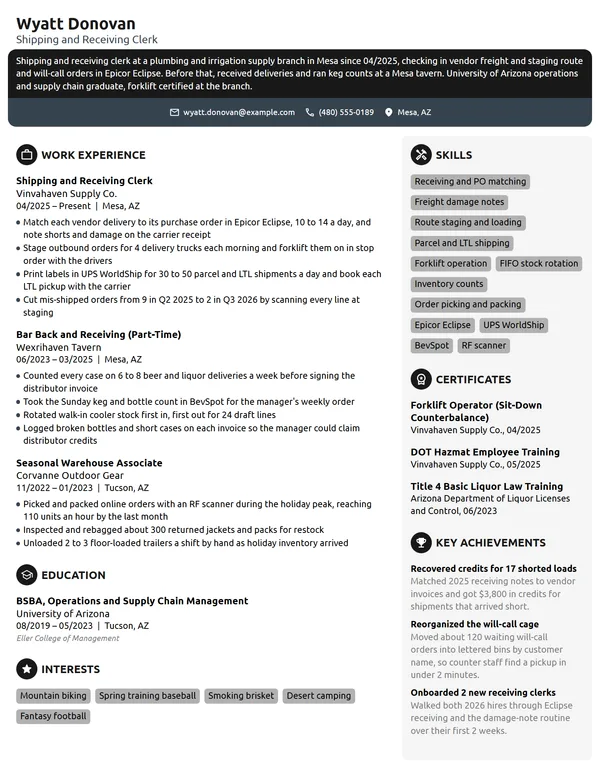
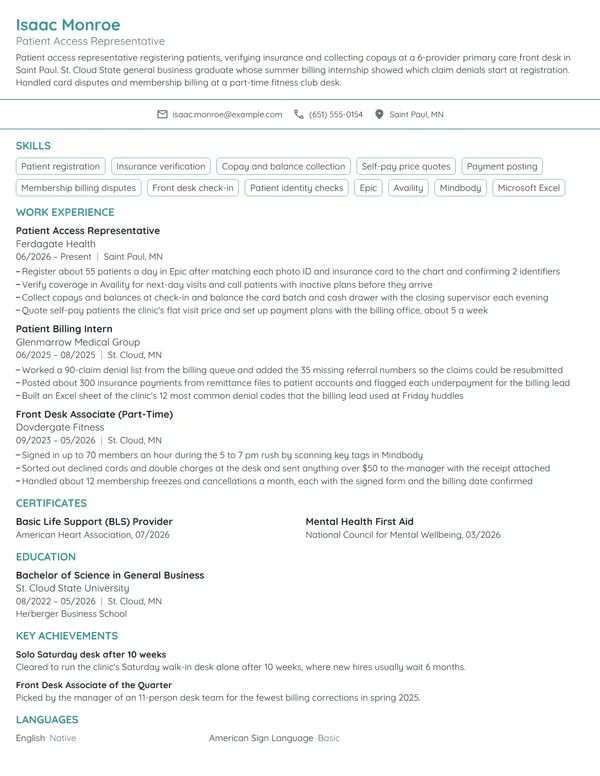
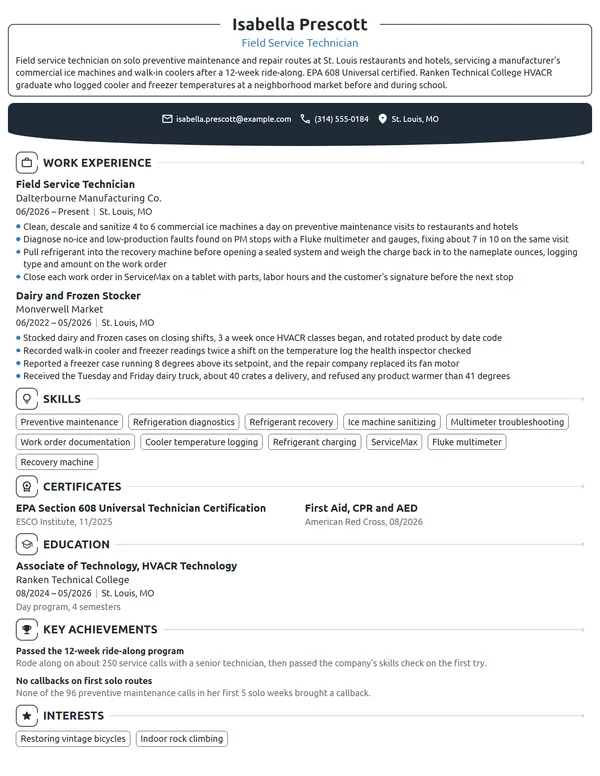
- Use the reverse-chronological format on 1 page, with Education high on the page until you have a year of full-time work in your field.
- Open with a 2- to 3-line objective (a summary once you have held a full-time job in the field) that names the job title from the posting, your training and 1 result with a number.
- Put internships and part-time, seasonal or campus jobs under Work Experience, with bullets that count shifts, customers, orders or hours.
- List 6 to 8 skills from the job ad that your bullets prove, and write each piece of software by its exact name.
- Add the certificates a posting names, such as OSHA 10-Hour, ServSafe Food Handler or Microsoft Office Specialist, with the issuer and the month you earned them.
- Leave off your date of birth, family details and street address, then test the file with an ATS resume checker before you apply.
What hiring managers look for in an entry-level resume
A hiring manager filling an entry-level role already knows you have little full-time history. In NACE's Job Outlook 2026 Spring Update, employers said they want graduates to show evidence of teamwork, problem-solving and communication, and nearly 70% said they now use skills-based hiring.
That evidence can come from more places than a full-time job. O*NET groups the occupations that need the least preparation into Job Zones 1 and 2, where some need little or no previous experience and others ask for several months to a year of it. Internships, part-time work and campus jobs are how you cover that ground on paper: nearly all employers in the NACE survey called US internships valuable, and more than 40% seek candidates with on-campus student work.
Build the page from these sections, with headings an applicant tracking system reads without trouble:
- Name, the job title you are applying for, and your city, phone, email and LinkedIn URL
- An objective of 2 to 3 lines under your name, which prints without a heading of its own
- Education, near the top while it is your strongest item
- Work Experience, with internships and part-time jobs, newest first
- Skills, including the software you have used
- Certificates, each with its issuer and date
- Optional: Key Achievements or Volunteer Experience, plus Languages or Interests
Best format for an entry-level resume
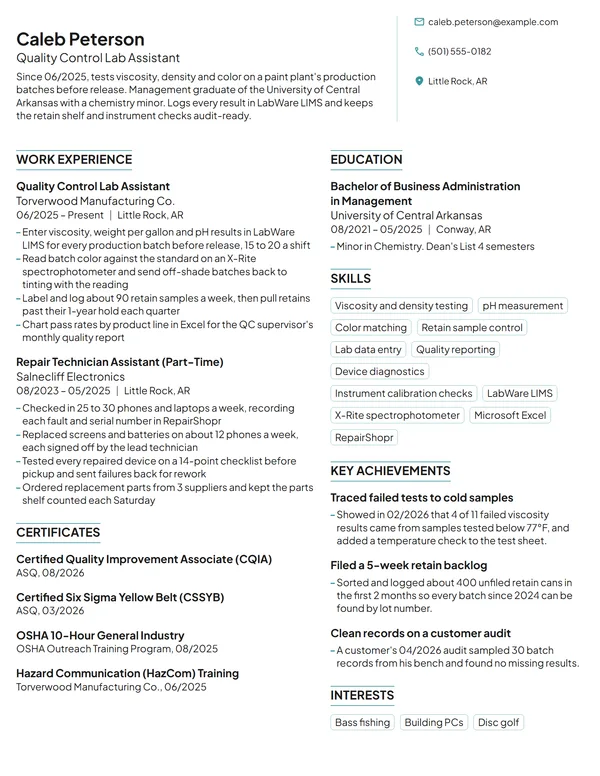
Use the reverse-chronological resume format: your newest entry first, each with the title, the employer, the city and MM/YYYY dates. A short history in date order is easy to check, and it shows a part-time job you kept for years as the reliability record it is. A combination layout, with a skills block above your history, fits only if you are changing fields and your past job titles say nothing about the new work.
- Best for most entry-level applicantsReverse-chronologicalYour jobs, newest first, with your results under each one.Best for: A steady work history in your field
- FunctionalSkills grouped up top, with a short work history below.Best for: Gaps or very little experience
- CombinationA skills section first, then your full work history.Best for: A career change with strong skills
Keep an entry-level resume to 1 page. If it runs over, cut high school once you have a college degree or a certificate program, then trim the oldest part-time job to 1 bullet. A half-empty page is the opposite problem: fill it with a certificate, a language or a class project in your Education line, never with a longer objective.
| Setting | What to use |
|---|---|
| Length | 1 page |
| Section order | Education high on the page while it is your strongest item; lower once you have a year of full-time work in the field |
| Headline under your name | The title you are applying for, written the way the posting writes it |
| Dates | MM/YYYY for every entry; Expected 05/2027 for a degree you have not finished |
| Contact details | City and state, phone, a professional email and a LinkedIn URL; no full street address |
| Photo and personal details | Usually no photo in the US and Canada; no date of birth, family details or Social Security number |
| File | A PDF named with your first and last name, unless the portal asks for a .docx |
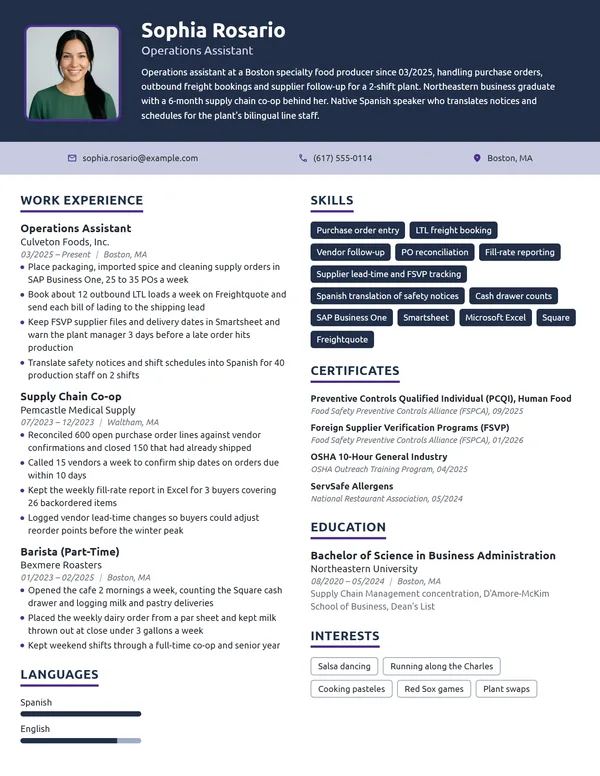
Most US and Canadian resumes carry no photo. Large employers often take entry-level applications through an online portal, so keep every heading, date and skill as plain text rather than inside a graphic or a text box.
Entry-level resume objective vs. summary
Apply a single test: if you have held a full-time job in the field you are applying to, write a summary; if you have not, write an objective. An objective names the job you want and gives the strongest proof you have so far, in 2 to 3 lines under your name. These resume objective examples show the shape across many fields. Write yours last, and take its number from one of your bullets.
Entry-level resume objective formula
Degree, certificate or training graduate with internship, part-time or campus job, seeking a job title from the posting role. 1 result with a number. Certificate, tool or language.
Example
Marketing graduate from the University of Toledo with a summer internship at a credit union, seeking a junior marketing coordinator role. Promoted 3 branch events that drew 140 sign-ups. Microsoft Office Specialist in Excel.
Don't
Motivated recent graduate looking for an entry-level opportunity where I can learn and grow with a great company.
Do
Communications graduate with 2 years at a campus tutoring center, seeking an Admissions Assistant role. Booked and confirmed about 60 tutoring appointments a week and answered front-desk email within 1 business day. Fluent in Spanish.
The second version names the target title, a weekly volume and a skill the reader can check.
How to write entry-level work experience bullets with numbers
List internships and part-time, seasonal and campus jobs under Work Experience, each with its title, employer, city and dates. A paid job outside your field still proves you can keep a schedule, so it stays. When listing work experience on a resume at this stage, give each entry 2 to 4 bullets, the most to the entry closest to the job, each starting with a verb and counting something: shifts, customers, files, orders, hours or a deadline met.
| Area | What to count | Example bullet |
|---|---|---|
| Retail and food service | Guests or customers a shift, register accuracy, hours a week | Served up to 95 guests a shift on weekend doubles while working 25 hours a week through finals. |
| Warehouse and stockroom | Pallets, orders, line items, errors caught | Received and counted 18 pallets a shift against the packing list. |
| Campus jobs | Students served, tours, tickets, shifts | Led 8 campus tours a month for groups of about 40 prospective students and parents. |
| Internships | Deliverables, deadlines, people you supported | Built a weekly Excel report on open orders that 6 account managers used in their Monday meeting. |
| Volunteering | Hours, events, people served | Gave 60 hours over 2 semesters to intake and sorting at a Saturday food pantry. |
| Class projects, in your Education line | Team size, client, result | Rewrote a local retailer's sizing chart in a 6-person class project, cutting its 2 most common return reasons. |
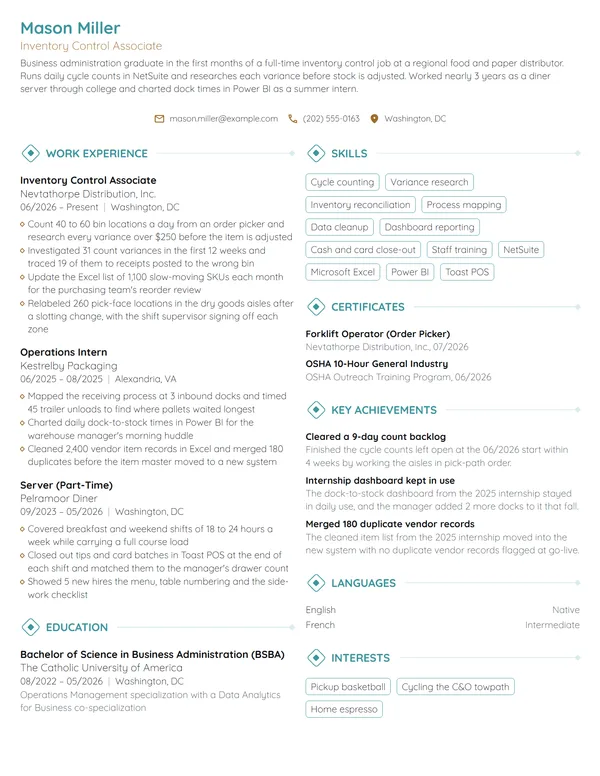
Here is one graduate's entry built that way. The internship comes first because it is the newest entry and the closest to the job she wants; the part-time job keeps 2 bullets that show she can be trusted with a register and new staff.
Work Experience
- Drafted 22 member emails in Mailchimp as open rates rose from 24% to 31% over the summer.
- Promoted 3 branch events with flyers and social posts that drew 140 sign-ups.
- Logged event sign-ups and email results in an Excel tracker the branch manager reviewed every Friday.
- Worked 20 hours a week through 4 years of college and moved up from cashier to shift lead in 2024.
- Trained 7 new cashiers on the register and returns, with 0 register shortages in her last 12 months as shift lead.
Don't
Responsible for stocking shelves and helping customers.
Do
Restocked 4 grocery aisles each closing shift and took about 70 curbside phone orders every weekend.
The rewrite gives the reader a count for each task, so the job reads as real work rather than a duty list.
Don't
Helped with data entry during my internship.
Do
Entered 1,800 paper intake forms into the client database in 6 weeks, with fewer than 2% flagged on spot checks.
Entry-level skills and software for your resume
Choose 6 to 8 skills from the job ad that something on your page proves. Entry-level hiring runs on transferable skills: cash handling, scheduling, data entry and customer service carry from a store or a campus office into most first full-time jobs. Add a soft skill only where a bullet backs it, as training new hires backs teamwork.
Hard skills for entry-level resumes
- Data entry
- Cash handling and drawer counts
- Inventory counts
- Scheduling and calendar management
- Customer service by phone and email
- Microsoft Excel (formulas, sorting, pivot tables)
- Google Workspace
- Filing and records management
- Basic bookkeeping
- Bilingual communication
Soft skills entry-level hiring managers value
- Reliability and punctuality
- Following written procedures
- Learning new systems quickly
- Teamwork on shared shifts
- Clear written communication
- Problem-solving with customers
Name software exactly as the job ad writes it, and only what you could open and use on day 1. Office roles tend to ask for Microsoft Excel, Word and Outlook or Google Workspace; warehouse and retail roles name a point-of-sale system, a handheld scanner or an inventory system. If you used a tool in an internship or a class, write it into that bullet as well, so the reader sees what you did with it.
Certificates that help an entry-level resume
List certifications on your resume in a Certificates section, with the issuer and the month and year, whenever the posting names them or the work calls for them. At entry level, a short certificate can stand in for experience: it tells a hiring manager you have already finished training they would otherwise have to provide.
| Credential | Issued by | What it takes |
|---|---|---|
| OSHA 10-Hour (General Industry or Construction) | An OSHA-authorized trainer or online provider, under OSHA's Outreach Training Program | A 10-hour class on common job safety and health hazards, ending in a completion card. OSHA calls it voluntary training that does not meet the requirements of any OSHA standard. |
| Forklift operator | Your employer, under OSHA rule 29 CFR 1910.178(l) | Formal instruction, hands-on practice and an evaluation at work. The employer certifies each operator and repeats the evaluation at least once every 3 years. |
| Microsoft Office Specialist (MOS) | Certiport, with exams endorsed by Microsoft | A performance-based exam taken live in the application, at Associate or Expert level, for a single app such as Excel. |
| ServSafe Food Handler | National Restaurant Association | Food safety training followed by the ServSafe Food Handler Assessment. |
How to list a forklift certification your employer issued
A forklift certification comes from the employer that trained and evaluated you, so list it with that employer's name and the evaluation date, and name the truck type in a Work Experience bullet. Under the OSHA rule, a new employer still has to evaluate you before you drive its trucks, but your line shows you are not starting from zero.
Certificates
- Microsoft Office Specialist: Excel Associate (Microsoft 365 Apps), Certiport, 02/2026
- ServSafe Food Handler, National Restaurant Association, 06/2025
How to list your degree, GPA and coursework on an entry-level resume
Keep Education high on the page until you have a year of full-time work in your field. List your education on your resume with the full degree name, the school, its city and the month you graduated, and write Expected before the date if you are still finishing. A certificate program, an associate degree or an apprenticeship gets the same line as a bachelor's degree.
Show your GPA only when it is 3.5 or higher, and drop it once you have a full-time job behind you. A note line under the degree can carry what a Projects section would elsewhere: a capstone, a course the posting cares about or an honor, with a number in it.
Education
GPA 3.6. Capstone: a pricing study of an animal shelter's adoption fees, with a 4-person team.
Entry-level resumes with no experience, a gap or a career change
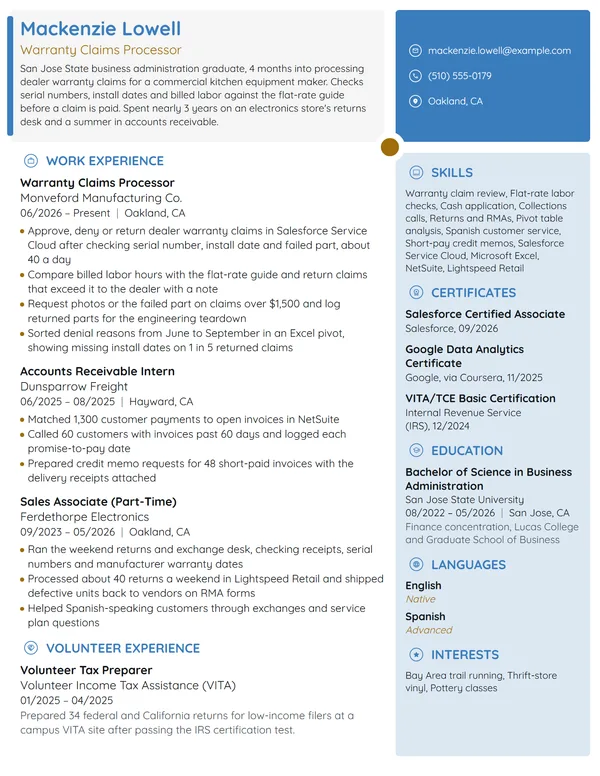
With no paid job yet, your page can still be full and honest. A semester of volunteering, a family business or a campus role counts if you can give it dates and a number. Write volunteer experience on your resume under Volunteer Experience, or choose Key Achievements instead when a scholarship or a competition result is your stronger item.
| Experience | Section | What to write |
|---|---|---|
| Internship, paid or unpaid | Work Experience | Your title with Intern in it, the employer, the city, the dates and 2 to 3 bullets |
| Part-time, seasonal or campus job | Work Experience | 2 to 4 bullets with shifts, customers or hours |
| Apprenticeship | Work Experience, with the program under Education | The trade, your sponsor employer and the hours completed so far |
| Volunteering | Volunteer Experience | The organization, the dates, and the hours you gave or the people you served |
| Class or capstone project | Education, in the note line | The project, the team size and the result |
| Scholarship, award or competition | Key Achievements | The name, the year and what it recognized |
A gap between school and your first job needs no apology on the page. If you spent it caring for family, traveling or taking short courses, leave the dates honest and put anything you learned under Certificates; the interview is the place to explain the rest.
Don't
Career changer looking for a fresh start in an office environment.
Do
Former line cook with 5 years in high-volume kitchens, seeking an Entry-Level Purchasing Assistant role. Ordered produce and dry goods for a 120-cover dinner service and kept weekly food cost within budget.
A career changer's objective names the old job's tasks that match the new posting.
Starting over in a new field at 30 or 40 is entry-level too. Keep reverse-chronological order, give past jobs the bullets that match the new posting, and let a career-change resume layout carry the rest. Explain the switch in an entry-level cover letter, in 2 or 3 sentences that connect your old work to the new job.
Recent graduates can also apply for federal jobs through the Recent Graduates Program. According to OPM, you must apply within 2 years of finishing your degree or certificate, or up to 6 years for veterans held back by military service, and the program lasts 1 year. Follow the resume instructions in each USAJOBS posting, which can differ from a private employer's.
Entry-Level resume FAQ
What should I put on an entry-level resume with no experience?
Put your degree or training first, then any internship, part-time or campus job, volunteering, and certificates. Give each entry dates and a number, such as hours, shifts or people served. Finish with 6 to 8 skills from the job ad that those entries prove.
How long should an entry-level resume be?
Keep it to 1 page. If yours runs longer, drop high school once you have a college degree or certificate, and cut the oldest part-time job to a single bullet before you shrink the font or margins.
Should I use an objective or a summary on an entry-level resume?
Use an objective if you have not yet held a full-time job in the field, and a summary once you have. Either way, keep it to 2 or 3 lines with the posting's job title, your qualification and 1 result with a number.
Should I put my GPA on an entry-level resume?
Only when it reaches 3.5 or above, or when an employer requests it. Put it on the degree line under Education, and remove it after your first full-time job, when your results start to say more than your grades.
Can I list part-time or unrelated jobs on an entry-level resume?
Yes. A part-time job you held for a year or more shows reliability, which is what an entry-level hiring manager is testing for. Keep its bullets to the tasks that carry over, such as cash handling, scheduling or customer service.
Do internships go under Work Experience on an entry-level resume?
Yes, paid or unpaid. Write Intern in the title, add the employer, city and dates, and give it 2 to 3 bullets with numbers. If your internship is closer to the job than your part-time work, give it the most bullets.
Should I apply if an entry-level job asks for 1 to 2 years of experience?
Yes, if you meet most of the other requirements. Internships, co-ops, apprenticeships and long-running part-time work all count as experience, so give them full entries with dates. Then name the posting's job title in your objective so the match is clear.
Should I keep high school on an entry-level resume?
Only until you have a college degree, an associate degree or a certificate program to list. After that, delete it and use the line for a certificate or a stronger bullet, unless an employer lists a high school diploma as a requirement.
Can recent graduates apply for entry-level federal jobs?
Yes. OPM's Recent Graduates Program accepts applications within 2 years of finishing a degree or certificate, or up to 6 years for veterans held back by military service, and the program lasts 1 year. Each USAJOBS posting sets its own resume instructions.
Next steps
Start with the example nearest to the job you are applying for and swap in your own entries, one section at a time. Count something in every bullet, check each tool name against the posting, and keep the page to 1 sheet. Then build the final version in our resume builder or from one of the resume templates.