
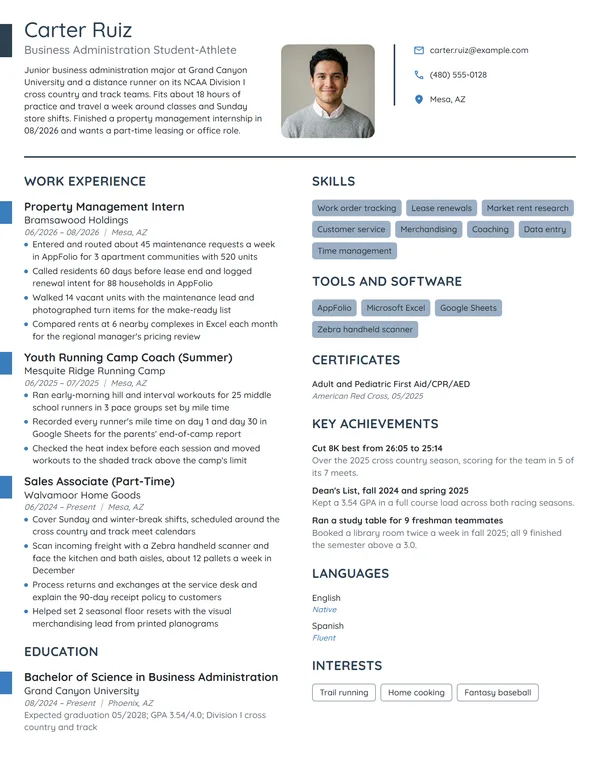
Writing a resume while you are still in school can feel thin, with a part-time job or two and not much else. People who hire students expect that. Signs that you show up and follow through, from a shift, a sports team or a group project, count for a lot, and so do the hours you can work. The main task is giving classes, clubs and short jobs real weight without padding them.
How to Write a Student Resume - Key Takeaways
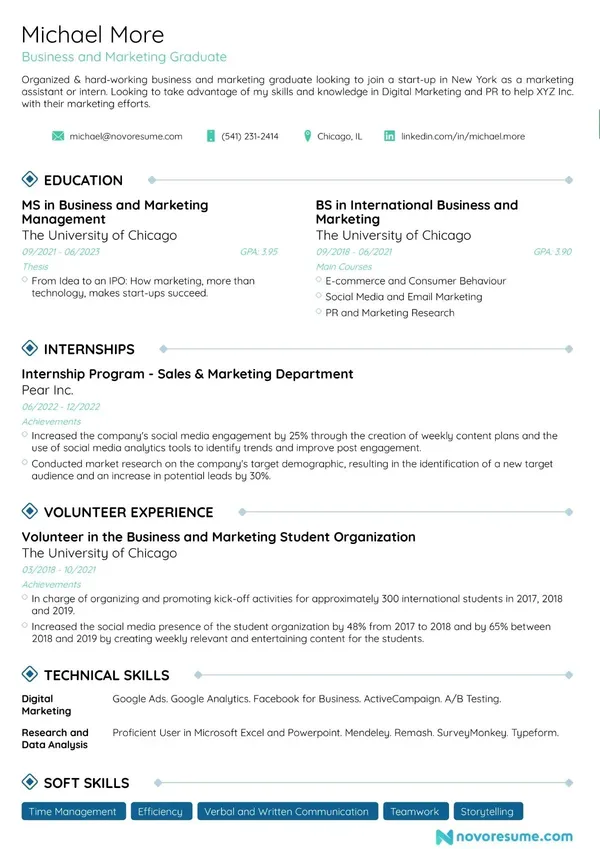
- Keep it to 1 page in reverse-chronological order, with Education above Work Experience while you are still enrolled.
- Write an objective unless you already have a job in the field you are applying to; then a short summary fits.
- Give part-time and summer jobs bullets with numbers: hours a week, customers a shift, cash handled or people you trained.
- List your GPA only at 3.5 or higher, and add 3 to 4 course names that match the job.
- Put clubs, teams and volunteering in Volunteer Experience or Key Achievements, with a count in every line.
- Run the file through an ATS resume checker before you apply to a chain store or a large campus employer.
What employers look for in a student resume
Working while studying is common. According to the Bureau of Labor Statistics, 49.2% of college students aged 16 to 24 were in the labor force in October 2024, including 81.6% of those enrolled part time. A manager hiring students wants 3 answers fast: what you are studying and when you finish, which hours you can work, and whether someone has already trusted you with money, customers, kids or a deadline.
Skills count as much as job titles at this stage. In NACE's Job Outlook 2026 Spring Update, employers said they want student resumes to show that a candidate can work in a team, solve problems and communicate effectively. A shift lead role, a group project or a club budget can prove all 3. Build your resume from these sections:
- Name, a headline such as Psychology Student or Business Administration Student, and contact details with a plain email address
- An objective or summary of 2 to 3 lines, printed without a heading
- Education, placed first while you are enrolled
- Work Experience: part-time, summer, campus and internship jobs
- Skills, with the apps you use
- Volunteer Experience or Key Achievements (pick one)
- Optional: Certificates, Languages or Interests
Best format for a student resume
Use the reverse-chronological resume format, with 1 change while you are in school: Education goes above Work Experience. Inside each section, list the newest entry first, with the title, the employer or school, the city and MM/YYYY dates. A skills-first layout hides the dates of your few jobs, which is the part a manager hiring for shifts wants to see.
- Best for most studentsReverse-chronologicalYour jobs, newest first, with your results under each one.Best for: A steady work history in your field
- FunctionalSkills grouped up top, with a short work history below.Best for: Gaps or very little experience
- CombinationA skills section first, then your full work history.Best for: A career change with strong skills
1 page is enough for almost every student. If it runs over, cut high school details first once you are in college, then older summer jobs down to 1 bullet each, before you shrink the font.
| Setting | What to use |
|---|---|
| Length | 1 page |
| Order of sections | Education first while enrolled; Work Experience moves up once you graduate and work full time |
| Dates | MM/YYYY; an expected graduation month for a degree in progress |
| Headline | Your major or program plus Student, or the job you want: Biology Student, Aspiring Barista |
| First and last name at a common provider or your school address | |
| Photo and personal details | A photo is rare in the US and Canada; never your age, birth date or Social Security number |
Most US and Canadian resumes carry no photo. Leave off your age and your full street address too: a city and state tell a manager whether you can get to the job.
Student resume objective vs. summary
Use 1 test: can you name a result from a job in the same field as the posting? If not, write a resume objective: your year and major, your best piece of evidence with a number, and the role and hours you want. If you can, write a 2 to 3 line summary that leads with that job. Most students in their first or second year write an objective.
Student resume objective formula
Year and major student at school, graduating MM/YYYY. Your strongest result from a job, class or club, with a number. Looking for a role for hours a week or season.
Example
Psychology senior at the University of Vermont, graduating 05/2027, with 2 years of part-time cashier work beside a full course load. Balanced a $2,400 drawer every shift without a shortage. Looking for a campus research assistant or office role for 15 hours a week.
Don't
Hardworking and motivated student seeking a position where I can gain experience and grow my skills.
Do
Psychology sophomore with 20 hours of peer tutoring in statistics, available Tuesday and Thursday afternoons. Looking for a front desk role in a campus office.
The second version gives a manager a subject, a number and the days you can work.
How to write student work experience bullets with numbers
A part-time job, a campus job, an internship or a summer job all go under Work Experience, written like any other job: list your work experience with the title, employer, city and dates, then 2 to 4 bullets that start with a verb. A Federal Work-Study job is a job too, so give it the office name and its own entry. Small jobs still produce numbers: customers served, cash handled, kids supervised, shifts covered.
| Area | What to count | Example bullet |
|---|---|---|
| Retail or food service | Customers an hour, sales, accuracy, shifts | Took orders for about 35 customers an hour at the drive-through window during weekend lunch rushes. |
| Class projects | Team size, sample size, the grade or the result | Ran a survey with 4 classmates, collected 210 responses and presented the findings to the dean of students. |
| Clubs and teams | Members, events, dollars raised or managed | Raised $1,850 for a robotics trip by organizing 3 bake sales with the club's officers. |
| Volunteering | Hours, people served, items sorted | Logged 48 hours at an animal shelter over 1 summer, walking and feeding up to 20 dogs a shift. |
| Tutoring and childcare | Students or children, sessions, progress | Tutored 6 ninth graders in algebra twice a week; 4 raised their grade from a C to a B. |
| Campus jobs | Calls, visitors, requests handled | Answered about 60 calls a shift at the residence hall front desk and logged every package delivery. |
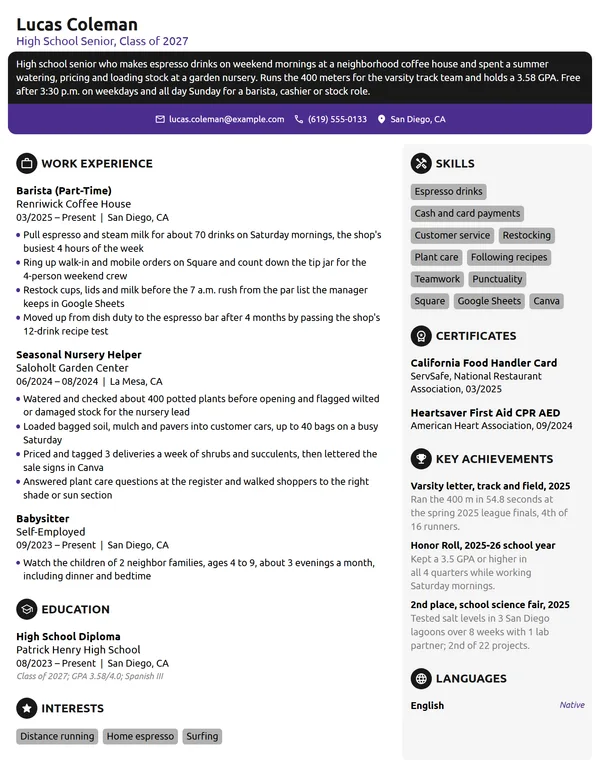
In the entry below, the current job gets 3 bullets, the summer job 1, and the hours sit in the first line.
Work Experience
- Work 12 hours a week across 3 evening shifts while taking 15 credits a semester.
- Serve about 140 customers a shift at the register and balance a drawer of about $2,400 with no shortages in 2 years.
- Trained 3 new cashiers on the register, produce codes and the store's ID check for alcohol sales.
- Led a group of 11 campers aged 8 to 10 through a 9-week season of swim, hiking and craft sessions.
Don't
Responsible for the cash register and helping customers.
Do
Rang up about 120 customers a shift and caught 2 mispriced items a week at the register.
Volume and accuracy are the 2 things a store manager checks first.
Don't
Member of the environmental club.
Do
Planned 5 campus cleanup events as events chair for a 30-member club and managed its $700 semester budget.
Student skills and software for your resume
Choose 6 to 8 skills from the job posting that you can point to in a bullet or in your Education entry. A short list of hard skills, plus the soft skills your bullets already show, reads better than 15 adjectives. If you list Excel, a bullet should say what you built in it.
Hard skills for students
- Customer service
- Cash handling
- Microsoft Excel
- Google Docs and Sheets
- Data entry
- Scheduling
- Research and citation
- Social media content
- Basic bookkeeping
- Canva
Soft skills employers look for in students
- Reliability
- Time management
- Teamwork
- Clear writing
- Problem-solving
- Learning new tasks quickly
Name the apps you actually used, by their real names: Microsoft Excel or Google Sheets rather than spreadsheets, Square or Toast if you rang sales on one, Canva or Adobe Express for a club's flyers. A language you speak well goes under Languages, with a level such as Fluent or Conversational, not in Skills.
How to list education, GPA and coursework on a student resume
Give your degree or diploma its full name, the school's official name, the city and your dates, following the standard rules for listing education on a resume. Under it, 1 line holds the extras: a GPA of 3.5 or higher, Dean's List or honors, a minor, and 3 to 4 relevant courses that match the posting. Once you are in college, drop your high school unless the posting asks for it or you finished it in the last year.
Where to put an expected graduation date
Write the month and year you expect to finish, and say expected in the note line, so nobody reads it as a degree you already hold. Keep that date the same in your objective, your Education entry and your cover letter; our college student cover letter examples show how to state it in a short opening paragraph.
Education
Expected graduation 05/2027. GPA 3.6, Dean's List 4 semesters. Relevant coursework: Statistics, Research Methods, Child Development.
Clubs, sports, volunteering and certificates on a student resume
Clubs, teams and causes need a home on the page, and each one goes where a reader expects it. A club office or a regular volunteer role becomes an entry under Volunteer Experience, with a title, dates and 1 to 2 bullets, which is how volunteer experience on a resume should read. A scholarship, an award or a team season fits Key Achievements instead. Use one of those 2 sections, not both, and put your strongest extracurricular activities there.
| What you did | Section | How to write it |
|---|---|---|
| Part-time, summer or campus job | Work Experience | Title, employer, city, dates and 2 to 4 bullets with numbers |
| Internship or practicum | Work Experience | Intern in the title line, plus the project you owned |
| Babysitting, lawn care or pet sitting for neighbors | Work Experience | A plain title such as Babysitter, Self-Employed, with the families or clients and how often |
| Club officer or regular volunteering | Volunteer Experience | The role, the group, dates and what you organized or raised |
| Scholarship, award or varsity team | Key Achievements | 1 line each, with the year and a number such as the amount or the place |
| CPR and First Aid or another credential | Certificates | The full name, the issuer and the month you earned it |
Here is the same student's volunteer entry. It reads like a job: a role, an organization, dates and numbers.
Volunteer Experience
- Sort and shelve about 600 pounds of donations on 2 Saturday mornings a month.
- Built a Google Sheets intake log that the pantry's 14 volunteers use to track the 85 households served each week.
Certificates are short on most student resumes, and that is fine. Add one when the job uses it: CPR and First Aid from the American Red Cross or the American Heart Association for camp, lifeguard and childcare jobs, or a food handler card for restaurant work.
Student resumes with no experience, on a visa or on a team
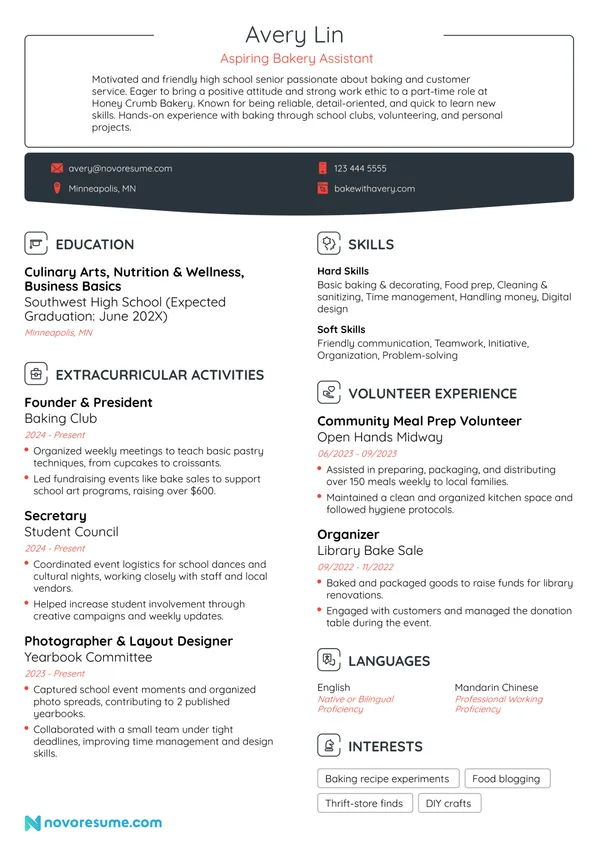
With no paid job yet, your Education entry, a class project, babysitting for neighbors and anything you did every week for a club or a cause carry the page. A high school student can use the high school student resume layout. Hours matter here as well: under the US Department of Labor's rules, 14 and 15-year-olds can work no more than 3 hours on a school day and 18 hours in a school week, while federal law sets no hour limit for 16 and 17-year-olds, though some states do.
- Paid odd jobs: babysitting, mowing or pet sitting as a Work Experience entry, with how many clients and how often.
- School projects: a science fair entry, a group report or a website, with the team size and the result.
- Club or church roles: under Volunteer Experience, with the events you ran or the money you raised.
- Responsibilities at home or in a family business: 1 entry if it was regular, such as weekend shifts at a relative's shop.
Don't
High school student looking for any job to earn money.
Do
10th grade student available weekends and summer weekdays. Mowed and edged 9 neighbors' lawns every week for 3 summers and handled the scheduling and payments alone.
Regular paid work for neighbors is still work, and a manager reads it that way.
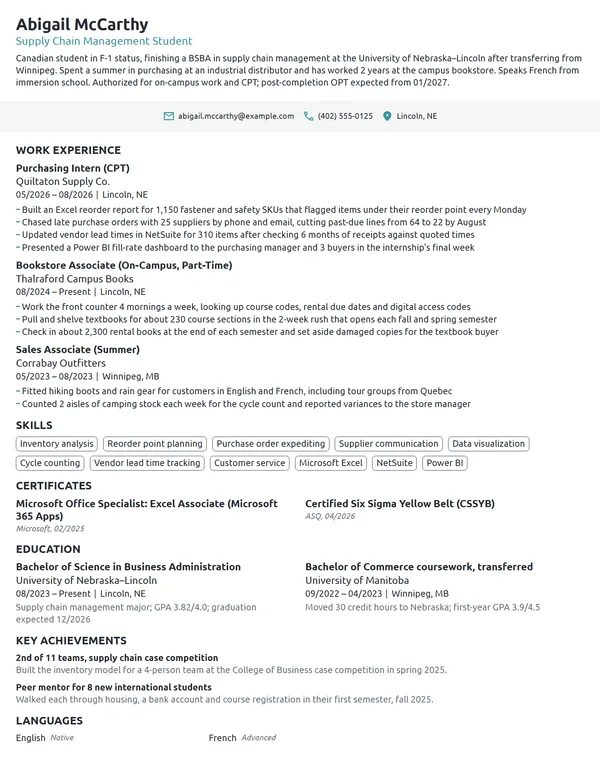
International students should lead with the US program and its expected date. On-campus jobs for F-1 students are limited to 20 hours a week while school is in session, according to the Department of Homeland Security, so those hours match what a campus employer expects. For work after graduation, USCIS describes Optional Practical Training (OPT) as temporary employment directly related to your major, for up to 12 months, with a 24-month extension for eligible STEM degrees. A single line such as Eligible for OPT from 06/2027 answers the question before an employer asks it; never add a passport or visa number.
Student athletes can treat their sport as evidence of time management. In NCAA Division I, countable athletically related activities are capped at 4 hours a day and 20 hours a week in season, so a line such as Division I soccer, 3 seasons, beside a job or a full course load shows a real schedule. Put the team in Key Achievements or the Education note line, with any captaincy and its season. Applying for a first internship? The internship resume examples show that layout.
Student resume FAQ
Should education go before work experience on a student resume?
Yes, while you are enrolled. Your program and graduation date are the first things a manager hiring students checks. Move Work Experience above Education once you graduate and hold a full-time job in your field.
Should I put my GPA on a student resume?
Only if it is 3.5 or higher, or if the posting asks for it. Write it in the note line under your degree with the scale, such as GPA 3.7/4.0. A lower GPA is better left off, with honors or coursework in its place.
How do I list an expected graduation date on a resume?
Write the month and year you expect to finish with the word expected in the line under the degree. Use the same date in your objective and cover letter, so nobody thinks you already hold the degree.
Should I keep high school on my resume once I'm in college?
Not after your first year of college, unless the posting asks for it. Freshmen can keep it for a strong GPA, a varsity sport or a leadership role, then replace it with college clubs and jobs as they add up.
What can I put on a student resume with no work experience?
Start with your Education entry and its coursework, then add paid odd jobs like babysitting or lawn care, class projects, clubs and volunteering. Give each one a number, such as hours a week, children cared for or dollars raised.
Should I list my availability on a student resume?
Yes, for part-time, seasonal and campus jobs. Put the days or weekly hours you can work in the last line of your objective. For internships and full-time roles after graduation, give your start month instead.
Should international students put visa status on a resume?
Only as 1 short line about work authorization, such as Eligible for OPT from 06/2027, since an employer will ask about it anyway. Leave off your passport number, your visa number and your date of birth.
How long should a student resume be?
1 page. Cut older summer jobs to 1 bullet and drop high school details before you shrink the font. Graduate students with research or several internships can sometimes justify a second page, but most students never need one.
Next steps
Pick the example closest to where you are now, whether that is high school, a first college job, a visa or a team schedule, and keep its order of sections. Swap in your own program, dates, hours and numbers. Fill it in with our resume builder or one of our student-friendly templates, and pair it with a short cover letter that says when you can work.