
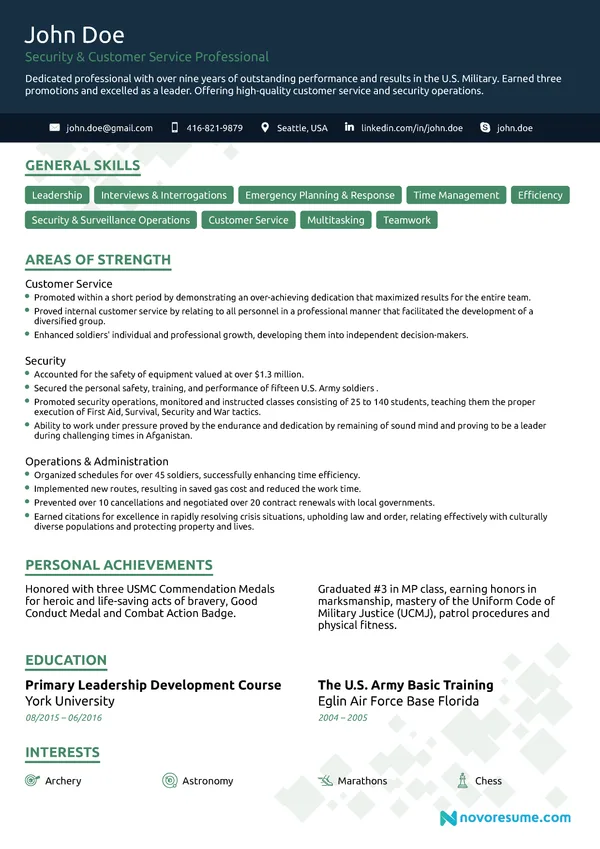
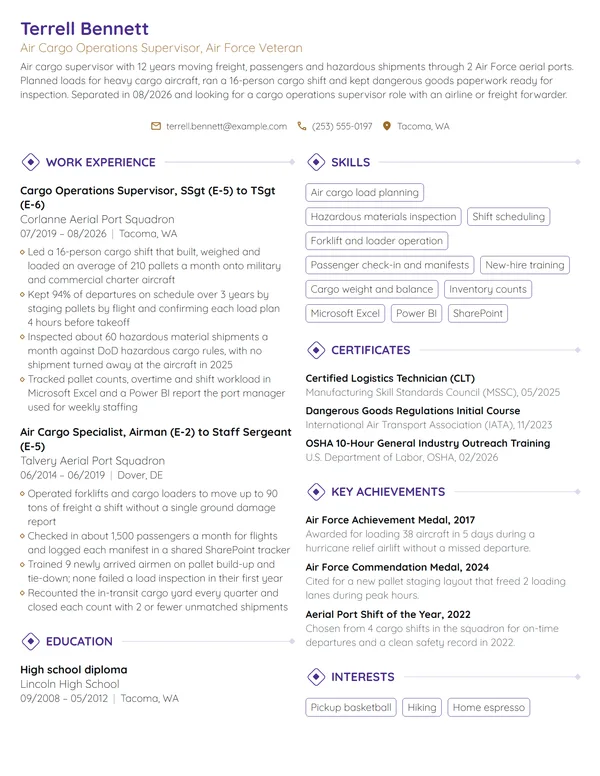
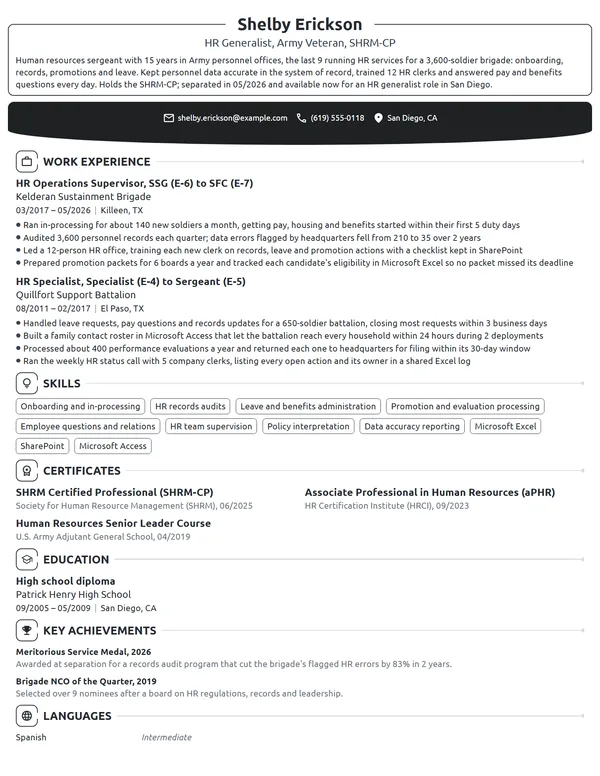
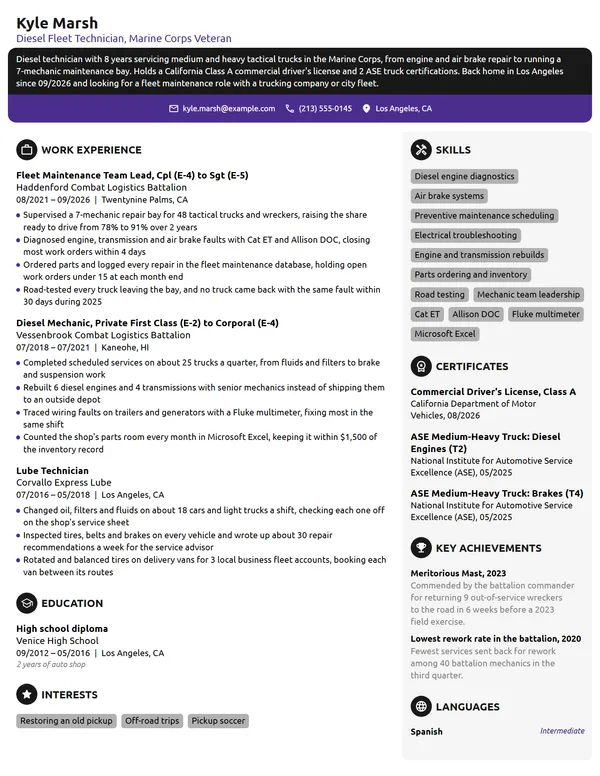
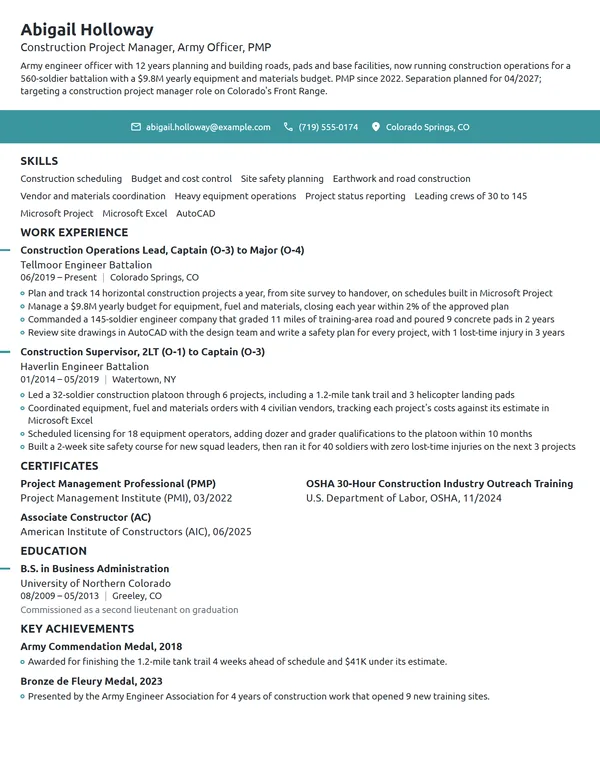
Leaving the service means applying to people who have never seen your evaluations and may not know what your job code involved. A civilian manager is filling a specific opening, and wants to see you can do that work: how many people you supervised, what money and equipment you handled, what training you hold and what got better because of you, written in the words of their posting. Pick the civilian job first. Every line of service on the page then has a single purpose, which is proving you can do it.
How to Write a Military-to-Civilian Resume - Key Takeaways
- Choose 1 civilian target job before you write, and put that title in the headline under your name, followed by your branch and veteran status.
- List your posts newest first on 1 page, or 2 with 10+ years of service, each with its MM/YYYY dates.
- Start each job title line with the civilian equivalent of your post, then add your rank and pay grade after it.
- Rename military measures in civilian terms: readiness becomes uptime, property accountability becomes inventory accuracy, and qualifications become training time.
- End your summary with your separation or availability month, so a recruiter knows when you can start.
- Mirror the keywords in each job ad, then run the file through an ATS resume checker before you apply.
What civilian hiring managers look for in a military-to-civilian resume
A warehouse manager, a hospital recruiter and an IT director each read your resume against their own opening. They look for work that matches the posting, the scale you handled and results with numbers, as they would from any applicant. Your service holds all of it; sort it so the matching parts come first, in the employer's vocabulary.
That means choosing what to leave out. A 4-line description of every collateral duty buries the 2 lines a hiring manager needed. Lay the page out with these sections:
- Name, a headline with your target job and veteran status, city and state, phone and email
- A profile of 2 or 3 lines under the headline (no section title needed) naming the target role and your availability date
- Work Experience, your latest post first, each one retitled for a civilian reader
- Skills, chosen from the job ad and including the software you used
- Certificates, for civilian credentials and job-related military courses
- Education, with any degree or college credit earned in or after service
- Optional: Key Achievements, Languages or Volunteer Experience, where they support the target
Best format for a military-to-civilian resume
Use the reverse-chronological resume format, with your current or final post at the top. Years of continuous service with promotions is a strong work history, and this order shows it; hiding the dates makes a civilian recruiter wonder why. If the job you want has little to do with your service, keep the order and let the profile and the Skills section carry the match.
- Best for most veteransReverse-chronologicalYour jobs, newest first, with your results under each one.Best for: A steady work history in your field
- FunctionalSkills grouped up top, with a short work history below.Best for: Gaps or very little experience
- CombinationA skills section first, then your full work history.Best for: A career change with strong skills
Fit it on 1 page if you served under 10 years. A longer career, or one with a senior leadership post, can run to 2 pages as long as page 1 holds your last 2 posts. Federal applications have their own length rule, set out on the federal resume page.
| Setting | What to use |
|---|---|
| Length | 1 page under 10 years of service; up to 2 for a longer career, with your last 2 posts on page 1 |
| Headline | Target civilian title, then branch and veteran status: Warehouse Operations Supervisor, Navy Veteran |
| Job title line | The civilian equivalent of the post first, with rank and pay grade after it |
| Dates | MM/YYYY for each post; Present on the current one until you separate |
| Acronyms | Spell out or replace every one the job ad itself does not use |
| Photo and ID numbers | Rarely a photo in the US and Canada; leave off your service number, Social Security number and disability rating |
Most US and Canadian resumes carry no photo, and a civilian employer judges a veteran's application on the same clean, text-only page as anyone else's. Send a PDF unless the portal asks for a Word file.
How to find the civilian job title that fits your service
O*NET OnLine's Military Crosswalk takes your MOS, rating, AFSC or SFSC and lists the civilian occupations related to it. The lists are long, so treat them as a shortlist to test against real job ads, not as an answer. Pick the 1 or 2 titles whose postings describe work you have actually done, then build the resume around the transferable skills those postings ask for.
| Military job | Related civilian occupations | Titles worth testing against job ads |
|---|---|---|
| Army 92Y, Unit Supply Specialist | 172 | Purchasing agent; transportation, storage and distribution manager |
| Navy LS, Logistics Specialist | 29 | Logistician; logistics analyst; purchasing agent |
| Army 68W, Combat Medic Specialist | 55 | Emergency medical technician; paramedic; licensed practical nurse |
| Air Force 3P0X1, Security Forces | 36 | Security manager; loss prevention manager; security guard |
Some of those titles need a civilian license before you can be hired, such as an EMT or nursing license, so check the posting's requirements before you choose. A target you qualify for today gets a straight resume; a target that needs 1 more credential gets the same resume with that credential's status under Certificates.
Military-to-civilian resume summary vs. objective
Write a resume summary when the target job uses the work you did in uniform, such as a supply supervisor moving into warehouse operations. Write an objective when you are switching to a field your service never touched: name the role, then the strongest proof you have for it. Both end with the month you can start, because a recruiter hiring for next month needs to know you will be free.
Military-to-civilian resume summary formula
Target civilian title and branch veteran with X years in the work in civilian words, scope: people, budget or assets. Best result, with its number. Degree, credential or clearance, available MM/YYYY.
Example
Warehouse operations supervisor and Navy veteran with 10 years in inventory control, leading teams of up to 11 and accounting for $14.6M in parts. Cut parts request fill time from 6 days to 2. B.S.B.A. in Management, available 02/2027.
Don't
Motivated veteran with proven leadership skills, looking to bring military discipline and integrity to a civilian company.
Do
Maintenance planner and Air Force veteran with 8 years scheduling inspections for a fleet of 14 aircraft. Brought overdue inspections from 9 to 1 within a year. Seeking a maintenance planning role in a manufacturing plant.
This version gives the target job, the scale and a result a plant manager can picture.
How to write military experience bullets for a civilian job
Under your latest post, write 3 to 4 bullets that open with a verb and end with a result; older posts get 1 to 3. Pick the bullets for the target job, not for the size of the duty: a logistics recruiter cares more about your inventory accuracy than about the ceremony you planned. Then rename each measure the way a civilian manager would say it.
| What you tracked in service | Civilian name for it | Example bullet |
|---|---|---|
| Equipment readiness | Uptime or fleet availability | Kept 31 of 34 generators available for use over 12 months, up from 26. |
| Property accountability | Asset management and inventory accuracy | Managed $7.4M in tools and test equipment at 100% accuracy across 4 quarterly counts. |
| Personnel qualifications | Training completion and time to productivity | Shortened the time for new technicians to work unsupervised from 10 weeks to 6. |
| Inspection results | Audit and compliance findings | Prepared a 40-person shop for an inspection that closed with 2 minor findings, down from 11. |
| Supply requests | Order fill rate and lead time | Filled 93% of parts requests from stock, up from 81%, by resetting reorder points on 600 items. |
| Watch and duty rosters | Shift scheduling and coverage | Built 24/7 shift rosters for 28 people with no uncovered posts in 18 months. |
How to write the job title line for a civilian reader
Lead with the civilian title that matches what you did, then your rank and pay grade, so the reader sees the job and the level in 1 line. Choose the civilian title from your target postings where it is honest: a supply petty officer who ran a stockroom team was a supply supervisor. Keep the branch or unit on the employer line and the installation's city as the location.
Work Experience
- Supervise 11 logistics specialists who receive, store and issue parts for a crew of 340.
- Cut average fill time for parts requests from 6 days to 2 by re-slotting 4,800 storage locations by demand.
- Account for $14.6M in repair parts; closed 2 annual wall-to-wall inventories at 99.7% accuracy.
- Built a 3-week onboarding plan for the inventory system and trained 23 new sailors on it.
- Processed about 260 receipts and issues a week with no shipment lost in transit.
- Found and returned $410K in excess parts to the supply system in 2019.
Don't
Conducted daily PMCS on assigned vehicles IAW unit SOP and TM standards.
Do
Ran daily preventive maintenance checks on a 22-vehicle fleet, keeping 20 or more ready for dispatch on 96% of workdays.
The acronyms are gone, and the fleet size and availability rate are in.
Don't
Deployed to the Middle East in support of combat operations.
Do
Ran a 6-person supply point in Kuwait for 9 months, issuing fuel, water and parts to 14 units without a missed delivery.
A deployment reads as work once it has a team, a time span and an output.
Transferable skills and software for a veteran resume
Choose 6 to 8 hard skills for your resume from the target job ad, and keep only the ones a bullet already proves. Name each skill as a civilian task, such as inventory control or shift scheduling, rather than as a trait like discipline.
Hard skills veterans bring to civilian jobs
- Inventory control and cycle counts
- Shift and crew scheduling
- Fleet and equipment maintenance planning
- Procurement and vendor follow-up
- Safety inspections and hazard reporting
- Training program design
- Budget tracking
- Incident and status reporting
- Physical security procedures
- Emergency medical response
Soft skills civilian employers value in veterans
- Calm decisions with incomplete information
- Accountability for team results
- Short, clear briefings
- Adapting to new rules and teams
- Coaching new hires
- Working across ranks and departments
List your software with your skills, then name it a second time inside a bullet. Civilian tools such as Microsoft Excel, SharePoint or SAP need no explanation. A military-only system becomes the work it did, such as a supply ordering system or a maintenance tracking database, unless the target posting names it, which happens mostly with defense contractors.
Certifications, military training and clearances on a civilian resume
Civilian employers search for credentials by name, so list your certifications on your resume under Certificates with the issuing body and the month, and put any license first. Military courses belong there too when they match the target job. Everything else from your service record has its own place, or none.
| What you earned | Where it goes | How to write it |
|---|---|---|
| Civilian certification (CompTIA, OSHA training, a trade credential) | Certificates | Full name, issuing body, MM/YYYY |
| State license (EMT, commercial driver's license) | Certificates, listed first | License type and the state that issued it |
| Military course tied to the target job | Certificates | The subject in plain words, the school that ran it, the month you finished |
| Security clearance | Headline or profile | Level and whether it is active, nothing more |
| Degree or college credit awarded | Education | Only credit a school has actually granted |
| Medals and awards | Key Achievements, if any | Only those whose citation names a result, written as that result |
If the target job asks for a credential you do not hold yet, the VA says your GI Bill can cover approved licensing and certification tests, up to $2,000 per test, and Post-9/11 GI Bill users can also use benefits for prep courses. Write a scheduled exam under Certificates with its month and status so a recruiter sees it coming.
Education, the GI Bill and college credit on a veteran resume
When listing education on a resume, write the degree, the school, its city and the month you graduated. A degree finished online during service is listed like any other, and one you are still completing gets its expected month. Basic training and boot camp stay off: every veteran has them, and the line tells a civilian reader nothing new.
If you plan to start a degree on the GI Bill after separating, name the program and the start month in your profile, not under Education, until you are enrolled. List only college credit a school has awarded you, and copy the degree title exactly as your transcript gives it.
Education
How to apply for civilian jobs before you separate
Start the resume during your Transition Assistance Program: the Department of Labor's 2-day Employment Workshop includes help writing it. Apply while still in uniform, with Present on your current post and your availability month in the profile. If your service was short or the target is far from your old job, collect evidence beyond your main duty.
- A SkillBridge or other civilian internship: its own Work Experience entry under the host company's name, with what you did there.
- Collateral duties that match the target: safety officer, training coordinator or unit supply roles, each written into the bullets of the post where you held them.
- Off-duty courses and exams: under Certificates or Education, with the month you passed.
- Volunteer work: coaching, mentoring or community projects under Volunteer Experience, with numbers.
Don't
Transitioning service member seeking a rewarding civilian career that makes use of my leadership experience.
Do
Army signal support specialist separating in 01/2027, seeking a network technician role in Raleigh, NC. Maintained radio and network equipment for 180 users and passed CompTIA Network+ in 2026.
A target role, a start date and 1 piece of proof make this objective worth reading.
A move into an unrelated field works like any career-change resume: the bullets closest to the new job go first under each post. Explain why you are switching in the letter you send with it, not on the resume; the steps in how to write a cover letter apply, with 1 paragraph on what carries over. For employers and industries that hire veterans, start with the jobs for veterans list.
Military-to-Civilian resume FAQ
Should a veteran use a functional resume to change careers?
No. A functional resume hides dates, and civilian recruiters tend to read that as something to hide, when your service is in fact a continuous work history. Use reverse-chronological order and let the headline, the profile and the Skills section carry the match to the new field.
How do I translate my military job title for a civilian resume?
Find what the target postings call the work you did, and use that title if it is honest, then add your rank and pay grade after it. A petty officer who supervised a stockroom team becomes Supply Supervisor, Petty Officer First Class (E-6).
Can I apply for civilian jobs while I am still on active duty?
Yes. Keep Present on your current post and put your separation or availability month in the profile, such as available 02/2027. Recruiters filling a role with a fixed start date can then see whether your timing works.
Should I write a different resume for each civilian job?
Yes, a version for each target title. The headline, the profile, the order of your bullets and the skills list change with the target; your posts, dates and numbers stay the same. 2 or 3 versions usually cover a job search.
Can the GI Bill pay for a certification exam?
Yes, for approved tests. The VA says GI Bill benefits can cover licensing and certification test costs of up to $2,000 per test, and Post-9/11 GI Bill users can also use them for prep courses. Check that your exam is on the VA's approved list before you book it.
Should I mention a VA disability rating on my resume?
No. A resume shows what you can do for the job, and a rating is personal medical information that is not part of that. Leave it off the resume. Social Security and service numbers stay off as well.
What if my military job has no civilian equivalent?
Write the parts that do have one. Infantry and other combat roles include team leadership, training, equipment accountability, planning and safety, each of which a civilian manager recognizes. Search your code in O*NET's Military Crosswalk, pick a target from the list and lead with the bullets that fit it.
Is it harder for veterans to find a job than for civilians?
Not on average. The BLS reports that the unemployment rate for all veterans was 3.5% in 2025, lower than the 4.2% rate for nonveterans.
Next steps
Choose your target job, then find the example nearest your branch and level and keep its structure. Replace each post's title and numbers with your own, add your availability month, and build it in our resume builder or from one of the resume templates. Pair it with a short letter naming the role you want.