
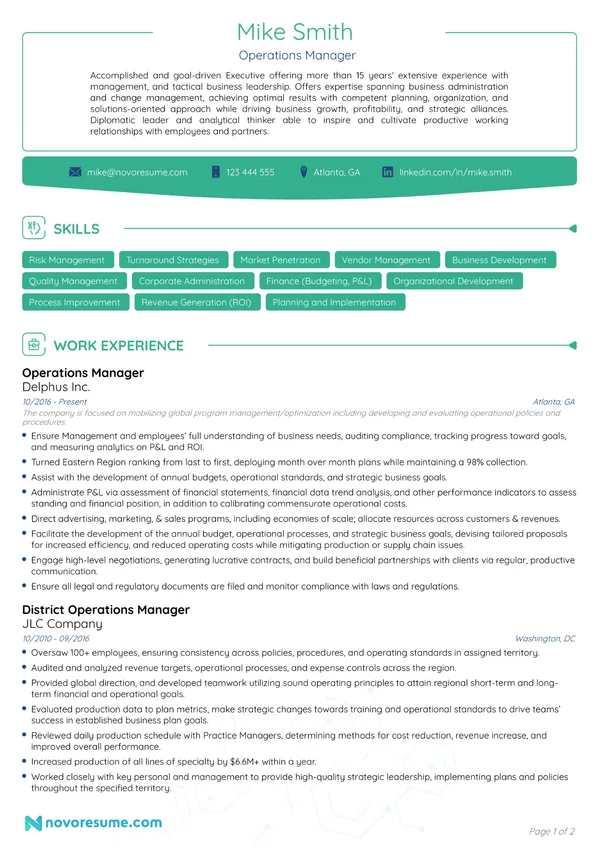
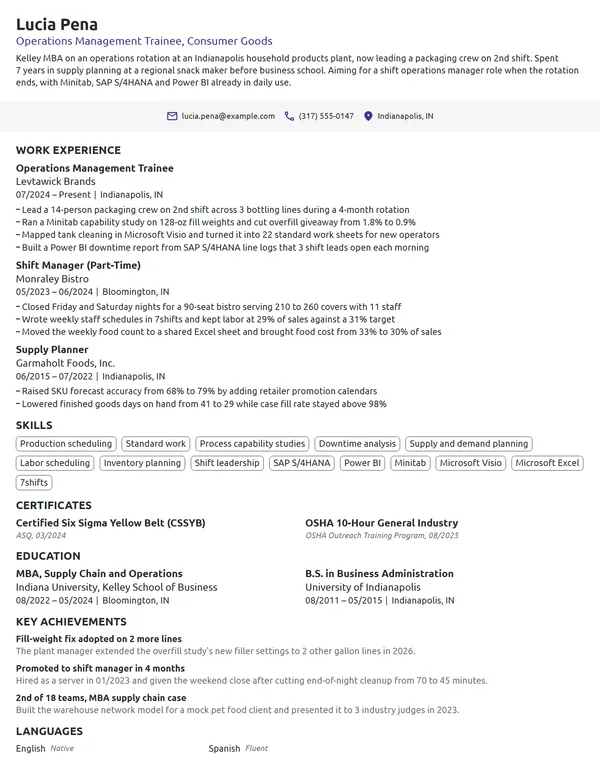
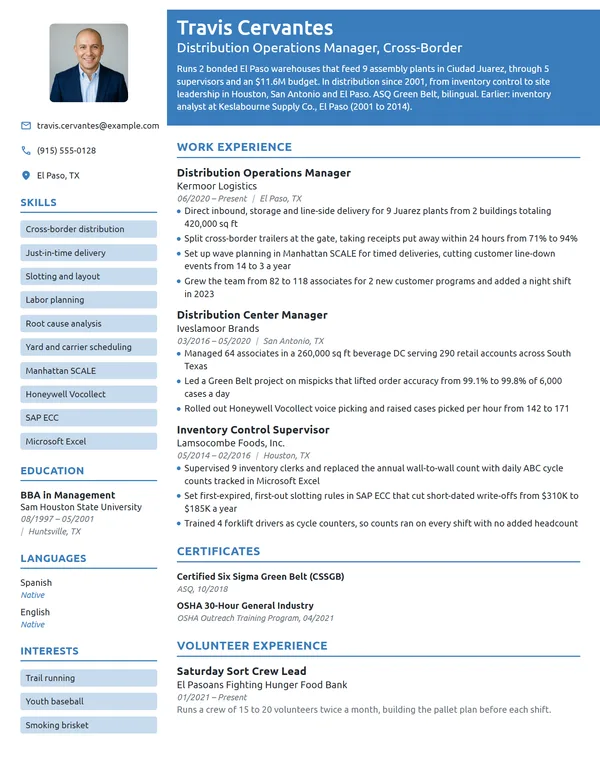
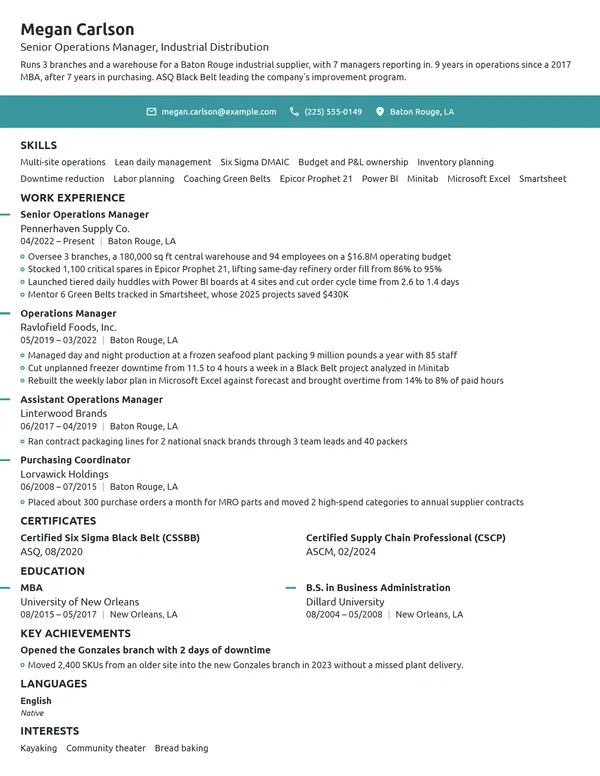
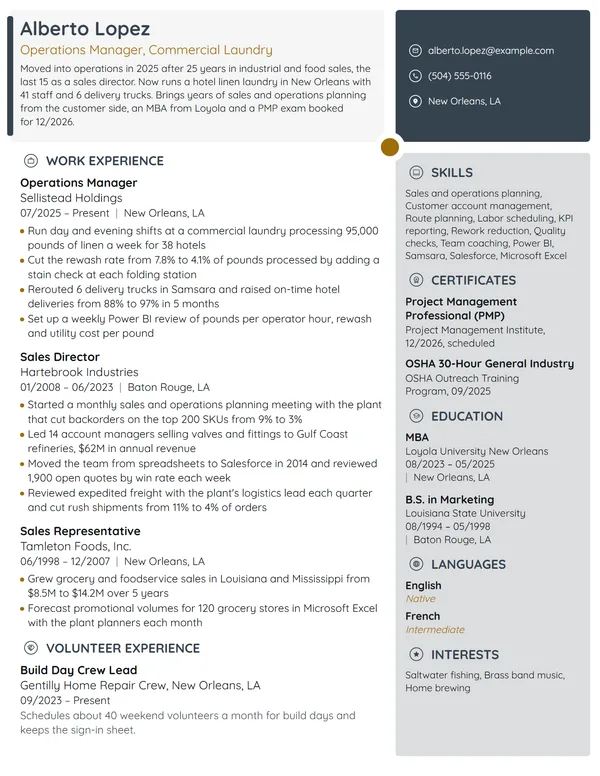
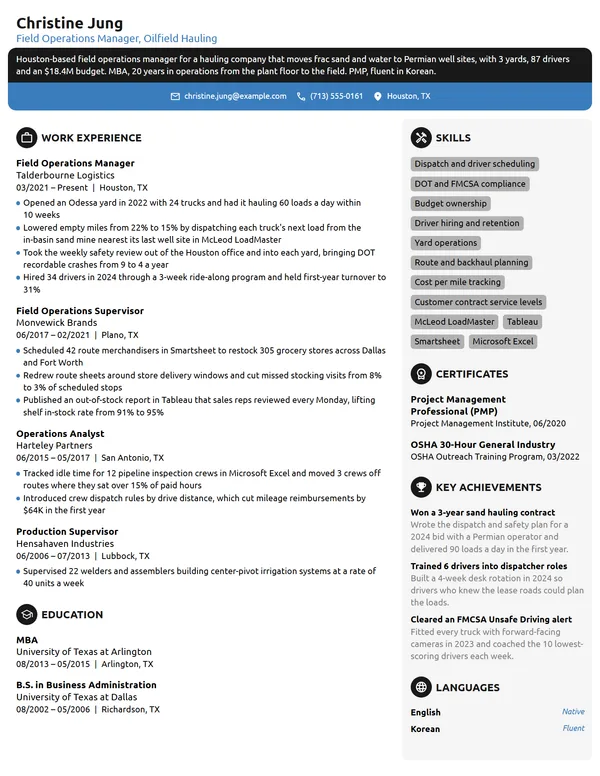
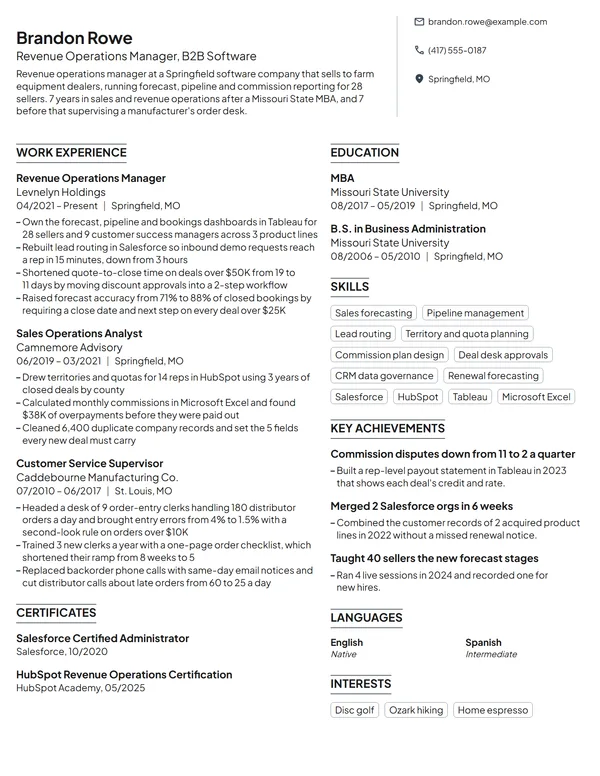
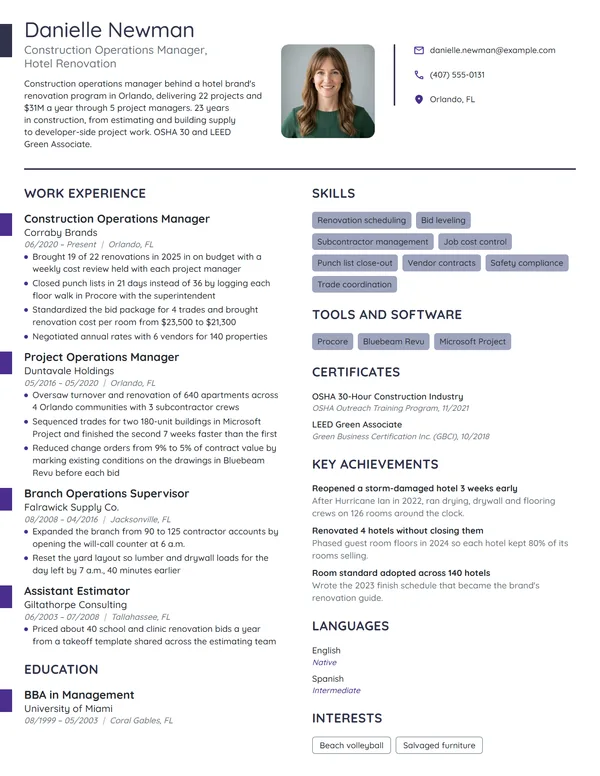
Operations managers keep a business running, whether it is a plant, a distribution center or a hotel. Whoever hires you will want to see how big the operation was, who reported to you and what improved while you ran it. Cost per unit, on-time rates, safety records and the size of your team are the figures that show it, and the certifications you hold back them up.
How to Write an Operations Manager Resume - Key Takeaways
- Go reverse-chronological and fit it on 1 page, or 2 once you have 10+ years or several sites behind you.
- Open with a 2- to 3-line summary that names your years, the type of operation, the size of your team and your strongest result.
- Start each job with its scope (people, shifts, sites, budget), then give every bullet a metric such as units per labor hour, OTIF, cost per order or TRIR.
- List 6 to 8 skills and the systems from the job ad, and prove each one inside a bullet.
- Put PMP and ASQ belts under Certificates with the issuer and date, and write OSHA training as a 10- or 30-hour card, never as a certification.
- Leave your birth date and marital status off, and run the PDF through an ATS resume checker before the first application goes out.
What hiring managers look for in an operations manager resume
The person hiring an operations manager, often a plant manager, a director of operations or a general manager, reads your resume with 2 questions in mind: how big was what you ran, and what got better because you ran it. The BLS describes general and operations managers as overseeing activities too diverse to fit one area of management. O*NET's core tasks for the role include reviewing performance data to find cost reductions, preparing staff schedules and directing budget activities, so your bullets should show those tasks with a number attached.
Build the page from these sections, using headings that resume-screening software can parse:
- Name, headline (for example, Operations Manager, Distribution and Fulfillment) and contact details
- Summary: a short opening paragraph of 2 to 3 lines that carries no heading
- Work Experience, starting with your current role
- Skills, with the systems you run the operation on
- Certificates, such as PMP, an ASQ belt or an OSHA 30-Hour card
- Education
- Optional: Key Achievements (or Volunteer Experience instead), plus Languages if you manage a multilingual workforce
Best format for an operations manager resume
Use the reverse-chronological resume format, with your latest role on top and each entry showing your title, the employer, its city and the MM/YYYY start and end. Operations careers usually climb from lead to supervisor, manager and director, often at the same company, and this layout makes each promotion visible. It works for career changers as well, because your most recent and most relevant work stays on top.
- Best for most operations managersReverse-chronologicalYour jobs, newest first, with your results under each one.Best for: A steady work history in your field
- FunctionalSkills grouped up top, with a short work history below.Best for: Gaps or very little experience
- CombinationA skills section first, then your full work history.Best for: A career change with strong skills
Stay on 1 page with under 10 years of experience. A director of operations or a manager with several sites, plants or business units can use 2 pages, provided page 1 holds the current role and the one before it.
| Setting | What to use |
|---|---|
| Length | 1 page under 10 years; 2 pages for multi-site or senior roles |
| Headline | Your title plus the type of operation: Operations Manager, Food Manufacturing |
| Dates | Month and year (MM/YYYY) on each entry; Present marks the current one |
| Bullets | 3 to 4 under the current job, 1 to 3 under older ones, each with a metric |
| Photo and personal data | Skip the photo unless a posting asks for one; leave out birth date, marital status and Social Security number |
| File type | PDF by default, Word only when the application portal asks for it |
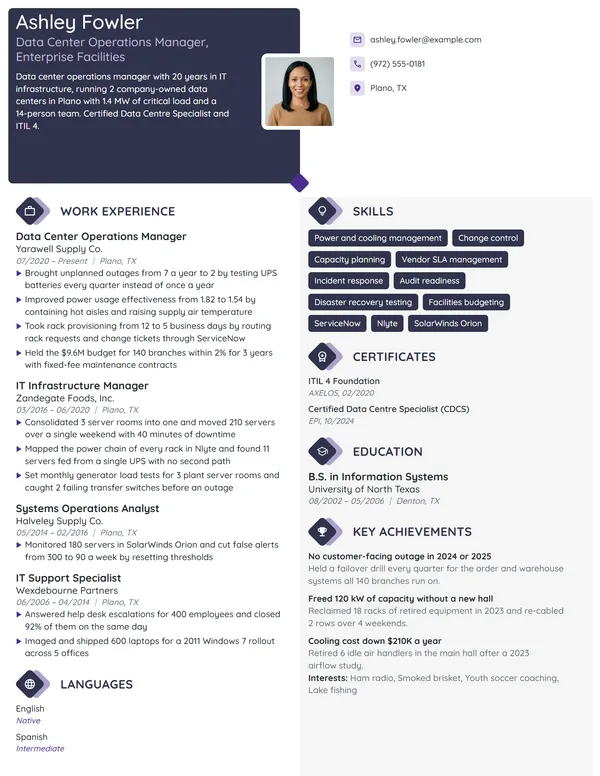
Most US and Canadian resumes carry no photo. For an operations role, use that space for one more line of scope or results instead.
Operations manager resume summary vs. objective
If you already manage people in an operation, write a resume summary: your years, the kind of operation, your team size and 1 result. If you have never held a role with direct reports, a resume objective works better: the role you are targeting, plus the closest evidence you have, such as a shift you led or a budget you tracked. Draft it after your bullets, so its figure comes from them.
Operations manager resume summary formula
Title with X years in type of operation, leading team size. Biggest throughput, cost or service result, with a number. Certification or method you work with.
Example
Operations manager with 13 years in manufacturing and e-commerce fulfillment, leading teams of up to 100. Raised units per labor hour by 21% across a 2-shift building shipping 14,500 orders a day. PMP and ASQ Six Sigma Green Belt.
Don't
Results-oriented operations leader with a proven track record of optimizing processes and improving efficiency.
Do
Operations manager with 8 years in food manufacturing, leading 3 supervisors and 70 hourly staff on 2 shifts. Raised OEE on the main bottling line from 64% to 77% and passed 2 SQF audits with no major findings.
The rewrite names the industry, the team, the metric and an audit outcome a plant manager would ask about.
How to write operations manager work experience bullets with numbers
Your current operations role gets 3 to 4 bullets, older roles 1 to 3, and every bullet starts with what you did. Your employer already tracks productivity, service, cost, safety and quality every week, so the figures exist. Pull them from those reports and turn them into achievements on your resume, each with a before and after or a base it is measured against.
| Area | What to count | Example bullet |
|---|---|---|
| Throughput | Units per labor hour, orders or units a day, line uptime | Raised uptime on 4 packaging lines from 82% to 90% in 2 quarters. |
| Service | OTIF, fill rate, order cycle time | Lifted OTIF for a 40-store grocery customer from 89% to 96% in 1 year. |
| Cost | Budget owned, cost per unit or order, overtime | Cut cost per order from $3.85 to $3.20 while volume grew 18%. |
| Safety | TRIR, recordable injuries, lost-time days | Brought TRIR from 4.1 to 1.9 over 2 years with daily safety walks on 3 shifts. |
| Quality | Scrap rate, defects, returns, audit findings | Reduced returns caused by picking errors from 0.9% to 0.3% of orders. |
| People | Headcount, turnover, internal promotions | Lowered 90-day turnover among hourly hires from 44% to 27% with a 2-week buddy program. |
| Inventory | Cycle count accuracy, turns, shrink | Held cycle count accuracy at 99.7% across 18,000 bin locations. |
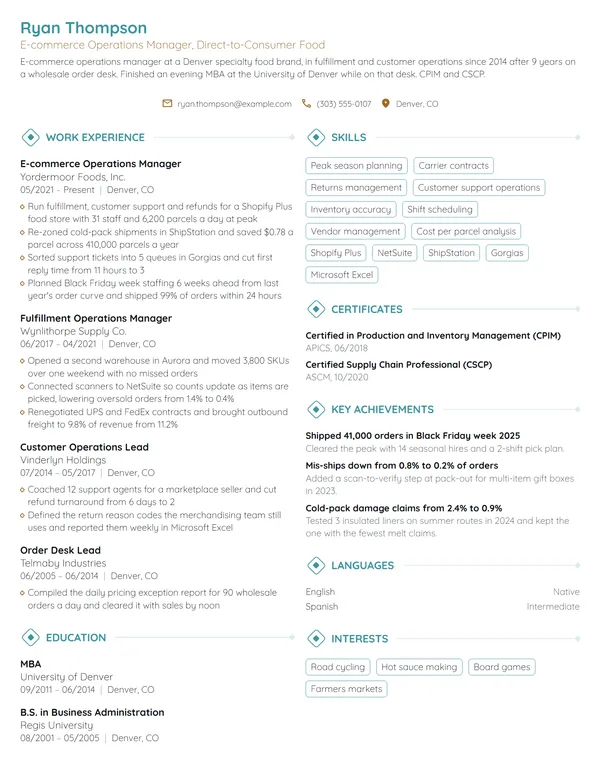
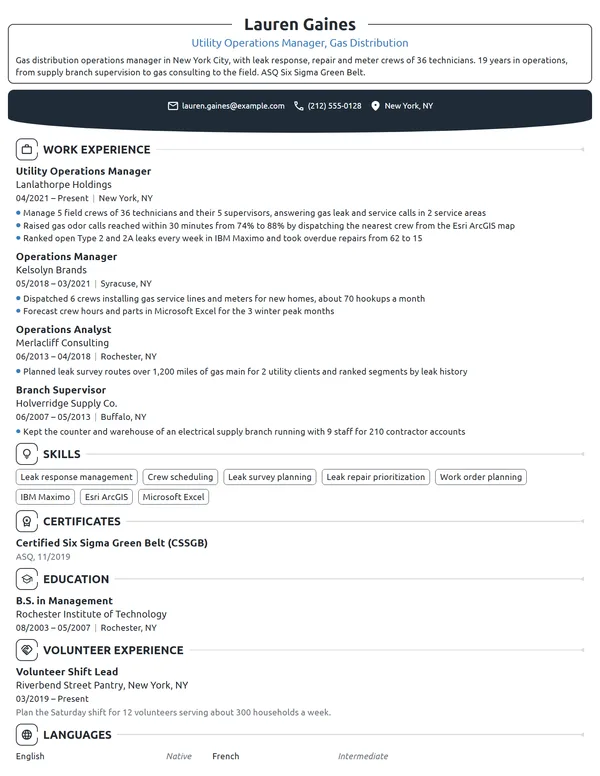
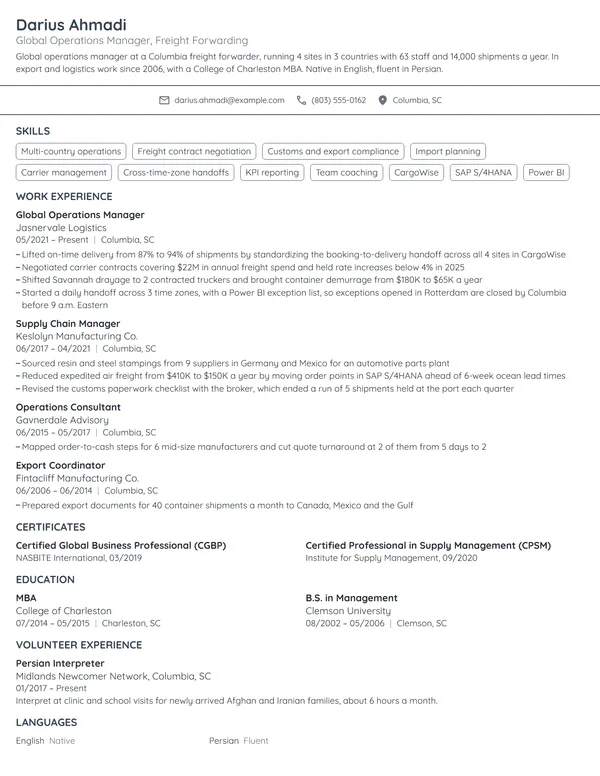
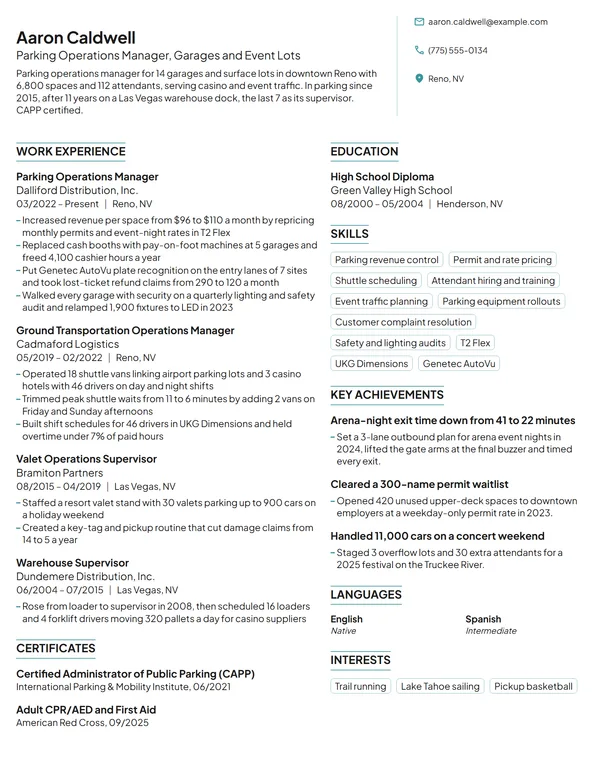
This sample shows the pattern: the first bullet sets the scope, the next ones show what changed, and the older supervisor role is kept short.
Work Experience
- Lead 4 shift supervisors and 96 associates across 2 shifts in a 310,000-square-foot center shipping about 14,500 orders a day.
- Raised units per labor hour from 61 to 74 in 9 months by re-slotting 2,300 fast-moving SKUs next to the pack stations.
- Moved on-time shipping from 93.1% to 98.6% while keeping overtime under 6% of paid hours.
- Own a $7.4M annual operating budget and closed FY2025 $212K under plan.
- Supervised 38 machine operators on 3 injection molding lines and cut scrap from 4.2% to 2.7%.
- Ran 11 kaizen events that shortened mold changeovers from 47 to 26 minutes.
Don't
Responsible for managing warehouse operations and staff.
Do
Managed 3 inbound docks and 52 associates, cutting average trailer unload time from 3.5 to 2.25 hours.
A duty becomes a result once it carries the scope and a before-and-after figure.
Don't
Improved efficiency and reduced costs across the department.
Do
Renegotiated 2 LTL carrier contracts and consolidated 5 weekly routes into 3, saving $148K a year in freight.
Operations manager skills and software for your resume
Your Skills section needs 6 to 8 hard skills for your resume, taken from the posting and each one shown in action somewhere in your bullets. Lean, scheduling and budgeting fit almost every operations role; S&OP, vendor management or ISO 9001 only belong where you have done that work.
Hard skills for operations managers
- Budgeting and P&L management
- KPI reporting
- Lean and continuous improvement
- Labor planning and scheduling
- Process mapping
- Inventory control
- Vendor and carrier management
- Safety programs and OSHA compliance
- Capacity planning
- Sales and operations planning (S&OP)
Soft skills operations directors value
- Leading through supervisors
- Decisions under time pressure
- Coaching and accountability
- Cross-department coordination
- Clear shift handoffs
- Conflict resolution
Name your systems inside Skills, then show each one at work in a bullet. O*NET marks Microsoft Excel, PowerPoint and the Office suite as both in-demand and hot technology for general and operations managers, and lists Tableau, Salesforce and Microsoft Visio among its hot technologies. If the posting names an ERP or warehouse system you have used, such as SAP, NetSuite or Manhattan, copy that name exactly. O*NET also lists Kronos Workforce Timekeeper; if the ad calls the timekeeping system UKG, write UKG.
PMP, Six Sigma and OSHA training: how to list operations certifications
No license is required to work as an operations manager, so certifications act as proof of method. List certifications on your resume under Certificates with the issuer and the date, and repeat the strongest one in your summary or headline. PMP fits roles built around projects and rollouts, ASQ Six Sigma belts fit plants and process-heavy operations, and an OSHA 30-Hour card fits any site with a safety program.
| Credential | Issued by | What it takes |
|---|---|---|
| PMP (Project Management Professional) | Project Management Institute (PMI) | 36 months of project management experience with a 4-year degree, or 60 months with a secondary diploma, plus 35 contact hours of project management education, then the exam. |
| CSSGB (Certified Six Sigma Green Belt) | ASQ | 3 years of full-time, paid work in areas of the Green Belt Body of Knowledge and a 110-question exam. ASQ grants no education waivers. |
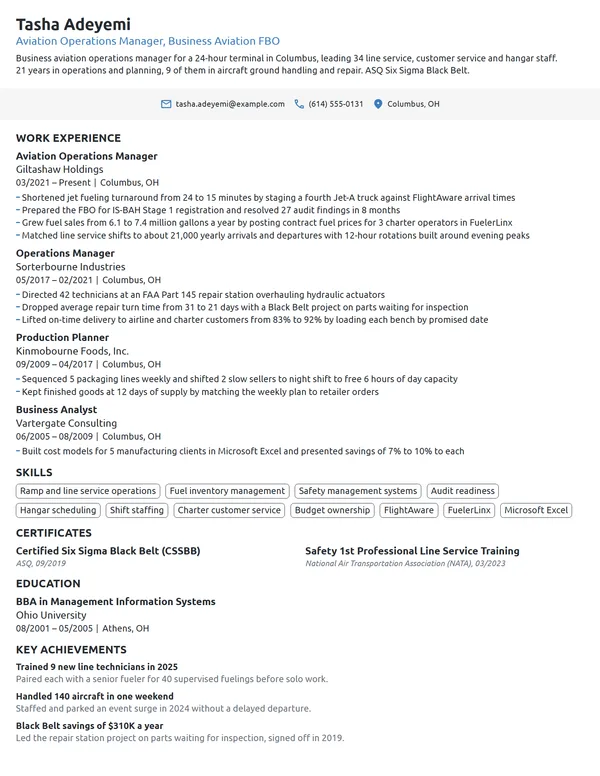
| CSSBB (Certified Six Sigma Black Belt) | ASQ | At least 1 completed Six Sigma project with a signed affidavit, work experience in the Black Belt Body of Knowledge, and a 165-question exam. |
| OSHA 30-Hour General Industry card | An OSHA-authorized trainer, through OSHA's Outreach Training Program | A 30-hour class, which OSHA calls more appropriate for supervisors or workers with some safety responsibility. It is voluntary and not a certification. |
How to list company belts and OSHA cards
Many employers run their own Lean or Six Sigma programs. Name the real issuer: a belt from your company's program carries the company's name, and only an exam passed with ASQ or another body is a certification from that body. OSHA says none of its Outreach courses is a certification, so write the card as OSHA 30-Hour General Industry with its date, never as OSHA certified.
Certificates
- Project Management Professional (PMP), Project Management Institute, 04/2022
- Certified Six Sigma Green Belt (CSSGB), ASQ, 10/2019
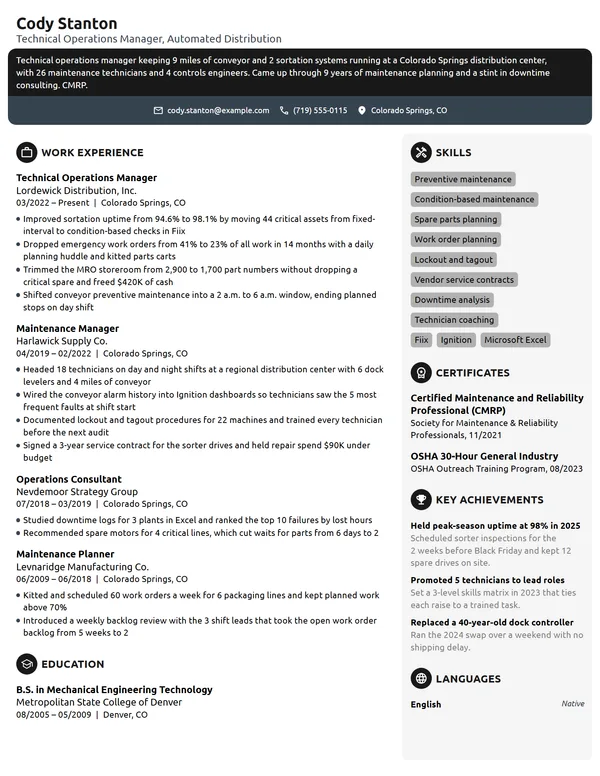
- OSHA 30-Hour General Industry, Outreach Training Program card, 02/2018
How to list your business degree or MBA on an operations manager resume
The BLS says top executives, the group that includes general and operations managers, typically need at least a bachelor's degree and considerable work experience, and that those at large corporations may hold an MBA. O*NET's data shows how varied the route is: 27% of respondents say the job requires a bachelor's degree, 29% say high school or its equivalent, and 22% some college without a degree. Business administration, supply chain, industrial engineering and management degrees all fit the role.
Each degree line needs 4 things, as in any guide to listing education on a resume: the degree, the school, its city and state, and the MM/YYYY you graduated. Put an MBA above your bachelor's degree, and add a concentration only when it matches the role, such as supply chain or operations management. Without a degree, keep Education short with your diploma or coursework and let your promotions and certifications carry the page.
Education
Entry-level, trainee and career-change operations manager resumes
Few people start as operations managers. Many reach the role through a management trainee program, a shift lead or operations supervisor role, or an MBA. For a first management role, use an entry-level resume structure: an objective, then any evidence that you have already organized people, time or money, each item with a figure.
- Shift lead or key holder roles: people on your shift, opening and closing duties, schedules you built.
- Internships and trainee rotations: the departments you rotated through and 1 process you measured or fixed in each.
- Part-time work in restaurants, retail or warehouses: covers per night, orders picked an hour, inventory you counted.
- MBA or capstone projects, under Education: only when they used real company data, such as a capacity study for a local plant.
Don't
Motivated professional seeking an operations manager position where I can grow my skills.
Do
Retail store manager with 6 years running a $4.2M-a-year location and 28 staff, seeking an assistant operations manager role in distribution. Cut shrink from 2.1% to 1.3% of sales and staffed 3 peak seasons on a fixed labor budget.
An objective still needs scale and a result, just from the job you already have.
If you are moving in from retail management, military logistics, project coordination or account management, keep the reverse-chronological order and lead each recent job with its operations work: leadership skills shown through people you scheduled, budgets you tracked and processes you changed. A career-change resume works when a reader can see the operations manager in your last 2 roles without explanation. Use the cover letter for the reason behind the move; these management cover letter examples show how to keep that part to a short paragraph.
Operations Manager resume FAQ
How long should an operations manager resume be?
Use 1 page while your experience is under 10 years. With 10+ years, several sites or a director-level scope, 2 pages are fine as long as your current and previous roles sit on page 1 and every bullet still carries a metric.
What metrics should an operations manager put on a resume?
Use the ones your employer reviewed every week: units per labor hour, on-time or OTIF rates, cost per unit or order, budget variance, TRIR, scrap or defect rates and staff turnover. Give each one a starting point and a result, and state the scope it covers.
Do you need a degree to be an operations manager?
Not always. The BLS says top executives, including general and operations managers, typically need a bachelor's degree and considerable experience, but in O*NET's data 29% of respondents name high school or its equivalent as the requirement. Without a degree, put promotions and certifications first.
Is PMP or Six Sigma better for an operations manager resume?
Pick the one that matches the operation. PMP suits roles built on projects, launches and system rollouts. An ASQ Green or Black Belt suits plants, distribution centers and other process-heavy work. If you hold both, list both under Certificates and name the one the job ad asks for in your summary.
Can I write "OSHA certified" on my resume?
No. OSHA states that none of the courses in its Outreach Training Program is a certification. Write the class as OSHA 30-Hour General Industry, or OSHA 10-Hour, with the date on your card, and list it under Certificates.
How do I go from supervisor to operations manager on a resume?
Show the manager-level parts of your supervisor job first: budgets you helped build, other supervisors you trained, schedules for more than 1 shift and projects that changed a process. Use a headline such as Production Supervisor, ASQ Certified Six Sigma Green Belt, and write a summary aimed at the manager role.
How do I show multi-site experience on an operations manager resume?
Put the number of sites in your job title line or first bullet, such as 3 distribution centers in 2 states, then report results across the network rather than for 1 building. Add the combined headcount and budget so a reader can compare your scope with the role.
Does an MBA help on an operations manager resume?
Yes, at larger employers. The BLS notes that top executives of large corporations may hold an MBA. List it above your bachelor's degree with any operations or supply chain concentration, but keep your management results in Work Experience, since the degree alone does not show you can run a site.
Should I put salary expectations on an operations manager resume?
No. Pay belongs in the salary field of the application or in a later conversation with the recruiter. For reference, the BLS reports that the median annual wage for general and operations managers was $105,770 in May 2025; your range will depend on the industry, the region and how many people and sites you run.
Next steps
Pick the example that matches your level and type of operation, borrow its layout, and swap in your own scope and results: team size, budget, throughput, service and safety. Build it in our resume builder or start from one of the resume templates, and open your cover letter with your strongest operations result.