
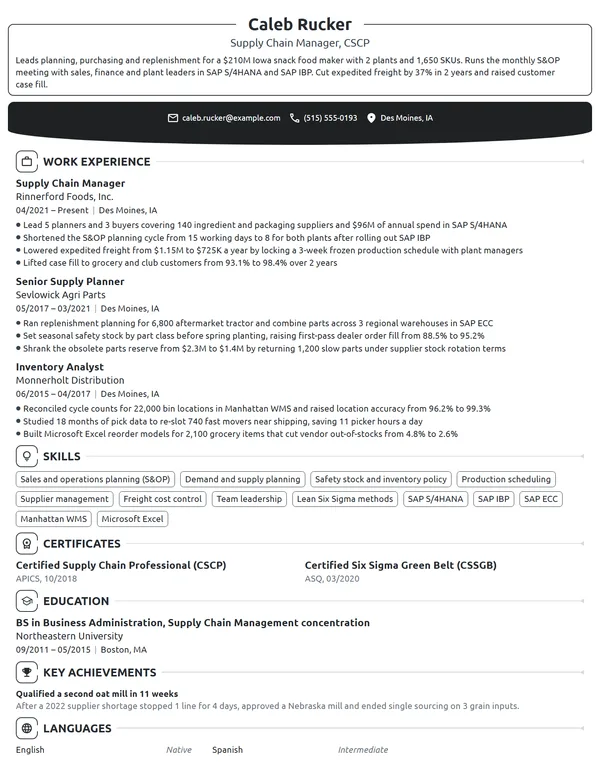
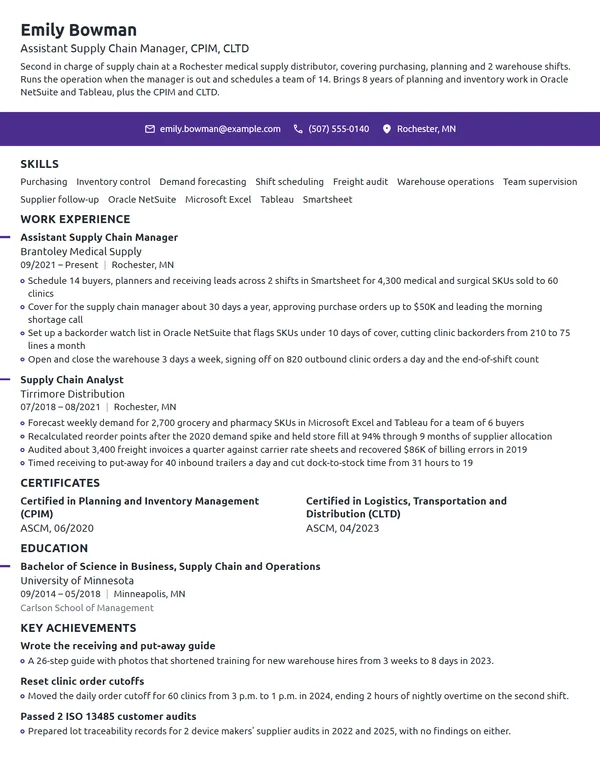
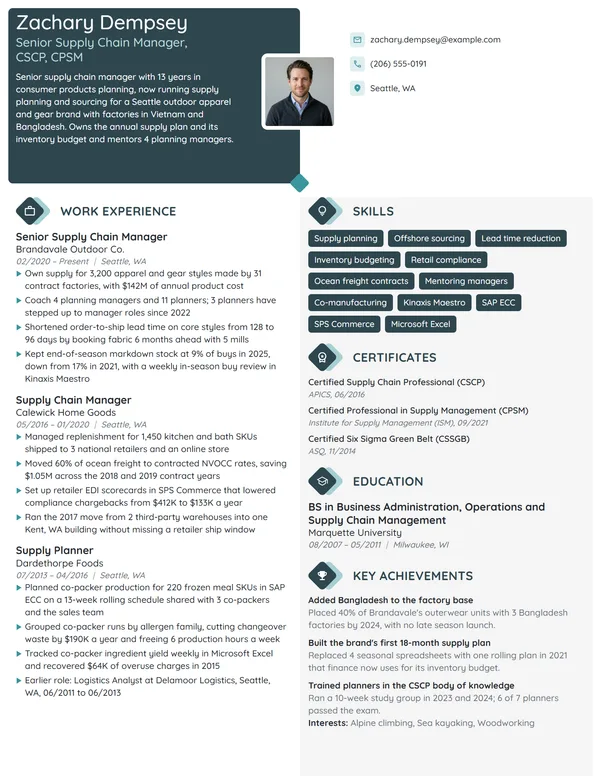
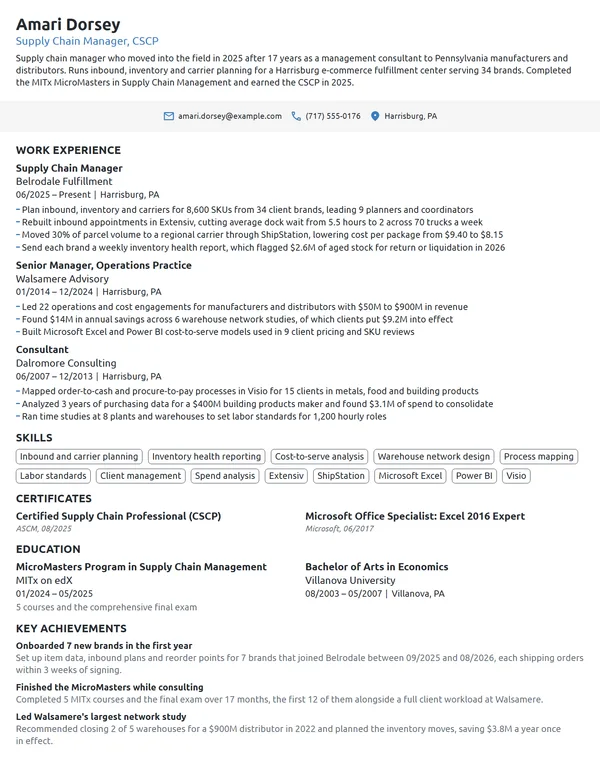
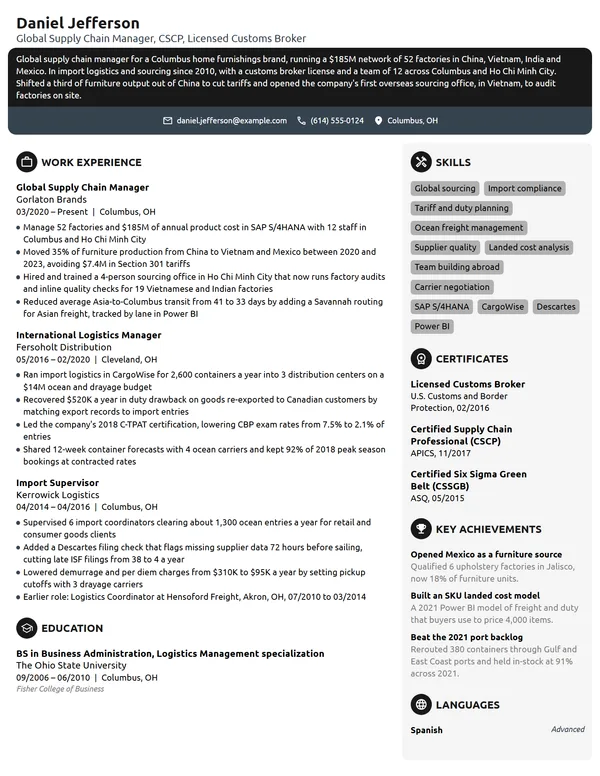
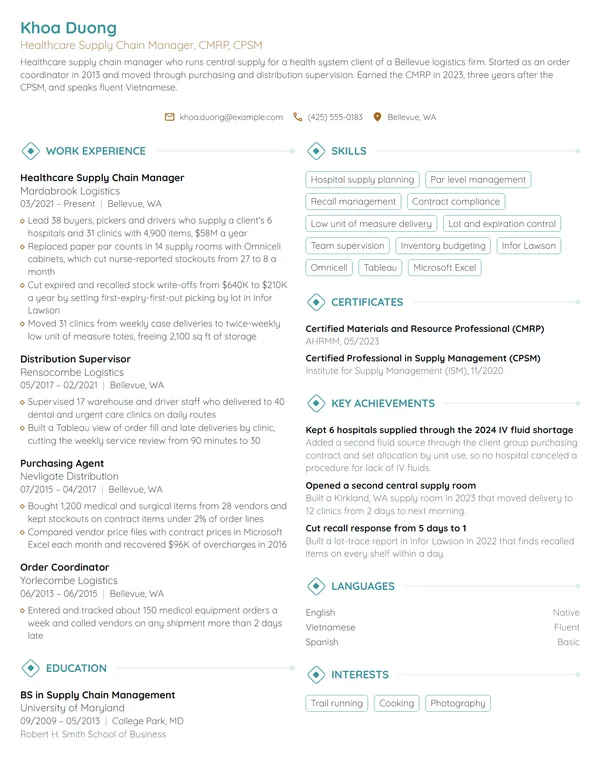
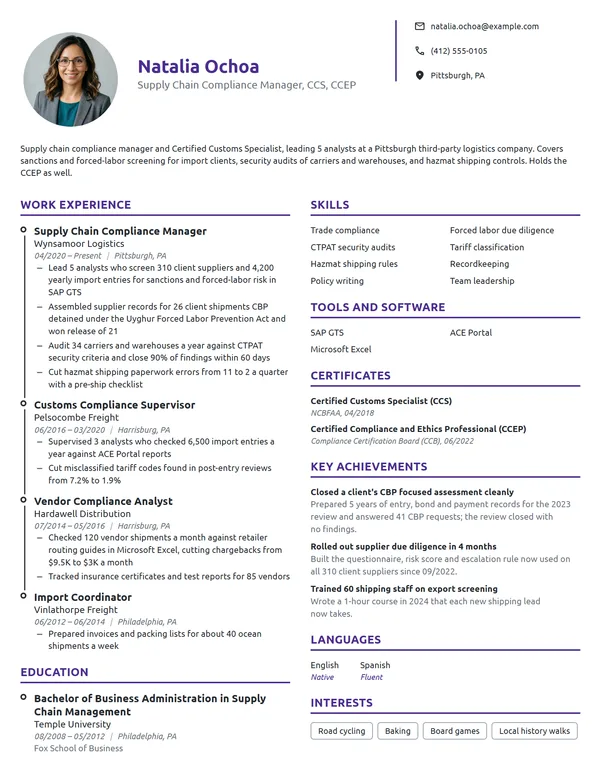
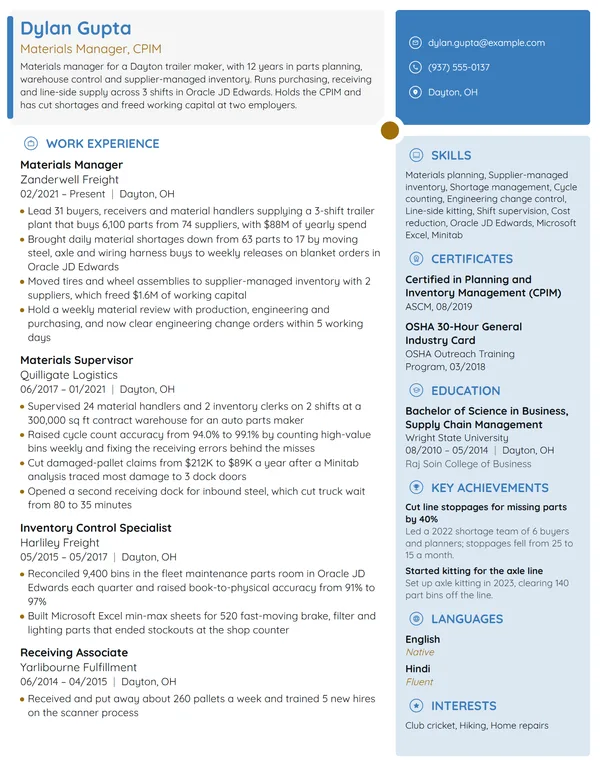
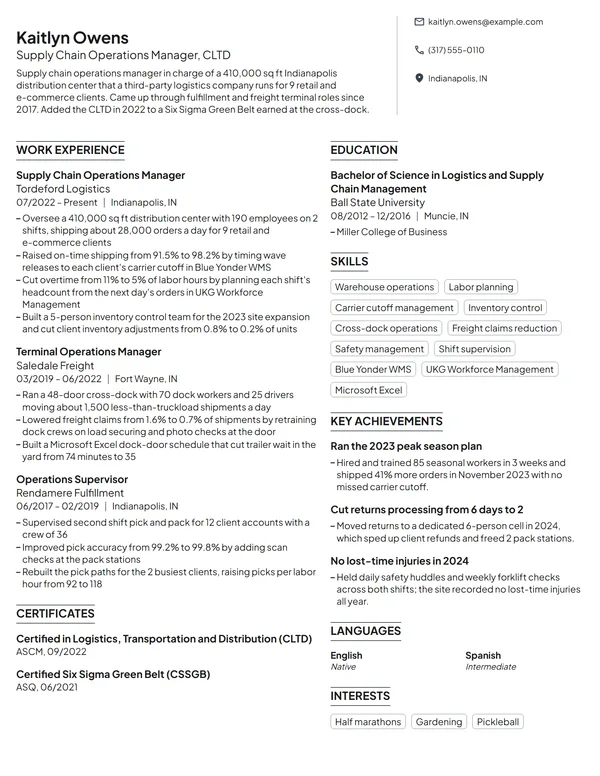
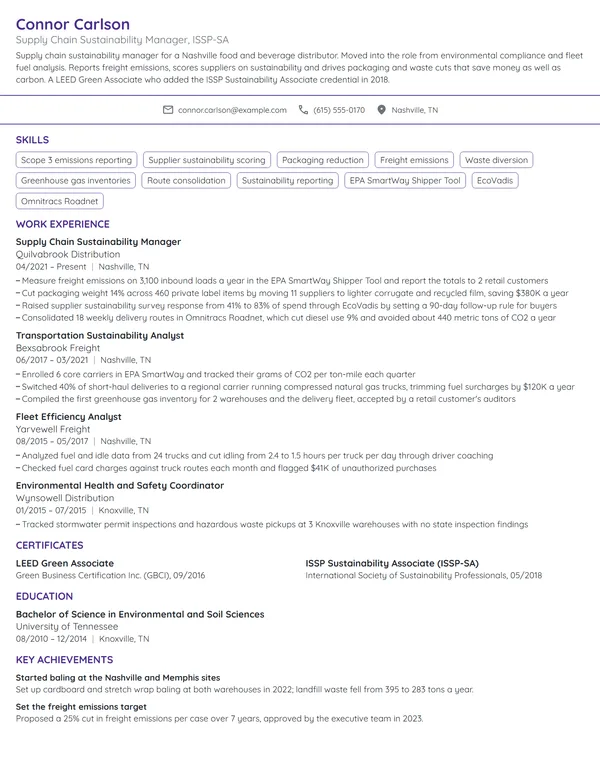
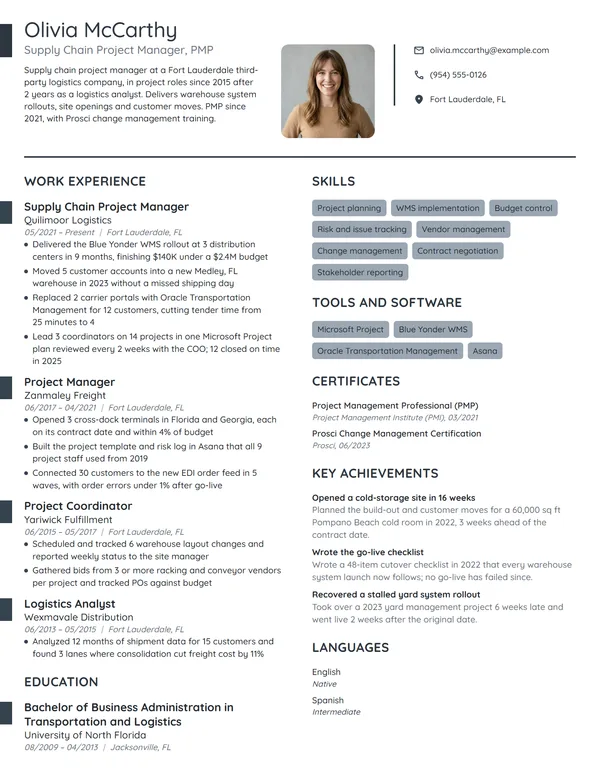
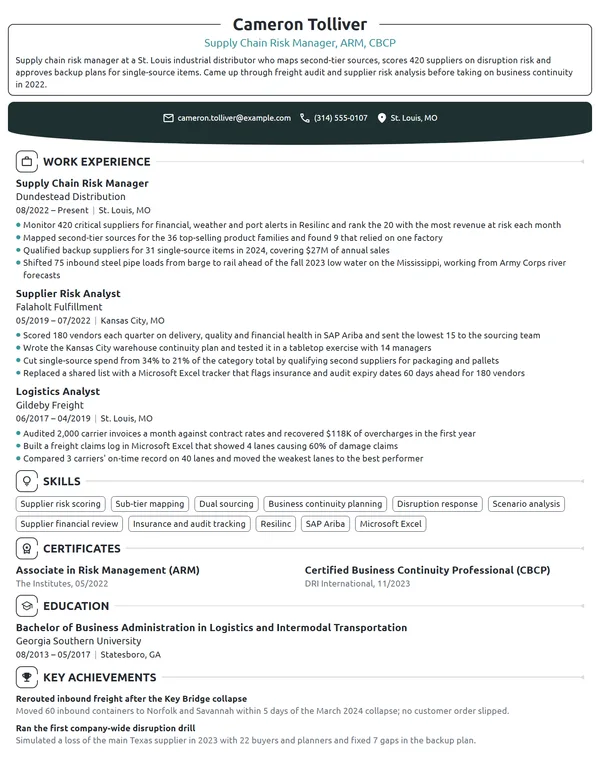
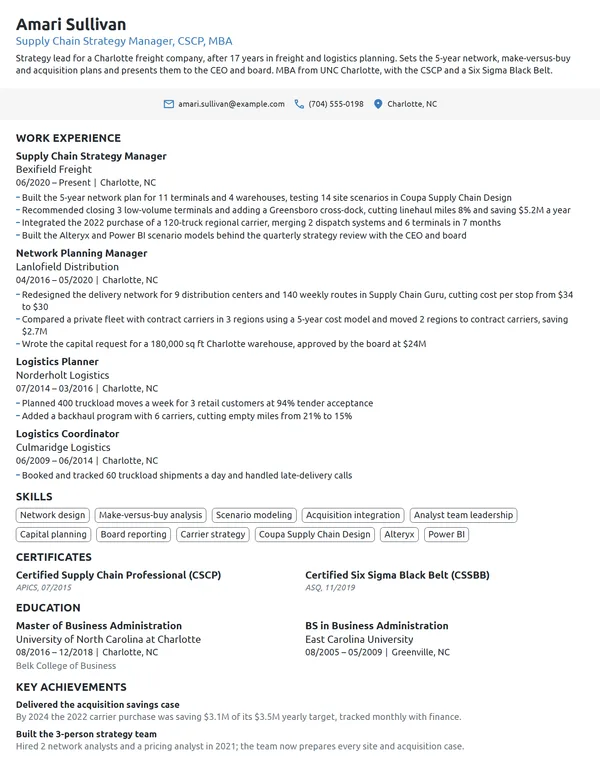
Supply chain managers decide what gets bought, made, stored and shipped, and when. The director filling the role will ask how much inventory and spend you controlled, how many suppliers and sites you coordinated, and what happened to cost and delivery while you were in charge. Every one of those answers is a number, so your resume should show inventory in dollars, on-time delivery rates, freight savings and forecast accuracy, each with a before and an after.
How to Write a Supply Chain Manager Resume - Key Takeaways
- Use the reverse-chronological format on 1 page, moving to 2 only with 10+ years or a multi-site or global scope.
- Open each job with its scope (SKUs, suppliers, sites, annual spend or inventory value) so every result below it has a size.
- Write bullets with a before and an after: inventory dollars, turns, on-time, in-full delivery, freight cost per shipment, forecast accuracy.
- Name your ERP and planning systems exactly as the posting does, such as SAP S/4HANA or Manhattan WMS, in Skills and inside a bullet.
- List CSCP, CPIM, CLTD or CPSM under Certificates with the issuer and date, and put the one the job ad requests in your headline.
- Skip your birth date and other personal details, and run the PDF through an ATS resume checker before applying.
What hiring managers look for in a supply chain manager resume
O*NET lists managing purchasing, material requirements planning, inventory control, warehousing and receiving among the core tasks of supply chain managers, along with negotiating prices and terms with suppliers, vendors and freight forwarders. The BLS adds overseeing procurement and working with sales, accounting and human resources. A hiring director reads your resume for that span: what you planned, what you bought, what you moved and what it cost.
Build the page from these sections, under plain headings an applicant tracking system can sort:
- Your name, a headline such as Supply Chain Manager, CSCP, and contact details
- Summary: 2 to 3 lines below the headline, printed without a section title
- Work Experience, current role on top
- Skills, with your ERP, planning and warehouse systems named
- Certificates
- Education
- Optional: Languages for global roles, then Volunteer Experience or a Key Achievements block
Best format for a supply chain manager resume
Choose the reverse-chronological resume format, with your latest job first and each entry giving your title, the employer, its city and MM/YYYY dates. Supply chain careers usually climb from analyst, planner or buyer to supervisor, manager and director, and that order lets a reader see the climb at a glance. If you are coming from consulting, purchasing or the military, keep the same order and let your summary draw the line to supply chain work.
- Best for most supply chain managersReverse-chronologicalYour jobs, newest first, with your results under each one.Best for: A steady work history in your field
- FunctionalSkills grouped up top, with a short work history below.Best for: Gaps or very little experience
- CombinationA skills section first, then your full work history.Best for: A career change with strong skills
Under 10 years of experience fits on 1 page. With more, or with several plants, regions or a global network behind you, 2 pages are fine as long as page 1 carries your current job and the one before it.
| Setting | What to use |
|---|---|
| Length | 1 page; 2 once you pass 10 years or manage several sites |
| Dates | Start and end as MM/YYYY; write Present for the job you still hold |
| Scope | First bullet of each job: SKUs, suppliers, sites and annual spend or inventory value |
| Type | Calibri, Arial or a similar sans serif, 10 to 12 pt in the body |
| Photo and personal details | Most carry none; no Social Security number, birth date or marital status either |
| File type | PDF, or .docx when the employer's application portal requests it |
Most US and Canadian resumes carry no photo. Postings at manufacturers, retailers and logistics providers often come through an applicant tracking system, so standard headings and one clear reading order serve you better than graphics.
Supply chain manager resume summary vs. objective
Write a summary if you have run any part of a supply chain, even as a planner or buyer: your title, your years, your industry, your planning system and your best cost or delivery result. Write an objective only if supply chain work is new to you, as after a move from consulting or store management, and name the role you want plus the proof you can do it. A resume summary sits directly under your headline in 2 to 3 lines.
Supply chain manager resume summary formula
Title with X years in industry, planning in ERP or planning system. Your biggest inventory, cost or delivery result, with a before and after. Certifications.
Example
Supply chain manager with 11 years in consumer goods, planning in SAP S/4HANA. Lowered inventory by $4.2M while on-time, in-full delivery rose from 88% to 96%. CSCP and CPIM certified.
Don't
Results-driven supply chain professional with a proven track record of optimizing operations and reducing costs.
Do
Supply chain manager with 9 years in automotive parts, running sales and operations planning for 3 plants in Oracle Fusion Cloud SCM. Raised supplier on-time delivery from 79% to 93% across 46 suppliers. CPSM.
The rewrite names the industry, the scope, the system and a measured change.
How to write supply chain manager bullets with numbers
Your current job gets 3 to 4 bullets and earlier jobs get 1 to 4, each led by a verb and finished with a result. Write achievements on your resume that show what changed, rather than duties from a job description.
| Area | What to count | Example bullet |
|---|---|---|
| Inventory | Inventory value, turns, excess and obsolete stock | Raised inventory turns from 5.1 to 6.8 by resetting safety stock on slow movers. |
| Forecasting and planning | Forecast accuracy, SKUs planned, planning cycle | Improved SKU-level forecast accuracy from 58% to 74% across 900 SKUs. |
| Suppliers | Suppliers managed, on-time receipts, defects, lead times | Brought 25 suppliers from 81% to 94% on-time with monthly scorecards. |
| Sourcing and contracts | Annual spend, savings, contract length | Renegotiated packaging contracts for $1.3M in savings over 3 years. |
| Customer service | Fill rate, on-time, in-full delivery, backorders | Held a 97.5% fill rate on 14,000 orders a month through peak season. |
| Systems and projects | Rollouts, sites, weeks to go live | Led a WMS rollout in 2 distribution centers, live in 14 weeks. |
List each work experience entry with your title, the employer and its city, and the dates. In this entry, the first bullet sets the scope and the next ones show what moved.
Work Experience
- Manage planning, purchasing and inventory for 2,400 SKUs, 38 suppliers in 5 countries and 2 distribution centers, with a team of 6 planners and buyers.
- Cut inventory from $31M to $26.8M in 2 years while on-time, in-full delivery to retailers rose from 88% to 96%.
- Saved $610K a year on a $9.6M freight budget by combining less-than-truckload orders into scheduled multi-stop loads.
- Raised forecast accuracy from 64% to 79% by moving monthly demand review into SAP S/4HANA with sales and finance.
- Planned replenishment for 450 SKUs and reduced stockouts from 41 to 12 a quarter.
Don't
Responsible for managing inventory levels.
Do
Cleared $1.8M of slow-moving stock in 10 months by setting reorder points for 1,100 SKUs from 12 weeks of sales data.
The second bullet gives the dollar change, the time it took and the method.
Don't
Worked with suppliers to improve performance.
Do
Ran quarterly scorecards for 22 suppliers and moved 4 low performers to dual sourcing, lifting on-time receipts from 84% to 95%.
Supply chain management skills and software for your resume
Pick 6 to 8 hard skills for your resume that appear in the job ad and that a bullet of yours backs up. Demand planning and inventory control fit almost every supply chain manager resume; import compliance, contract negotiation or network design only where you have done that work.
Hard skills for supply chain managers
- Demand planning and forecasting
- Sales and operations planning (S&OP)
- Inventory optimization
- Material requirements planning (MRP)
- Supplier management and scorecards
- Strategic sourcing
- Contract negotiation
- Freight and carrier management
- Import and export compliance
- KPI reporting
Soft skills supply chain directors value
- Cross-functional coordination
- Negotiation
- Decision-making under shortages
- Clear reporting to leadership
- Team leadership
- Vendor relationship building
Put your systems in Skills, then use each one again inside a bullet so a reader sees the work you did in it. O*NET's technology list for supply chain managers marks SAP software, warehouse management systems, inventory management systems and Microsoft Excel as in demand, and names SQL, Microsoft Visio and Microsoft Project among its hot technologies. If the posting names Oracle, Blue Yonder, Kinaxis or Manhattan and you have worked in it, use that exact product name. For Excel, name what you build, such as pivot tables, Power Query or a safety stock model.
CSCP, CPIM, CLTD and CPSM: supply chain certifications on a resume
Give each credential its own line under Certificates with the issuer and month and year, the same way you would list certifications on a resume in any field. CSCP, CPIM and CLTD are issued by ASCM, the association formerly called APICS, and its handbook still calls them APICS credentials. CPSM comes from the Institute for Supply Management (ISM) and leans toward sourcing and procurement.
| Credential | Issued by | What it takes |
|---|---|---|
| CSCP (Certified Supply Chain Professional) | ASCM | Exam on end-to-end supply chain management, from supplier to end customer. ASCM removed the eligibility requirement on December 2, 2022, and the credential is maintained every 5 years. |
| CPIM (Certified in Planning and Inventory Management) | ASCM | 1 exam on planning and inventory control since version 8.0 in 2023 (it was 2 exams before); maintained every 5 years. |
| CLTD (Certified in Logistics, Transportation and Distribution) | ASCM | Exam on logistics, transportation and distribution practice; maintained every 5 years. |
| CPSM (Certified Professional in Supply Management) | Institute for Supply Management (ISM) | 3 exams (Supply Management Core, Integration and Leadership) plus 3 years of full-time professional supply chain experience with a bachelor's degree, or 5 years without one. |
Old APICS names and exams still in progress
ASCM renamed Certified in Production and Inventory Management to Certified in Planning and Inventory Management on February 25, 2021, and applied the new name to certificates already issued, so write the current name even if you passed before 2021. List a credential you no longer maintain only as earned in its year, never as active. For CPSM, list each exam you have passed with its date and the next one as scheduled; ISM counts a passed exam for 4 years.
Certificates
- Certified Supply Chain Professional (CSCP), ASCM, 10/2022
- Certified in Planning and Inventory Management (CPIM), ASCM, 08/2020
- CPSM Exam: Supply Management Core, ISM, passed 05/2026
- CPSM Exam: Supply Management Integration, ISM, scheduled 01/2027
How to list a supply chain degree on your resume
In O*NET's survey for this occupation, 67% of respondents said a new hire needs a bachelor's degree and 19% said a master's. Some colleges now offer bachelor's programs in supply chain management and logistics, the BLS reports, and employers may also prefer degrees in business or engineering. When listing education on a resume, give the degree, the school, the city it sits in, and your graduation month and year.
Add a GPA only if it is 3.5 or above and you finished school within about 3 years; after that, your planning and cost results carry more weight. An MBA or a master's in supply chain management goes above your bachelor's, newest first, and a university certificate in supply chain fits the same section with its completion date.
Education
Moving up to supply chain manager, or in from another field
Most first-time supply chain managers come up from planner, buyer or supply chain analyst roles. If that is you, frame your current job by what you already own, such as a product line, a supplier group or a site, and show any time you ran the plan while your manager was out. People moving in from other fields have more to translate, and these sources give the strongest proof:
- Consulting projects: the operations or cost engagements you led, with the client's industry and the savings you found.
- Purchasing or buying: annual spend placed, vendors managed and the terms you negotiated.
- Military logistics: supply accounts, equipment value and the units you supported, written in civilian terms.
- Store, plant or warehouse management: inventory accuracy, shrink, ordering and the headcount you scheduled.
- A supply chain certificate or CPIM: under Education or Certificates with the date, to show you have learned the vocabulary.
Don't
Motivated professional looking to transition into supply chain management.
Do
Purchasing lead moving into supply chain management after 6 years buying for a 40-store grocery chain. Placed about 9,000 purchase orders a year with 60 vendors and earned the CPIM in 2026.
An objective still needs a number and a credential that ties the old job to the new one.
A career-change resume works best when the first bullets under your latest job are its most supply chain heavy tasks: forecasts, vendors, inventory, freight. Keep the story of why you switched for your cover letter, and follow a cover letter guide to fit it into 2 or 3 sentences that end on your best number.
Supply Chain Manager resume FAQ
Should I list a lapsed CSCP or CPIM on my resume?
Yes, but date it honestly. ASCM requires these credentials to be maintained every 5 years, so list a lapsed one with the year you earned it and no claim that it is current. If the posting asks for it, renew before you apply or say in your summary when you will.
How long should a supply chain manager resume be?
One page covers most candidates with under 10 years of experience. Use 2 pages if you have run several plants, distribution centers or regions, and keep your current role and the one before it on page 1.
What software should a supply chain manager put on a resume?
Your ERP, your planning or forecasting tool and your warehouse management system, each by its product name, such as SAP S/4HANA. O*NET flags SAP, warehouse management systems and Excel as in demand for this job. Add only systems you have worked in, and show each one in a bullet.
Do you need a certification to become a supply chain manager?
Not always. A CSCP, CPIM or CPSM helps most when the posting names it, and it gives a career changer proof of the core knowledge. Without one, a relevant degree and experience written with clear inventory, cost and delivery numbers carry the application.
How do I show global supply chain experience on my resume?
Name the countries or regions in your scope bullet, such as suppliers in 5 countries, and give numbers for the work that crossed borders: import volume, landed cost, lead times or duty savings. Add a Languages section if you work with suppliers in another language.
Which numbers should a supply chain manager put on a resume?
Start with scope: SKUs, suppliers, sites and the annual spend or inventory value you managed. Then show what changed under you, such as inventory dollars, turns, on-time, in-full delivery, freight cost, forecast accuracy or supplier on-time rates, each with a before and an after.
How much do supply chain managers make, and should salary go on the resume?
Leave pay off the resume and raise it in the interview or on the application form. O*NET places supply chain managers in the group the BLS calls transportation, storage, and distribution managers, and the BLS reports that group's median annual wage as $107,230 in May 2025.
Can I become a supply chain manager without a supply chain degree?
Yes. The BLS says employers may also prefer business or engineering degrees, and the CSCP has had no eligibility requirement since December 2022. Put your strongest supply chain results first under Work Experience and list any certificate or credential with its date.
Next steps
Start from the example nearest your level, keep its layout, and swap in your own scope, inventory, delivery and freight figures. Our resume builder and resume templates both take it from there, and your cover letter can open on the inventory or delivery result you are proudest of.