
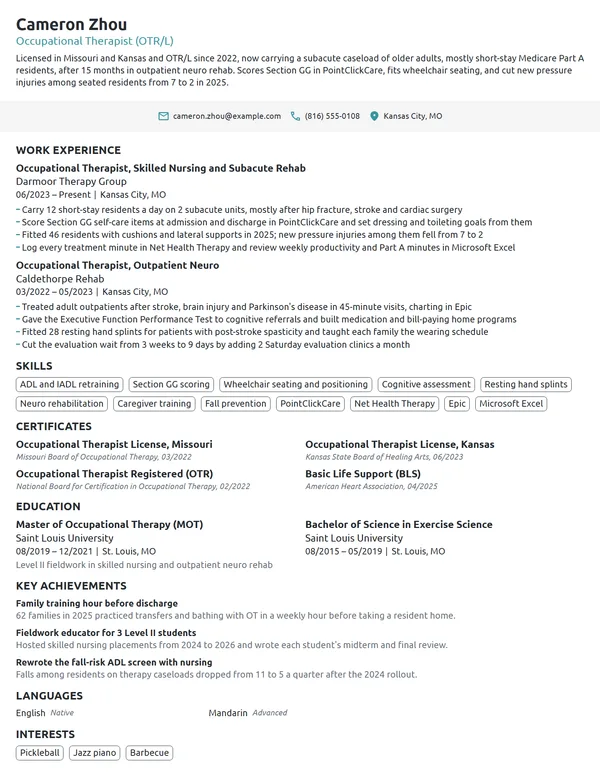
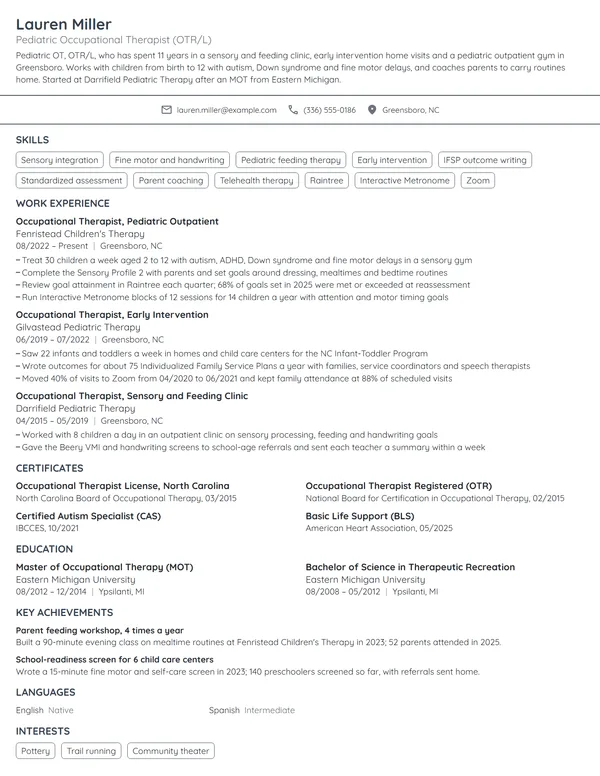
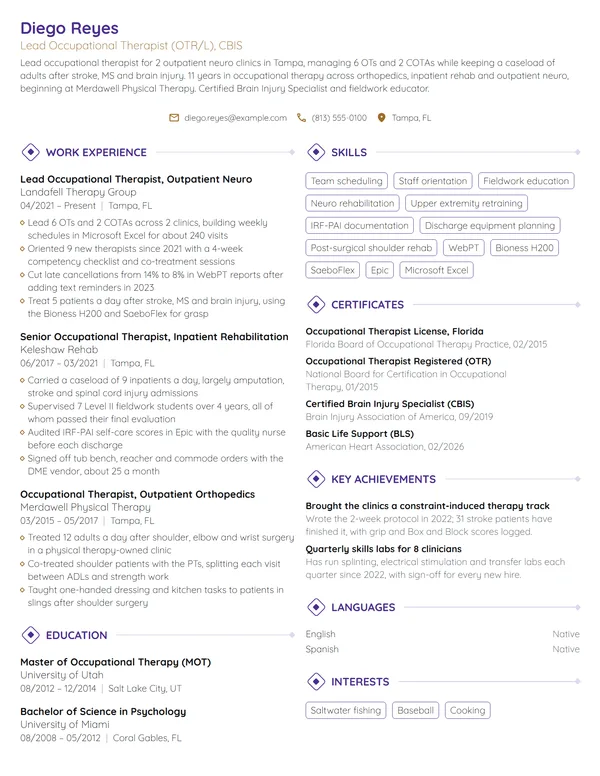
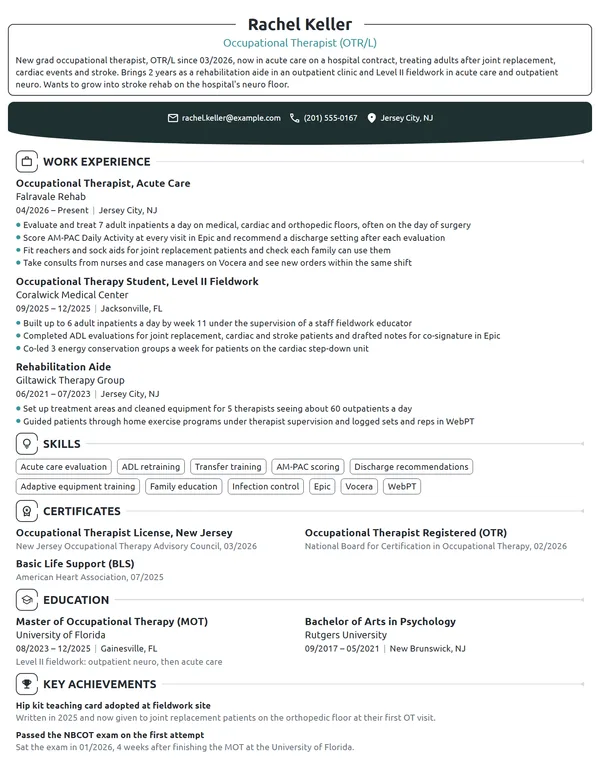
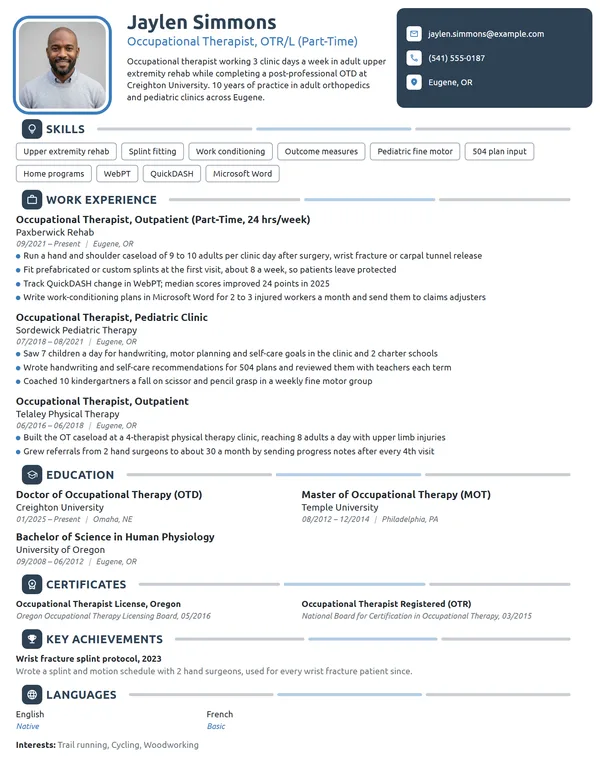
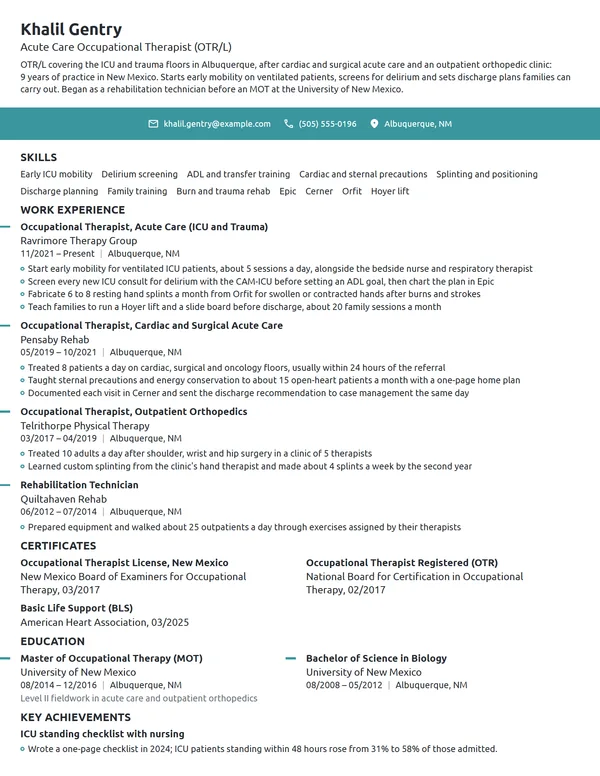
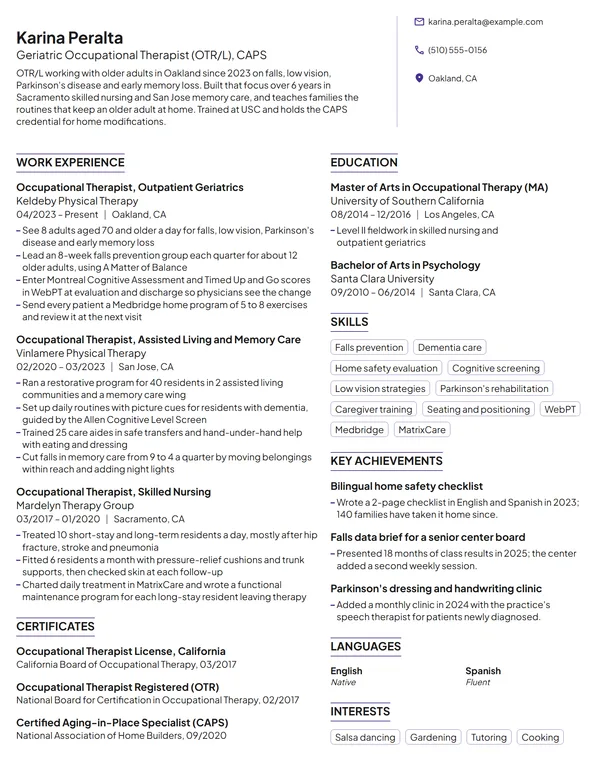
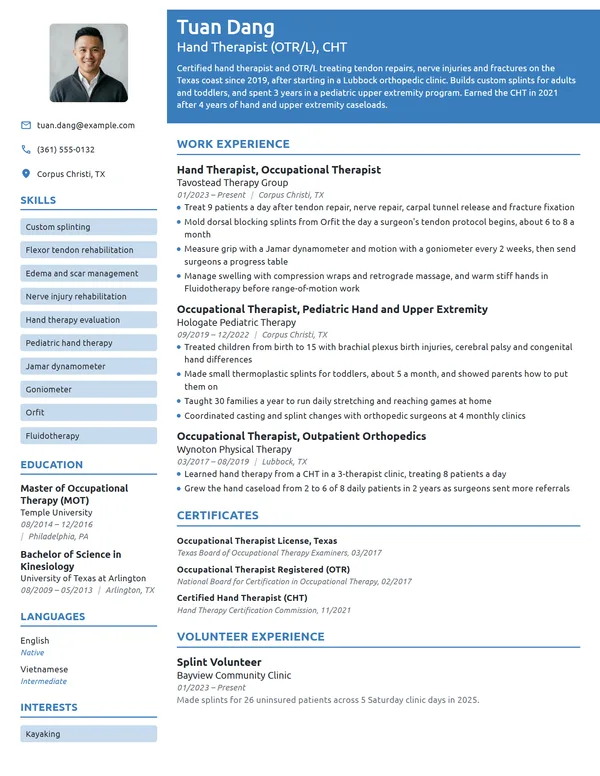
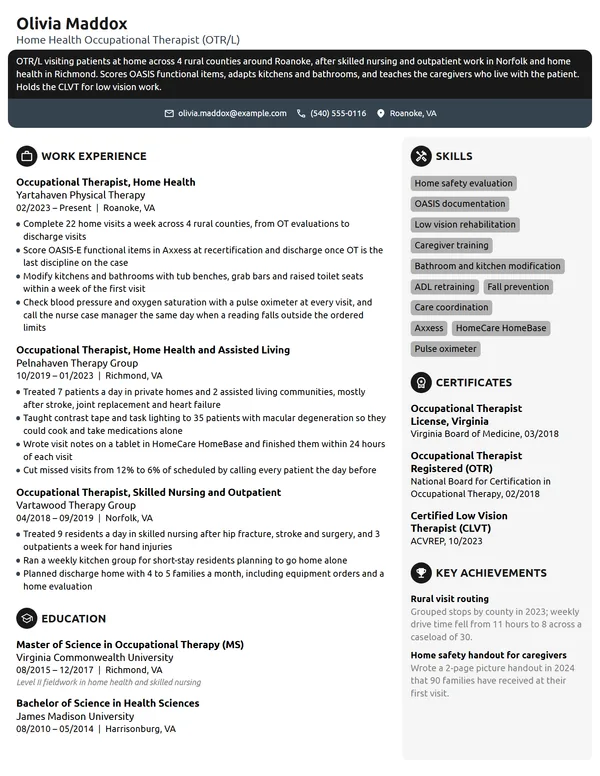
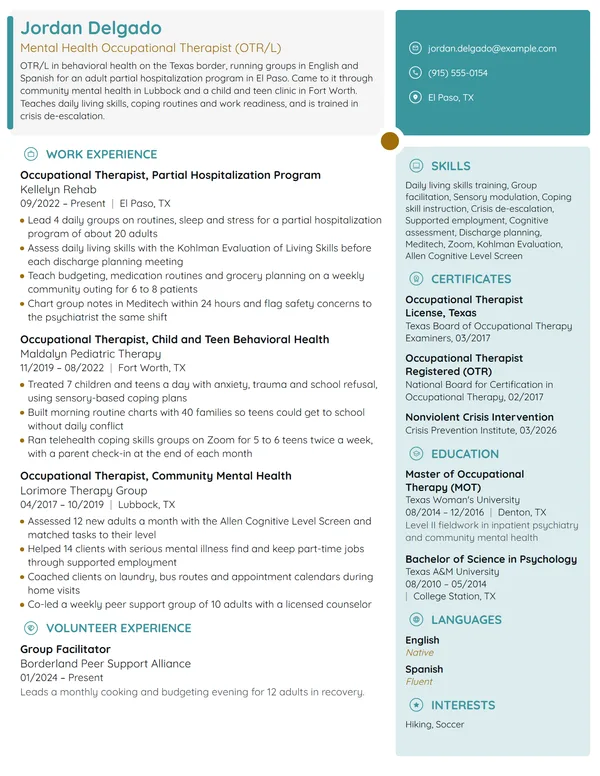
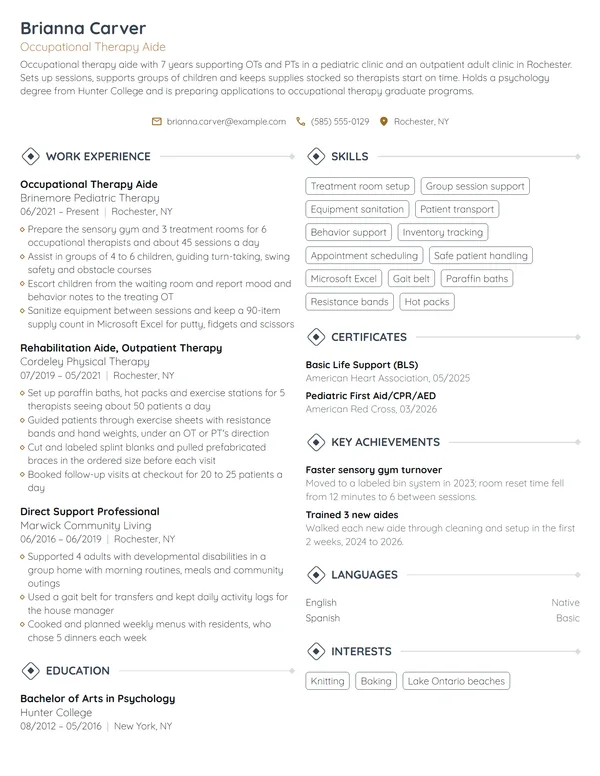
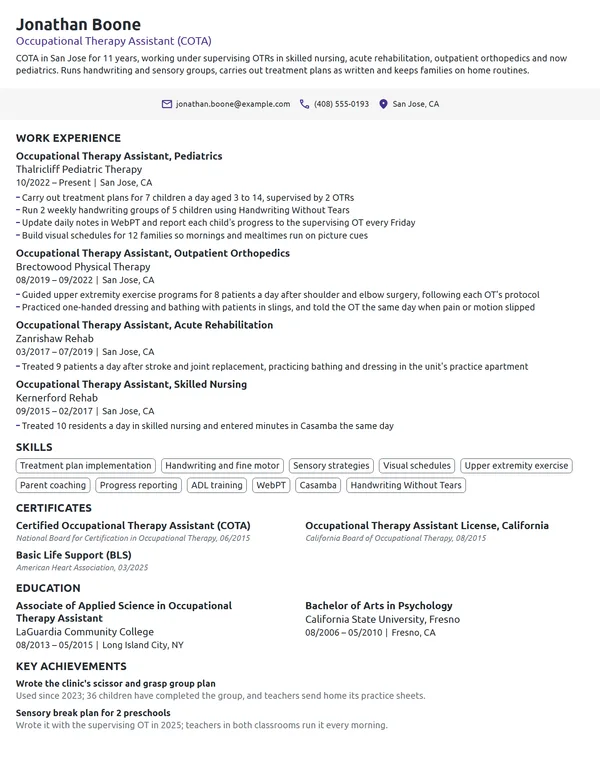
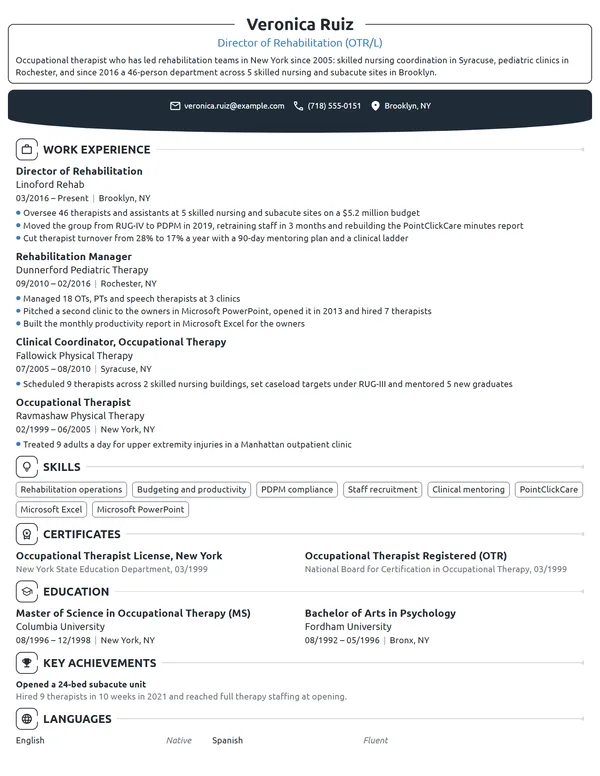
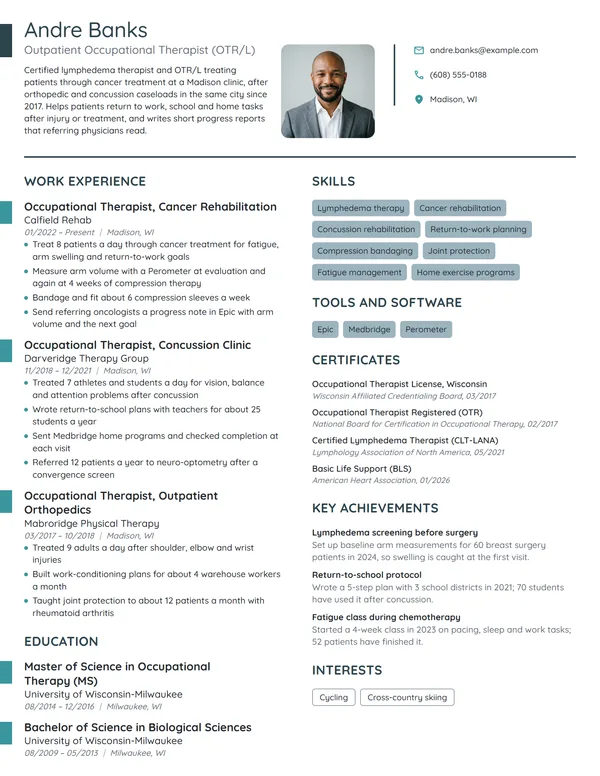
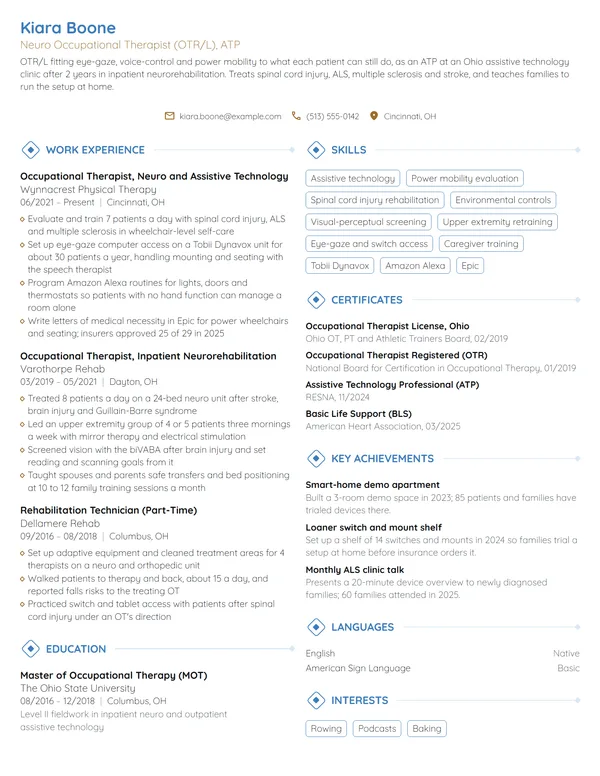
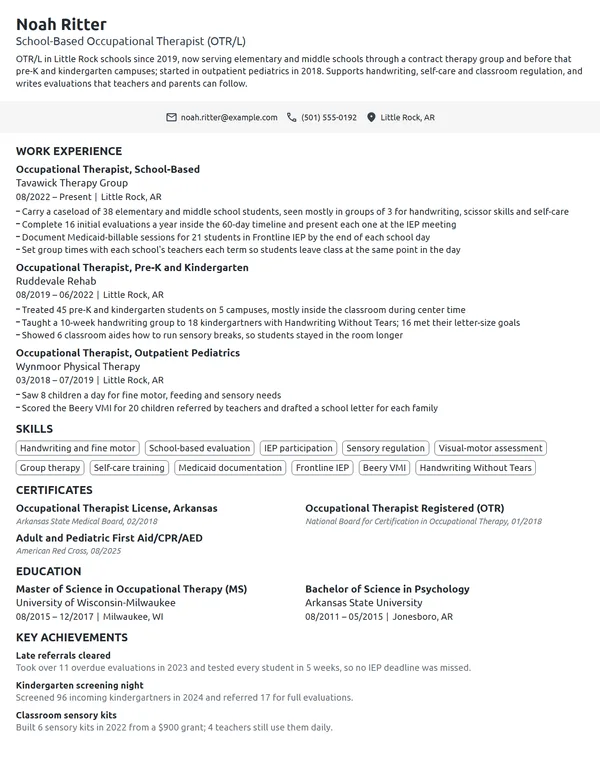
Occupational therapy helps people get back to the everyday tasks that matter to them, and your resume should make that work easy to see. A rehab director will check which patients you treat, the settings you know, the caseload you carry and whether your license is current. Progress is harder to show. Grip strength and range of motion mean a lot to another therapist but little to a busy director, so tie each gain to something the patient could do again, like dressing without help or returning to work.
How to Write an Occupational Therapist Resume - Key Takeaways
- Use the reverse-chronological format on 1 page; move to 2 pages only after 10+ years or several practice settings.
- Put the setting in each job title line and the patient population in the first bullet, such as stroke rehab, hand therapy or school-based pediatrics.
- Count what a rehab manager tracks: patients a day, productivity, goals met, discharges home, orthoses made and caregivers trained.
- List your state license first under Certificates, then OTR from NBCOT, then specialty credentials such as CHT or ATP.
- As a new grad, give each Level II fieldwork placement its setting and weeks, and your NBCOT exam status with a date.
- Run the finished file through an ATS resume checker, since health system portals search for OTR, license and setting keywords.
What rehab managers look for in an occupational therapist resume
A therapy manager reads your resume for 3 things: whether you have treated patients like theirs, whether you can carry their caseload, and whether your license lets you start in their state. The Bureau of Labor Statistics describes OTs evaluating a client's condition by observing them perform tasks, recommending special equipment and educating the family. O*NET adds training caregivers and designing or requisitioning splints and adaptive equipment. Write those duties as results, under a named setting, with the volume you handled.
Settings differ more than the job title suggests. The BLS counts 28% of OTs in therapy offices, 26% in hospitals, 13% in educational services, 8% in home health and 7% in nursing facilities, and a hiring manager in each one reads for different proof. Build your resume from these sections:
- Name, headline with your credentials (for example, Occupational Therapist, OTR/L) and contact details
- A short summary of 2 to 3 lines under your name, without a section title
- Work Experience in reverse order, each job titled with its setting
- Certificates: state license first, then OTR, then CHT, ATP, BLS or other training
- Skills, including the EHR or documentation system you used
- Education, with your entry-level OT degree first
- Optional: Key Achievements, Volunteer Experience or Languages
Best format for an occupational therapist resume
Use the reverse-chronological resume format: your current job first, each with the title and setting, the employer, its city and MM/YYYY dates. OT careers often move between settings, such as acute care to inpatient rehab or outpatient to home health, and this order lets a manager follow those moves. If you worked PRN for a second employer while holding your main job, give that role its own entry with its dates.
- Best for most occupational therapistsReverse-chronologicalYour jobs, newest first, with your results under each one.Best for: A steady work history in your field
- FunctionalSkills grouped up top, with a short work history below.Best for: Gaps or very little experience
- CombinationA skills section first, then your full work history.Best for: A career change with strong skills
Most OTs stay on 1 page for their first 10 years of practice. A second page makes sense once you have led a team or worked across 3 or more settings, as long as your license, OTR and current role all appear on page 1.
| Setting | What to use |
|---|---|
| Length | 1 page; 2 pages after 10+ years, a lead role or several settings |
| Dates | MM/YYYY for start and end, and Present for the job you hold now |
| Job title line | Title plus setting: Occupational Therapist, Inpatient Rehabilitation |
| Credentials after your name | OTR/L once NBCOT has certified you and a state has licensed you |
| Type and spacing | 1 clean font for body and headings, body text no smaller than 10 pt |
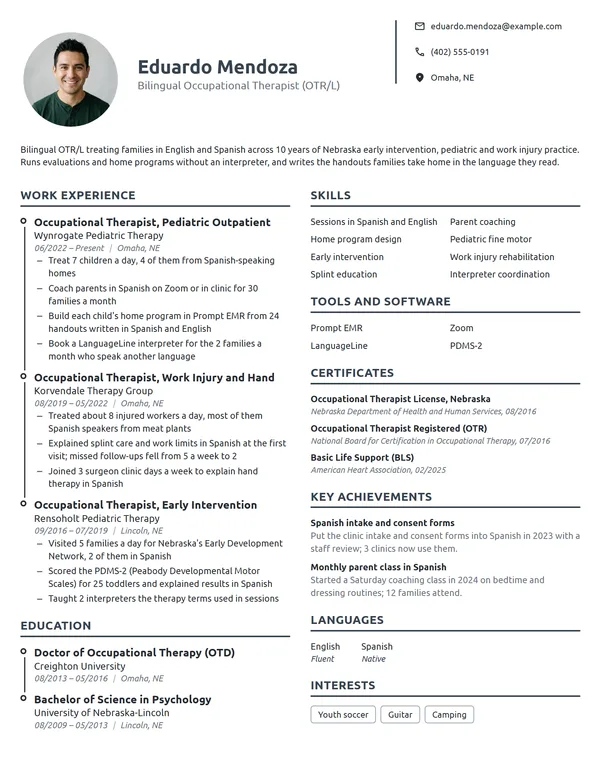
| Photo and personal details | Usually no photo in the US and Canada, and no birth date, marital status or Social Security number either |
| File | A PDF named with your name and OT, or a Word file if the application portal requests one |
Most US and Canadian resumes carry no photo. Hospital and school district portals copy your file into their own forms, so plain headings and a single column of dates help your OTR and license land in the right fields.
Occupational therapist resume summary vs. objective
Ask yourself whether you have treated patients as a licensed OT. If you have, write a resume summary with your credentials, years, setting, population and 1 result. If you are a new graduate or still waiting on the NBCOT exam, write a resume objective instead: the setting you want, your exam or license status and your fieldwork. Either way, take the number from a bullet further down so the 2 parts agree.
Occupational therapist resume summary formula
Credentials occupational therapist with X years in settings, treating patient population. 1 result with a number. Specialty credential or training you hold or are working toward.
Example
OTR/L with 5 years in inpatient rehab and outpatient hand therapy, treating adults after stroke and spinal cord injury. Wrote the bathroom equipment checklist now used at 40 discharges a month. Logging direct hand therapy hours toward the CHT.
Don't
Passionate occupational therapist dedicated to helping clients achieve their highest level of independence.
Do
Occupational therapist, OTR/L, with 3 years in skilled nursing, treating 14 residents a day for falls, contractures and seating needs. Completes about 9 wheelchair seating assessments a month and is LSVT BIG certified.
The second version gives the setting, the daily load and a specialty the facility can put to use.
How to write OT work experience bullets with numbers
Give your current job 3 to 4 bullets and older jobs 1 to 3, each starting with a verb. Open with your caseload: the setting, the diagnoses or ages, and how many patients you see a day. Then write achievements on your resume as the gains your patients made, the programs you built, or the equipment and training that got someone home safely.
| Area | What to count | Example bullet |
|---|---|---|
| Caseload and productivity | Patients or visits a day, productivity against target | Treated 10 patients a day in acute care while holding productivity at 90%. |
| Functional outcomes | Goals met, time to reach them, standardized score changes | Helped 22 of 26 hip fracture patients meet their lower body dressing goals within 3 weeks. |
| Discharge and safety | Discharges home, home evaluations, falls after discharge | Added pre-discharge home video walkthroughs that raised discharges home from 71% to 78%. |
| Equipment and orthoses | Splints made, seating assessments, equipment ordered | Fabricated 15 custom thermoplastic orthoses a month for tendon repairs and fractures. |
| Caregiver training | Families trained, sessions held, handouts written | Trained 120 family caregivers a year in safe transfers using 2 picture-based handouts. |
| School-based and pediatrics | Students on caseload, IEP goals, schools covered | Served 32 students across 4 schools and wrote 41 IEP goals for handwriting and self-care. |
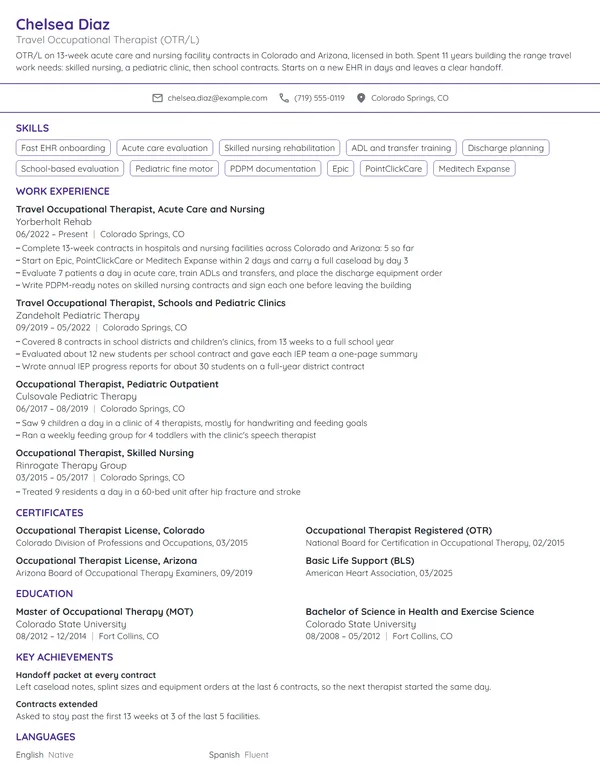
Here is how one occupational therapist's entry looks with those numbers in place. Caseload opens each job, the results follow, and the older role keeps fewer bullets.
Work Experience
- Treat 8 to 9 patients a day on a 36-bed unit, mainly adults after stroke, spinal cord injury and brain injury.
- Started a 6-week upper extremity group in which 27 of 34 stroke patients met their dressing goals by discharge.
- Complete home safety visits for 48 patients a year and order bathroom equipment before each discharge.
- Keep productivity at 87% against an 85% target, with every note in Epic signed the same day.
- Saw 11 to 13 clients a day with hand, wrist and elbow injuries and made 3 to 4 custom orthoses a week.
Don't
Provided ADL training to patients.
Do
Taught dressing, bathing and toileting to 6 patients a day after hip and knee replacements; 8 of 10 went home instead of to a skilled nursing facility.
The rewrite names the tasks, the population and where patients went next.
Don't
Responsible for documentation and billing.
Do
Wrote evaluations and daily notes in WebPT within 24 hours for a 65-client caseload, and passed 2 Medicare audits with 0 denied claims.
Occupational therapy skills and EHR software for your resume
Pick 6 to 8 hard skills for your resume that the posting asks for and your bullets already show. ADL training and treatment planning fit almost every OT resume; splinting, sensory integration or driver rehab belong only where you actually used them.
Hard skills for occupational therapists
- ADL and IADL training
- Standardized and functional assessment
- Treatment planning and goal writing
- Upper extremity rehabilitation
- Splinting and orthotic fabrication
- Cognitive and visual-perceptual retraining
- Sensory integration techniques
- Home safety evaluation
- Adaptive equipment and DME recommendations
- Documentation for Medicare and private insurance
Soft skills therapy managers value
- Clinical reasoning
- Patience with slow progress
- Creative problem-solving
- Clear teaching for patients and families
- Coordination with PT, speech and nursing
- Encouragement through setbacks
Name your documentation system in Skills and again in a bullet. O*NET lists eClinicalWorks EHR software as a hot technology for occupational therapists, together with Microsoft Office, Word and Excel. If the job ad names Epic, WebPT, Net Health or PointClickCare and you have charted in it, use that exact name; if you charted in Cerner before Oracle bought it in 2022, write Oracle Health (Cerner). Name the standardized assessments you give, such as the COPM or MoCA, only where the posting or your setting relies on them.
OTR, state license and OT certifications on a resume
The BLS states that all states require occupational therapists to be licensed, and that at a minimum candidates must pass a qualifying exam. That exam is NBCOT's 4-hour certification exam, and passing it lets you use the title Occupational Therapist Registered (OTR). NBCOT certification renews for 3 years at a time with at least 36 units, and an expired certificant cannot use OTR after their name. List certifications on your resume under the license and OTR, each with its issuer and month.
| Credential | Issued by | What it takes |
|---|---|---|
| State occupational therapist license | Your state's OT licensing board | Rules vary by state; at a minimum a passing score on the qualifying exam, plus continuing education to renew. |
| OTR (Occupational Therapist Registered) | National Board for Certification in Occupational Therapy (NBCOT) | An entry-level degree from an ACOTE-accredited OT program and a pass on the certification exam; renewed every 3 years with 36 units. |
| CHT (Certified Hand Therapist) | Hand Therapy Certification Commission (HTCC) | At least 3 years as a licensed OT or PT and 4,000 hours of direct practice in hand therapy, then the exam. |
| ATP (Assistive Technology Professional) | RESNA | For OTs with a master's or higher, 1,000 hours of paid assistive technology work in the last 6 years, then the exam. |
| BLS or CPR | American Heart Association or American Red Cross | Some employers require it, per the Bureau of Labor Statistics; list the card with its issuer and date. |
How to write OTR/L and the license line
Many OTs write OTR/L after their name: OTR for the NBCOT credential and L for the state license. Use it only once both are active, and in the Certificates section spell out the license, the state board that issued it and the month. If you hold licenses in 2 states, list both. The Occupational Therapy Licensure Compact lets an OT licensed in good standing in a member state practice in other member states through a compact privilege, which it calls equivalent to a license; member states open applications at their own pace, so list a privilege only once you have been granted it.
Certificates
- Occupational Therapist License, Pennsylvania, State Board of Occupational Therapy Education and Licensure, 08/2021
- Occupational Therapist Registered (OTR), National Board for Certification in Occupational Therapy (NBCOT), 07/2021
- Basic Life Support (BLS), American Heart Association, 01/2026
How to list an MOT, MSOT or OTD degree
The BLS says occupational therapists typically need a master's degree in occupational therapy, and NBCOT accepts an entry-level master's or doctoral degree from an ACOTE-accredited program. Write the degree exactly as your school awards it, such as Master of Occupational Therapy (MOT), Master of Science in Occupational Therapy (MSOT) or Doctor of Occupational Therapy (OTD), with the school, its city and the graduation month. Put your bachelor's degree below it, whatever its major.
Follow the standard rules for listing education on a resume, then add the OT details a new grad needs. ACOTE requires at least 24 weeks of full-time Level II fieldwork, and programs may split it across settings, so name each setting and its weeks in 1 line. Once your work history fills the page, cut the entry to the degree, school and date.
Education
Level II fieldwork: 12 weeks in acute care, 12 weeks in outpatient hand therapy. Doctoral capstone: a fall prevention program for 2 senior centers.
New grad and career-change occupational therapist resumes
As a new graduate, your objective should give your NBCOT status with a date (scheduled, passed or OTR issued) and the setting you want. Hiring managers know fieldwork is supervised, so give it the same detail as a job: the setting, the population, your caseload by the final week and anything you built. Keep reverse-chronological order and place Education near the top until your first OT job is on the page.
- Level II fieldwork: setting, weeks and your caseload by the end, in 1 line under the degree or as its own entry if your resume is thin.
- Doctoral capstone: the site, the program or tool you created and how many people it reached.
- Rehab aide, COTA or direct support jobs: a full Work Experience entry with patients a day and the tasks you assisted with.
- Camps, adaptive sports or community programs: under Volunteer Experience, with the number of children or adults you worked with.
Don't
Recent OT graduate looking for an opportunity to develop my clinical skills.
Do
OTD graduate who passed the NBCOT exam in 08/2026, seeking an inpatient rehab or acute care role. Completed 24 weeks of Level II fieldwork with adults after stroke and joint replacement, and led 2 caregiver workshops.
Even an objective needs evidence: an exam date, a setting and something you did.
Moving up from COTA to OT, or arriving from teaching, psychology or another health job, keep reverse-chronological order and lead with your new OT degree and exam status. NBCOT lets a COTA who later completes an OT degree sit for the OTR exam, so list both credentials with their dates. Under older jobs, keep the bullets that carry into therapy, such as teaching, adapting tasks or documenting progress, and see how a career-change resume places them. Explain the move in your cover letter; our healthcare cover letter examples show how to frame it.
Occupational Therapist resume FAQ
Should I write OTR/L after my name on my resume?
Yes, once you hold both an active NBCOT certification and a state license. OTR/L tells a recruiter both are in place. If your license is still pending, write OTR alone and add the license under Certificates with its expected month.
Can I put OTR on my resume before I pass the NBCOT exam?
No. OTR is a certification mark that NBCOT grants after you pass its exam. Until then, write your degree after your name, such as MOT or OTD, and give the exam date in your objective, such as NBCOT exam scheduled for 11/2026.
How long should an occupational therapist resume be?
1 page for new grads and most staff therapists. 2 pages fit once you have 10+ years, a lead or supervisor role, or work across 3 or more settings, provided page 1 carries your license, OTR and current job.
How do I list Level II fieldwork on a new grad OT resume?
Write each placement with its setting, its weeks and your caseload by the end. Put it in 1 line under your degree if you have other work to show, or give each placement its own entry when fieldwork is your main clinical experience.
Which assessments should I name on an occupational therapy resume?
Name only those the posting asks for or your setting uses every week, such as the COPM in rehab or the Sensory Profile in pediatrics. Put each one in a bullet that shows what you did with the results, not in a long list under Skills.
How do I show PRN or part-time OT work on a resume?
Give each employer its own entry and add PRN or Part-Time to the job title line. Then open with your usual hours or visits a week, so a reader can judge the caseload, and list both jobs if you held them at the same time.
How do I show a school-based or pediatric OT caseload?
State how many students or children you serve, their ages and how many schools or homes you cover. Then add results a school or clinic tracks: IEP goals written and met, handwriting or self-care gains, and the teachers or parents you trained.
Do I need a doctorate to work as an occupational therapist?
No. The BLS says a master's degree in occupational therapy is the typical entry route, and NBCOT accepts graduates of ACOTE-accredited entry-level master's or doctoral programs. List whichever degree you earned by its full name and abbreviation.
What is the average occupational therapist salary?
The BLS reports that the median annual wage for occupational therapists was $100,330 in May 2025. Your offer depends on your state, setting and specialty; keep pay off your resume and raise it once an employer makes an offer.
Next steps
Pick the example that matches your setting and stage, keep its layout, and fill it with your own caseload, outcomes and credentials. Build it in our resume builder or begin from one of our templates, then send it with a cover letter that names the setting you want and your clearest patient result.