
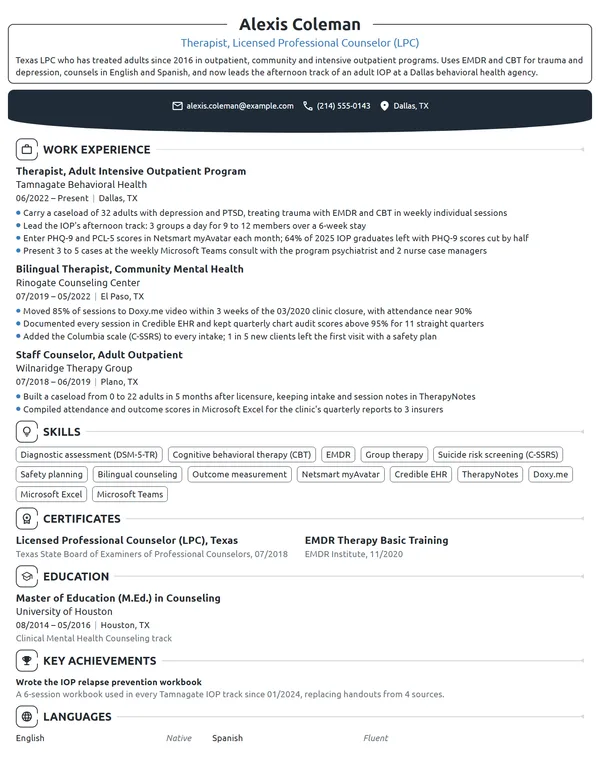
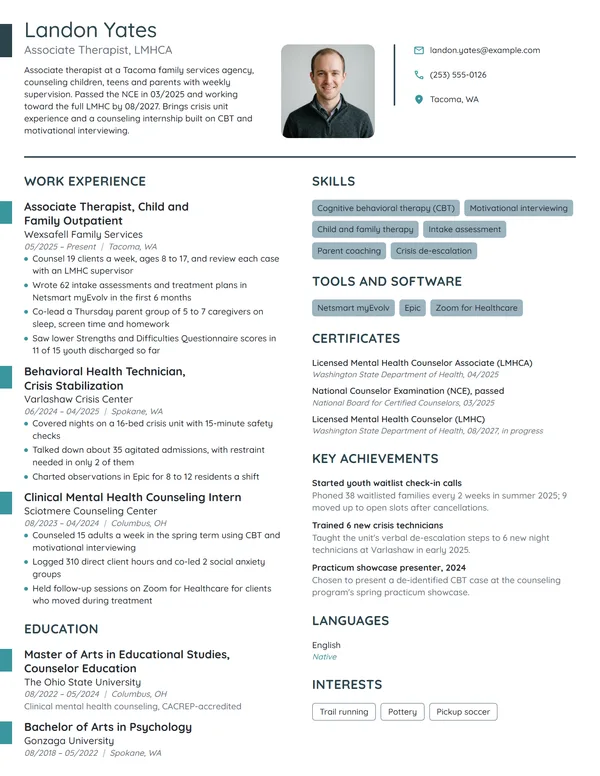
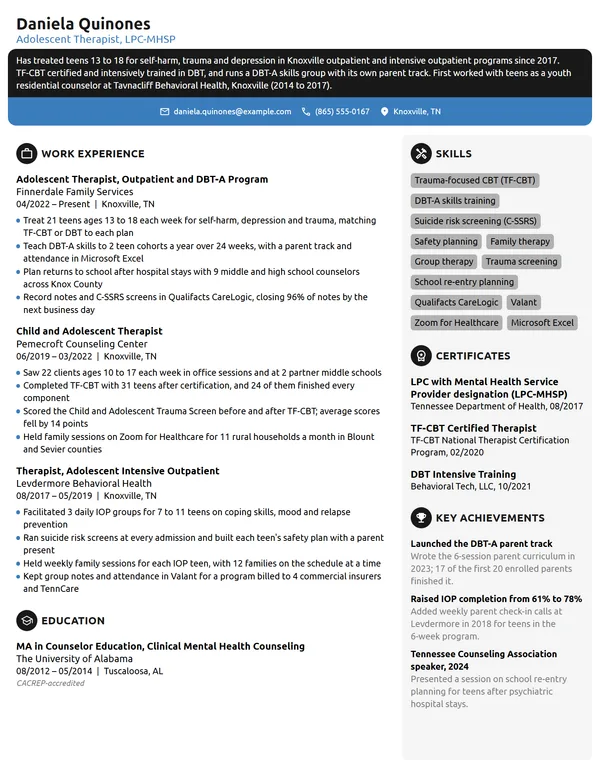
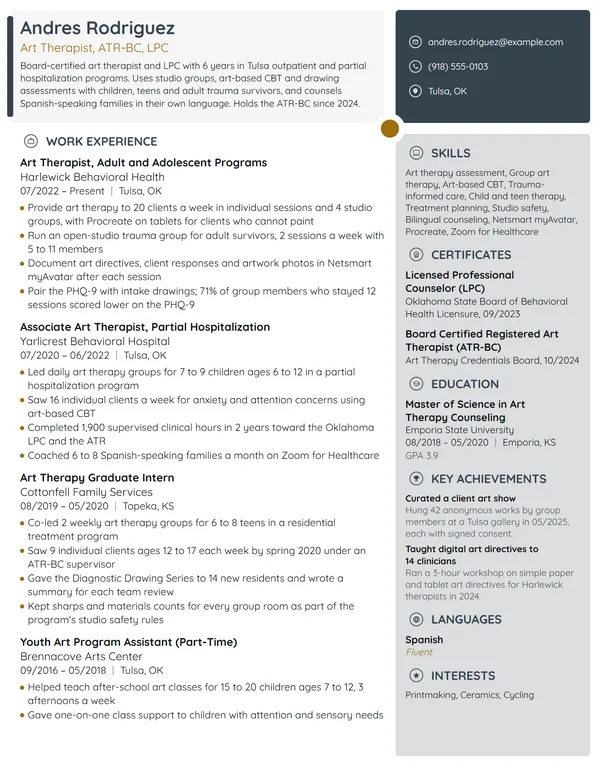
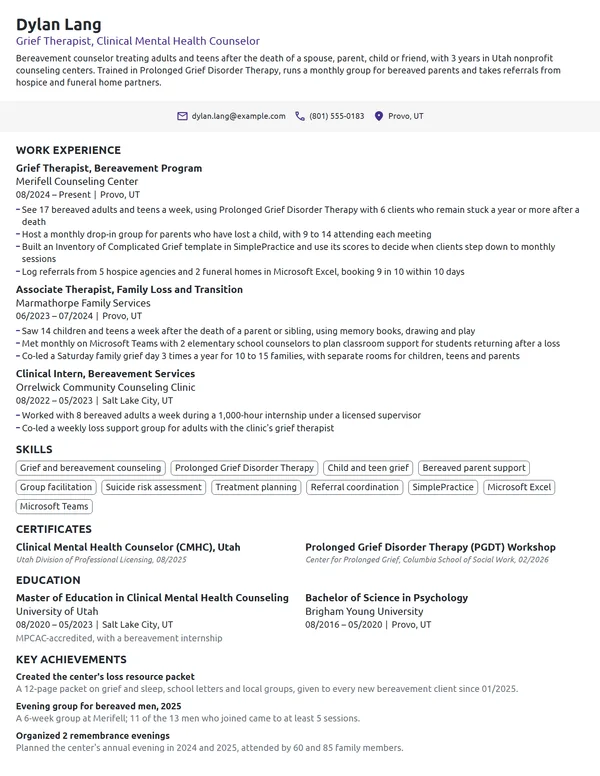
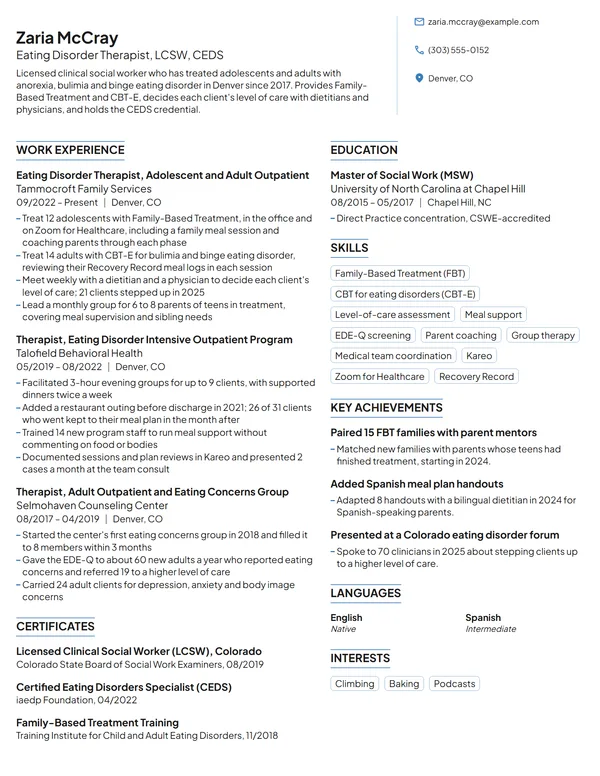
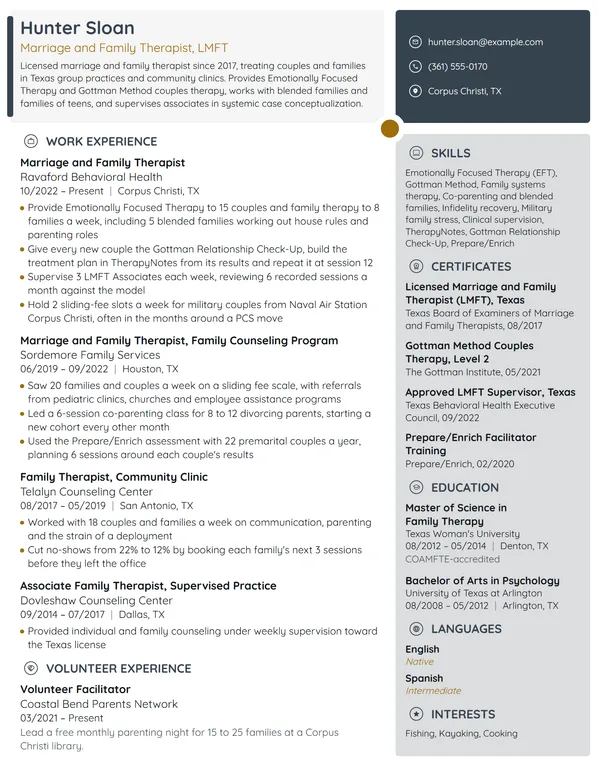
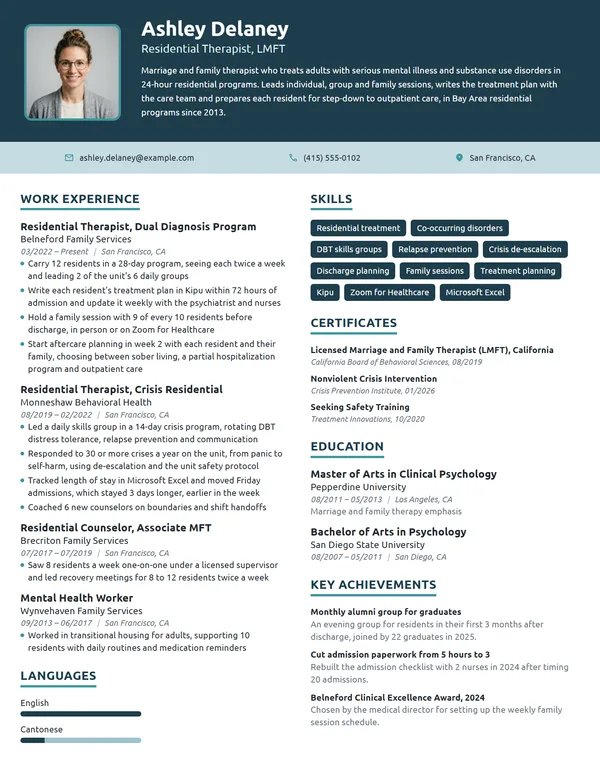
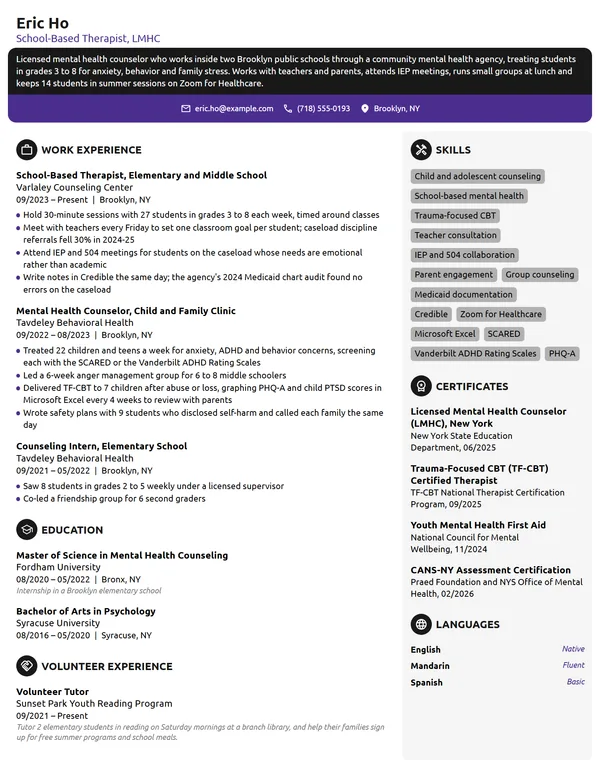
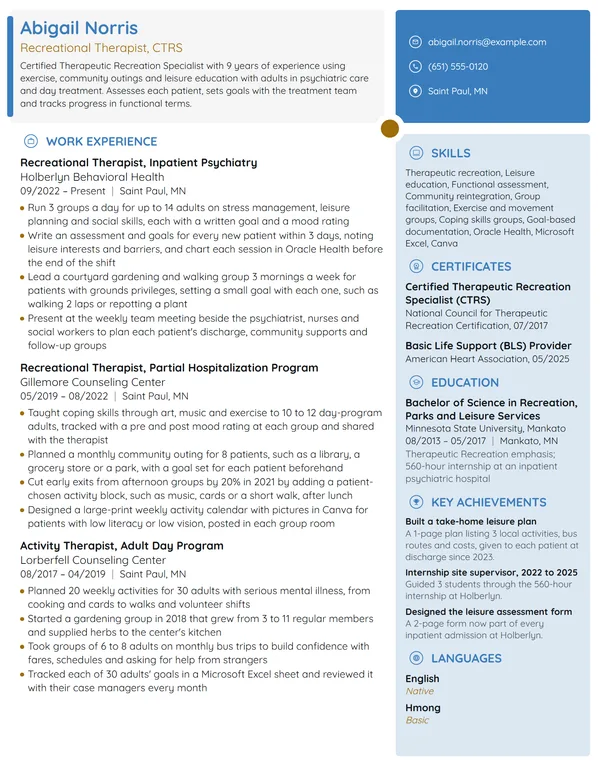
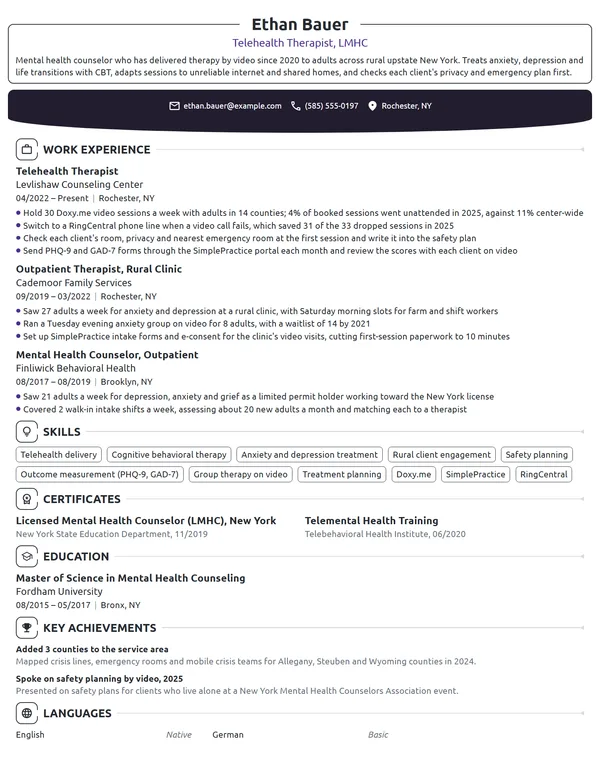
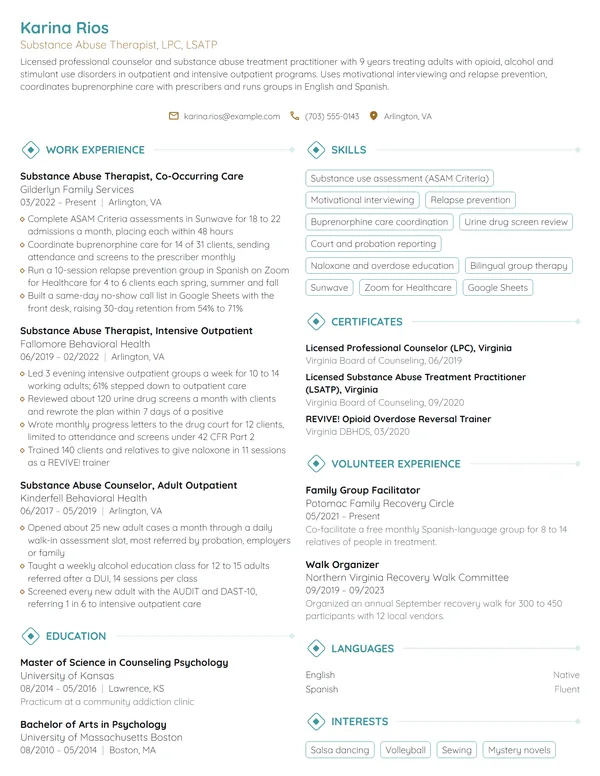
Therapist is a title shared by licensed counselors, marriage and family therapists, clinical social workers and art or music therapists. That is why a clinical director looks first at the letters after your name, or how close you are to earning them. Next come the people you treat, the approaches you are trained in and how many sessions you hold in a week. Caseloads, shorter waitlists and symptom scores that improved turn those claims into proof.
How to Write a Therapist Resume - Key Takeaways
- Order jobs newest first and keep the page count at 1, moving to 2 only after 10+ years or once supervision and teaching roles fill a second page.
- Put your license in the headline and list it first under Certificates, written exactly as your state board issues it.
- Open each job with your caseload or weekly sessions, then add access, outcome and group numbers.
- Describe clients by age group, setting and presenting concern, never by name, initials or a story someone could recognize.
- Name your therapy methods in Skills and prove each one in a bullet, such as a DBT skills group with its length and size.
- Test your file with an ATS resume checker, since agency and hospital portals screen for license titles and method names.
What clinical directors look for in a therapist resume
Whoever hires a therapist, from a group practice owner to a community agency's clinical director, wants to know 3 things: can you bill and practice under your license, have you treated clients like theirs, and can you carry their caseload. The Bureau of Labor Statistics lists evaluating clients, building treatment goals and plans with them, and documenting their progress as core counselor duties. O*NET adds assessing clients for suicide risk and handling crisis interventions, so a posting for a crisis or inpatient role will look for both.
Build the page from these sections, using headings an applicant tracking system can parse:
- Your name and contact details, plus a headline carrying your license (for example, Therapist, LPC, NCC)
- A short profile of 2 to 3 lines under your name; it needs no heading of its own
- Work Experience, most recent role first, with the setting in each job title
- Certificates: your license first, then national certifications and formal method trainings
- Skills, covering your therapy methods and the EHR you document in
- Education, with your master's degree and its internship
- Optional: Key Achievements, Volunteer Experience or Languages, the last one valuable if you counsel in a second language
Best format for a therapist resume
Use the reverse-chronological resume format: your current role first, each with the job title and setting, the employer and its city, then start and end months as MM/YYYY. Therapy careers are read through settings and license stages, from a supervised associate role in community mental health to a fully licensed clinician in a group practice, and newest-first order makes both easy to follow. If you hold a private practice beside an agency job, list it as its own entry with its own dates.
- Best for most therapistsReverse-chronologicalYour jobs, newest first, with your results under each one.Best for: A steady work history in your field
- FunctionalSkills grouped up top, with a short work history below.Best for: Gaps or very little experience
- CombinationA skills section first, then your full work history.Best for: A career change with strong skills
Keep it to 1 page through your first years of licensed practice. A second page fits once you have 10+ years, clinical supervision of interns or associates, or teaching and training roles worth listing, provided your license and current setting sit on page 1.
| Setting | What to use |
|---|---|
| Length | 1 page early on; 2 pages after 10+ years or with supervision and teaching roles |
| Dates | Start and end as MM/YYYY; the role you hold now ends in Present |
| Headline line | License and certifications after your title: Therapist, LPC, NCC |
| Client details | Counts, age groups and settings only; no names, initials or case stories |
| Font and size | One readable font, 10 to 12 pt in bullets and 14 to 16 pt for your name |
| Photo and private data | Leave the photo off, as most US and Canadian employers expect; age, marital status and a Social Security number stay off too |
| File type | PDF, unless an agency or hospital portal asks for .docx |
Most US and Canadian resumes carry no photo. Practice owners who hire for fit sometimes ask for a short bio with a headshot for their website, and that belongs in the bio, not on the resume you send with your application.
Therapist resume summary vs. objective
The test is whether you have treated clients since graduating. If you have, write a resume summary with your license, years, population, setting and 1 number. If your clinical hours all come from practicum and internship, write a resume objective naming the role you want, your license stage and the hours you completed.
Therapist resume summary formula
License with X years treating population in setting. Trained in 2 methods. 1 outcome you can count.
Example
LPC with 7 years treating anxiety and depression in outpatient and school settings. Trained in CBT and motivational interviewing. Built an anxiety group that now runs 4 cycles a year.
Don't
Compassionate, client-centered therapist passionate about helping people heal and grow.
Do
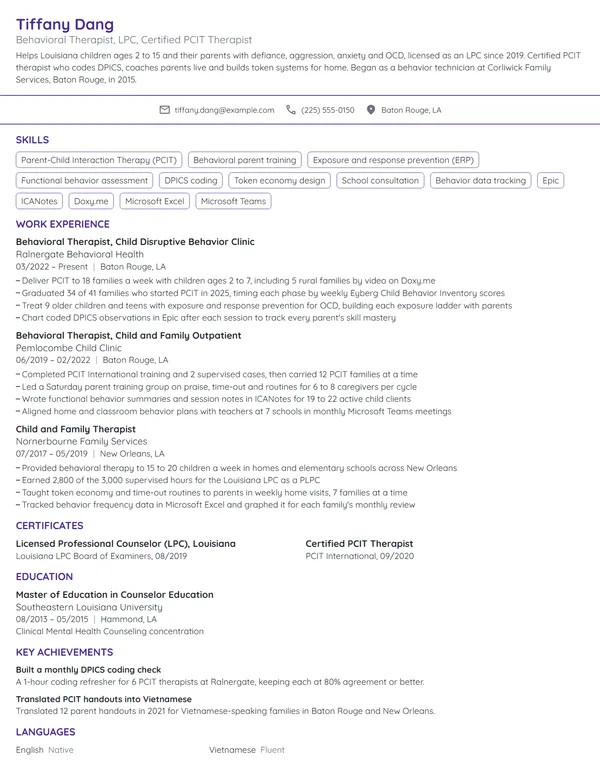
LMFT with 5 years in community mental health, treating couples and families referred by courts and schools. Sees 26 clients a week and leads Spanish-language parent sessions.
The rewrite names the license, the clients, the volume and a skill the employer can use.
How to write therapist work experience bullets with numbers
Your current role gets 3 to 4 bullets; earlier roles get 2 to 4. Lead with your weekly sessions or caseload, since a clinical director reads every other number against it, then add what changed: shorter waits, better scores on a standard measure, groups filled. The rules for listing work experience on a resume hold here too, with counts in place of client stories.
| Area | What to count | Example bullet |
|---|---|---|
| Caseload | Active clients, sessions a week, no-show rate | Held 28 sessions a week for an active caseload of 36 adults, with a no-show rate under 8%. |
| Access | Intakes a month, waitlist length, days to a first session | Completed 14 intake assessments a month and shortened referral to first session from 21 days to 6. |
| Outcomes | Scores on standard measures, goals met, planned discharges | Gave the PHQ-9 every 4 sessions; 58% of clients who finished treatment moved down at least 1 severity band. |
| Groups | Groups run, cycles a year, members, completion | Ran 3 cycles a year of an 8-week grief group for 6 to 9 adults. |
| Risk and crisis | Risk screenings, safety plans, crisis calls | Screened 40+ clients a quarter for suicide risk and wrote a safety plan with each one who screened positive. |
| Documentation | Notes on time, audit results, plan reviews | Raised on-time progress notes from 81% to 97% across a 9-clinician team with shared note templates. |
Here is one counselor's entry built that way. The weekly volume and the setting come first, the results follow, and the pre-licensed job keeps 2 lines.
Work Experience
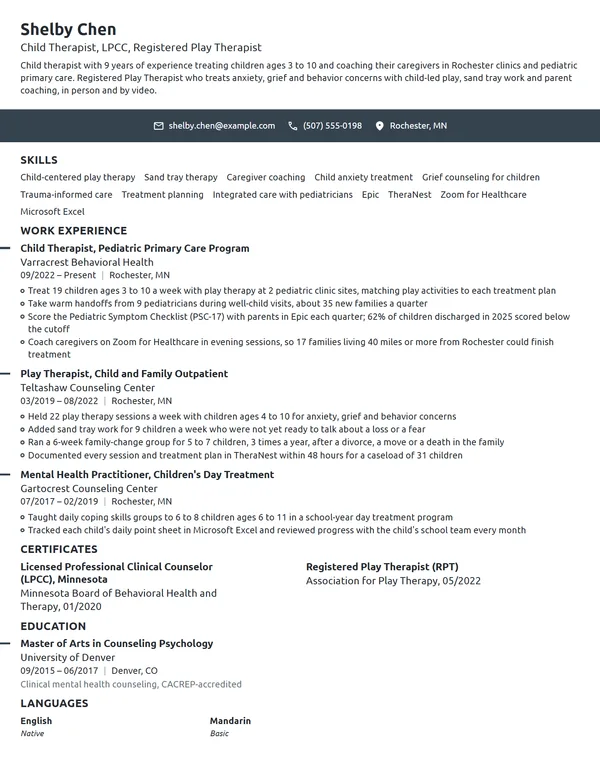
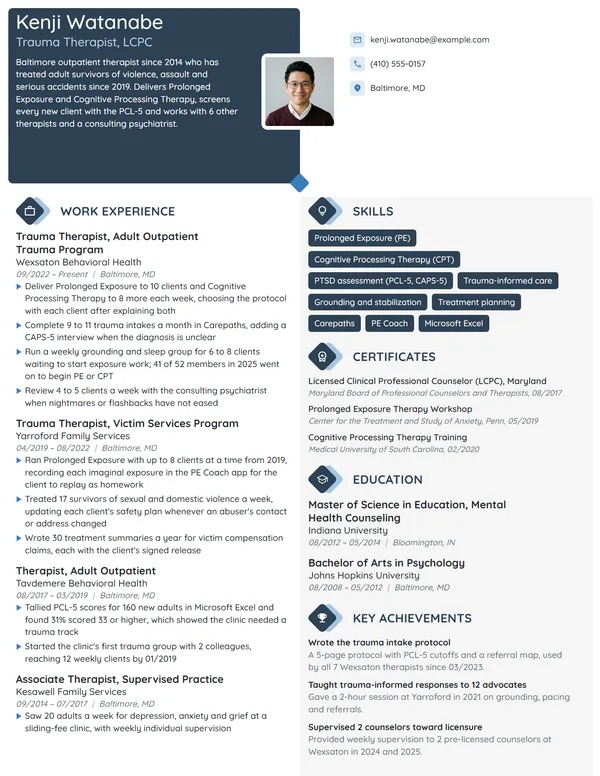
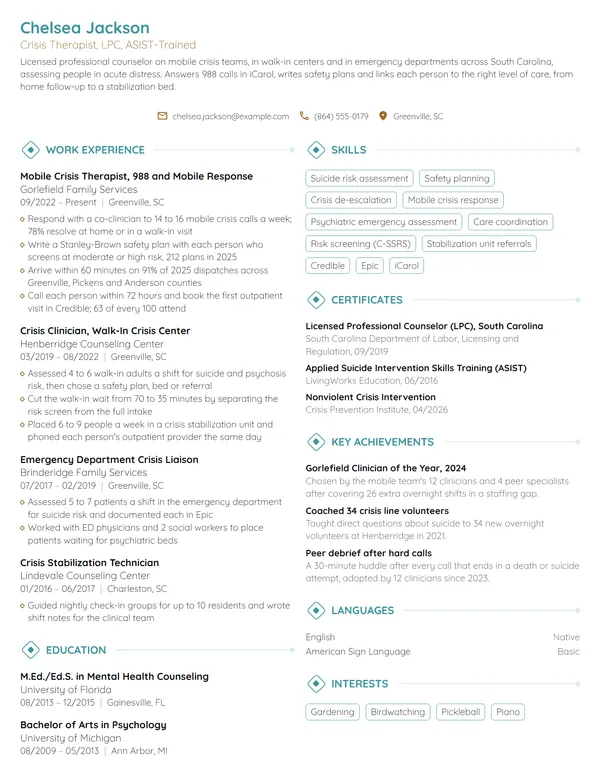
- See 24 to 26 adult clients a week for anxiety, depression and trauma, about 40% of sessions by telehealth.
- Built and lead a 10-week CBT group for anxiety, run 4 times a year with 8 to 10 members each.
- Helped cut the intake waitlist from 47 to 12 adults in 8 months by taking 3 extra intake assessments a week.
- Track GAD-7 scores at intake and every 6th session; 2 in 3 group completers dropped 5 or more points.
- Treated 20 to 23 students a week in 3 elementary and middle schools under weekly supervision by an LPC.
- Met each student's parents at least once a month and joined 30+ IEP meetings a year.
Don't
Provided individual and group therapy to clients.
Do
Delivered individual therapy to 29 adults a week and co-led a 12-week DBT skills group of 7 members, 5 of whom completed every module.
The second bullet gives the volume, the method and how many clients stayed with it.
Don't
Responsible for documentation and treatment plans.
Do
Closed progress notes within 24 hours for all 1,140 sessions in 2025 and reviewed every treatment plan on its 90-day date.
Therapy skills, methods and EHR software for your resume
Pick 6 to 8 hard skills for your resume from the posting and keep only the ones a bullet backs up. Assessment, treatment planning and crisis intervention fit almost every therapist role; EMDR, play therapy or couples work belong only when you have done them under supervision or after formal training.
Hard skills for therapists
- Diagnostic assessment (DSM-5-TR)
- Treatment planning
- Cognitive behavioral therapy (CBT)
- DBT skills training
- Motivational interviewing
- Trauma-informed care
- Suicide risk assessment and safety planning
- Crisis intervention
- Group therapy
- Family and couples therapy
Soft skills clinical directors value
- Active listening
- Steady presence in a crisis
- Firm professional boundaries
- Cultural humility
- Coordination with psychiatrists and case managers
- Patience with gradual progress
Name the EHR you write notes in, such as SimplePractice, TherapyNotes, Netsmart myAvatar or Epic, and show it in a bullet about documentation or scheduling. O*NET's flagged technologies for mental health counselors are office tools, Microsoft Office with Excel, Word and Outlook among them, so list those only where the role involves reports or program data. If you deliver therapy by video, say so with a share of sessions rather than a platform list.
LPC, LMFT, LCSW and therapist certifications on a resume
Every state requires mental health counselors to be licensed, the BLS notes, and licensure takes a national exam plus supervised clinical work under a licensed counselor. Marriage and family therapists and clinical social workers take the same route with their own exams, as the Pennsylvania rules in the table show. The same counseling license goes by LPC in some states and LMHC in others, so copy the exact title your board issues. Below the license, list certifications on your resume with the body that issued each one and the month you earned it.
| Credential | Issued by | What it takes |
|---|---|---|
| Licensed Professional Counselor (LPC), Pennsylvania | State Board of Social Workers, Marriage and Family Therapists and Professional Counselors | A master's or doctorate in counseling or a related field, 3,000 supervised hours over 2 to 6 years, and an approved exam such as the NCE. |
| Licensed Marriage and Family Therapist (LMFT), Pennsylvania | Same Pennsylvania board | A master's or doctorate in marriage and family therapy or a related field, 3,000 supervised hours over 2 to 6 years, and the national MFT exam from AMFTRB. |
| Licensed Clinical Social Worker (LCSW), Pennsylvania | Same Pennsylvania board | A CSWE-accredited MSW, 3,000 supervised clinical hours after the MSW over at least 2 years, and the ASWB Clinical exam. |
| National Certified Counselor (NCC) | National Board for Certified Counselors (NBCC) | A national certification; the NCE and the NCMHCE are its exam options, and some states also use them for licensure. |
| Board Certified Registered Art Therapist (ATR-BC) | Art Therapy Credentials Board (ATCB) | Master's-level art therapy education and supervised experience for the ATR, then the national board exam; ATR-P covers the supervision years. |
| Music Therapist-Board Certified (MT-BC) | Certification Board for Music Therapists (CBMT) | The MT-BC exam, then renewal every 5 years with 100 continuing education credits. |
| Registered Behavior Technician (RBT) | Behavior Analyst Certification Board (BACB) | Eligibility steps and an exam through Pearson VUE; RBTs practice under close supervision. |
How to list a license in progress
Between your degree and full licensure you practice under a pre-licensed or associate title. Pennsylvania, for one, issues a Licensed Associate Professional Counselor (LAPC) license that requires a supervision plan and no exam. Write that title exactly, add the full license with its expected month, and keep LPC or LMFT out of your headline until the board issues it. Leave the license number off; employers check it with the board.
Certificates
- Licensed Professional Counselor (LPC), Pennsylvania, State Board of Social Workers, Marriage and Family Therapists and Professional Counselors, 09/2022
- National Certified Counselor (NCC), National Board for Certified Counselors, 08/2019
- Basic Life Support (BLS), American Heart Association, 03/2026
How to list a counseling, MFT or MSW degree
Mental health counselors typically need a master's degree, per the BLS, and those programs often include a clinically supervised internship. MFTs hold a master's in marriage and family therapy or a related field, and clinical social workers an MSW. CACREP accredits master's and doctoral programs in counseling, and a degree from one is required for counselor licensure in Ohio, Kentucky, North Carolina and Florida (since 07/2025), so add CACREP-accredited to the entry when it applies.
Follow the usual pattern for listing education on a resume: the degree name, the school and its city, and the month you graduated. In your first 2 to 3 years, add 1 line with your internship setting and hours; later, the degree, school and date are enough. List a bachelor's in psychology below the master's only if space allows.
Education
60 credits, CACREP-accredited. Internship: 600 hours at a community mental health center.
New grad and career-change therapist resumes
As a new graduate, your practicum and internship are your clinical record, so give each one a full Work Experience entry with the setting, hours, weekly client load and the methods you used under supervision. Put your exam status and associate license, or the date you applied for it, in the objective. Related jobs held during school count as experience too.
- Practicum and internship: setting, total hours, clients a week by the end and the populations you saw.
- Exam and license stage: NCE or other exam passed with the month, and the associate title once issued.
- Behavioral health technician, RBT or case manager jobs: a Work Experience entry with clients served and the skills you practiced.
- Crisis line or peer support shifts: under Volunteer Experience, with hours and calls taken.
Don't
Recent counseling graduate seeking a position where I can use my skills to help others.
Do
M.S. in Clinical Mental Health Counseling graduate (05/2026) seeking an associate therapist role with weekly supervision. Completed a 700-hour internship at a college counseling center, carrying 18 clients a week by the final term.
Even a first objective can give the degree date, the role and a count of hours.
Teachers, nurses and case workers who move into therapy after a master's should still list jobs newest first and lead with the new degree, internship and license stage. Under earlier jobs, keep the bullets that carry over to a therapy room: crisis response, family meetings, documentation and group work. Our career-change resume examples show the layout, and the cover letter is where you explain the move; our healthcare cover letter examples show it done in a short paragraph.
Therapist resume FAQ
Can I call myself a therapist on my resume before I am fully licensed?
Yes, as a job title if your employer used it, but only the credentials you hold go after your name. Write your associate or pre-licensed title exactly as the board issues it, and show the full license as expected with its month.
How do I describe my clients on a therapist resume without breaking confidentiality?
Use counts, age groups, settings and presenting concerns, such as 25 adolescents a week with anxiety and self-harm. Leave out names, initials, dates of events and any rare detail that could point to one person, even in an achievement.
Should I list therapy approaches like CBT, DBT or EMDR on my resume?
Yes, if you use them in practice. Put each one in Skills and back it with a bullet, such as a trauma caseload treated with EMDR. List a formal training with its provider and month under Certificates.
How long should a therapist resume be?
1 page for new graduates and most clinicians in their first years of licensure. 2 pages work after 10+ years or with supervision, training or teaching roles. Save the longer academic format for faculty and research applications.
Do I need a CACREP-accredited degree to work as a therapist?
Not in every state, but some require it. CACREP lists Ohio, Kentucky, North Carolina and Florida as states where counselor licensure requires a CACREP-accredited degree. Elsewhere, write CACREP-accredited on the education entry when your program held it, so a screener sees it without asking.
Should I include practicum and internship hours on a therapist resume?
Yes, while they are your main clinical experience. Give the setting, total hours and weekly client load for each placement. After 2 to 3 years of paid practice, shorten them to 1 line under your degree or drop them.
What is the average salary for a therapist?
BLS data show a median annual wage of $60,320 for counselors in May 2025. Pay for therapists varies with the license, the setting, the state and whether you see private-pay clients, so leave it off your resume and raise it at the offer stage.
Next steps
Start from the example nearest your license stage and setting, keep its layout, and replace the details with your own caseload, methods and results. Our resume builder and templates give you that layout ready to fill. Pair the finished page with a cover letter about the clients you hope to serve.