
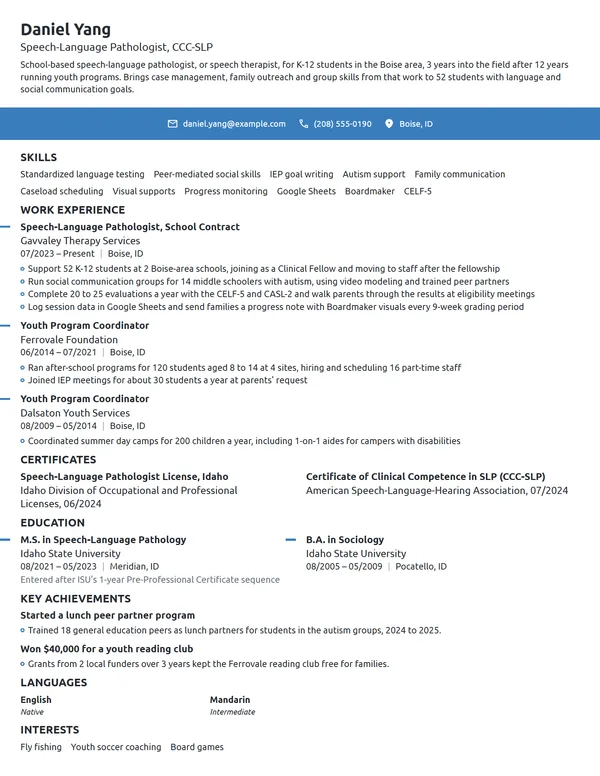
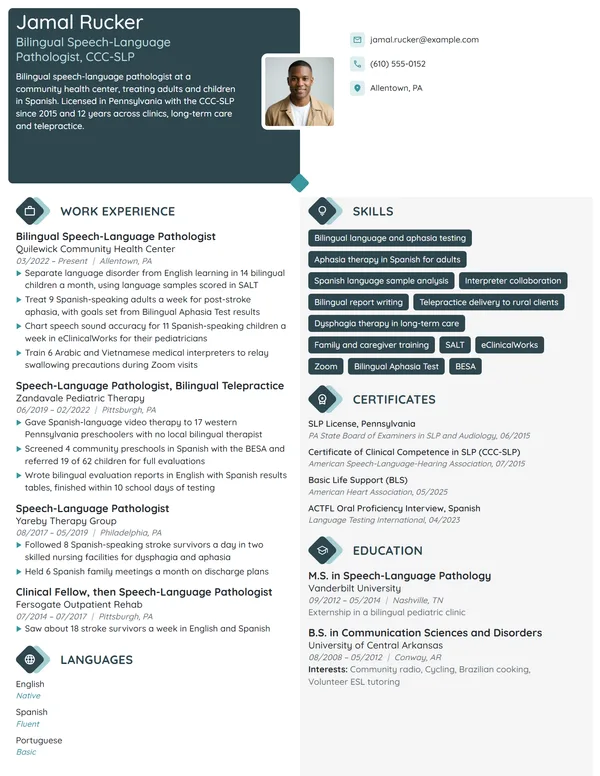
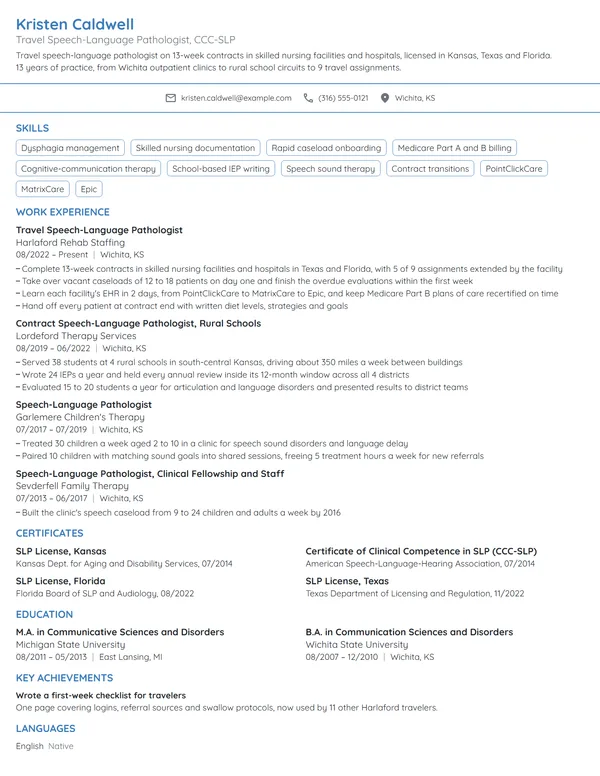
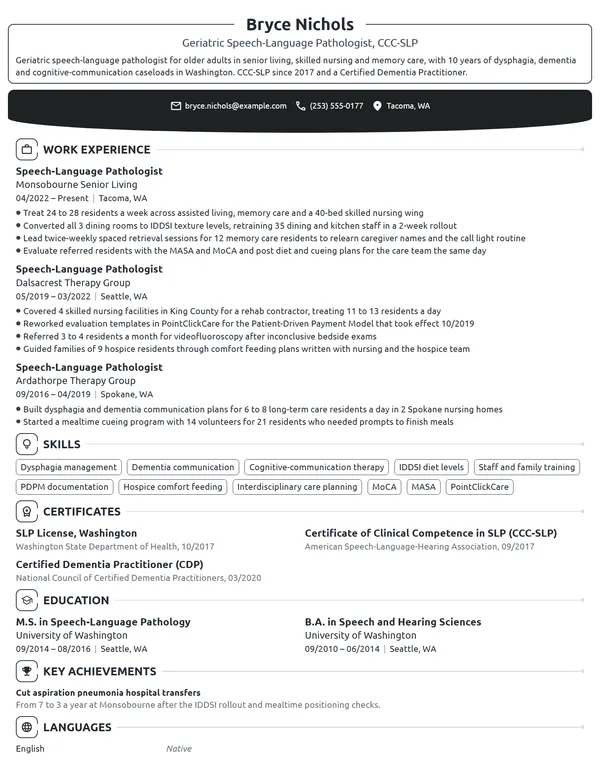
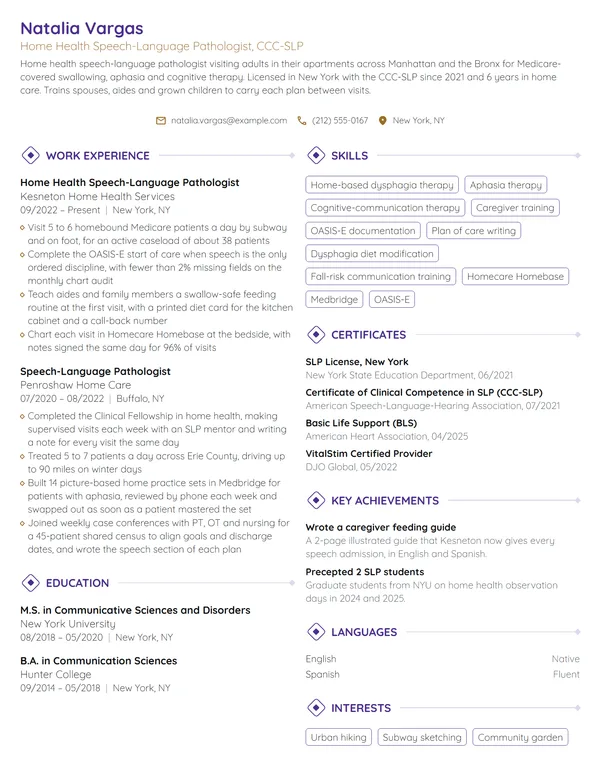
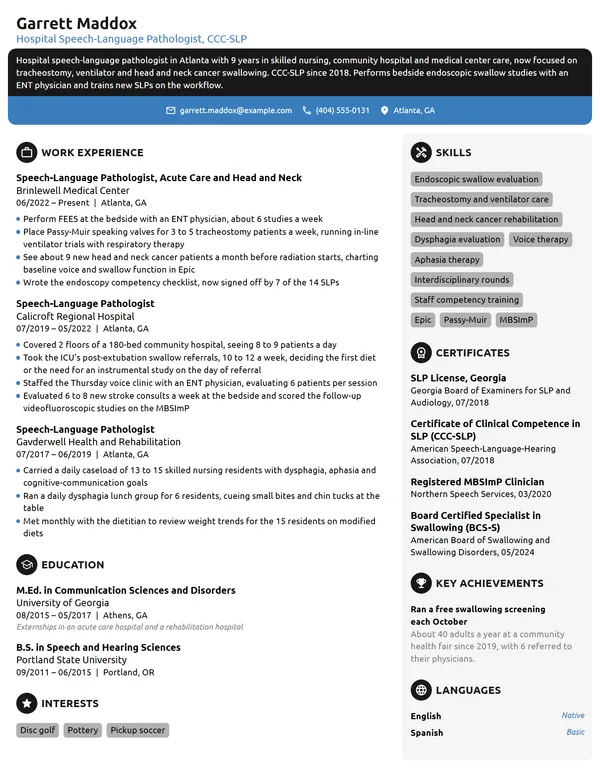
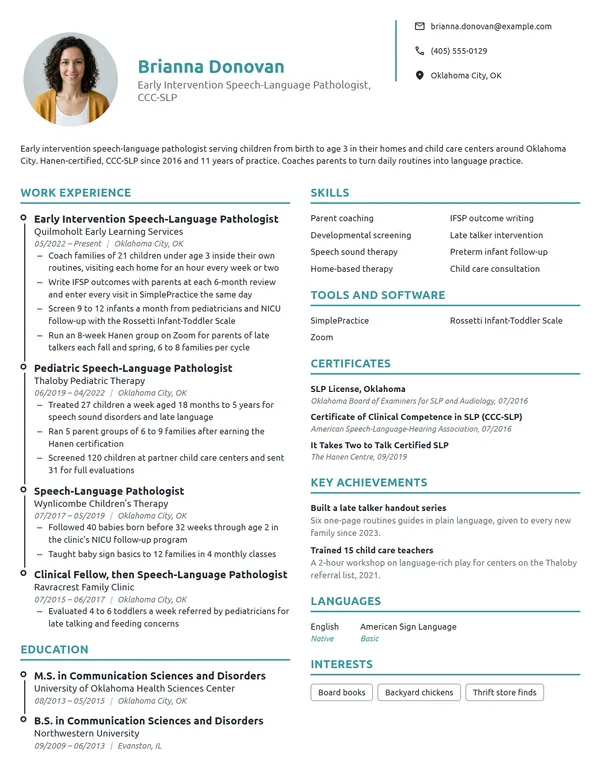
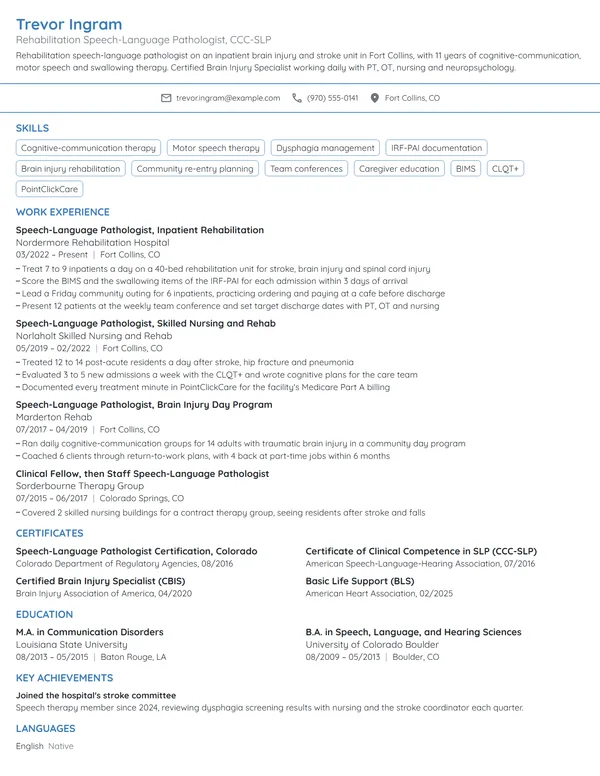
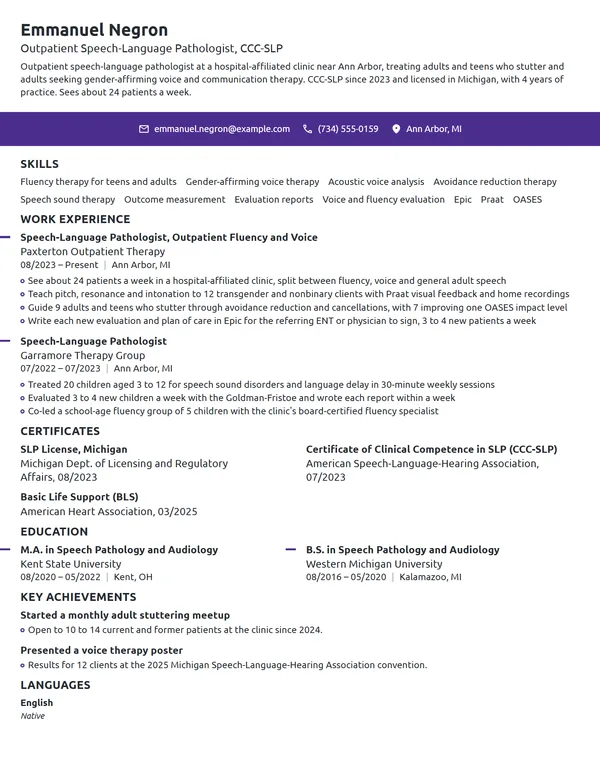
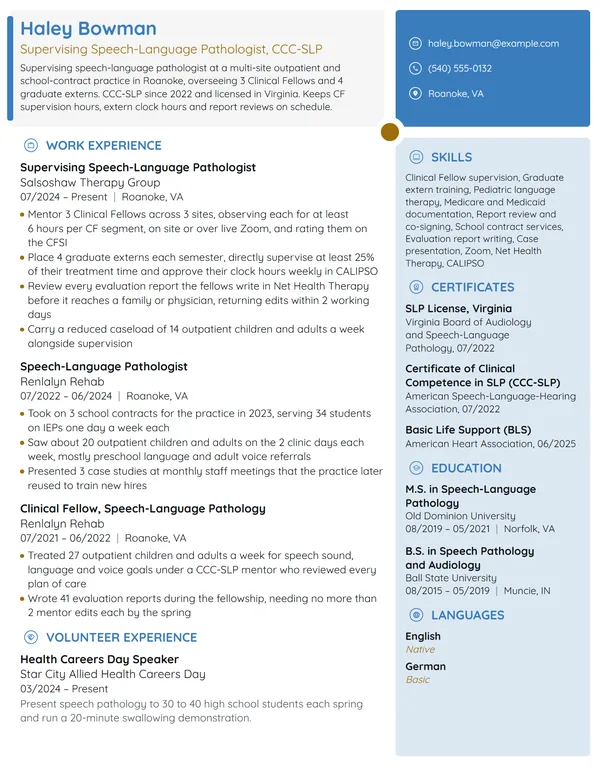
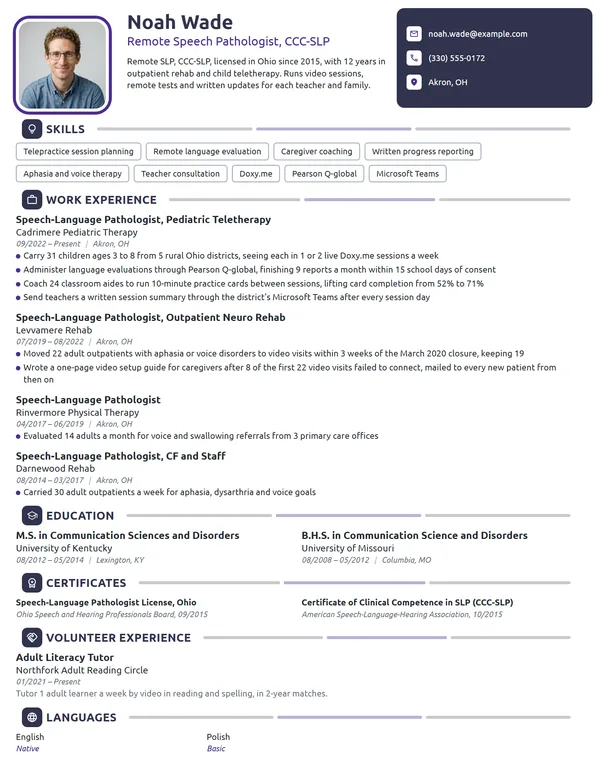
Speech-language pathologists help people of every age talk, understand and swallow, from toddlers saying their first words to adults relearning speech after a stroke. A school district or a hospital rehab team will want to know which of those people you treat, how many you see in a week and whether your license is current. Therapy gains build over months of sessions, so they rarely fit in one tidy line. Goals met, test scores and patients back on a regular diet turn that slow progress into proof.
How to Write a Speech Pathologist Resume - Key Takeaways
- List jobs newest first in a reverse-chronological layout on 1 page, moving to 2 only after 10+ years or with supervision and teaching roles to show.
- Name the setting and the age group in each job, then open with your caseload: students or patients, and sessions a week.
- Back your bullets with counts an SLP keeps anyway: evaluations completed, goals met, swallow studies run, productivity and caregivers trained.
- Put your state SLP license first under Certificates, followed by the CCC-SLP from ASHA and any specialty certification.
- As a Clinical Fellow, write Clinical Fellow in the title line and add CCC-SLP after your name only once ASHA awards it.
- Run the file through an ATS resume checker, since district and hospital portals search for license and test names.
What clinic directors and schools look for in a speech pathologist resume
The person hiring an SLP wants 4 answers fast: your setting, the ages and disorders you treat, the size of your caseload and the state of your credentials. The Bureau of Labor Statistics lists evaluating speech, language or swallowing difficulty, building an individualized treatment plan and counseling clients and families among the core duties. O*NET adds documentation such as Medicaid and billing records, and writing reports for IEP meetings.
Settings differ more than the title suggests. The BLS puts 39% of speech-language pathologists in educational services, 25% in therapy offices and 13% in hospitals, so a district reads for IEPs and classroom work while a hospital reads for swallowing and adult neurology. Set up the resume with these sections:
- Your name, contact details and a headline like Speech-Language Pathologist, CCC-SLP
- A summary of 2 to 3 lines under your name, without a heading
- Work Experience, newest first, with the setting and age group in each entry
- Certificates: the state license on top, then the CCC-SLP and any specialty credential
- Skills, with your assessments and documentation system
- Education, with your clinical placements if you are a Clinical Fellow
- Optional: Languages (with a bullet if you evaluate in that language), Key Achievements or Volunteer Experience
Best format for a speech pathologist resume
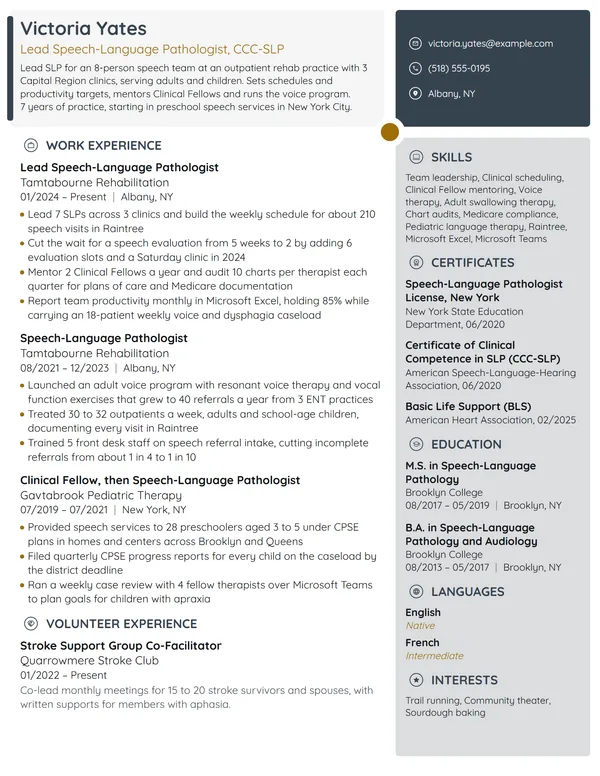
Use the reverse-chronological resume format: your current job first, each entry with the title, the employer, its location and start and end months in MM/YYYY form. SLP careers move from Clinical Fellow to staff therapist to lead or supervisor, often across settings, and newest-first order makes both the climb and any move between schools and hospitals easy to follow. Contract work through a staffing agency goes under the agency, with each school or facility in a bullet.
- Best for most speech pathologistsReverse-chronologicalYour jobs, newest first, with your results under each one.Best for: A steady work history in your field
- FunctionalSkills grouped up top, with a short work history below.Best for: Gaps or very little experience
- CombinationA skills section first, then your full work history.Best for: A career change with strong skills
Fit your first 10 years on 1 page; supervising Clinical Fellows or assistants, university clinic teaching or 3 or more settings can justify a second.
| Element | What to use |
|---|---|
| Length | 1 page for most SLPs; 2 pages after 10+ years or with supervision and teaching |
| Job title line | Title plus setting or population: Speech-Language Pathologist, Pediatric Outpatient |
| Credentials after your name | CCC-SLP only once ASHA has awarded it; no CF or Praxis status in the headline |
| Dates | MM/YYYY start and end dates, including the CF; Present for your current role |
| Photo and private data | Skip the photo, as most US and Canadian applicants do; no age, family status or Social Security number on an SLP resume |
| File type | PDF, unless the district's online application asks for a Word file |
Most US and Canadian resumes carry no photo. School districts and hospital systems usually load your file into an applicant tracking system, and plain section names in a text-based PDF keep your license and settings in the right fields.
Speech pathologist resume summary vs. objective
Ask yourself 1 question: have you finished your Clinical Fellowship? If yes, write a resume summary with your credential, your years, your setting and population, and 1 result. If you are a graduate student looking for a CF or moving into the field from teaching or another job, a resume objective fits better: the setting you want, your Praxis and license status, and your clinical hours.
Speech pathologist resume summary formula
Title, credential, with X years in setting for population or disorders. 1 measured outcome. Specialty training or the next credential you are working toward.
Example
Speech-language pathologist, CCC-SLP, with 5 years in hospital and skilled nursing care for adults with dysphagia and aphasia. Trained 45 nurses on a bedside swallow screen now used on 3 medical floors. Working toward board certification in swallowing.
Don't
Dedicated speech therapist passionate about helping clients of all ages communicate with confidence.
Do
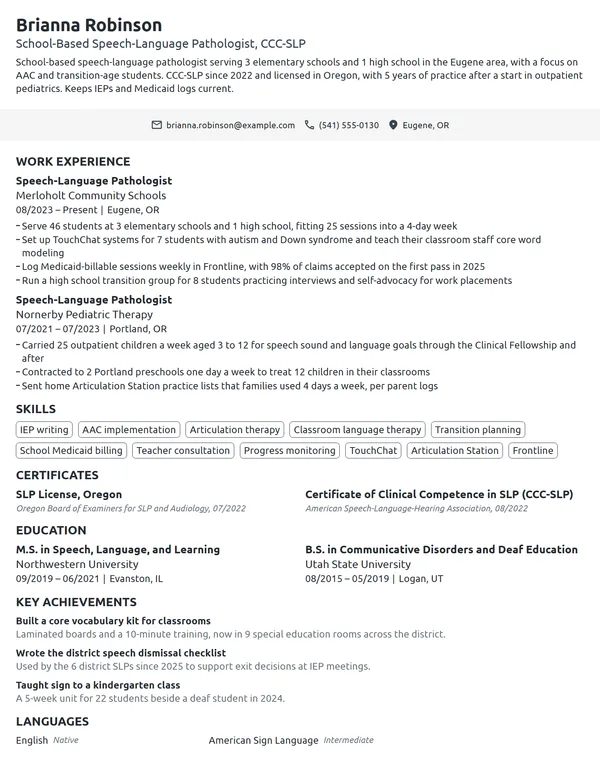
School-based SLP, CCC-SLP, with 7 years in K-5 and a caseload of 55 students with articulation, language and AAC goals. Bilingual in English and Spanish, evaluating in both.
The rewrite names the setting, the caseload and the skill a district has trouble finding.
How to write speech pathology work experience bullets with numbers
Write 3 to 4 bullets under the job you hold now and 1 to 3 under each earlier one. Open with the caseload, because every result after it reads against that size: the number of students or patients, their ages and the sessions or visits a week. Then turn duties into achievements on your resume with figures you already keep in progress notes, IEP reports and productivity logs.
| Area | What to count | Example bullet |
|---|---|---|
| Caseload | Students or patients, ages, sessions a week, sites | Served 58 students across 2 elementary schools in 31 weekly individual and group sessions. |
| Evaluations | Initial evaluations and re-evaluations a month, reports on time | Completed 12 initial and 3-year re-evaluations a month, each report finished before the IEP meeting. |
| Swallowing | Instrumental studies, diet changes, time back to oral intake | Returned 22 of 30 head and neck cancer patients to a regular diet within 6 weeks of finishing radiation. |
| Therapy outcomes | Goals met, standardized score change, discharges | Raised the share of caseload students meeting annual goals from 64% to 79% over 2 school years. |
| Productivity and documentation | Productivity rate, notes signed on time, billing accuracy | Held 90% productivity in outpatient rehab with every daily note signed within 24 hours. |
| Family and staff training | Caregivers coached, teachers or nurses trained | Coached 26 parents through a 6-week home language program for toddlers on the clinic waitlist. |
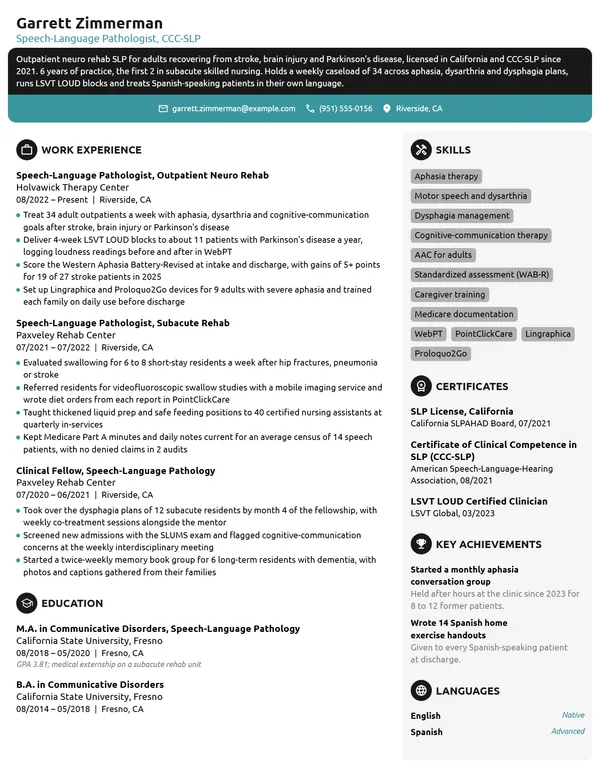
Here is how those numbers sit in a hospital SLP's entry. The setting and daily load come first, the result follows, and the Clinical Fellowship keeps 1 bullet.
Work Experience
- Evaluate and treat 10 to 12 adult inpatients a day on the neurology, ICU and oncology floors of a 340-bed hospital.
- Run 4 to 6 modified barium swallow studies a week with radiology and chart diet recommendations the same day.
- Built a nurse-run bedside swallow screen for stroke admissions with the stroke coordinator, cutting the average wait for a first diet order from 31 to 19 hours.
- Treated 9 to 11 residents a day in a 120-bed skilled nursing facility, mainly for dysphagia and dementia-related communication goals, under a CCC-SLP mentor.
Don't
Provided speech and language therapy services to students.
Do
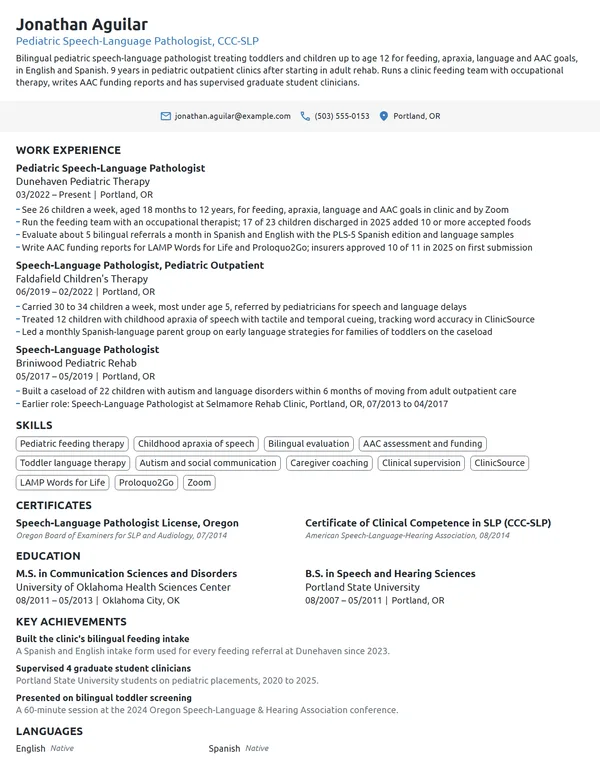
Ran 22 weekly pull-out and push-in sessions for 48 K-3 students; 35 met their annual articulation or language goals.
The rewrite gives the delivery model, the caseload and the outcome a special education director reports.
Don't
Responsible for dysphagia evaluations on the stroke unit.
Do
Completed 8 to 10 clinical swallow evaluations a week on a 28-bed stroke unit and moved 1 in 3 patients to a less restricted diet within 5 days.
Speech pathology skills, assessments and software for your resume
Choose 6 to 8 hard skills for your resume, each one named in the posting and backed by a bullet. A school SLP leans on language assessment, articulation therapy and IEP writing; a hospital SLP on dysphagia, aphasia and instrumental swallow studies.
Hard skills for speech pathologists
- Speech and language evaluation
- Dysphagia assessment and treatment
- Modified barium swallow studies
- Articulation and phonology therapy
- Aphasia and cognitive-communication therapy
- Fluency treatment
- Voice therapy
- AAC device selection and training
- IEP goal writing and progress reports
- Medicare and Medicaid documentation
Soft skills SLP employers value
- Family and caregiver counseling
- Collaboration with teachers and therapists
- Patience with slow, steady progress
- Caseload scheduling
- Clear report writing
- Cultural and linguistic responsiveness
Put your software in the Skills section and prove it in a bullet. O*NET flags eClinicalWorks EHR software and Microsoft Office, Word and Excel as hot technologies for speech-language pathologists. Add the system your employer used for notes or IEPs, your teletherapy platform, and AAC apps such as Proloquo2Go or TD Snap by their exact names, since some postings ask for them by name.
SLP license, CCC-SLP and specialty certifications on a resume
In the BLS's words, all states require speech-language pathologists to be licensed, and SLPs who work in schools may need a teaching certification as well. Some states license school SLPs separately: Virginia's Board of Audiology and Speech-Language Pathology issues both a Speech-Language Pathologist license and a School Speech-Language Pathologist license. List certifications on your resume with each issuer and date, with the license on top.
| Credential | Issued by | What it takes |
|---|---|---|
| State SLP license | Your state's licensing board | Required in every state. California, for example, asks for a master's degree, 36 full-time weeks of supervised Required Professional Experience and a Praxis score of at least 162. |
| Certificate of Clinical Competence in Speech-Language Pathology (CCC-SLP) | American Speech-Language-Hearing Association (ASHA) | A graduate degree from a CAA-accredited program, 400 supervised clinical hours (25 observation, 375 direct contact), a passing Praxis score and a Clinical Fellowship of at least 36 weeks and 1,260 hours. Kept with 30 professional development hours every 3 years. |
| Praxis Examination in Speech-Language Pathology (5331) | ETS, used by ASHA and state boards | ASHA's passing score is 162 on a 100 to 200 scale; each state sets its own score for licensure and school credentials. |
| Clinical specialty certification | ASHA-recognized boards in child language, fluency, swallowing, and augmentative and alternative communication | A current CCC, plus the experience, demonstrated expertise and continuing education each board sets. |
How to write the license line as a Clinical Fellow
During your CF, list the license you actually hold under the name your state uses: California calls it an RPE temporary license, and Wisconsin issues a Temporary License to applicants who will complete a clinical fellowship. Write Clinical Fellow, Speech-Language Pathology as the job title, and give your mentor's credential, not their name. Once ASHA awards the CCC-SLP, add it after your name and to Certificates with the month it was granted.
Certificates
- Speech-Language Pathologist License, Virginia, Virginia Board of Audiology and Speech-Language Pathology, 07/2022
- Certificate of Clinical Competence in Speech-Language Pathology (CCC-SLP), American Speech-Language-Hearing Association, 08/2022
- Basic Life Support (BLS), American Heart Association, 03/2026
How to list a master's in speech-language pathology
BLS guidance is that speech-language pathologists typically need at least a master's degree in speech-language pathology, and that graduating from an accredited program is required for certification and often for state licensure. ASHA's CCC-SLP standards name that accreditor as the CAA; there is no need to add CAA to your degree line unless a posting requests it.
When listing education on a resume, give the degree as your school prints it, then the school, its location and the month you finished. In your first 2 years, add 1 line with your total supervised clinical hours and the settings of your placements. List the bachelor's degree too, and if it was in another field, the post-baccalaureate prerequisite courses that got you into graduate school.
Education
420 supervised clinical hours across a university clinic, a public elementary school and an acute care hospital.
Clinical Fellow and career-change speech pathologist resumes
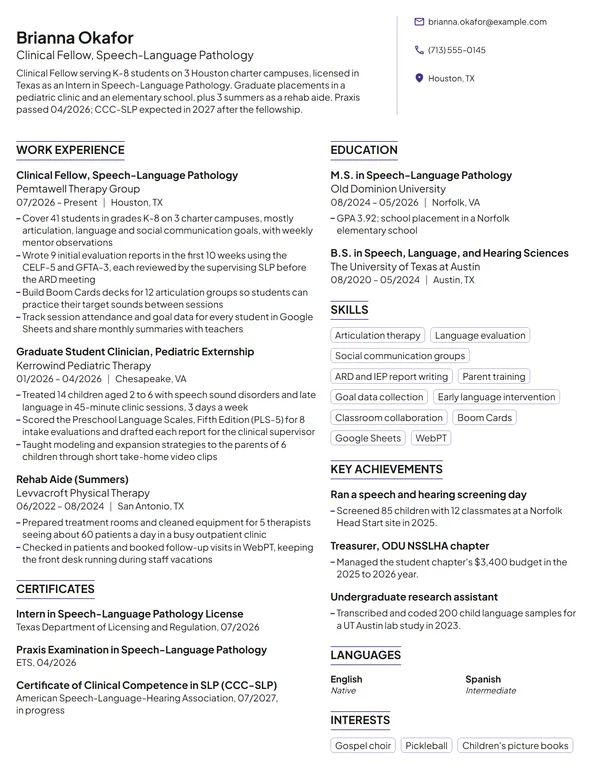
A CF applicant is hired on clinical placements, so make them easy to count. Write an objective with the setting you want and your Praxis and license status, then show the hours, ages and disorders behind each placement. Still applying to graduate programs? The SLP grad school resume layout puts observation hours and research first.
- Externships and placements: the setting, the ages, the disorders treated and your hours, as a full entry or 1 line under Education.
- SLPA or school aide work: a Work Experience entry with the caseload you supported and the programs you ran.
- Bilingual skills: the language under Languages, plus a bullet if you evaluated or treated in it.
- Camps, literacy programs and stroke support groups: under Volunteer Experience, with the number of people you worked with.
Don't
Recent graduate seeking a Clinical Fellowship where I can grow my clinical skills.
Do
M.S. graduate in speech-language pathology, Praxis passed 06/2026, seeking a Clinical Fellowship in outpatient pediatrics. Completed 410 supervised clinical hours in a school, a clinic and a hospital.
A Clinical Fellow objective still needs proof: an exam date, a setting and hours a reader can count.
Moving into speech pathology from teaching, special education or another field, keep reverse-chronological order and put the new degree and license up front. Under older jobs, keep the bullets that carry over: classroom behavior plans, reading interventions, parent meetings or reports written to a deadline. The career-change resume examples show the layout, and a cover letter explains the move in 2 or 3 sentences, as the healthcare cover letter examples show.
Speech Pathologist resume FAQ
Should I write CCC-SLP after my name on my resume?
Yes, once ASHA has awarded it. Write it after your name in the headline and list it under Certificates with the month granted. During your Clinical Fellowship, leave it off and write Clinical Fellow in your job title instead.
How do I list my Clinical Fellowship on a resume?
As its own Work Experience entry, titled Clinical Fellow, Speech-Language Pathology, with the employer, city and dates. Give it the same caseload and outcome bullets as any SLP job, and note that you worked under a CCC-SLP mentor. ASHA requires at least 36 weeks and 1,260 hours.
Do school-based SLPs need a different license?
Sometimes. The BLS says SLPs in schools may need a teaching certification, and some states issue a separate school license: Virginia has both a Speech-Language Pathologist and a School Speech-Language Pathologist license. List every credential you hold, each with its issuing agency.
Should I put the ASLP Interstate Compact on my resume?
Only if you hold a privilege to practice. 37 jurisdictions have enacted the Audiology and Speech-Language Pathology Interstate Compact, and Tennessee began issuing privileges in May 2026. If you hold one, add it under Certificates below your home state license, with the states it covers.
Should I list my Praxis score on a speech pathology resume?
No. Write Praxis passed with the month instead. ASHA's passing score is 162, but each state sets its own score, and employers care that you passed, not by how much. Before you pass, give the scheduled date in your objective.
How do I describe my caseload without sharing private information?
Use counts, age ranges and disorder types, never names, schools a child can be traced to, or details from a medical record. A line such as 48 K-3 students with articulation and language goals tells an employer everything they need.
How long should a speech pathologist resume be?
1 page for Clinical Fellows and most staff SLPs. Use 2 pages after 10+ years, or when supervision, university clinic teaching or several settings need the room, as long as your license, CCC-SLP and current job are on page 1.
What is the average speech-language pathologist salary?
The BLS reports that the median annual wage for speech-language pathologists was $97,870 in May 2025. Pay varies with the setting, the state and whether you work for a district, a hospital or a contract agency; leave it off your resume and raise it at the offer stage.
Next steps
Start from the example nearest your setting and career stage, then swap in your own caseload, outcomes and credentials line by line. Build it in our resume builder or start from one of our templates, and pair it with a short letter naming the population you want to serve and your strongest result.