
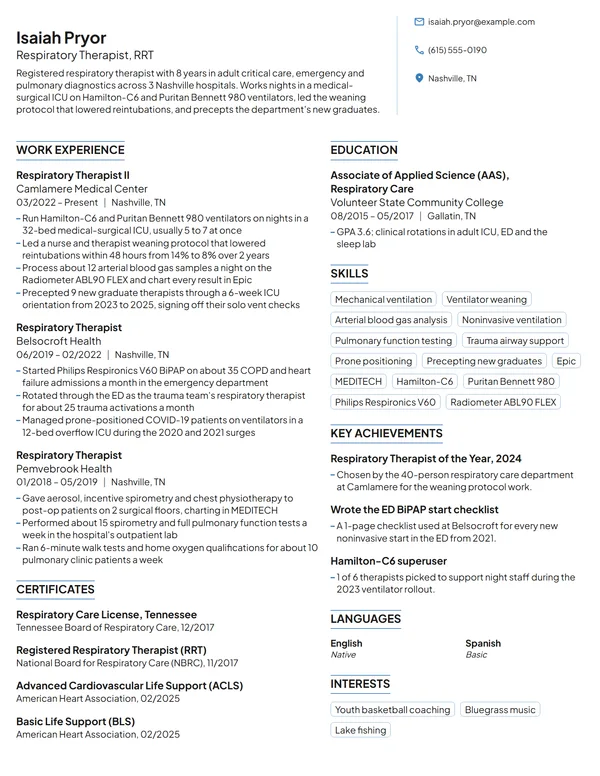
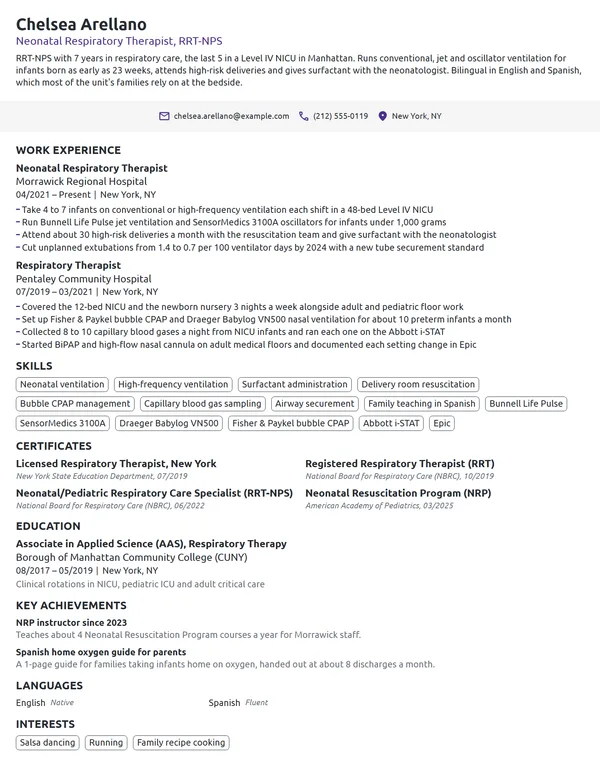
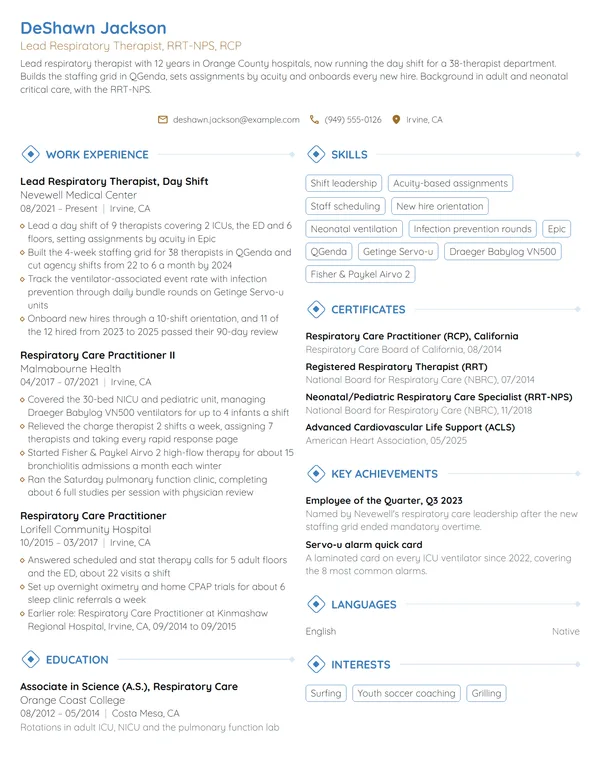
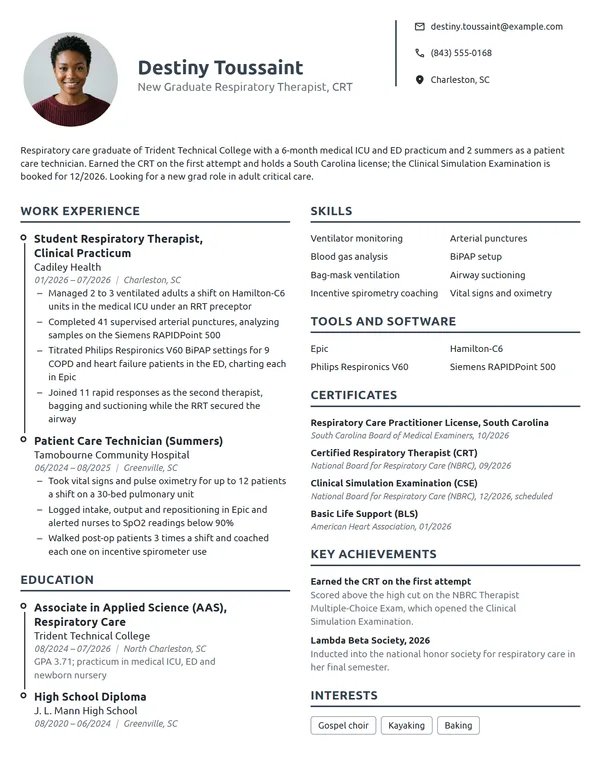
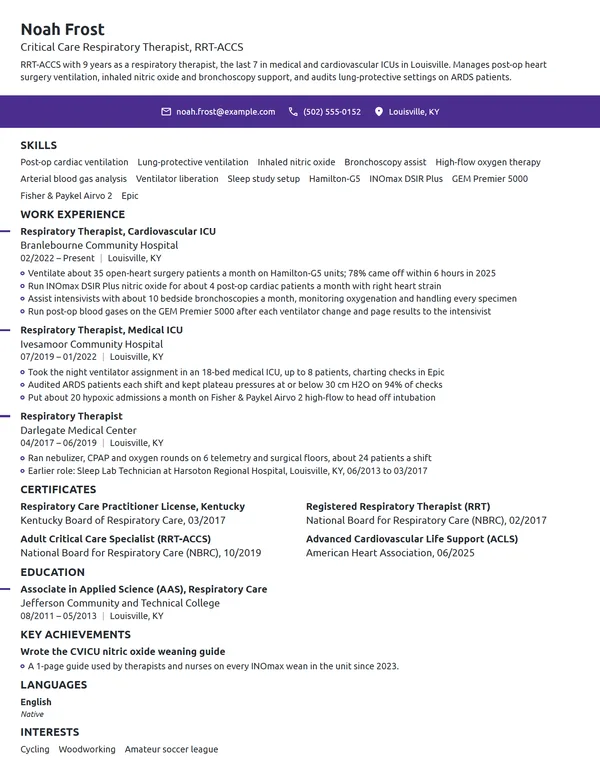
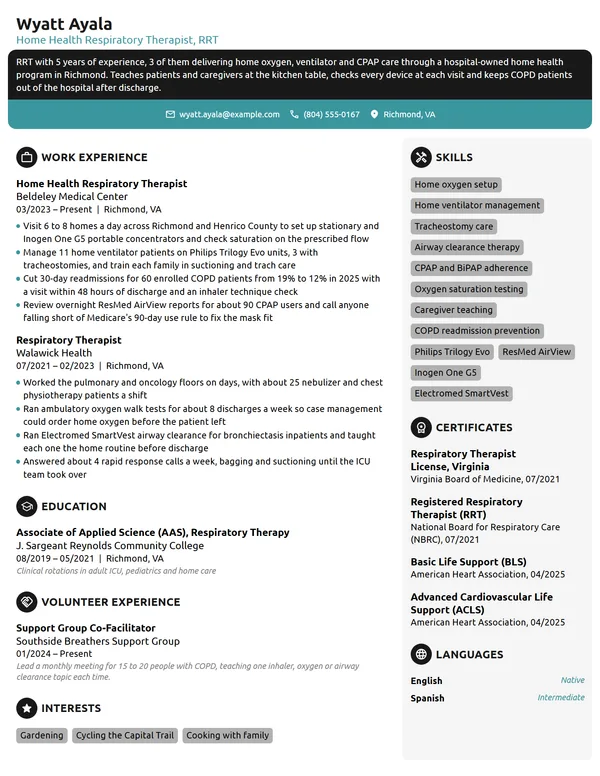
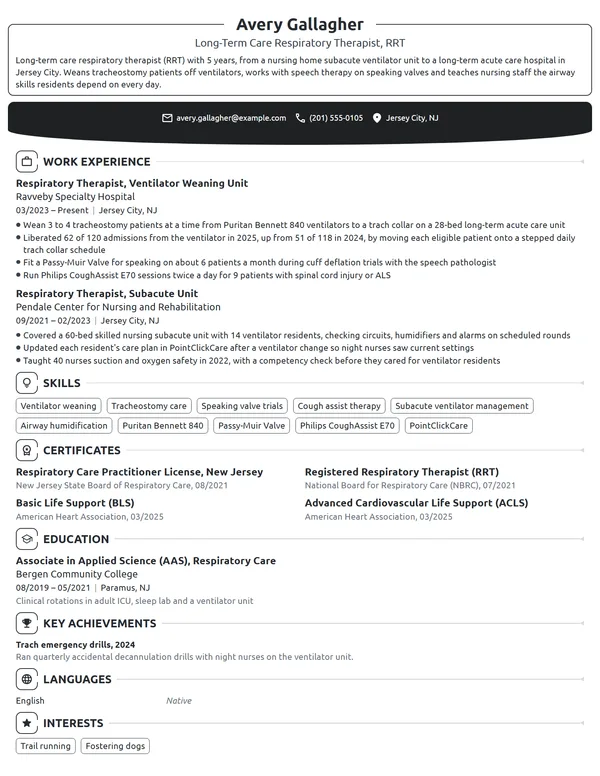
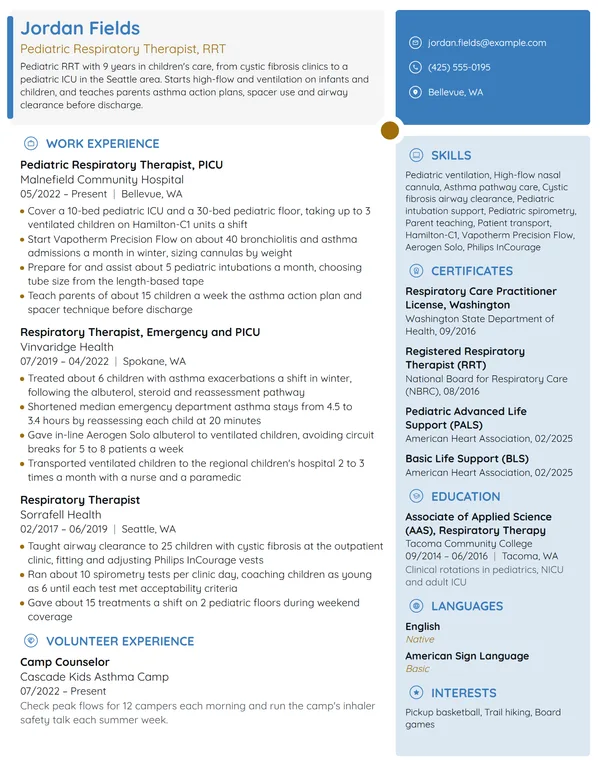
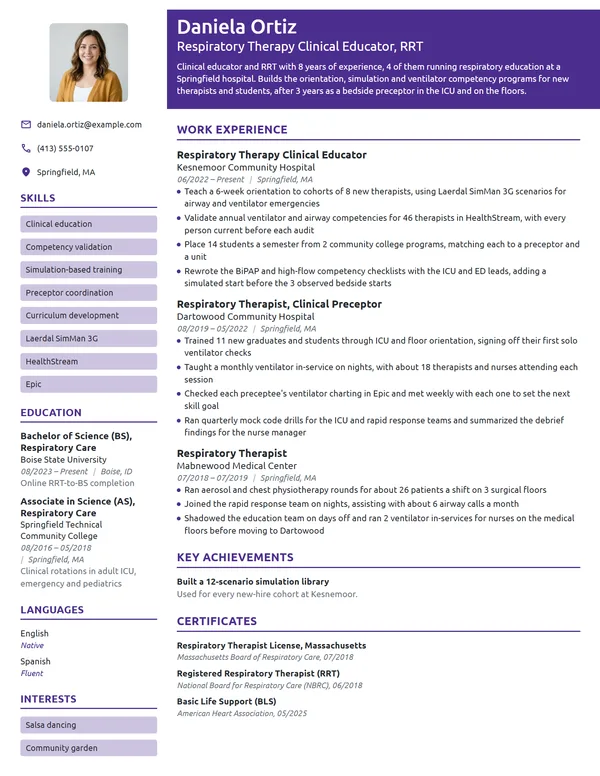
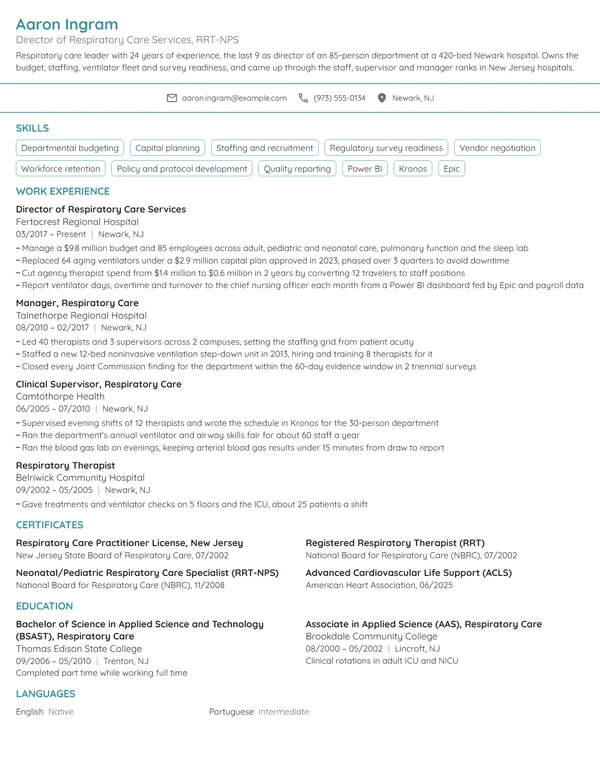
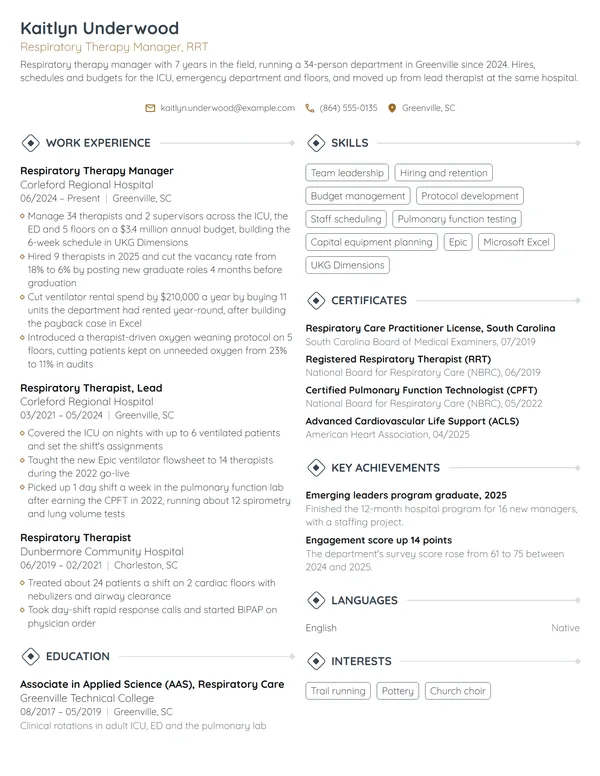
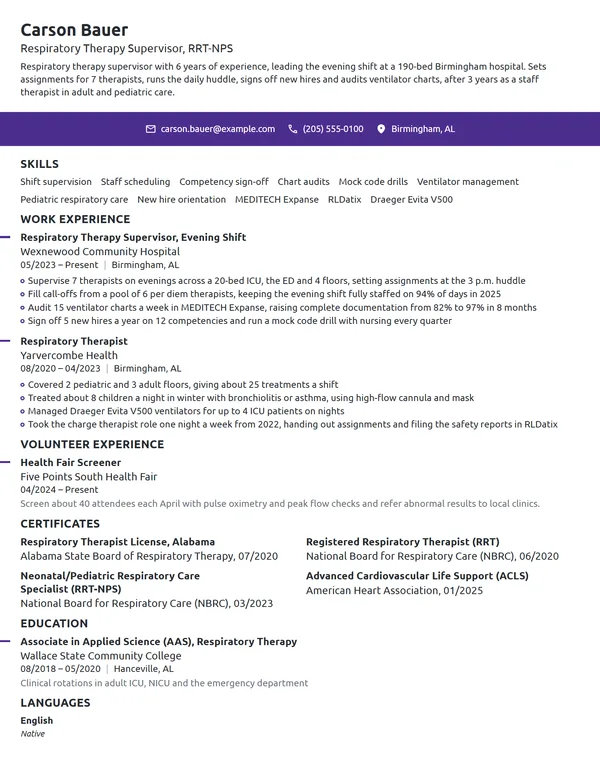
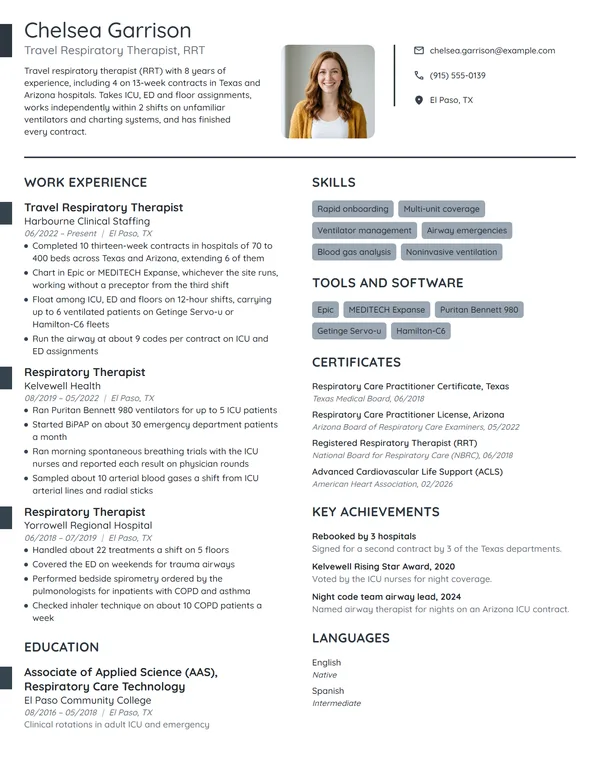
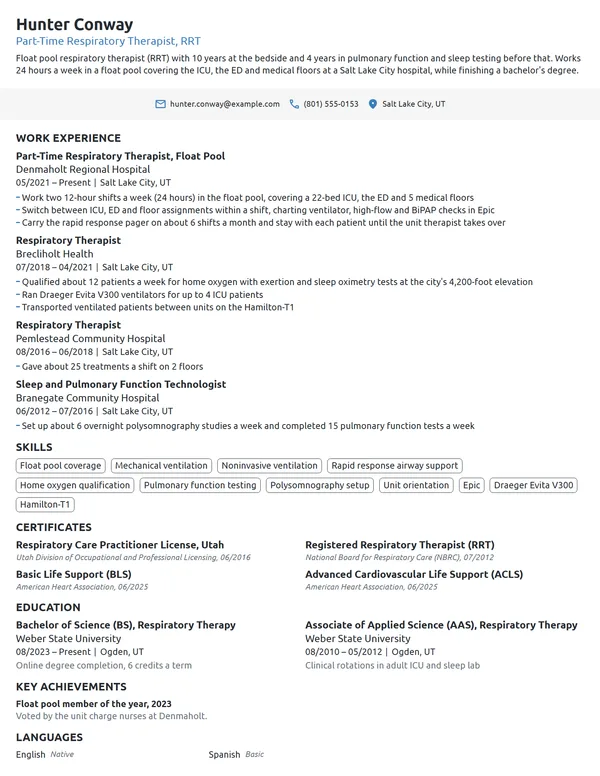
Respiratory therapists keep people breathing, from a premature baby on CPAP to an adult on a ventilator after surgery. The managers who hire them check 3 things first: your credential and state license, the units and patients you have covered, and whether you can run their equipment without someone at your elbow. Most of that fits in a few lines. Turning a shift of treatments, blood gases and codes into bullets with numbers takes more thought, and those numbers are what let a manager picture you on their floor.
How to Write a Respiratory Therapist Resume - Key Takeaways
- Use the reverse-chronological format on 1 page, and move to 2 only for lead or supervisor roles with 10+ years.
- Put your credentials in the headline, such as Respiratory Therapist, RRT, RCP, and list your state license first under Certificates.
- Open each job with the hospital's size and the units you covered, then give your usual assignment.
- Count what your department already tracks: ventilated patients, treatments a shift, blood gases, codes, weaning results and students precepted.
- Name your ventilators and charting system under Skills, and prove each one in a bullet.
- Test the file with an ATS resume checker, since many hospital portals search for credential keywords such as RRT, BLS and ACLS.
What respiratory care managers look for in a respiratory therapist resume
A respiratory care manager reads your resume to learn which NBRC level you hold, if you hold a license in their state, and which patients you can take on day 1. The Bureau of Labor Statistics lists examining patients with breathing or cardiopulmonary disorders, performing diagnostic tests, treating patients, monitoring their progress and teaching them to use medications and equipment as core duties. O*NET ranks setting up and operating mechanical ventilators as the job's most important task, followed by monitoring responses to therapy such as arterial blood gases.
Set the sections in this order:
- Name, headline with your credentials (for example, Respiratory Therapist, RRT, RCP) and contact details
- Summary: 2 to 3 lines under your name, no heading
- Work Experience, newest job first, with the units you covered in the bullets
- Certificates: your state license, then NBRC credentials and life support cards
- Skills, with the ventilators and charting system you know
- Education
- Optional: Key Achievements, Volunteer Experience or Languages
Best format for a respiratory therapist resume
Use the reverse-chronological resume format: your current job on top, each entry with the title, the hospital or agency, its city and MM/YYYY dates. Respiratory careers move from staff therapist to specialty units, lead or supervisor roles and education, and this order shows that path. Per diem shifts at a second hospital get their own entry beside your main job.
- Best for most respiratory therapistsReverse-chronologicalYour jobs, newest first, with your results under each one.Best for: A steady work history in your field
- FunctionalSkills grouped up top, with a short work history below.Best for: Gaps or very little experience
- CombinationA skills section first, then your full work history.Best for: A career change with strong skills
A staff therapist with under 10 years of work needs only 1 page. A second page suits lead therapists, supervisors and educators with several roles to show, as long as your license, your NBRC credential and your current job all sit on page 1.
| Setting | What to use |
|---|---|
| Length | 1 page; 2 for lead, supervisor or educator roles with 10+ years |
| Headline | Title plus credentials: Respiratory Therapist, RRT-NPS, RCP |
| Dates | MM/YYYY for each role; Present marks your current one |
| Units | Named in your bullets: adult ICU, NICU, ED, floors, pulmonary function lab |
| Photo and personal details | Usually no photo in the US and Canada; your birth date, marital status and Social Security number stay off too |
| File | A PDF with standard headings, or Word if the hospital portal asks for it |
Most US and Canadian resumes carry no photo. Hospital careers sites read your file into their own form fields, so plain section headings and one column of dates help more than any design choice.
Respiratory therapist resume summary vs. objective
Once you have worked as a therapist, write a resume summary: your credential, your years, the settings you work in and 1 result. Before your first job, a resume objective fits better: the unit or new grad role you want, your exam status and the clinical rotations that prepared you. Either way, take its number from a bullet further down.
Respiratory therapist resume summary formula
Credential respiratory therapist with X years in settings, at a size and type of hospital. 1 result with a number. Specialty credential or next step.
Example
Registered respiratory therapist with 7 years in adult critical care and emergency care at a 310-bed hospital. Trained 31 therapists on a new ventilator fleet. Preparing for the Adult Critical Care Specialist exam in 2027.
Don't
Dedicated respiratory therapist with strong patient care skills, looking for a challenging role in a growing hospital.
Do
RRT with 4 years at a 160-bed community hospital, covering the ICU, the ED and 3 medical floors. Airway therapist at about 6 codes a month, with the RRT-NPS for delivery room calls.
The rewrite gives the hospital's size, the units, a monthly volume and a specialty credential.
How to write respiratory therapy work experience bullets with numbers
Write 3 to 4 bullets for the job you hold now and 1 to 3 for each earlier hospital. Lead with the hospital's size, the units you covered and your usual assignment, because a manager weighs every later number against it. Then turn duties into achievements on your resume by adding a count or a before and after.
| Area | What to count | Example bullet |
|---|---|---|
| Ventilator care | Ventilated patients a shift, weaning trials, extubations | Carried up to 5 ventilated adults a shift on a 16-bed medical ICU. |
| Treatment volume | Treatments a shift, floors covered, protocol assessments | Delivered 28 to 35 nebulizer and airway clearance treatments a shift across 3 medical floors. |
| Emergencies | Codes, rapid responses, intubations, transports | Responded as airway therapist to about 150 codes and rapid responses a year. |
| Blood gases and diagnostics | ABGs a shift, pulmonary function tests, turnaround | Drew and analyzed 15 to 20 arterial blood gases a shift, calling critical values to the physician within 10 minutes. |
| Patient safety | Unplanned extubations, device-related pressure injuries | Added a BiPAP mask skin check every 4 hours and cut device-related pressure injuries from 7 to 1 in a year. |
| Teaching | Students precepted, staff trained, patients taught | Taught inhaler and home oxygen use to about 12 COPD patients a week before discharge. |
Here is how those numbers sit in a staff therapist's entry. The units and assignment come first, a measured result follows, and the older job shrinks to 1 line.
Work Experience
- Cover 10 to 13 patients a shift across a 24-bed adult ICU and 2 step-down units in a 310-bed hospital, including 4 to 6 on ventilators.
- Run the daily spontaneous breathing trial screen with ICU nurses; median ventilator days on the unit fell from 5.1 to 4.2 in 18 months.
- Manage the airway at about 8 codes and rapid responses a month and confirm every tube placement with end-tidal CO2.
- Gave 30 to 40 aerosol, CPAP and airway clearance treatments a shift across 4 medical floors and the 14-bed emergency department.
Don't
Performed breathing treatments as ordered.
Do
Assessed about 20 floor patients a day under the therapist-driven protocol and stopped 6 to 8 treatments a week that no longer met criteria.
Protocol work shows judgment, not only volume.
Don't
Responsible for equipment checks.
Do
Checked and logged 22 ventilators and 40 BiPAP units each week, and pulled 3 failing units from service before they reached a patient.
Respiratory therapy skills and equipment for your resume
Pick 6 to 8 hard skills for your resume that the posting names and your bullets already prove. Ventilator management and blood gas analysis belong on nearly every hospital therapist's list; neonatal ventilation, pulmonary function testing or home oxygen setups only where you have done them.
Hard skills for respiratory therapists
- Mechanical ventilation and weaning
- Noninvasive ventilation (BiPAP, CPAP)
- Arterial blood gas sampling and analysis
- Airway management and intubation assist
- Aerosol and inhaled medication delivery
- Airway clearance therapy
- Oxygen and high-flow nasal cannula therapy
- Pulmonary function testing
- Protocol-based patient assessment
- Tracheostomy care
Soft skills respiratory care managers value
- Composure during codes
- Clear reports to physicians and nurses
- Patient and family teaching
- Care with equipment checks
- Prioritizing a full assignment
- Working alongside nurses at the bedside
Write equipment by make and model where you can, such as Hamilton, Servo or Puritan Bennett ventilators, because managers hiring for a unit want to know whether you need training on its fleet. O*NET flags MEDITECH and eClinicalWorks EHR software as hot technologies for respiratory therapists, along with Microsoft Office. Whatever system you charted in, Epic included, write its exact name under Skills and again in the bullet where you used it.
RRT, CRT and state license: how to list respiratory therapy credentials
The BLS states that respiratory therapists must be licensed in all states except Alaska, where national certification is recommended. The license comes from your state board, and the national credentials come from the National Board for Respiratory Care (NBRC). List certifications on your resume in this order: state license, NBRC credentials, then life support cards, each with its issuer and month.
| Credential | Issued by | What it takes |
|---|---|---|
| State license (in California, Respiratory Care Practitioner, RCP) | Your state board, such as the Respiratory Care Board of California | In California: a CoARC-accredited program with at least an associate degree, the NBRC's RRT credential and an approved 3-hour law and professional ethics course. |
| CRT (Certified Respiratory Therapist) | National Board for Respiratory Care (NBRC) | An associate degree or higher from a CoARC-accredited program and the low cut score on the NBRC's multiple-choice exam. |
| RRT (Registered Respiratory Therapist) | National Board for Respiratory Care (NBRC) | The high cut score on the multiple-choice exam (offered through 12/2026) plus the Clinical Simulation Examination; from January 2027, the high cut score on the new RT Examination. |
| RRT-NPS (Neonatal/Pediatric Specialist) | National Board for Respiratory Care (NBRC) | The RRT, then the NPS exam. |
| RRT-ACCS (Adult Critical Care Specialist) | National Board for Respiratory Care (NBRC) | At least 1 year as an RRT, then the ACCS exam. |
| BLS and ACLS; NRP or PALS for neonatal and pediatric roles | American Heart Association; NRP from the American Academy of Pediatrics | Provider courses with a card date; write the month from your current card. |
Critical care postings sometimes ask for CCRN. That is AACN's nursing credential, and AACN requires a current RN or APRN license, so it does not belong on a respiratory therapist's resume. The therapist's equivalent is the RRT-ACCS.
How to show an NBRC exam in progress
Write each credential you hold with its month, and add the exam you are waiting on as its own line with a status, such as Clinical Simulation Examination, scheduled 11/2026. The NBRC's single RT Examination starts on January 4, 2027: its low cut score earns the CRT and its high cut score the RRT, so name that exam if you sit it after that date. Put RRT after your name only once the NBRC has awarded it, and RCP or your state's license title only once the board has issued it.
Certificates
- Respiratory Care Practitioner (RCP), California, Respiratory Care Board of California, 09/2019
- Registered Respiratory Therapist (RRT), National Board for Respiratory Care (NBRC), 08/2019
- Advanced Cardiovascular Life Support (ACLS), American Heart Association, 01/2026
- Basic Life Support (BLS), American Heart Association, 01/2026
How to list an associate or bachelor's degree in respiratory care
According to the BLS, respiratory therapists typically need at least an associate's degree in respiratory therapy from an accredited program, and some employers prefer a bachelor's. The NBRC's exams require a program supported or accredited by the Commission on Accreditation for Respiratory Care (CoARC), so write your degree's exact name and the school as it appears on your diploma. If you are finishing a bachelor's degree while working, list it first with its expected date.
Follow the usual rules for listing education on a resume: degree, school, city and graduation month. In your first 2 years, add 1 line with your clinical rotations by unit; after that, the line is optional.
Education
Clinical rotations: adult ICU, NICU, emergency department and pulmonary function lab.
New grad and career-change respiratory therapist resumes
As a new graduate, your objective carries the credential news: NBRC exam passed or scheduled, license applied for or issued, each with its month. Rotations stand in for job history, so give your strongest one real detail, such as the unit, its patients and what you did without help by the end. The entry-level resume layout also works if you have little paid work to show.
- Clinical rotations: 1 line under Education with the units, and a fuller entry for the rotation you want to work in.
- Care jobs during school: CNA, EMT or patient care technician work as a full Work Experience entry with patients a shift.
- Sleep lab or equipment work: sleep studies scored or home ventilators set up, with a count.
- Asthma camps and health fairs: under Volunteer Experience, with the number of children or adults you screened or taught.
Don't
Recent respiratory therapy graduate seeking an entry-level position to gain experience.
Do
Respiratory care graduate (A.S., 05/2026), RRT since 08/2026, seeking a new grad role in adult critical care. Assisted with 18 extubations during 6 weeks of ICU rotations.
Dates, a credential and a count turn a wish into evidence.
Coming from EMS, nursing assistant work or a sleep lab, keep reverse-chronological order and lead with the new degree and credential. Under the older jobs, keep the bullets that carry over: airway work, patient assessment, equipment and work under pressure. Our career-change resume examples show the layout, and a cover letter explains the move in a few lines; these healthcare cover letter examples show how to keep that paragraph short.
Respiratory Therapist resume FAQ
Should I write RRT or CRT after my name on a respiratory therapist resume?
Write the highest NBRC level you hold, plus any specialty: RRT, or RRT-NPS or RRT-ACCS. A CRT writes CRT. Add your state license title, such as RCP in California, after it, and list the same credentials with their months under Certificates.
Should I put my respiratory care license number on my resume?
No. Write the license title, the state, the issuing board and the month it was issued. Employers check the license with the board themselves, and the number does not need to travel through every application portal you use.
How do I list NBRC exams I have not passed yet?
List what you hold, then add the exam as its own line with a status and month, such as Clinical Simulation Examination, scheduled 11/2026. From January 4, 2027, the NBRC's RT Examination awards the CRT at its low cut score and the RRT at its high cut score.
Can a respiratory therapist earn the CCRN?
No. AACN requires a current RN or APRN license for the CCRN (Adult), so it is a nursing credential. For adult critical care, respiratory therapists earn the RRT-ACCS from the NBRC after at least 1 year as an RRT.
How long should a respiratory therapist resume be?
1 page covers a new grad or a staff therapist. Lead therapists, supervisors and clinical educators with 10+ years can use 2 pages, provided the license, the NBRC credential and the current job all appear on page 1.
Which ventilators and equipment should I list on my resume?
List the ventilators, noninvasive devices and blood gas analyzers you can run on your own, by make and model where you know it. Put them under Skills and prove each in a bullet, such as the number of ventilated patients you carry a shift.
Do I need a bachelor's degree to work as a respiratory therapist?
Not usually. The BLS says respiratory therapists typically need at least an associate's degree from an accredited program, though some employers prefer a bachelor's. If you are working toward one, list it above your associate degree with its expected date.
What is the median salary for a respiratory therapist?
The BLS reports that the median annual wage for respiratory therapists was $82,280 in May 2025. Your pay depends on your state, shift, setting and credentials such as the RRT-NPS; keep it off your resume and raise it when an offer is on the table.
Next steps
Pick the example closest to your units and career stage, keep its structure, and replace its numbers with your own: hospital size, assignment, ventilated patients, codes and credentials. Build it in our resume builder or start from one of our templates, and send it with a cover letter that names the unit you want.