
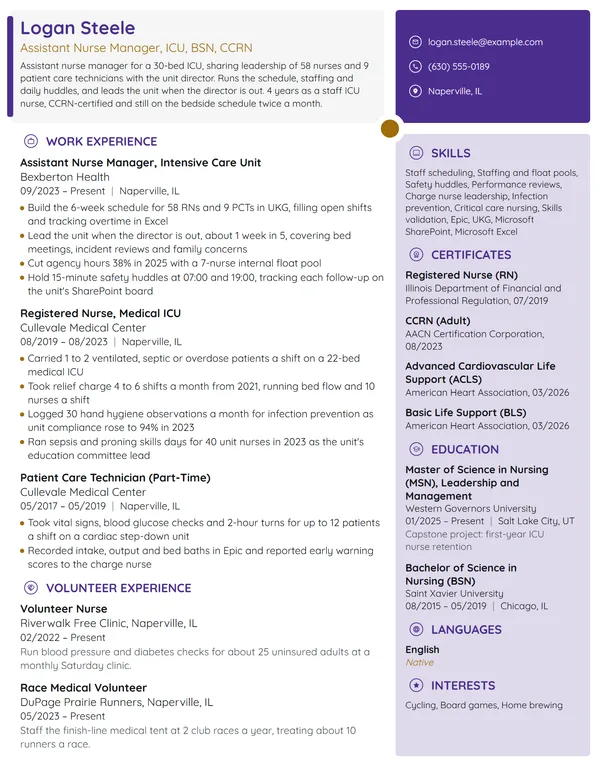
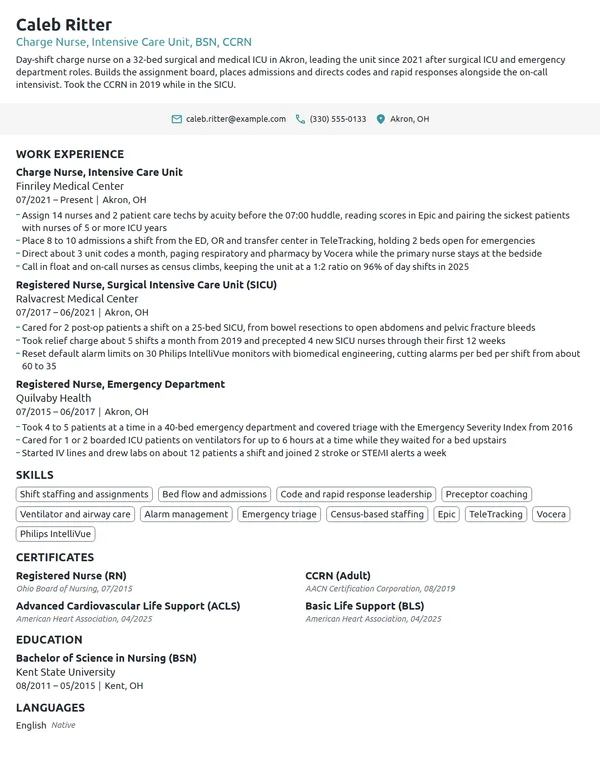
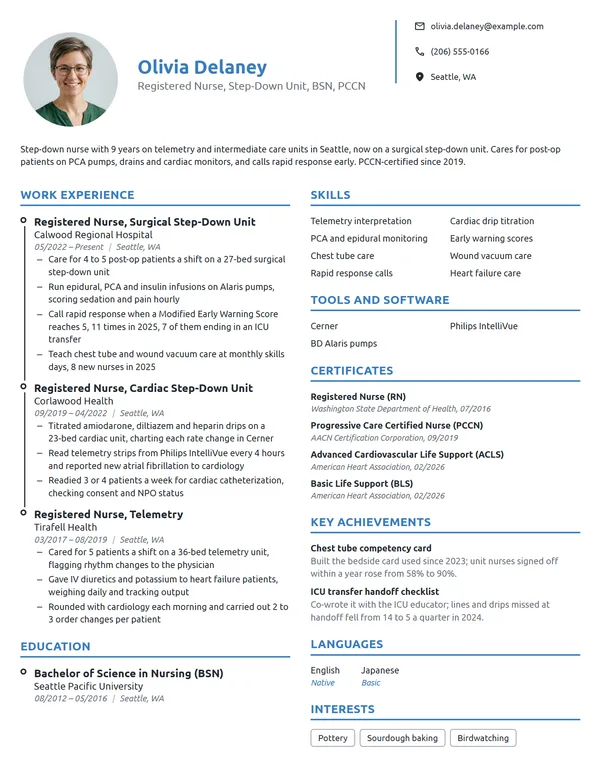
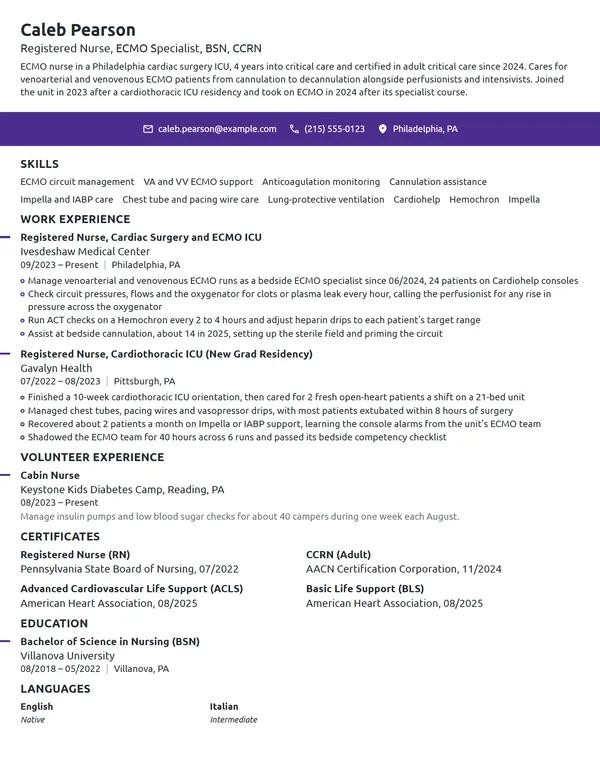
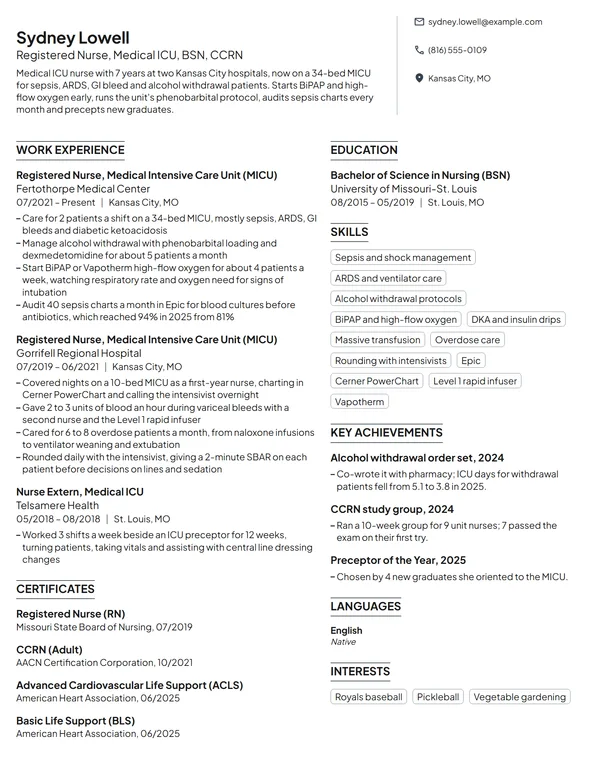
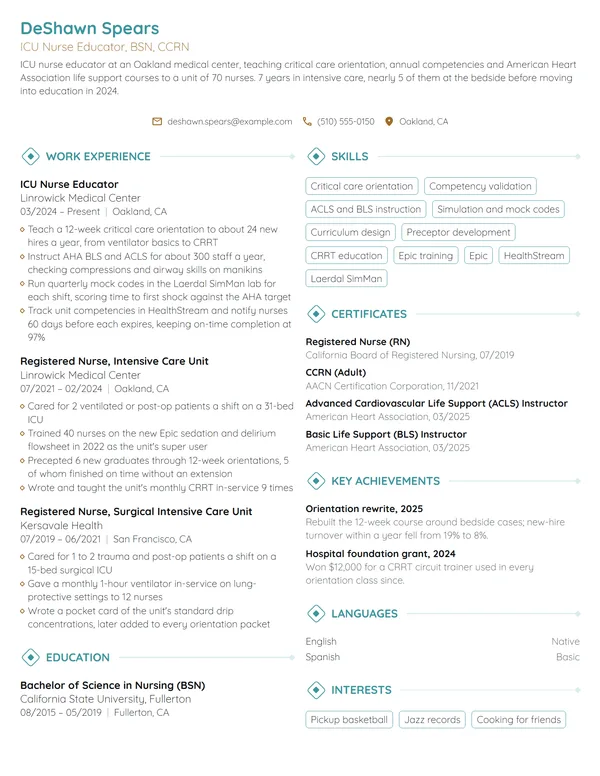
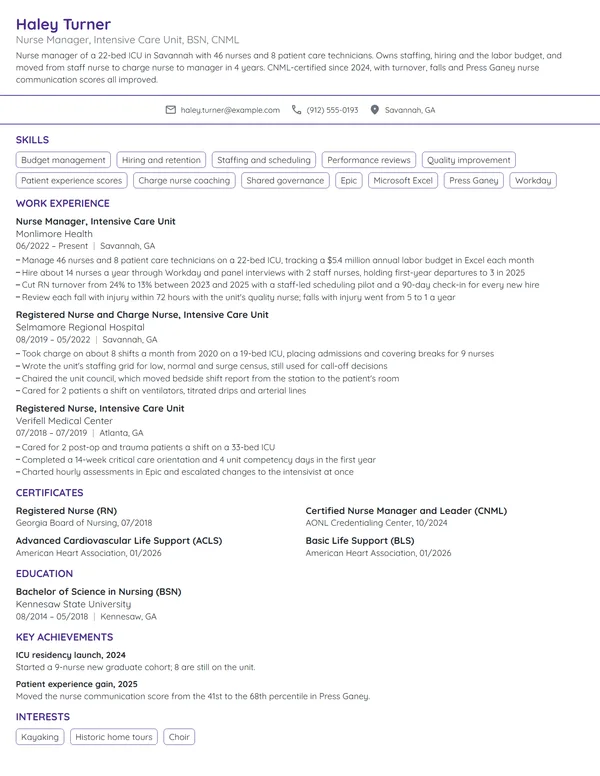
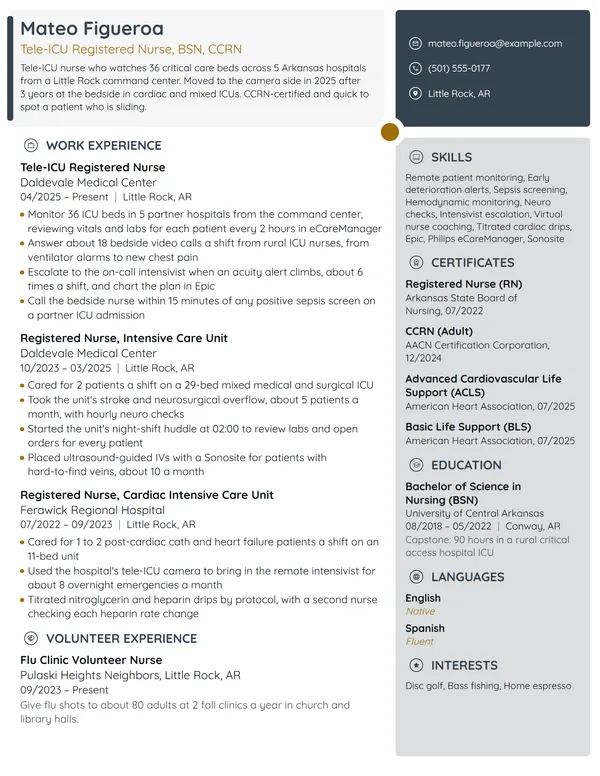
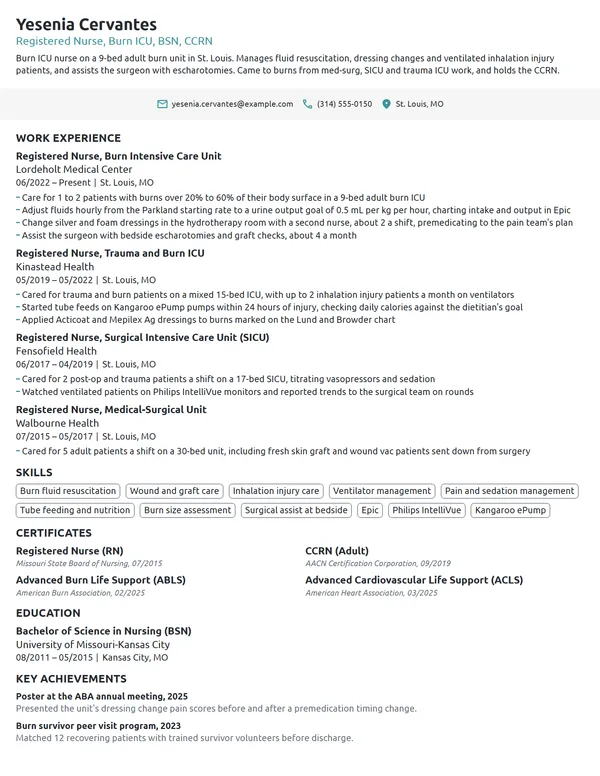
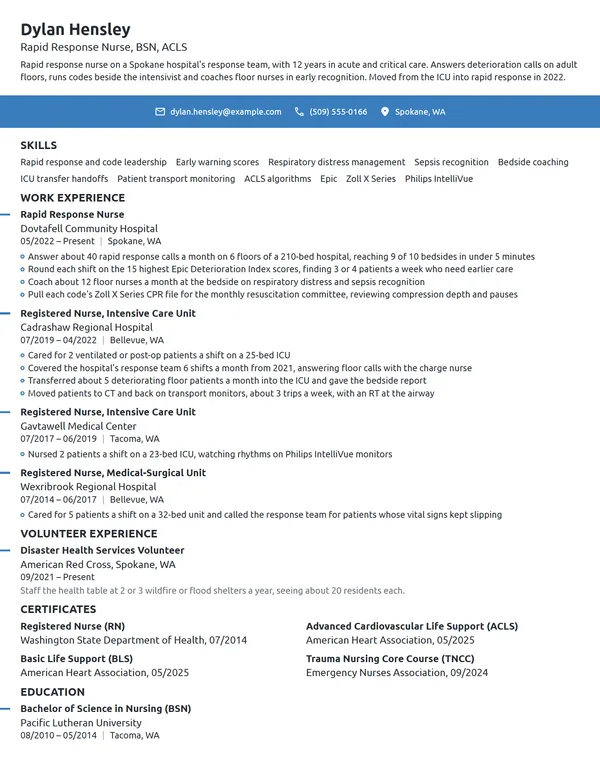
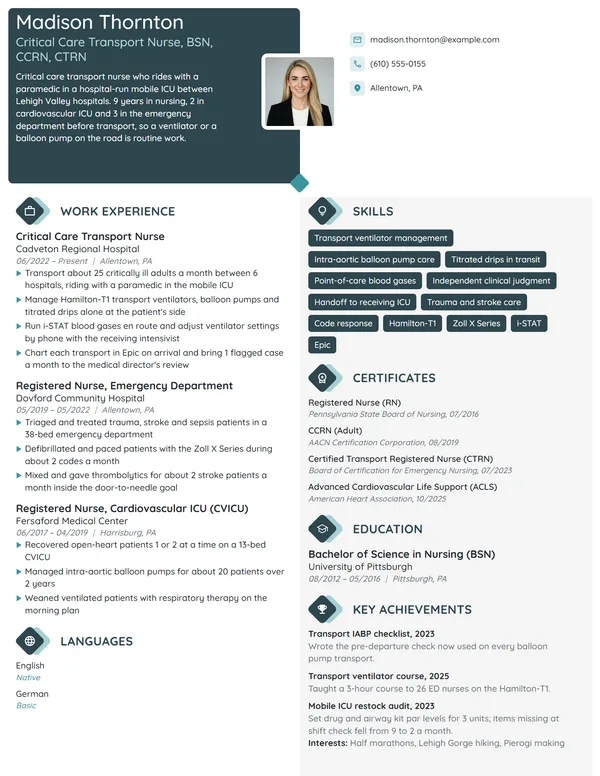
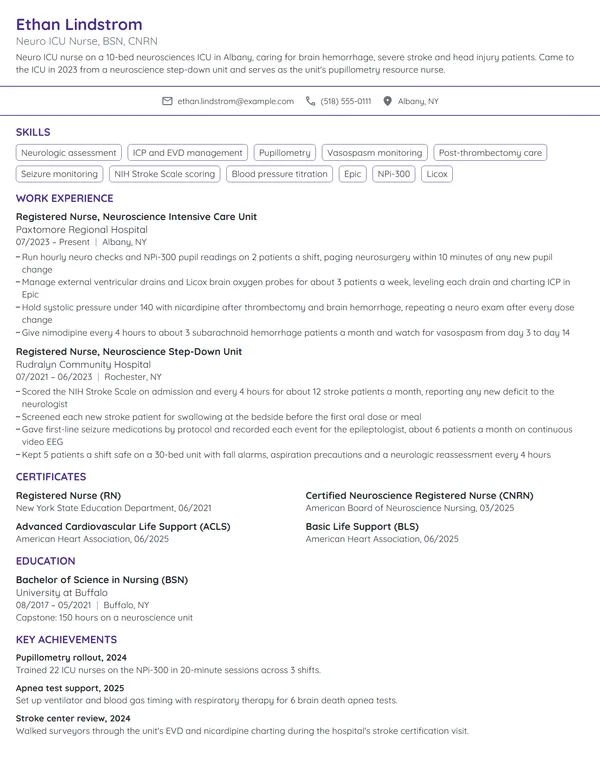
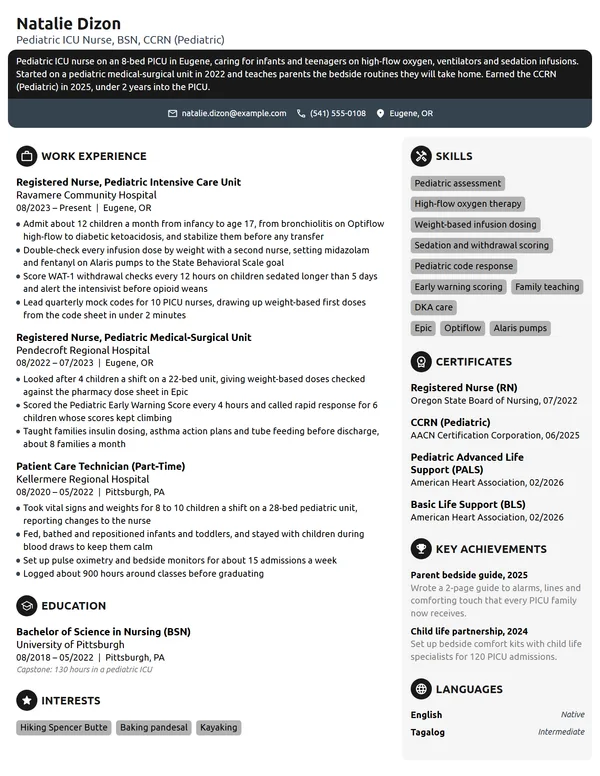
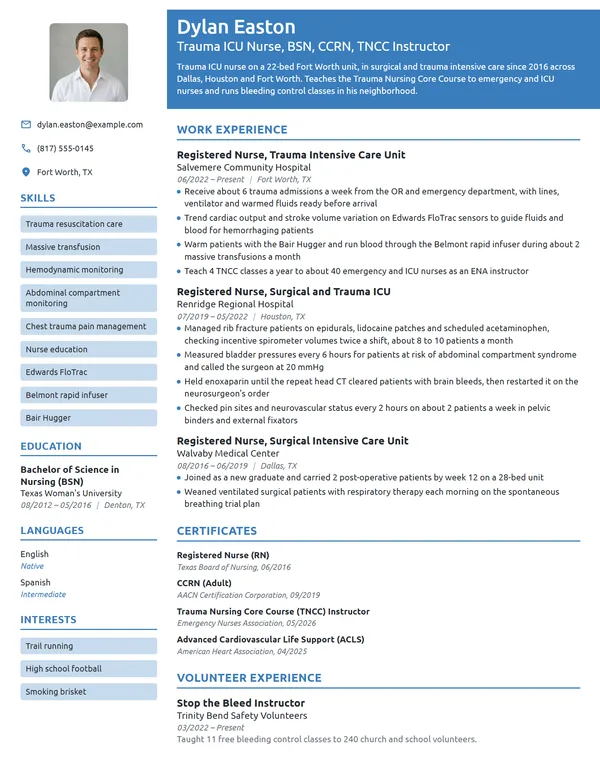
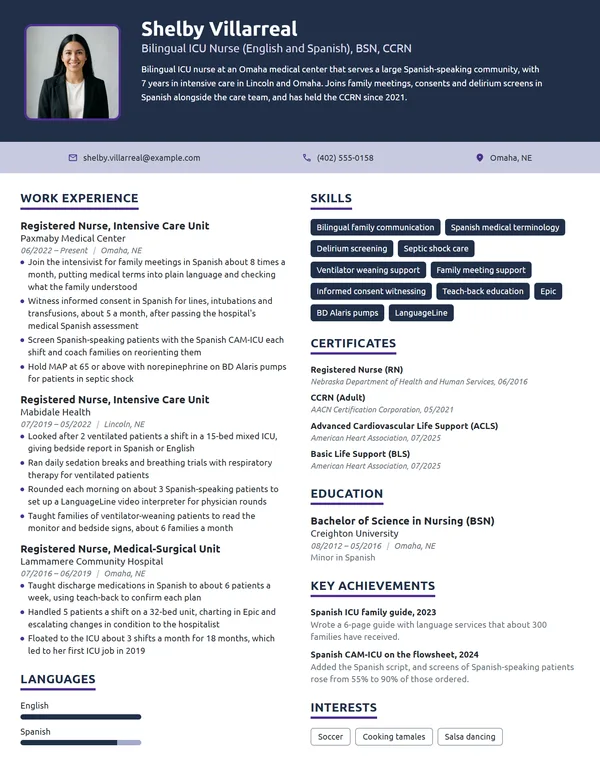
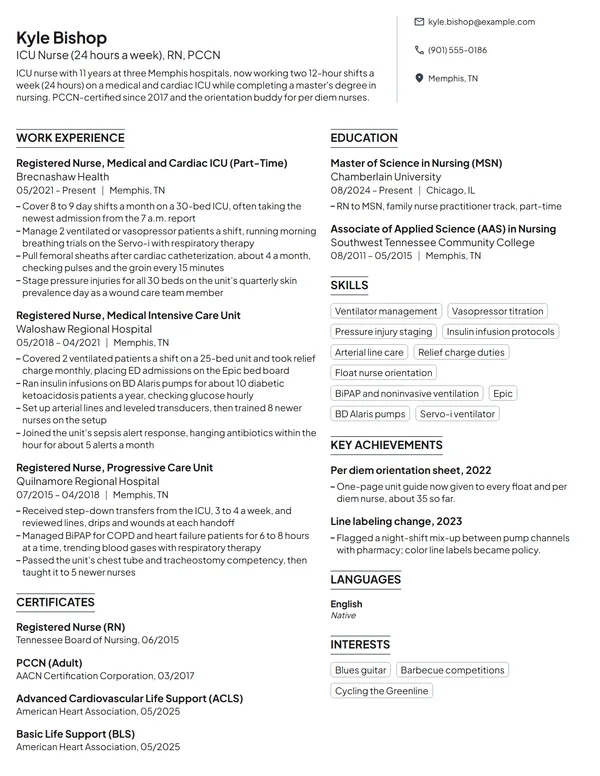
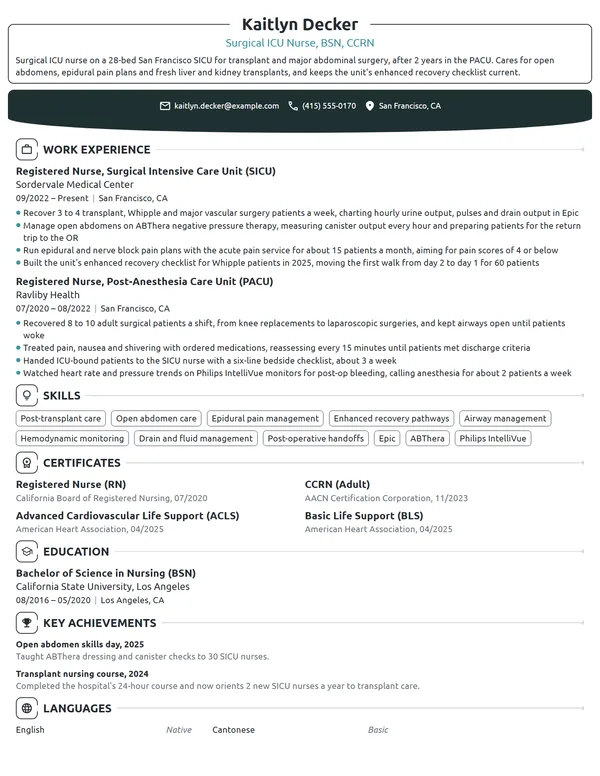
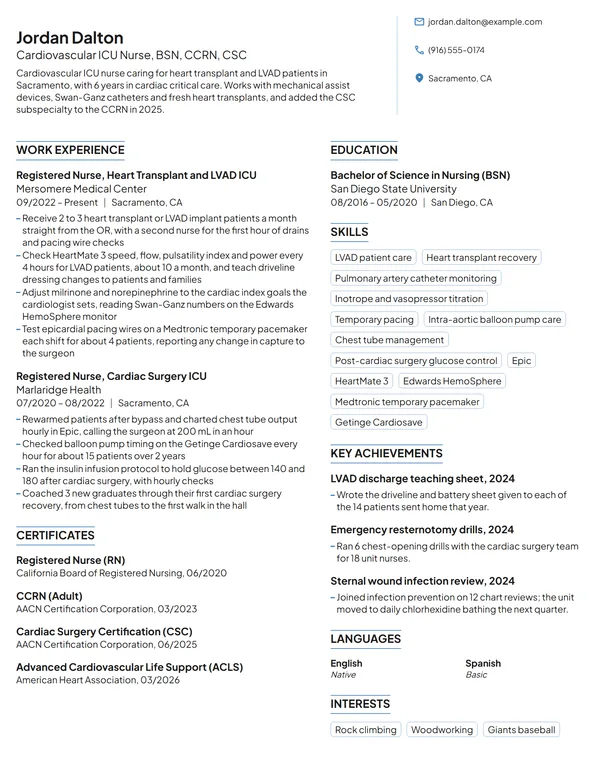
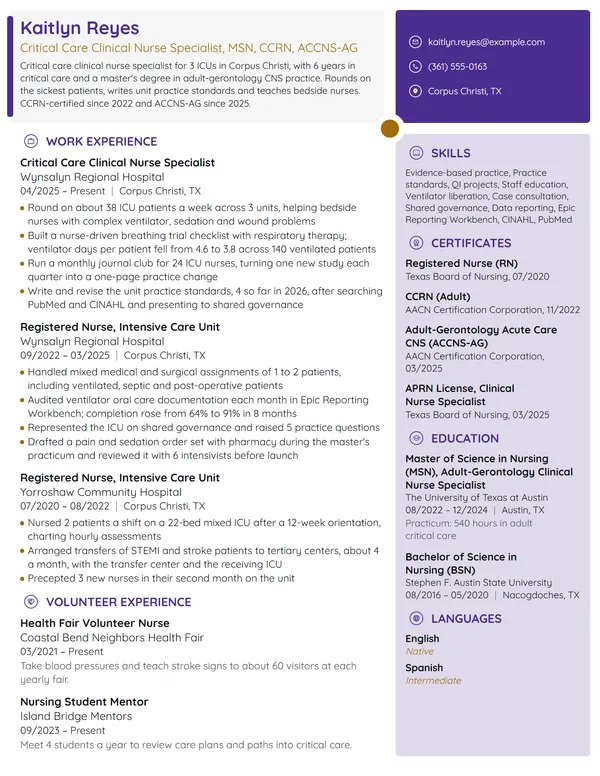
Some hospitals post the job as ICU nurse and others as critical care nurse; either way it means caring for the sickest patients in the building. The first questions are what kind of unit you worked in, how many patients you carried at once, which life support you managed, and whether you hold a critical care certification or are on your way to one. A resume that names the unit, the assignment and a few hard numbers answers all 4 before the interview starts.
How to Write an ICU Nurse Resume - Key Takeaways
- Lay it out newest job first on 1 page, moving to 2 only with 10+ years, charge or leadership roles.
- Write the ICU type and its bed count in every job title line or first bullet, such as Medical Intensive Care Unit, 18 beds.
- Open each ICU job with your usual assignment, then add results the unit tracks: ventilator events, line infections, sepsis bundles or nurses precepted.
- List your RN license first under Certificates, then the CCRN (Adult) with its issuer and the month you earned it.
- Name only the devices and drips you really managed, and prove each one in a bullet.
- Before you apply, scan it with an ATS resume checker, since hospital portals search for ICU, critical care and CCRN as typed.
What ICU nurse managers look for in a critical care resume
According to the Bureau of Labor Statistics, critical care nurses work in hospital intensive care units with patients whose illnesses or injuries need close monitoring and treatment. O*NET files ICU Nurse and Critical Care Registered Nurse (CCRN) under the same occupation, and its core tasks read like an ICU shift: evaluating vital signs and lab data for emergency needs, watching for sepsis or shock, giving IV medications and prioritizing care across your assigned patients.
An ICU manager checks 4 things first: whether your unit resembles theirs (medical, surgical, cardiac, neuro or trauma), how many patients you take, what life support you handle without help, and whether you hold or are near a CCRN. Arrange the page so each answer is easy to find:
- Name, a headline such as Registered Nurse, BSN, CCRN, and contact details
- 2 to 3 summary lines below your name, with no section title
- Work Experience, newest first, with the ICU type in the job title
- Certificates: the RN license, then CCRN, ACLS and BLS
- Skills, with your charting system and the devices you use
- Education
- Optional: a Languages section, and either Volunteer Experience or Key Achievements if space allows
Best format for an ICU nurse resume
Pick the reverse-chronological resume format, with your current ICU job at the top and each entry giving the title with the unit, the hospital, its location and MM/YYYY dates from start to finish. Many ICU nurses arrive through med-surg, telemetry or step-down, and this order shows that climb in acuity at a glance. Keep the format even if you are transferring from another unit: your RN years count, and the skills that carry over belong in the bullets.
- Best for most ICU nursesReverse-chronologicalYour jobs, newest first, with your results under each one.Best for: A steady work history in your field
- FunctionalSkills grouped up top, with a short work history below.Best for: Gaps or very little experience
- CombinationA skills section first, then your full work history.Best for: A career change with strong skills
One page covers most staff ICU nurses through their first decade. Go to 2 pages when charge, preceptor, educator or assistant manager roles need room, but keep your current unit, license and CCRN on page 1.
| Setting | What to use |
|---|---|
| Length | 1 page for staff roles; 2 once leadership or 10+ years need the space |
| Job title line | Title plus ICU type, written out once: Registered Nurse, Surgical Intensive Care Unit (SICU) |
| First bullet | Bed count, your usual assignment and the patients you care for |
| Dates | Month and year as MM/YYYY; Present marks the job you hold now |
| Personal details | A photo is unusual in the US and Canada; never add your date of birth, marital status or SSN |
| File type | PDF by default; Word only when the hospital's career site requests it |
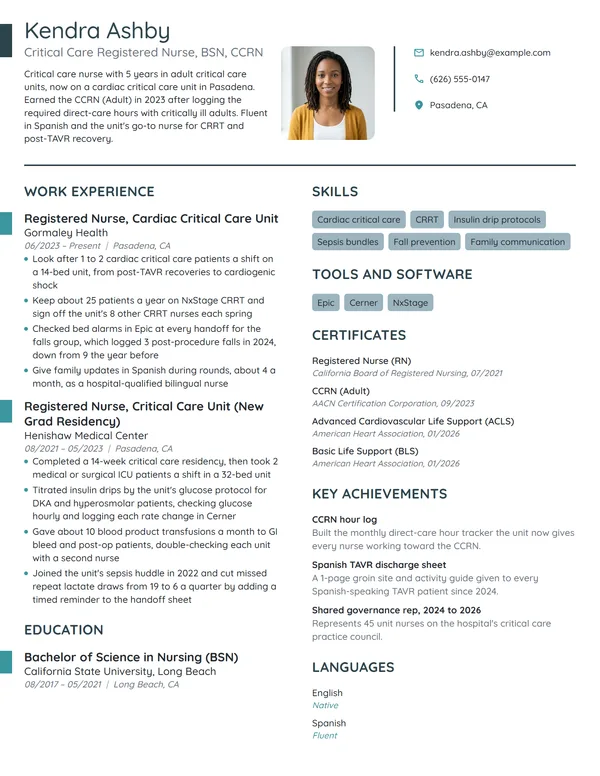
Most US and Canadian resumes carry no photo. Hospital career sites usually read your file into their own form, so standard headings and plain dates travel through that step better than a decorated layout.
ICU nurse resume summary vs. objective
Use one test: if you have already worked as an RN in an ICU, write a resume summary that gives your ICU years, unit type, the patients you manage and 1 result. If your RN years were on another unit, or you are a new graduate, write a resume objective that names the ICU or critical care program you want and the closest experience you have.
ICU nurse resume summary formula
Credentials with X years in nursing, the last Y in a size and type of ICU caring for patients and life support. 1 measured result. CCRN status or your next step.
Example
RN, BSN, CCRN, with 9 years in nursing, the last 7 in an 18-bed medical ICU caring for septic and ventilated adults. Cut the unit's time from sepsis alert to first antibiotic from 74 to 41 minutes as its sepsis champion. CCRN since 2021 and a preceptor for new ICU hires.
Don't
Dedicated ICU nurse with strong critical thinking skills and a passion for caring for critically ill patients.
Do
CCRN-certified RN with 5 years in a 16-bed surgical ICU at a Level I trauma center, mostly caring for patients on ventilators and vasopressors. Takes charge 1 shift a week.
Adjectives give way to the unit, its acuity and a leadership step.
How to write ICU nurse work experience bullets with numbers
Give your current ICU job 3 to 4 bullets and each earlier job up to 4, fewer the further back it goes. The first bullet sets the scale: bed count, your usual assignment of 1 or 2 patients, and what keeps them in the ICU. The rest should turn duties into achievements with numbers your unit already reports, from infection counts to the nurses you trained.
| Area | What to count | Example bullet |
|---|---|---|
| Acuity and assignment | Beds, ratio, ventilated patients, drips, devices | Cared for 1 to 2 patients a shift in a 12-bed cardiovascular ICU, including fresh open-heart patients on 3 to 5 drips. |
| Infection prevention | CLABSI, CAUTI, ventilator-associated events | Audited the ventilator bundle on 14 beds each week; ventilator-associated events fell from 7 to 2 in a year. |
| Sepsis | Bundle compliance, time to antibiotics | Raised 3-hour sepsis bundle compliance on the unit from 68% to 87% as its sepsis resource nurse. |
| Early mobility | Patients mobilized, days to first walk, delirium screens | Led an early mobility pilot that got 40 ventilated patients out of bed within 48 hours of intubation. |
| Rapid response | Calls attended, codes, transfers to the ICU | Answered about 6 rapid response calls a month on medical floors as the ICU outreach nurse. |
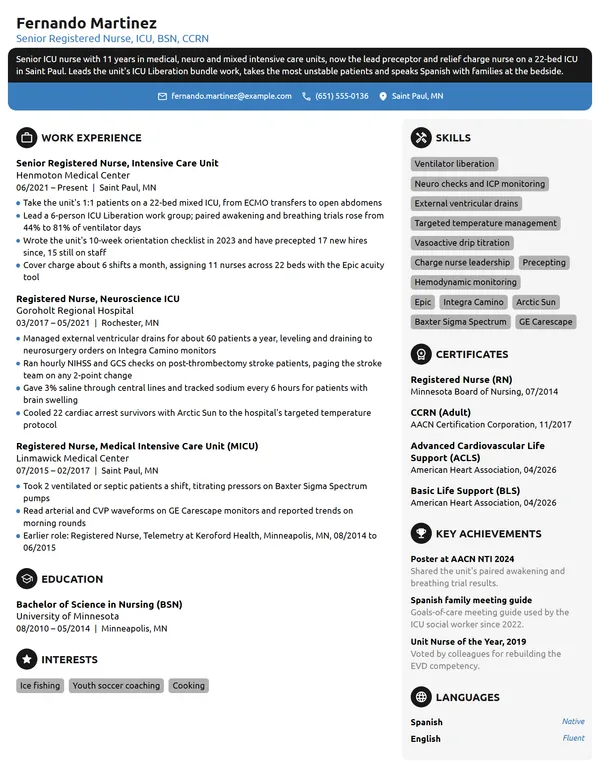
| Leadership | Charge shifts, beds placed, nurses precepted | Ran charge 2 shifts a week for 20 beds, placing ED and OR admissions with no diverted transfers in 2025. |
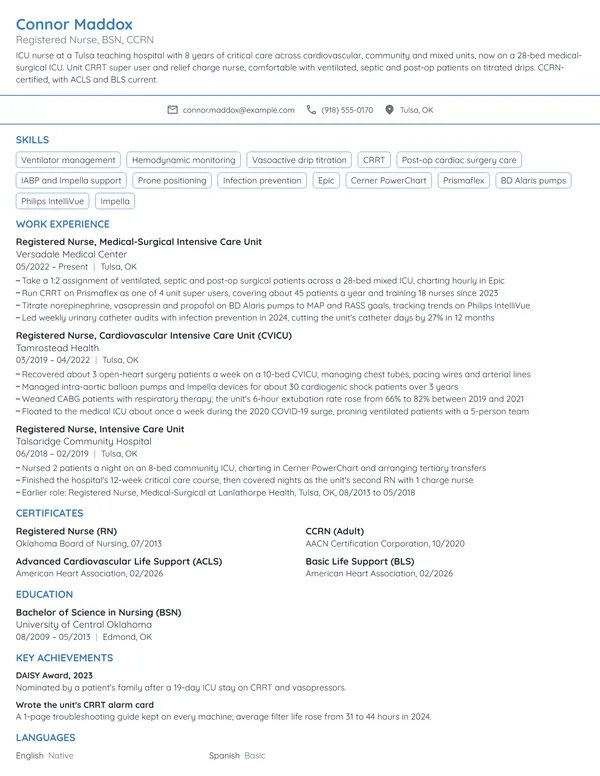
Here is one nurse who came to the ICU from step-down: the older job stays short and the current one carries the results.
Work Experience
- Care for 2 patients a shift on an 18-bed MICU, most on mechanical ventilation, titrated sedation or vasopressors.
- Screen each assigned patient for delirium every shift with CAM-ICU; helped raise the unit's documented screening rate from 61% to 92% in 9 months.
- Joined the unit's CLABSI team; central line infections dropped from 6 in 2023 to 1 in 2025 after daily line-necessity huddles.
- Precept 2 to 3 new ICU nurses a year through a 16-week critical care orientation.
- Managed 3 to 4 patients a shift on a 26-bed progressive care unit, including BiPAP, heparin drip and post-op cardiac patients.
Don't
Monitored critically ill patients and administered medications.
Do
Titrated vasopressors and sedation for 2 ventilated patients a shift against the unit's sedation protocol, with 0 unplanned extubations in 2025.
Now the drugs, the load and a safety result an ICU manager tracks are all on the line.
Don't
Participated in quality improvement projects on the unit.
Do
Rebuilt the turning schedule with 2 colleagues; hospital-acquired pressure injuries on the unit fell from 11 to 4 in a year.
Critical care nursing skills and EHR software for your resume
Pick 6 to 8 hard skills for your resume that match the posting and appear somewhere in your bullets. A medical ICU nurse leads with ventilator care and sepsis; a cardiovascular ICU nurse with hemodynamics and post-op cardiac surgery care; a neuro ICU nurse with neuro checks and intracranial pressure monitoring.
Hard skills for ICU nurses
- Hemodynamic monitoring
- Ventilator and airway care
- Vasoactive drip titration
- Sedation and pain assessment
- Arterial and central line care
- Sepsis recognition and bundles
- Continuous renal replacement therapy (CRRT)
- Code and rapid response
- Post-op cardiac surgery care
- Neuro checks and ICP monitoring
Soft skills critical care teams rely on
- Fast clinical judgment
- Prioritizing unstable patients
- SBAR handoffs
- Speaking up during rounds
- Composure during codes
- Supporting families through bad news
Name your charting system in Skills and again in a bullet. For critical care nurses, O*NET marks Epic Systems, MEDITECH software and eClinicalWorks EHR software as hot technologies, along with Microsoft Office and SharePoint. Oracle bought Cerner in June 2022, so write Oracle Health only for work after that date; Cerner is right at any date. Pumps, monitors and devices such as Impella or ECMO circuits go in a bullet that shows your role, never as a bare list.
CCRN, PCCN and your RN license on an ICU nurse resume
The BLS states that registered nurses must hold a license from the state they work in, earned by graduating from an approved program and passing a qualifying exam, the NCLEX. Put that license first, then list certifications on your resume in order of weight for an ICU: CCRN, any subspecialty, then ACLS and BLS. If your license is multistate, say so: NCSBN counts 43 Nurse Licensure Compact jurisdictions, which matters for ICU travel and float roles.
| Credential | Issued by | What it takes |
|---|---|---|
| RN license | Your state board of nursing | An approved nursing program and a passed NCLEX; multistate status where your home state is in the compact. |
| CCRN (Adult) | AACN Certification Corporation | A current RN or APRN license and 1,750 direct-care hours with acutely or critically ill adults in 2 years (875 in the latest year), or 2,000 hours in 5 years (144 in the latest year). Pediatric and Neonatal versions exist. |
| PCCN | AACN Certification Corporation | The same hour options, with acutely ill adults in step-down, telemetry, intermediate care or similar settings. |
| CSC (subspecialty) | AACN Certification Corporation | A current specialty certification such as the CCRN, plus direct care of adult cardiac surgery patients in their first 48 hours after surgery. |
| ACLS and BLS | American Heart Association | Provider courses with a card for each; list the course name in full the first time. |
Keep the CCRN current: each certification period runs 3 years, and AACN asks for 432 direct-care hours with acutely or critically ill adults in that period, 144 of them in the last 12 months, plus 100 continuing education points or a passed exam. Write the month you first earned it; you do not need a renewal date on the resume.
How to show a CCRN before you are eligible
Never add CCRN to your headline until you pass the exam. If you are still building hours, put the credential in Certificates with the status in progress and the month you expect to sit for it, and let your ICU bullets show the hours. Once you pass, move CCRN into the headline after BSN.
Certificates
- Registered Nurse (RN), Virginia, Virginia Board of Nursing, 07/2017
- CCRN (Adult), AACN Certification Corporation, 09/2021
- Advanced Cardiovascular Life Support (ACLS), American Heart Association, 03/2026
- Basic Life Support (BLS), American Heart Association, 03/2026
How to list your BSN or ADN on an ICU nurse resume
Write the degree as it reads on your diploma, then the school, its city and the graduation month, following the standard rules for listing education on a resume. An ADN with a BSN underway shows both, the BSN first with its expected date. A graduate degree, such as an MSN for an educator or nurse practitioner track, goes above the BSN.
New graduates add 1 line under the degree with a GPA of 3.5 or higher and the ICU where they did their capstone, with its hours. Once you have 2 years of ICU work, cut that line: the unit you work on now says more than the one you trained on.
Education
GPA 3.6. Capstone: 160 hours in a 24-bed neuro ICU.
New grad ICU nurse resumes and moving into critical care from another unit
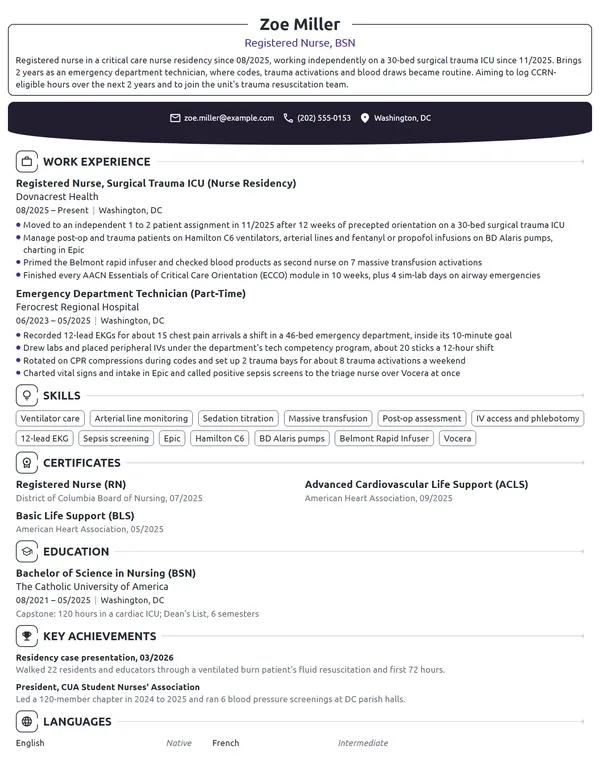
As a new graduate, aim the objective at a critical care residency or new grad program and give your license status with a month: NCLEX scheduled, passed, or license issued. Then put every hour that touched critical care where a manager can count it. If you are still in school, the nursing student resume layout fits better.
- ICU capstone or preceptorship: the unit type, its beds, your hours and how many patients you carried by the last week.
- Patient care technician or nurse aide work in an ICU: its own Work Experience entry with the unit and what you did, such as turns, vital signs and blood draws.
- Step-down, telemetry or ED shifts: drips, monitoring and rapid responses you handled, written as bullets with counts.
- ACLS earned before your first job: under Certificates with its date whenever the posting lists it.
Don't
New graduate nurse seeking an ICU position to gain experience in critical care.
Do
BSN graduate with an RN license issued 07/2026, applying to a critical care nurse residency. Completed a 140-hour capstone in a 20-bed surgical ICU after 2 years as an ICU patient care technician.
Even an objective needs proof: a license date, a unit and a count of hours.
Moving into the ICU from med-surg, telemetry or step-down, stay with newest-first order and pull the critical care parts of your current job into the first bullets: drips you titrate, patients you watch on monitors and rapid responses you start. A PCCN tells an ICU manager you already work at high acuity. A cover letter is where the reason for the move goes, and the healthcare cover letter examples show how to keep that to 1 short paragraph. Coming from outside nursing altogether, see the career-change resume layout.
ICU Nurse resume FAQ
Is an ICU nurse the same as a critical care nurse?
Yes. O*NET lists ICU Nurse and Critical Care Registered Nurse (CCRN) as titles within one occupation, Critical Care Nurses. Use whichever name the posting uses in your headline or summary, and write the other once elsewhere so a search for either finds you.
Do I need a CCRN to get an ICU nursing job?
No, not for a staff role. AACN asks for 1,750 hours with acutely or critically ill adults over 2 years, or 2,000 over 5, before you can sit for the CCRN (Adult), so most nurses earn it on the job. Add it as soon as you pass; until then, your ICU hours and bullets carry the application.
Can I list the CCRN on my resume before I am eligible to sit for it?
Only as a goal, never as a credential. Put CCRN (Adult) under Certificates with the status in progress and the month you plan to test, and keep CCRN out of your headline until you pass.
Does step-down or progressive care experience help an ICU application?
Yes. Step-down work with drips, telemetry and noninvasive ventilation shows you can handle high acuity. Put those tasks in your first bullets, and add the PCCN if you hold it, since AACN builds it on the same hour rules as the CCRN.
Can a new grad nurse get hired straight into the ICU?
Yes, where a hospital takes new graduates into its ICU through a residency or new grad program. Show your license status, an ICU capstone with its hours, and any patient care technician work on a critical care unit, and write an objective that names the program.
How long should an ICU nurse resume be?
1 page for most staff ICU nurses. Move to 2 pages after 10+ years or once charge, preceptor or assistant manager roles need room, with your current unit, license and CCRN on page 1.
Should I list ventilators, drips and CRRT on an ICU nurse resume?
Yes, if you managed them yourself. Name each device or therapy the way the posting does, list it with your skills, and back it with a bullet that has a count, such as patients you cared for on CRRT in a year.
How much do ICU nurses make?
The BLS does not publish a separate figure for ICU nurses; the median annual wage for registered nurses overall was $97,550 in May 2025. Unit, shift, state and certifications all move ICU pay, and the number belongs in the offer conversation rather than on your resume.
Next steps
Choose an example that matches your ICU type and career stage, then swap in your own unit, bed count, assignment, devices and results. Our resume builder and templates keep the layout clean, and a short letter naming the unit you want and your best critical care number completes the application.