
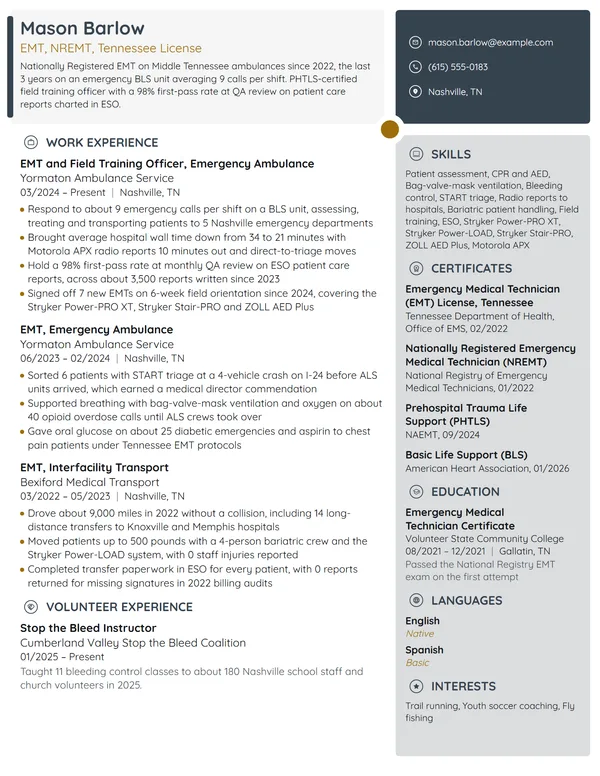
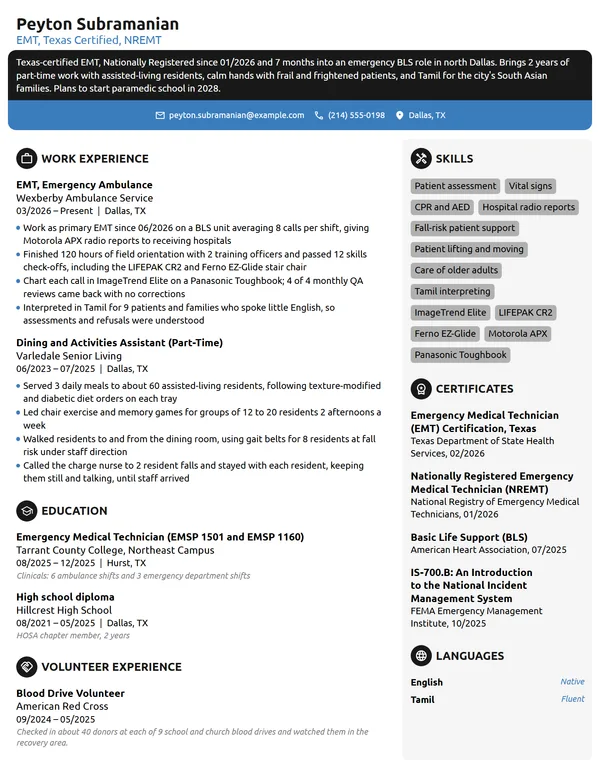
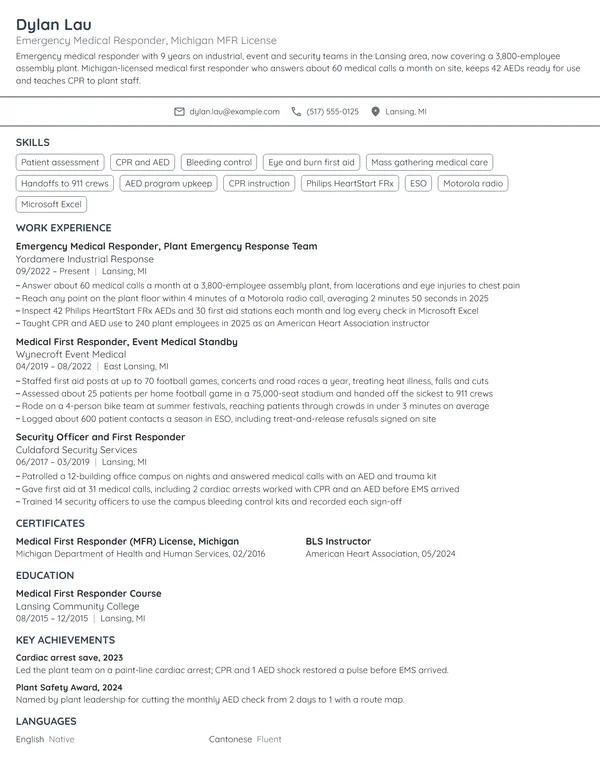
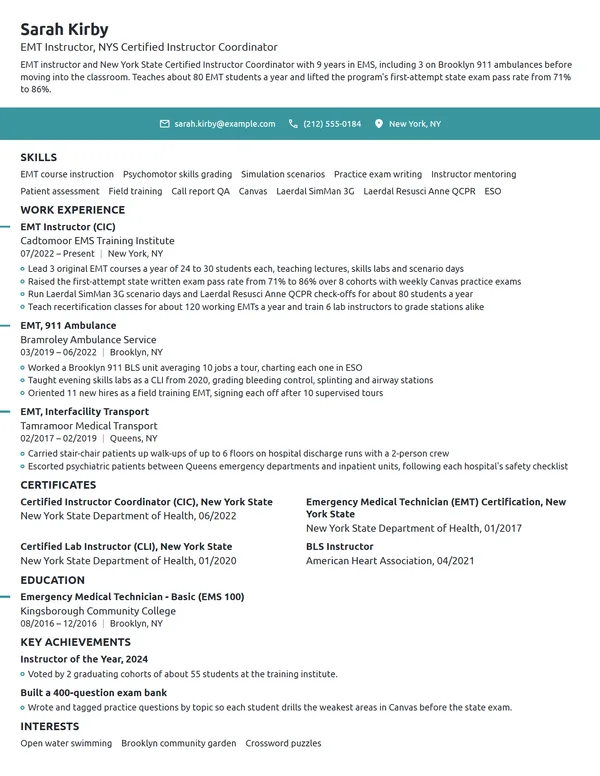
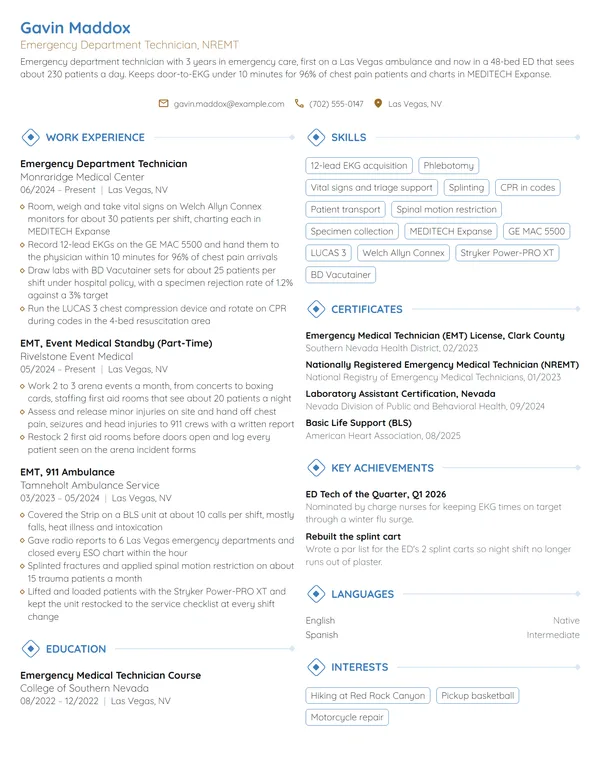
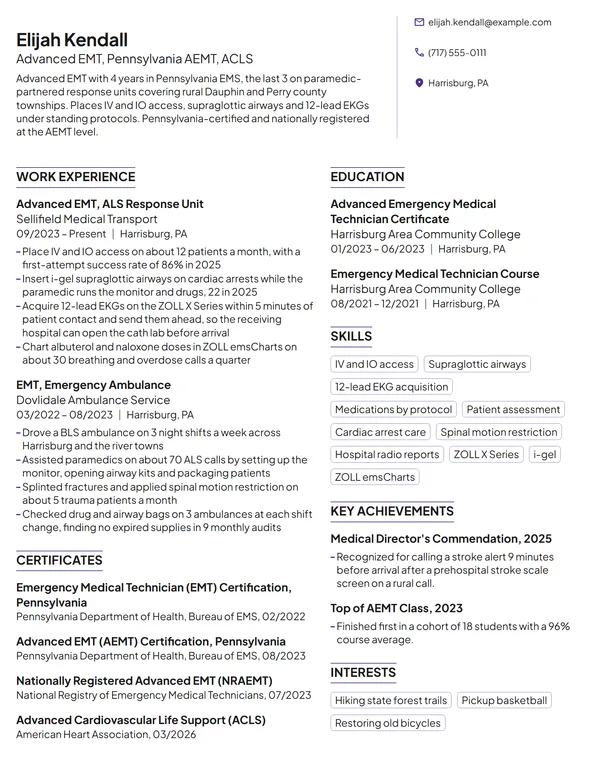
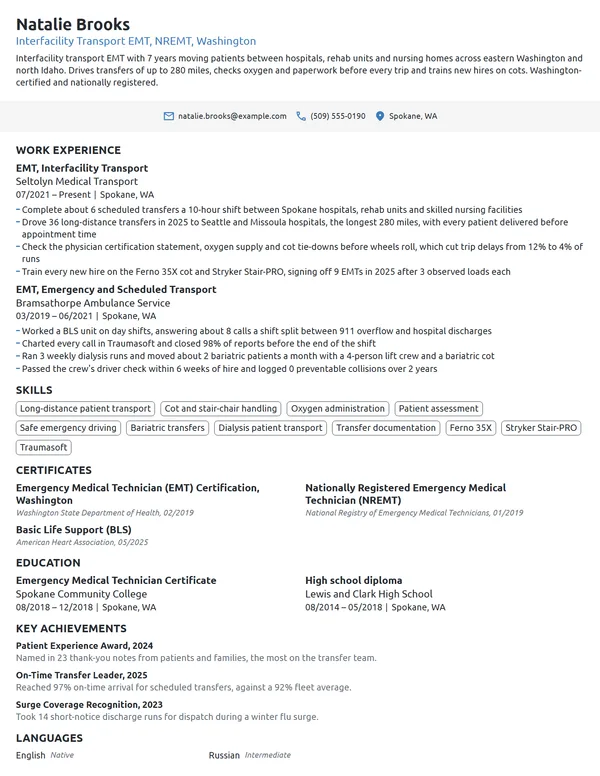
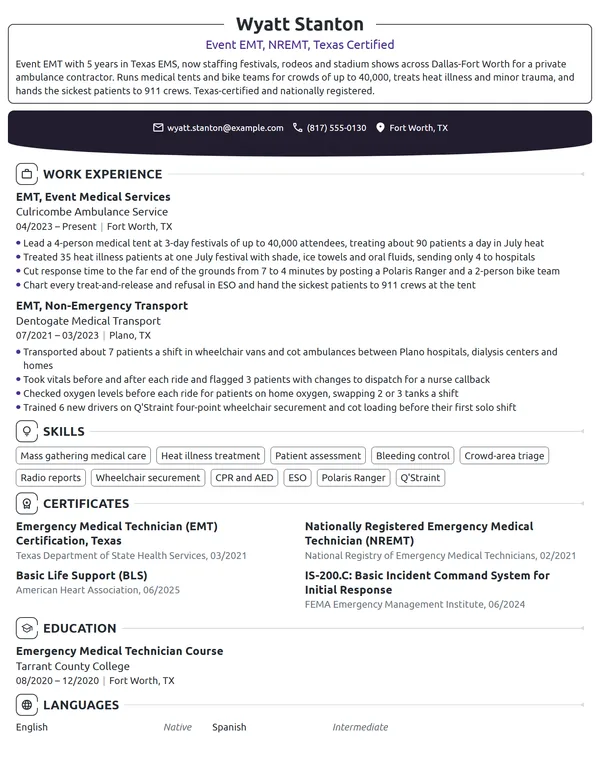
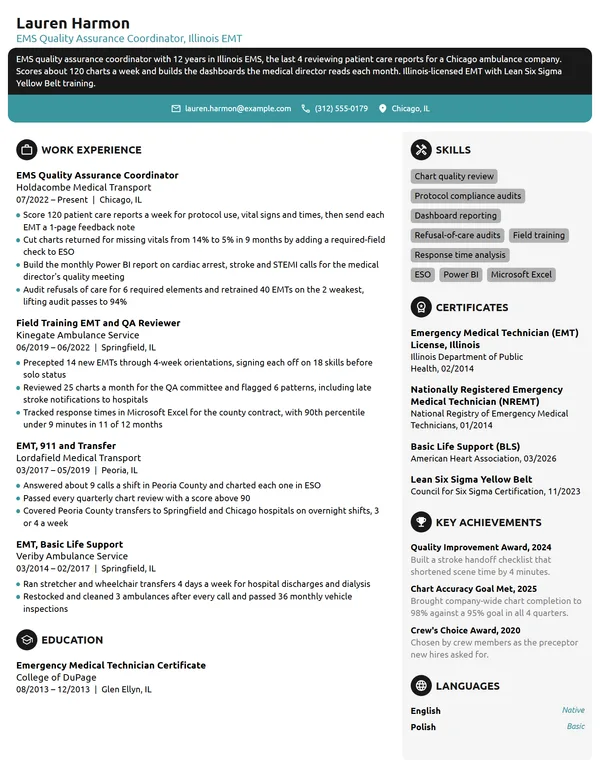
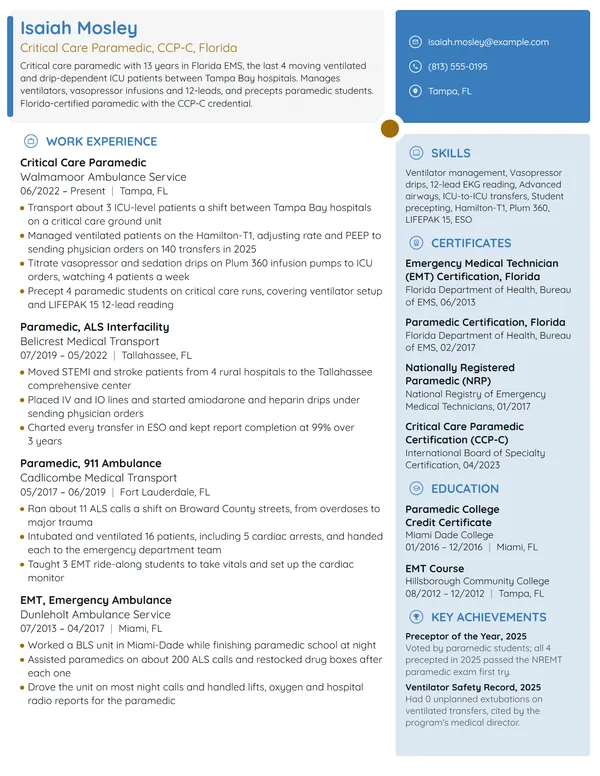
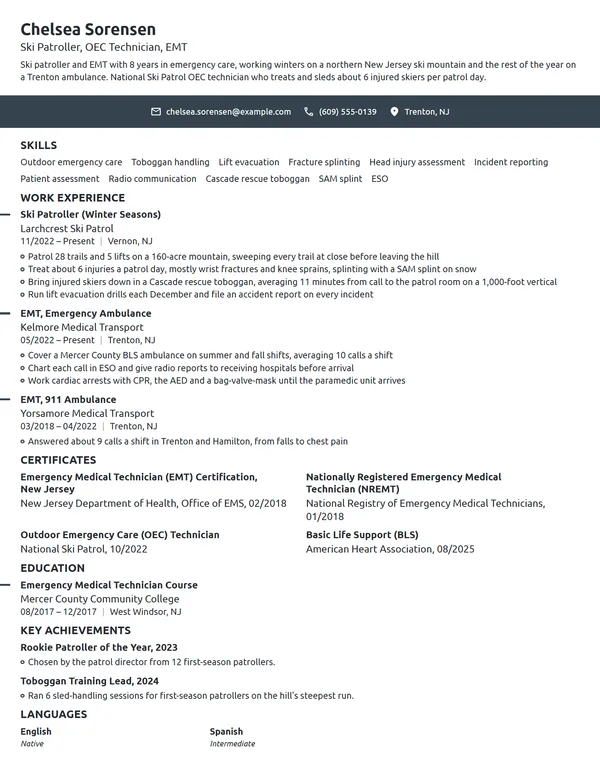
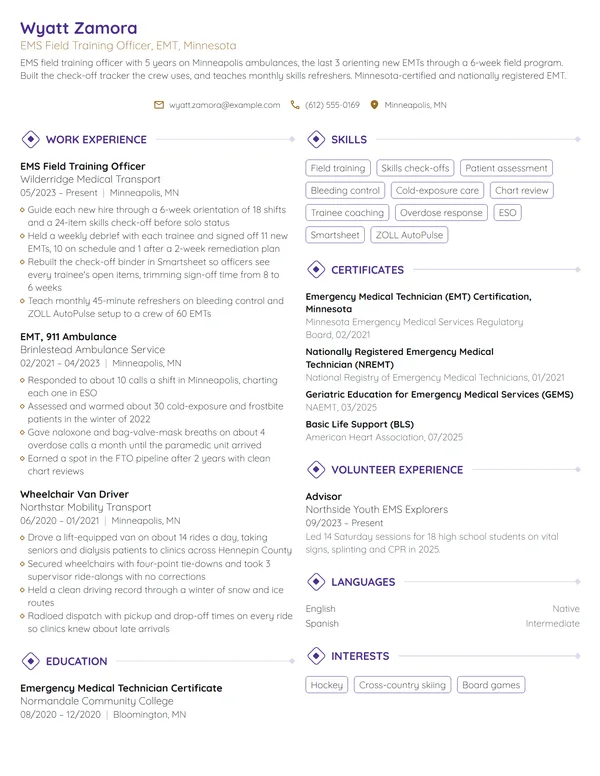
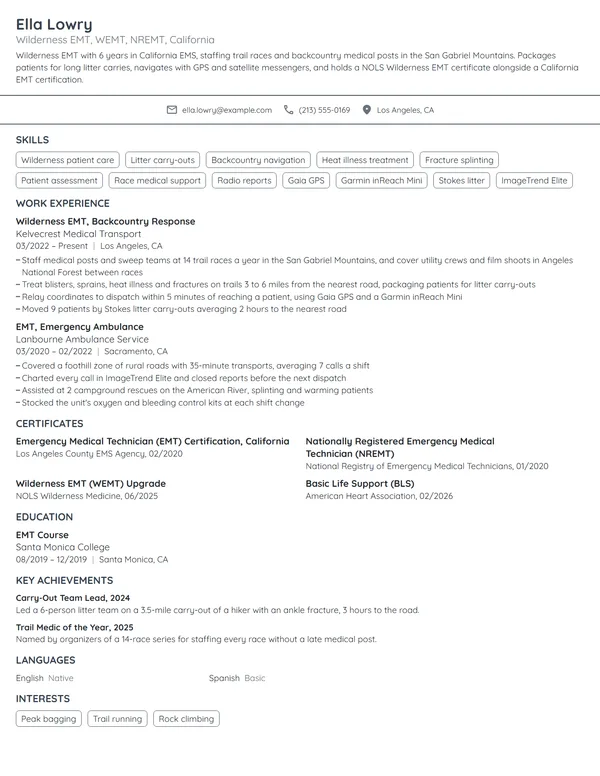
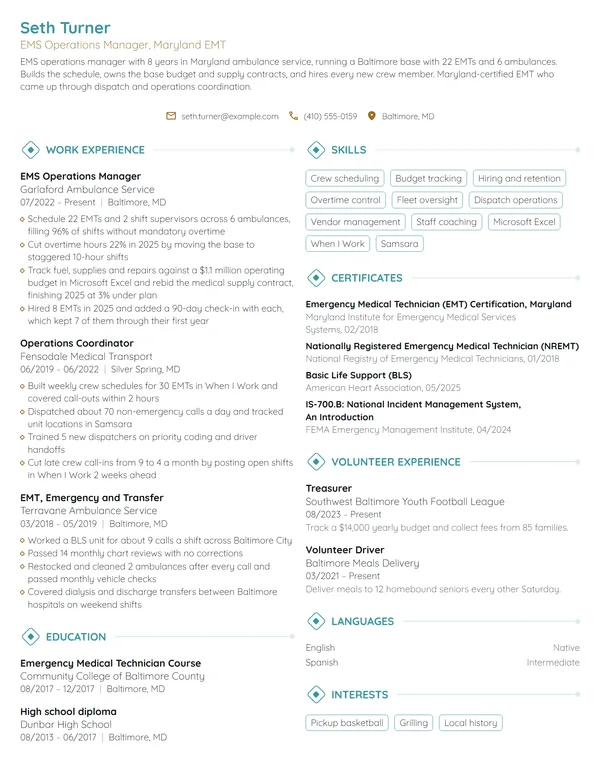
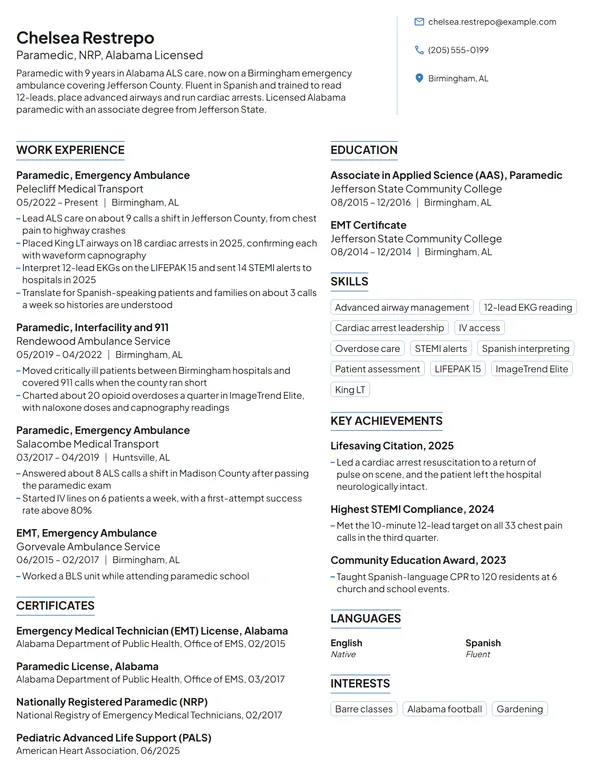
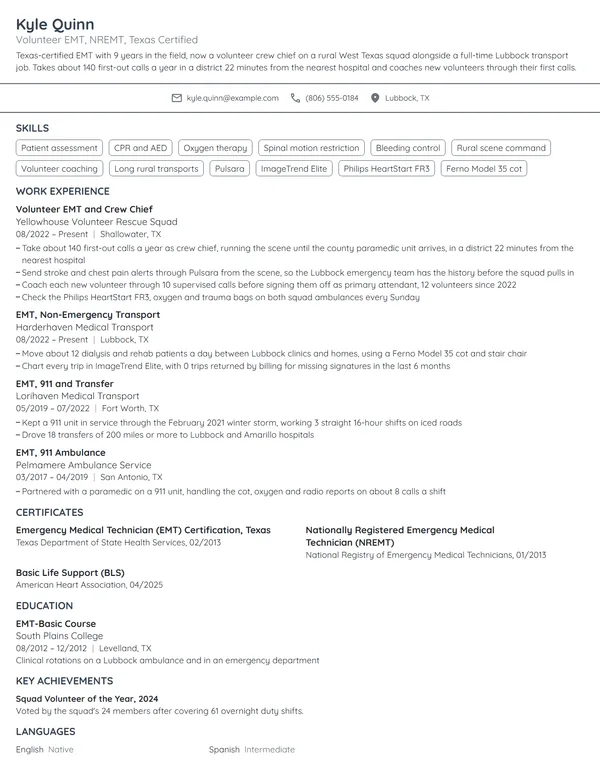
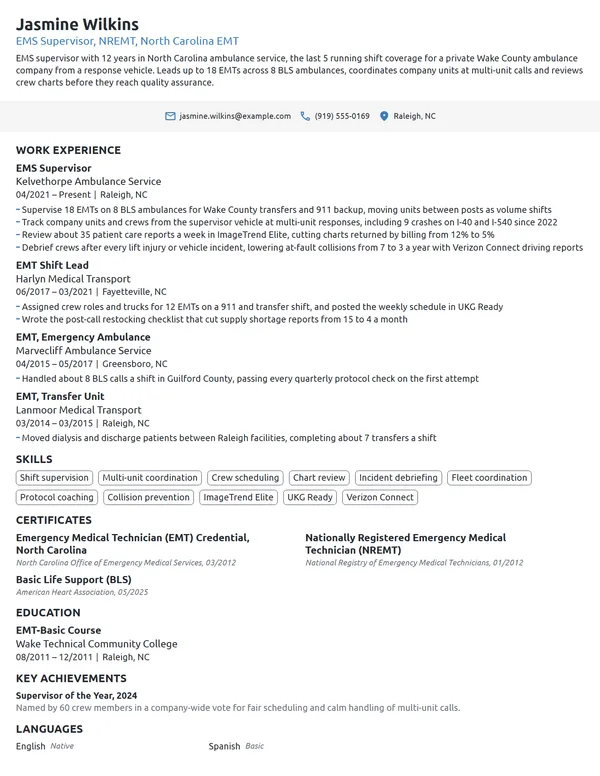
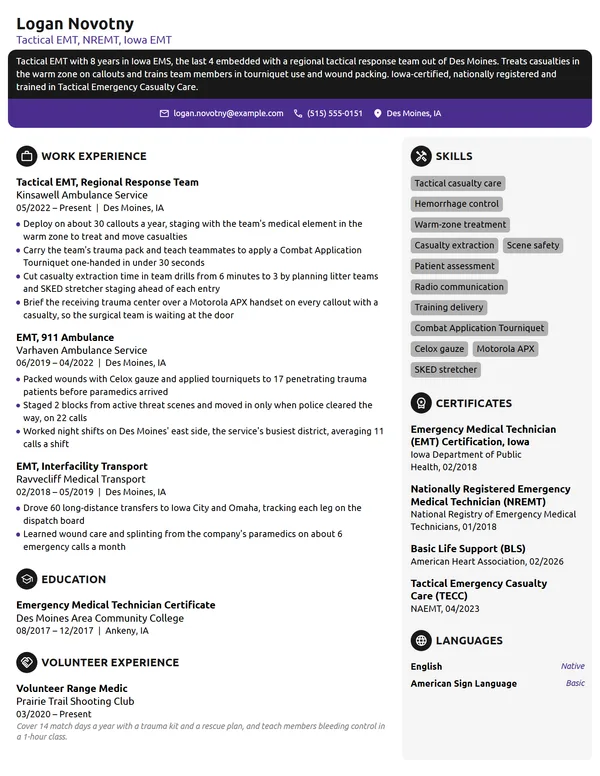
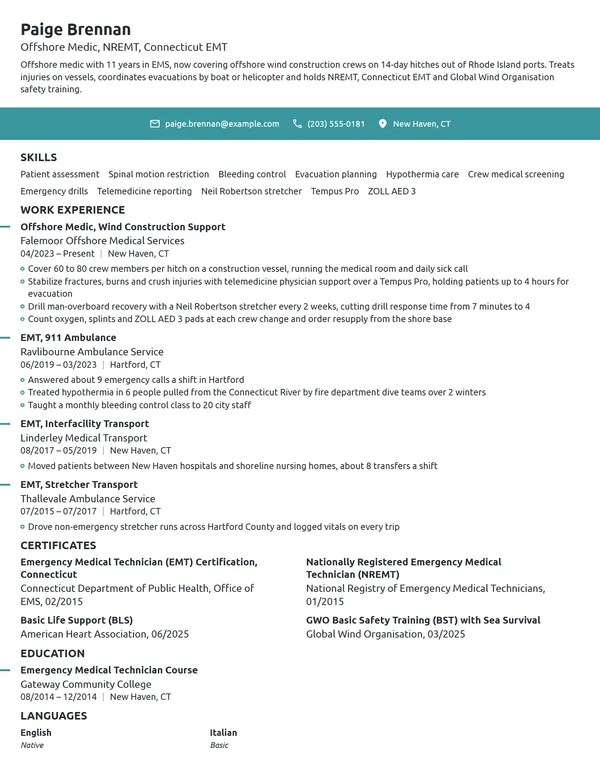
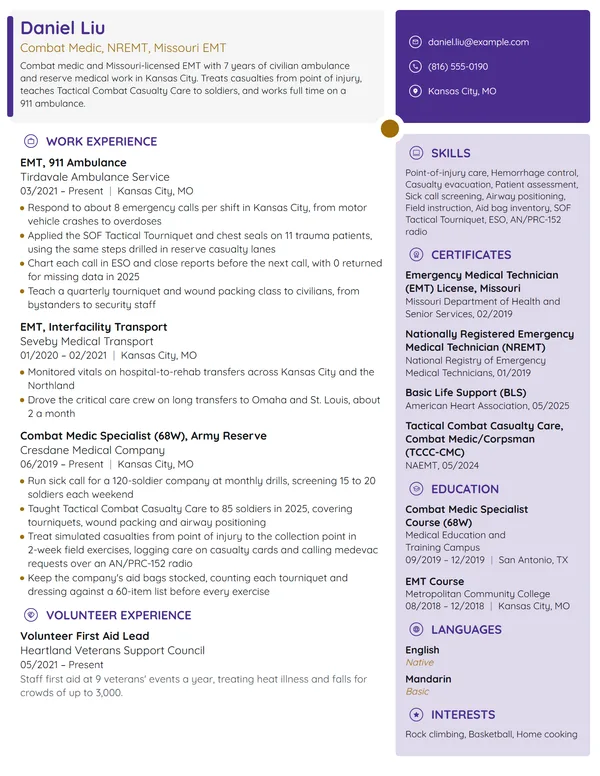
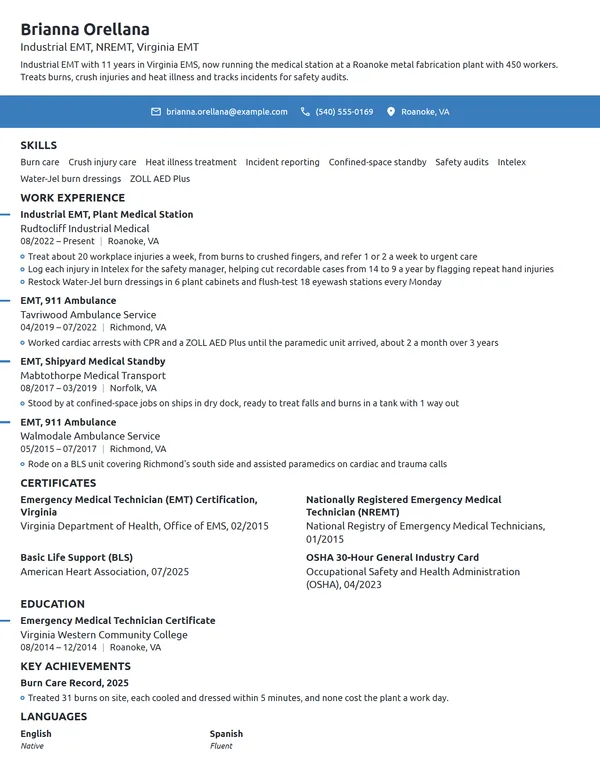
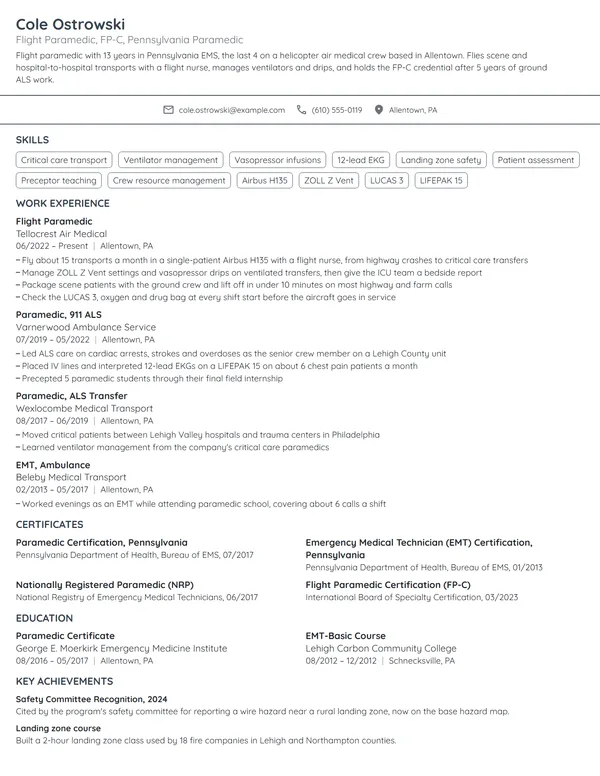
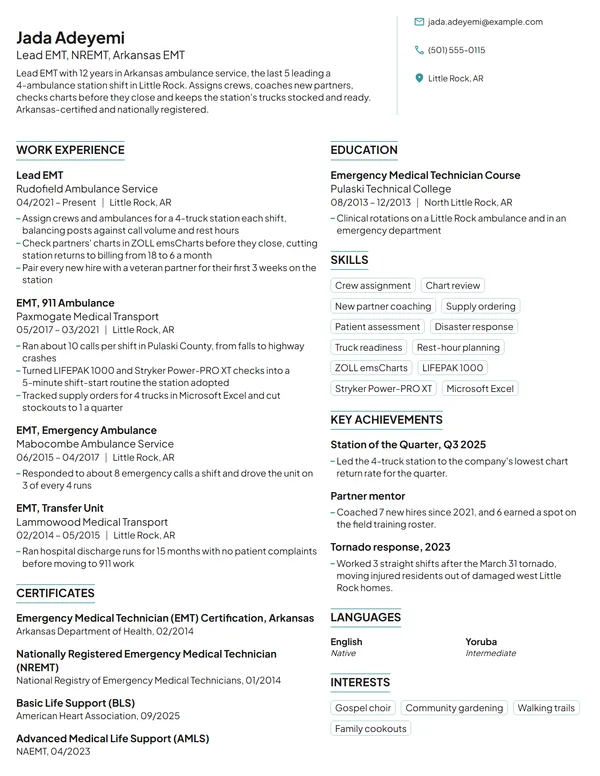
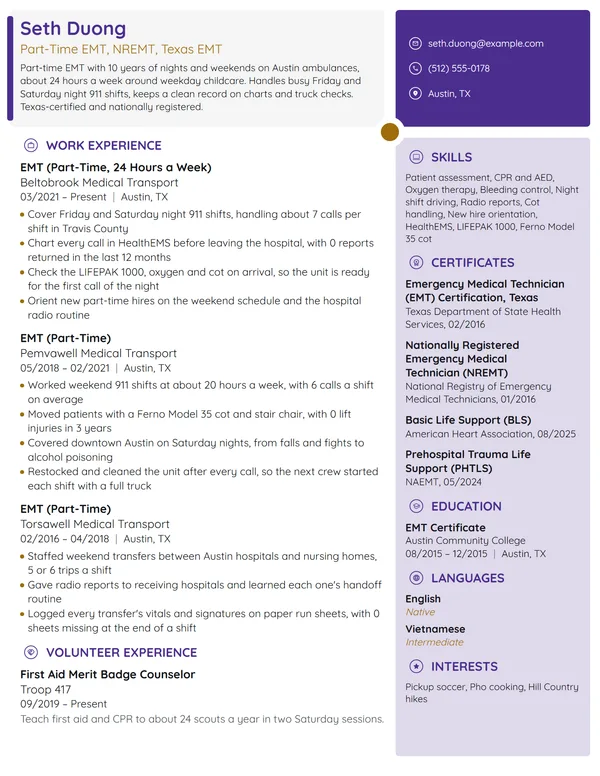
An EMT is often the first trained person a patient sees, so services hire for steady judgment and reliability. The people screening applicants check your certification level, the state that licensed you, how busy your system was and whether you can drive an ambulance safely. On paper, that proof is your calls per shift, the miles you have driven without a collision and a license line that names your state.
How to Write an Emergency Medical Technician (EMT) Resume - Key Takeaways
- List jobs newest first (reverse-chronological) on 1 page; go to 2 only with 10+ years or instructor, supervisor or field training roles.
- Put your level and state in the headline, such as EMT, NREMT, Oregon, and repeat the same wording under Certificates.
- Open your current job with calls a shift, shift length and unit type, then add results such as cardiac arrests worked or reports closed on time.
- List your state EMT license first under Certificates, then National Registry certification, BLS and courses such as PHTLS.
- Keep every bullet inside EMT scope of practice: IV lines and fluids belong on an Advanced EMT or paramedic resume.
- Before you apply, scan the file with an ATS resume checker, because county and private EMS portals screen for level and license keywords.
What EMS employers look for in an EMT resume
A field supervisor or operations chief reads an EMT resume for 3 answers: what level you hold and in which state, how busy your system was, and whether you can be trusted with a patient and a rig. The Bureau of Labor Statistics lists responding to calls, assessing patients, giving first aid or life support, transporting patients safely, documenting care and restocking supplies as typical EMT duties. O*NET adds immobilizing patients for transport, decontaminating the ambulance after an infectious case and keeping dispatch informed. Your bullets should show those tasks with a setting and a count.
Keep to standard headings so hiring software can sort your resume:
- Name, headline (for example, EMT, NREMT) and contact details
- A 2 to 3 line summary or objective at the top, printed without a heading
- Work Experience, newest job at the top, the setting named in each title
- Certificates: your state license first, then National Registry and courses
- Skills, with the charting system you use
- Education, including your EMT course
- Key Achievements or Volunteer Experience, plus Languages if you speak one your patients use
Best format for an EMT resume
Use the reverse-chronological resume format: newest job first, each with your title, the service and its city, and dates written as MM/YYYY. EMS careers move in visible steps, from responder or volunteer squad to EMT, then to field training officer, Advanced EMT or paramedic, and this order shows where you stand on that path. If you work for 2 services at once, give each its own entry and dates.
- Best for most EMTsReverse-chronologicalYour jobs, newest first, with your results under each one.Best for: A steady work history in your field
- FunctionalSkills grouped up top, with a short work history below.Best for: Gaps or very little experience
- CombinationA skills section first, then your full work history.Best for: A career change with strong skills
1 page covers most EMTs. Go to 2 only with 10+ years, or with instructor, supervisor or field training roles that need bullets of their own, and keep your license line and current job on page 1.
| Setting | What to use |
|---|---|
| Length | 1 page; 2 for 10+ years or instructor and supervisor roles |
| Headline | Level, registry status and state: EMT, NREMT, Oregon |
| Job title line | Level plus setting: EMT, 911 ALS Ambulance or EMT, Interfacility Transport |
| Dates | MM/YYYY throughout, with Present on your current job |
| Font | Arial, Calibri or a similar font at 10.5 to 12 pt |
| Photo and private data | No photo for most US and Canadian services; skip your Social Security number, marital status and date of birth |
| File type | PDF, or Word when a county or city job portal asks for it |
Most US and Canadian resumes carry no photo. Many EMS jobs sit with counties, cities and fire districts that hire through online portals, which read your text into their own fields, so plain headings matter more than design.
EMT resume summary vs. objective
If you have worked as an EMT, write a resume summary: your level, your years, the kind of system (911, interfacility, event or hospital) and 1 number. If you are newly certified or coming from another field, write a resume objective with the role you want and your National Registry and license status. Write it last, and lift its number from one of your bullets.
EMT resume summary formula
Level with X years in 911, interfacility or event EMS, working shift pattern and unit. 1 call, patient care or driving figure. License state, National Registry status or the next level you are training for.
Example
EMT with 4 years in 911 and interfacility transport in Central Oregon, working 24-hour shifts on an ALS unit. Drove 41,000 emergency and non-emergency miles with 0 collisions. Oregon-licensed, Nationally Registered, and starting a paramedic program in 01/2027.
Don't
Dedicated EMT with a passion for helping people in emergency situations.
Do
EMT with 4 years on 911 ambulances in a county system and about 2,300 patient contacts. Nationally Registered, a field trainer for new hires, and starting an AEMT course in spring 2027.
The second version gives the system, the volume and the next level.
How to write EMT work experience bullets with numbers
Your recent jobs take 3 to 4 bullets; older ones, 1 to 3. Start with your call volume and the unit you ran on, since a supervisor reads every other number against it. Then add results your service already measures, such as cardiac arrests worked, reports closed on time or rig readiness, and give each entry in the work experience section its title, service, city and dates.
| Area | What to count | Example bullet |
|---|---|---|
| Call volume | Calls a shift, shift length, stations or district size | Ran about 14 calls a 12-hour shift in a 3-station county system. |
| Patient care | Cardiac arrests, trauma activations, stroke and STEMI alerts | Called 27 stroke alerts ahead to the receiving hospital in 2025, with door-to-CT under 25 minutes on each. |
| Documentation | Report completion, QA review scores | Raised average QA review scores on patient care reports from 82 to 95 in 1 year. |
| Response | Turnout time, units ready at shift change | Cut the crew's average turnout time from 90 to 60 seconds by staging gear at shift change. |
| Equipment and supplies | Rig checks, expired items, out-of-service hours | Ran monthly inventory on 2 units with 0 expired items found in 12 audits. |
| Training | Students precepted, ride-along hours, CE credits | Precepted 6 EMT students through 96 ride-along hours. |
Here is one EMT's entry built that way. The call volume and unit come first, patient care and paperwork follow, and the older transport job keeps a single line.
Work Experience
- Run about 11 calls a 24-hour shift as the EMT partner on a 2-person ALS unit covering a 600-square-mile district.
- Worked 38 cardiac arrests in 2025 on compressions, AED and bag-valve-mask ventilation; 9 patients had a pulse at hospital arrival.
- Raised care reports closed before the next call from 88% to 97% by charting in the hospital bay instead of at shift end.
- Complete 52 weekly rig checks a year, with 0 missed items flagged at supervisor audits.
- Transported 6 to 8 dialysis, discharge and transfer patients a shift between 3 hospitals and local care homes.
Don't
Responded to 911 calls and provided patient care.
Do
Answered 1,450 calls in 12 months on a BLS unit, including 31 trauma activations with spinal motion restriction and bleeding control.
This one shows the volume, the unit type and the care you gave.
Don't
Responsible for ambulance maintenance.
Do
Ran daily checks on 4 ambulances and cut out-of-service hours from 40 to 12 a quarter by reporting faults at shift start.
EMT skills and charting software for your resume
Pick 6 to 8 hard skills for your resume from the posting that your bullets already prove, and stay inside your certification level. CPR, patient assessment and bag-valve-mask ventilation fit every EMT resume. Starting IV lines and giving IV fluids go only on an Advanced EMT or paramedic resume, which is where Bureau of Labor Statistics data places them.
Hard skills for EMTs
- Patient assessment
- CPR and AED
- Bag-valve-mask ventilation
- Oxygen therapy
- Bleeding control and tourniquets
- Splinting and spinal motion restriction
- Vital signs monitoring
- Stretcher and patient lifting
- Emergency vehicle operation
- Triage at multi-patient scenes
- Radio reports to receiving hospitals
Soft skills EMS supervisors value
- Composure on chaotic scenes
- Clear radio communication
- Teamwork with fire and police
- Scene safety awareness
- Patience with frightened patients
- Stamina on 24-hour shifts
Name the system you chart in exactly as your agency does, and prove it in at least 1 bullet, since services search for it. O*NET flags MEDITECH and Microsoft Office as hot technologies for EMTs; MEDITECH matters most if you are moving into a hospital role such as emergency department technician. If you only ever wrote reports in your service's own ePCR software, list that product by name rather than a generic phrase.
State EMT license, National Registry and other EMS certifications
The Bureau of Labor Statistics says every state requires EMTs to be licensed, with requirements that vary by state, and that most states require certification to get there. That certification is usually the National Registry's, but the National Registry states that its certification does not, by itself, give you the right to practice: your State EMS Office licenses you. So most EMT resumes carry both lines, under the name your state uses. List certifications on your resume with the issuer and the month for each.
| Credential | Issued by | What it takes |
|---|---|---|
| State EMT license | Your State EMS Office, such as the Oregon Health Authority EMS Program | Required to practice in every state. Oregon asks for current National Registry certification with an EMT application, and EMT licenses there renew every 2 years. |
| Nationally Registered EMT (NREMT) | National Registry of Emergency Medical Technicians | An EMT course finished within the past 2 years, the National Registry EMT exam and a state-approved skills check; renewal every 2 years with 40 credits of continuing education. |
| Basic Life Support (BLS) | American Heart Association | CPR and BLS training, which Bureau of Labor Statistics data says EMT program applicants usually need before they start. |
| Prehospital Trauma Life Support (PHTLS) | National Association of Emergency Medical Technicians (NAEMT) | A trauma care course NAEMT describes as suited to EMTs, paramedics, nurses and other prehospital practitioners. |
| IS-100.C: Introduction to the Incident Command System | FEMA Emergency Management Institute | A 2-hour independent study course on the command structure used at large incidents. |
| Advanced EMT (AEMT) | Your State EMS Office, often with National Registry AEMT certification | The next level up; the Bureau of Labor Statistics lists IV fluids and some medications among the procedures Advanced EMTs can perform. |
How to write the license and National Registry lines
Write the state license as the level, the state, the issuing office and the month it was issued. Write the National Registry line as Nationally Registered Emergency Medical Technician (NREMT) with the month you passed; the National Registry renews every 2 years, with March 31 as the expiration date. Leave license and registry numbers off, since employers verify both themselves.
Certificates
- Emergency Medical Technician (EMT) License, Oregon, Oregon Health Authority, 08/2022
- Nationally Registered Emergency Medical Technician (NREMT), National Registry of Emergency Medical Technicians, 07/2022
- Basic Life Support (BLS), American Heart Association, 03/2026
- Prehospital Trauma Life Support (PHTLS), NAEMT, 10/2024
- IS-100.C: Introduction to the Incident Command System, FEMA, 09/2022
How to list an EMT course, certificate or paramedic program
The Bureau of Labor Statistics says EMTs typically complete a postsecondary program, that applicants usually need to have finished high school (or an equivalent) and to hold CPR and BLS certification, and that EMT-Basic programs typically take less than 1 year. Course length still varies by state: Oregon's health authority puts an initial EMT course at about 160 hours. List your course or certificate under Education with the school, the city and the month you finished, and add a high school line only when it is your only other schooling.
Follow the standard rules for listing education on a resume, then add what matters in EMS: new EMTs can put their clinical ambulance shifts and patient contacts in 1 line under the course. If you are in an AEMT or paramedic program, list it first with its expected completion date, and drop the clinical line once you have a year on the job.
Education
Clinical: 10 ambulance shifts with a 911 service and an emergency department rotation.
New EMT, EMR and career-change EMT resumes
As a new EMT, start with an objective naming the setting you want (911, interfacility or hospital) and your status: National Registry exam passed with its month, and the state license issued or pending. Put your clinical ride time and patient contacts where a supervisor can count them, and use the entry-level resume layout if this is your first job.
- Clinical ride time: ambulance shifts, hours and patient contacts, in 1 line under your EMT course.
- Emergency department rotation: the hours and what you did, such as vitals, splinting or patient transfers.
- Volunteer squad or fire department: under Volunteer Experience, with the calls you answered a month.
- Lifeguard, nursing assistant, security or event first aid jobs: a full Work Experience entry with the people you helped and the care you gave.
Don't
Motivated EMT seeking an entry-level position where I can help people and grow.
Do
Newly Nationally Registered EMT (05/2026) seeking a 911 ambulance role. Finished 48 hours of ambulance ride time with 14 patient contacts, after 2 summers as a lifeguard.
A new EMT objective still needs proof: a registry date, a setting and a count.
Moving up from Emergency Medical Responder, or into EMS from lifeguarding, nursing assistant work or the military, list jobs newest first and lead with the new license. Under older jobs, keep bullets that carry over to patient care: first aid given, vitals taken, people screened, calm work under pressure. Our career-change resume examples show the layout, and our healthcare cover letter examples show how to account for the switch in 1 short paragraph.
Emergency Medical Technician (EMT) resume FAQ
Should I list my state EMT license or my National Registry certification?
List both when you hold both. The state license is what lets you practice, and the National Registry certification is what most states ask for to issue it. Put the state license first under Certificates with the issuing office and month, then the National Registry line with the month you passed.
Can I write EMT on my resume before I pass the National Registry exam?
Not as a credential. Until you pass and your state issues the license, list your EMT course under Education with its finish date and give your exam status in the objective, such as National Registry EMT exam scheduled for 11/2026.
How long should an EMT resume be?
1 page for new EMTs and most field EMTs. Use 2 pages only after 10+ years or with instructor, supervisor or field training work that needs its own bullets, and keep your license and current job on page 1.
Should I include volunteer EMS or ride-along hours on my EMT resume?
Yes, when you have under 2 years of paid EMS work. Put a volunteer squad or fire department under Volunteer Experience with calls a month, and your clinical ride time in 1 line under your EMT course. Drop the ride-along line once paid jobs fill the page.
How do I list part-time EMT jobs at more than one ambulance service?
Give each service its own entry with its own dates, newest start date first, and add part-time or per diem to the job title line. Keep 1 to 2 bullets on the second job, each with the calls or transports you ran there.
Do I need to mention a driver's license or EVOC on an EMT resume?
Yes, if you drive the ambulance. Bureau of Labor Statistics data says employers typically require a driver's license and may prefer ambulance driver certification, so list an emergency vehicle operator course under Certificates and back it with a driving bullet, such as miles driven without a collision.
What is the average EMT salary?
Bureau of Labor Statistics figures put the median pay of emergency medical technicians at $44,470 a year in May 2025. Your state, employer, shift pattern and level all move that figure, so keep pay off the resume and bring it up at the offer stage.
Next steps
Start from the example nearest your level and setting, follow its layout, and fill in your own call volume, license line and results. Our resume builder and templates make that layout quick to copy. Send the finished file with a cover letter naming the service, the shift you want and your strongest number.