
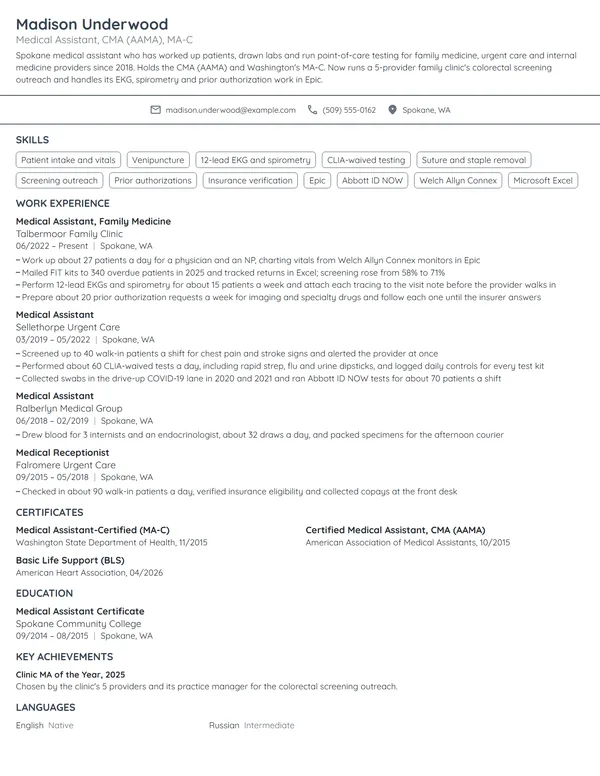
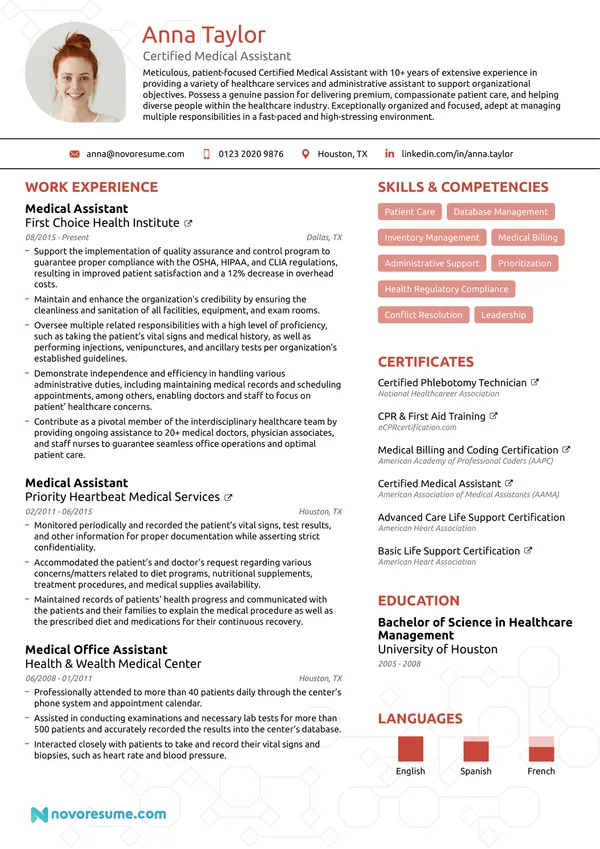
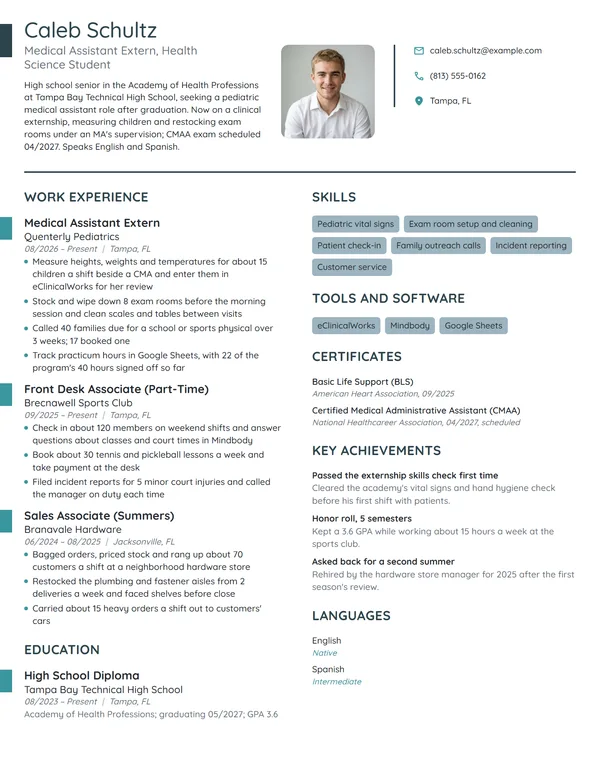
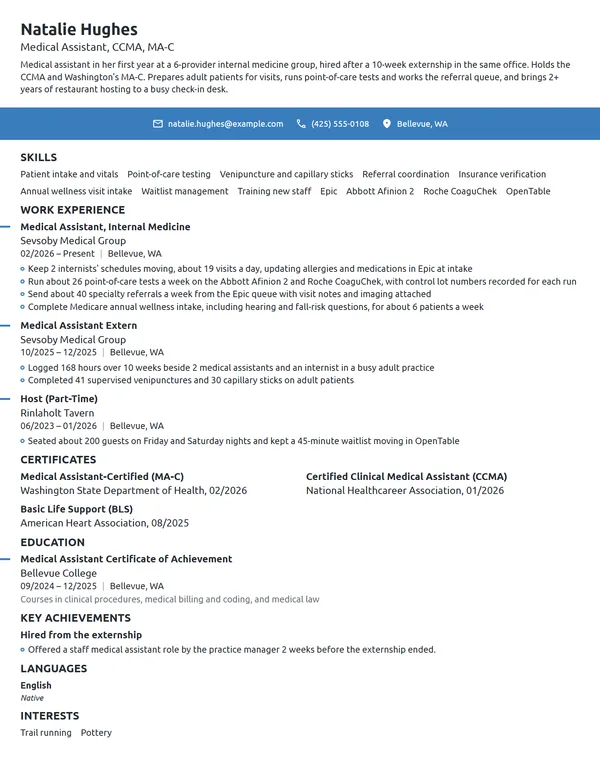
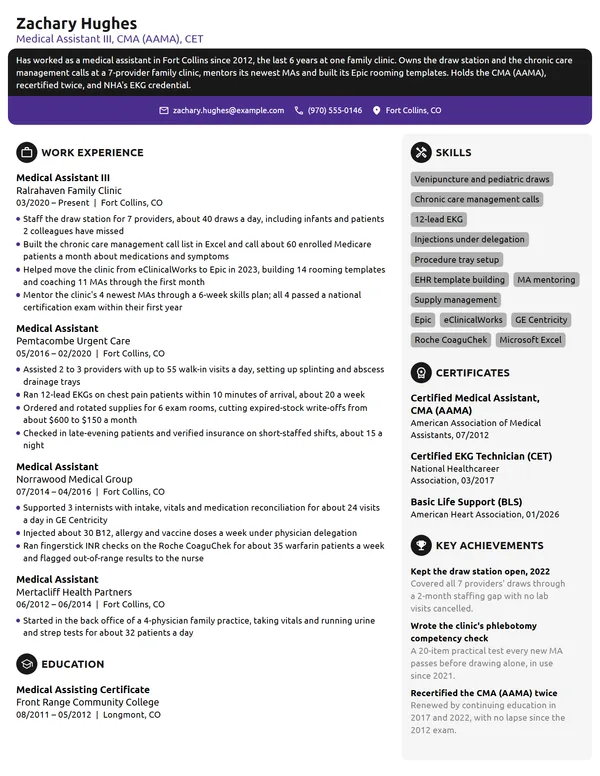
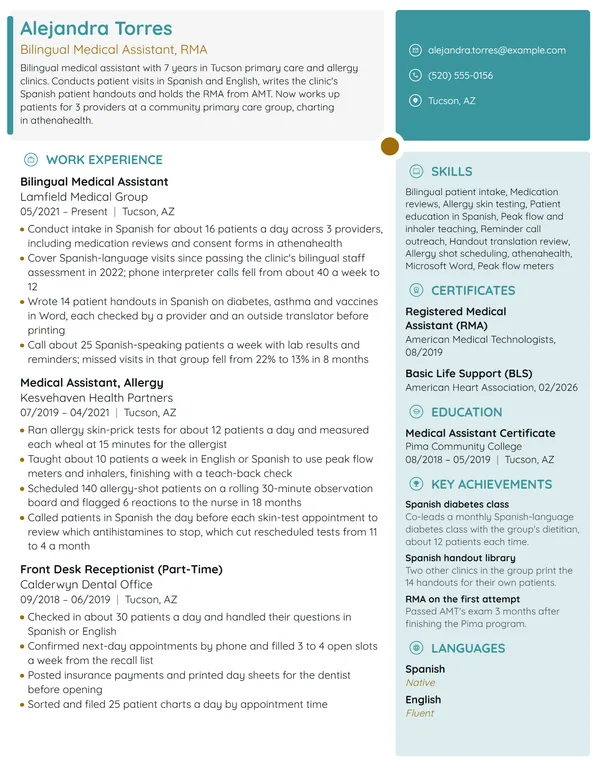
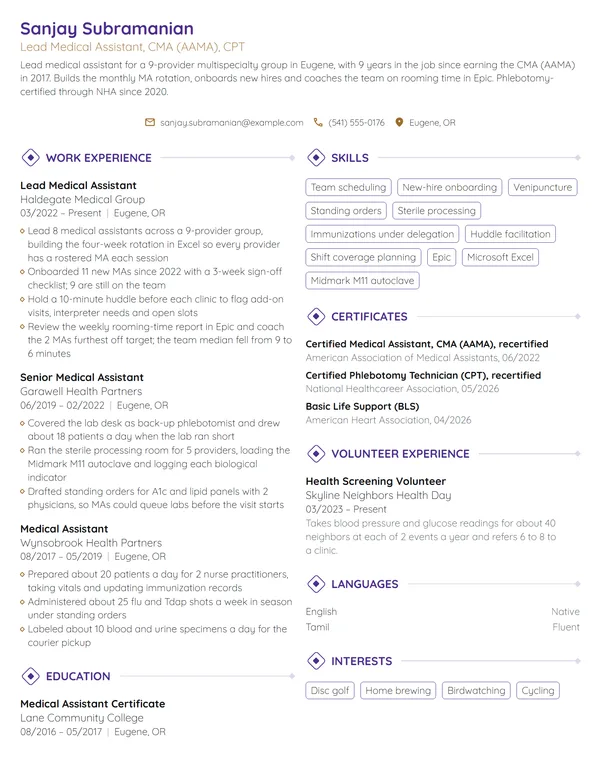
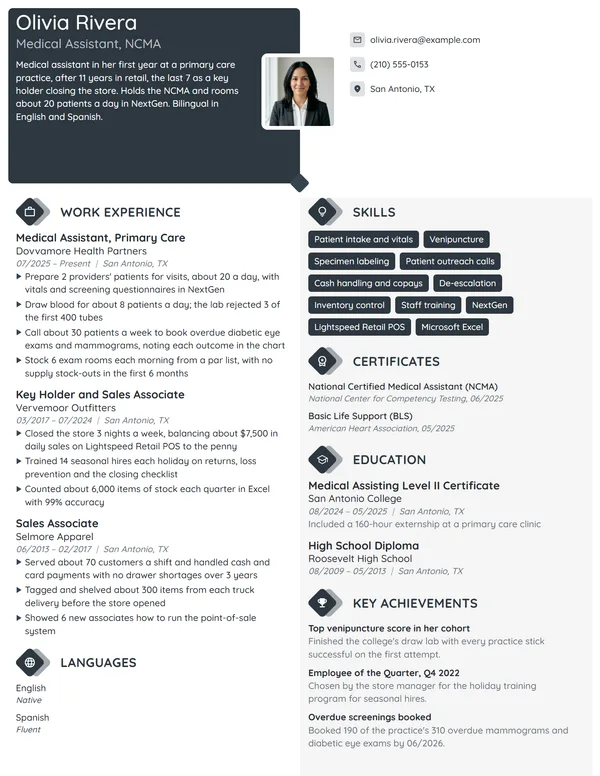
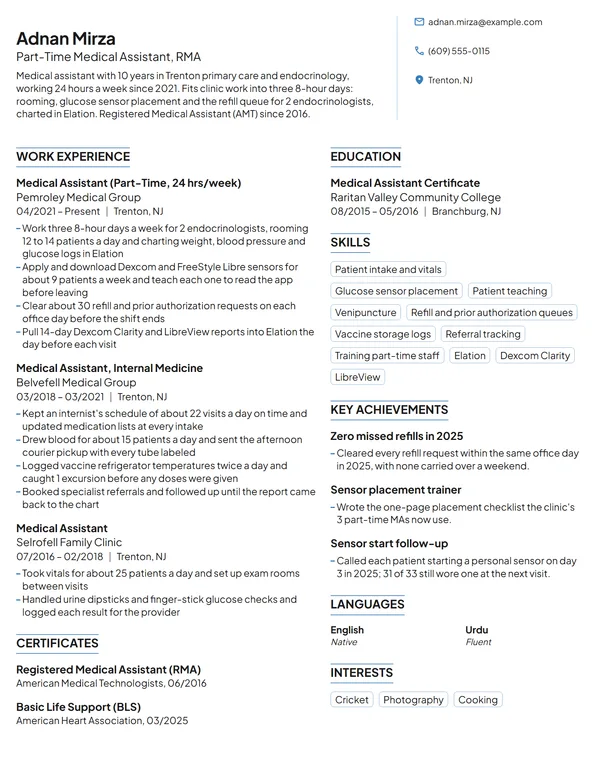
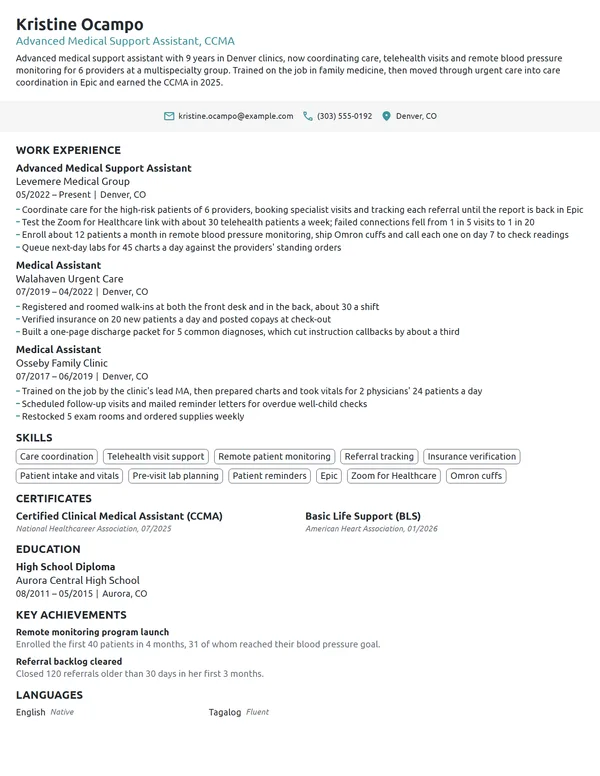
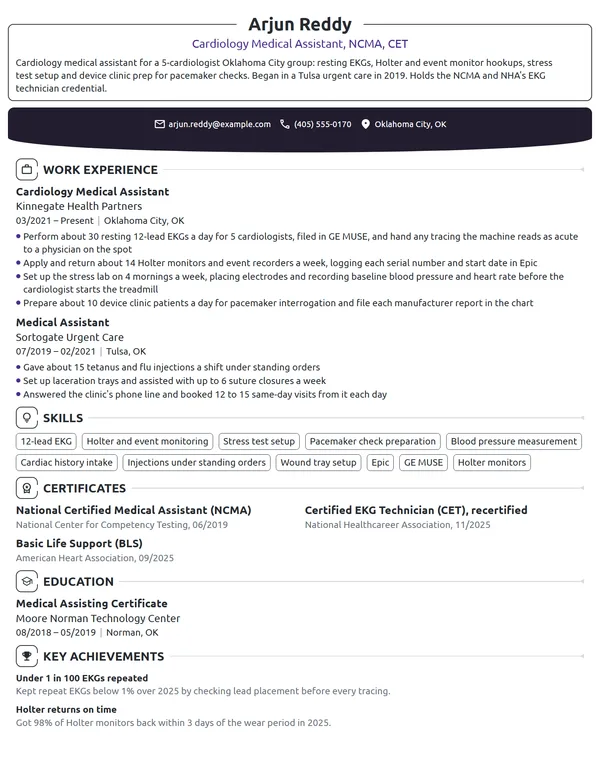
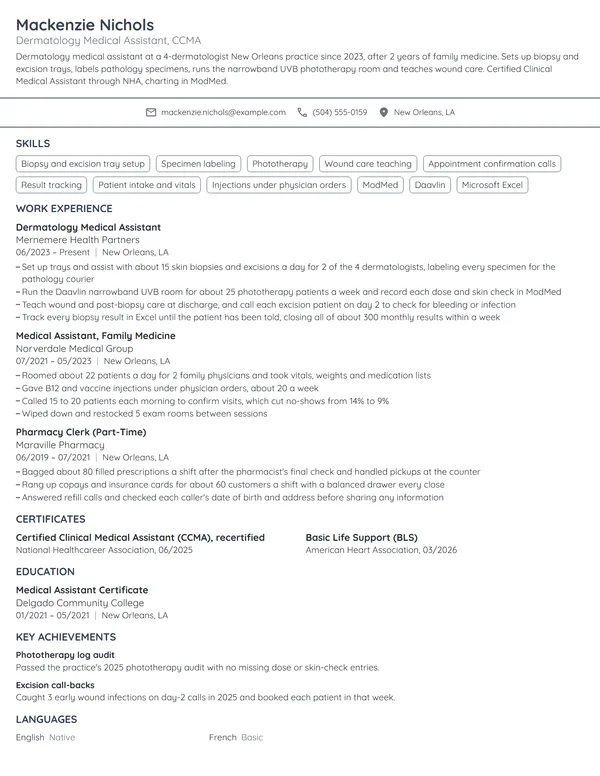
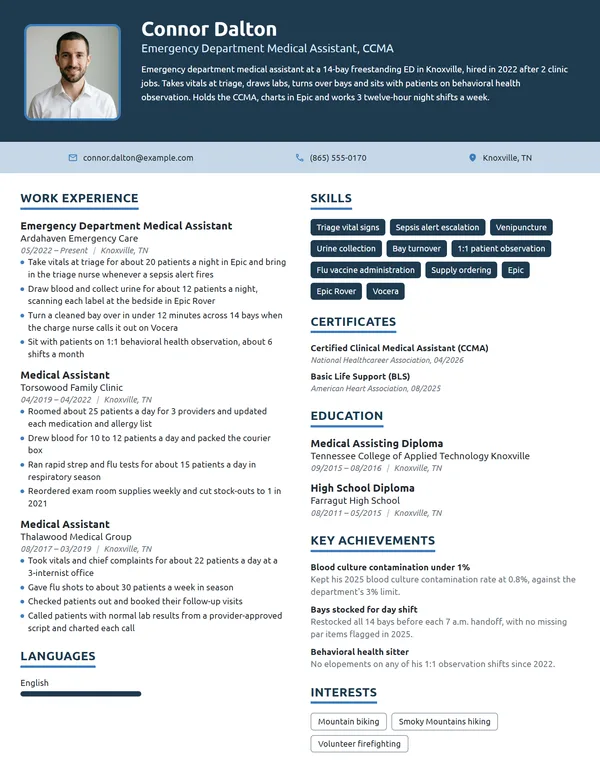
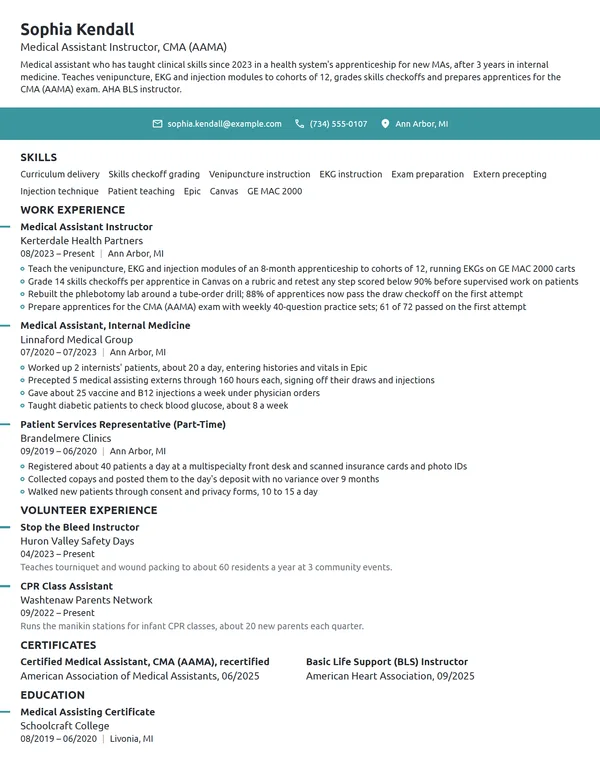
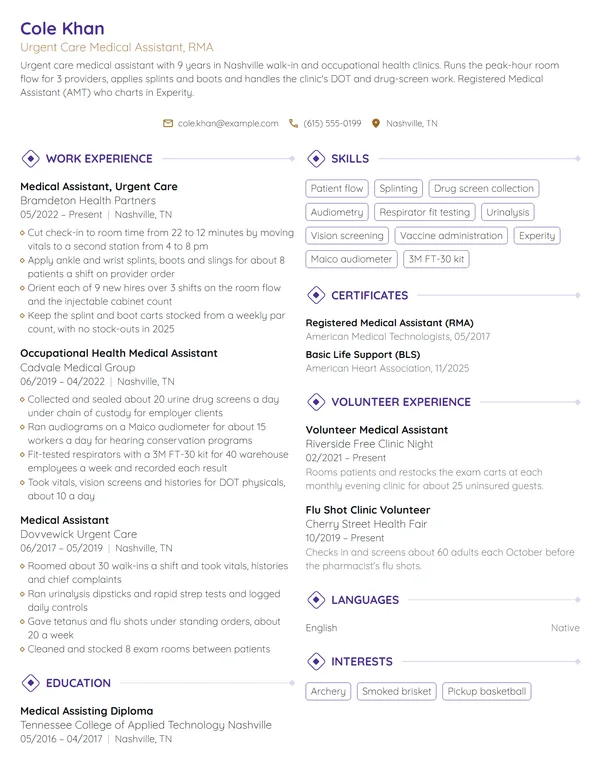
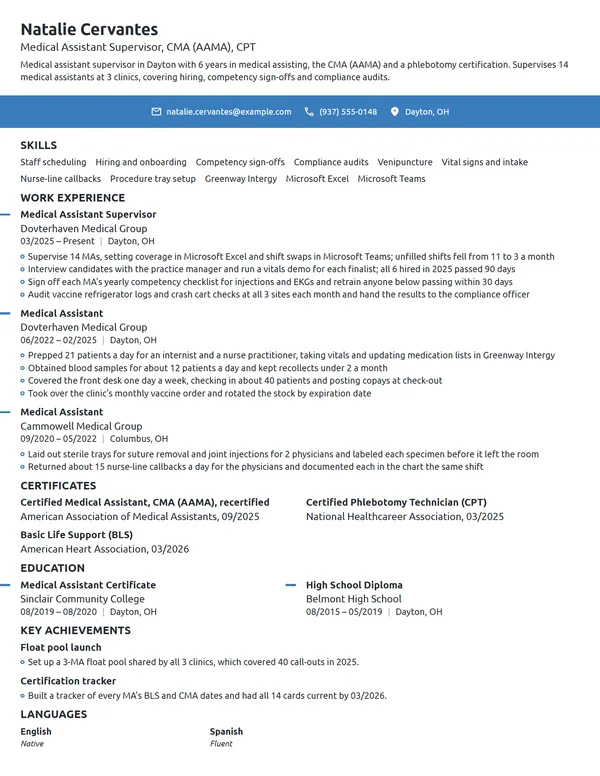
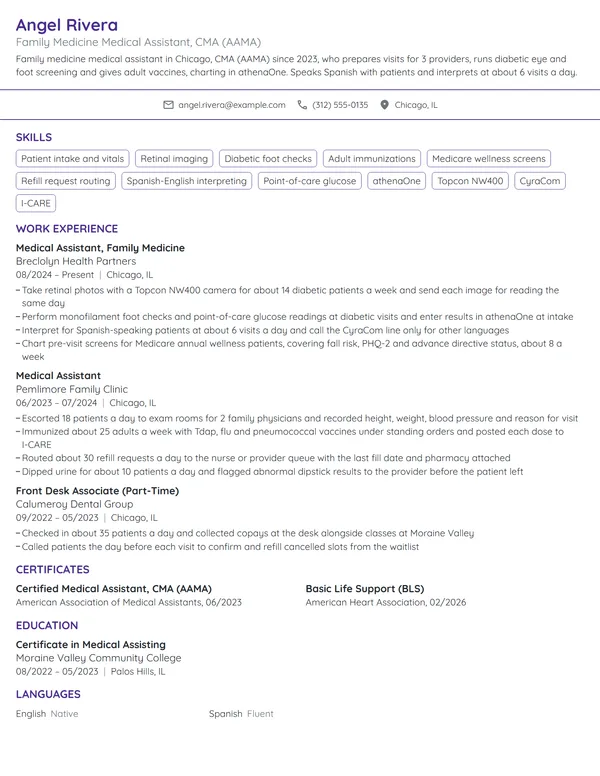
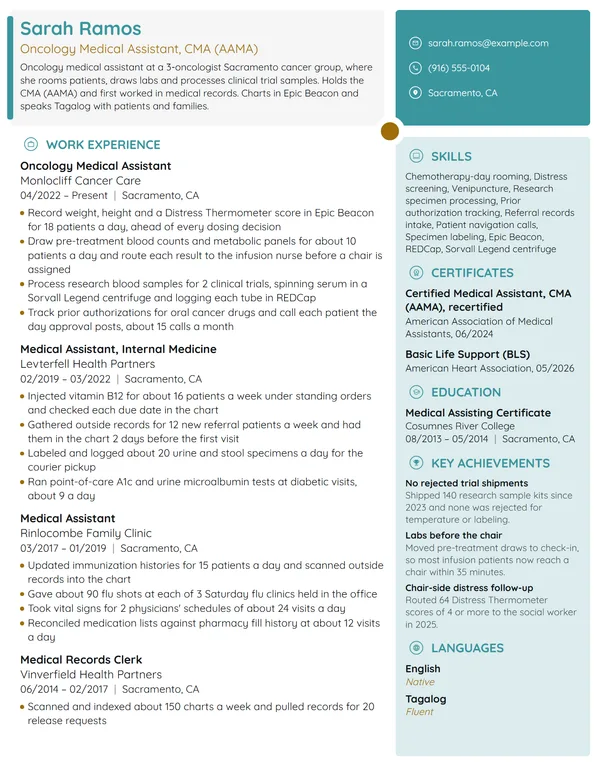
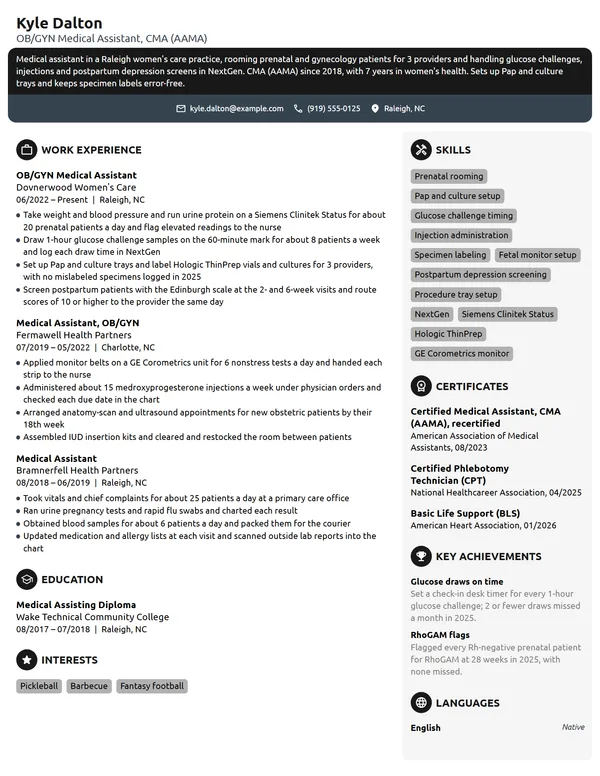
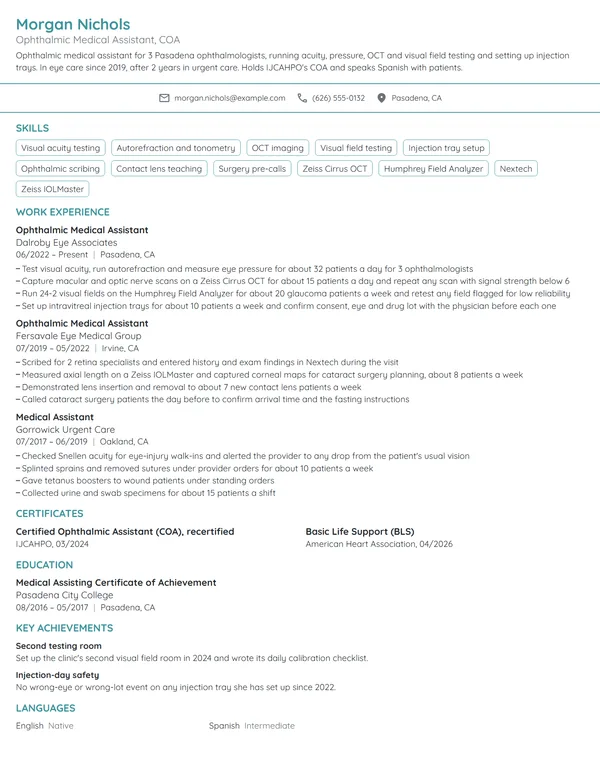
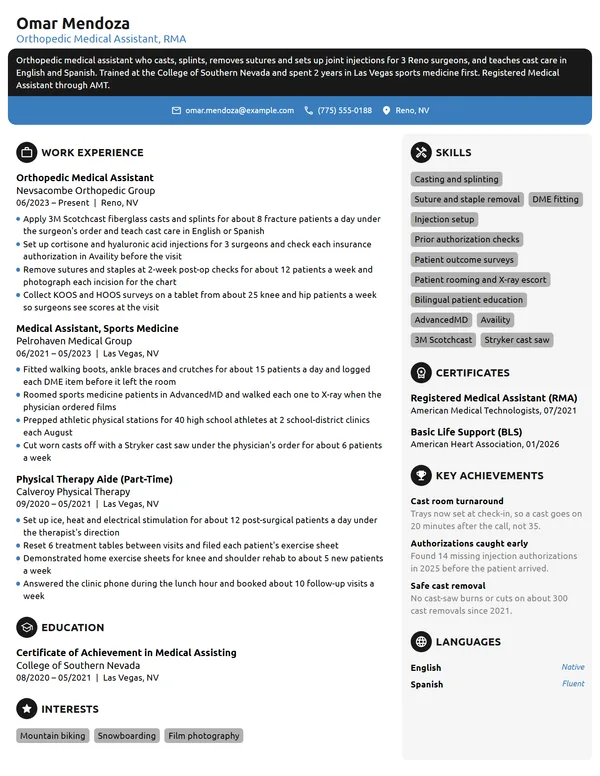
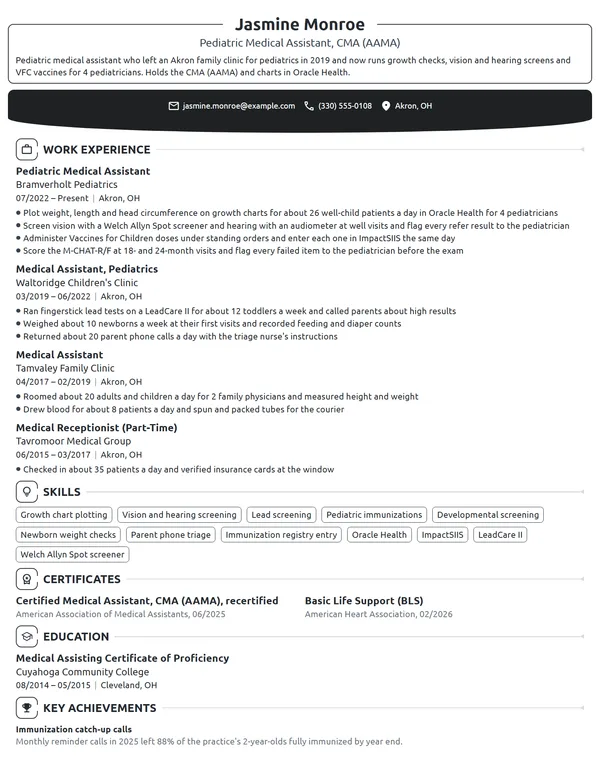
Medical assistants work both sides of a clinic, caring for patients in the exam room and keeping the front office running. Clinic managers want to know which certification you hold, how many patients you see in a day, the EHR you use and which clinical tasks you can handle on your own. Work split two ways is hard to lay out clearly. The right format, and sections built around what a practice manager checks, give both halves their space.
How to Write a Medical Assistant Resume - Key Takeaways
- Keep it reverse-chronological and 1 page long; a second page only makes sense for lead, supervisor or instructor roles with 10+ years.
- Open each job with the clinic type, the number of providers you support and the patients you room a day.
- Count the clinical work a manager tracks: draws, injections, EKGs, point-of-care tests, screenings and care gaps closed.
- Write your credential the way its issuer prints it, such as CMA (AAMA), RMA or CCMA, plus the issuing body and the month you earned it.
- Name your EHR, such as Epic or eClinicalWorks, in Skills and prove it in a work bullet too.
- Test your file with an ATS resume checker before you apply, since health systems screen applications for credential and EHR keywords.
What clinic managers look for in a medical assistant resume
A practice manager or clinical supervisor reads your resume with 3 questions in mind: are you credentialed for this clinic and this state, can you keep a provider's schedule moving, and which hands-on tasks can you do without supervision getting in the way. The Bureau of Labor Statistics describes medical assistants as completing both administrative and clinical tasks, from recording histories and vital signs to scheduling appointments and preparing lab specimens. O*NET rates interviewing patients and measuring their vitals, and cleaning and sterilizing instruments, among the most important tasks of the job.
Most of those readers work in doctors' offices: the BLS counts 56% of medical assistants in offices of physicians, 17% in hospitals and 10% in outpatient care centers. Build your resume around these sections:
- Name, headline with your credential (for example, Medical Assistant, CMA (AAMA)), phone, email and city
- A short summary under the headline, 2 to 3 lines, with no heading of its own
- Work Experience, starting with your current clinic
- Certificates: a state credential first, then your national certification, phlebotomy or EKG and BLS
- Skills, clinical and administrative, with your EHR
- Education, including your externship
- Optional: Languages (a second language is a real asset in many clinics), Volunteer Experience or Key Achievements
Best format for a medical assistant resume
Choose the reverse-chronological resume format: your current job on top, then each earlier one with the job title, the practice name and city, and the months you started and left, as MM/YYYY. Medical assisting careers often move from urgent care to a specialty office or from front desk to back office, and this order lets a manager follow that path at a glance. If you covered both front and back office in one job, keep it as 1 entry and show both in the bullets.
- Best for most medical assistantsReverse-chronologicalYour jobs, newest first, with your results under each one.Best for: A steady work history in your field
- FunctionalSkills grouped up top, with a short work history below.Best for: Gaps or very little experience
- CombinationA skills section first, then your full work history.Best for: A career change with strong skills
Keep it to 1 page, which holds 3 jobs, your credentials and your skills with room to spare. Lead medical assistants, supervisors and program instructors with more than 10 years can use 2 pages, as long as page 1 carries the current job and the credential line.
| Setting | What to use |
|---|---|
| Length | 1 page; 2 only for lead, supervisor or instructor roles past 10 years |
| Dates | MM/YYYY for every job, Present for the clinic you work at now |
| Credential line | Under your name: Medical Assistant, CMA (AAMA), or the exact initials of your own credential |
| Job title line | Title plus specialty: Medical Assistant, Pediatrics |
| Font | One clean, readable font such as Calibri or Arial, sized 10.5 to 12 for bullets |
| Photo and private information | No photo for most US and Canadian clinics; never your Social Security number, birth date or marital status |
| File type | PDF, or Word when a health system's careers portal asks for .docx |
Most US and Canadian resumes carry no photo. Large health systems run applications through portals that copy your resume into their own fields, so keep standard section headings.
Medical assistant resume summary vs. objective
Use one test: have you been paid to work as a medical assistant? If yes, write a resume summary with your credential, your years, the clinic types you know, your EHR and 1 result. If not, because you are an extern, a new graduate or moving over from another job, write a resume objective with the role you want, your program and externship hours, and your exam status. Write it last, and pull its number from a bullet below.
Medical assistant resume summary formula
Credential medical assistant with X years in specialty or clinic type, charting in EHR. 1 counted result. An extra skill such as phlebotomy or EKG, or your next step.
Example
CMA (AAMA) medical assistant with 7 years in family medicine and urgent care, charting in eClinicalWorks. Trained 6 new MAs on the clinic's rooming and vitals checklist. Phlebotomy-certified and the go-to draw for difficult sticks.
Don't
Caring, detail-oriented medical assistant seeking to provide quality patient care in a fast-paced clinic.
Do
Bilingual medical assistant (English and Spanish) with 4 years in a pediatric practice, rooming about 28 patients a day in Epic. CCMA through NHA, adding a phlebotomy certification in 2027.
This version names the specialty, the daily volume, the system and the credential.
How to write medical assistant work experience bullets with numbers
Your current job gets 3 to 4 bullets; each older job gets 1 to 3. The first bullet sets the scale: specialty, providers supported and patients a day. After that, choose numbers your clinic already reports, such as draws, tests run, screening rates, no-shows or messages cleared, and put them in the form of achievements on your resume rather than a list of duties.
| Area | What to count | Example bullet |
|---|---|---|
| Patient flow | Patients roomed a day, providers supported, door-to-room minutes | Roomed 30 patients a day for 2 pediatricians and kept door-to-room time under 8 minutes. |
| Lab and specimens | Draws a day, point-of-care tests, rejected specimens | Drew blood for about 25 patients a day and cut rejected lab specimens from 11 a month to 2. |
| Immunizations | Injections a week, registry entries, missed doses (only where state law and your clinic allowed it) | Gave 60+ immunizations a week during flu season and logged each lot number in the state registry. |
| Charting and inbox | Visits pre-charted, portal messages, refill and prior authorization requests | Pre-charted 18 visits a day and cleared about 50 patient portal messages a shift. |
| Quality measures | Screenings at intake, care gaps closed, recall lists | Raised depression screening at intake from 61% to 92% of adult visits in 1 quarter. |
| Front office | Check-ins, providers scheduled, copays collected | Scheduled for 4 providers and collected $9,800 in copays a month at check-out. |
| Infection control | Sterilization cycles, spore tests, audits | Ran weekly autoclave spore tests and kept sterilization logs complete through 2 internal audits. |
This sample shows one medical assistant's last 2 jobs with the counts added.
Work Experience
- Room 22 to 26 patients a day for 3 family physicians, taking vitals, histories and medication lists in eClinicalWorks.
- Perform 15 to 20 venipunctures a day with a 96% first-stick rate, including pediatric and geriatric patients.
- Run the practice's A1c recall list; brought 112 overdue diabetic patients back for testing in 6 months.
- Triaged up to 35 walk-in patients a shift for 2 providers, running rapid strep and flu tests and logging every result.
Don't
Took patients' vital signs.
Do
Took vitals and histories for 24 to 28 patients a day and rechecked every blood pressure over 140/90 before the provider entered, per clinic protocol.
Adding the volume and the safety step gives a supervisor something to check.
Don't
Responsible for scheduling appointments.
Do
Ran a 3-provider schedule in Epic and filled 85% of same-day cancellations from a waitlist.
Medical assistant skills and EHR software for your resume
Pick 6 to 8 hard skills for your resume that match the posting and that a bullet already proves. Vitals and intake belong on almost every medical assistant resume; EKGs, spirometry, ear lavage or suture removal only where your clinic had you do them. Mix clinical and front-office skills if the job covers both, since many practices staff MAs across the 2.
Hard skills for medical assistants
- Vital signs and patient intake
- Venipuncture and capillary sticks
- Injections and immunizations
- 12-lead EKG
- CLIA-waived point-of-care testing
- Specimen collection and handling
- Instrument sterilization
- Medication reconciliation
- Appointment scheduling
- Insurance verification and prior authorizations
Soft skills practice managers value
- Calm with anxious patients
- Clear patient instructions
- Accuracy at a full schedule
- Teamwork with providers and nurses
- Discretion with health information
- Switching between front and back office
Put your EHR in Skills, then back it up with a work bullet about what you charted or ran in it. O*NET lists Epic and Microsoft Office as in-demand technologies for medical assistants, and flags eClinicalWorks and MEDITECH as hot technologies. Write the system the way the clinic does, and add a practice management or billing system only if the posting names one.
CMA, RMA and CCMA: how to list medical assistant certifications
Most states do not require medical assistants to be certified, the BLS says, but employers may prefer or require it, and some states require graduation from an accredited program. Washington adds a state layer: its Department of Health issues its own medical assistant credentials, and Medical Assistant-Certified (MA-C) calls for a recognized program and a passed national exam, such as the CMA, RMA or CCMA. List certifications on your resume in a Certificates section with each issuer and month, and put a state credential first.
| Credential | Issued by | What it takes |
|---|---|---|
| CMA (AAMA), Certified Medical Assistant | Certifying Board of the American Association of Medical Assistants | Graduation from a CAAHEP- or ABHES-accredited medical assisting program, or another route AAMA lists such as an approved apprenticeship, then the exam; current for 60 months, renewed by continuing education or exam. |
| RMA, Registered Medical Assistant | American Medical Technologists (AMT) | An accredited program finished in the past 4 years with 720 hours of instruction, including a 160-hour externship, or 3 years of medical assisting work in the past 7, among other routes; then AMT's exam. |
| CCMA, Certified Clinical Medical Assistant | National Healthcareer Association (NHA) | A high school diploma or GED plus a training program, or 1 year of supervised work in the field in the past 3 years; renewed every 2 years with 10 continuing education credits. |
| Medical Assistant-Certified (MA-C) | Washington State Department of Health | A recognized program, such as one accredited by CAAHEP or ABHES or 720 clock hours with a 160-hour externship, and a passed exam from AAMA, AMT, NHA, NCCT or AMCA. |
| Basic Life Support (BLS) | American Heart Association | A classroom or blended course with a hands-on skills check; the Bureau of Labor Statistics names it as a qualification some employers require. |
How to write the credential name
Write the initials and the issuer exactly as the certifying body does, then the month you earned or last renewed it. AAMA reserves the words Certified Medical Assistant and the initials CMA (AAMA) for medical assistants whose CMA (AAMA) is current, so an RMA or CCMA holder writes that credential's own name instead. AAMA also lets employers verify a CMA (AAMA) online, which is one more reason to keep the dates accurate.
Certificates
- Certified Medical Assistant, CMA (AAMA), American Association of Medical Assistants, 02/2019, recertified 02/2024
- Certified Phlebotomy Technician (CPT), National Healthcareer Association, 09/2022
- Basic Life Support (BLS), American Heart Association, 06/2026
How to list a medical assisting diploma, certificate or degree
Medical assistants typically complete a postsecondary certificate or an associate's degree, per the BLS, which usually takes 1 to 2 years, though some start with a high school diploma and learn on the job. The program matters for the next step: CMA (AAMA) eligibility runs through an accredited program, and AMT and Washington both count programs of 720 hours with a 160-hour externship.
Follow the standard rules for listing education on a resume: credential, school, city and completion date. Add your externship hours and the clinic type in 1 line under it while you are new; after 3 years in the job, keep only the credential, school and date. Your high school diploma can sit as a short second line under the program, since the program is what the reader checks.
Education
Externship: 200 hours at a 4-provider internal medicine office.
Entry-level, extern and career-change medical assistant resumes
If you are still in your program or just finished it, your externship is your strongest evidence: name the clinic type, your hours and how many patients you roomed by the last week. Give your exam status with a date, whether it is scheduled, passed or pending. Our entry-level resume layouts show how to put education above experience when the program is your main qualification.
- Externship or practicum: a full entry with the clinic type, your hours, patients a day by the end and the skills you signed off on.
- Front desk, scribe or patient registration jobs: a Work Experience entry with check-ins a day, the EHR you used and any insurance tasks.
- CNA, phlebotomy or EMT work: a Work Experience entry with patients or draws a shift, which shows hands-on care before your MA credential.
- High school health science or dual-credit courses: 1 line under Education with the skills you practiced, such as vitals or first aid.
- Health fairs and flu clinics: under Volunteer Experience, with the number of people you screened or helped check in.
Don't
Recent medical assisting graduate looking for an entry-level position where I can grow and learn.
Do
Medical assisting graduate (diploma, 08/2026) seeking a family practice role. Completed a 180-hour externship rooming up to 20 patients a day; CMA (AAMA) exam scheduled for 11/2026.
Even a new graduate's objective needs a date, an hour count and a patient count.
Coming to medical assisting from retail, hospitality or office work, stay with the newest-first order and put your program and credential at the top. Under your earlier jobs, hold on to the lines a clinic can use: handling payments, calming upset customers, scheduling or working to a checklist. Our career-change resume page shows where those older jobs go, and a cover letter can give the reason for the switch in 2 to 3 sentences, as our medical assistant cover letter examples do.
Medical Assistant resume FAQ
Do you need to be certified to work as a medical assistant?
Not in most states, though the BLS adds that employers may prefer or require it and that some states require an accredited program. Washington's Department of Health issues its own medical assistant credentials, so check your state's rules and the posting before you apply.
Which is better on a resume: CMA, RMA or CCMA?
The one your target employers ask for. Read 10 local postings and note which initials they name and whether they accept any national certification. If you hold one a posting does not name, write its full name next to the initials so the reader still recognizes it.
Can I write Certified Medical Assistant if I hold the CCMA or RMA?
No. AAMA reserves the phrase Certified Medical Assistant and the initials CMA (AAMA) for medical assistants whose CMA (AAMA) is current. Write Certified Clinical Medical Assistant (CCMA) or Registered Medical Assistant (RMA), with the issuer and the month you earned it.
How do I list a certification exam I have not passed yet?
List it under Certificates with the word scheduled and the exam month, such as CMA (AAMA) exam, scheduled 11/2026. Mention it in your objective too. Never write the initials in your headline until you have passed and your issuer lists you as certified.
Should I list my medical assistant externship as work experience?
Yes, if it is your main clinical experience. Give it a full entry with the clinic type, your hours and the patients you roomed a day, and note that it was an externship in the title line. After your first year in a paid MA job, move it to 1 line under Education.
Can I list injections on my medical assistant resume?
Only if you gave them in that job. The BLS says medical assistants give injections or medications as directed by physicians and as permitted by state law, so rules differ by state. Write the types and the weekly count, such as immunizations or B12 injections, only for clinics where you did them.
How do I show front-office and back-office work in one job?
Keep it as 1 entry and split the bullets: lead with your clinical work if you are applying for a back-office role, or with scheduling and check-in numbers for a front-office role. Name both in your skills so a keyword search finds either side.
How long should a medical assistant resume be?
1 page for almost every medical assistant. Lead MAs, supervisors and instructors with 10+ years can use 2 pages if the current job, the credential line and the EHR sit on page 1.
What is the average medical assistant salary?
Medical assistants earned a median of $45,690 a year in May 2025, the BLS reports. Pay varies by state, specialty and credential, so leave salary off your resume and discuss it once the clinic makes an offer.
Should I put my high school diploma on a medical assistant resume?
It is optional: add it as a short line under your medical assisting program, or list it on its own with the expected date while you are still in school. The program is the entry a manager reads first, so list it above the diploma once you have it.
Next steps
Choose the example that matches your clinic type and experience, copy its section order, and fill it with your own specialty, patient counts, credential and results. Our resume builder and templates handle the layout; pair the finished file with a short letter to the practice manager that mentions your best number.