
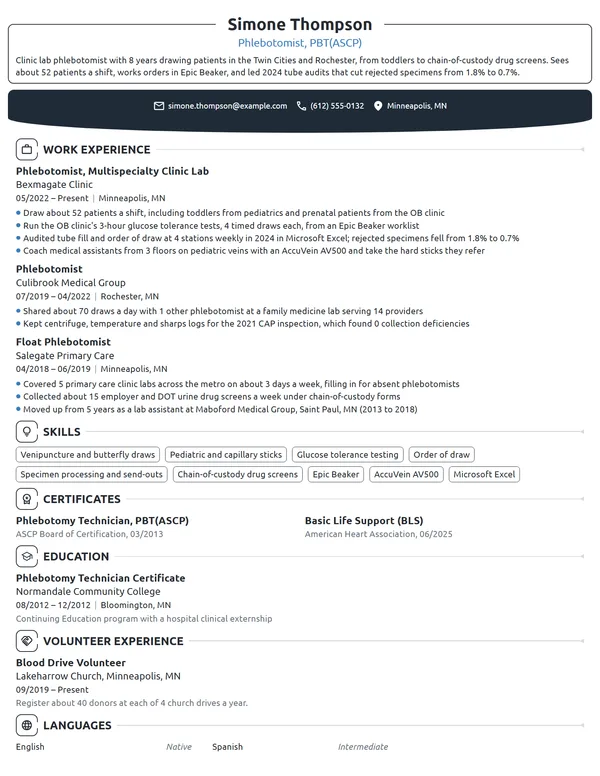
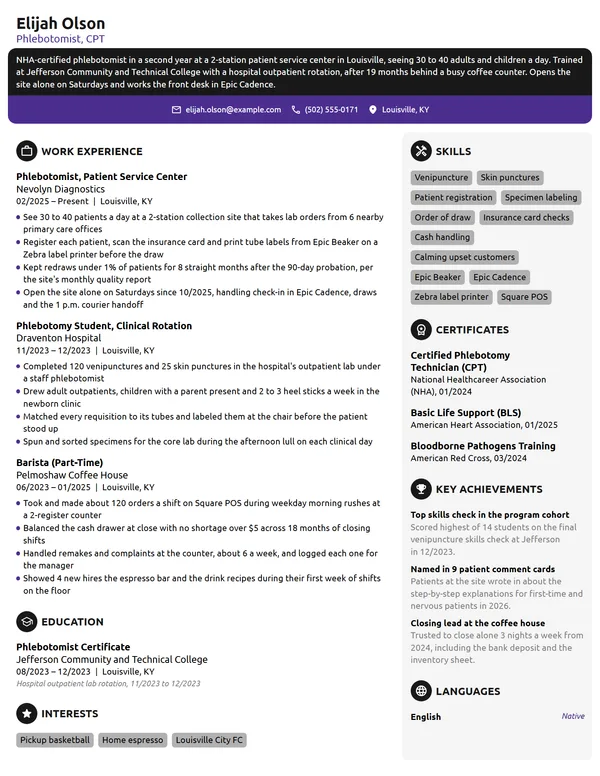
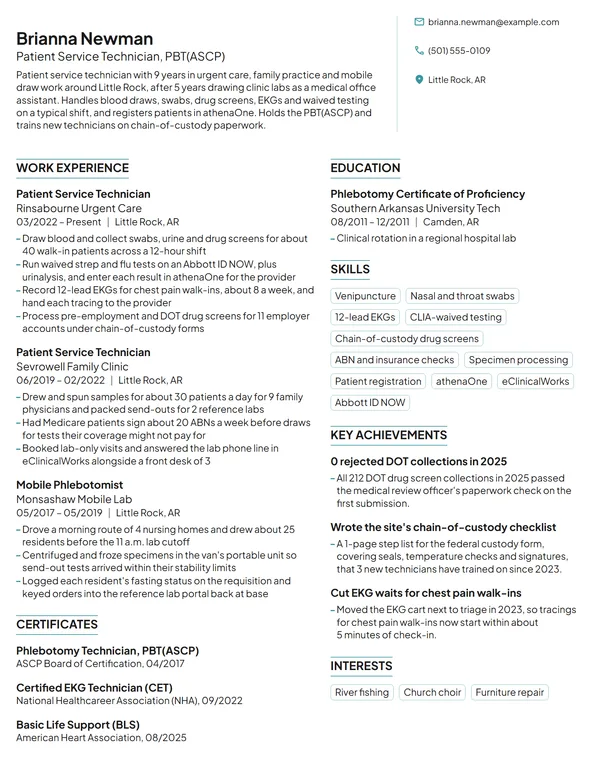
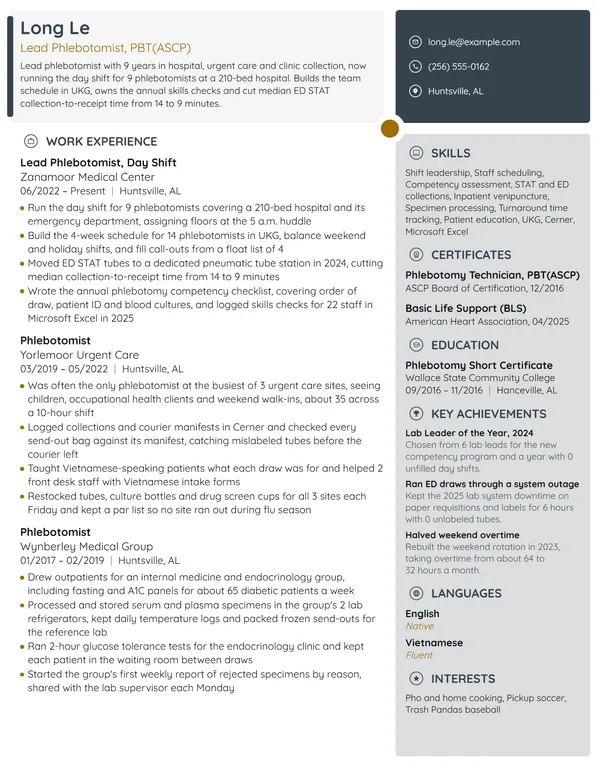
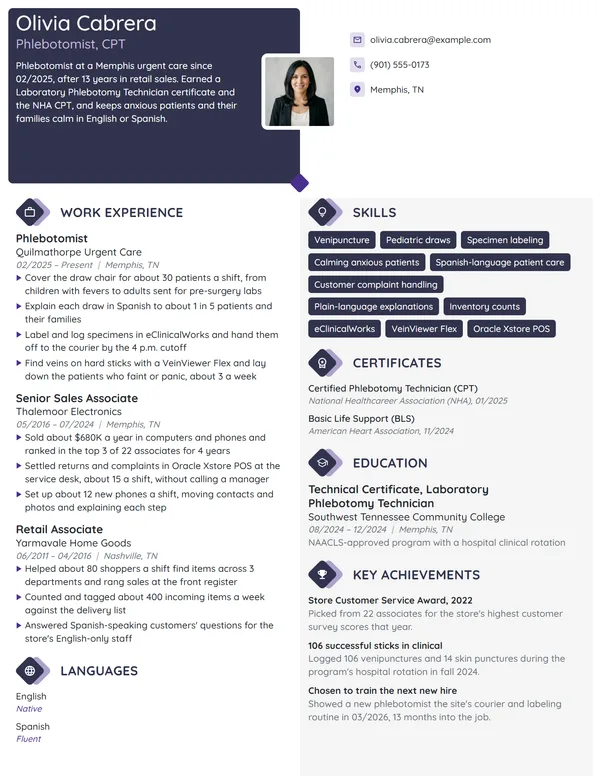
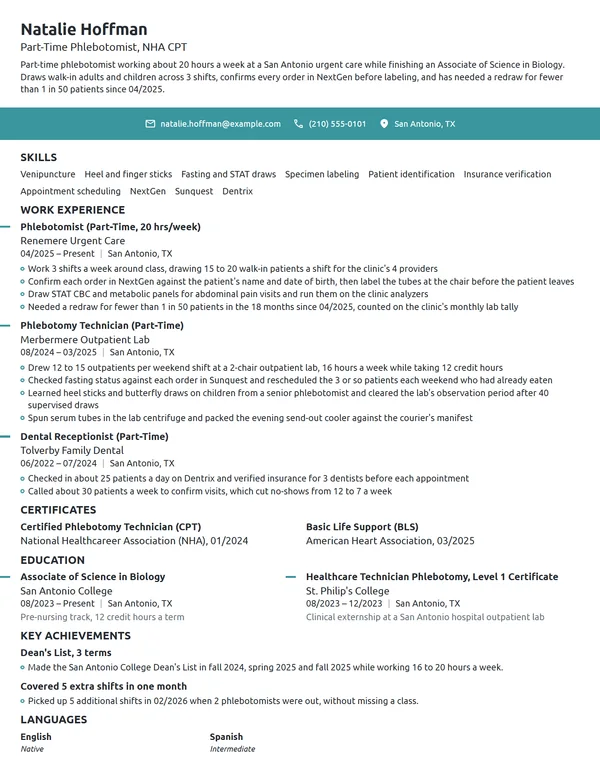
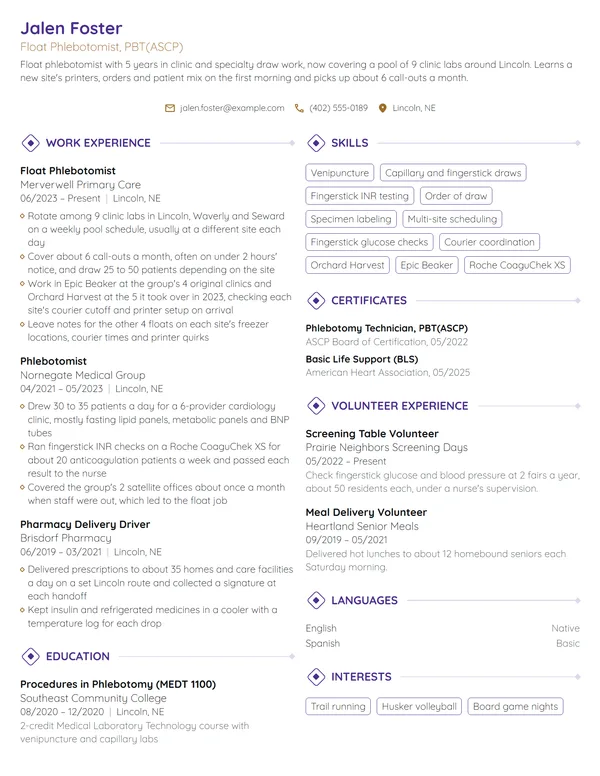
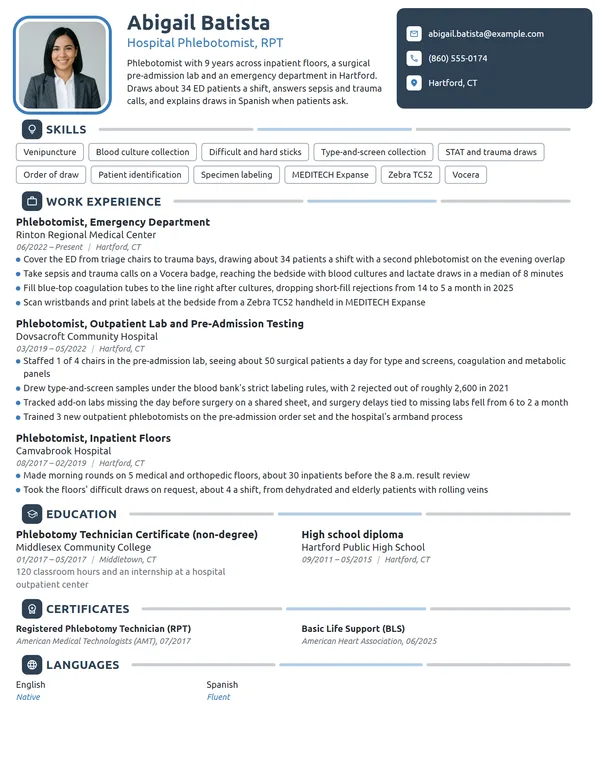
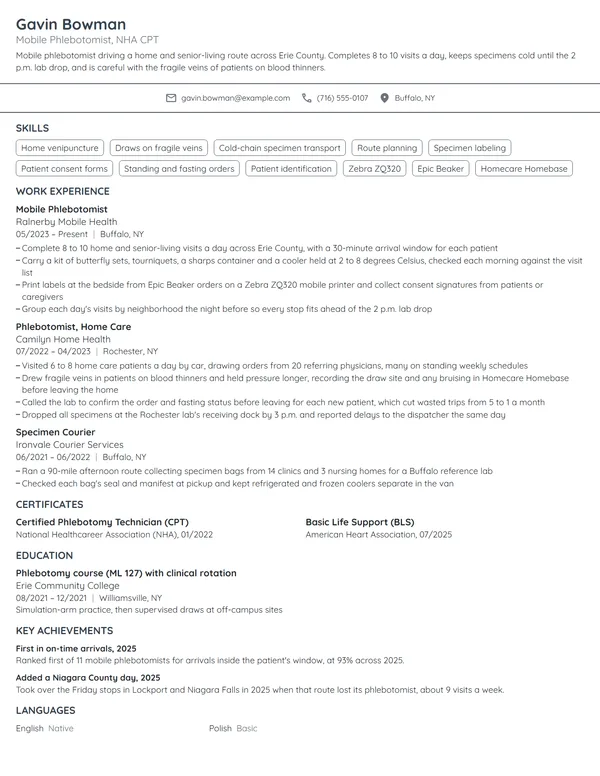
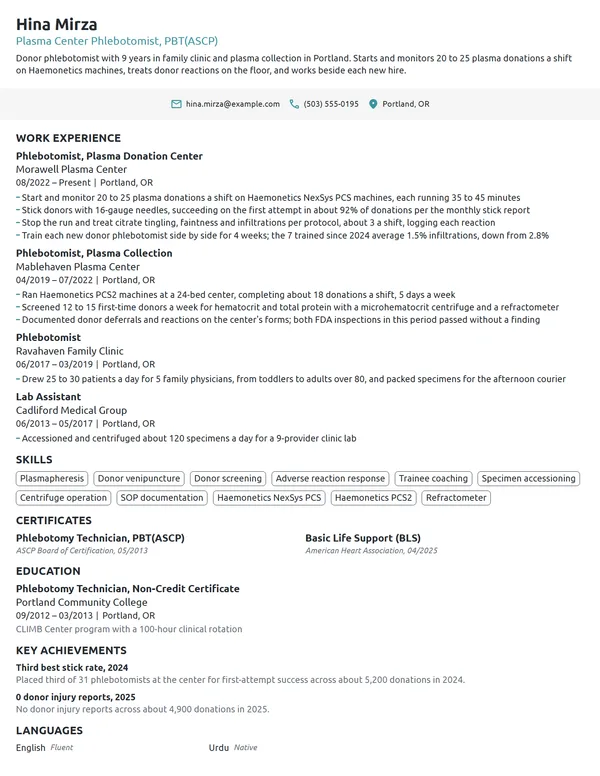
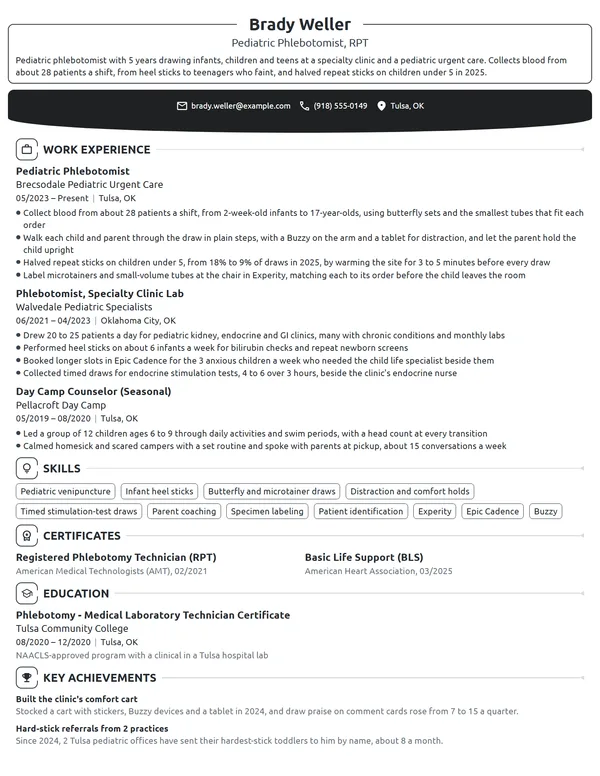
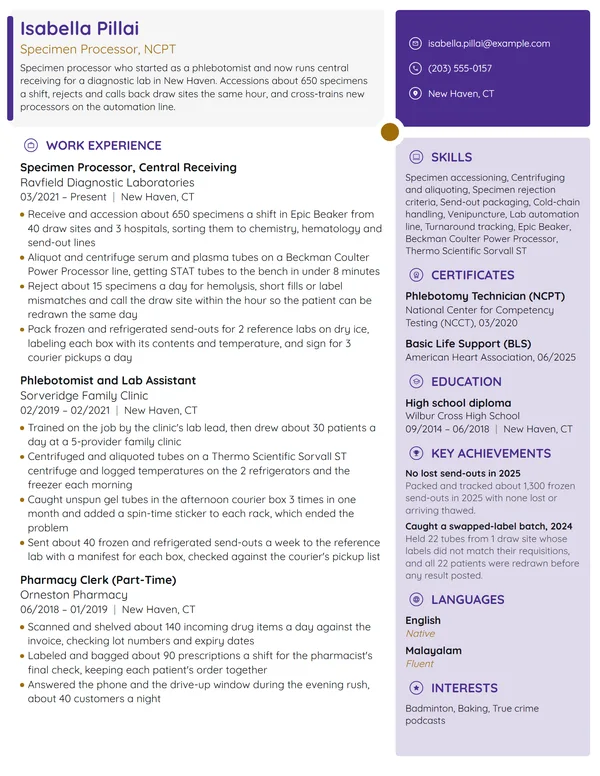
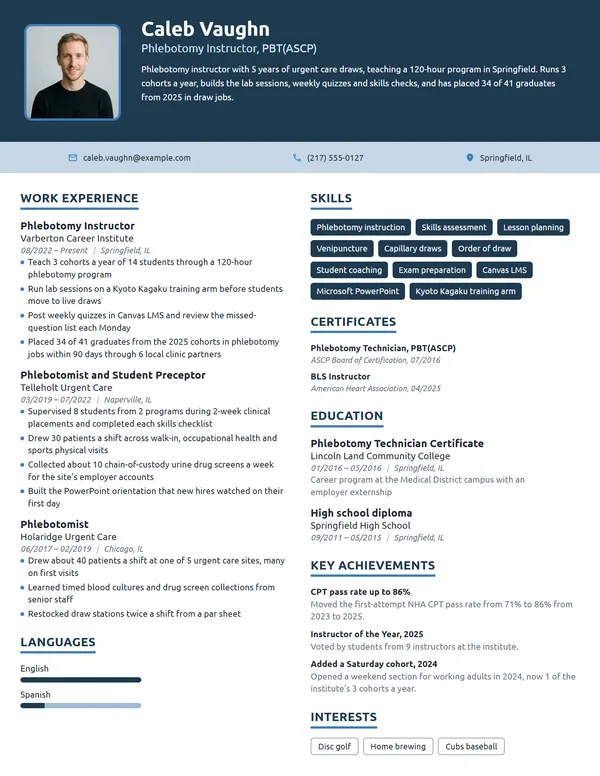
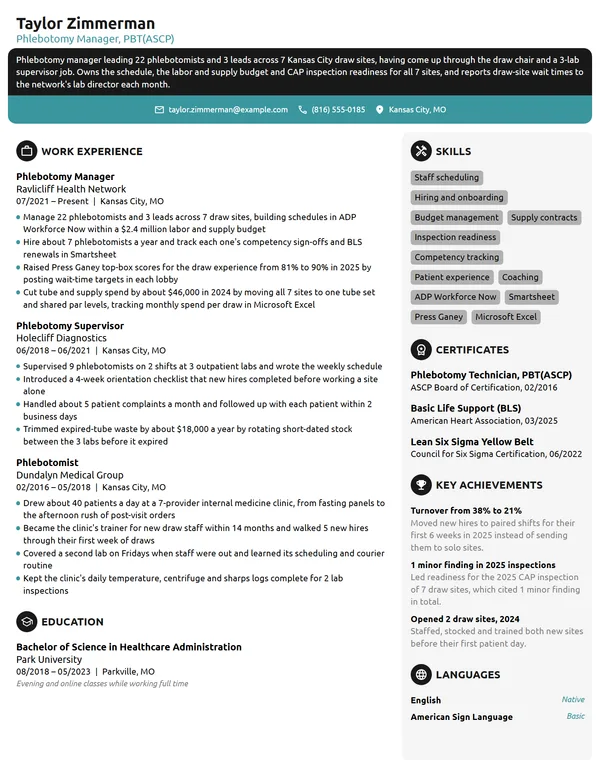
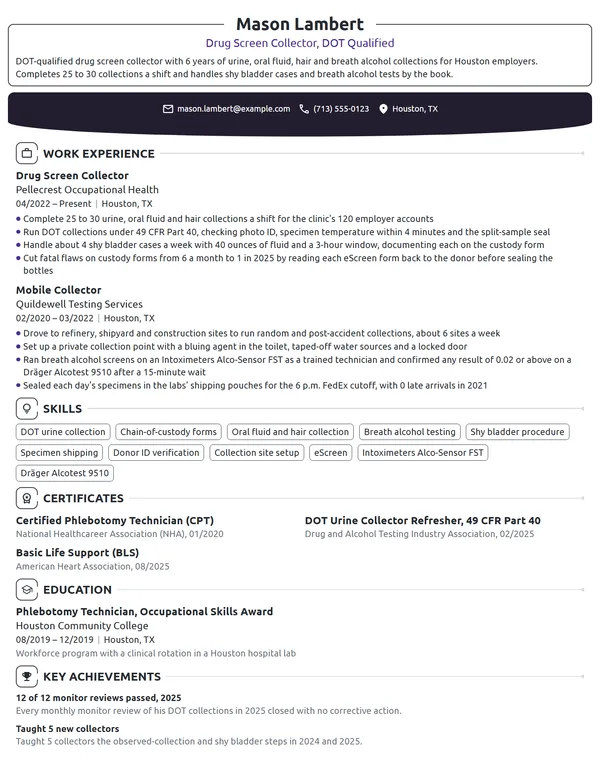
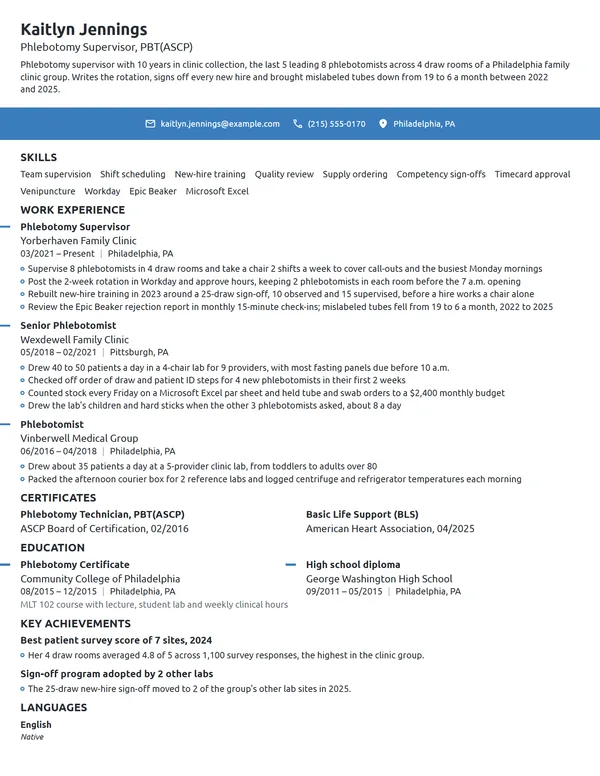
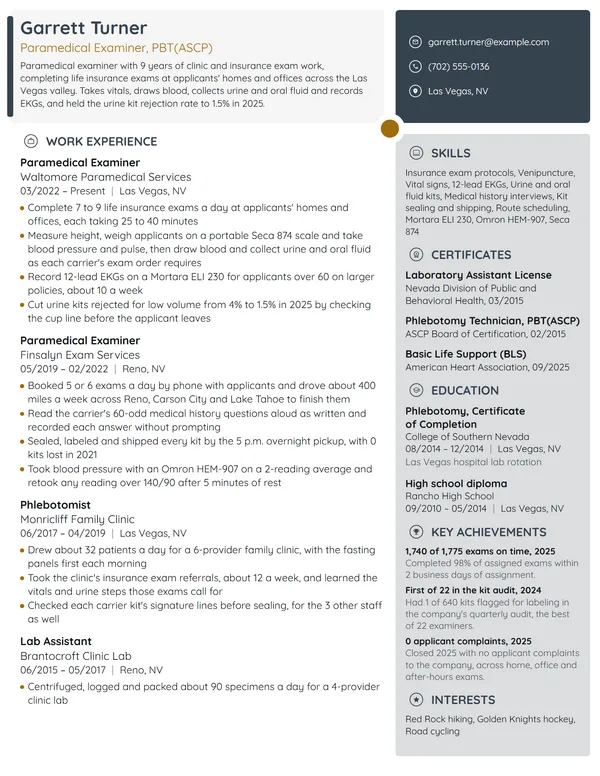
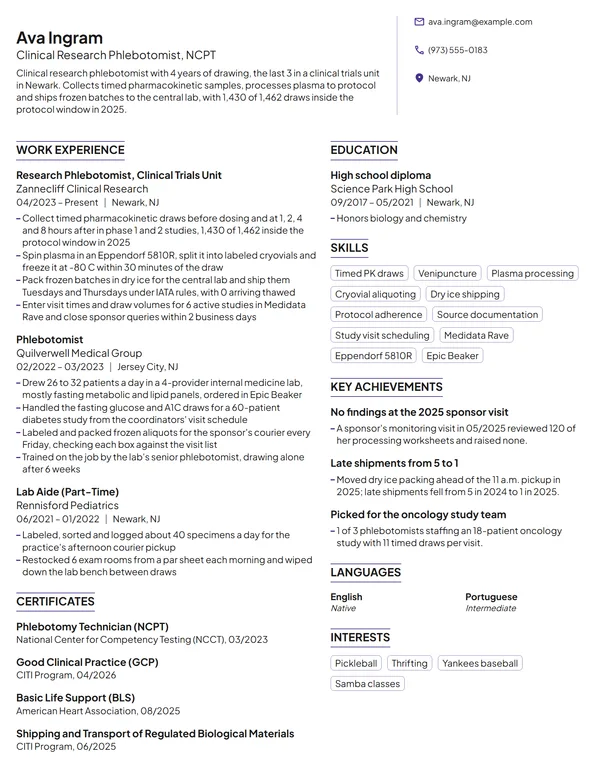
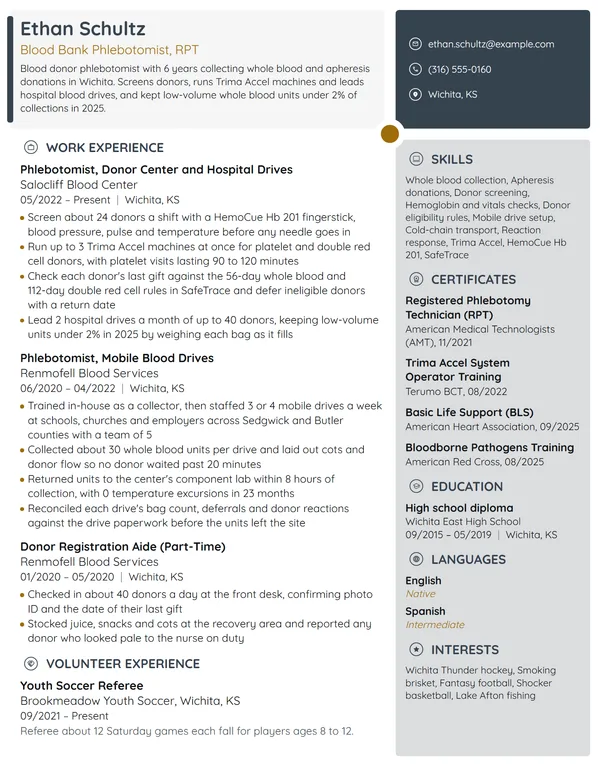
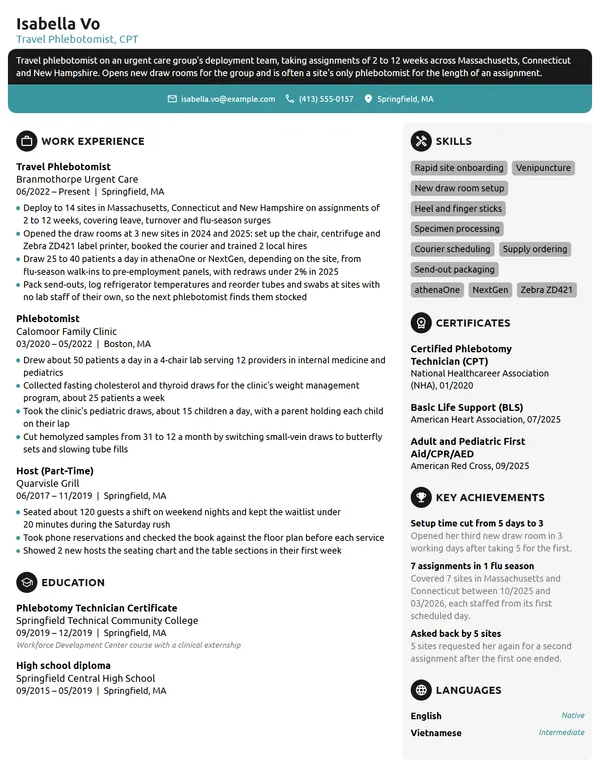
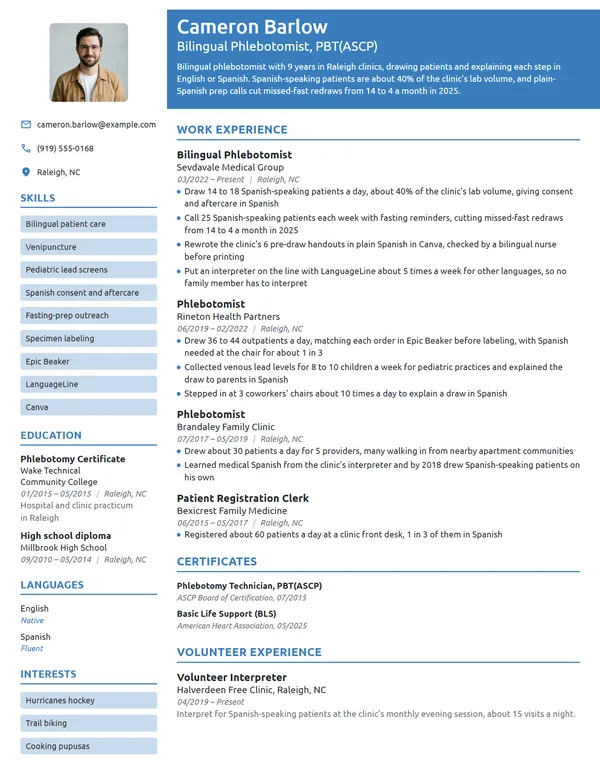
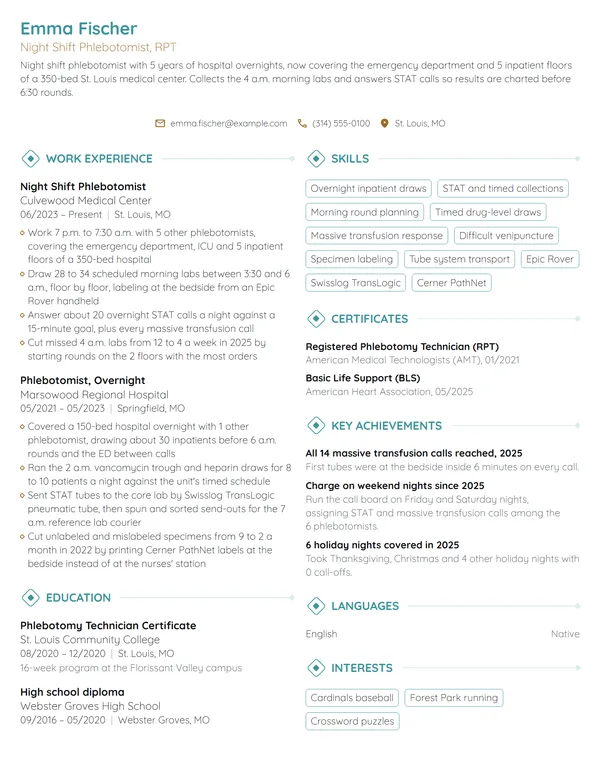
Phlebotomy sits between patient care and the lab, and you need to be good at both sides. A hiring manager checks that you keep up with a busy draw schedule, put anxious patients at ease, label every specimen correctly and hold the right certification. Drawing blood in a children's clinic is a different job from drawing in a dialysis center or a hospital, yet most resumes describe them the same way. Your setting, your patients and your draw volume belong at the top of each job.
How to Write a Phlebotomist Resume - Key Takeaways
- Keep to 1 page in reverse-chronological order; most phlebotomists never need a second.
- Open each job with your setting and your draw volume: patients a shift or a day, and the floors or chairs you covered.
- Give bullets numbers your lab already tracks, such as redraws, hemolyzed tubes, timed draws on schedule and patient wait times.
- List a state certificate first under Certificates, then your national certification such as PBT(ASCP), CPT, RPT or NCPT, then BLS.
- Put your phlebotomy program, its clinical hours and your successful sticks under Education if you are new to the job.
- Run the file through an ATS resume checker, because hospital and lab portals screen for certification names.
What lab managers look for in a phlebotomist resume
Whoever hires you, a lab supervisor, a hospital draw team lead or a clinic manager, wants to know if you can collect a clean, correctly labeled specimen from any patient on the first try. The BLS lists drawing blood, verifying each patient's identity, labeling the samples and entering their information into a database as core duties, along with helping nervous patients relax. O*NET ranks confirming patient identity and matching requisition forms to specimen tubes among the most important tasks in the job.
That means accuracy and volume carry equal weight. The BLS counts hospitals (36%) and medical and diagnostic laboratories (33%) as the 2 largest employers, and each reads your resume a little differently: a hospital wants inpatient rounds and STAT draws, a reference lab wants a fast and steady patient service center. Build the page from these sections:
- Name, headline with your credential (for example, Phlebotomist, PBT(ASCP)) and contact details
- A 2 to 3 line summary or objective under your name, which needs no heading
- Work Experience, newest first, each job opening with its setting and draw volume
- Certificates: a state certificate first, then your national certification and BLS
- Skills, with the lab or charting system you used
- Education, with your phlebotomy program
- Optional extras: Volunteer Experience, Languages or Key Achievements
Best format for a phlebotomist resume
Choose the reverse-chronological resume format: your newest job on top, each with the title, the employer, the city, and start and end dates as MM/YYYY. Phlebotomy careers move from outpatient to inpatient work, to timed and special collections, and then to lead or training roles, and this order shows each step. If you came from retail, food service or another field, keep the same order and let your summary explain the switch.
- Best for most phlebotomistsReverse-chronologicalYour jobs, newest first, with your results under each one.Best for: A steady work history in your field
- FunctionalSkills grouped up top, with a short work history below.Best for: Gaps or very little experience
- CombinationA skills section first, then your full work history.Best for: A career change with strong skills
Keep it to 1 page. Even a lead or supervisor with 10+ years can fit the last 3 jobs, the certificates and the program on a single sheet, and older retail or office jobs shrink to 1 line each.
| Setting | What to use |
|---|---|
| Length | 1 page at every stage of the job |
| Headline | Your title plus your credential: Phlebotomist, PBT(ASCP) or Phlebotomy Technician, CPT |
| Job title line | Title plus setting: Phlebotomist, Inpatient Draw Team or Phlebotomist, Patient Service Center |
| Dates | MM/YYYY start and end dates, with Present for the role you have today |
| Photo and personal details | Usually no photo in the US and Canada; no birth date, Social Security number or marital status either |
| File type | A PDF, or a Word file when the lab's portal asks for one |
Most US and Canadian resumes carry no photo. Large hospital systems and national labs read applications through the same portal for every opening, so plain headings and your certification written out in full help the right fields fill in.
Phlebotomist resume summary vs. objective
The test is simple: if you have drawn blood on the job, write a resume summary with your credential, your years, your setting, your usual volume and 1 result. If your only draws come from a training program, write a resume objective that names the role you want, your certification status and the sticks you completed in your practicum.
Phlebotomist resume summary formula
Credential phlebotomist with X years in setting, averaging draws a shift or a day. 1 specimen-quality or speed number. An extra skill or the next step you are working toward.
Example
PBT(ASCP) phlebotomist with 6 years in reference-lab and hospital collection, averaging about 38 draws a shift on adult inpatient floors. Lowered blood culture contamination on assigned floors from 2.9% to 1.6% in 2025. Cross-trained in specimen processing.
Don't
Dedicated phlebotomist with excellent people skills and a passion for patient care, looking to join a great team.
Do
Certified phlebotomy technician with 3 years at a reference-lab patient service center, averaging about 55 draws a day across pediatric, adult and geriatric patients. NHA CPT and AHA BLS.
The rewrite gives the setting, the volume and the patient range, and the credentials a portal will search for.
How to write phlebotomy work experience bullets with numbers
Write 3 to 4 bullets under your current draw job and 1 to 3 under earlier ones. The first bullet sets the scale: patients a shift or a day, the floors, units or chairs you covered, and any hard-stick groups. After that, use the achievements on your resume that your lab already measures, since your supervisor can confirm a redraw rate or a timed-draw log in a reference call.
| Area | What to count | Example bullet |
|---|---|---|
| Draw volume | Patients a shift or a day, floors or chairs covered, team size | Covered morning rounds for 48 patients a shift with a 2-person team on surgical and oncology floors. |
| Specimen quality | Hemolyzed, clotted or short-draw tubes, redraw requests | Stopped drawing through IV starts on assigned floors and dropped hemolyzed specimens from 5.1% to 2.3%. |
| Patient identification | Label audits, wrong-patient errors, ID checks | Passed 14 months of monthly label audits with 0 wrong-patient labels. |
| Timed and special draws | Glucose tolerance tests, peaks and troughs, blood cultures, on-time rate | Ran about 42 glucose tolerance tests a month and collected 97% of timed samples on schedule. |
| Patient experience | Wait times, survey scores, complaints | Reorganized walk-in check-in so the average wait fell from 22 to 11 minutes. |
| Training | Students precepted, new hires trained, sign-offs | Precepted 5 phlebotomy students through 40-hour clinical rotations. |
Here is one phlebotomist's entry with those numbers in place. The current hospital job opens with the scale, the specimen-quality result follows, and the older lab job keeps a single line.
Work Experience
- Draw blood for 35 to 40 inpatients a shift across 6 adult medical and surgical floors, starting with the 4:30 a.m. pre-round collection.
- Brought redraws for mislabeled specimens down from 3.2% to 1.4% of tubes by labeling at the bedside after a 2-identifier check.
- Collect peak and trough levels, blood cultures and other timed specimens, meeting 96% of scheduled collection windows in 2025.
- Drew about 60 outpatients a day at a 3-chair center, including children, glucose tolerance tests and urine drug screen collections.
Don't
Drew blood from patients in a fast-paced environment.
Do
Drew about 45 patients a shift at an outpatient cancer center, most with fragile or scarred veins, with a 94% first-stick rate on peripheral draws.
The rewrite gives the volume, the patient group and a quality number a lab manager can check.
Don't
Helped train new phlebotomists.
Do
Trained 6 new hires through a 3-week orientation and signed each one off after 150 supervised draws.
Phlebotomy skills and lab software for your resume
From the job ad, choose 6 to 8 hard skills for your resume that a bullet of yours can prove. Venipuncture, capillary sticks and order of draw belong on every phlebotomy resume; arterial draws, therapeutic phlebotomy or donor collection only when you have done them.
Hard skills for phlebotomists
- Venipuncture (vacuum tube, syringe, butterfly)
- Capillary and heel sticks
- Order of draw
- Patient identification
- Specimen labeling and handling
- Blood culture collection
- Timed draws (peaks and troughs, glucose tolerance)
- Centrifuge and specimen processing
- Urine and drug screen collection
- Sharps and biohazard disposal
Soft skills lab managers value
- Calming anxious patients
- Attention to detail
- Clear, simple explanations
- Speed on morning rounds
- Composure when a patient faints
- Teamwork with nurses and lab staff
Name the system you print labels and look up orders in, both in Skills and in a bullet. In O*NET's list for phlebotomists, MEDITECH software is a hot technology and Microsoft Office is in demand, and the list also names laboratory information systems (LIS), electronic medical records and Iatric Systems MobiLab. Write the product as your lab calls it, such as MEDITECH or Epic, rather than just EMR.
Phlebotomy certification and state certificates on a resume
Your state may set its own rules, as California and Washington do, and the BLS notes that some employers prefer certified candidates and that you may also need Basic Life Support. The national credentials you will see in postings are PBT(ASCP) from the ASCP Board of Certification, CPT from the National Healthcareer Association (NHA), RPT from American Medical Technologists (AMT) and NCPT from the National Center for Competency Testing (NCCT). List certifications on your resume in their own Certificates section, each with its issuer and the month you earned it.
| Credential | Issued by | What it takes |
|---|---|---|
| Registered Phlebotomy Technician (RPT) | American Medical Technologists (AMT) | A program of at least 120 classroom hours finished in the last 4 years, or 1,040 hours of work in the last 3 years, plus at least 50 venipunctures and 10 skin punctures, then the exam. |
| Phlebotomy Technician (NCPT) | National Center for Competency Testing (NCCT) | An NCCT-authorized program finished in the last 5 years, or 1 year of full-time phlebotomy work in the last 5 years, plus a high school diploma or GED, then the exam. |
| Certified Phlebotomy Technician I (CPT I), California | California Department of Public Health, Laboratory Field Services | With no work experience: 40 classroom hours and 40 clinical hours with at least 50 venipunctures and 10 skin punctures, plus a national exam; renewed every year with continuing education. |
| Medical Assistant-Phlebotomist, Washington | Washington State Department of Health | A phlebotomy program at an accredited school, or one your supervising health care practitioner attests you completed. |
How to write a state phlebotomy certificate
California's Department of Public Health issues 3 certificates with different scopes: the Limited Phlebotomy Technician (LPT) may do skin punctures only, the CPT I adds venipuncture, and the CPT II adds arterial punctures. California's CPT I is a state certificate, not the NHA's CPT. Write the exact level, because a hospital hiring for arterial draws needs to see CPT II. List the state certificate first, then your national certification, and leave certificate numbers off, since employers check them with the issuer.
Certificates
- Phlebotomy Technician, PBT(ASCP), ASCP Board of Certification, 02/2020
- BLS (Basic Life Support), American Heart Association, 01/2026
How to list a phlebotomy training program
The BLS says phlebotomists usually start with a postsecondary nondegree award from a phlebotomy program, and some employers hire people with a high school diploma and train them on the job. Follow the usual rules for listing education on a resume: the program name, the school and where it is, plus the month you finished. In your first year or two, add 1 line with your clinical hours and successful sticks; after that, the program and date are enough.
Those stick counts matter because certifiers set minimums: AMT and California's CPT I both ask for at least 50 venipunctures and 10 skin punctures. If your total beats the minimum, write the number. Skip the high school diploma once you hold a phlebotomy certificate, unless an employer requests it.
Education
40-hour clinical rotation with 80 successful sticks.
Entry-level and career-change phlebotomist resumes
Without a paid phlebotomy job yet, your practicum is your best evidence: write it like a job, with the site, its hours and your draws. Lead with your certification status, such as CPT passed or exam scheduled with the month, and follow the entry-level resume layout if your other work is short. Count the things a lab manager can picture:
- Practicum or externship: the site, the hours, your venipunctures and skin punctures, and the patient groups.
- Patient-facing jobs: CNA, medical assistant or pharmacy work, with patients a shift and the tasks that carry over.
- Retail and food service: customers a day, cash or order accuracy, and handling upset people calmly.
- Blood drives and health fairs: under Volunteer Experience, with donors checked in or people screened.
Don't
Recent phlebotomy graduate seeking an entry-level position where I can use my skills.
Do
Phlebotomy technician, NHA CPT since 09/2026, seeking a patient service center role. Completed 62 venipunctures and 12 skin punctures in practicum, after 2 years as a pharmacy cashier serving about 150 customers a shift.
Even an objective needs proof: the credential date, the draw counts and the people skills from the last job.
If you are changing careers, keep reverse-chronological order and put your phlebotomy program and certification at the top of the page. Under older jobs, keep the bullets that show accuracy, speed or patient and customer care, and cut the rest to 1 line. The career-change resume examples show that layout. Your cover letter can say why you made the move, and our healthcare cover letter examples show how to do it briefly.
Phlebotomist resume FAQ
Do you need a certification to work as a phlebotomist?
Not always, but many employers prefer it. The BLS notes that some employers hire people with a high school diploma and train them on the job. California requires a state certificate from its Department of Public Health, and Washington issues a Medical Assistant-Phlebotomist certification, so check the rules where you will work.
Which phlebotomy certification is best on a resume?
The one the posting names. PBT(ASCP), NHA CPT, AMT RPT and NCCT NCPT are all national credentials, and California accepts exams from each of these bodies for its CPT I. If a posting lists one by name and you hold another, write yours in full with its issuer so a recruiter sees it is equivalent.
Can I write CPT or PBT after my name before I pass the exam?
No. Add the letters only once the certifying body has issued the credential. Until then, list your program under Education and put the exam with its month under Certificates, marked as scheduled, so a recruiter can see when you will be certified.
How do I list a phlebotomy practicum on my resume?
As a Work Experience entry if you have no paid phlebotomy job, with the site, the city, the dates and 2 to 3 bullets on your hours, your venipunctures and skin punctures, and the patients you drew. After a year or two of paid draws, shrink it to 1 line under your program in Education.
How many blood draws should I put on my resume?
Give a rate, not a career total. Patients a shift or a day, with the setting, tells a manager how you will fit their workload, while a lifetime number such as 10,000 draws is hard to picture or check. For training, the total of successful sticks is the number to give.
Should I use the title patient service technician or phlebotomist?
Use the title your employer gave you, then add phlebotomy work in the bullets. O*NET lists Patient Service Technician as a reported title for phlebotomists, and labs often use it for patient service center staff. If a posting says phlebotomist, put that word in your headline and summary too.
How do I write a phlebotomist resume with no experience?
Lead with an objective that names your certification status and your practicum draws, then put the practicum first under Work Experience. Keep earlier jobs in retail, food service or caregiving, with 1 or 2 bullets each on accuracy, volume or calming upset people.
How long should a phlebotomist resume be?
1 page. That fits a new graduate's practicum and certificate, and it fits a lead phlebotomist's last 3 jobs too. Cut jobs older than 10 years to a single line, or drop them if they do not involve patients, specimens or customers.
What is the average phlebotomist salary?
BLS figures put median yearly pay for phlebotomists at $45,230 in May 2025. Pay varies with the state, the setting and your shift, so leave it off your resume and raise it once an employer makes an offer.
Next steps
Pick the example closest to your setting and stage, keep its order, and fill in your own credential, draw volume and specimen-quality numbers. Build it in our resume builder or begin with one of our templates, then pair it with a short cover letter naming the setting you want and your best number.