
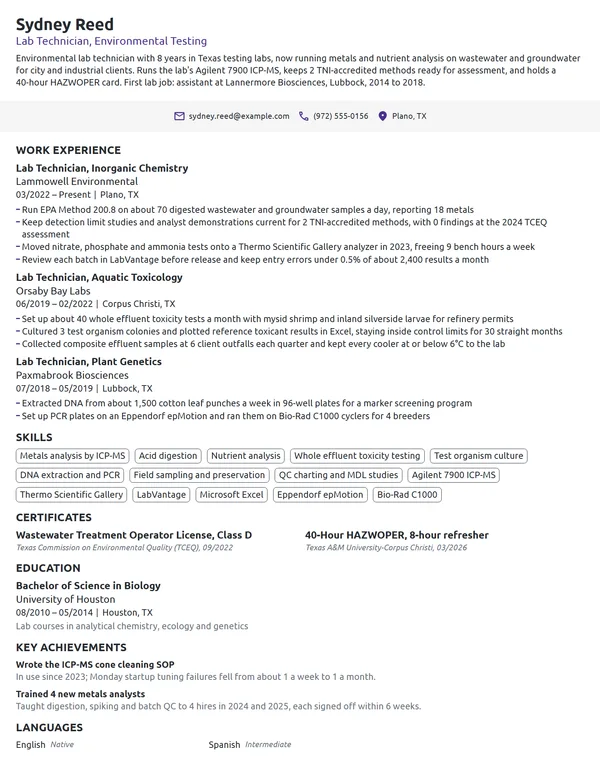
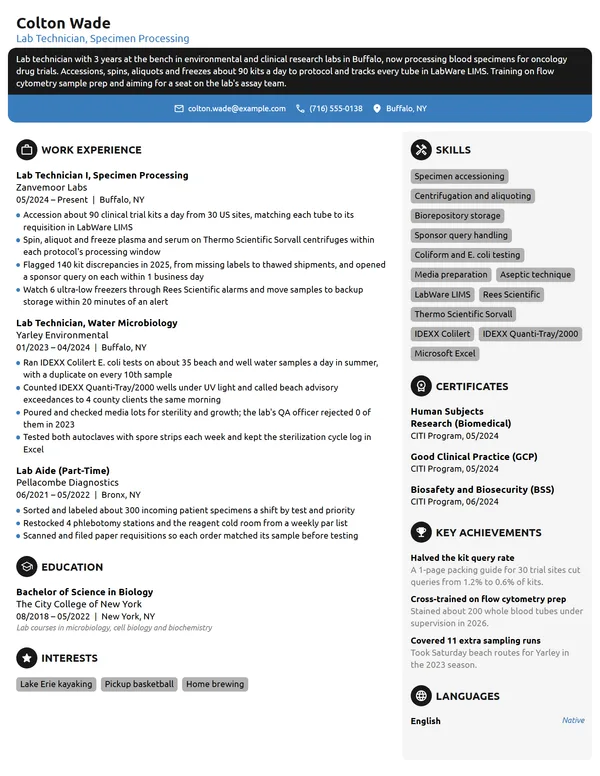
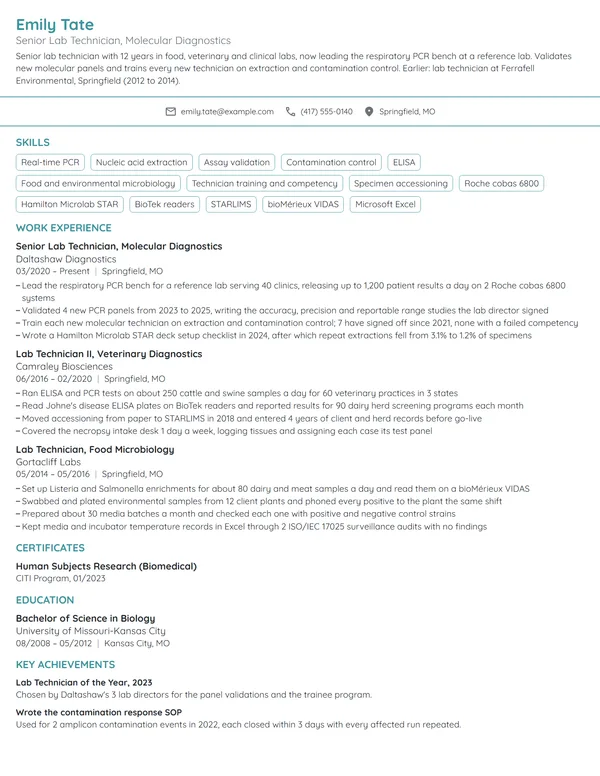
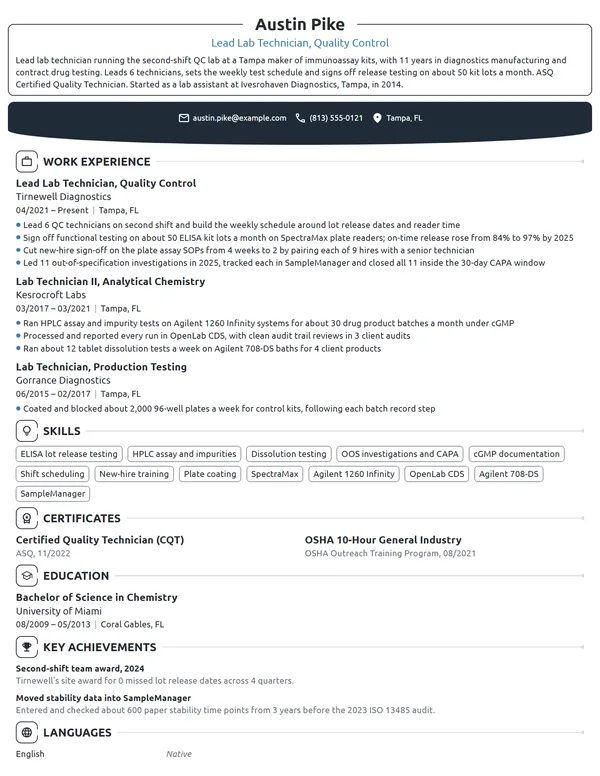
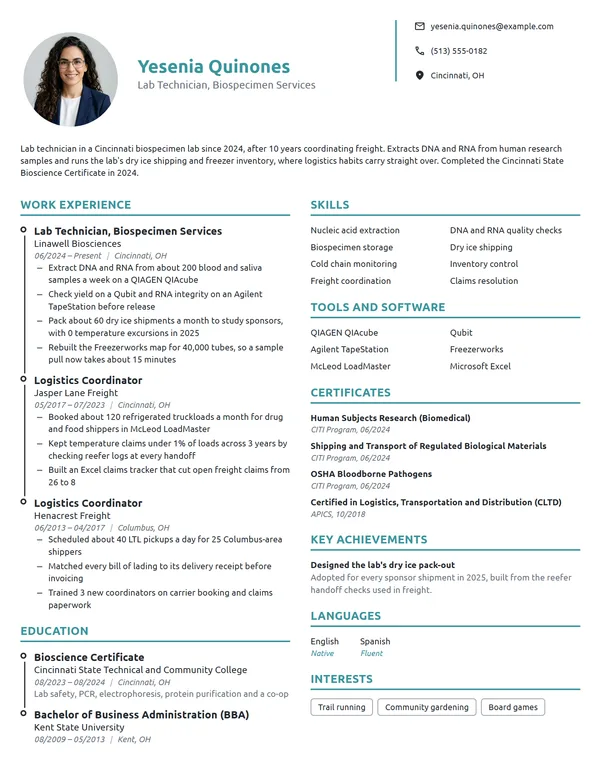
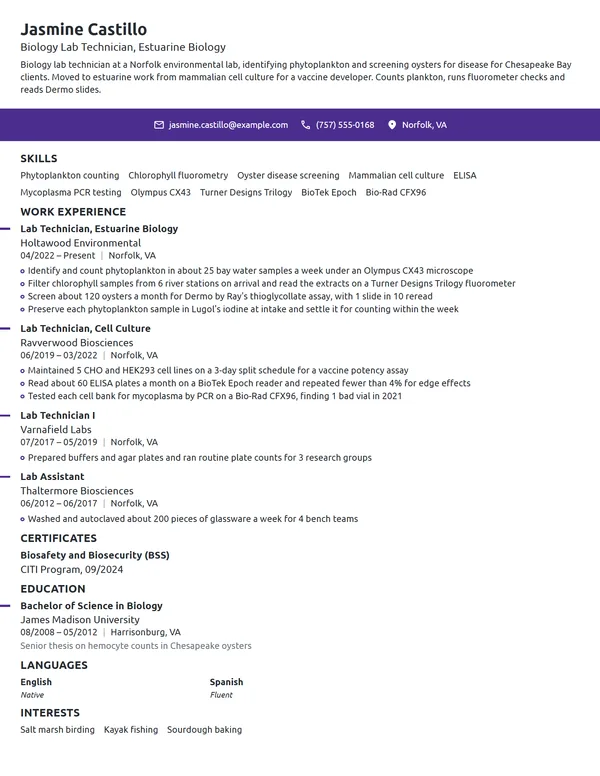
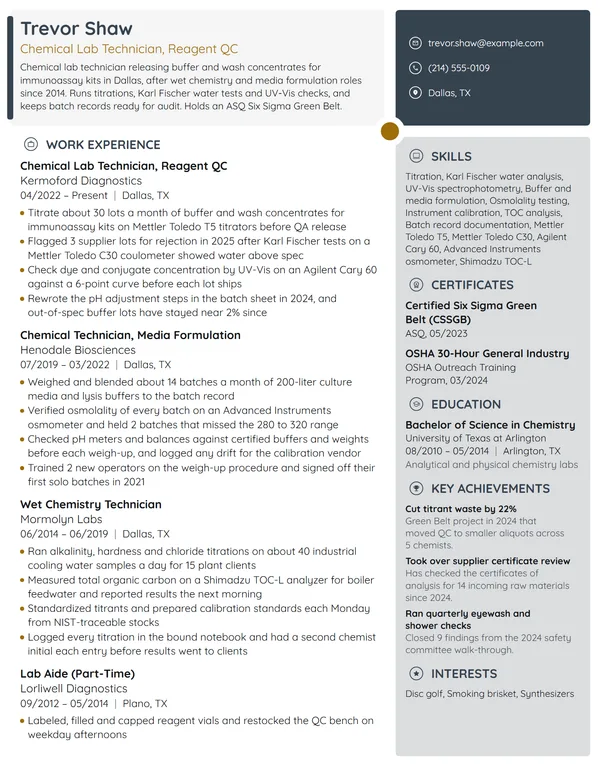
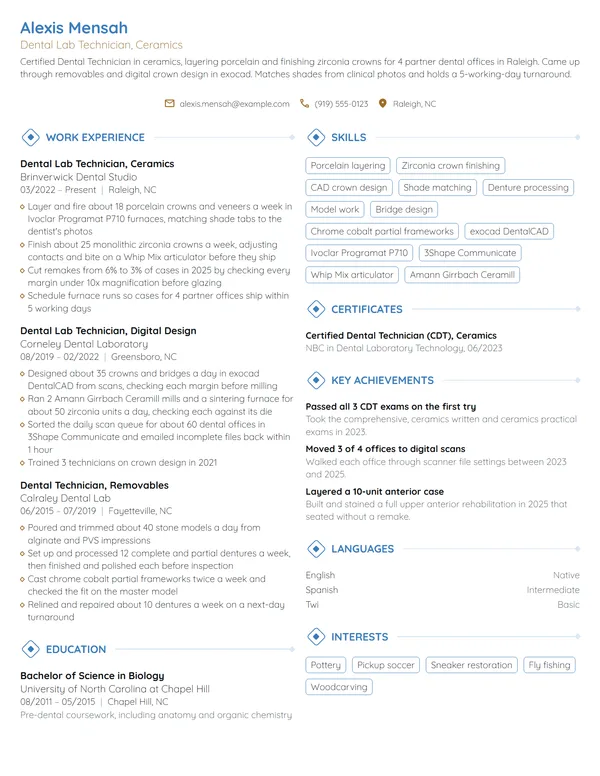
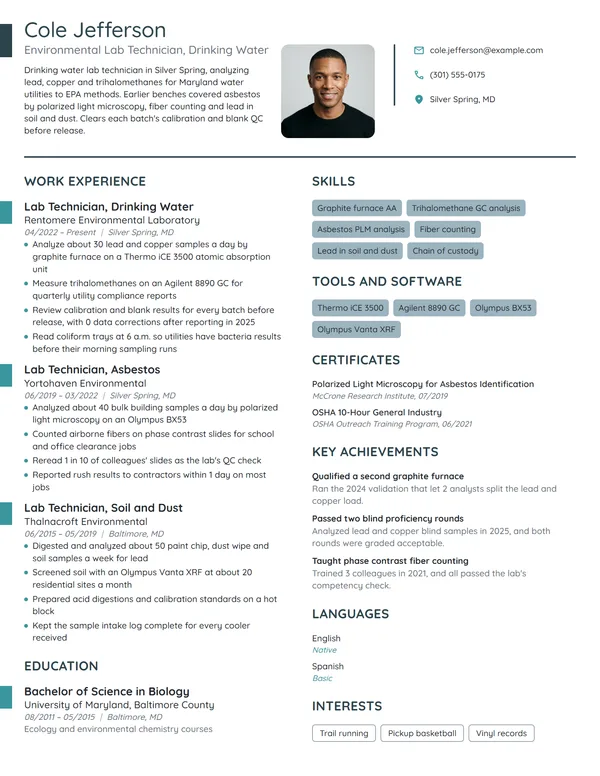
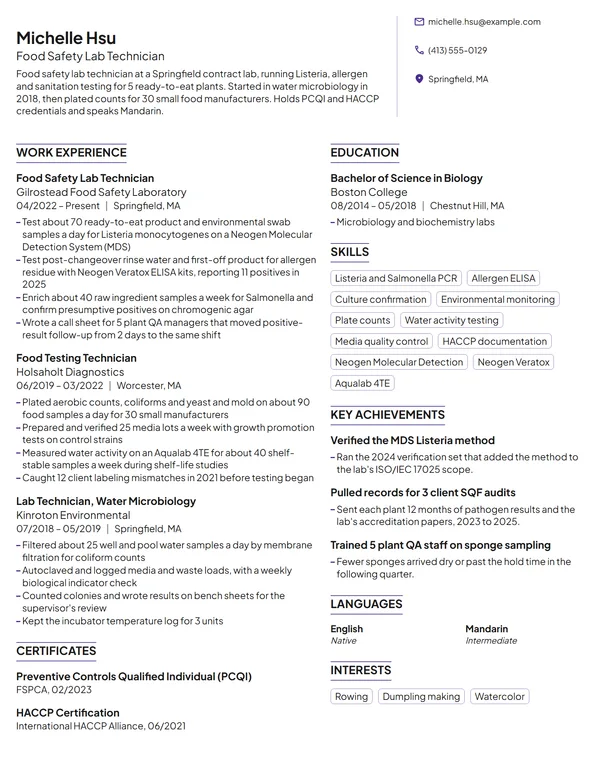
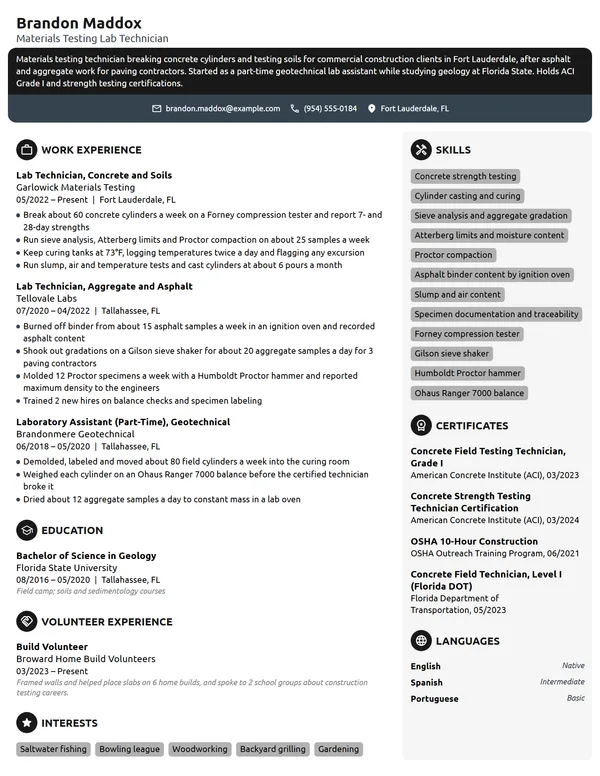
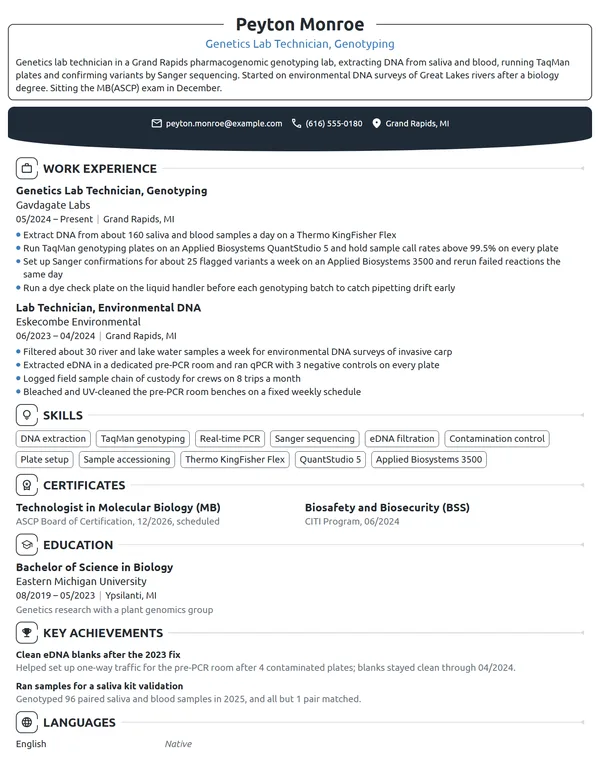
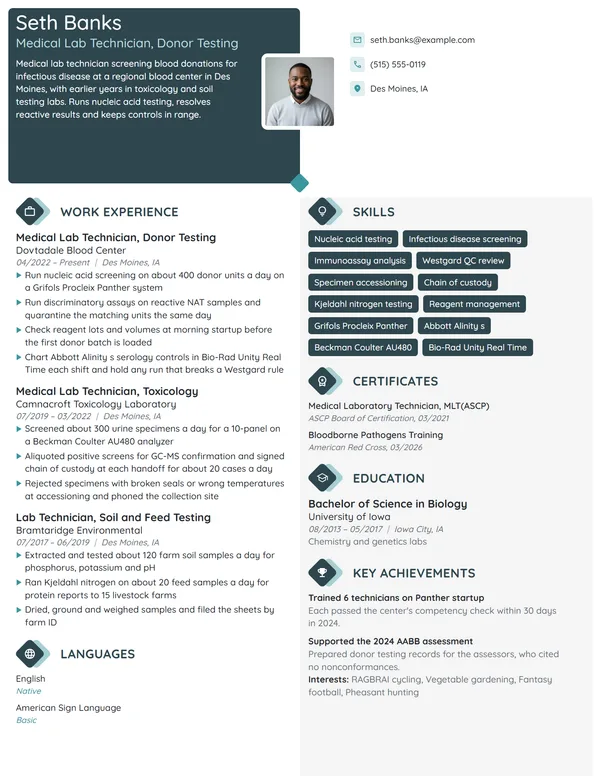
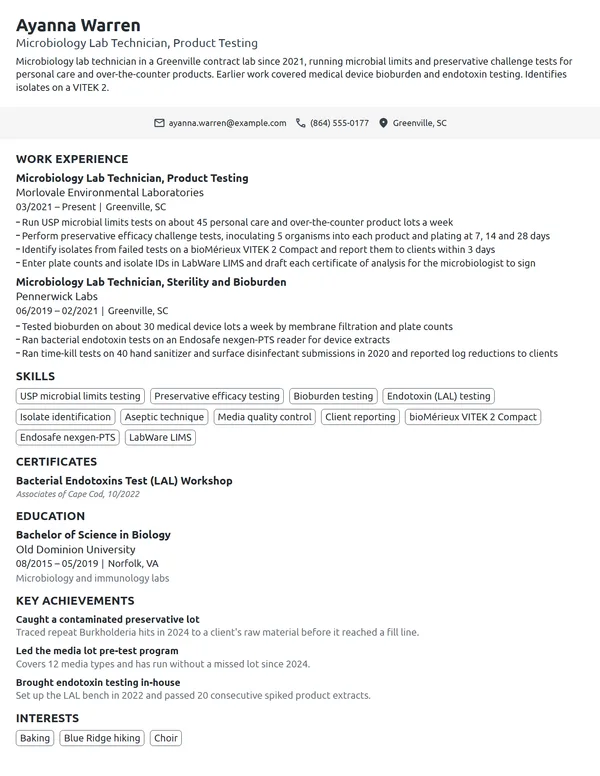
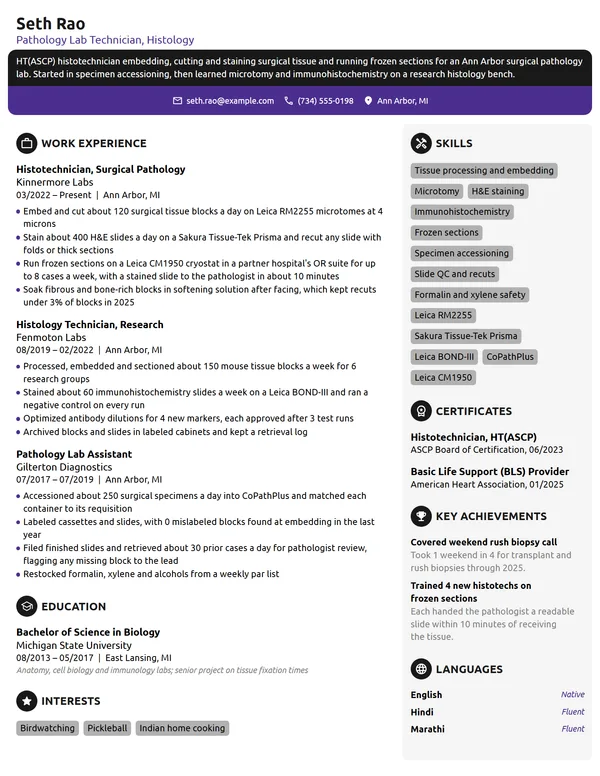
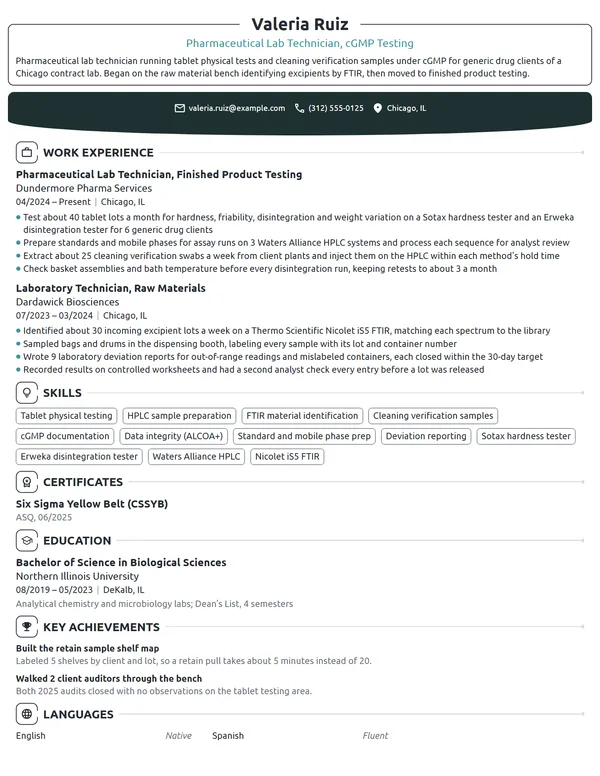
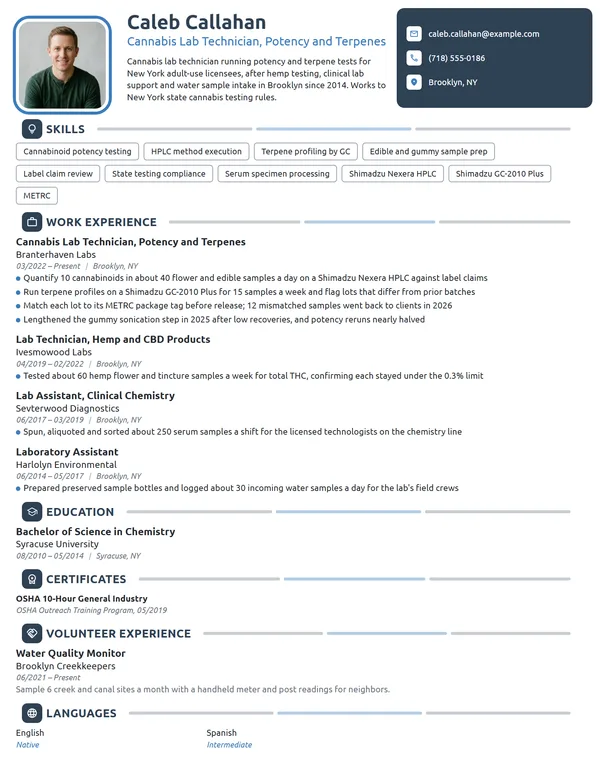
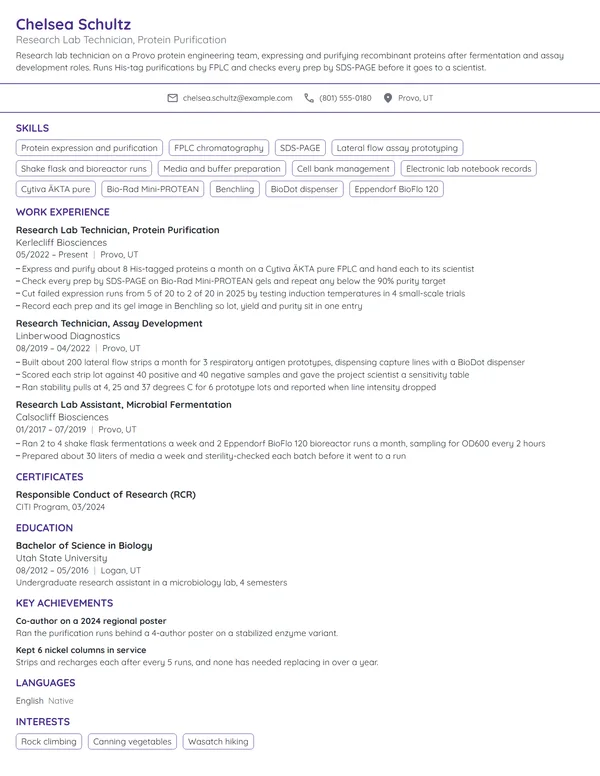
Lab technician jobs run from hospital core labs to research groups, food plants and water testing labs, and a manager hiring for one wants proof that your bench matches theirs. That means the instruments and methods you ran, the samples you handled and how your quality control held up. A list of tests performed shows none of it. Each job on your resume should name the lab type, your methods and a figure such as samples a shift, turnaround time or proficiency tests passed.
How to Write a Lab Technician Resume - Key Takeaways
- Order your jobs newest first, keep the file to 1 page, and put the lab type in every job title line.
- Open with a 2- to 3-line summary that names your lab setting, your main instruments and 1 quality or volume result.
- Give each bullet a lab number: samples a shift, turnaround hours, QC failures caught, repeat rates or calibrations kept on schedule.
- Write instruments, methods and your LIMS by their exact names under Skills, then prove each one inside a work bullet.
- List a state license first under Certificates, then MLT or other certifications and any safety training named in the job ad.
- Run the finished file through an ATS resume checker, since lab postings are screened for method and certification keywords.
What lab managers look for in a lab technician resume
A lab manager or supervising scientist reads your resume to see whether you can run their bench from week 1: the same kind of samples, the same instruments and the same quality rules. In clinical labs, the BLS describes technicians testing body fluids such as blood and urine, running microscopes and automated cell counters, and recording results, usually under the general supervision of technologists or lab managers. In research and manufacturing labs, the BLS has biological and chemical technicians preparing samples, maintaining instruments, testing product quality and documenting procedures and results. O*NET ranks quality control analyses as the most important task for clinical lab technicians.
Lay the resume out in sections that hiring software can parse:
- Name, headline (such as Lab Technician, MLT) and contact details
- Summary of 2 to 3 lines, placed under your name without a heading
- Work Experience, newest first, with the lab type in each job title
- Skills, covering techniques, instruments and your LIMS
- Certificates, opening with a state license if you hold one
- Education, with the lab courses that match the posting
- Languages, plus Key Achievements or Volunteer Experience (not both) when space allows
Best format for a lab technician resume
Choose the reverse-chronological resume format: your current lab first, then each earlier one, every entry carrying your title, the employer, its location and MM/YYYY dates. Lab careers grow by setting and responsibility, from bench technician to senior, lead and lab manager, and this order lets a reader follow that path. Lab technicians changing careers keep this order too and add a short skills summary at the top rather than switching formats.
- Best for most lab techniciansReverse-chronologicalYour jobs, newest first, with your results under each one.Best for: A steady work history in your field
- FunctionalSkills grouped up top, with a short work history below.Best for: Gaps or very little experience
- CombinationA skills section first, then your full work history.Best for: A career change with strong skills
Hold it to 1 page for your first 10 years. A senior or lead lab technician with several labs, validations or training duties can use 2 pages, provided page 1 shows the current lab, its instruments and your strongest quality result.
| Setting | What to use |
|---|---|
| Length | 1 page; 2 only past 10 years or with lead and validation work |
| Job title line | Title plus lab type: Lab Technician, Clinical Chemistry |
| Dates | MM/YYYY for every job, and Present for the lab you work in now |
| Type | 1 readable font, body text between 10 and 12 pt, headings slightly larger |
| Photo | Skip it on most US and Canadian applications |
| Personal data | Leave out age, family status and your SSN |
| File type | PDF, or a Word file if the employer's application system asks for one |
Most US and Canadian resumes carry no photo. Hospital, university and manufacturer job portals usually read your file into their own fields, so plain headings and 1 column of dates parse more reliably than a decorative layout.
Lab technician resume summary vs. objective
If you have worked in a lab, write a resume summary that names your lab setting, your years, your main instruments and 1 result. If your lab experience is coursework, research credit or a practicum, write a resume objective: the lab type you want and the strongest hours or methods you can show. Write the summary last and take its number from a bullet below it.
Lab technician resume summary formula
Title with X years in lab setting, running instruments or methods. 1 quality, volume or turnaround figure. Certification, license or training the job ad names.
Example
Lab technician with 8 years in clinical and food testing labs, running chemistry and hematology analyzers in a hospital core lab. Passed 6 of 6 chemistry proficiency testing events since 2024. Certified as an MLT by American Medical Technologists.
Don't
Hardworking lab technician with excellent attention to detail looking to join a growing laboratory team.
Do
Research lab technician with 3 years in a university cell biology lab, culturing 4 cell lines and running about 20 Western blots a month. Trained 6 graduate students on the lab's flow cytometer.
The rewrite names the lab, the methods, the volume and a responsibility a manager can check.
How to write lab technician work experience bullets with numbers
Write 3 to 4 bullets for the lab you work in now and up to 4 for earlier jobs, cutting an old job that no longer matches the posting to 1. Open with the sample type and volume, since a reader judges every later number against it, then add results your lab already tracks: turnaround, QC failures, repeat runs, calibrations or audit findings. Each bullet should read as one of your achievements on a resume, a task with its count and its outcome, rather than a duty copied from the job description.
| Area | What to count | Example bullet |
|---|---|---|
| Sample volume | Samples or specimens a shift or day, batch size, sample types | Prepared 60 soil extracts a day for metals analysis by ICP-OES. |
| Turnaround | Hours or days from receipt to reported result | Cut reporting time for routine water bacteria tests from 48 to 30 hours by adding a weekend setup shift. |
| Quality control | QC failures traced, repeat rate, proficiency testing results | Brought the plate assay's repeat rate from 7% to 2% after retraining on multichannel pipetting. |
| Instruments | Instruments owned, calibrations, downtime, audit findings | Owned calibration for 5 balances and 3 pH meters, with no overdue checks in 2 external audits. |
| Reagents and inventory | Expired stock, stockouts, ordering cost | Set up first-expiry-out reagent storage that cut expired stock write-offs by $3,200 a year. |
| Records | Samples logged, chain of custody, data errors | Logged 1,100 samples a month in LIMS, each with a complete chain-of-custody form. |
The entry below belongs to a lab technician who moved from food quality control into a hospital lab. The current job opens with volume and setting, the QC bullet carries a count, and the older role keeps a single line.
Work Experience
- Process about 380 specimens a day shift on chemistry and hematology analyzers for a 160-bed hospital.
- Review daily QC on 3 analyzers; traced 14 out-of-range runs in 2025 to reagent lots or calibration before any patient result was released.
- Raised the share of stat chemistry orders resulted within 45 minutes from 88% to 96% in 2025 by reordering the centrifuge queue.
- Tested moisture, pH and salt on about 25 finished snack lots a day and held 3 out-of-spec lots before shipment in 2021.
Don't
Performed tests on samples.
Do
Tested 45 drinking water samples a day for total coliform and nitrate, with results reported to clients within 24 hours.
Sample type, volume, tests and turnaround now all appear in 1 line.
Don't
Maintained laboratory equipment.
Do
Ran weekly checks on 2 biosafety cabinets and 4 centrifuges and kept a service log that cut unplanned downtime from 9 days a year to 2.
Lab technician skills, instruments and LIMS for your resume
Pick 6 to 8 hard skills for your resume from the posting, and keep only those a bullet already shows you using. Pipetting, solution preparation and documentation fit almost any lab; PCR, chromatography or blood banking only when your lab ran them.
Hard skills for lab technicians
- Sample preparation and accessioning
- Pipetting and serial dilution
- Reagent and buffer preparation
- Instrument calibration and maintenance
- Quality control documentation
- Microscopy and staining
- Chromatography (HPLC, GC)
- Spectrophotometry
- Aseptic technique and cell culture
- Chain of custody
- LIMS data entry
Soft skills lab managers value
- Attention to detail
- Following SOPs exactly
- Clear, complete lab records
- Managing several runs at once
- Reporting problems early
- Working well with scientists and clinicians
Write each instrument and system by its maker or product name, and repeat it in a bullet. For clinical lab technicians, O*NET flags Microsoft Excel and Microsoft Office as in-demand technologies and MEDITECH as a hot technology; for biological technicians it lists laboratory information management systems (LIMS). Name your LIMS, your analyzers and the quality system your lab works under, such as CLIA, GLP, GMP or ISO/IEC 17025, since postings screen for those words.
MLT certification, state licenses and lab training on a resume
Some states, the BLS says, require lab personnel to be licensed or registered, with rules that vary by state and specialty, and that employers may prefer certified technicians. Under the federal CLIA rules (42 CFR 493.1489), staff doing high-complexity testing need a state license where the state issues one, and an associate degree in a laboratory science or medical laboratory technology is one route to qualify. Research, food and environmental labs ask for different proof, often safety or research training. List certifications on your resume with the issuer and date, and put a state license first.
| Credential | Issued by | What it takes |
|---|---|---|
| Medical Laboratory Technician (MLT) | American Medical Technologists (AMT) | An associate degree from a NAACLS or accredited MLT program in the last 5 years, a 50-week US military lab program, or an associate degree or 60 semester hours (24 in science) plus 1,040 hours of clinical lab work across the main lab sections. |
| California MLT license | California Department of Public Health, Laboratory Field Services | An associate degree or 60 semester units with set science, chemistry and biology hours, approved training or 3 years of clinical lab work in 5, and a national certification such as MLT(ASCP). |
| 40-Hour HAZWOPER | A training provider under OSHA's 29 CFR 1910.120 | 40 hours of off-site instruction and 3 days of supervised field experience, then 8 hours of refresher training a year. |
| Human Subjects Research (HSR) | CITI Program | Online modules for staff on human subjects research; CITI says most organizations retrain every 3 years. |
Read a license's scope before you describe your work. California's MLT license, for example, covers waived and moderate-complexity tests, not high-complexity testing, so a bullet should match what the license allows.
How to list a certification exam you have not passed yet
Write the credential's full name and issuer, then scheduled with the month of your exam date, such as scheduled 03/2027. Leave the initials out of your headline until the result arrives. Once you pass, add the date you were certified and move the initials up next to your name.
Certificates
- Medical Laboratory Technician (MLT), American Medical Technologists, 08/2023
- Registered Phlebotomy Technician (RPT), American Medical Technologists, 05/2022
How to list a lab technician associate's or bachelor's degree
The degree a lab expects depends on its type. The BLS says clinical lab technicians usually complete an associate's degree in clinical laboratory science, chemical technicians typically need an associate's degree or 2 years of postsecondary education, and biological technicians usually need a 4-year degree in biology or a related field. Write the degree in full, such as Associate of Applied Science in Medical Laboratory Technology, since certification bodies and state licenses check the program.
When listing education on a resume, give the degree, the school with its location, and the month you graduated. In your first 2 years out, add 1 line with the lab courses or research that match the posting; after that, the degree, school and date are enough.
Education
Lab courses in analytical chemistry, microbiology and genetics; 2 semesters as an undergraduate research assistant.
Entry-level and career-change lab technician resumes
Without paid lab work, open with an objective and put the bench hours you have where a reader can count them, as the entry-level resume examples do. A clinical practicum, undergraduate research or a teaching lab job all count, as long as each names the methods and instruments you used.
- Clinical practicum: the lab sections you rotated through, your hours and the analyzers you ran.
- Undergraduate research: a Work Experience entry with the lab, the methods and what you produced, such as samples prepared or data sets logged.
- Teaching lab assistant: the courses, the number of students and the reagents or setups you prepared each week.
- Co-op or summer QC job: a full entry with samples a day and the tests you ran.
- Science fairs or citizen water monitoring: under Volunteer Experience, with the number of samples or students involved.
Don't
Recent biology graduate seeking an entry-level lab position to gain experience.
Do
Biology graduate seeking a lab technician role in environmental testing. Ran 150 hours of water and soil analysis in a senior research course and prepared reagents for 2 semesters as a teaching lab assistant.
Even with no lab job yet, an objective can name the lab type and give a count of bench hours.
Moving into lab work from another field, lead with your new degree or certificate program and its practicum, then keep the older bullets that carry over to a lab, the way the career-change resume examples do: record keeping, inventory, chain of custody, safety checks or work to a written procedure. Explain the move in the letter you send with your application, and follow the steps for writing a cover letter to keep that reason to a short paragraph.
Lab Technician resume FAQ
Do I need a license to work as a lab technician?
Only in some states and mostly for clinical work. The BLS says some states require lab personnel to be licensed or registered, and California, for one, issues an MLT license through its Laboratory Field Services. Research, food and environmental lab postings list the training they need instead.
Is a medical lab technician (MLT) the same as a lab technician on a resume?
Not quite. MLT is a certification and, in some states, a license for clinical lab work, while lab technician is a job title used in many kinds of labs. Use the title your employer gave you, and add MLT to your headline and Certificates once you hold it.
How do I show an MLT exam I am still scheduled to take?
Write the certification and its issuer under Certificates, followed by scheduled and the exam month. Keep the initials out of your headline until you pass, then replace scheduled with the month you were certified.
Which lab instruments should I list on my resume?
List the instruments and systems the posting names that you have really used, written the same way: HPLC, qPCR, a hematology analyzer or your LIMS. Put each one in Skills and prove it in a work line with a sample count or result.
How long should a lab technician resume be?
1 page for most lab technicians. Go to 2 pages only after 10+ years or when lead, validation and training work need the room, and keep your current lab and its instruments on page 1.
Should I put HAZWOPER or CITI training on a lab resume?
Yes, when the posting or the lab's work calls for it. HAZWOPER fits environmental labs that sample hazardous waste sites, and OSHA requires an 8-hour refresher each year, so give the latest date. CITI human subjects training fits research labs working with people or their samples.
How much does a lab technician make?
Clinical laboratory technologists and technicians earned a median of $62,930 a year in May 2025, according to the BLS. Pay varies with the lab type, your state, your shift and certifications such as MLT, so keep salary off the resume and raise it once an offer is on the table.
Next steps
Choose a sample on this page from a lab like yours, then replace its figures with your own samples a shift, instruments, QC results and credentials. Lay it out in our resume builder or one of our templates. Send the finished file along with a short letter that names the lab you want to join and your best result.