
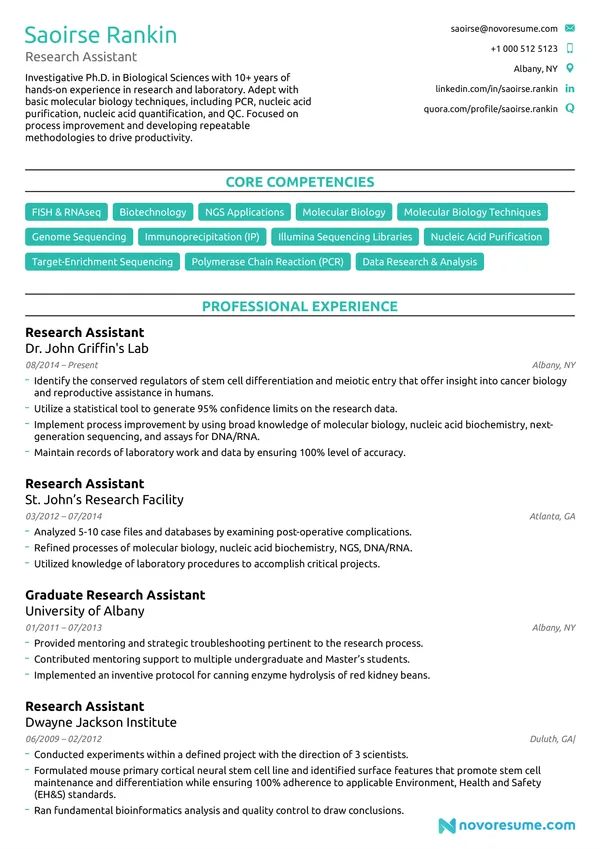
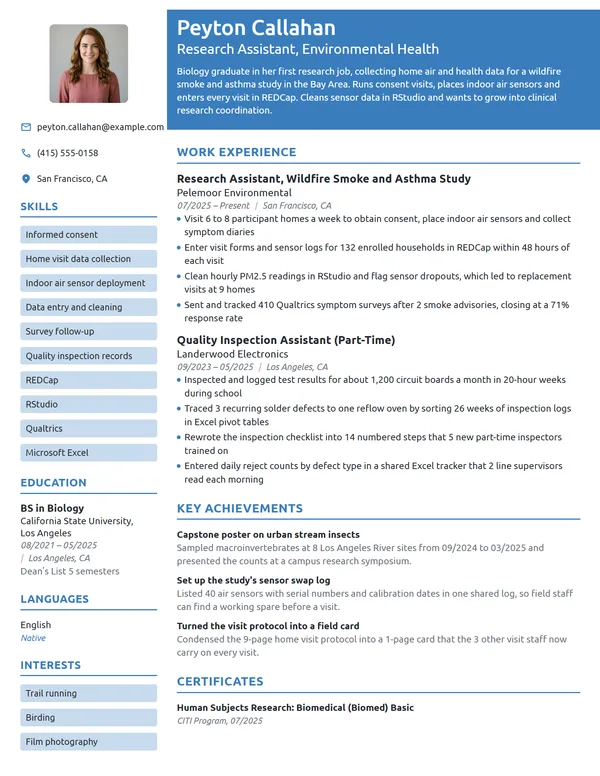
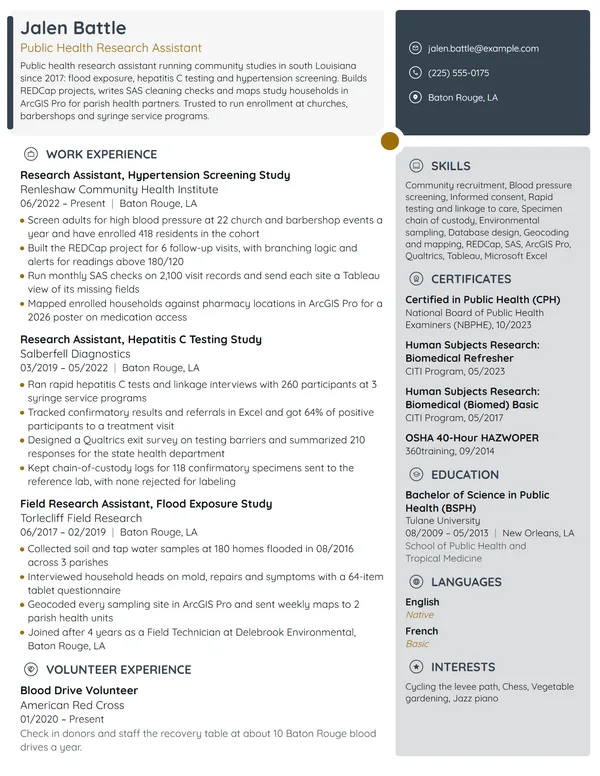
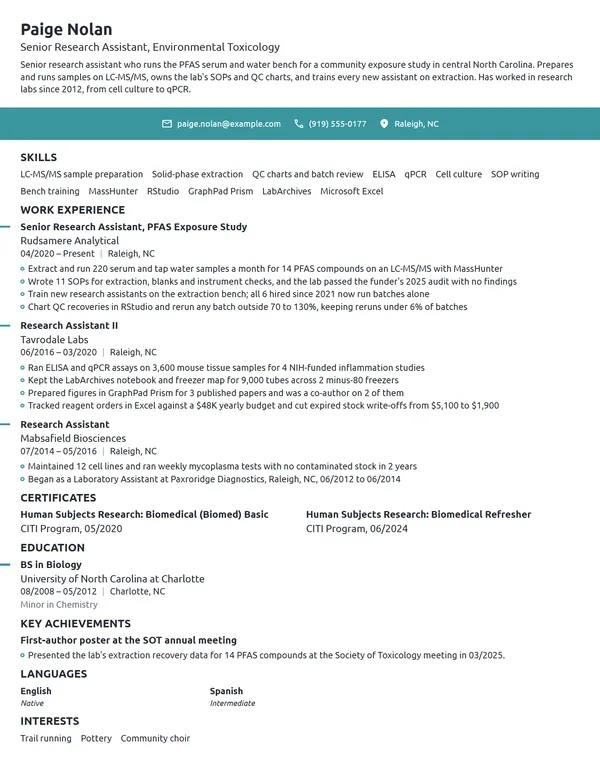
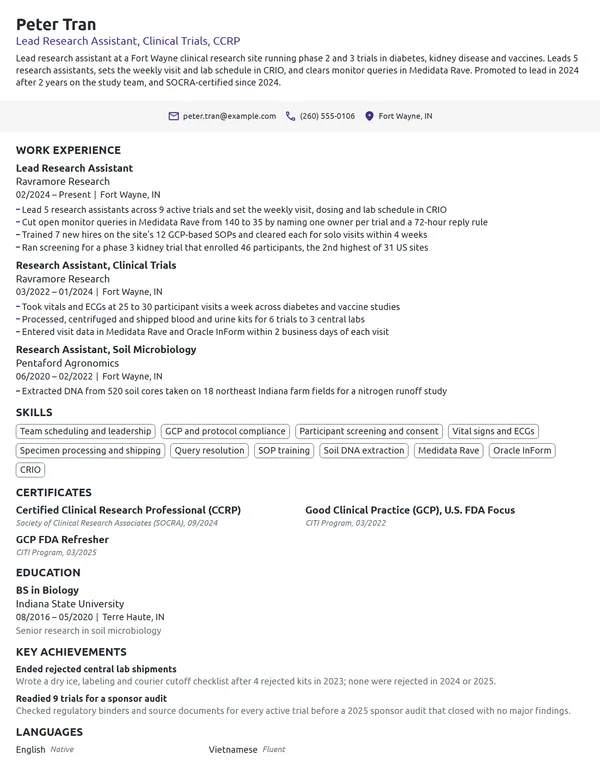
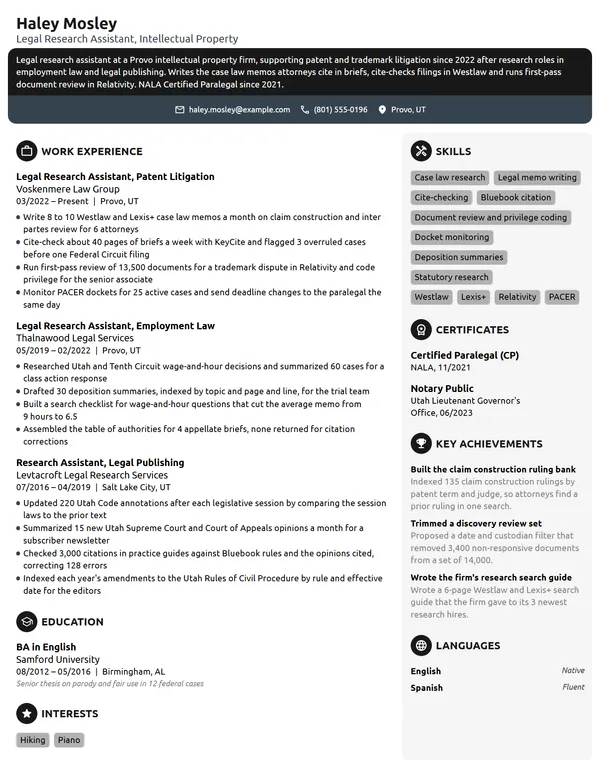
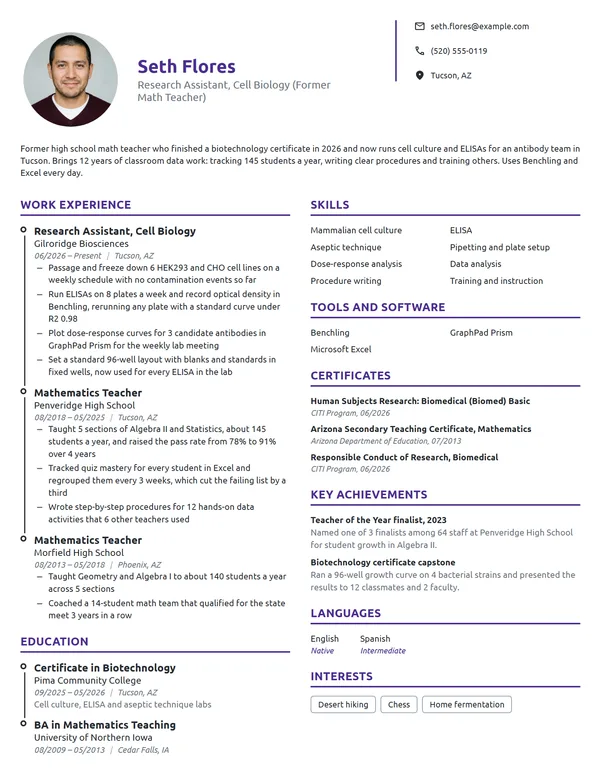
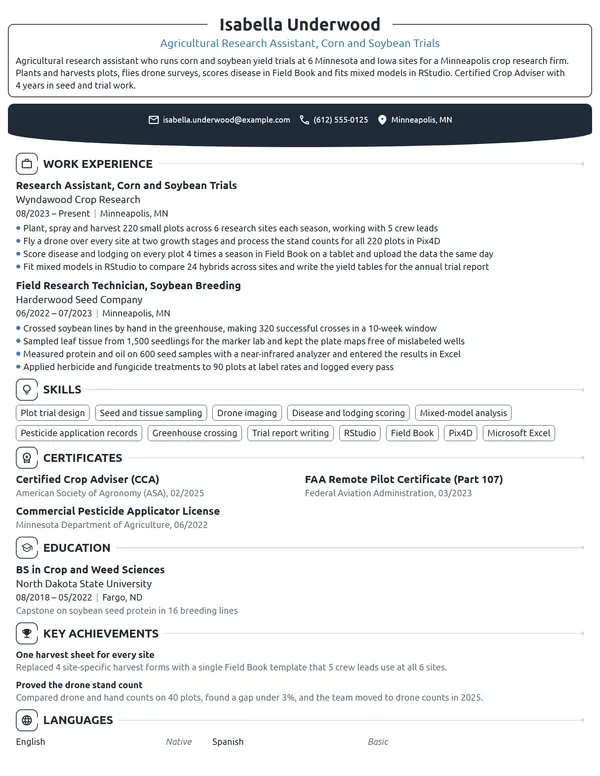
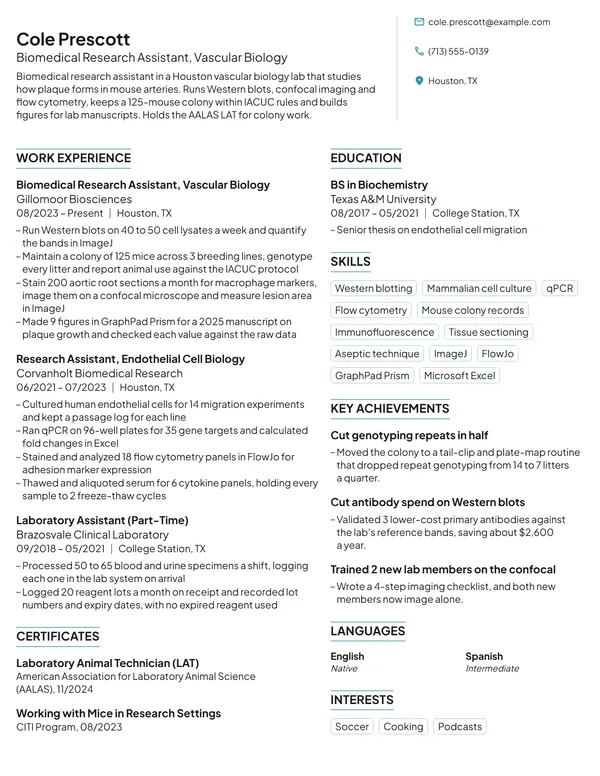
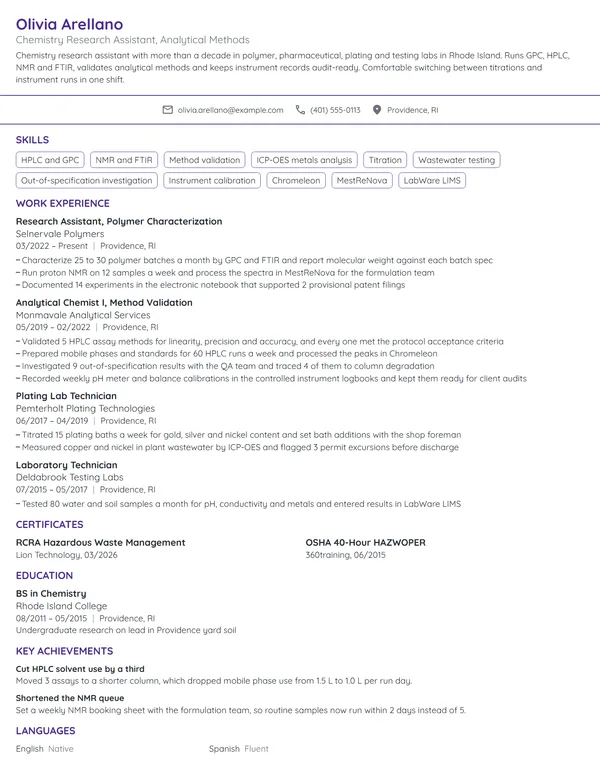
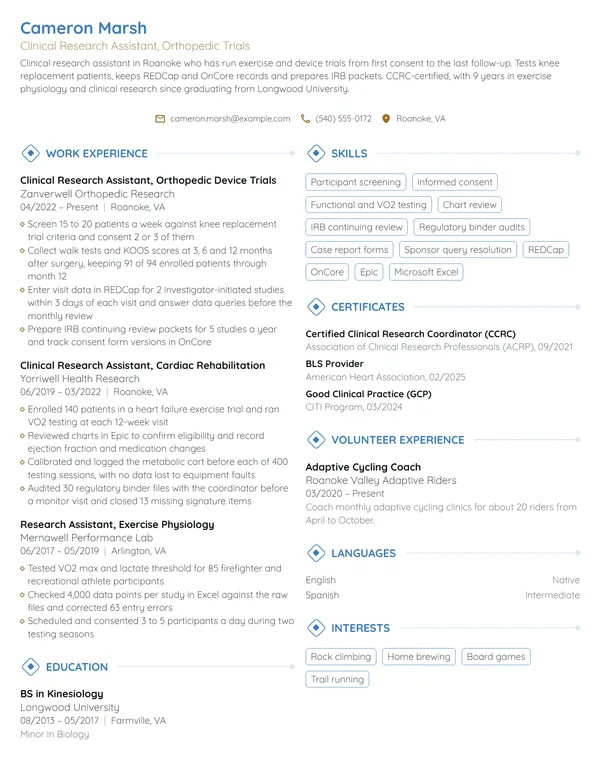
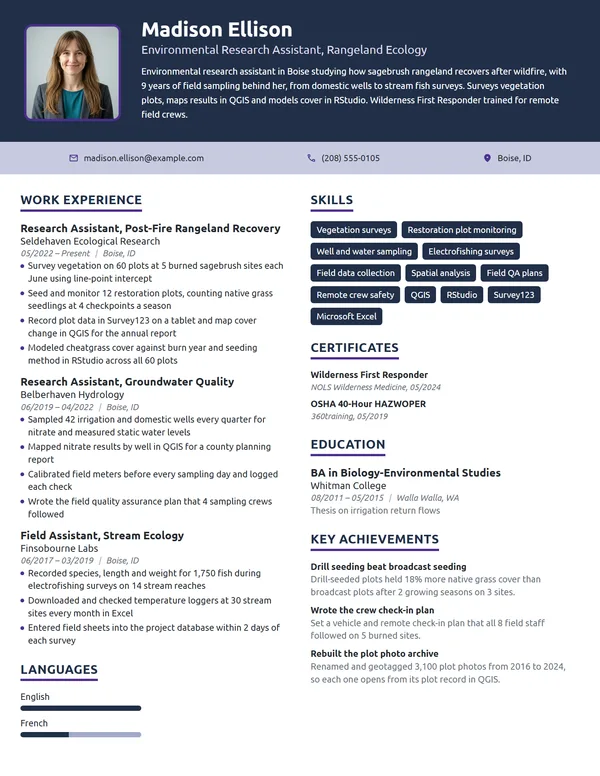
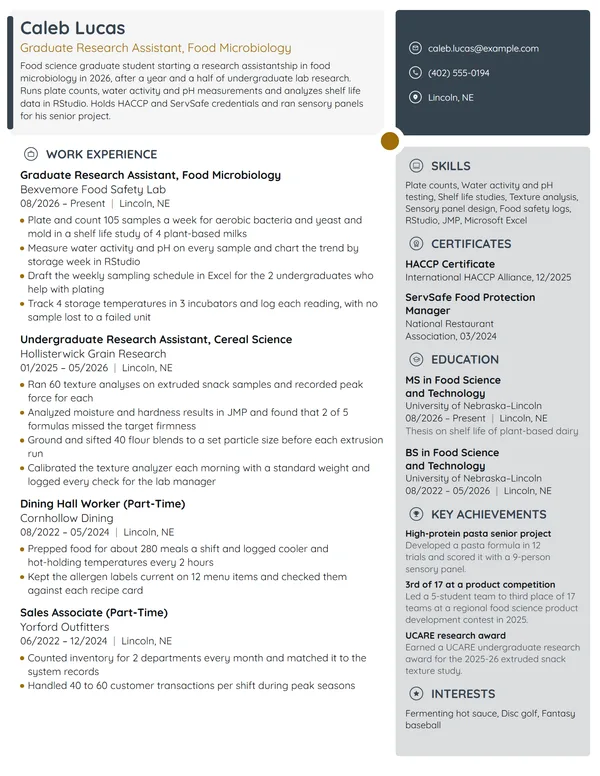
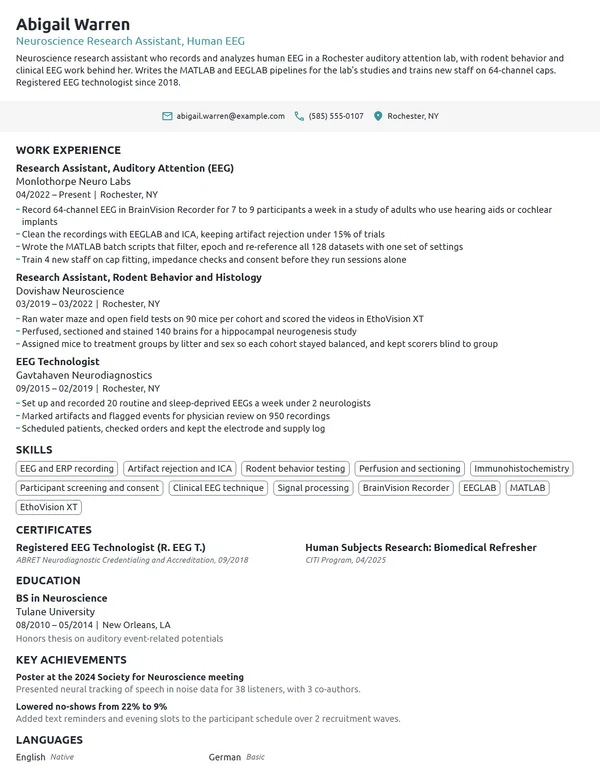
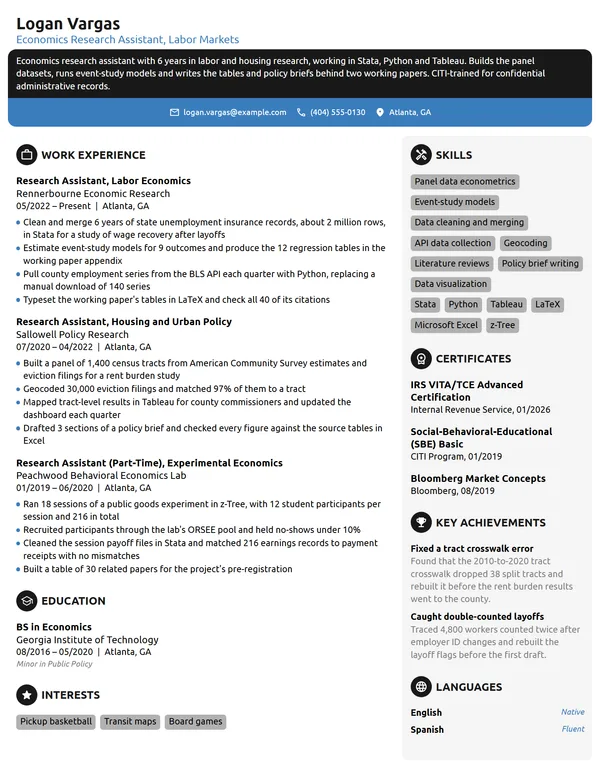
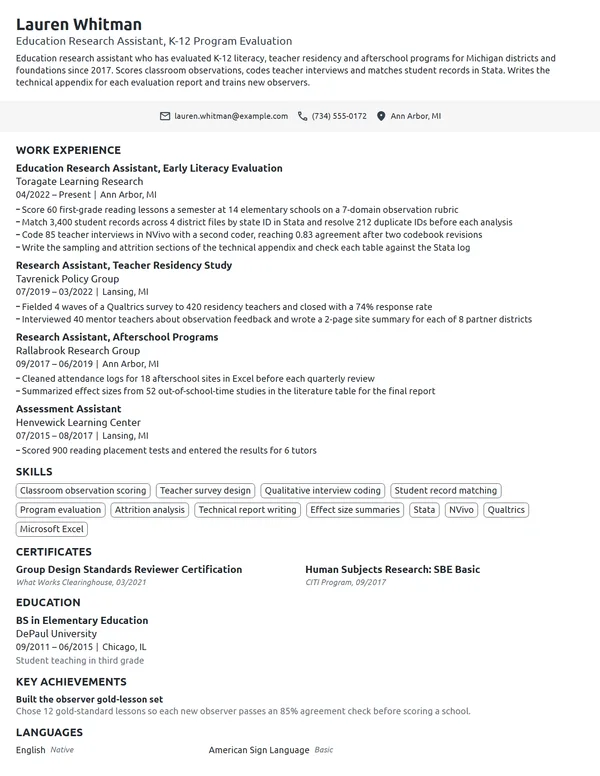
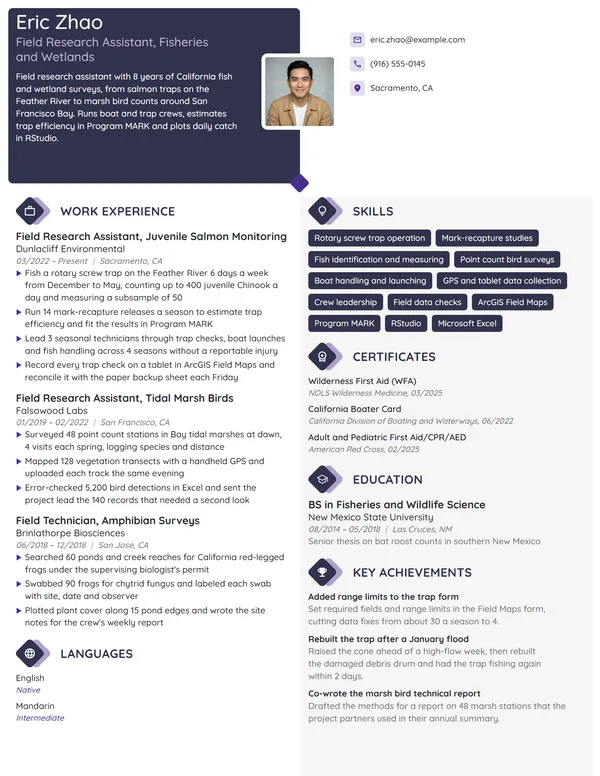
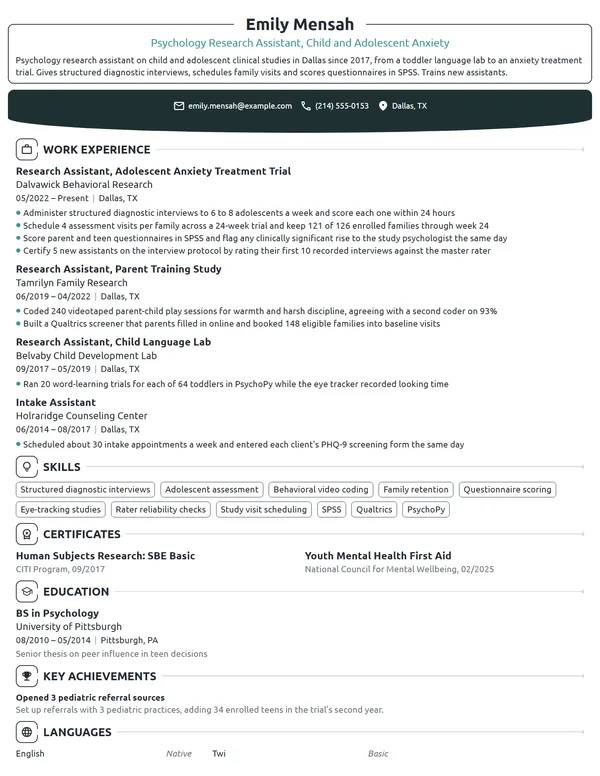
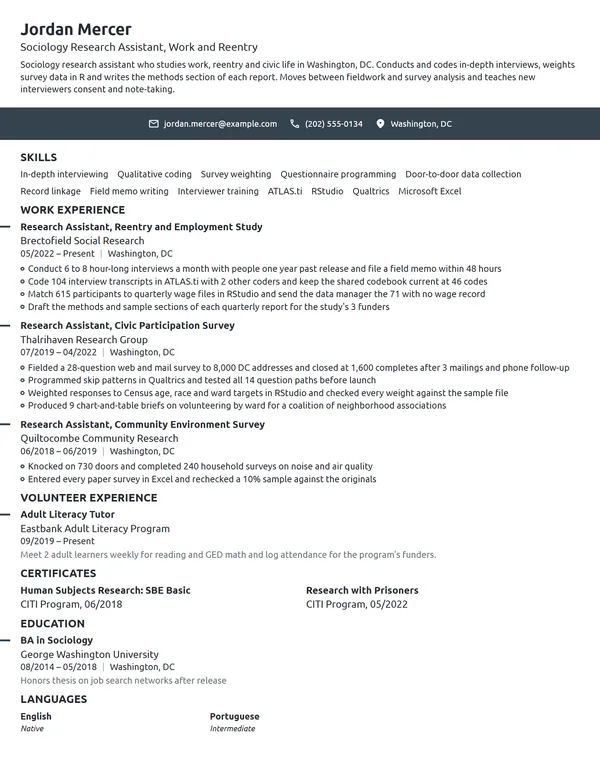
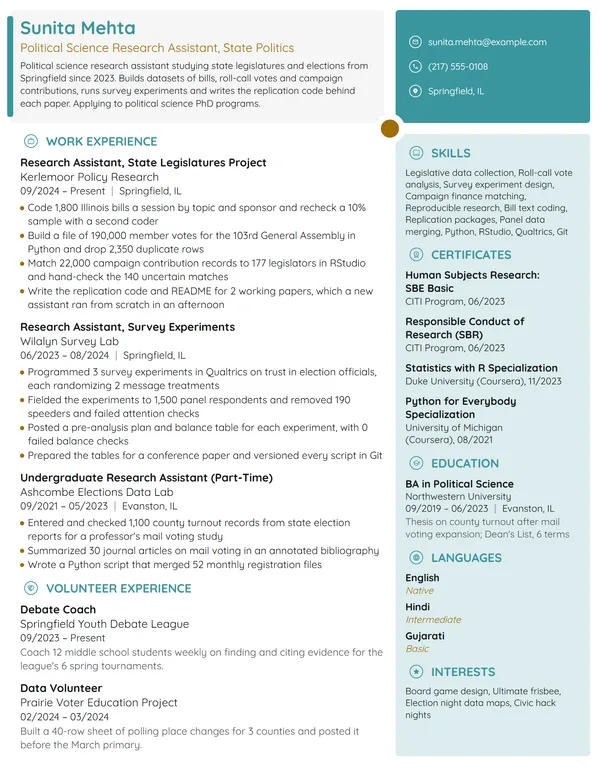
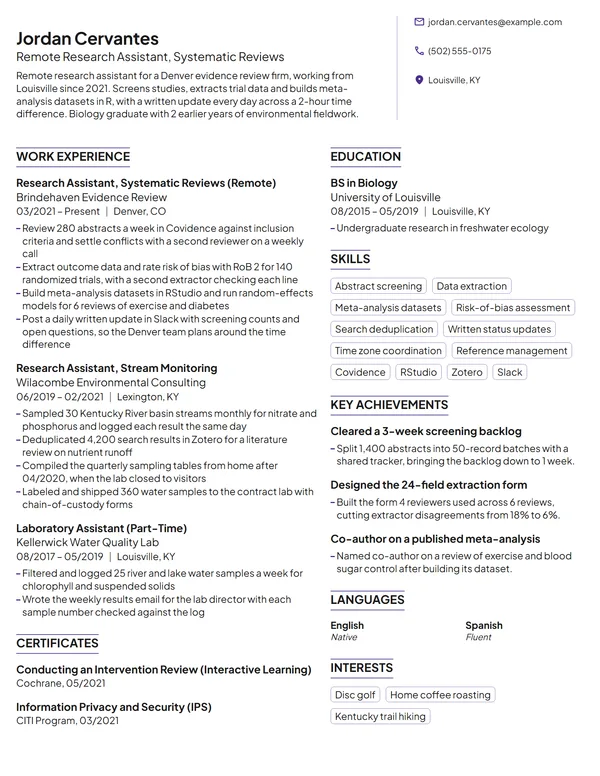
Research assistants keep studies moving: they recruit participants, collect data, clean it and turn it into tables a principal investigator can publish. A principal investigator checks which kind of study you have worked on, which methods and software you can run alone, and whether your data held up. One lab's research assistant pipettes all day while another's runs interviews, so your title alone tells the reader little. The study you name and its numbers fill that gap: participants enrolled, samples processed, records verified, papers you helped write.
How to Write a Research Assistant Resume - Key Takeaways
- Order jobs newest first in a reverse-chronological layout on 1 page, and send a full academic CV only when the job ad requests one.
- Name the study type in your job title line, such as Research Assistant, Pediatric Sleep Study, so the reader sees bench, clinical or survey work at a glance.
- Put a research number in every bullet: participants screened, enrolled or retained, assessments given, records verified, samples processed or scripts written.
- List R, Python, SPSS, REDCap or whichever software the posting names under Skills, and show each one at work in a bullet.
- Put CITI Human Subjects Research and GCP courses under Certificates with completion dates, and add each refresher as you finish it.
- Credit papers and posters inside the job that produced them, with your part in each.
What principal investigators look for in a research assistant resume
A principal investigator, lab manager or study coordinator reads your resume to decide whether you can follow a protocol, produce data they can trust and keep participants or samples on schedule. O*NET's profile of social science research assistants puts data entry and cleaning, statistical analysis, and preparing tables, graphs and manuscripts at the core of the job, with recruiting and screening participants, giving standardized tests and obtaining informed consent alongside. Lab-based roles add sample handling and assays, so say early which kind of research you do.
These are the sections the reader expects, in names hiring software parses cleanly:
- Name, headline (for example, Clinical Research Assistant) and contact details
- A 2- to 3-line summary at the head of the page; it needs no section title
- Work Experience, current study or lab first
- Skills, with your statistical and data software
- Certificates, for CITI courses and any clinical research credential
- Education, with a thesis or research methods coursework where it helps
- Optional extras: Languages, Interests, Key Achievements or Volunteer Experience
Best format for a research assistant resume
Use the reverse-chronological resume format, with your current study or lab first and each entry carrying your title, the employer, its city, and the months you began and left in MM/YYYY form. Research assistant careers usually move from an undergraduate lab or survey job to a full-time study, then to senior or lead roles that train others, and this order makes that path easy to follow. A combination format is rarely needed; even career changers do better in reverse-chronological order with their research-like work first.
- Best for most research assistantsReverse-chronologicalYour jobs, newest first, with your results under each one.Best for: A steady work history in your field
- FunctionalSkills grouped up top, with a short work history below.Best for: Gaps or very little experience
- CombinationA skills section first, then your full work history.Best for: A career change with strong skills
A 1-page resume fits almost every research assistant with under 8 years of experience. University postings sometimes ask for a CV instead of a resume; the difference between a CV and a resume is mostly length and the full publication list, so send a 1-page resume unless the ad says CV, and build an academic CV only for that case.
| Setting | What to use |
|---|---|
| Length | 1 page; 2 only with 8+ years or a long run of studies and publications |
| Job title line | Title plus study type: Research Assistant, Cognitive Aging Study |
| Dates | MM/YYYY for start and end, Present for the study you are on now |
| Publications and posters | A bullet under the job that produced them; a first-author paper can go under Key Achievements |
| Photo and private data | Leave the photo off for most jobs in the US and Canada; never your Social Security number, birth date or marital status |
| File type | PDF, unless the university's hiring portal asks for Word |
Most US and Canadian resumes carry no photo, and university and hospital hiring portals read a text-only page more reliably than one with images.
Research assistant resume summary vs. objective
If you have been paid to work on a study, write a summary; if your research so far is coursework, a thesis or an unpaid lab placement, write an objective. A resume summary for this job names your study type, your methods or software and one counted outcome. Draft it after your bullets so it can borrow their strongest figure.
Research assistant resume summary formula
Title with X years on study type or field research, working in software. Your best recruitment, data or analysis figure. Training or credential.
Example
Research assistant with 5 years on behavioral sleep studies and statewide surveys, working in REDCap and R. Enrolled 214 adults in a 3-year cohort and kept 88% through the 12-month follow-up. CITI-trained in social-behavioral research and Good Clinical Practice.
Don't
Motivated and detail-oriented research assistant passionate about contributing to meaningful science as part of a collaborative team.
Do
Research assistant with 2 years on a pediatric asthma study, collecting spirometry and questionnaire data at 3 clinic sites. Scheduled 160 family visits a quarter and resolved 95% of data queries within 5 days. CITI GCP and Biomedical HSR current.
The second version gives the study, the sites, the volume and the training a coordinator checks first.
How to write research assistant work experience bullets with numbers
Your current role takes 3 to 4 bullets and earlier roles take 2 to 4, fewer as they get older, each starting on a verb and ending on a count or result. Research already runs on counts (enrollment targets, visit windows, query logs, sample manifests), so pull your figures from the study's own tracking sheets. When you list work experience on a resume for a research job, add the study type to the title line and keep confidential study names and participant details out.
| Area | What to count | Example bullet |
|---|---|---|
| Recruitment and retention | People screened, enrolled, retained; target reached | Reached 120 of a 150-participant target by month 10 of a 14-month enrollment window. |
| Data collection | Interviews, assessments or visits; protocol deviations | Conducted 70 structured interviews a quarter with 0 consent deviations at the annual audit. |
| Data management | Records entered or verified, error rates, duplicates removed | Merged 3 waves of panel data and cut duplicate records from 4% to 0.2%. |
| Analysis | Scripts written, models run, hours saved | Wrote 14 R scripts that replaced hand-built Excel tables, cutting report time from 3 days to 4 hours. |
| Lab work | Samples processed, assays run, freezer inventory | Logged and aliquoted 1,000 plasma samples a month into a 3-freezer biorepository. |
| Writing and reporting | Manuscripts, posters, grant reports, IRB documents | Drafted the methods sections for 2 posters and 1 grant progress report a year. |
Here is one research assistant's entry with those counts in place. The current study gets 4 bullets that cover recruitment, testing, data and analysis, and the earlier survey job gets 2.
Work Experience
- Enrolled 214 adults into a 3-year sleep and memory study by screening 640 phone referrals against 11 eligibility criteria.
- Administered 9 cognitive tests at each of 3 study visits and kept 88% of participants through the 12-month follow-up.
- Verified 1,900 REDCap records each quarter against source forms, holding the data-entry error rate under 0.5%.
- Wrote the R scripts behind 6 tables in a manuscript the team submitted to a peer-reviewed journal in 2026.
- Conducted 1,150 telephone interviews in English and Spanish for 4 statewide health studies.
- Coded 300 open-ended responses in SPSS for a county housing report.
Don't
Responsible for data entry and data management.
Do
Entered and double-checked 2,400 survey records in REDCap, flagging 37 out-of-range values before the interim analysis.
This version names the system, the volume and the problem caught before it reached the results.
Don't
Assisted with participant recruitment.
Do
Recruited 58 caregivers through 4 community clinics in 6 months, finishing 12 participants past the site's target.
Research assistant skills and data software for your resume
Your Skills section needs 6 to 8 hard skills for your resume, picked from the posting and each backed by a bullet. A survey or behavioral study wants consent, interviewing and data cleaning; a wet lab wants sample processing and assays; a data-heavy role wants statistics and programming. Let the soft skills below show through your results instead of listing many of them.
Hard skills for research assistants
- Participant recruitment and screening
- Informed consent
- Standardized test administration
- Survey design
- Data entry and cleaning
- Descriptive and multivariate statistics
- Literature reviews
- IRB submissions and amendments
- Sample processing and storage
- Manuscript and poster preparation
Soft skills principal investigators value
- Following protocols exactly
- Rapport with participants
- Discretion with confidential data
- Attention to detail
- Clear scientific writing
- Juggling visit schedules
Put your software in the Skills section, then name it again in the bullet where you used it. O*NET lists R, Python, Microsoft Excel, PowerPoint and Microsoft Office as in-demand for social science research assistants, and also flags IBM SPSS Statistics, SAS, MATLAB, Tableau, ArcGIS and SQL. If the posting names a data capture or survey platform such as REDCap or Qualtrics, use its exact name, and for R or Python say what you did with it: cleaning, mixed models, figures for a paper.
CITI training and clinical research certifications on a resume
On any study with human participants, list your human subjects training; on a clinical trial, add your Good Clinical Practice (GCP) training as well. CITI Program's Human Subjects Research series runs in 2 tracks, Biomedical and Social-Behavioral-Educational, so name the track that matches the job. List certifications on your resume under Certificates, naming the issuer and the month you finished. Clinical research credentials from SOCRA and ACRP come later, once you have paid hours on human subject studies.
| Credential | Issued by | What it takes |
|---|---|---|
| Human Subjects Research (HSR), Biomedical or Social-Behavioral-Educational track | CITI Program | An online basic course in the track your study needs; refresher courses then retrain people who have finished the basic course. |
| Good Clinical Practice (GCP) | CITI Program | A basic course with a U.S. FDA or ICH focus, or the social and behavioral research course, then a refresher at the interval your organization sets. CITI says most organizations choose 3 years. |
| CCRP (Certified Clinical Research Professional) | SOCRA | 2 years of full-time clinical research work (or 3,500 part-time hours) in the last 5 years, or 1 year with a clinical research degree or certificate, then the exam. |
| CCRC (Certified Clinical Research Coordinator) | ACRP | 3,000 hours of paid, verifiable human subject research work; internships and degree-track work do not count, and an active ACRP certification or an accredited clinical research program can waive 1,500 hours. |
How to list CITI training and its refresher dates
Write each CITI course as its own line, with the series, the track or course name and the month you completed it. When you finish a refresher, add it as a new line rather than changing the old date, so the reader sees when you first trained and that you kept it current.
Certificates
- Human Subjects Research: Social-Behavioral-Educational (SBE) Basic, CITI Program, 08/2023
- GCP: Social and Behavioral Research Best Practices for Clinical Research, CITI Program, 08/2023
- Human Subjects Research: SBE Refresher, CITI Program, 08/2026
How to list your degree and thesis on a research assistant resume
O*NET places social science research assistants in Job Zone 4, noting that most of these occupations require a 4-year bachelor's degree, but some do not. Psychology, biology, public health, sociology and statistics are the usual majors. Follow the standard way to list education on a resume: degree name, school and its city, graduation month.
For this job, the research inside your degree counts. Add 1 line for an honors thesis, a capstone study or a methods sequence such as regression and research design, with a number if you have one. Show your GPA only within 2 years of graduating and only at 3.5 or above; once you have a full-time study behind you, the line about your thesis can go too.
Education
Honors thesis on sleep and recall in 82 undergraduates.
Entry-level and career-change research assistant resumes
If your research so far comes from an undergraduate lab and you have no paid study yet, use an entry-level resume layout: an objective, Education placed high on the page, then every piece of research you have done, counted the way a full-time job would be. A student researcher resume shows the same approach for people still enrolled.
- Undergraduate research for credit or work-study: participant sessions run, samples processed, hours a week, under Work Experience.
- Honors thesis or capstone: sample size, method and the software you analyzed it in, under Education.
- Survey, call center or data entry jobs: interviews completed or records entered, which transfer directly to study work.
- Community health or clinic volunteering: people reached or events staffed, listed under Volunteer Experience.
Don't
Recent psychology graduate seeking a research assistant position to gain hands-on experience.
Do
Psychology graduate with 2 semesters in an undergraduate memory lab, seeking a full-time research assistant role. Ran 45 participant sessions and built the Qualtrics survey for an honors thesis.
Even a new graduate's objective can carry proof: the lab, a session count and a tool.
Coming from teaching, nursing, social work or a data job, stay with reverse-chronological order but put the research-like parts of your current work first: assessments given, records kept, reports written. A career-change resume works when your summary names the study type you want and the training you have already finished. Save the reason for switching for the letter you send with it; these research assistant cover letter examples show how to tie your past job to a study's needs in a few lines.
Research Assistant resume FAQ
Should I list publications on a research assistant resume?
Yes, if you contributed to them. Write each paper or poster as a bullet under the job that produced it, with your part, such as the analysis or the figures. A first-author paper can also go under Key Achievements. Send a full publication list only for a job ad that requests a CV.
Should I send a resume or a CV for a research assistant job?
Send a resume unless the ad requests a CV. Most research assistant jobs at universities, hospitals and companies are filled from a 1-page resume; a CV with every publication and presentation is for academic postings that request one.
How do I list CITI training on my resume?
Under Certificates, 1 line per course: the series and track or course name, CITI Program as the issuer, and the month you completed it. Add each refresher as a new dated line so the reader can see your training is current.
Do you need a degree to be a research assistant?
Usually. O*NET places social science research assistants in a job zone where most jobs require a 4-year bachelor's degree, but some do not. Without one, lead with data, survey or clinic experience and finish human subjects training before you apply.
How long should a research assistant resume be?
1 page for most people, including those with several years of research work. Go to 2 pages only with 8+ years or a long record of studies and publications, and keep your current study and its results on page 1.
Should I name the principal investigator on my resume?
Not in the employer line. That line holds the organization and the city, and the title line can name the study or lab. Name the principal investigator in the letter that goes with your application, or offer them as a reference when the employer asks.
How much does a research assistant make?
BLS data put median yearly pay for social science research assistants at $61,990 in May 2025; lab, clinical and industry roles can pay differently. Leave pay off your resume and discuss it on the application form or in the interview.
Next steps
Start from the example nearest your study type and level, follow its layout, and swap in your own enrollment, data and analysis numbers. Build it in our resume builder, or take one of the resume templates as a base, and pair it with a letter naming the study you want to join and the result you are proudest of.