
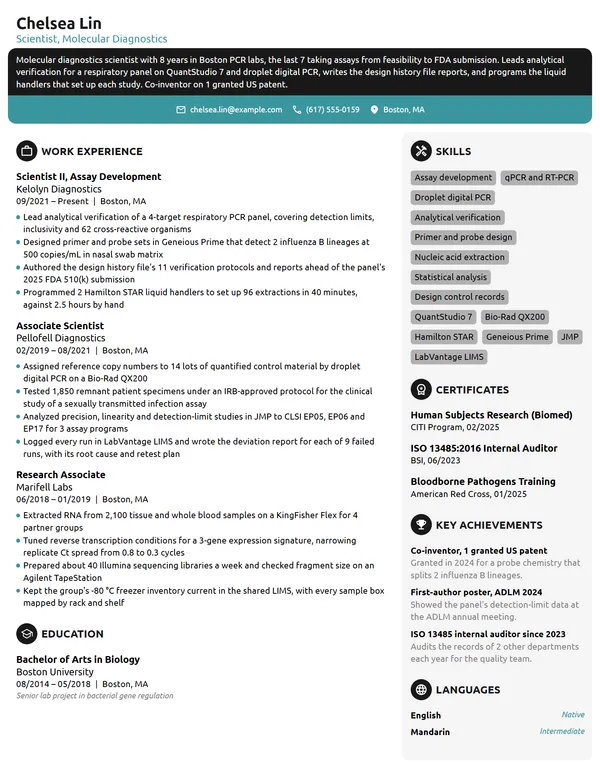
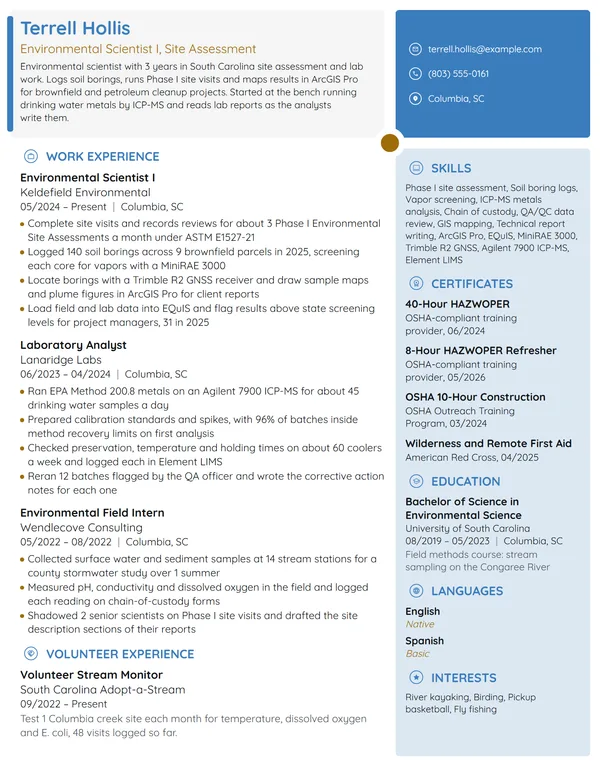
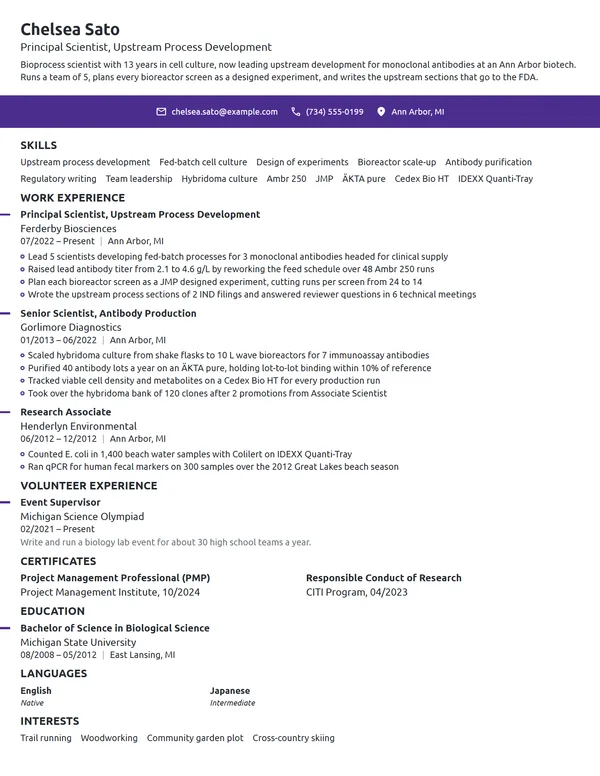
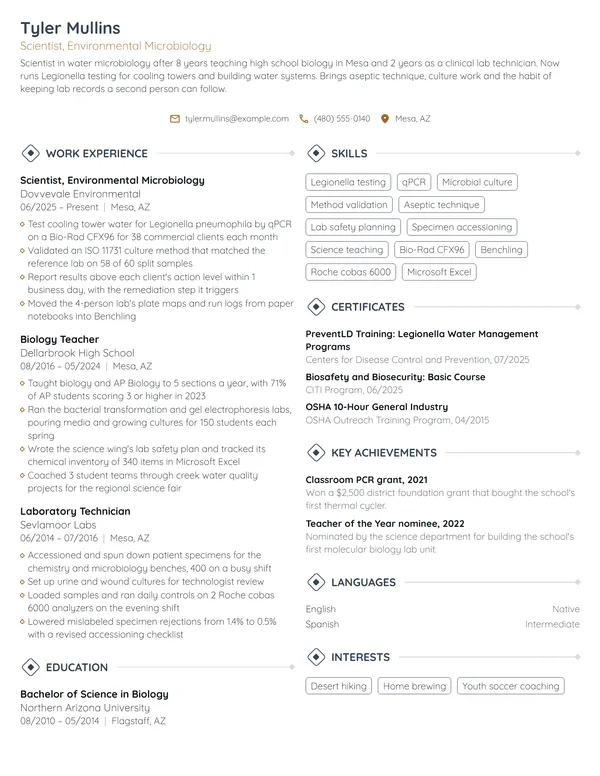
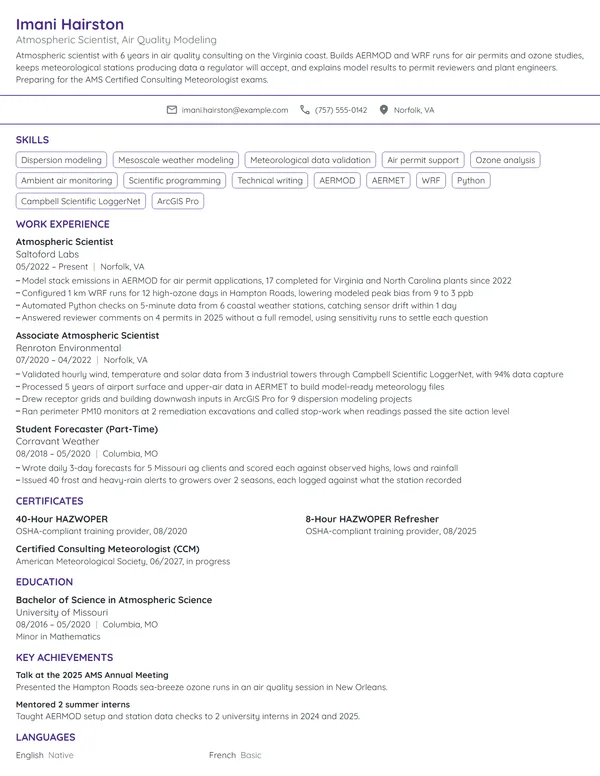
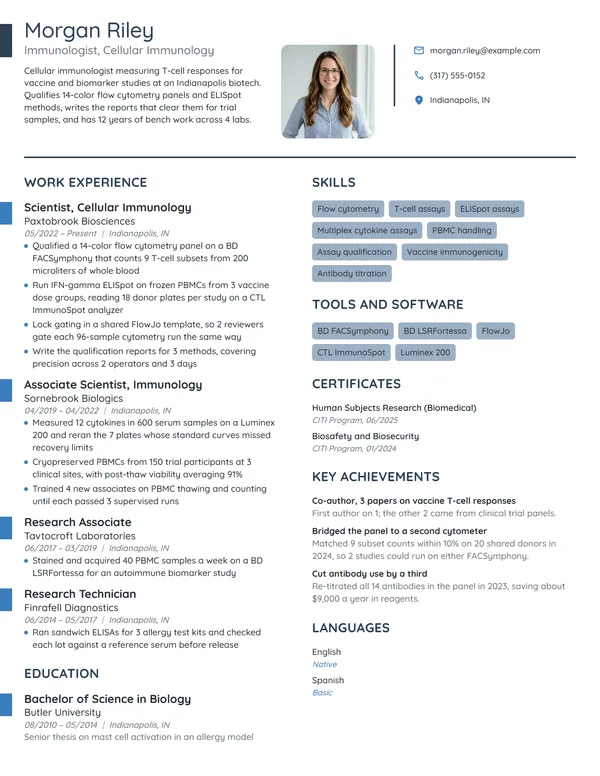
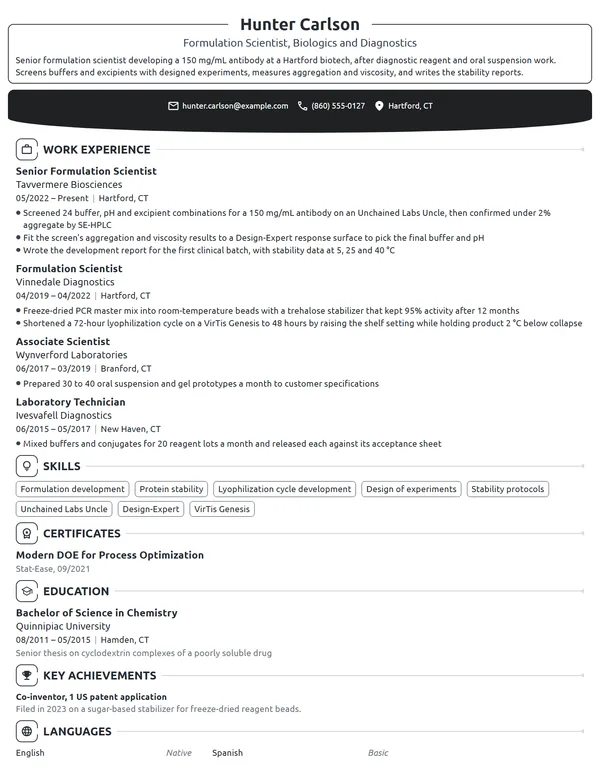
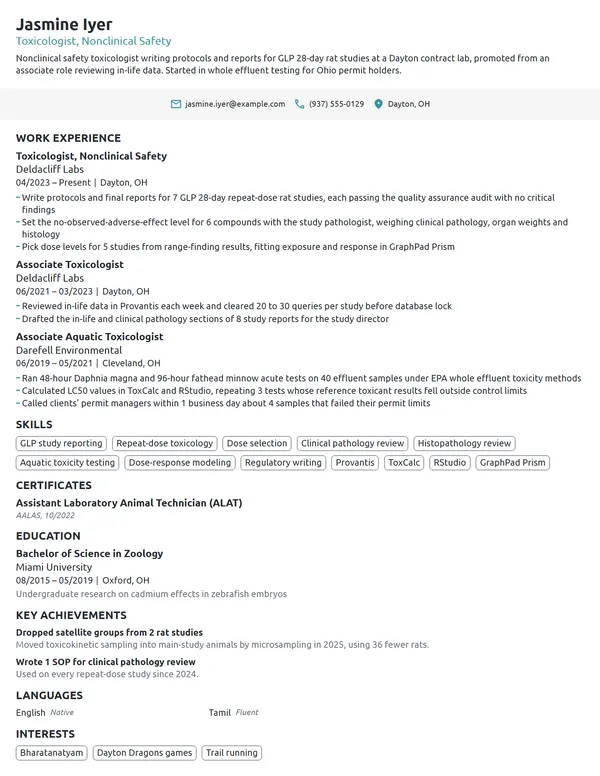
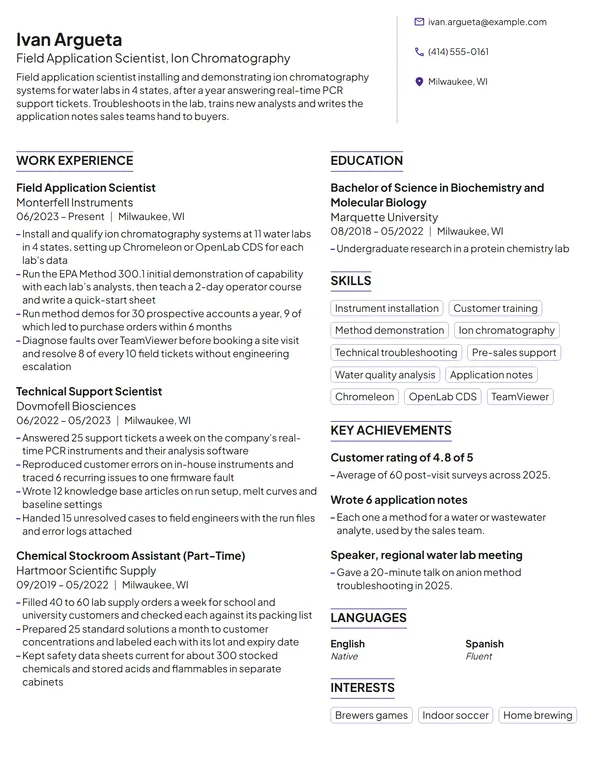
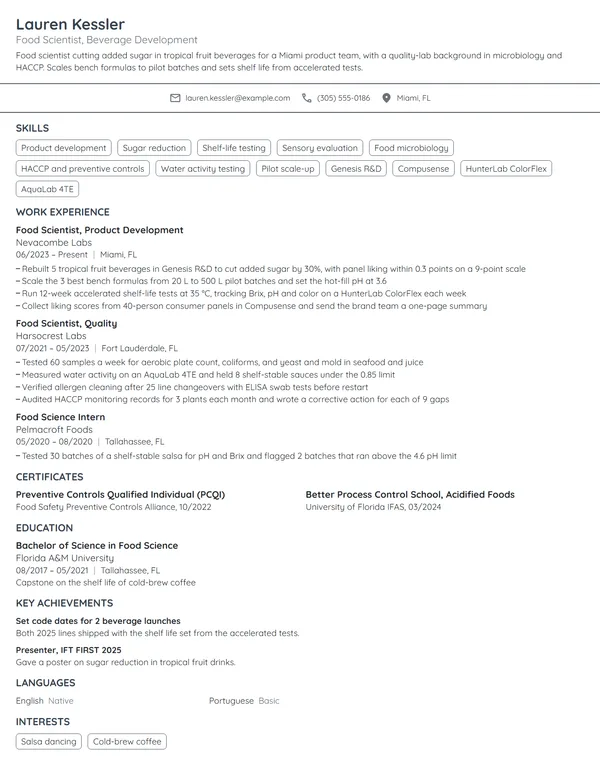
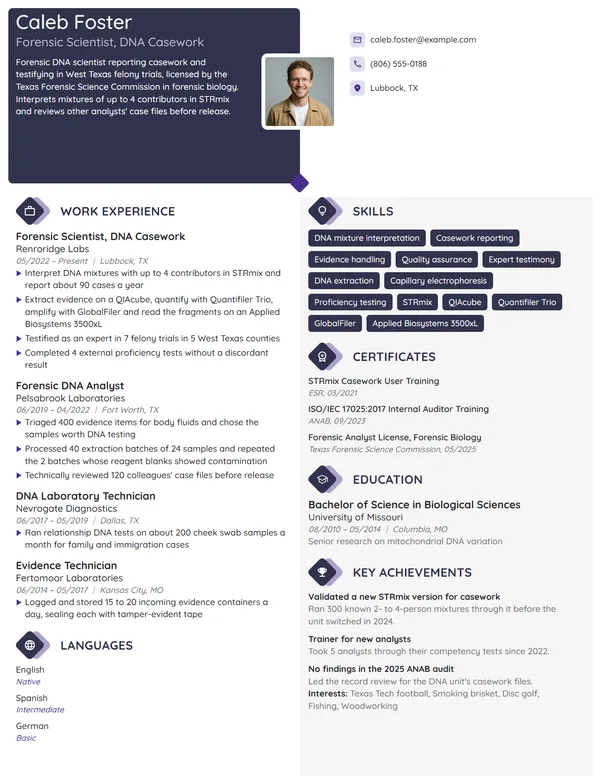
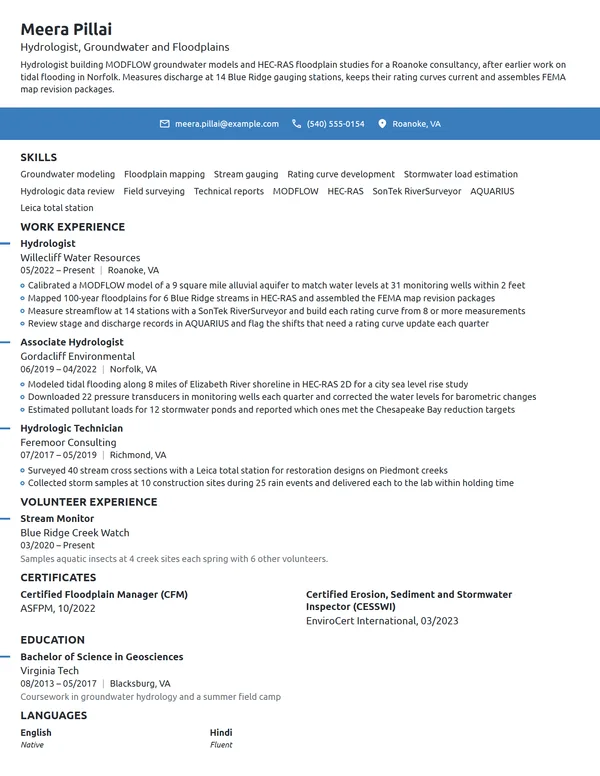
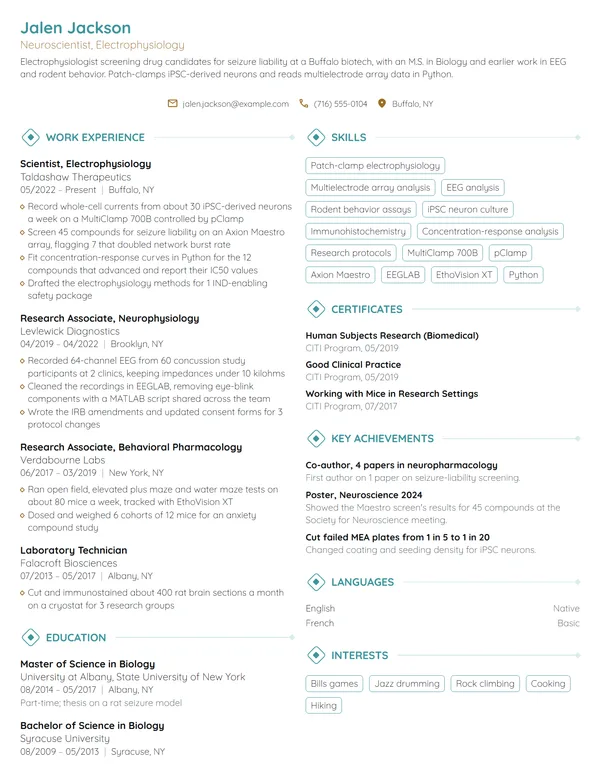
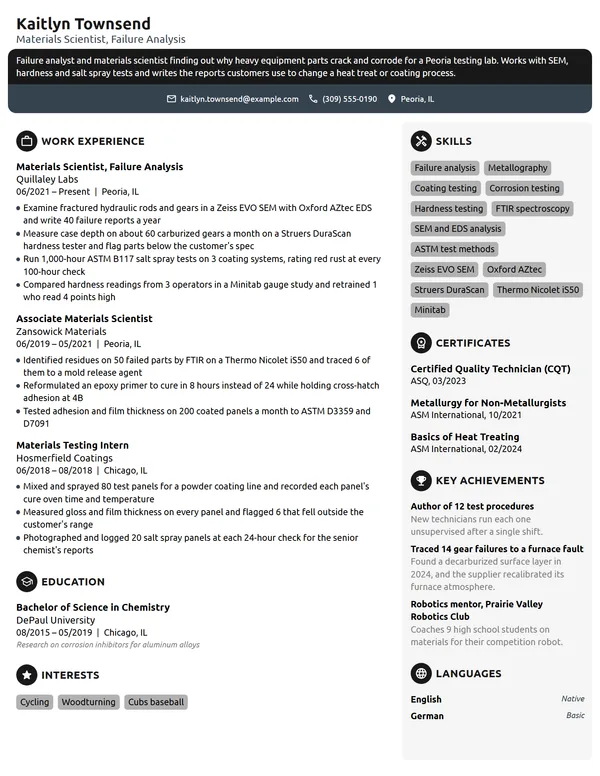
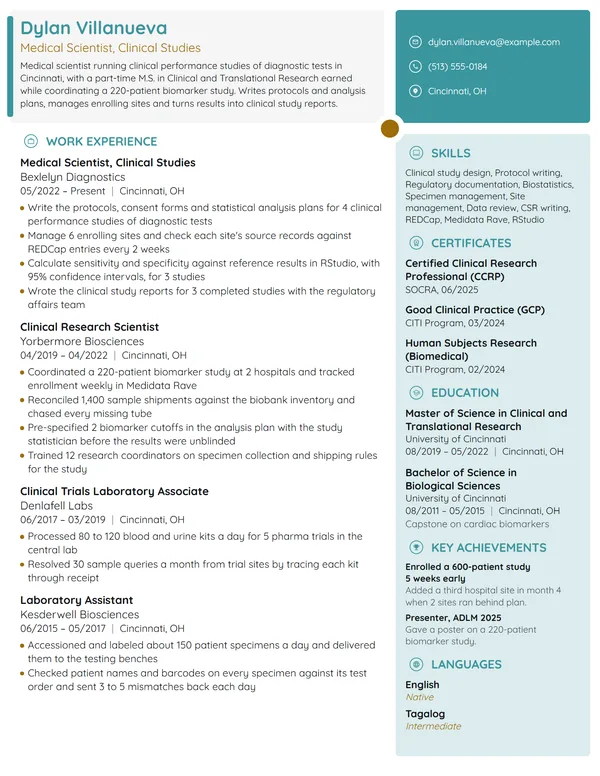
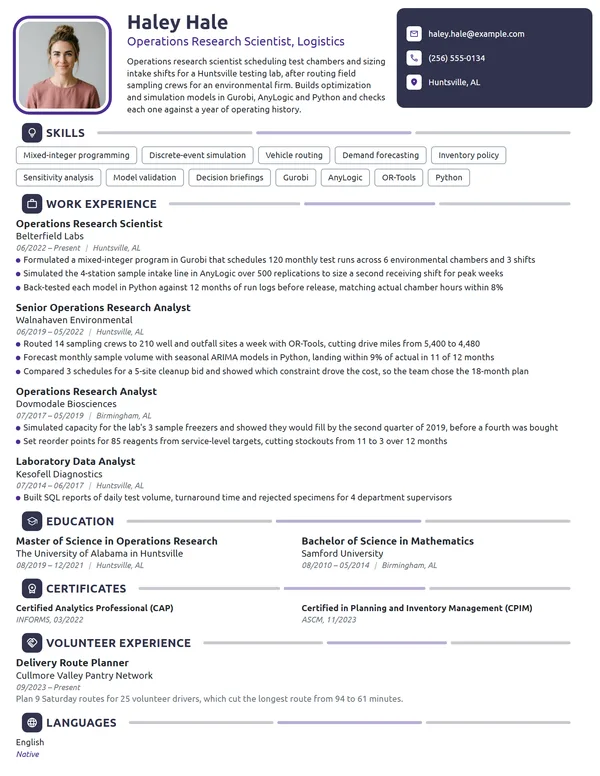
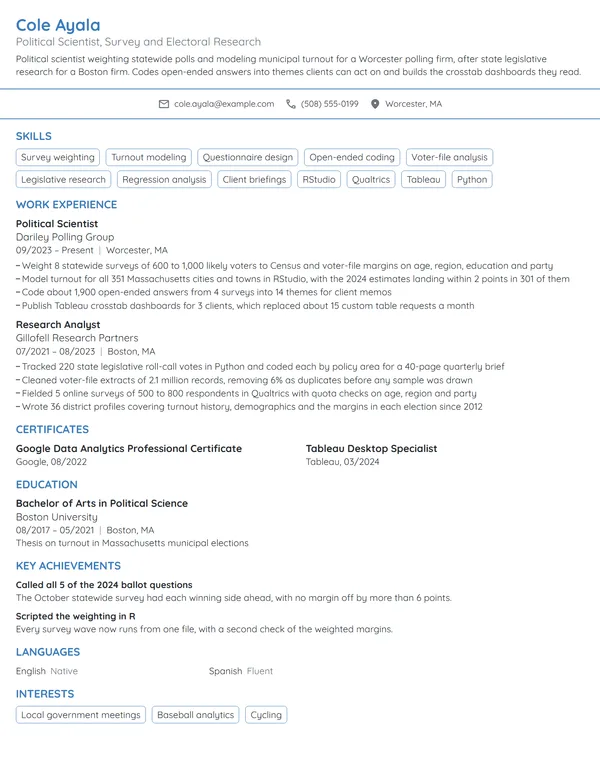
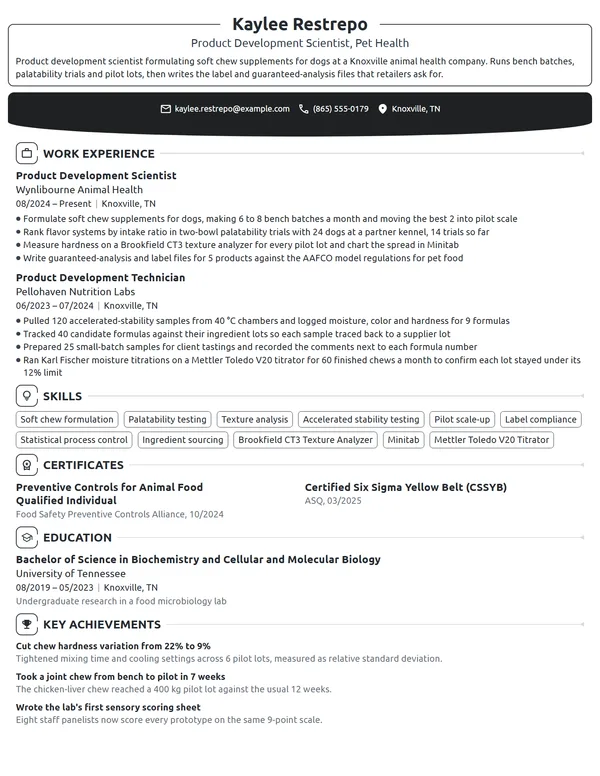
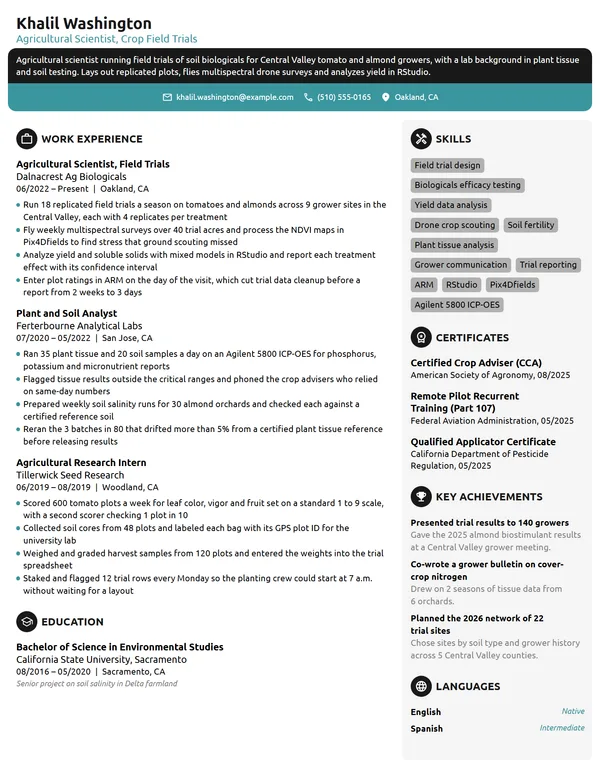
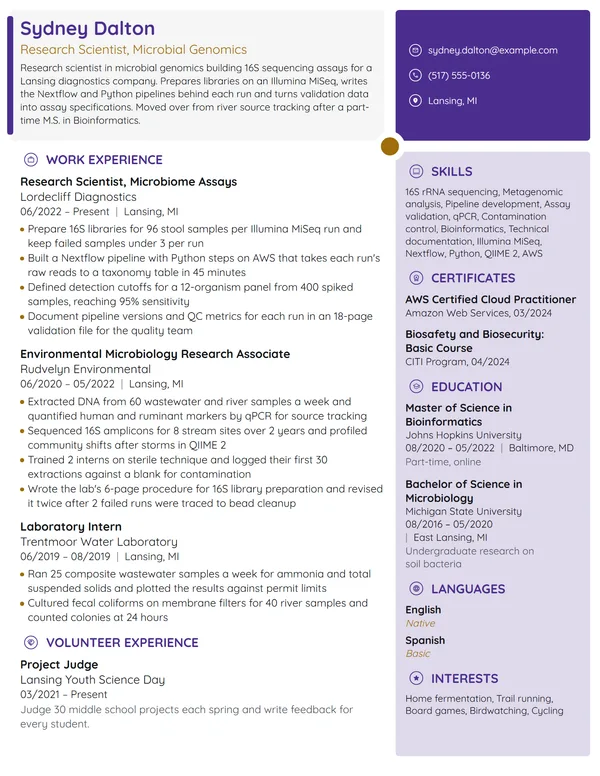
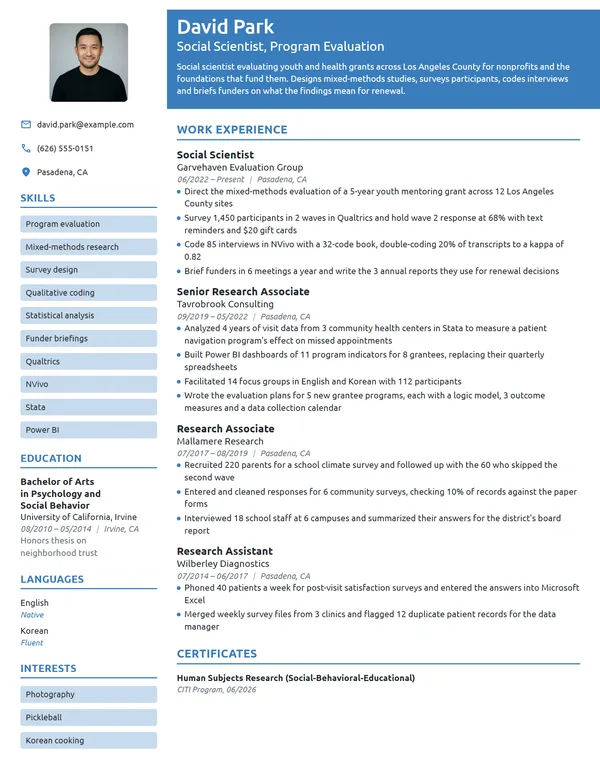
Scientists get hired for what they found and how they found it. Whether the opening sits in a biotech lab, an environmental consultancy or a weather service, the scientist doing the hiring looks for your field, the methods and instruments you can run on your own, and results with a number attached. A long list of techniques shows none of that. A bullet that names the question, the method and the outcome does: samples run, assays validated, papers published, grants won.
How to Write a Scientist Resume - Key Takeaways
- Send a 1 to 2 page resume to industry and government labs, and keep the full academic CV for faculty and postdoc applications.
- Put your field in the job title line, such as Research Scientist, Protein Sciences, so a reader sees the fit before the bullets.
- Give every bullet a count a lab already tracks: samples, assays, validations, sites, papers or grant dollars.
- Name each technique with its instrument or software, and keep 6 to 8 skills your bullets prove.
- Count papers and grants in a bullet or under Key Achievements, and keep the full list for an academic CV.
- Run the file through an ATS resume checker before you apply, because lab postings are screened for exact method names.
What hiring managers look for in a scientist resume
The first reader is often a recruiter, but the decision usually sits with a scientist who runs the group. O*NET lists sharing findings through scientific articles and conference talks, writing grant proposals and managing laboratory teams among the core tasks of biochemists and biophysicists. Bullets that show you doing those things, with counts, answer the hiring scientist faster than a list of duties.
Lay the resume out with headings that every applicant tracking system recognizes:
- Name, headline with your field and highest degree (for example, Research Scientist, Ph.D.) and contact details
- A 2 to 3 line summary under your name, without a heading of its own
- Work Experience, current role first, including postdocs and research assistantships
- Skills, with your methods, instruments and analysis software
- Education, with your thesis or dissertation topic if it matches the job
- Certificates, for safety, compliance and quality training
- Optional: Key Achievements for papers, patents and grants, or Volunteer Experience, plus Languages
Best format for a scientist resume
Use the reverse-chronological resume format, starting with your current role and listing each one with its title, the employer or institution, the city and MM/YYYY dates. Science careers climb in titles a reader can follow, from research associate to scientist, senior scientist and principal scientist, and this order puts that climb on page 1. If you are switching into science from another field, a combination layout with a skills summary on top works, but most scientists should stay chronological.
- Best for most scientistsReverse-chronologicalYour jobs, newest first, with your results under each one.Best for: A steady work history in your field
- FunctionalSkills grouped up top, with a short work history below.Best for: Gaps or very little experience
- CombinationA skills section first, then your full work history.Best for: A career change with strong skills
Industry and government postings expect a resume: 1 page with a bachelor's or master's and under 5 years of work, 2 pages once you have a Ph.D., a postdoc or a run of papers. Universities and some research institutes ask for an academic CV instead, with every paper, talk and grant listed in full. When a posting says CV but comes from a company, send the 2-page resume and offer the full list on request.
| Setting | What to use |
|---|---|
| Length | 1 page early on; 2 pages with a Ph.D., a postdoc or 5+ years of work |
| Job title line | Title plus field: Research Scientist, Protein Sciences or Environmental Scientist, Groundwater |
| Dates | MM/YYYY for every role, with Present on the current one |
| Publications | A count in a bullet or under Key Achievements; the full list only on an academic CV |
| Font | A single clean typeface, 10 to 12 pt in the body, so chemical names and units stay readable |
| Personal details | No birth date, marital status or Social Security number on any version |
| File type | PDF, or Word if a university or agency portal requires it |
Most US and Canadian resumes carry no photo. University and federal hiring systems often copy your file into their own forms, so plain headings and Greek letters or subscripts typed as standard characters (IC50, CO2) survive that step better than special symbols.
Scientist resume summary vs. objective
If you have held a paid research role, including a postdoc, write a resume summary with your field, your setting, your core methods and 1 result. If you are finishing a degree or changing careers, a resume objective fits better: the kind of role you want, the lab work you have already done and your degree date. Either way, take the number from your strongest bullet.
Scientist resume summary formula
Field scientist with X years in setting, skilled in 2 to 3 methods or instruments. 1 result with a number. Degree or credential.
Example
Bioanalytical scientist with 7 years in contract research, skilled in LC-MS/MS, method validation and Watson LIMS. Led the transfer of 3 assays from a sponsor lab, all passing cross-validation on the first attempt. M.S. in Chemistry and Certified Six Sigma Green Belt.
Don't
Motivated scientist with a passion for research and strong attention to detail.
Do
Cell biologist with 6 years in oncology drug discovery, running high-content imaging screens of up to 20,000 compounds. Built the group's first organoid model, now used in 3 programs.
The rewrite gives the field, the scale of the work and something the reader can ask about in an interview.
How to write scientist work experience bullets with numbers
Give your current role 3 to 4 bullets and older roles 1 to 3, each led by an action verb. Science produces numbers on every project, so pick the ones a reader can check: how many samples or sites, how many methods built or transferred, what changed in time, yield or accuracy, and what got published or funded. As with achievements on your resume in any job, put the result first, then the method that got it.
| Area | What to count | Example bullet |
|---|---|---|
| Methods and assays | Assays developed, validated or transferred; first-pass success | Transferred 6 ELISA methods to a partner lab, with all 6 passing comparability on the first run. |
| Data analysis | Datasets, scripts, models, hours saved | Wrote R scripts that cut plate-reader analysis for 384-well screens from 2 days to 3 hours. |
| Field work | Sites, samples, sampling rounds, rejected samples | Sampled 42 monitoring wells across 7 sites each quarter, with zero samples rejected for chain-of-custody errors. |
| Publications and talks | Papers, first-author papers, conference talks | Co-authored 5 peer-reviewed papers, 2 as first author, and presented at 3 national meetings. |
| Funding | Grants written or supported, dollars, renewals | Drafted the aims and methods for a $480,000 state grant that was renewed for 3 years. |
| Lab operations | Instruments, uptime, inventory, safety inspections | Kept 3 qPCR instruments on a service schedule, holding uptime at 98% over 2 years. |
The entry below belongs to a bioanalytical scientist at a contract research lab. The field sits in the title, the scale comes first and each bullet ends on something a sponsor would notice.
Work Experience
- Develop and validate LC-MS/MS assays for drug levels in human plasma; 9 methods validated for 4 clinical-stage sponsors.
- Cut sample turnaround for a 1,200-sample Phase II study from 15 to 9 business days by running 2 instruments on staggered batches.
- Wrote 6 validation reports that passed sponsor audits with no method findings.
- Train 2 research associates on Watson LIMS and SCIEX Analyst software.
- Prepared and ran 60 to 80 plasma and urine samples a week across 5 client studies.
Don't
Performed experiments and analyzed data.
Do
Ran 3 rounds of dose-response studies in primary hepatocytes and identified 2 compounds with an IC50 under 50 nM for the lead program.
The second version names the model, the method and the result that moved the project forward.
Don't
Responsible for maintaining lab equipment.
Do
Ran weekly calibration and maintenance on 2 LC-MS systems, cutting unplanned downtime from 9 days to 2 in a year.
Lab skills and scientific software for a scientist resume
Choose 6 to 8 hard skills for your resume that the job ad asks for and that your bullets show in use. Write methods the way your field writes them (qPCR, flow cytometry, GC-MS, groundwater sampling), and leave out anything you ran once in a class but could not set up today.
Hard skills for scientists
- Experimental design
- Assay development and validation
- HPLC and LC-MS
- qPCR and PCR
- Cell culture
- Statistical analysis
- Field sampling and chain of custody
- Data modeling
- Technical and grant writing
- Good laboratory practice (GLP)
Soft skills research leads value
- Patience with failed experiments
- Clear writing for non-specialists
- Careful record keeping
- Collaboration across disciplines
- Meeting study deadlines
- Mentoring junior staff
O*NET flags Python, R and IBM SPSS Statistics as hot technologies for biochemists and biophysicists, with Microsoft Excel and PowerPoint marked in demand. Code matters well beyond the bench: the BLS notes that atmospheric scientists use computer models to analyze weather data and write programs to support that modeling. List your analysis software with your skills, name it again in the bullet where you used it, and add the lab's own systems, such as a LIMS or an electronic lab notebook, by their product names.
Certifications, training and publications on a scientist resume
Most scientist jobs require no license, so the Certificates section holds the training a lab or field site checks before you start. The BLS notes that some employers of environmental scientists prefer or require certification tied to the work. Put certifications on your resume with the issuer and the month you earned or renewed each one.
| Credential | Issued by | What it takes |
|---|---|---|
| 40-Hour HAZWOPER | Training provider meeting OSHA 29 CFR 1910.120 | At least 40 hours of off-site instruction and 3 days of supervised field experience, then 8 hours of refresher training each year. |
| Human Subjects Research (Biomedical or Social-Behavioral-Educational) | CITI Program | A basic course (Foundations or Comprehensive), then refresher courses; most organizations set a 3-year retraining cycle. |
| Certified Consulting Meteorologist (CCM) | American Meteorological Society | At least 5 years of professional work in meteorology or a related field, plus written and oral exams. |
| Certified Six Sigma Green Belt (CSSGB) | ASQ | 3 years of full-time, paid experience in one or more areas of the Green Belt Body of Knowledge, plus an exam. |
Where publications and grants go
An industry reader does not need every citation. Count your papers in a bullet under the job that produced them, or gather papers, patents and grants in Key Achievements with 1 line each. Save the full reference list for an academic CV or a link in your contact line.
Certificates
- Certified Six Sigma Green Belt (CSSGB), ASQ, 04/2025
- Human Subjects Research: Biomed Comprehensive, CITI Program, 09/2023
How to list a B.S., M.S. or Ph.D. on a scientist resume
Degree level shapes the jobs open to you. The BLS says environmental scientists typically need a bachelor's degree in a natural science to enter the field, while atmospheric scientists in research typically need at least a master's or a Ph.D. In biochemistry, a Ph.D. is needed for independent research and development roles, bachelor's and master's holders qualify for some entry-level positions, and most Ph.D. holders start in temporary postdoctoral positions.
Follow the standard way to list education on a resume: degree, school, city and graduation date. Add a 1-line thesis or dissertation topic when it matches the job, and drop GPA once you have 2 years of research work. A postdoc is a job, so it goes under Work Experience with its own bullets, not under Education. If you hold a Ph.D., the PhD resume layout shows how to turn a dissertation into industry bullets.
Education
Thesis: degradation pathways of 2 peptide drugs under accelerated storage conditions.
Entry-level and career-change scientist resumes
Without a paid research job, your proof sits in lab courses, undergraduate research, internships and technician work. Treat each as a short Work Experience entry when it ran for a semester or longer, with the methods you ran and a count. The entry-level resume layout works when Education has to sit above Work Experience.
- Undergraduate research: the lab, the question, your methods and any poster or paper, as a Work Experience entry.
- Lab technician or QC jobs: samples a week, the instruments you ran and any SOP you wrote.
- Field seasons and internships: sites visited, samples collected and the agency or firm, with MM/YYYY dates.
- Citizen science or outreach: under Volunteer Experience, with the number of surveys, events or students reached.
Don't
Recent graduate seeking an entry-level scientist position where I can apply my skills.
Do
Biochemistry graduate (B.S., 05/2026) seeking a research associate role in protein sciences. Purified 14 recombinant proteins over a 2-year undergraduate research placement and presented 1 poster at a regional meeting.
The rewrite names the role, the degree date and lab work a hiring scientist can ask about.
Moving in from teaching, sales or healthcare, lead with the science you already do: lab courses taught, instruments demonstrated to customers, samples handled in a clinic. A short certificate in biotechnology or data analysis goes under Education with its completion date, and the career change resume layout puts those skills above your older jobs. Use your cover letter to explain the move in 2 to 3 sentences, so the resume can stay on the evidence.
Scientist resume FAQ
Should a scientist use a resume or a CV?
Use a resume for industry, government and nonprofit labs, and a full academic CV for faculty, postdoc and most university research posts. The resume runs 1 to 2 pages and counts your papers; the CV lists each one with authors, journal and year.
How long should a scientist resume be?
1 page if you have a bachelor's or master's and under 5 years of work. 2 pages suit Ph.D. holders, postdocs and scientists with 5+ years in industry, as long as your current role and core methods sit on page 1.
How do I list publications on a scientist resume?
Count them rather than listing them. Write the total and your first-author count in a bullet under the job that produced them, or in Key Achievements, and name 1 or 2 papers only if they match the role. Keep the full list for an academic CV.
Do I need a PhD to get a scientist job?
Not for every role. The BLS says biochemists need a Ph.D. for independent research and development work, but bachelor's and master's holders qualify for some entry-level positions, and environmental scientists typically enter with a bachelor's degree in a natural science.
How do I list a postdoc on my resume?
As a job under Work Experience, with the title Postdoctoral Researcher or Postdoctoral Fellow, the lab or institution, the city and MM/YYYY dates. Give it 3 to 4 bullets with methods, papers and any funding you won, the same as an industry role.
Which certifications help a scientist resume?
Only the ones your field checks. Field and remediation work often asks for 40-hour HAZWOPER training, research with human participants needs CITI human subjects training, consulting meteorologists can earn the AMS CCM, and industry labs value quality credentials such as the ASQ Six Sigma Green Belt.
Should I list every lab technique I know?
No. Keep 6 to 8 skills that match the posting and that a bullet proves, and name each with its instrument or software. A long list of techniques invites interview questions about methods you have not run in years.
How much do scientists earn?
The BLS reports that the median annual wage for life, physical and social science occupations was $82,530 in May 2025, against $50,980 for all occupations. Pay varies widely by field and degree. Keep pay expectations off the resume and raise them when a lab makes you an offer.
Next steps
Start with your current role: name your field in the title, then write 3 to 4 bullets that count samples, methods, papers or funding. Pick 6 to 8 skills those bullets prove, add your training under Certificates, and choose a template in the resume builder that keeps 2 pages easy to scan.