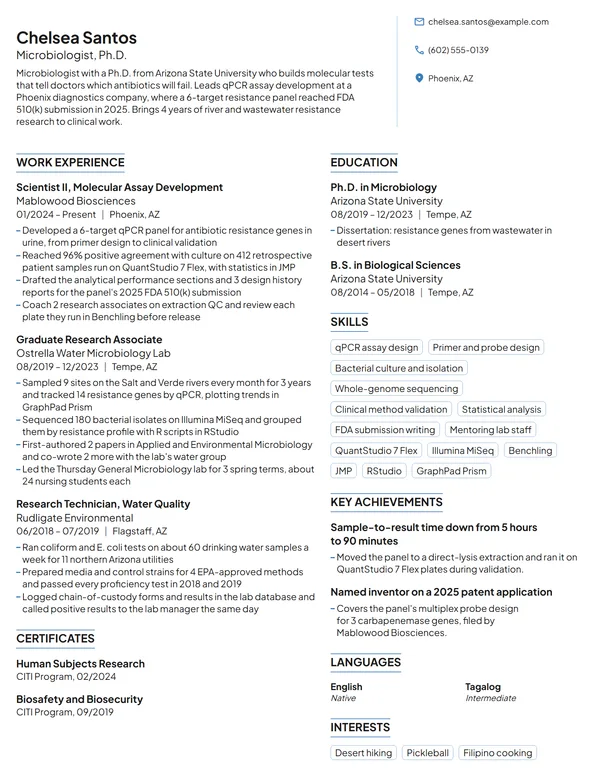
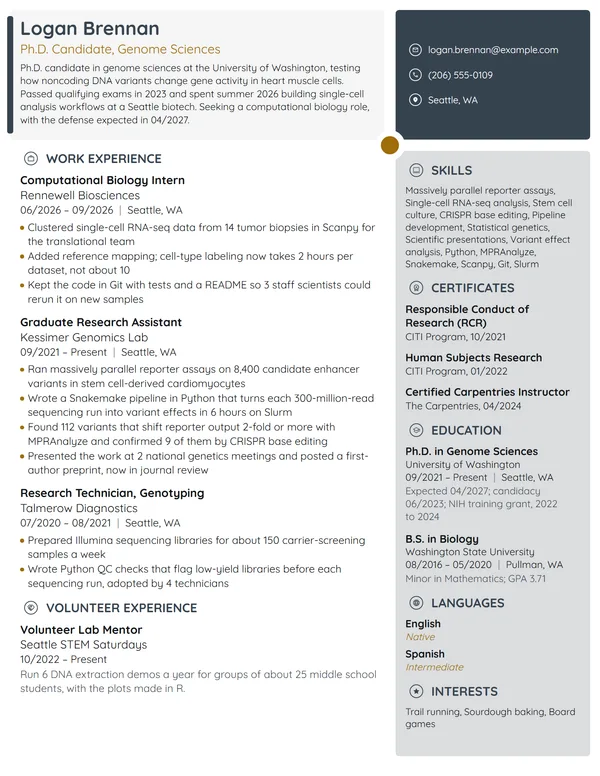
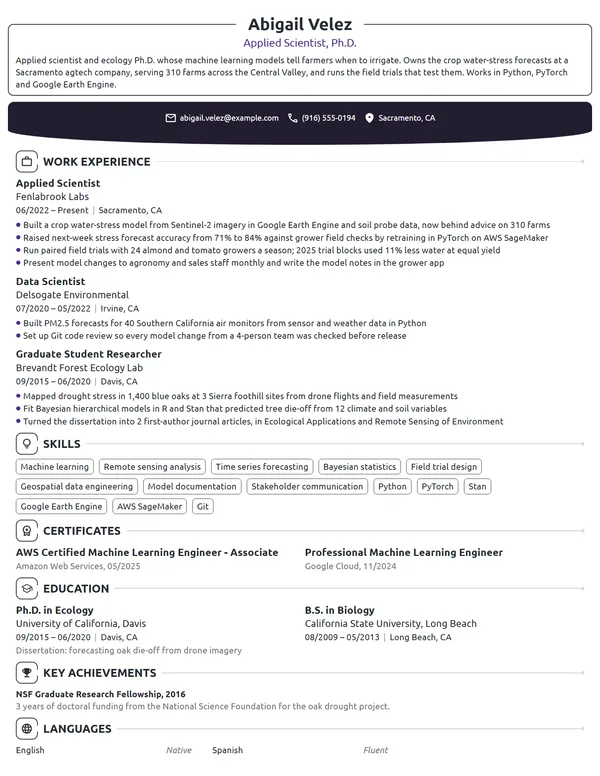
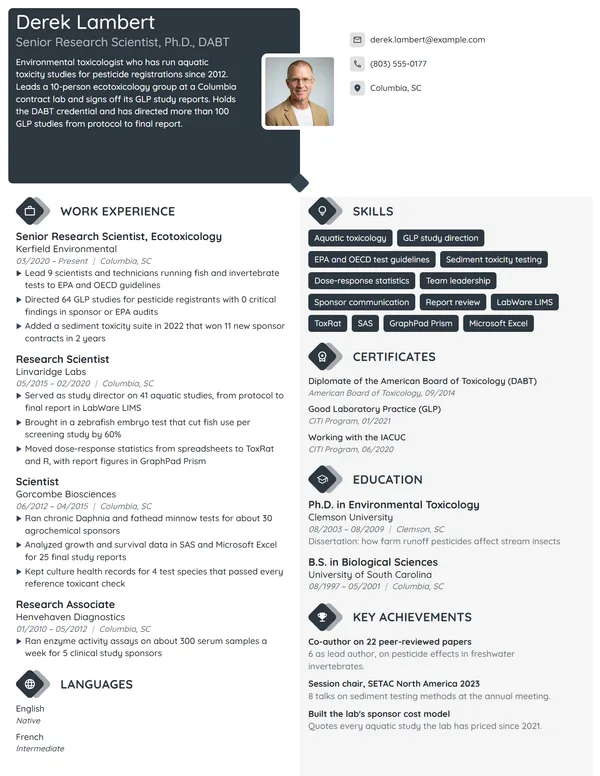
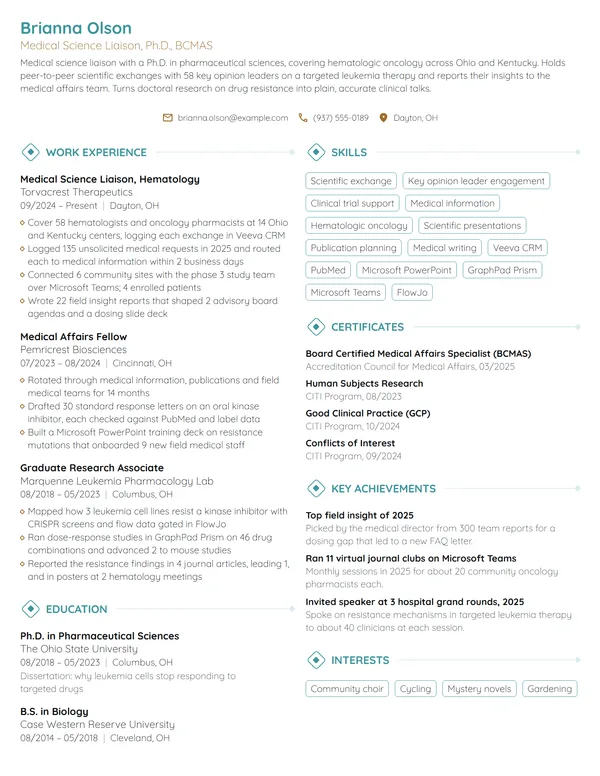
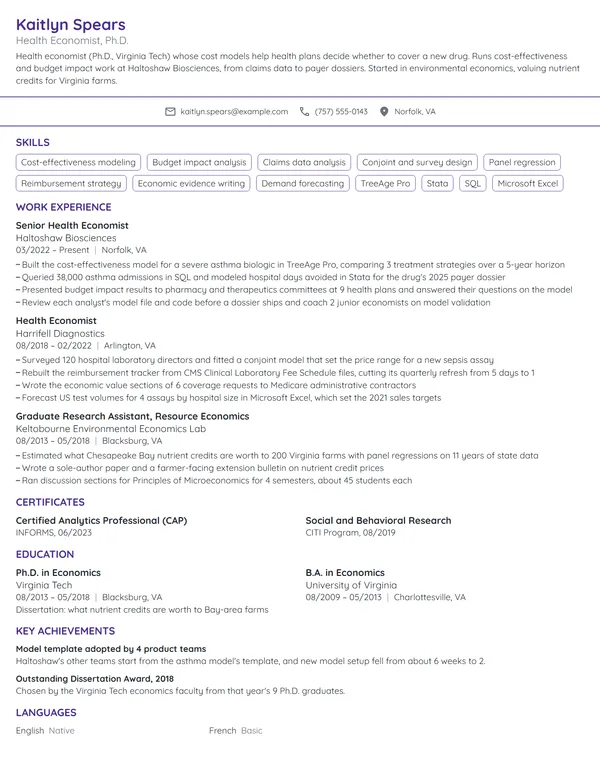
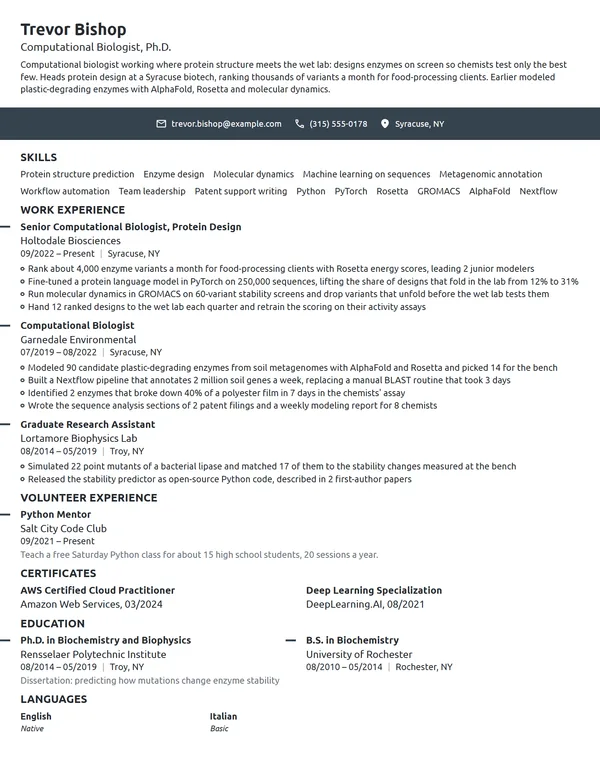
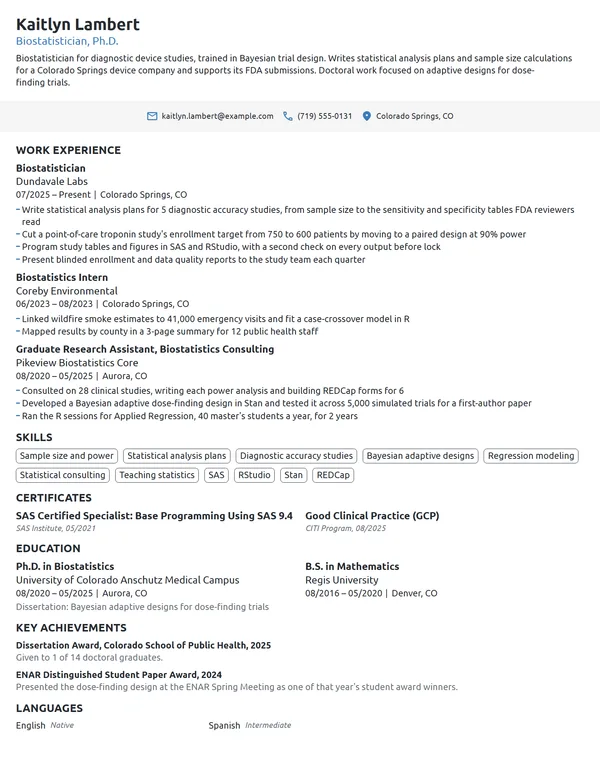
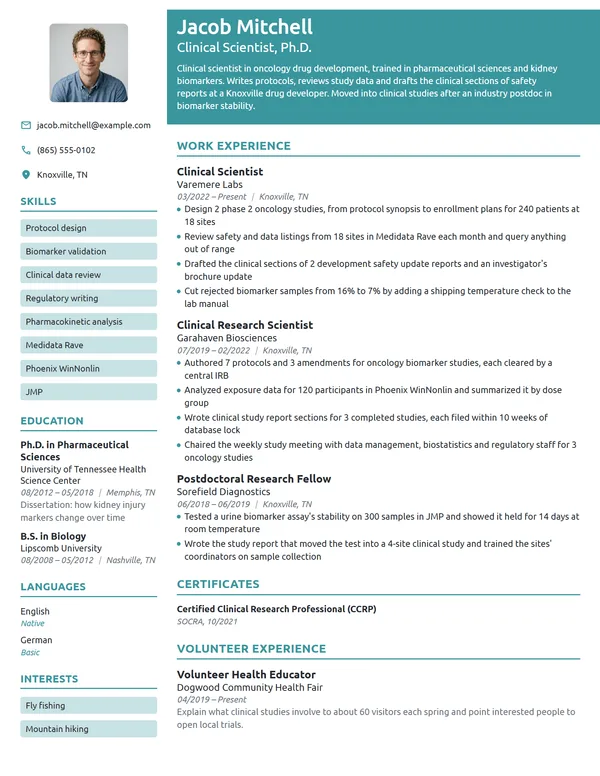
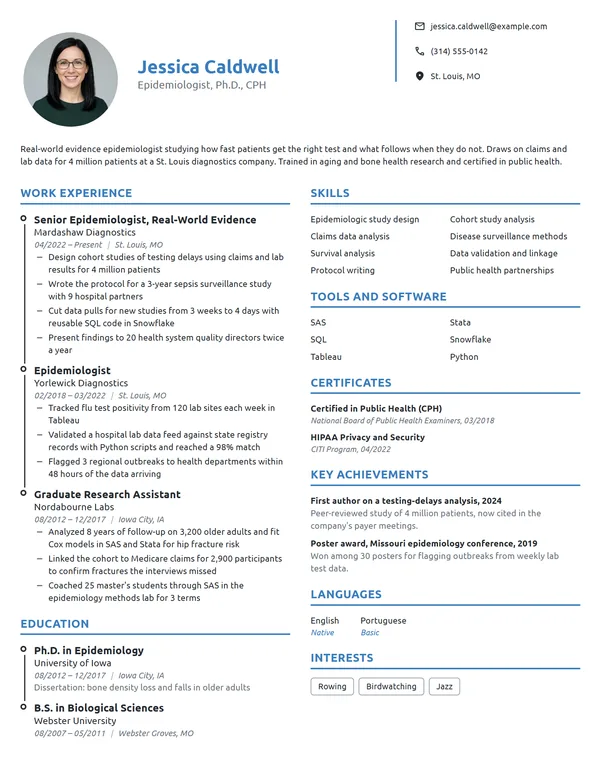
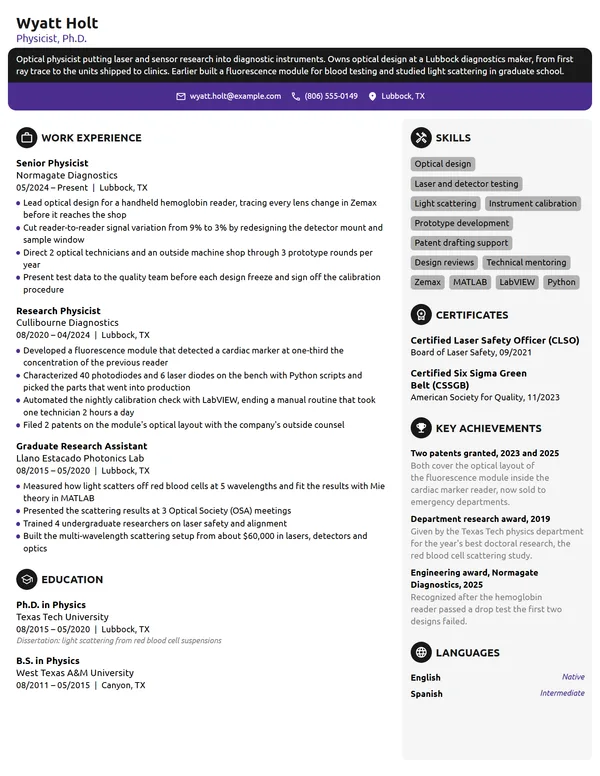
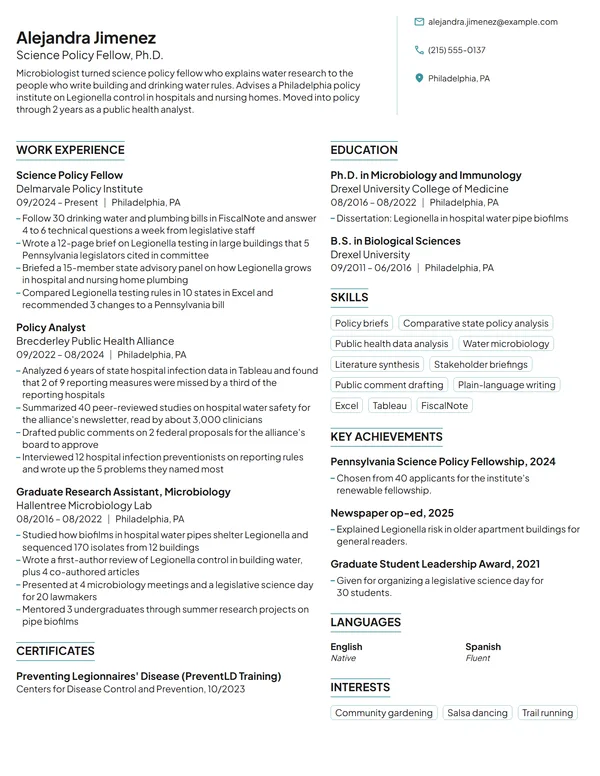
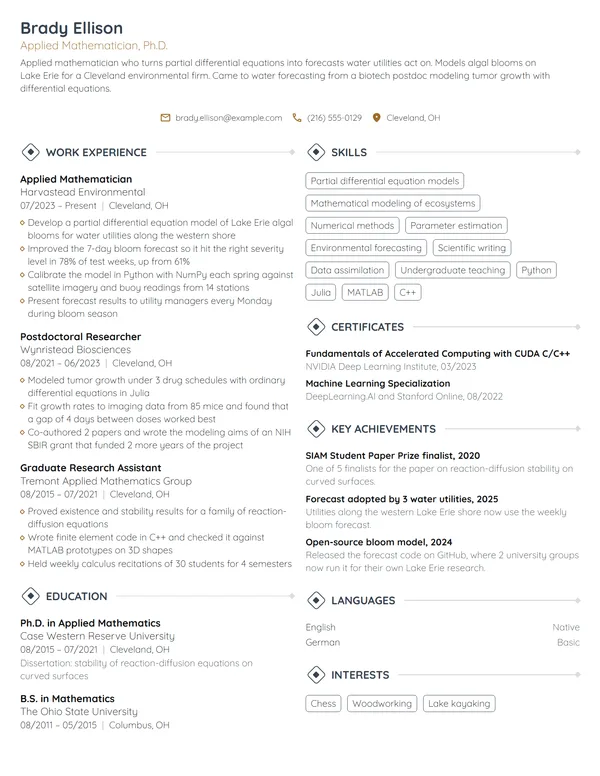
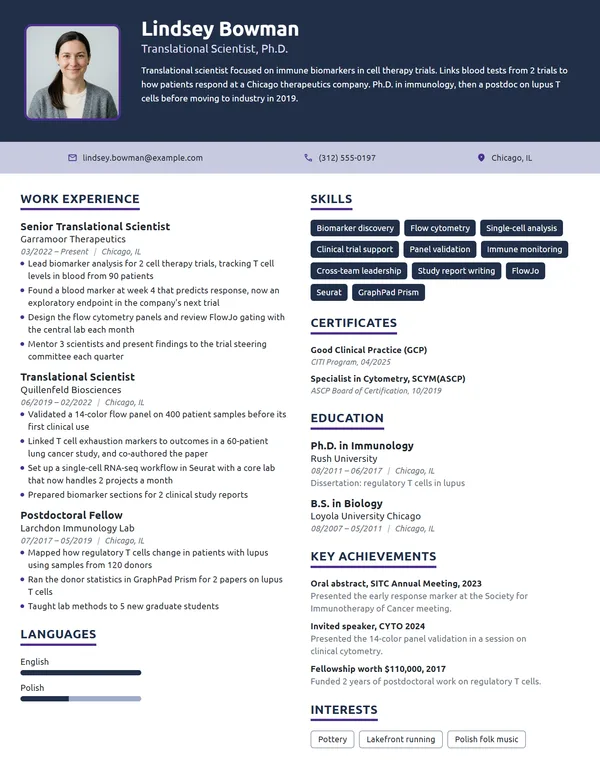
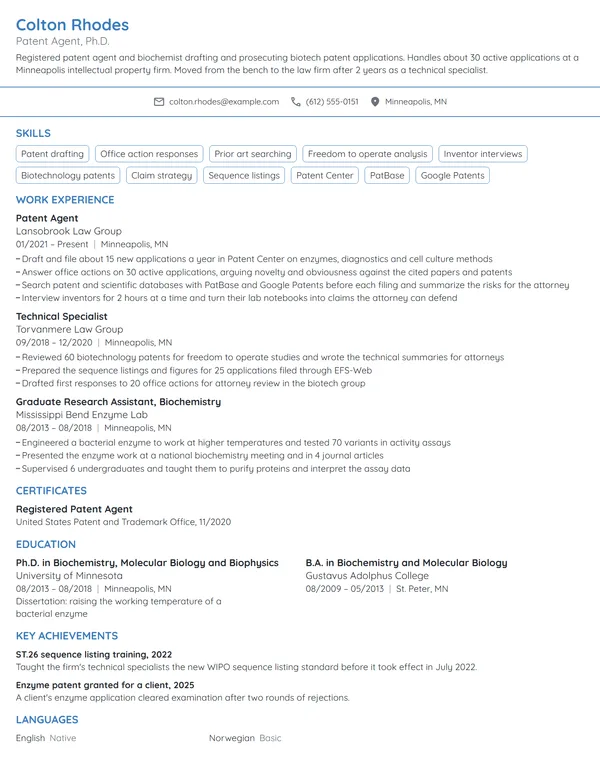
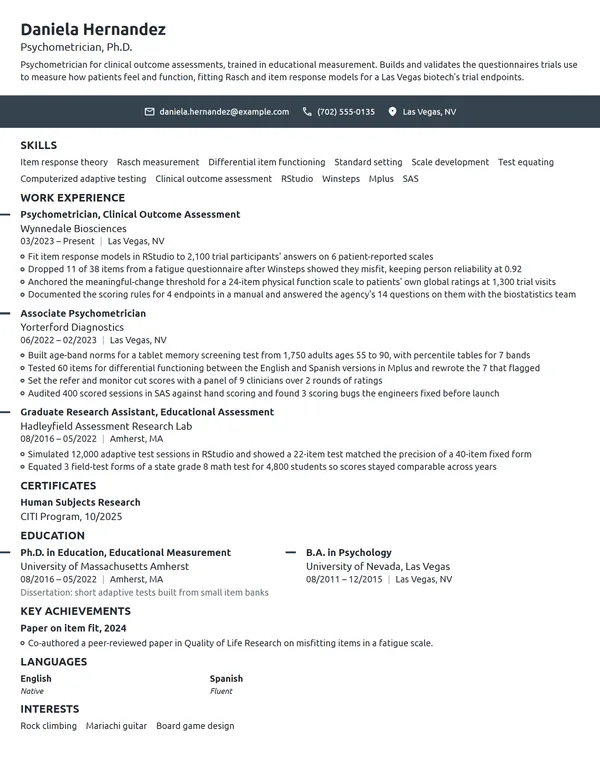
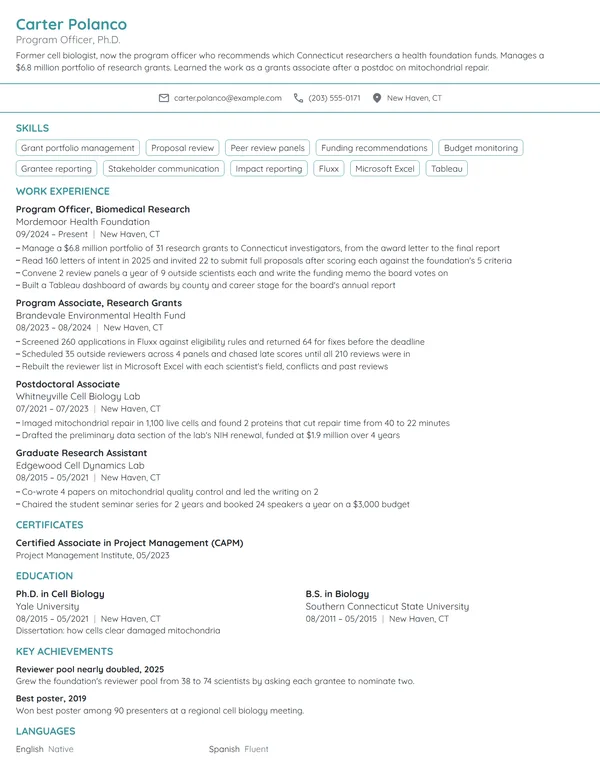
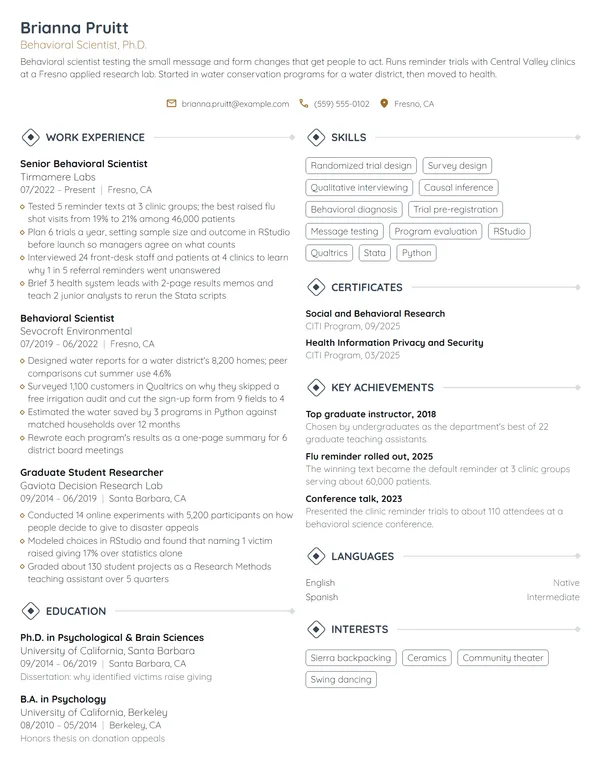
A PhD proves you can take on a hard problem for years and finish it. Outside the university, that record is judged on different terms: the methods you can run on your own, the results you can put a number on, and how well you work with people outside your field. Turning a dissertation, papers and teaching into that evidence takes translation, since a hiring manager will read 2 pages, not 200. Every research year can become a job entry with a title, dates and bullets that end in a result.
How to Write a PhD Resume - Key Takeaways
- Send a 1- to 2-page resume for industry and government jobs, and keep the full academic CV for faculty searches.
- Write each assistantship, fellowship and postdoc as its own Work Experience entry, with a title, the institution, its location and the months you began and finished.
- End every research bullet on a counted result: samples run, methods adopted, time saved, papers published or funding won.
- Put your paper count in a bullet, your 2 or 3 strongest papers under Key Achievements, and the full list behind a Google Scholar or ORCID link.
- Describe the dissertation in 1 plain line under the degree, and write an unfinished PhD as a candidacy with an expected date.
- Match the job ad's own words for your methods and software, then check how it parses with an ATS resume checker before you apply.
What hiring managers look for in a PhD resume
A hiring manager outside academia wants proof that you run methods unsupervised and deliver on a schedule alongside people from other fields. Your committee judged whether your research was original; an employer judges whether the same skills solve its problem. In some fields the doctorate is close to a requirement: the BLS says medical scientists typically have a Ph.D., usually in biology or a related life science. There, the degree gets you considered and your bullets decide the rest.
Industry jobs expect a resume, not the academic CV that lists every paper, poster and course you taught. Learn the difference between a CV and a resume before you cut: the resume keeps only what this employer can use. A PhD resume usually holds these sections:
- Name, headline (for example, Materials Scientist, Ph.D.) and contact details
- A 2- to 3-line profile naming your field, your main methods and your best result; it prints without a heading
- Work Experience, with every research appointment written as a job
- Skills, with your methods and software together
- Education, with the dissertation described in 1 line
- Certificates, for research training and any professional credential
- Optional: Key Achievements for top papers, patents or awards, or Volunteer Experience, plus Languages
Best format for a PhD resume
Use the reverse-chronological resume format, with your current or latest role first. Your doctorate belongs in that timeline as a job: a title such as Graduate Research Assistant or Doctoral Researcher, the department and university, where it is, and MM/YYYY dates for when you began and left. Move to a combination format, with a skills block above your history, only when your field sits far from the job, such as an astrophysics PhD applying for analytics roles.
- Best for most PhD holdersReverse-chronologicalYour jobs, newest first, with your results under each one.Best for: A steady work history in your field
- FunctionalSkills grouped up top, with a short work history below.Best for: Gaps or very little experience
- CombinationA skills section first, then your full work history.Best for: A career change with strong skills
Fit an industry resume on 1 page if your doctorate and an internship are your only research jobs, and move to 2 only when a postdoc or industry role adds results that will not fit. Faculty searches and many research-university posts still ask for an academic CV with complete publication and teaching lists; the professor resume page covers teaching roles that ask for a resume.
| Setting | What to use |
|---|---|
| Length | 1 page with only doctoral research; up to 2 once you add a postdoc or industry job |
| Research jobs | Each assistantship, fellowship or postdoc as its own Work Experience entry |
| Publications | A count inside a bullet, the top 2 or 3 under Key Achievements, the full list behind a profile link |
| Dates | MM/YYYY on every appointment, with Present on the current one |
| Font and margins | One readable sans serif, 10 to 12 pt, margins between 0.5 and 1 inch |
| Personal details | A headshot is unusual in the US and Canada; leave your Social Security number, age and family status off |
| File type | PDF saved under your full name, or .docx if the company portal requires it |
Most US and Canadian resumes carry no photo. Use that space for a profile link instead: an ORCID iD is a free, persistent identifier for researchers, and a hiring scientist who opens it sees your full record without you listing it.
PhD resume summary vs. objective
Write a resume summary once your PhD is conferred or you hold any paid research job: 2 to 3 lines with your field, your methods and 1 result a non-specialist can weigh. Write an objective only while you are still a candidate looking for an internship or a first role, and give your defense date in it. Leave the word passion out of both; a number does that work better.
PhD resume summary formula
Field Ph.D. who the problem you solve, in the employer's words. 2 to 3 methods or tools. 1 result with a number, explained for a non-specialist.
Example
Materials science Ph.D. who turns lab-scale battery chemistry into cells a factory can build. Electrochemical testing, SEM imaging and Python data pipelines. Took 2 anode coatings from bench trials to a pilot line within 18 months.
Don't
PhD graduate with extensive research experience and a passion for solving complex problems, seeking a challenging industry role.
Do
Neuroscience Ph.D. with 5 years of rodent behavior research and 3 published papers, moving into preclinical contract research. Designed 12 dosing studies and wrote the R analysis code for every one.
The second version names the field, the setting it wants, the volume of work and the tool.
How to write PhD research as work experience with numbers
Your current role takes 3 to 4 bullets and earlier appointments 1 to 3, each starting with a verb and ending on what changed. Research is full of countable work, from samples and runs to methods other labs adopted, so write achievements on your resume instead of the topic of each project. Put the result a manager understands first and the technical detail second.
| Area | What to count | Example bullet |
|---|---|---|
| Experiments and screens | Samples, conditions, hits passed on | Screened 2,300 compounds in a cell-based assay and passed 18 hits to the chemistry team. |
| Methods built | Assays or protocols validated, precision, labs using them | Validated 6 ELISA assays with coefficients of variation under 15%, now run in 3 labs. |
| Speed and automation | Throughput, weeks saved, steps automated | Automated image analysis in Python, raising screening throughput from 40 to 320 samples a week. |
| Computation | Run time, model size, hardware moved to | Cut a fluid simulation from 9 weeks to 4 by porting it to GPUs. |
| Papers and talks | Peer-reviewed papers by your role, invited talks | Wrote 7 peer-reviewed papers, 2 as first author, and gave 3 invited talks. |
| Funding and mentoring | Awards won, amounts, students supervised | Supervised 14 undergraduates in a summer research program; 5 presented posters. |
This is how a postdoc and a first industry job look once each bullet carries its scale. The postdoc keeps 2 lines, and the industry role leads with results a business tracks.
Work Experience
- Lead a 3-person team testing silicon-rich anode coatings; 2 of 5 candidate coatings moved to the pilot line in 2026.
- Built a Python pipeline that parses 1,200 cycler files a week, cutting weekly report prep from 2 days to 3 hours.
- Ran the 500-cycle qualification tests 1 automotive customer required before signing a supply agreement.
- Designed and tested 140 electrolyte formulations; the best kept 91% of its capacity after 800 cycles.
- Published 4 first-author papers and trained 3 graduate students on the glovebox and cycler setup.
Don't
Conducted research on protein structure as part of my dissertation.
Do
Built a cryo-EM workflow that solved 3 protein structures below 3-angstrom resolution and cut the time per structure from 9 months to 4.
The rewrite turns a topic into an output, a quality bar and a time saving.
Don't
Taught undergraduate chemistry labs as a teaching assistant.
Do
Taught 4 sections of organic chemistry lab, 96 students a semester, and rewrote 6 lab protocols the department still uses.
Where to put publications on an industry PhD resume
An industry reader rarely wants your full publication list. Count your papers in the bullet of the job that produced them, with your role (first author, co-author), and put the 2 or 3 papers or patents closest to the job under Key Achievements with the journal and year. The profile link in your contact line carries everything else.
Research skills and software for a PhD resume
From the job ad, pick 6 to 8 hard skills for your resume, keeping only those a bullet backs up. Write methods the way the posting writes them: if it says experimental design and statistical analysis, those words should appear, not the name of your subfield. Skills from the soft column show best inside bullets, such as a protocol other labs adopted or students you supervised.
Hard skills for PhD holders
- Experimental design
- Statistical analysis
- Assay and method development
- Data analysis in Python or R
- Machine learning on research data
- Literature review and synthesis
- Grant and technical writing
- Scientific presentations
- Study protocols and lab compliance
- Project planning across studies
Soft skills research managers value
- Explaining technical work to non-specialists
- Independent problem solving
- Mentoring junior researchers
- Persistence on long projects
- Working across functions
- Prioritizing parallel experiments
List your software by its exact name with your skills, then prove each one in a bullet. Common examples are Python (with pandas or PyTorch), R, MATLAB, SAS, GraphPad Prism, ImageJ, COMSOL, LaTeX and Git, but only the ones you could use in week 1 belong there. Instruments count as tools too: name the technique and the instrument where the posting does, such as LC-MS/MS or confocal microscopy.
Certifications and research training after a PhD
A PhD rarely needs a license, but a few credentials help when you move into a regulated field. List certifications on your resume under Certificates, each with its issuer and month and year, and include research training a study or sponsor required. Clinical research and medical affairs roles, such as the Medical Science Liaison job, are where these lines carry most weight.
| Credential | Issued by | What it takes |
|---|---|---|
| CCRP (Certified Clinical Research Professional) | SOCRA | 2 years of full-time clinical research work, or 3,500 part-time hours, within the last 5 years, then the exam. Routes with a clinical research degree or certificate need 1 year. |
| BCMAS (Board Certified Medical Affairs Specialist) | Accreditation Council for Medical Affairs (ACMA) | A self-paced online program of 13 modules, then a final board exam taken online. |
| Research ethics and compliance courses | CITI Program (Collaborative Institutional Training Initiative) | Online courses such as Responsible Conduct of Research (RCR) and human subjects research; list the ones your lab or study required. |
Certificates
- Board Certified Medical Affairs Specialist (BCMAS), Accreditation Council for Medical Affairs, scheduled 02/2027
- Human Subjects Research, CITI Program, 03/2025
- Responsible Conduct of Research (RCR), CITI Program, 09/2023
How to list a PhD, dissertation or ABD status
US universities awarded 58,131 research doctorates in 2024, according to the NSF's Survey of Earned Doctorates, so the degree alone sets you apart less than what you did with it. Follow the standard rules for listing education on a resume: degree and field, university, city and the month and year it was conferred. Add 1 line on the dissertation in plain words; the advisor's name helps only when the reader is likely to know the lab.
Without a finished degree, write the program with Expected and a month and year, and say Ph.D. candidate in your profile only once you have passed qualifying exams. Leave the label ABD off: it reads as a stalled degree, while the expected date and your research results show where you stand. On an industry resume, Education goes below Work Experience once you hold a postdoc or a full-time job.
Education
Dissertation: solid-state electrolytes that let lithium-metal cells charge without shorting.
PhD candidate, postdoc and leaving-academia resumes
Still in your program, lead with Education and your expected date, then write your assistantship as a job and add anything that shows work outside the lab. Each item gets the same counted results a full-time job would:
- Industry internships: the project, the team you delivered to and what they used, such as a model put into production.
- Teaching appointments: sections, students a term and any course material you wrote.
- Consulting clubs and case competitions: clients served and the recommendation they acted on.
- Software and data work: packages released, code others run, datasets shared, with users or downloads where you can count them.
- Outreach and leadership: events run, attendance and budget, listed under Volunteer Experience.
Don't
PhD candidate seeking an internship where I can apply my research skills.
Do
Fifth-year chemical engineering Ph.D. candidate, defending 05/2027, seeking a process development internship. Scaled a catalyst synthesis from 2 g to 150 g batches in a university pilot lab.
Name the defense date, the role and 1 result, even in an objective.
Leaving academia after a postdoc or a faculty post is a career change on paper even when the science stays the same. Keep your real job titles, but reorder each entry's bullets so the business-relevant results come first, and cut teaching and service down to 1 line each. Explain the move in 2 to 3 sentences of your cover letter, and write the cover letter around the employer's problem rather than your reasons for leaving.
PhD resume FAQ
Should I send a resume or a CV with a PhD?
Send a resume for industry, government and nonprofit jobs, and an academic CV for faculty searches and postings that ask for one by name. The resume runs 1 to 2 pages and keeps only the research results the employer can use; the CV lists every paper, talk and course.
How long should a PhD resume be?
1 page if your doctorate and an internship are your only research jobs, and up to 2 pages once a postdoc or an industry role adds results that no longer fit on 1. Your profile, latest job and strongest results belong on page 1.
How do I list publications on a PhD resume?
Count them inside the bullet of the job where you wrote them, with your role, such as 5 peer-reviewed papers, 3 as first author. Put the 2 or 3 most relevant under Key Achievements with the journal and year, and link the full list through Google Scholar or ORCID in your contact line.
Should I put PhD after my name on my resume?
Yes, in the headline under your name, once the degree is conferred: Research Scientist, Ph.D. works for most industry jobs. While you are still a candidate, write Ph.D. Candidate in the headline instead, and show the expected date under Education.
How do I show an unfinished PhD on my resume?
Write the degree, the university and Expected with a month and year under Education, and describe yourself as a Ph.D. candidate in your profile if you have passed qualifying exams. If you have left the program, list the degree you earned on the way, such as an M.S., and your research as work experience.
Does a postdoc count as work experience on a resume?
Yes. A postdoc is a paid research job, so it goes under Work Experience with a title such as Postdoctoral Associate or Postdoctoral Fellow, the institution, the city and dates. Give it bullets with counted results, like any other job.
Should I include my dissertation title on a resume?
Only in plain words. Replace a long technical title with 1 line that says what you found or built and why it matters to the employer. Keep the formal title for an academic CV or for an interview where someone asks.
Do PhD holders earn more in industry than in academia?
Yes, at the start. The NSF's 2024 Survey of Earned Doctorates found expected median salaries for new doctorate recipients higher in industry than in academic jobs in every broad field. For one PhD-heavy job, the BLS reports a median of $103,410 for medical scientists in May 2025. Leave pay off the resume either way.
Next steps
Start from the example closest to the job you want, write your doctoral years and any postdoc as job entries, and give every bullet a number from your own research records. Lay it out in one of the resume templates or our resume builder, then send a cover letter alongside it, opening on the problem your research can solve for this employer.