
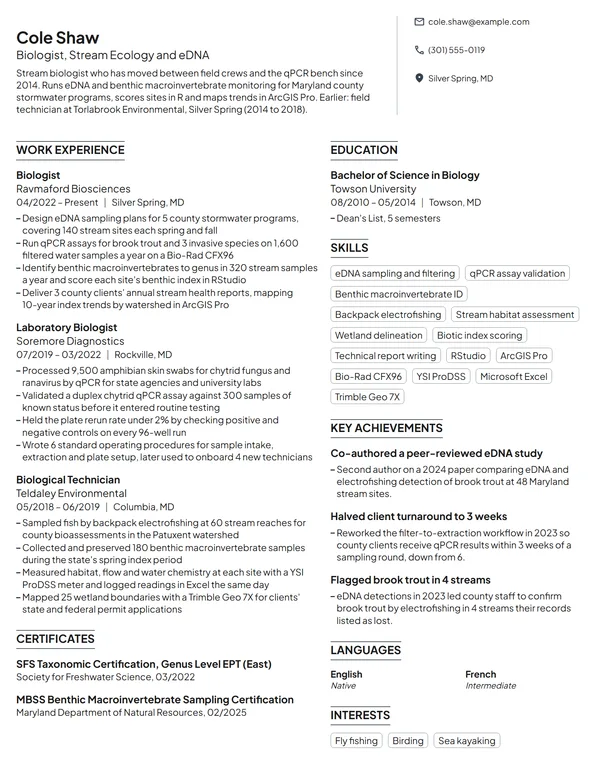
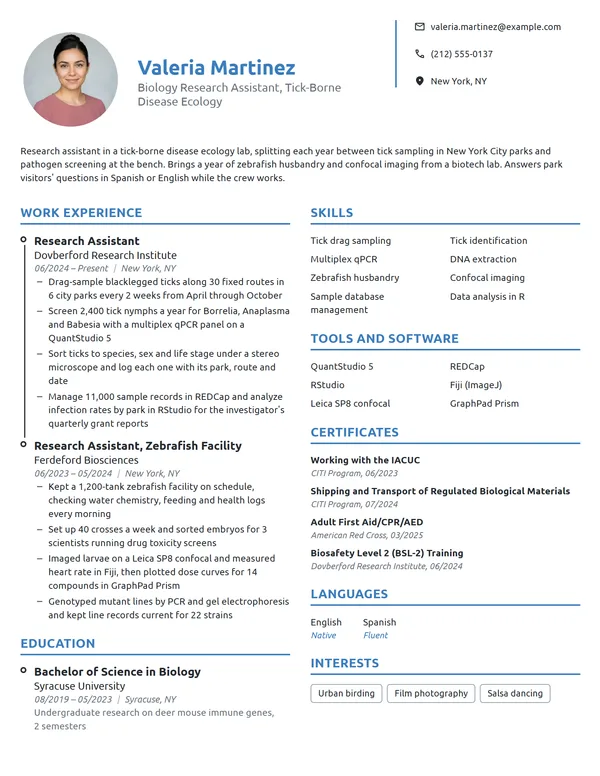
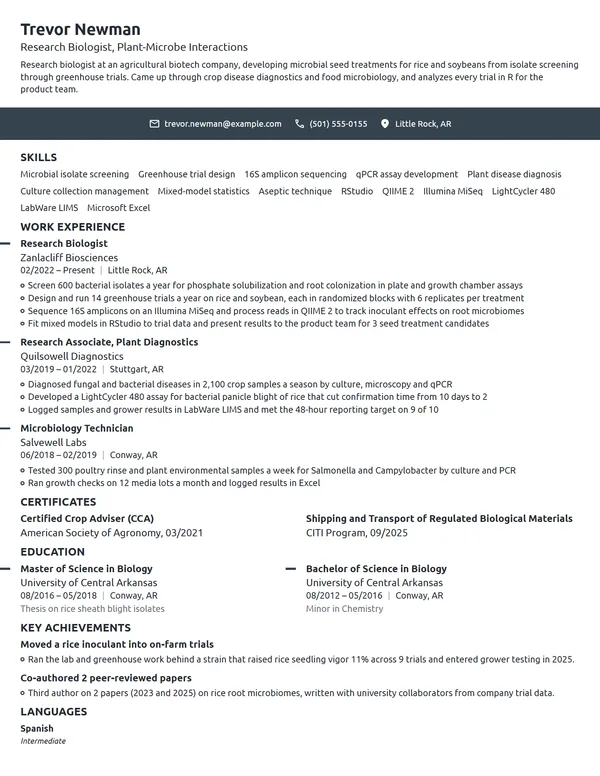
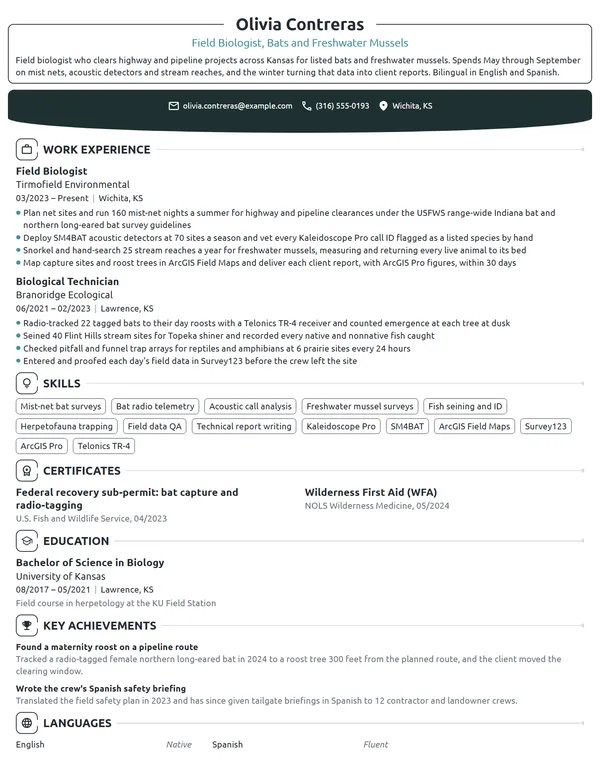
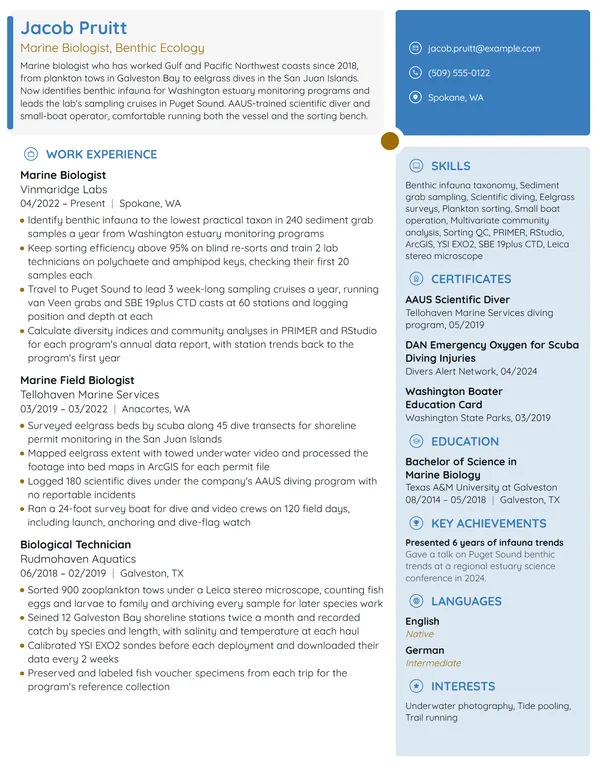
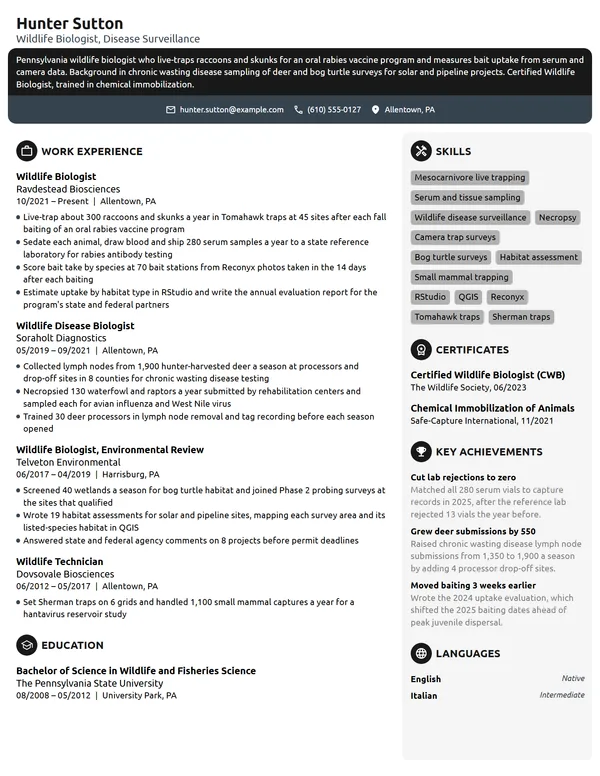
A biology degree can lead to a lab bench, a research boat or a survey route miles from the nearest road, and each of those hires on different proof. A lab manager wants to know which techniques you can run without supervision. A field crew lead checks how many seasons you have logged, which species you can identify and whether your data came back clean. A federal panel checks that your coursework and duties match the posting. Name the setting first, then give each job its organism, its method and a count: samples processed, plots surveyed, specimens catalogued.
How to Write a Biology Resume - Key Takeaways
- Use reverse-chronological order on 1 page early on, 2 pages with 5+ years or a graduate degree, and send an academic CV only when a university asks for one.
- Put the setting and the organism in your title line, such as Field Biologist, Avian Surveys, so the reader sees which bench or field site you fit.
- Give each bullet a count biologists keep anyway: samples processed, plots or transects surveyed, specimens catalogued, detections logged or reports filed.
- List R, Python, ArcGIS or a lab instrument with your skills only when a bullet shows you using it.
- Put field authorizations such as AAUS Scientific Diver, the DOI motorboat course or an Associate Wildlife Biologist credential under Certificates, with the issuer and date.
- Match the posting's method and species names, then test the file with an ATS resume checker before you upload it to an agency or university portal.
What hiring managers look for in a biology resume
Biology jobs split into lab, field and marine work, and the person deciding is usually a biologist: a principal investigator, a lab manager, a crew lead or a federal panel. O*NET lists collecting and analyzing data on organisms and their environment, processing that data by computer, writing technical reports and supervising technicians as core tasks for biologists. The BLS adds estimating wildlife populations and notes that fieldwork can mean long stays in remote locations.
So the reader looks for 3 things in each entry: the organism or system you worked on, the methods you used, and how much work you finished to a standard someone else could trust. Lay it out in these sections:
- Name, a headline with your setting (for example, Research Biologist, Molecular Ecology) and contact details
- A 2- to 3-line summary or objective under your name, printed without a heading
- Work Experience, with your newest job or field season on top
- Skills, with your lab methods, field methods and software together
- Certificates, for field authorizations, permits and safety training
- Education, with a thesis or field course line when it fits the job
- Optional: Key Achievements for papers and grants, Volunteer Experience or Languages
Best format for a biology resume
Use the reverse-chronological resume format, with your latest job first and each entry carrying the title, the employer, its location and MM/YYYY start and end dates. Biology careers often run from seasonal technician to research assistant to biologist, and this order lets a reader follow that climb season by season. A combination layout, with skills above your history, only helps when you are moving into biology from unrelated work.
- Best for most biologistsReverse-chronologicalYour jobs, newest first, with your results under each one.Best for: A steady work history in your field
- FunctionalSkills grouped up top, with a short work history below.Best for: Gaps or very little experience
- CombinationA skills section first, then your full work history.Best for: A career change with strong skills
Stay on 1 page with a bachelor's degree and under 5 years of work, and move to 2 pages once a graduate degree, several field projects or a run of papers fills it. Federal postings cap you at 2 pages: OPM's Merit Hiring Plan of May 2025 set a 2-page limit in place of the long federal resume. Faculty, postdoc and graduate program applications ask for a full academic CV instead, and the difference between a CV and a resume decides which file you send.
| Setting | What to use |
|---|---|
| Length | 1 page early on; 2 pages with a graduate degree or 5+ years, and never more than 2 for a federal job |
| Job title line | Title plus focus: Field Biologist, Avian Surveys or Biology Research Assistant, Plant Genetics |
| Seasonal jobs | One entry per employer, dated from the first season's start to the last season's end, with the number of seasons in the title line |
| Dates | MM/YYYY on every entry and Present on the job you hold now |
| Body text | One readable typeface at 10 to 12 pt, with species names in italics |
| Photo and private data | Usually no photo in the US and Canada, and no age, family status or Social Security number |
| File type | PDF for direct emails; the portal's own format for USAJOBS and university systems |
Most US and Canadian resumes carry no photo. Plain text survives university and agency portals best, so spell out degree symbols and Greek letters if a form will copy them.
Biology resume summary vs. objective
Use one test: if someone has paid you to do biology for a year or more, as a technician, crew member or research assistant, write a resume summary. If your biology so far is coursework, a thesis or a summer project, write a resume objective that names the job you want and the best evidence you have. Both open with your setting and take their number from your strongest bullet.
Biology resume summary formula
Title with X years of lab or field work on organisms or systems, using 2 to 3 methods or tools. 1 result with a count. Degree and credential.
Example
Wildlife biologist with 7 years of field work on sage-grouse, pronghorn and songbirds in western Montana, mapping in ArcGIS Pro and analyzing in R. Ran pre-construction surveys for 7 wind and transmission projects in 2025. B.S. in Wildlife Biology and Associate Wildlife Biologist (The Wildlife Society).
Don't
Passionate biology professional with a love of nature and strong research skills, looking for a rewarding role.
Do
Fisheries technician with 4 seasons on Pacific Northwest salmon streams, running electrofishing and snorkel surveys and cleaning data in R. Tagged 3,200 juvenile coho for a survival study. B.S. in Fisheries and Wildlife.
The rewrite names the species, the methods, a season count and a tally a crew lead can check.
How to write biology work experience bullets with numbers
Your current job gets 3 to 4 verb-first bullets, and older ones get 1 to 3. Biologists already count most of their work in field notebooks, lab logs and databases, so take the number from there: plots, transects, samples, specimens, sequences, reports. When you list work experience on a resume for a biology job, name the organism or system in the bullet as well as the method.
| Area | What to count | Example bullet |
|---|---|---|
| Field surveys | Transects, plots, survey hours, detections | Walked 22 breeding-bird transects 3 times a season and logged 2,600 detections. |
| Specimens and samples | Specimens collected or catalogued, samples labeled, records completed | Catalogued 1,850 herbarium specimens into the collection database with full locality data. |
| Lab methods | Extractions, runs, loci or assays, success rate | Extracted DNA from 480 fin clips and genotyped 12 microsatellite loci at a 96% success rate. |
| Data and analysis | Years of data, stations, models, maps | Built an R occupancy model from 4 years of camera-trap data at 90 stations. |
| Reports and permits | Reports filed, deadlines met, agencies served | Filed 9 annual permit reports with the state wildlife agency ahead of each deadline. |
| Crews and volunteers | People trained, crew size, safety record | Trained 15 volunteers in electrofishing safety and fish identification for a stream survey. |
The entry below belongs to a consulting wildlife biologist who started as a seasonal technician. Each bullet carries a count and a species or deliverable, and the 3 seasons of technician work sit in a single entry.
Work Experience
- Lead pre-construction wildlife surveys for 7 wind and transmission projects a year across 3 western Montana counties.
- Ran 2 seasons of sage-grouse lek counts on 38 leks and entered 1,140 observations into the project geodatabase, with under 1% flagged in QA review.
- Write 12 biological assessment chapters a year for clients' federal permit filings.
- Train and schedule 6 seasonal technicians each spring on survey protocols and ATV safety.
- Monitored 64 vegetation plots across 3 field seasons for a grassland restoration study.
- Captured and banded 410 songbirds in mist nets as a sub-permittee on the project's federal banding permit.
Don't
Conducted field surveys.
Do
Surveyed 14 ponds for amphibian egg masses each spring for 3 years, adding 2 new breeding sites to the county monitoring list.
The rewrite says what was surveyed, how often and what the work changed.
Don't
Responsible for lab maintenance and ordering.
Do
Ran supply ordering for a 9-person lab and kept the freezer inventory current, cutting duplicate reagent orders from 11 to 2 a quarter.
Biology skills, lab techniques and software
Choose 6 to 8 hard skills for your resume from the posting and back each one with a bullet. Write techniques at the level a biologist would ask about in an interview: mist-netting, quadrat sampling, qPCR or eDNA filtering, rather than field work or molecular biology.
Hard skills for biologists
- Field survey design
- Species identification
- Specimen collection and curation
- Animal capture and handling
- DNA extraction and PCR
- Microscopy
- Aseptic technique and cell culture
- Water quality sampling
- Statistical analysis in R
- GIS mapping and spatial analysis
Soft skills biology teams value
- Careful data recording
- Working in remote conditions
- Clear scientific writing
- Crew coordination
- Patience with repeat protocols
- Safety awareness
O*NET marks R, Python, Microsoft Excel and Microsoft Office as in-demand technology for biologists, and lists ESRI ArcGIS, MATLAB and IBM SPSS Statistics as hot technology. According to the BLS, wildlife biologists use GIS and modeling software to estimate populations and track animal movement. Name your version and use (ArcGIS Pro for habitat maps, R for occupancy models) and add the lab's own systems, such as a sequencer or a collection database, by their product names.
Field authorizations and certifications for biologists
Most biology jobs need no state license, so the Certificates section carries what a field site or lab checks before you start: diving and boating authorizations, banding or collecting permits, safety courses and professional credentials. List certifications on your resume with the issuing body and the month you earned or renewed each one, and put the one the posting asks for first.
| Credential | Issued by | What it takes |
|---|---|---|
| Associate Wildlife Biologist (AWB) | The Wildlife Society | A degree and coursework the society reviews; holders can upgrade to Certified Wildlife Biologist after 5 years of experience. |
| Certified Wildlife Biologist (CWB) | The Wildlife Society | 5 years of professional work in a 10-year window, in jobs that require at least a bachelor's degree; renewed every 5 years with continuing education. |
| AAUS Scientific Diver | Your employer's diving program, under AAUS standards | Affiliation with an AAUS organizational member and, per AAUS, a 100-hour advanced training course that includes 12 dives. |
| Motorboat Operator Certification Course (MOCC) | U.S. Department of the Interior | Required of U.S. Fish and Wildlife Service motorboat operators, with refresher training every 5 years. |
How to list permits and animal-use training
Many field permits belong to the project, not to you. The USGS Bird Banding Laboratory, for example, issues sub-permits only at the master bander's request and only to banders trained to work on their own. List the authorization you hold under Certificates with its scope (species, method, issuer), and write the permitted work into a bullet. Animal-use or lab safety training your institution required goes on the same list, named as the course was named.
Certificates
- Associate Wildlife Biologist (AWB), The Wildlife Society, 02/2020
- Federal bird banding sub-permit (songbirds, mist-net capture), USGS Bird Banding Laboratory, 04/2021
How to list a biology degree and coursework
Entry-level biology jobs usually start at a bachelor's degree. The BLS says zoologists and wildlife biologists typically need a bachelor's for entry-level positions, at least a master's for higher-level ones and a Ph.D. for independent research, and that biological technicians typically need a bachelor's in biology or a related field, with lab work built into their science courses.
When listing education on a resume, name the degree, then the school with its location and the month you finished, and add a thesis, field course or capstone line when it matches the job. For federal biology jobs, OPM's 0401 standard accepts a degree in the biological sciences or related fields, or coursework equal to a major plus experience, so add your biology credit hours when your degree title is in another subject.
Education
46 semester hours of biology coursework. Senior thesis: nest survival of grassland songbirds on 2 restored ranches.
Entry-level and career-change biology resumes
Most first biology jobs are technician, crew or research assistant posts, so an entry-level resume layout works: a short objective, Education near the top, then any work where you handled organisms, samples or data. Give each item a count, just as a paid job would get.
- Undergraduate research: the lab or advisor's focus, the methods you ran and how many samples or sites you handled, listed as a Work Experience entry if it lasted a semester or more.
- Summer field jobs: crew size, survey type, the species you identified and the number of plots or nights.
- Field courses and field stations: under Education, with the station and the weeks spent.
- Museum, herbarium or zoo work: specimens catalogued or animals cared for, under Volunteer Experience if unpaid.
Don't
Recent biology graduate looking for an opportunity to grow my skills in a research setting.
Do
Biology graduate (B.S., 05/2026) seeking a field technician role in avian ecology. Ran 120 mist-net sessions over 2 summers of undergraduate research and identify 150 Midwest bird species by sight and song.
An objective still needs a count and a named skill the crew lead will use.
Moving in from lab technician, veterinary, teaching or environmental compliance work, keep reverse-chronological order and open with the biology you already do: samples handled, animals cared for, water tests run, labs taught. A career-change resume reads best when your first 3 bullets are the most biological tasks of your current job. Use the cover letter for the reason behind the move; these research assistant cover letter examples show how to tie lab or field work to a new posting in a few lines.
Biology resume FAQ
Should I send a resume or a CV for a biology job?
Send a resume of 1 to 2 pages to companies, consulting firms, nonprofits and government agencies. Send a full academic CV, with every paper, talk and grant, only to faculty, postdoc and graduate program openings, or when a university posting asks for one by name.
Can I get a biologist job with only a bachelor's degree?
Yes, at entry level. The BLS says zoologists and wildlife biologists typically need a bachelor's degree for entry-level positions, a master's for higher-level ones and a Ph.D. to lead independent research. Technician and research assistant jobs are the usual first step, so put your field and lab hours on the resume.
How do I list seasonal field jobs on a biology resume?
Group repeat seasons with the same employer into one entry. Date it from the first season's start to the last season's end, add the number of seasons to the title line, and write bullets that total the work across seasons, such as plots monitored or animals tagged.
How long can a federal biologist resume be?
2 pages at most. OPM's Merit Hiring Plan of May 2025 dropped the long federal resume format for a 2-page limit, so cut older seasonal work to its title, dates and 1 bullet, and spend the space on duties that match the posting's qualifications.
Should I list publications on a biology resume?
Yes, briefly. On a resume, count your papers in the bullet for the job that produced them, or list 1 to 3 under Key Achievements with your author position. Keep the full reference list for an academic CV.
What software should a biology resume include?
Include the analysis and mapping tools the posting names and you have used, most often R, Python, Excel and ArcGIS, which O*NET flags for biologists. Add each lab or field system by its product name, and show it in at least 1 bullet.
Do I need a certification to work as a wildlife biologist?
No, but it helps. The Wildlife Society's Associate Wildlife Biologist credential suits early-career biologists, and the Certified Wildlife Biologist credential needs 5 years of professional experience. Field jobs may also require their own authorizations, such as a scientific diving or motorboat course, before you start.
How much do biologists earn?
BLS data show a median annual wage of $98,920 in May 2025 for the occupation group biological scientists, all other. Pay for your job depends on the specialty, the employer type and the degree it requires.
Next steps
Choose the example whose setting matches the job you want, lab, field or marine, and keep its order of sections. Swap in your own organisms, methods and counts, then build it in our resume builder or start from one of the resume templates. Send it with a cover letter that names the project you want to join.