
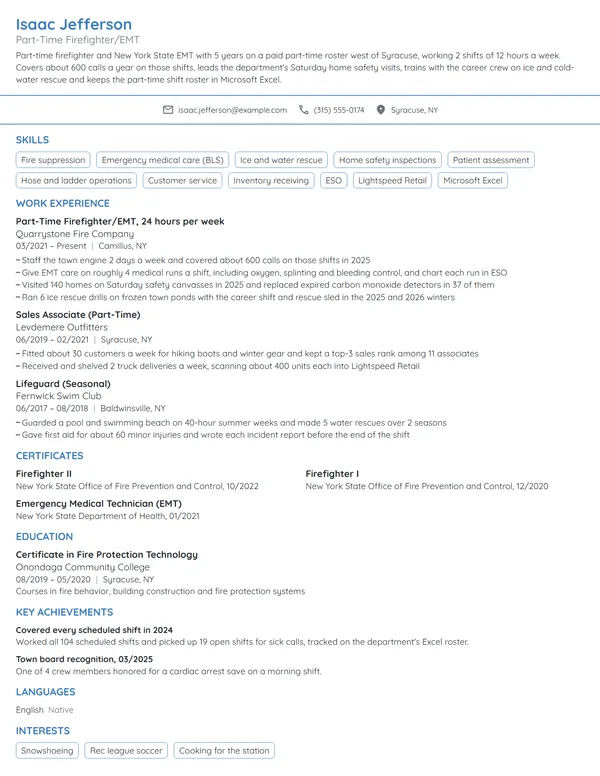
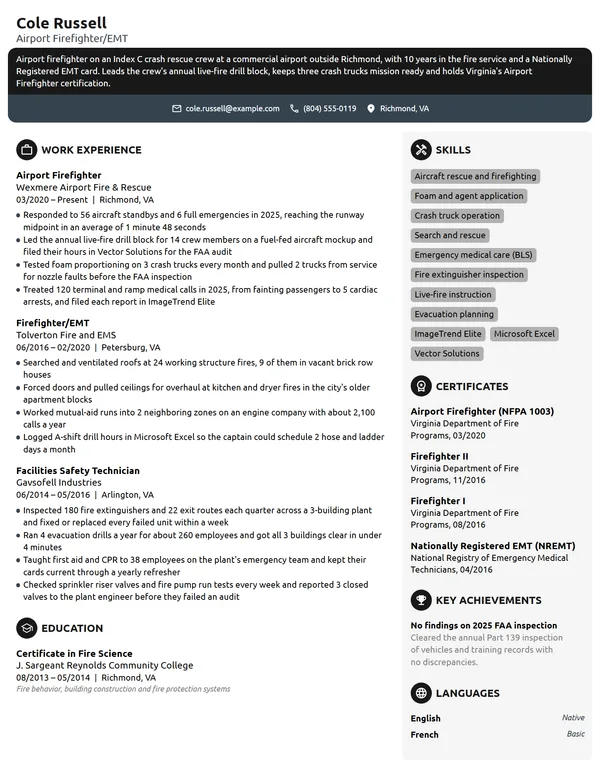
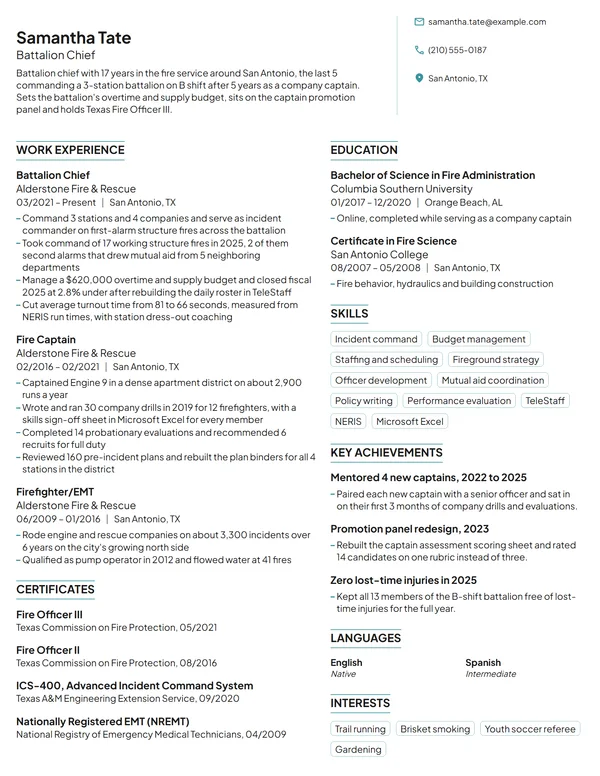
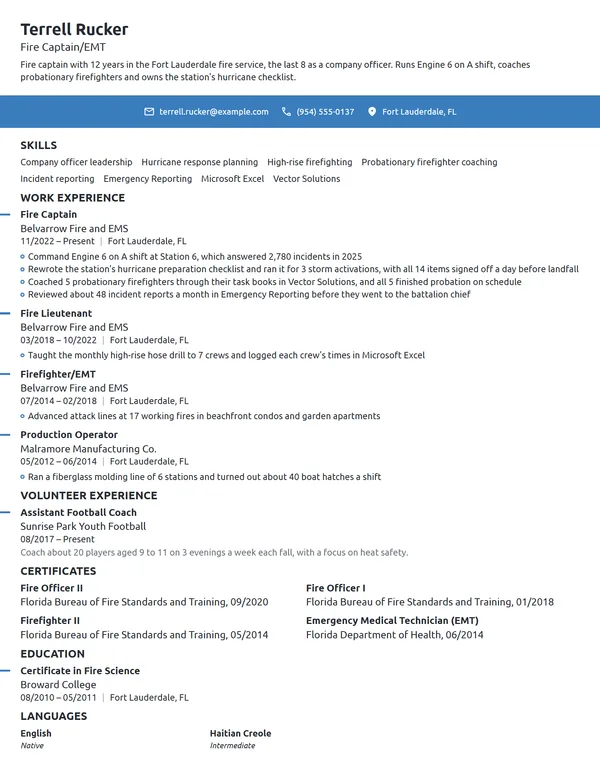
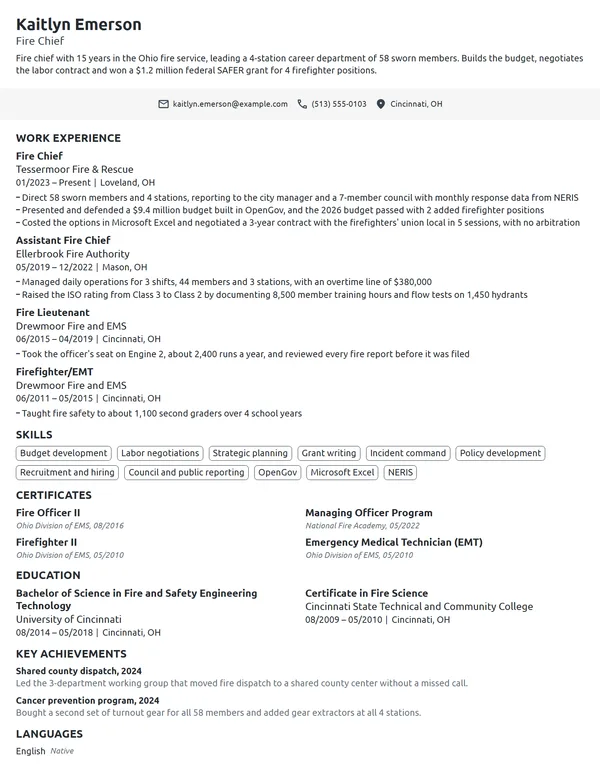
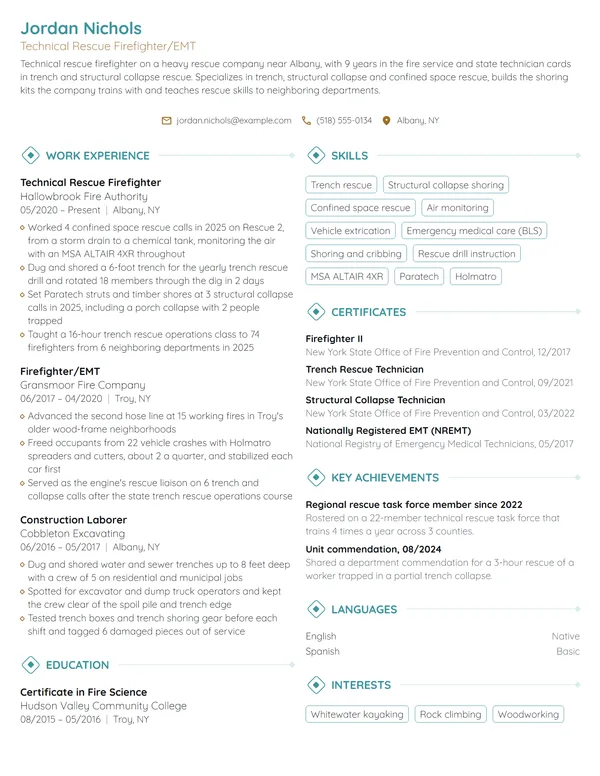
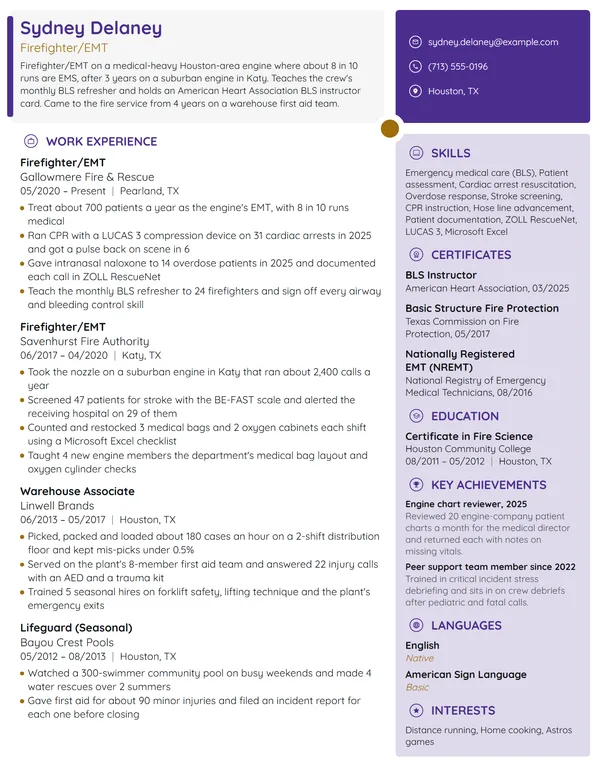
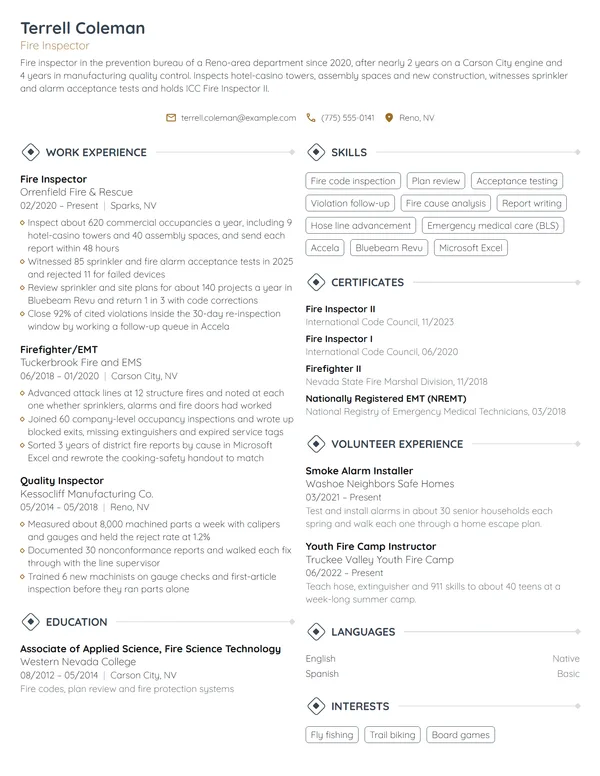
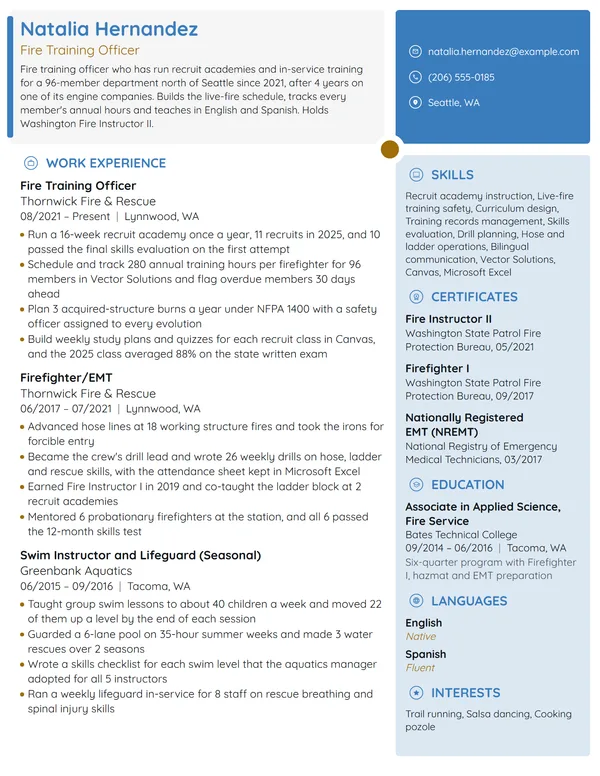
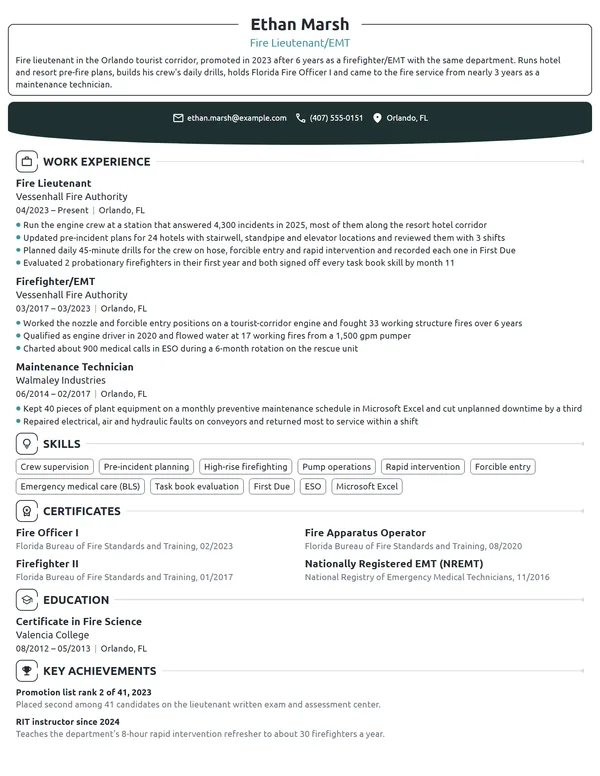
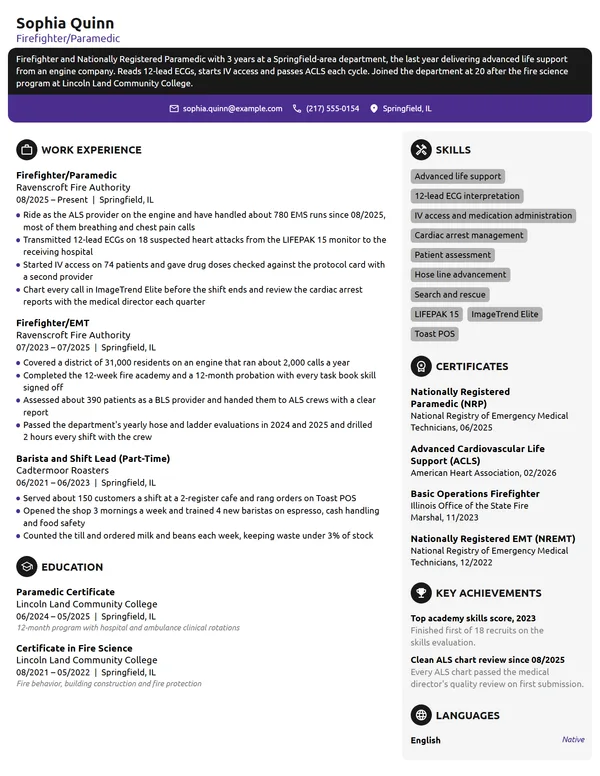
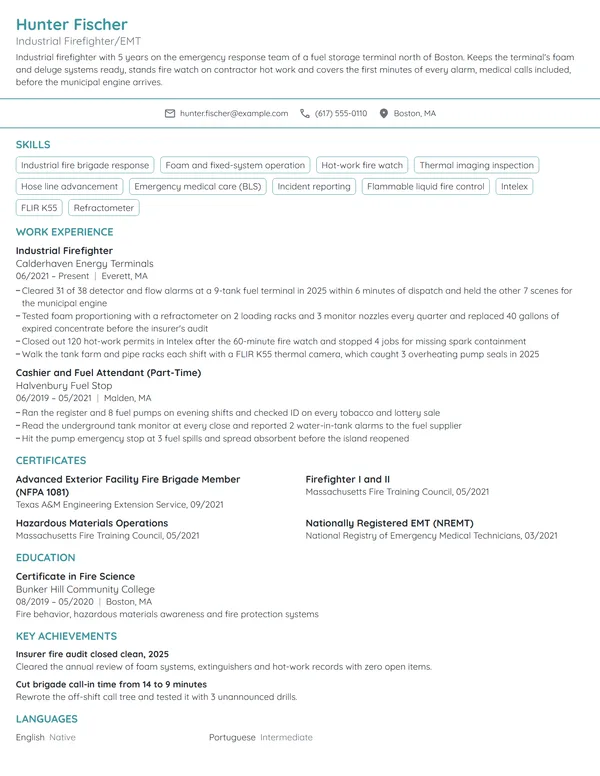
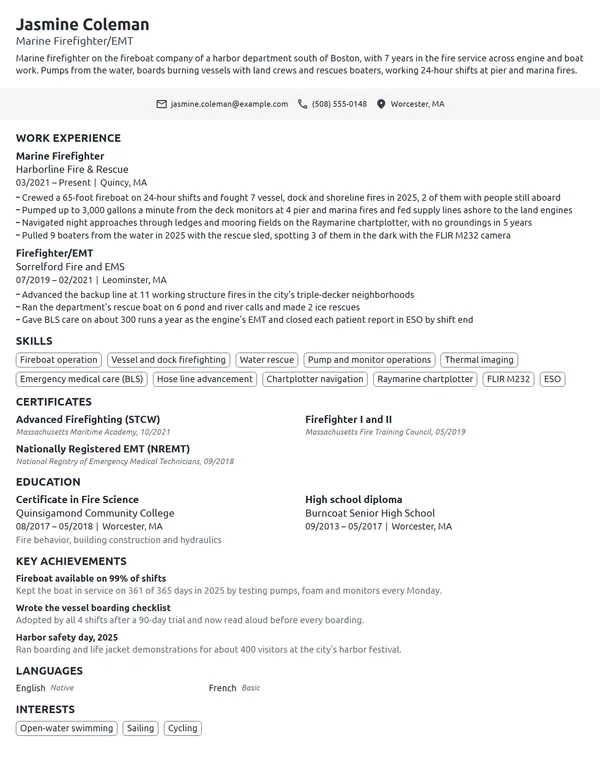
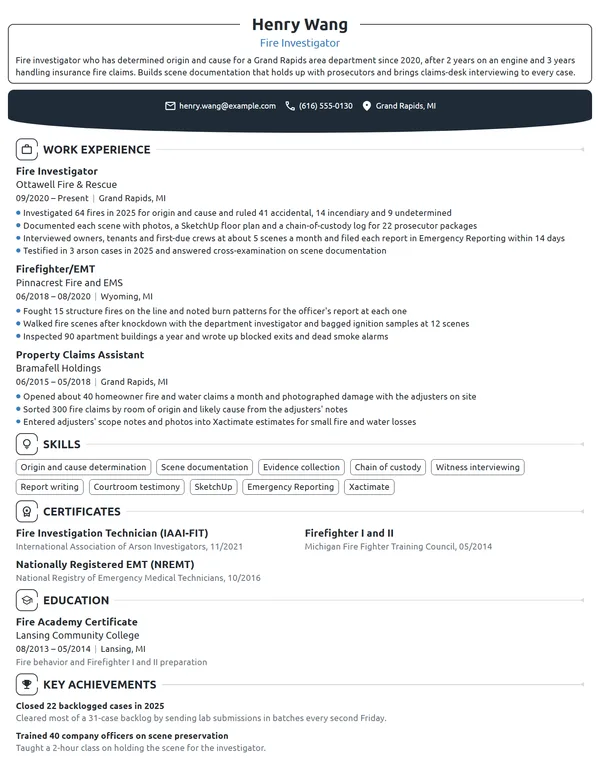
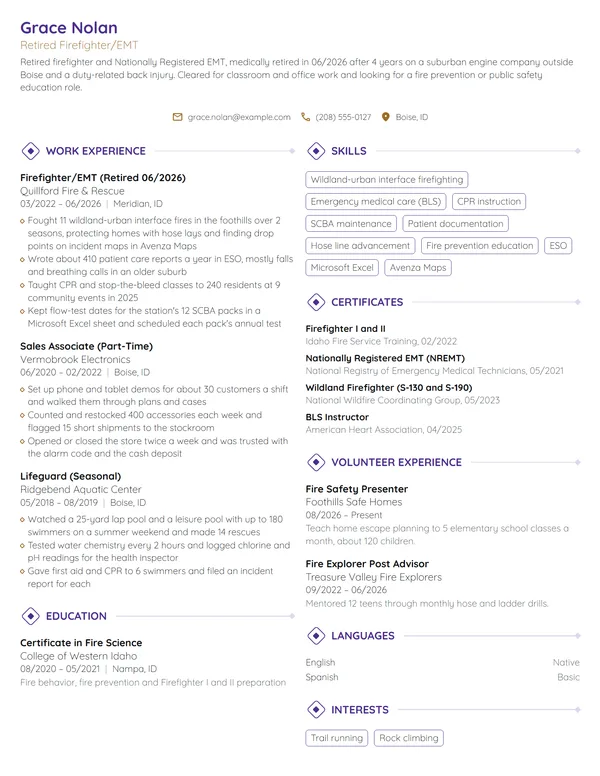
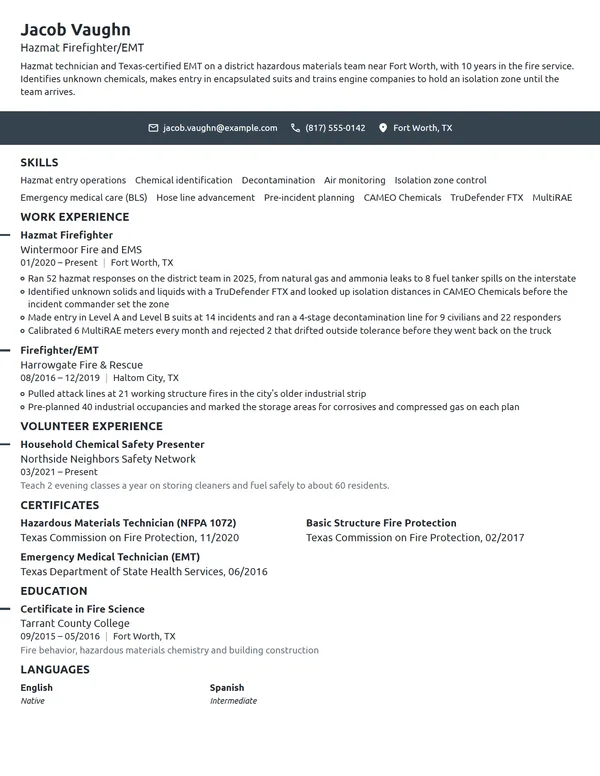
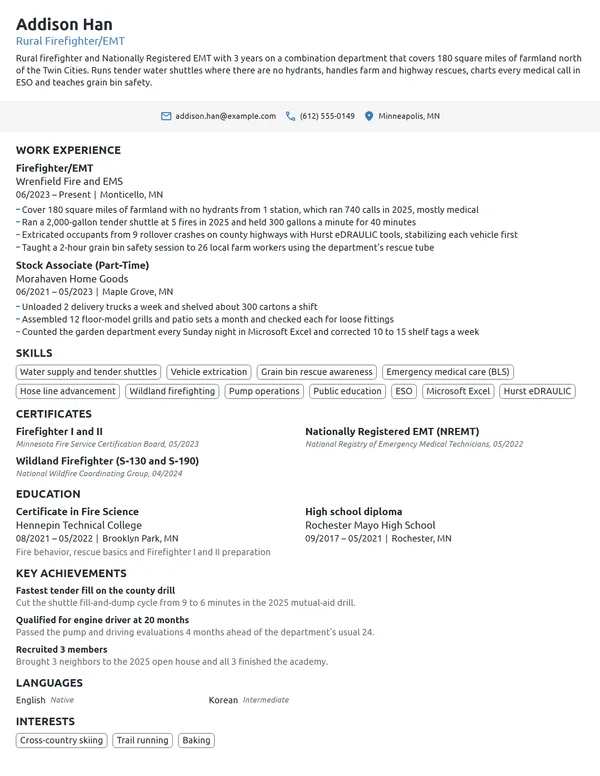
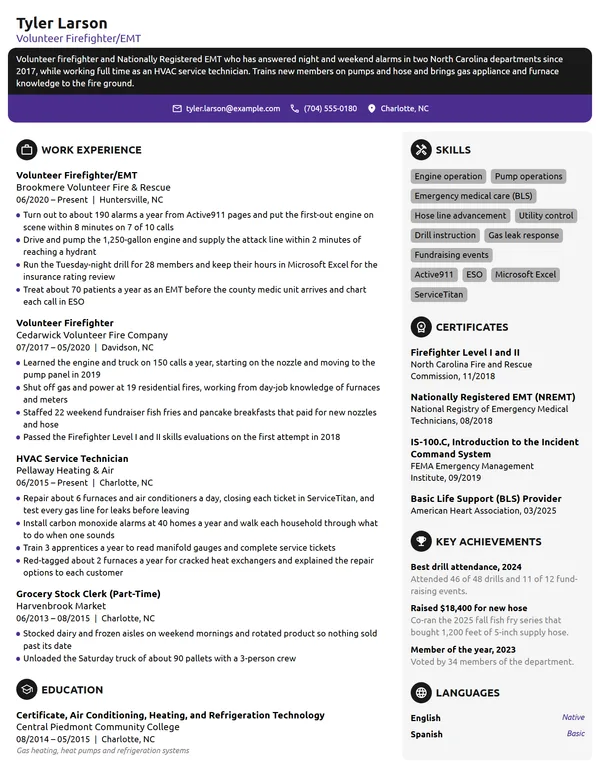
Departments hire firefighters to work on a crew, so they want to see that you can pull your weight on one. Certifications and EMS training come first, then the calls you have run and the station work in between. Drills, inspections and equipment checks often get left off because they feel routine. Calls a year, training hours and every certification you hold give a hiring panel what it needs.
How to Write a Firefighter Resume - Key Takeaways
- Keep it to 1 page in reverse-chronological order, with your current department and its dates at the top.
- Put Firefighter I and II, your EMT level and any Driver/Operator card first under Certificates, each with its issuer and year.
- Count the work a company officer tracks: calls a year, the share that were medical, working fires, inspections, smoke alarms and training hours.
- Write a 2- to 3-line summary with your title, years on the job, type of company and best result, or an objective if you are fresh out of the academy.
- Give part-time, paid-on-call and volunteer firefighting its own entry with the same numbers as a career job.
- Leave personal details off, and check the PDF in an ATS resume checker before you upload it to a city or county portal.
What fire departments look for in a firefighter resume
A fire department reads your resume twice. First, someone checks it against the posting's minimum qualifications. In the BLS description, applicants typically must be at least 18, hold a valid driver's license, and pass written and physical tests and interviews before they train at a fire academy. Then a hiring panel or a company officer reads it for what you have actually done on calls and at the station.
The BLS lists responding to emergencies, driving fire trucks, putting out fires, rescuing occupants, treating sick or injured people, writing incident reports and maintaining equipment as core duties. O*NET adds operating pumps connected to high-pressure hoses and giving first aid and CPR. Build your bullets around those tasks, with a count beside each one. A standard resume carries these sections:
- Name, a headline such as Firefighter/EMT, and contact details
- A 2- to 3-line summary or objective under your name, which needs no heading
- Certificates, with Firefighter I and II and your EMT level first
- Work Experience, current department first
- Skills, with any software you use for reports or inspections
- Education, including your fire academy
- Optional: Volunteer Experience, Key Achievements or Languages
Best format for a firefighter resume
Use the reverse-chronological resume format, with your current department first and each job carrying its title, the department, its city and the start and finish month as MM/YYYY. The fire service promotes in clear steps, and the BLS describes the usual ladder as firefighter to engineer, then lieutenant, captain and battalion chief. A reverse-chronological layout puts your current rung at the top, where a panel looks first.
- Best for most firefightersReverse-chronologicalYour jobs, newest first, with your results under each one.Best for: A steady work history in your field
- FunctionalSkills grouped up top, with a short work history below.Best for: Gaps or very little experience
- CombinationA skills section first, then your full work history.Best for: A career change with strong skills
One page fits almost every firefighter below the officer ranks. Go to 2 pages only once you hold an officer title or a long list of specialty cards, such as technical rescue, hazmat technician and instructor, and keep your current department on page 1.
| Setting | What to use |
|---|---|
| Length | 1 page; 2 only for officers or a long list of specialty certifications |
| Dates | MM/YYYY for every job and certification, with Present for your current department |
| Job title line | Rank plus EMS level, such as Firefighter/EMT or Firefighter/Paramedic |
| Certificates order | The posting's order, else Firefighter I and II, EMT or paramedic, Driver/Operator, then hazmat, rescue and FEMA courses |
| Typeface | One clean, readable font in 10 to 12 pt, the same on every page |
| Photo, height and weight | Leave all 3 off, as on most US and Canadian resumes, along with your birth date and marital status |
| File type | PDF, unless the city or county portal asks for a Word document |
Most US and Canadian resumes carry no photo. Leave fitness scores off too: the physical test measures those.
Firefighter resume summary vs. objective
Here is the test: if you have held a firefighter job, paid or volunteer, write a resume summary; if you are applying straight out of the academy or from another career, write an objective. A summary names your rank, your EMS level, your years on the job and the kind of company you ride on. The resume objective examples show the other version: the job you want, plus the training and tests you have already passed.
Firefighter resume summary formula
Rank and EMS level with X years on engine, truck or rescue company in type of department or call volume. Your best counted result. Next certification or specialty.
Example
Firefighter/EMT with 5 years on an engine company in a district that runs more than 3,000 calls a year. Led 36 company drills for new crew members in 2025. Certified Driver/Operator Pumper and scheduled for Fire Officer I in 2027.
Don't
Dedicated and courageous firefighter with a passion for serving the community and a strong work ethic.
Do
Firefighter II and NREMT-certified EMT with 4 years on a truck company in a combination department. Handled forcible entry and ventilation on about 60 structure fires and cut the crew's ladder drill time from 2:10 to 1:25.
The rewrite gives a rank, the company, the volume and a measured result, which courage alone cannot show.
How to write firefighter work experience bullets with numbers
Under your current job, write 3 to 4 bullets that open with a verb; earlier jobs get 1 to 3. Every run ends in an incident report, and inspections and drills go into the training and prevention records, so you can pull real figures instead of guessing. Lead with the size of the station's workload, then add achievements on your resume that go beyond answering calls.
| Area | What to count | Example bullet |
|---|---|---|
| Run volume | Calls a year or a shift, share that were EMS, working fires | Answered 2,600 runs a year from a single-engine station, 74% of them EMS. |
| Emergency medical care | Patients treated, EMS level, cardiac arrests, transports | Started CPR and AED care on 23 cardiac arrests in 2025 before the medic unit arrived. |
| Fire prevention | Inspections, pre-incident plans, hydrants | Flow-tested 130 hydrants in the first-due area and reported 9 low-pressure hydrants to the water utility. |
| Community risk reduction | Smoke alarms installed, school visits, residents reached | Taught fire safety at 27 school visits to about 1,900 students in a school year. |
| Training | Training hours, drills led, recruits mentored | Logged 240 training hours in 2025 and mentored 8 recruits through their probationary task books. |
| Apparatus and equipment | Daily checks, SCBA packs, hose tested, response times | Kept a 58-second average turnout time and tested 4,000 feet of hose on the annual service test. |
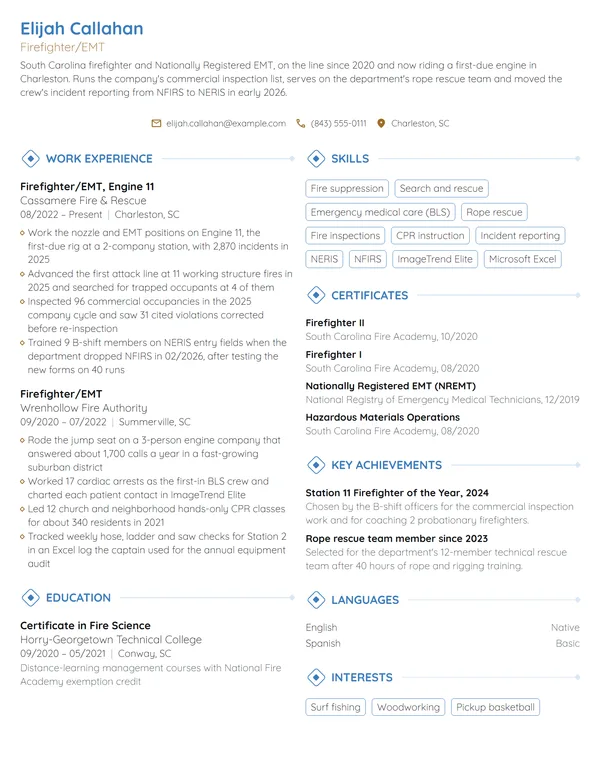
Here is how a firefighter with 5 years on an engine company wrote it up. The first bullet sets the station's scale, and the ambulance job before it gets 2 lines because it explains where the EMS experience came from.
Work Experience
- Respond on an engine company that ran 3,150 calls in 2025, about 68% of them medical, including 14 working structure fires.
- Completed 214 company fire inspections in 2025 and wrote 41 pre-incident plans for commercial buildings in the first-due area.
- Installed 380 smoke alarms across 6 neighborhoods during the district's 2024 home safety canvass.
- Treated and transported about 9 patients per 12-hour shift on 1 of the company's 2 contract units.
- Kept the unit's patient care reports complete on the shift they were written, with 0 returned for corrections in 2020.
Don't
Responded to emergency calls.
Do
Responded to 1,240 calls in 2025 on a 4-person engine company, 71% of them EMS, including 19 working fires.
Run volume and the EMS share tell a panel how busy your station is and how much patient care you see.
Don't
Responsible for maintaining equipment.
Do
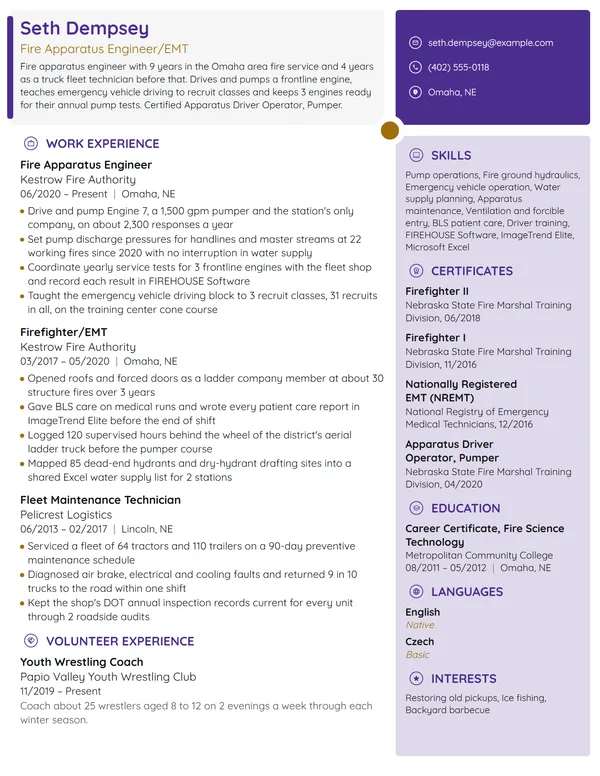
Ran daily checks on 2 engines and 28 SCBA packs and pulled 6 packs with failed regulators from service before they reached a fire in 2025.
Firefighter skills and software for your resume
Choose 6 to 8 hard skills for your resume from the job posting that your bullets already prove. Fireground skills and EMS skills belong on nearly every firefighter resume; technical rescue, pump operation or hazmat only where you hold the training.
Hard skills for firefighters
- Fire suppression and hose line advancement
- Search and rescue
- Ladder operations and ventilation
- Forcible entry
- Pump operation and hydraulics
- Emergency medical care (BLS or ALS)
- SCBA use and maintenance
- Vehicle extrication
- Hazardous materials operations
- Fire inspection and pre-incident planning
Soft skills fire officers value
- Calm decisions under pressure
- Teamwork in a crew
- Clear radio communication
- Compassion with patients and families
- Physical and mental stamina
- Following the chain of command
Software matters more than most applicants expect, because every call ends in a report. O*NET flags Microsoft Office, Excel, Word, Outlook and Access as hot technology for firefighters, and lists fire incident reporting systems, FIREHOUSE Software, GIS and incident command software. Federal reporting changed in 2026: the USFA set the end of January 2026 as the final date for NFIRS and moved reporting to NERIS, so name the system your department used in each year and the records software from the posting if you have worked in it.
Firefighter I and II, EMT and other firefighter certifications
List certifications on your resume in their own Certificates section, with the issuer and the month and year, because they are usually the first minimum qualification checked. Firefighter I and II are issued by your state's fire training agency to the NFPA professional qualification standards; since the 2024 edition, NFPA 1010 combines the old firefighter (1001) and driver/operator (1002) standards. EMT and paramedic requirements vary by city and state, the BLS says, so write your EMS level exactly as the posting does, whether it asks for a state license or National Registry certification.
| Credential | Issued by | What to know |
|---|---|---|
| Firefighter I and Firefighter II | Your state fire training agency, accredited by the Pro Board or IFSAC | Certified to the NFPA professional qualification standards; Firefighter II builds on Firefighter I. |
| Fire Apparatus Driver/Operator (Pumper, Aerial) | Your state fire training agency | Now part of NFPA 1010 (2024), which absorbed NFPA 1002. Key for engineer roles. |
| Hazardous Materials Awareness and Operations | Your state fire training agency | Written to NFPA 470 (2022), which combined NFPA 472, 473 and 1072. |
| Nationally Registered EMT (NREMT) or Paramedic | National Registry of Emergency Medical Technicians, plus your state EMS license | National Registry certification renews every 2 years and expires on March 31. |
| IS-100.C, IS-200.C and IS-700.B | FEMA Emergency Management Institute | Online courses in the Incident Command System and NIMS; list them on 1 line. |
How to list a CPAT pass or an academy in progress
The Candidate Physical Ability Test (CPAT), from an IAFF and IAFC task force, is 8 events done in a 50 lb weighted vest against a pass/fail time of 10 minutes and 20 seconds, and departments may not rank candidates by their time. List it under Certificates as CPAT, passed, with the month and year, and never add your time. If you are still in the academy, write each certification with its expected date and the word scheduled, and drop the word once the card is issued.
Certificates
- Firefighter II, New Mexico Firefighters Training Academy, 02/2021
- Firefighter I, New Mexico Firefighters Training Academy, 02/2021
- Nationally Registered EMT (NREMT), National Registry of Emergency Medical Technicians, 05/2018; expires 03/2028
- Driver/Operator Pumper, New Mexico Firefighters Training Academy, 10/2024
- Hazardous Materials Operations, New Mexico Firefighters Training Academy, 02/2021
- Fire Officer I, New Mexico Firefighters Training Academy, scheduled 02/2027
Fire academy, fire science degree and education on a firefighter resume
The BLS says firefighters typically need a high school diploma and training in emergency medical services, and that most train at a fire academy run by the department or the state, which takes a few months. Apply the standard rules for listing education on a resume: your academy, any college degree and the high school diploma only if you have nothing beyond it, each with the school, city and date.
A college degree is not required to get hired, but it counts later. The BLS reports that many departments require a bachelor's degree, preferably in fire science, public administration or a related field, for promotion beyond battalion chief. A degree in another field still earns its line. Exercise science, nursing or a trade program supports your fitness, EMS or fireground skills, so name it plainly.
Education
Completed an EMT course in the final semester.
Entry-level, part-time and career-change firefighter resumes
Before your first firefighter job, use an entry-level resume layout: an objective, Certificates near the top, then every experience that shows you can do the work. After the academy, the BLS notes, firefighters usually complete a probationary period, so the panel is hiring for what you can learn as much as what you know. Give each item below a number.
- Fire academy: its length in weeks, the certifications it led to and any class role, such as squad leader.
- EMT clinical and ride-along hours: shifts completed and patient contacts.
- Volunteer or Explorer service: years, calls answered and drills attended, listed under Volunteer Experience.
- Physical and written tests: CPAT passed with its month and year, under Certificates.
- Trades, driving or lifeguard work: the skills a crew uses, such as tools, heavy vehicles or water rescue.
Don't
Motivated individual seeking a firefighter position to serve my community.
Do
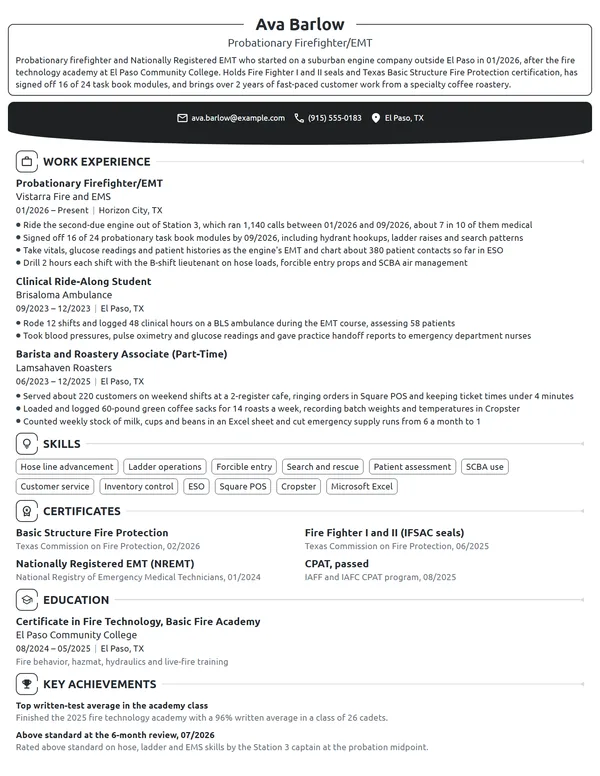
Firefighter I and II graduate of a 20-week academy and NREMT-certified EMT seeking a probationary firefighter role. Passed the CPAT in 08/2026 after 3 years in a fire department Explorer post.
An objective still needs proof: the academy, the EMS level and the physical test.
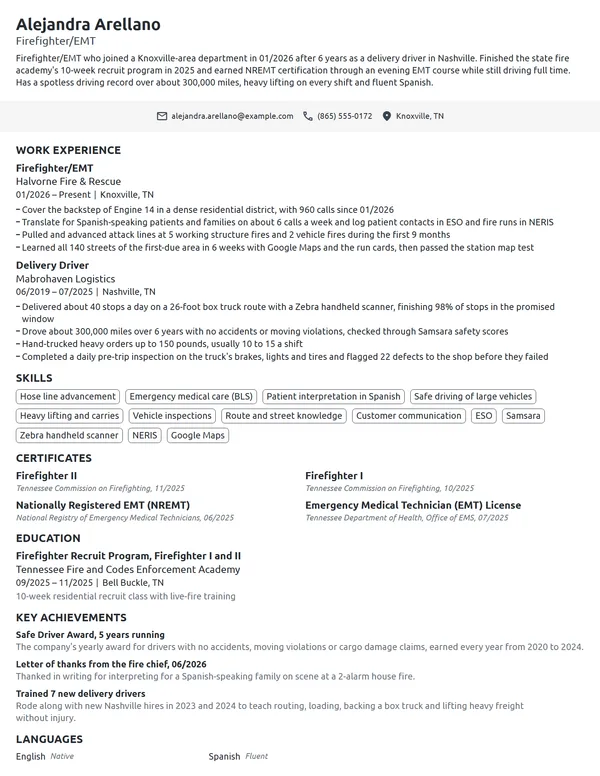
Part-time, paid-on-call and volunteer firefighting is firefighting: the BLS says volunteers make up the largest share of firefighters nationwide and share the same duties as paid ones. Give it a Work Experience entry with your title, the department and the same counts a career job would carry. If you are moving from another field, such as delivery driving, construction or the military, a career-change resume works best when the first bullets of your current job show the parts firefighting uses: a clean driving record, heavy lifting, tools or emergency care. Keep the reason for the switch for your letter, where the firefighter cover letter examples show how to explain it in a short paragraph.
Firefighter resume FAQ
Should I put my EMT certification on a firefighter resume?
Yes. The BLS counts treating sick or injured people among a firefighter's core duties, and EMT requirements vary by city and state, so a panel looks for your level first. Put it under Certificates with the level, the issuer and the date, such as Nationally Registered EMT with its expiration month, and name your EMS level in your headline.
How do I list a CPAT pass on my resume?
List it under Certificates as CPAT, passed, with the month and year you passed. Leave your time off, since the test is pass or fail and departments may not rank candidates by completion time. If a department wants a recent pass, check its window before you apply.
Can I list Firefighter I and II before the academy ends?
Only as scheduled. Write each certification with the month you expect it and the word scheduled after the date, and mention the academy and its end date in your objective. Remove the word once your state training agency issues the card.
How long should a firefighter resume be?
One page for nearly every firefighter, from academy graduates to engineers with 10 years on the job. Officers and firefighters with many specialty certifications, such as technical rescue or instructor cards, can use 2 pages if the current department sits on page 1.
How do I list volunteer or part-time firefighting on a resume?
Treat it as a firefighter job. Give it its own Work Experience entry with your title, such as Volunteer Firefighter or Part-Time Firefighter, the department, the city and the dates, then add the calls you answered, the drills you attended and the certifications you earned there.
How do I write a firefighter resume with no fire experience?
Lead with your training and tests. Open with an objective, list your academy, EMT and CPAT under Certificates, and then describe jobs that used the same skills, such as driving large vehicles, construction, lifeguarding or patient care, each with a number.
Should I list my driver's license on a firefighter resume?
Only when the job ad names it or you hold a commercial license. The BLS says applicants typically need a valid driver's license, so most panels assume it. A CDL goes under Certificates; a clean record from a driving job goes in your bullets.
How do I show 24-hour shifts on a firefighter resume?
Leave the schedule out and count what happens on it. The BLS describes firefighters who may work 24-hour shifts followed by 48 or 72 hours off, which every panel already knows. Write calls per shift or per year, and name your company, such as Engine 4, in the title line.
Should I mention NFIRS or NERIS on my resume?
Yes, if you wrote incident reports. Name the system you used in each job: NFIRS for reports filed through 01/2026, when the USFA retired it, and NERIS after that. Add your department's records software by name if the posting lists it.
What is the average firefighter salary?
The BLS reports that the median annual wage for firefighters was $59,280 in May 2025. Pay varies by department, overtime and rank, so leave salary off your resume and discuss it only when the department asks.
Next steps
Choose the firefighter resume that matches your rank and your route into the fire service, then replace its figures with your own run volume, inspections, training hours and certification dates. Our resume builder and resume templates give you a clean starting layout, and the posting's minimum qualifications make a final checklist before you submit.