
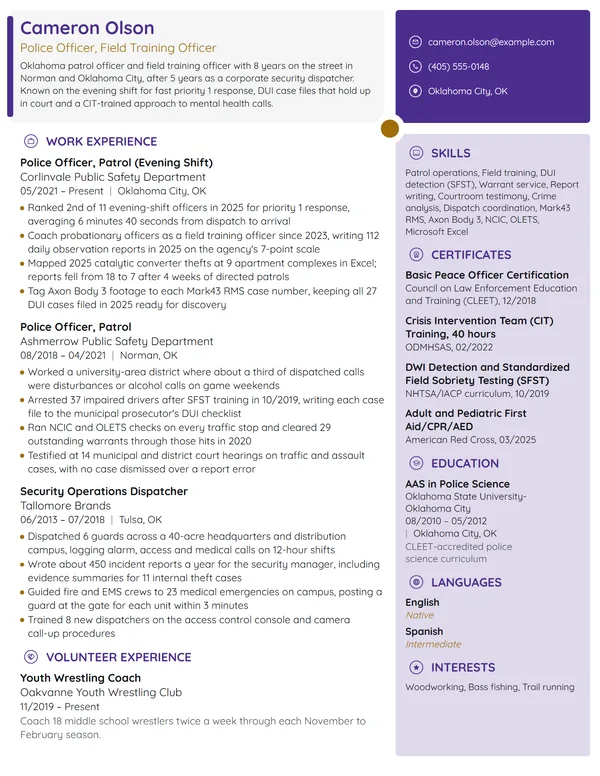
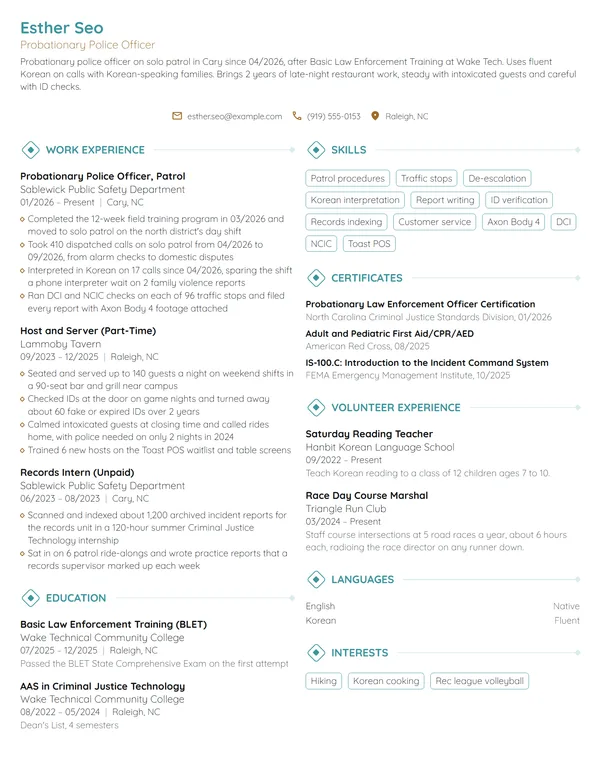
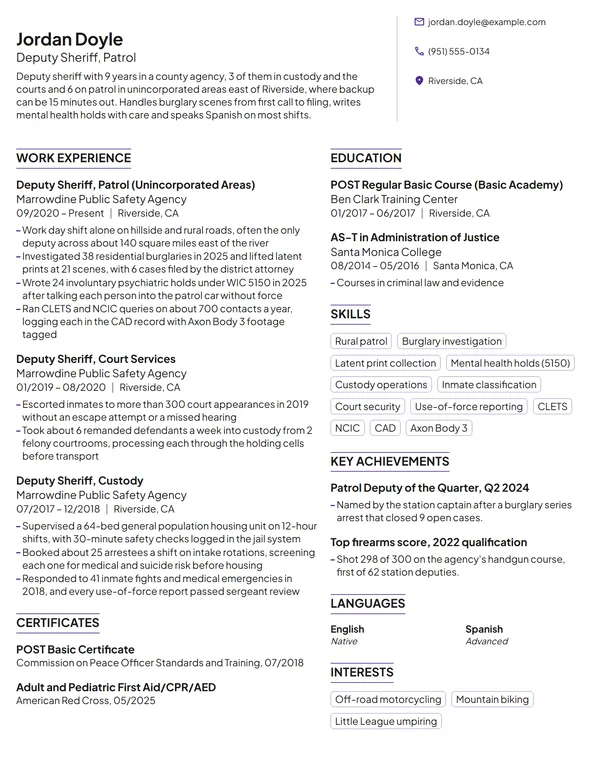
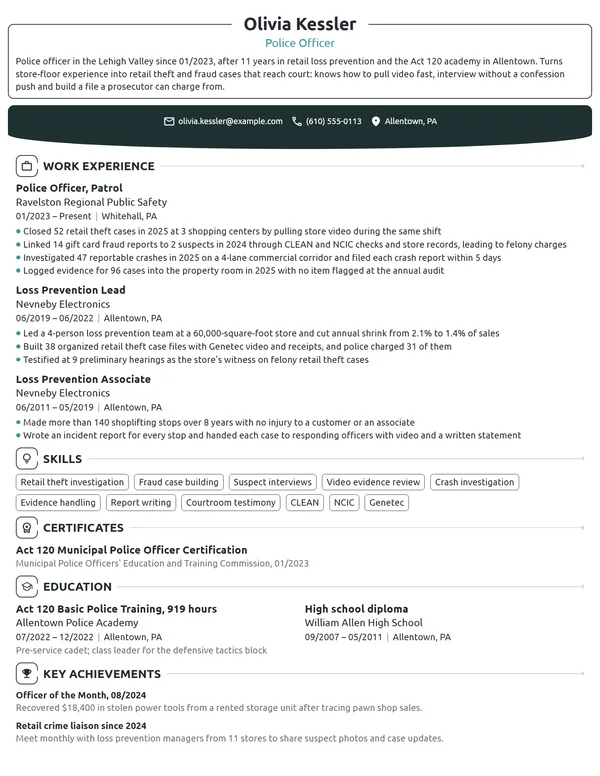
Few employers check an applicant as closely as a police department does, so every line on your resume has to hold up. Hiring boards look for your academy and license status, the calls and cases you have handled, how well you write and how you treat people under pressure. Good judgment is the heart of the job, yet it seldom shows in a list of duties. Plain facts and a few careful numbers can show it.
How to Write a Police Officer Resume - Key Takeaways
- Lay it out in reverse-chronological order on 1 page; a second page fits once you have 10+ years, specialty assignments or a supervisory rank.
- Write your rank and assignment in each job title line, such as Police Officer, Patrol (Night Shift).
- Give bullets a number your sergeant already tracks: calls a shift, reports written, DWI arrests, warrants served or crisis calls resolved.
- List your peace officer license first under Certificates, with your state's POST board, and write license eligible if you are not yet hired.
- Spell out SFST, ARIDE, CIT and similar training once, with the month and the hours.
- Test the file with an ATS resume checker before you upload it to a city or county hiring portal.
What police departments look for in a police officer resume
A police resume is usually read by a recruiter or civil service analyst first, then by the oral board and a background investigator. They want to know whether you can take calls safely on day 1, write a report a prosecutor can use, and stay calm with people on their worst day. The BLS duties for the job include responding to emergency and nonemergency calls, conducting traffic stops, writing detailed reports and testifying in court. O*NET adds recording facts to prepare reports and identifying, pursuing and arresting suspects.
Put these sections on the page, using headings a hiring portal can sort:
- Name, headline (for example, Police Officer, Field Training Officer) and contact details
- A 2 to 3 line opening summary or objective, which needs no heading
- Work Experience, current agency first, with rank and assignment in each title
- Certificates: the peace officer license first, then training such as SFST or CIT
- Skills, with the dispatch and records systems you used
- Education, including the academy or skills program
- Optional: Key Achievements, Volunteer Experience or Languages
Best format for a police officer resume
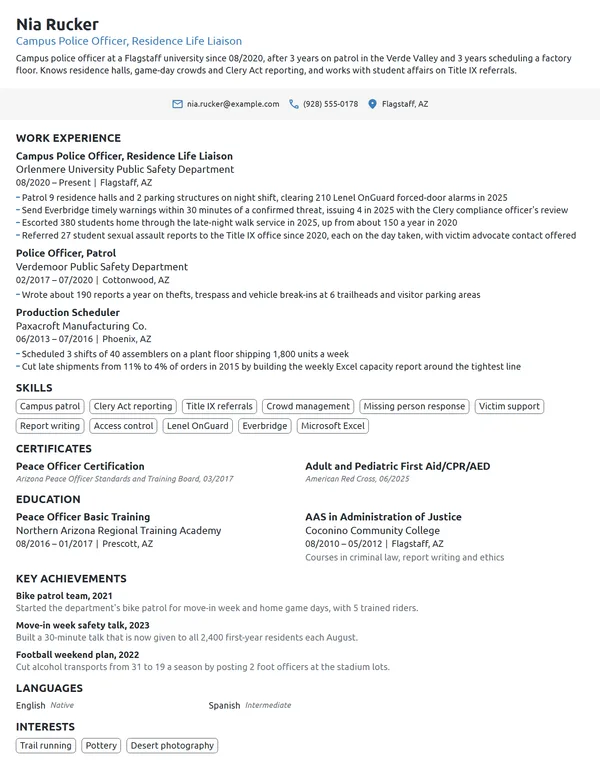
Use the reverse-chronological resume format: your current agency first, then each earlier one, with rank, assignment, location and dates in MM/YYYY. Departments read a police career as a ladder of assignments, from recruit to patrol to field training, investigations or a specialty unit, and this order lets them see the climb. If you moved between assignments inside one agency, give each assignment its own title line and dates.
- Best for most police officersReverse-chronologicalYour jobs, newest first, with your results under each one.Best for: A steady work history in your field
- FunctionalSkills grouped up top, with a short work history below.Best for: Gaps or very little experience
- CombinationA skills section first, then your full work history.Best for: A career change with strong skills
Hold it to 1 page through your first 10 years. Two pages suit officers with specialty units, supervisory rank or instructor roles, as long as page 1 carries your license, your current assignment and your strongest training.
| Setting | What to use |
|---|---|
| Length | 1 page; 2 once you hold rank or several specialty assignments |
| Dates | MM/YYYY for jobs and training, with Present on your current post |
| Job title line | Rank plus assignment: Police Officer, Traffic Unit |
| Training | Course name spelled out, month and hours |
| Photo and private data | No photo on a police application in the US or Canada; leave off date of birth, marital status and SSN too |
| File type | PDF, unless the city or county portal asks for Word |
Most US and Canadian resumes carry no photo, and a police application is no place to add one: the department meets you at the physical test and the oral board. Many cities and counties take applications through a civil service portal that copies your file into its own fields, so plain headings and clear MM/YYYY dates travel better than graphics or text boxes.
Police officer resume summary vs. objective
Use one test: if you have worked as a sworn officer, write a resume summary with your years, the size of your jurisdiction, your shift or unit and 1 result. If you are a recruit, a cadet or coming from another career, write a resume objective that names the position you want, your license or academy status and the experience closest to patrol. Write it last, and take its number from a bullet below it.
Police officer resume summary formula
Rank with X years in type of jurisdiction and shift or unit. 1 measured result. Training or role you hold, such as FTO, CIT or SFST.
Example
Police officer with 7 years in 2 Minnesota cities, on night patrol since 2022. Led a 2025 crash reduction detail at 3 intersections that cut injury crashes from 19 to 11. Field training officer, CIT-trained and SFST-certified.
Don't
Dedicated law enforcement professional committed to serving and protecting the community with integrity.
Do
Patrol officer with 5 years in a city of 70,000, trained in crisis intervention and impaired driving detection. Took 30+ impaired drivers off the road last year and field-trained 2 recruits.
Every officer claims integrity; the second version shows the jurisdiction, the training and what came of it.
How to write police officer work experience bullets with numbers
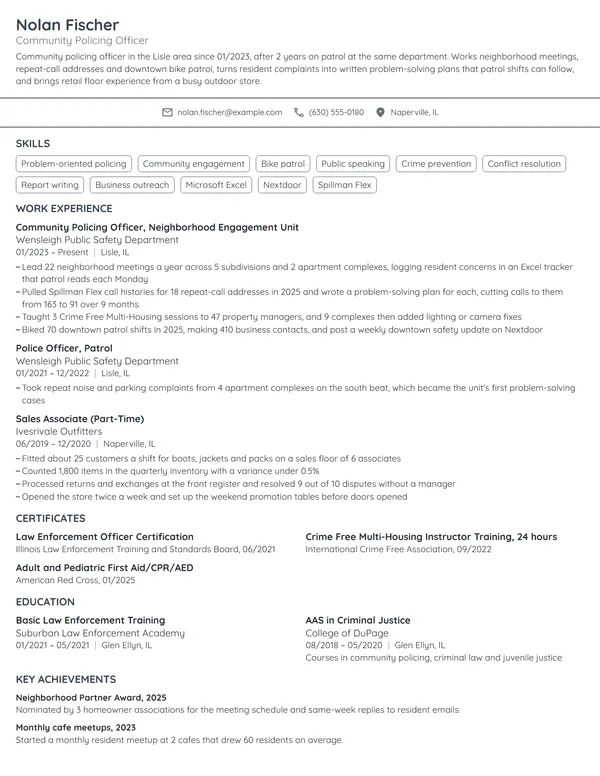
Give your current post 3 to 4 bullets and older ones 1 to 3. Open with the area you cover and your usual call load, because every other number reads against it. Then add results a supervisor already counts in your evaluations, and write each as one of your achievements on your resume rather than a duty: reports, arrests, warrants, crisis calls, crashes or recruits trained.
| Area | What to count | Example bullet |
|---|---|---|
| Calls for service | Calls a shift, priority calls, squad size | Answered an average of 13 calls a shift on a 4-officer evening squad. |
| Reports and cases | Reports a year, turnaround, cases charged | Wrote 260 incident reports in 2025 with a 2-day average turnaround to records. |
| Traffic safety | Crashes, speeds, DWI arrests, citations | Ran a 6-week speed detail in 2 school zones that brought average speeds from 34 to 27 mph. |
| Warrants and arrests | Warrants served, arrests, felony cases | Served 58 outstanding warrants in 2025 as the squad's warrant officer. |
| Crisis response | Mental health calls, referrals, use-of-force reviews | Handled 75 mental health calls in 2025 as a CIT officer, 61 of them closed with a referral instead of an arrest. |
| Community work | Meetings, programs, residents reached | Taught a 5-week citizens academy for 22 residents with the department's crime prevention unit. |
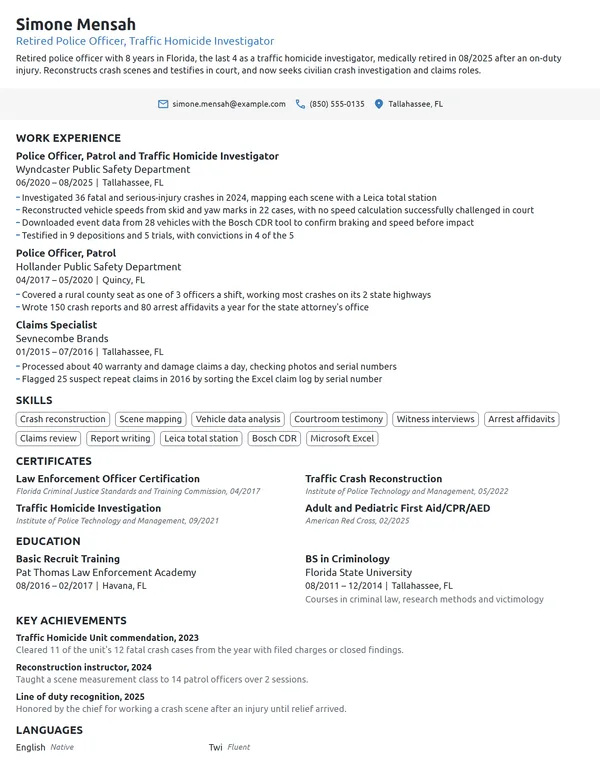
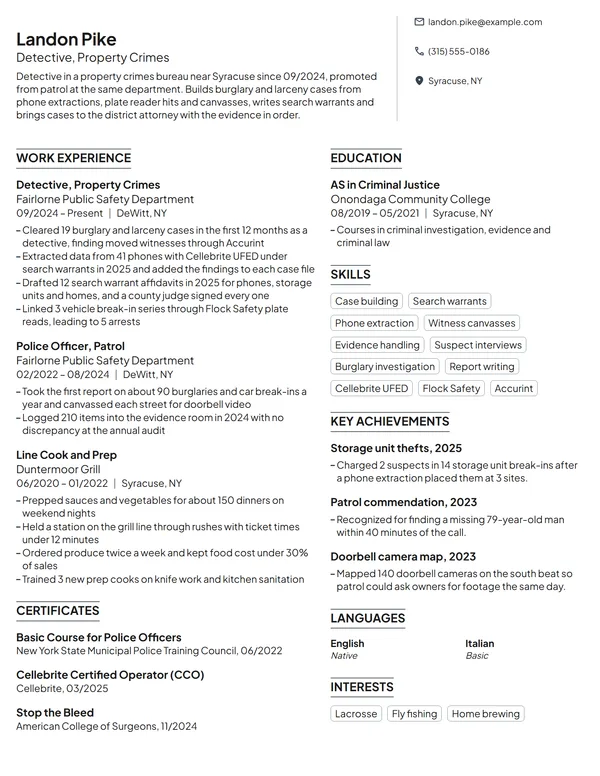
This officer's entry puts the district and call load up top, follows with counted results, and gives the earlier agency a single bullet.
Work Experience
- Patrol a 9-square-mile district on 10-hour night shifts, answering about 12 calls a shift, roughly 1 in 4 of them priority 1.
- Made 42 DWI arrests in 2025 using standardized field sobriety tests; 39 led to charges.
- Field-trained 3 recruits since 2024; all 3 cleared for solo patrol on schedule.
- Wrote 310 incident and arrest reports in 2025, none returned by the county attorney's office for missing elements.
- Covered 4 beats for a city of about 20,000, answering about 9 calls a shift on rotating days and evenings.
Don't
Patrolled assigned area and responded to calls for service.
Do
Patrolled a 6-beat downtown sector on day shift, answering about 10 calls a shift, including an average of 2 priority 1 calls.
The rewrite gives the area, the shift and the load a sergeant compares against their own.
Don't
Responsible for writing reports.
Do
Wrote 280 incident reports in 2025 in the department's records system; under 3% came back from supervisor review for corrections.
Police officer skills and software for your resume
Pick 6 to 8 hard skills for your resume from the job posting, and keep only the ones a bullet proves. Report writing, de-escalation and traffic enforcement belong on nearly every patrol resume; add evidence collection, interviewing or a second language only when your bullets show you used them. BLS lists a foreign language as an asset in many regions, so add Spanish, Vietnamese or another language under Languages with your level.
Hard skills for police officers
- Report writing
- Patrol procedures
- Traffic enforcement and crash investigation
- DWI detection (SFST)
- De-escalation and crisis intervention
- Evidence collection and chain of custody
- Interviewing victims and witnesses
- Defensive tactics
- Firearms proficiency
- Courtroom testimony
Soft skills police supervisors value
- Judgment under stress
- Clear, calm communication
- Empathy with victims
- Discretion with private information
- Teamwork with other agencies
- Patience on long calls
Name the systems you worked in under Skills, then show one of them in a bullet. O*NET lists computer-aided dispatch and crime mapping software for patrol officers and flags Microsoft Office, Excel and Access as hot technologies. Write your records management system (RMS), mobile data terminal and body-worn camera platform by the names your agency used, since the hiring agency's posting may name the same ones.
POST license and police training on a resume
Every state licenses or certifies its officers through a Peace Officer Standards and Training (POST) board or a similar commission, and the board's name goes on your license line. In Minnesota, for example, the Board of Peace Officer Standards and Training requires a postsecondary degree and an approved Professional Peace Officer Education program before the licensing exam, and issues the license only when an agency hires you. List certifications on your resume under the license, each with its month and hours.
| Credential | Issued by | What it takes |
|---|---|---|
| Peace officer license or certification | Your state's POST board or commission | Academy or skills training and the state exam; requirements and the credential's name differ by state. |
| DWI Detection and Standardized Field Sobriety Testing (SFST) | NHTSA/IACP curriculum, taught by state programs | A classroom course that IACP's standards put at about 24 hours. |
| Advanced Roadside Impaired Driving Enforcement (ARIDE) | NHTSA, with IACP input | A 16-hour course that sits between SFST and drug recognition expert training. |
| Drug Recognition Expert (DRE) | IACP Drug Evaluation and Classification Program | A 16-hour pre-school, a 56-hour DRE school and field certification of about 40 to 60 hours. |
| Crisis Intervention Team (CIT) | Local CIT programs, on CIT International's Memphis Model | A 40-hour course run with mental health partners. |
| IS-100.C and IS-700.B | FEMA Emergency Management Institute | Online courses on the Incident Command System (2 hours) and NIMS (3.5 hours). |
How to list a POST license before you are hired
In states like Minnesota, passing the exam makes you license eligible rather than licensed. Write exactly that: Peace Officer License Eligible, the board, and the month you passed. St. Cloud State University's program page notes that the eligibility lasts 3 years after the exam, so a hiring board will check the date. Change the line to the issued license the month an agency swears you in.
Certificates
- Peace Officer License, Minnesota, Minnesota Board of Peace Officer Standards and Training, 09/2019
- Advanced Roadside Impaired Driving Enforcement (ARIDE), 16 hours, 11/2024
- Crisis Intervention Team (CIT) Training, 40 hours, 06/2023
- DWI Detection and Standardized Field Sobriety Testing (SFST), 24 hours, 03/2020
- IS-100.C and IS-700.B, FEMA Emergency Management Institute, 10/2019
How to list a criminal justice degree and the police academy
The BLS puts the usual entry education anywhere from high school graduation to a college degree, and most new officers then graduate from a training academy that covers state law, constitutional law, civil rights, ethics, patrol, traffic control and firearms. Some states set a higher bar: Minnesota requires a postsecondary degree before its licensing exam. Put the academy or skills program under Education with its graduation month, beside any degree.
Follow the usual order for listing education on a resume: degree, school, city and graduation date, newest first. A recruit can add a GPA of 3.0 or higher, academy class rank or an EMT or first responder course in 1 line under the entry; an officer with 5+ years can keep it to the degree and date.
Education
GPA 3.4. Peace officer licensure coursework; EMSRB-approved First Responder course.
Entry-level, military and career-change police officer resumes
Without sworn experience, your resume has to show that you are ready for the academy and for the background check that comes with it. Applicants usually must be at least 21, may face physical, written and polygraph tests, and a felony conviction or drug use may disqualify them, the BLS says, so every date and employer on your resume should match the background packet you file. The entry-level resume layout works if your work history is short. Evidence that carries weight:
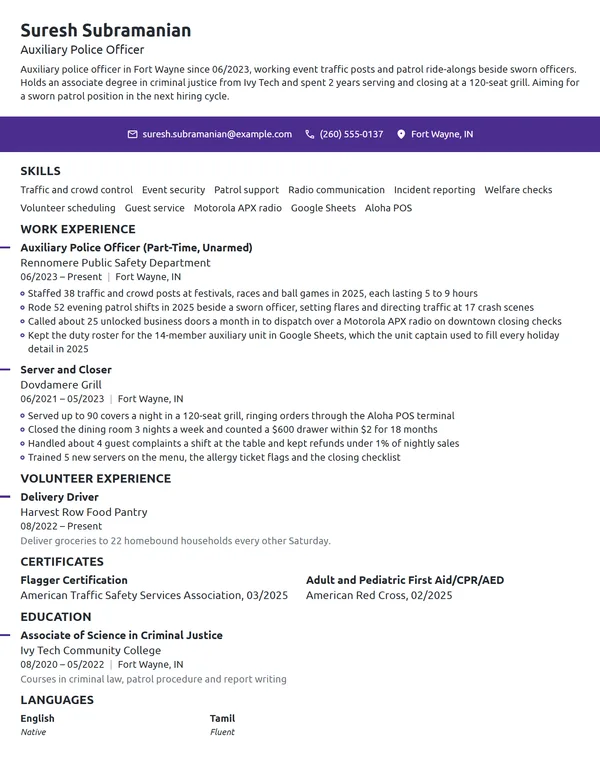
- Community service officer, cadet or Explorer work: the calls or events you handled, listed as a full Work Experience entry.
- Security, corrections or dispatch jobs: incidents a shift, reports written and any de-escalation training.
- Military service: your rating or MOS in plain words, the people you led and any military police or security forces duty.
- EMT, lifeguard or volunteer search and rescue: under Certificates or Volunteer Experience, with the hours or calls.
Don't
Motivated individual seeking a position in law enforcement where I can serve my community.
Do
License-eligible candidate (Minnesota POST exam passed 05/2026) seeking a patrol officer position. Finished POST skills training and 2 years as a community service officer, answering about 15 parking and animal calls a shift.
A recruit objective still needs a status, a date and a count.
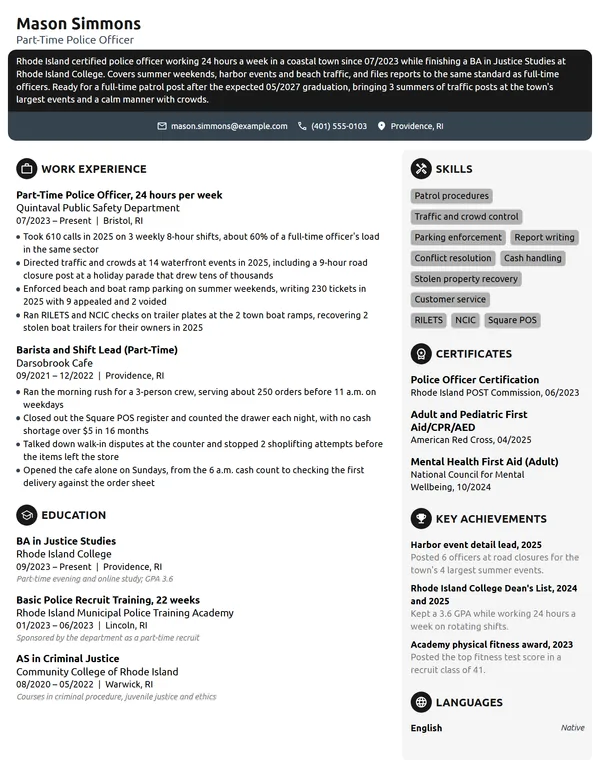
If you are changing careers into policing, or moving from part-time or reserve work to a full-time post, stay with newest-first order and put your academy and license status at the top of the page. Under earlier jobs, keep the bullets that carry over to patrol: conflict handled, reports written, emergencies managed or people supervised. Veterans can use the military-to-civilian resume layout, and the career-change resume examples cover a move from any other field. Say why you want this department in a short letter, using our law enforcement cover letter examples for the shape of that paragraph.
Police Officer resume FAQ
Should I put my POST certification or peace officer license on my resume?
Yes, first under Certificates. Write the credential as your state names it, the issuing board and the month it was issued or, if you are not yet hired, the month you became license eligible. Leave the license number off; the agency verifies it with the board.
How do I list police academy training on a resume?
Under Education, as its own entry: the academy or skills program, its city and your graduation month, with class rank or an award in 1 line if you have one. Courses you took later, such as SFST or CIT, go under Certificates with their hours.
How long should a police officer resume be?
1 page for recruits and most patrol officers. Move to 2 pages only with 10+ years, supervisory rank or several specialty assignments, and keep your license and current assignment on page 1.
Can I become a police officer without a college degree?
In many places, yes. BLS lists requirements from high school graduation up to a degree, and some federal agencies and departments ask for college coursework. Some states require more: Minnesota, for one, requires a postsecondary degree before its licensing exam.
How do I show military experience on a police officer resume?
Write each assignment as a Work Experience entry with your rank, unit type and dates, and translate the duties into civilian words: people supervised, patrols or security posts run, incidents reported. Name military police or security forces duty in the title line, since BLS mentions that military experience may help a cadet applicant.
Should I list my firearms qualification on a police resume?
Only as part of a bullet or a specialty role. Armed officers are expected to qualify, so a plain qualification line adds little; firearms instructor, armorer or a top score in your academy class is worth a line under Certificates or Key Achievements.
Should I mention my background check, polygraph or psychological exam?
No. Those steps belong to the hiring process, and the department runs its own. Your resume's job is to match the background packet: the same employers, titles and dates, with no gap you have not explained.
How do I write a resume for a promotion to sergeant?
Lead with supervision you already do: field training, acting sergeant shifts, squads you led on details and reviews you completed. Per the BLS, promotions to corporal and sergeant usually follow written exam scores along with performance, so the resume supports your exam score rather than replacing it.
What is the average police officer salary?
Police and sheriff's patrol officers earned a median of $76,210 a year in May 2025, per BLS wage data. Pay depends on your agency, state, rank and overtime, so check the department's posted pay scale and leave salary off the resume.
Next steps
Start from the example nearest your agency type and career stage, then replace its district, call load, license status and training with your own. Our resume builder and templates give you a clean layout to work in, and a short letter naming the department and assignment you want completes the application.