
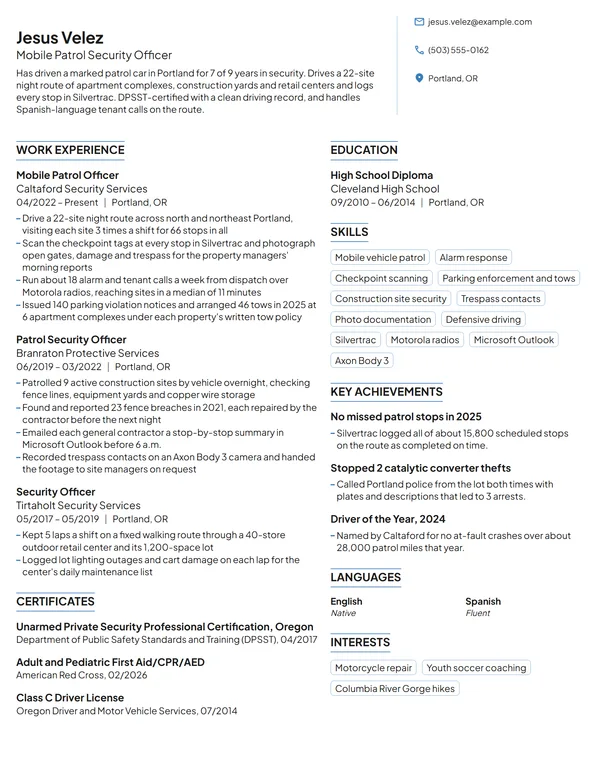
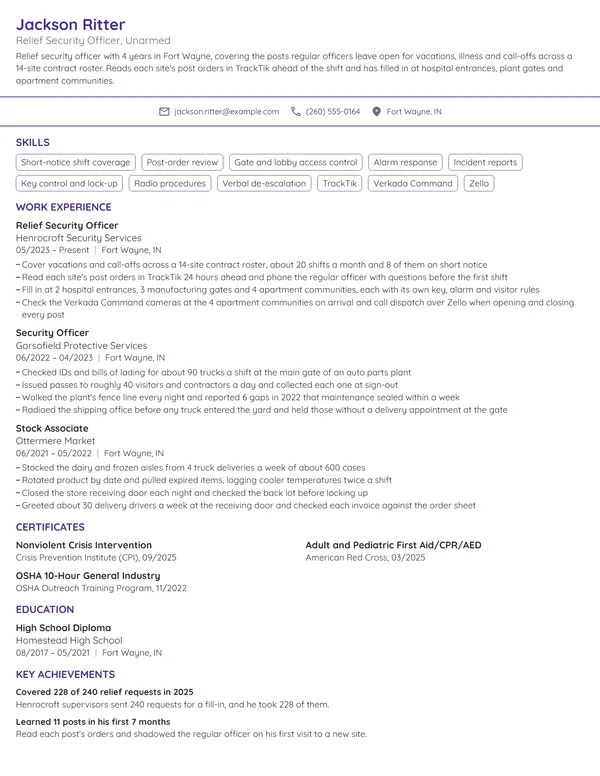
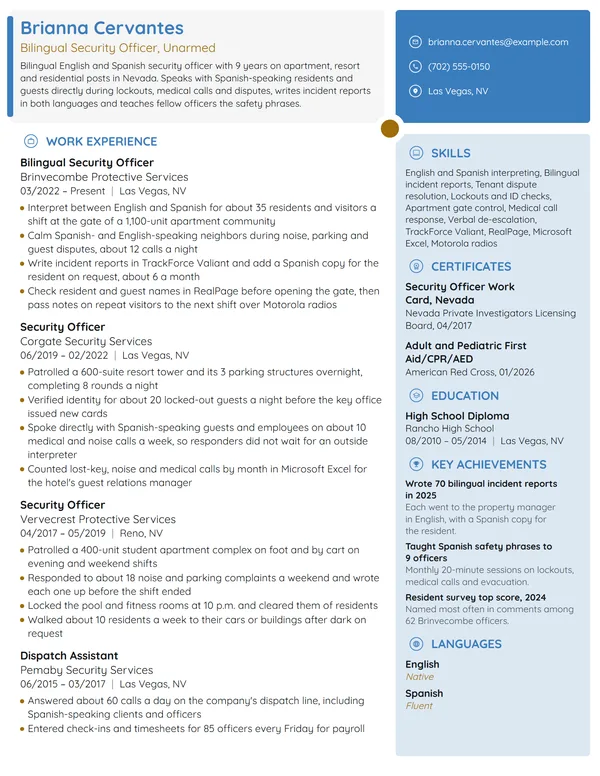
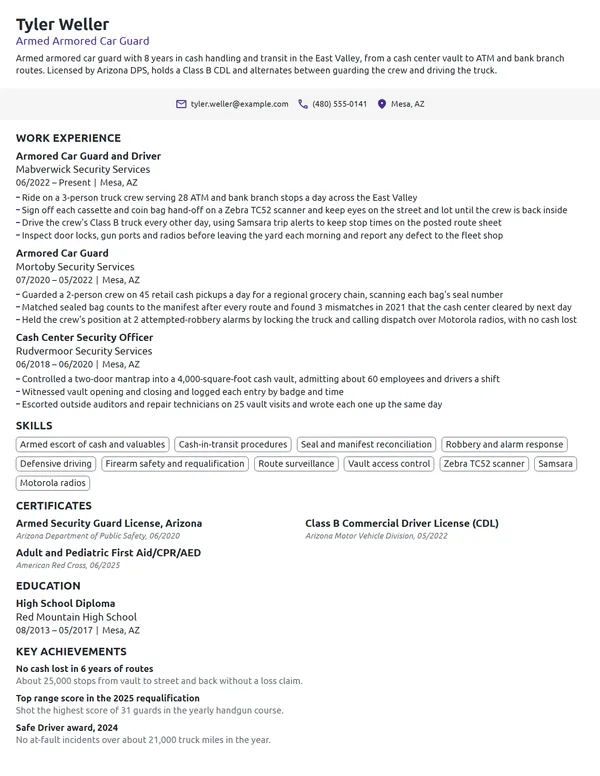
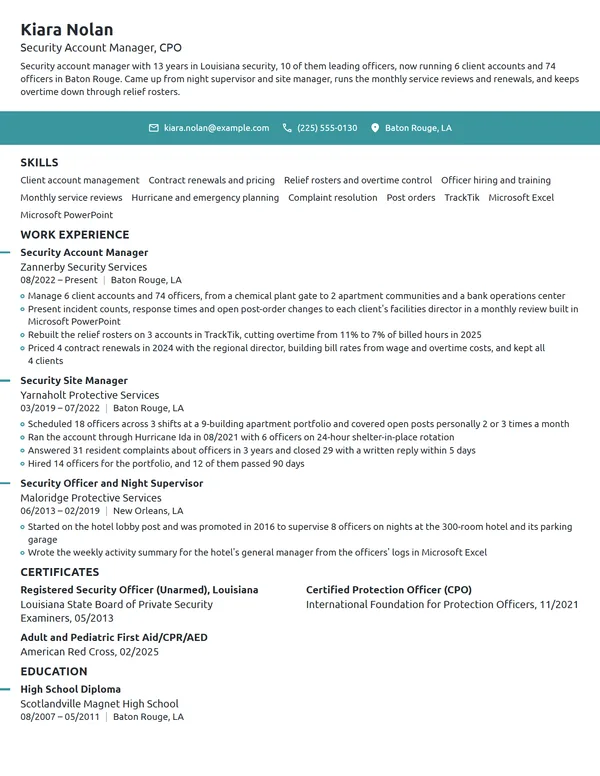
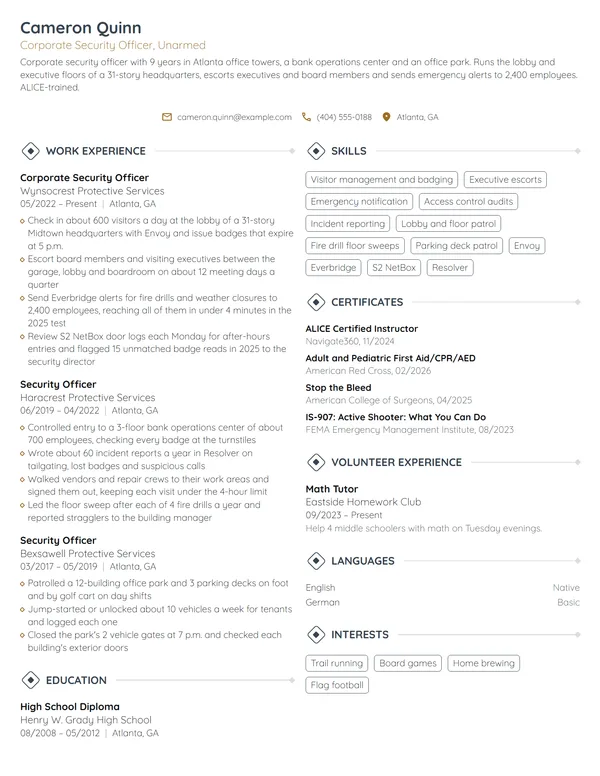
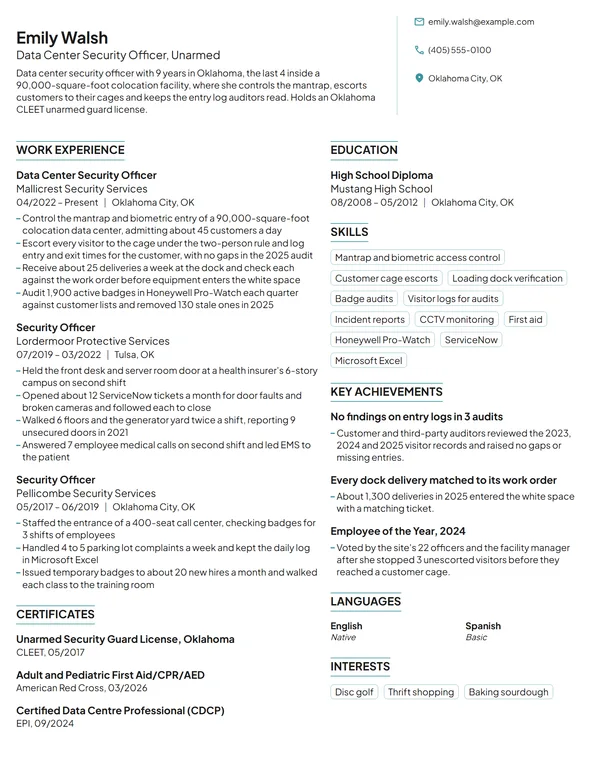
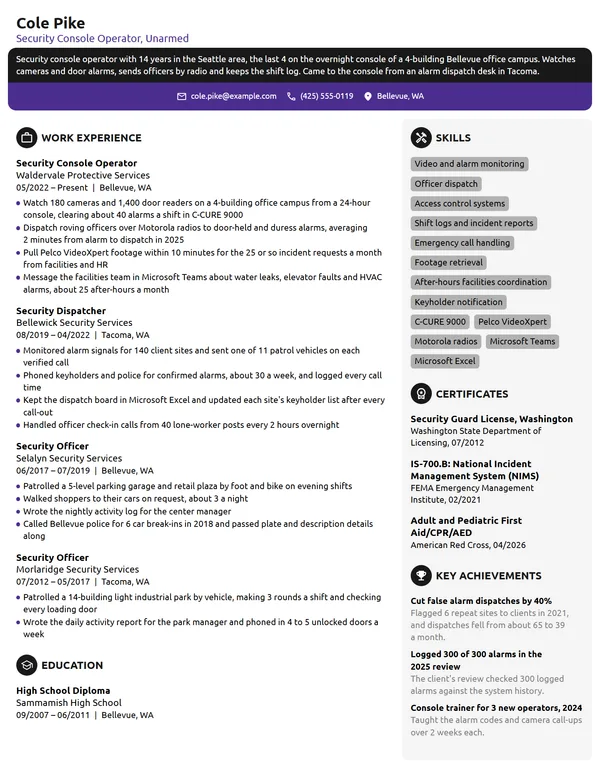
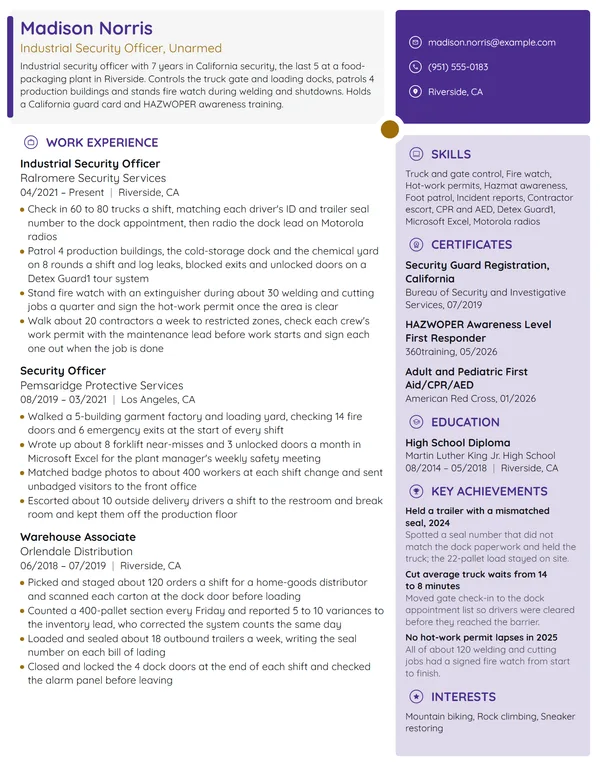
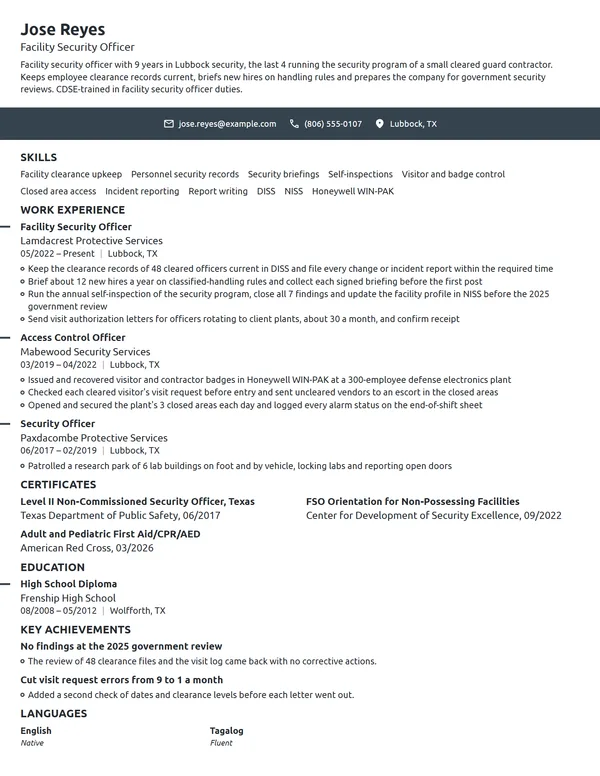
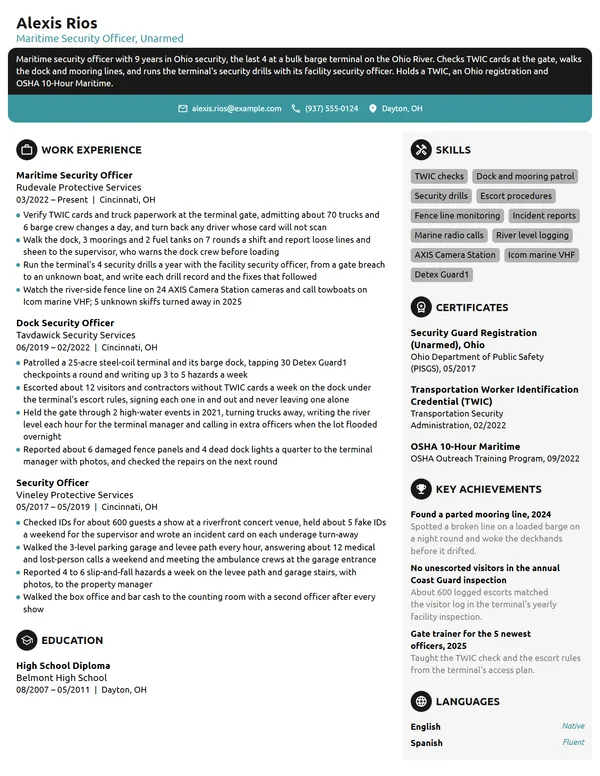
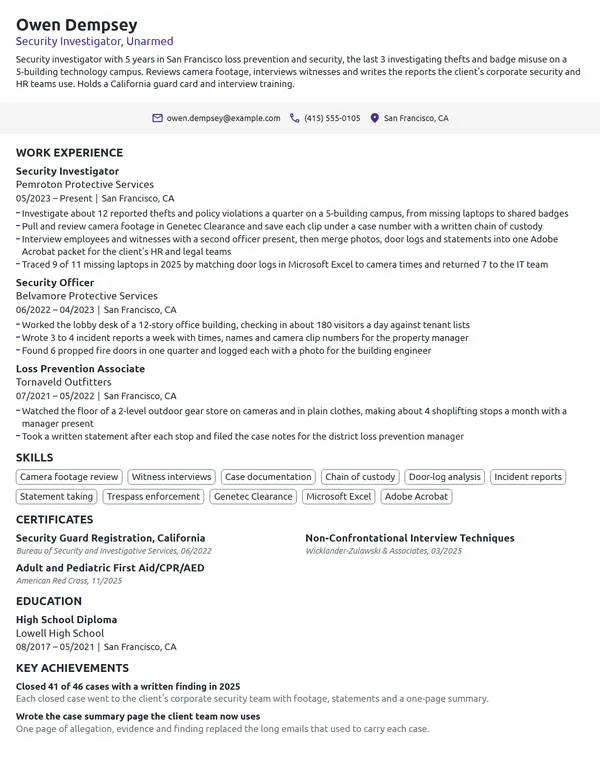
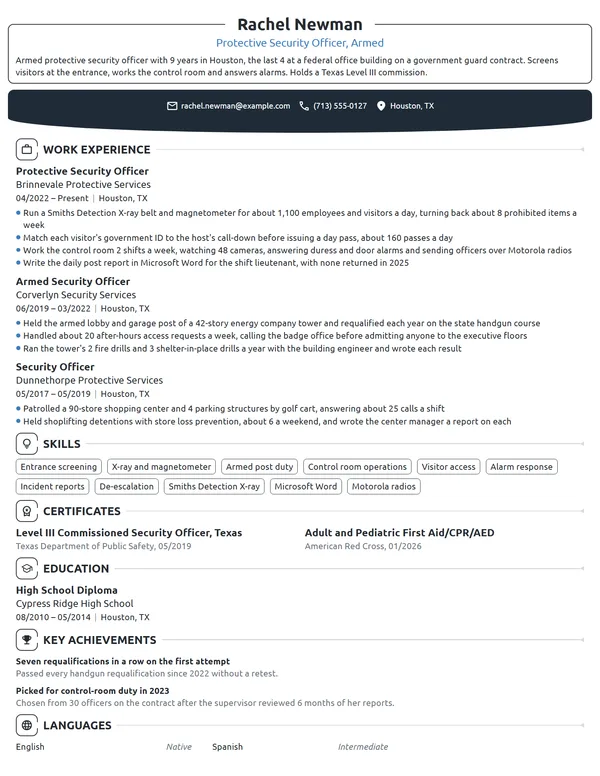
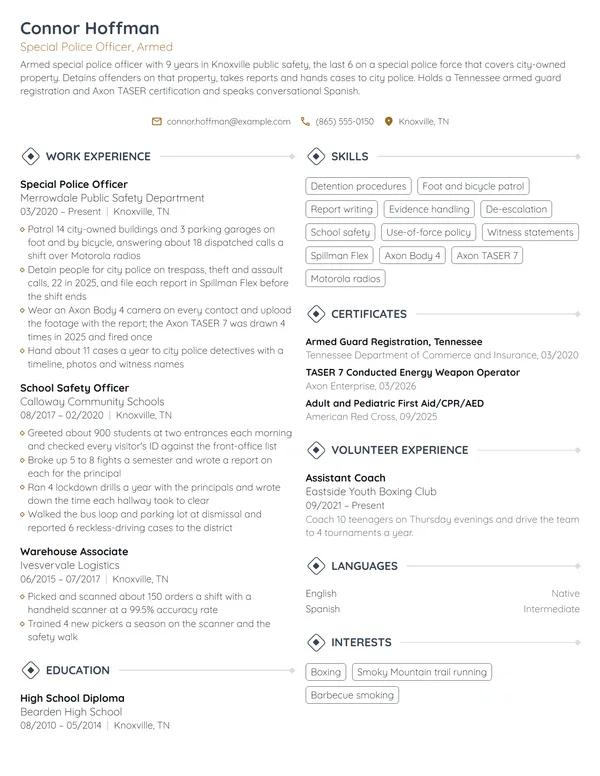
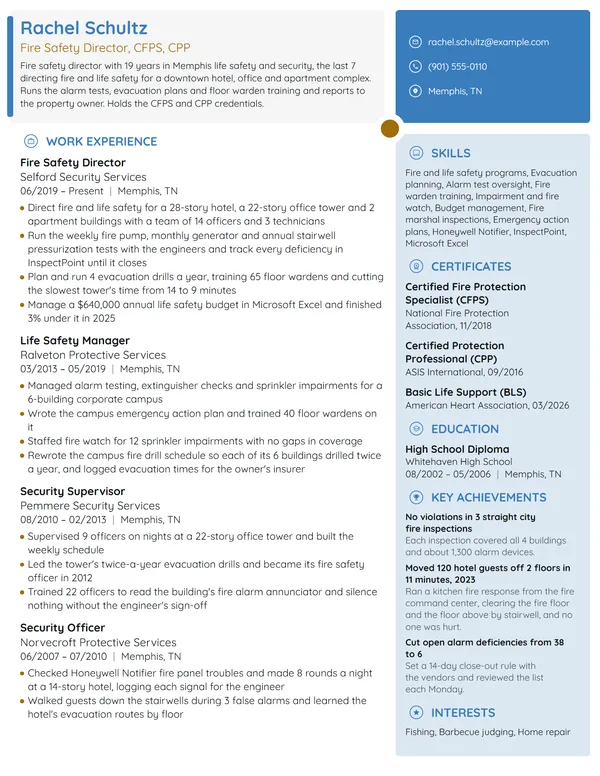
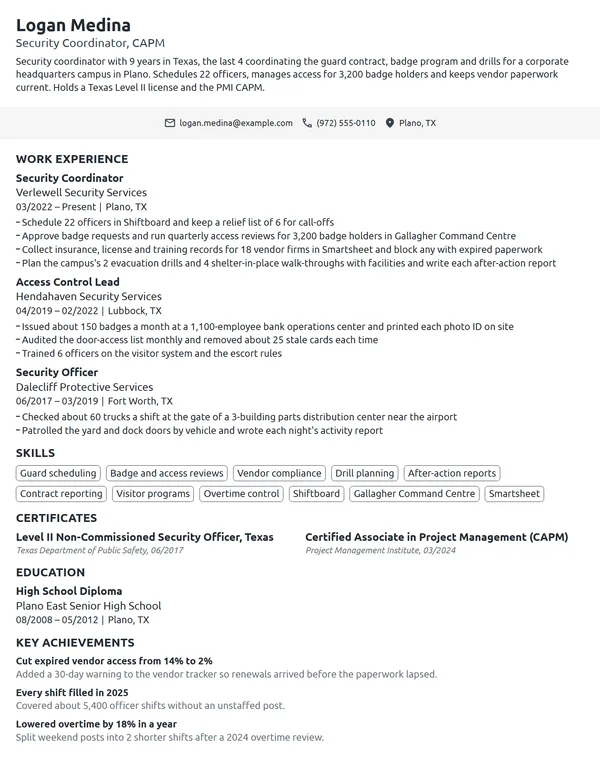
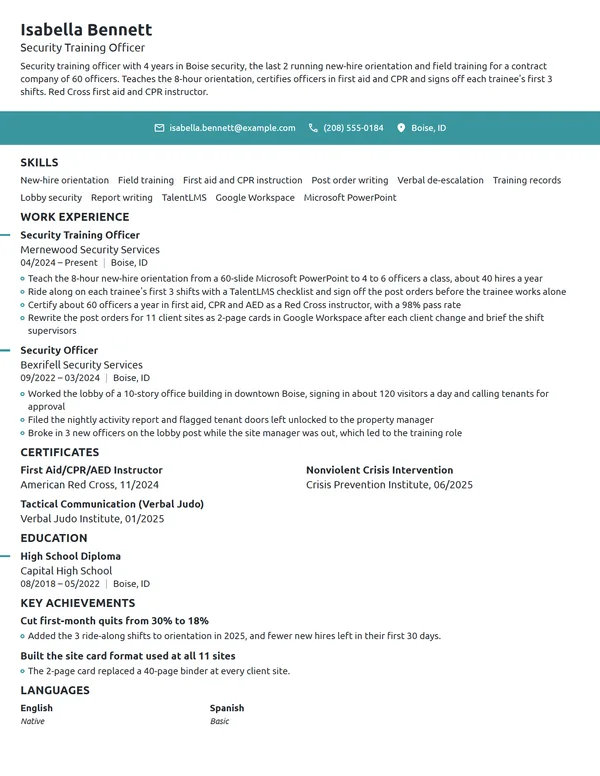
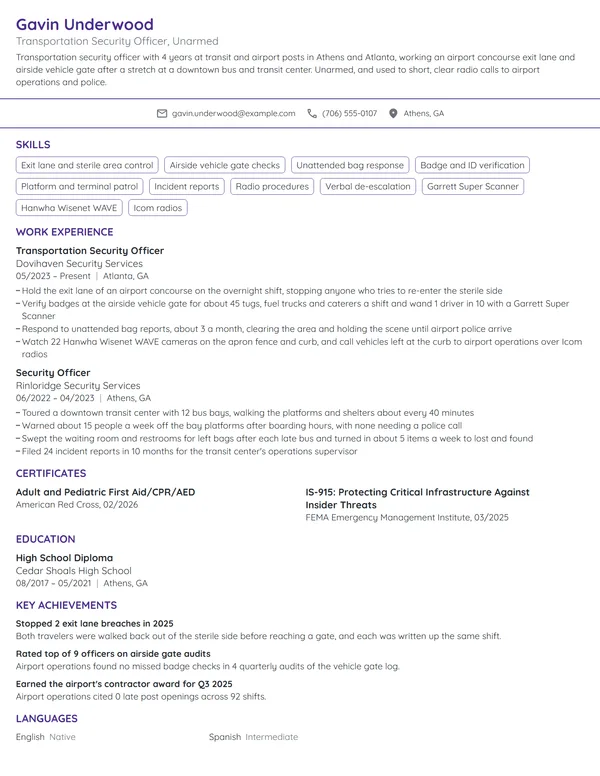
Security work comes down to trust: employers need officers who show up, stay alert and keep calm when trouble starts. They check for a current state license and experience in settings like theirs, such as hospitals, campuses or office buildings, plus signs that you can handle upset people and write clear reports. A plain task list rarely stands out. Naming each site and counting your work, from visitors checked in to incidents reported, does.
How to Write a Security Officer Resume - Key Takeaways
- Lay it out newest job first on 1 page; a second page fits only after 10+ years or a move into supervision.
- Name the setting in every entry, such as hospital, campus, office tower or hotel, because employers hire for settings like their own.
- Back each bullet with a count your supervisor already logs: visitors, rounds, calls, reports, escorts or officers trained.
- Put your state license at the top of Certificates under its official name, with the issuing agency and the date.
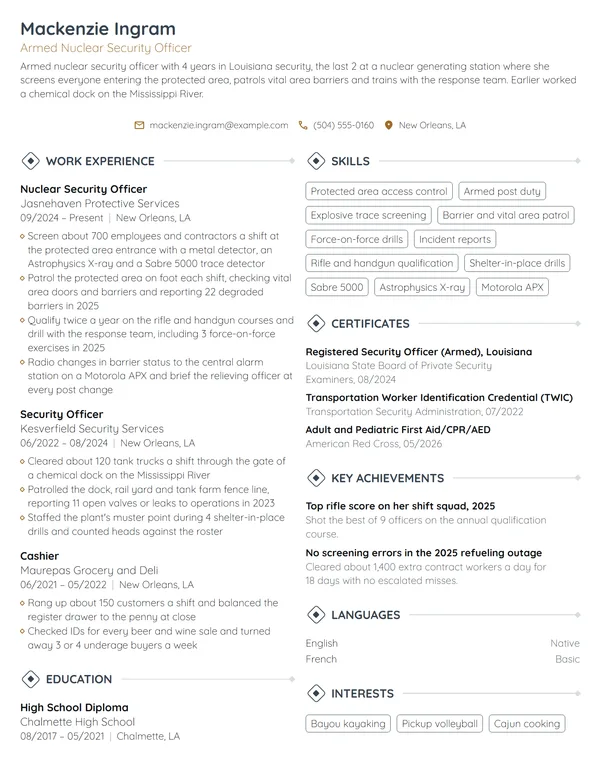
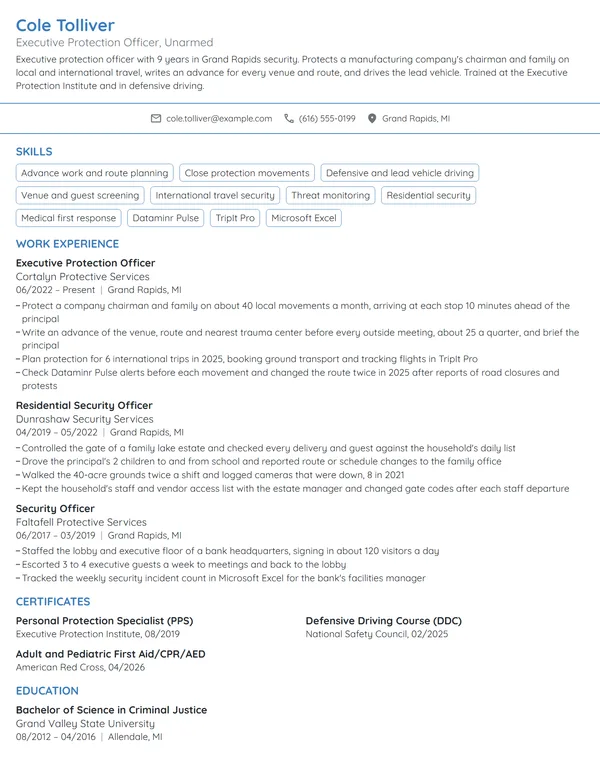
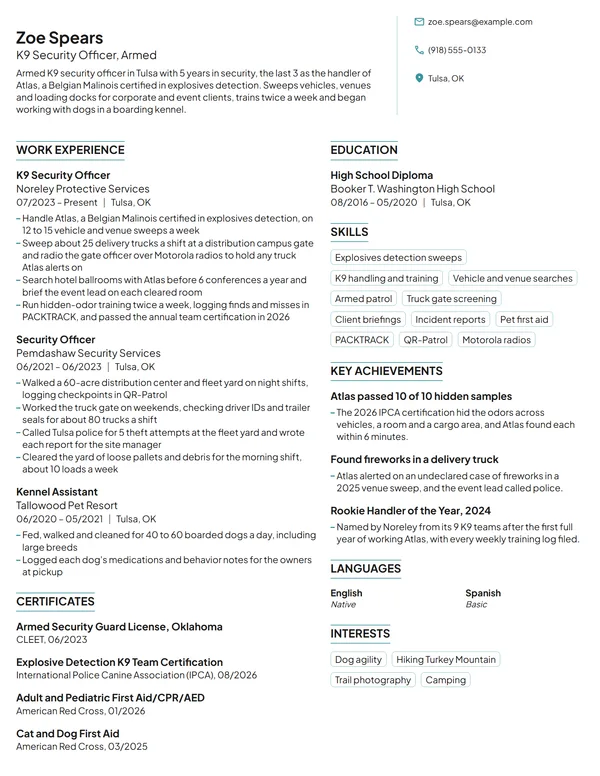
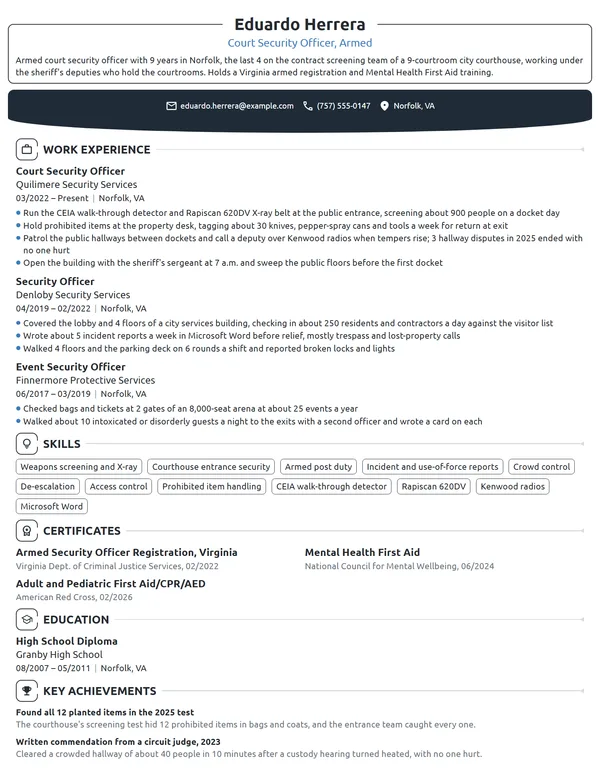
- State armed or unarmed in your headline or on the license line, and list any firearm permit as its own line.
- Before you apply, test the file with an ATS resume checker, since many employers screen applications for license and certification terms.
What security supervisors look for in a security officer resume
A security supervisor reads your resume for 3 things: a license that lets you start, experience in a setting like theirs, and signs that you keep your head with people and paperwork. In the BLS description, officers patrol property, respond to emergencies, control who enters a building and write reports on what they saw. O*NET adds circulating among visitors and employees to keep order and warning people about rule violations.
The BLS also names the ability to deal with confrontational situations and calm them down as a key quality. A resume can show that only through results. Plan your page with these sections:
- Name, headline (for example, Unarmed Security Officer, CPO) and contact details
- A 2- to 3-line summary under the headline, written without a section title
- Work Experience, current post first, with the setting named in each entry
- Certificates: state license on top, then first aid, CPR and security training
- Skills, with the badge, camera and report systems you know
- Education
- Optional: Key Achievements (or Volunteer Experience instead) and Languages
Best format for a security officer resume
Pick the reverse-chronological resume format: your current job on top, then each earlier one with the title, employer, location and month and year. Officers move up by post and responsibility, from a fixed desk to rover, lead officer and shift supervisor, and newest-first order makes each step easy to follow. A contract officer who rotated through client sites keeps 1 entry for the firm and names the sites inside it.
- Best for most security officersReverse-chronologicalYour jobs, newest first, with your results under each one.Best for: A steady work history in your field
- FunctionalSkills grouped up top, with a short work history below.Best for: Gaps or very little experience
- CombinationA skills section first, then your full work history.Best for: A career change with strong skills
Hold the page count to 1 unless you have 10+ years, supervision or investigations work to show. A security manager responsible for several sites, a schedule and a budget can run to 2 pages, with the license and current role kept near the top of page 1.
| Setting | What to use |
|---|---|
| Length | 1 page; 2 after 10+ years or with supervisory roles |
| Dates | Month and year (MM/YYYY), ending the job you hold now with Present |
| Site in each job | Setting and size, stated up front in bullet 1, such as a 24-story office tower |
| License line | Official license name, state, issuing agency and date issued |
| Private details | Skip birth date, height, weight and your SSN |
| File format | PDF, or .docx when the company's hiring portal requires it |
Most US and Canadian resumes carry no photo. Security employers run their own background checks, so anything personal beyond your name, city, phone and email only takes space from your posts.
Security officer resume summary vs. objective
Once you have worked a licensed security post, write a resume summary with your years, settings, 1 counted result and your license. Before your first post, write a resume objective instead, naming the shift or setting you want, where your license stands and the closest experience you have. Write it once the bullets are done, then lift its number from the strongest one.
Security officer resume summary formula
Armed or unarmed security officer with X years in settings. Your strongest count: visitors, rounds, calls or reports. State license and any certification.
Example
Unarmed security officer with 7 years on office tower and hotel posts. Checks in about 350 visitors a day at a 24-story building and wrote 112 incident reports in 2025. Holds a Florida Class D license and IFPO's Certified Protection Officer credential.
Don't
Motivated security professional with a strong eye for detail, looking for a position where I can protect people and property.
Do
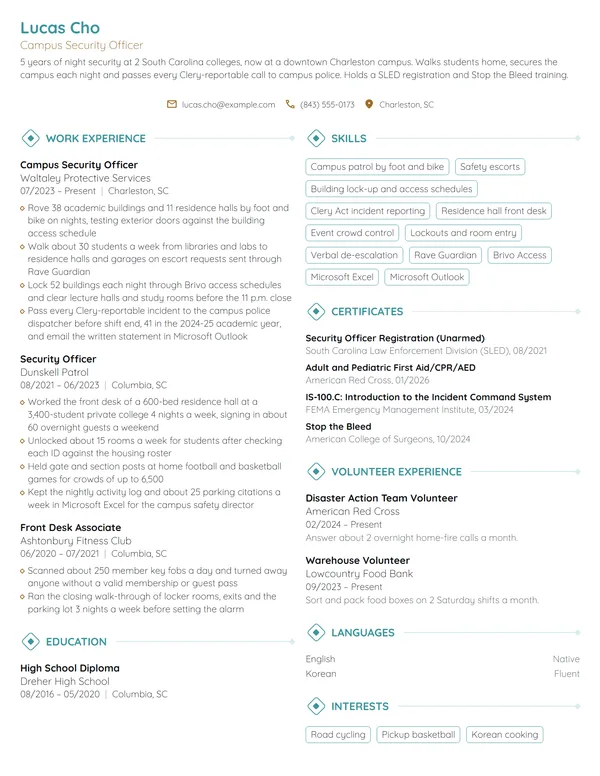
Security officer with 4 years on a university campus and 1 year at a hospital ER entrance, working nights. Answers about 25 escort and lockout calls a shift and holds CPR and AED training.
This version tells a supervisor where you worked, when, and how busy your shifts were.
Security officer bullets: sites, calls and reports with numbers
Your current job gets 3 to 4 bullets starting with a verb, and older jobs 1 to 3. Use the first bullet to set the scene: the setting, its size and what you covered each shift. After that, take your numbers from the logs your site already keeps, such as visitor sign-ins, guard tour scans, calls and incident reports, and give every entry a title and dates, as with listing work experience on a resume in any field.
| Area | What to count | Example bullet |
|---|---|---|
| Site and post | Buildings, floors, square feet, checkpoints | Covered a 3-building, 1.2M-square-foot campus on foot and by cart, scanning 140 checkpoints a shift. |
| People and access | Visitors, contractor badges, deliveries | Signed in about 220 visitors a day and issued 15 contractor badges a week at a single-entry lobby. |
| Calls and alarms | Calls a shift, average response time | Reached door-held and intrusion alarms in an average of 3 minutes across 12 buildings. |
| Hazards and loss | Hazards logged and fixed, losses stopped | Logged 27 safety hazards in a quarter, from blocked exits to broken lights; facilities fixed 25. |
| Medical calls | First aid given, EMS handoffs, evacuations | Gave first aid on 11 medical calls and briefed EMS on arrival with a written timeline. |
| Training | Officers trained, posts covered, site size | Trained 8 new officers on post orders and radio codes for a 20-officer site. |
Below is how an officer's entry reads with counts built in. The setting opens the current job, every bullet has a figure, and the earlier job stays short.
Work Experience
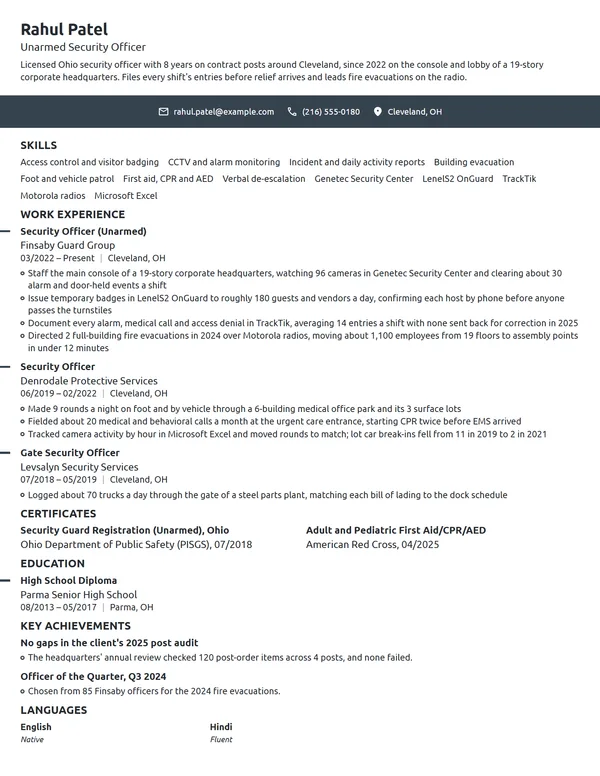
- Check in about 350 visitors and 40 deliveries a day at the lobby desk and loading dock of a 24-story office tower.
- Complete 6 guard tour rounds a shift across 24 floors and 2 parking levels, scanning 85 checkpoints, with no missed rounds in 2025.
- Wrote 112 incident reports in 2025, from trespass to water leaks, each filed before the end of the shift.
- Cut badge-access exceptions from 31 to 9 a month by auditing the tenant access list with the property manager.
- Patrolled a 210-room hotel, its pool deck and 2 parking lots overnight, handling about 15 noise and guest complaints a week.
Don't
Wrote incident reports.
Do
Filed every incident report within 1 hour of the call in 2025, including 4 that police used in trespass cases.
Speed and use are what make report writing believable on paper.
Don't
Provided customer service to visitors.
Do
Answered about 90 visitor questions a shift at the main desk and ran 15 after-hours escorts a week to the parking garage.
Security officer skills and systems for your resume
Choose 6 to 8 hard skills for your resume that match the job ad, and only those your bullets back up. Access control, patrol and report writing fit nearly every officer; emergency medical response, crowd management or armed post work only where your posts required them.
Hard skills for security officers
- Access control and visitor management
- Foot, bike and vehicle patrol
- Incident and daily activity reports
- Alarm and call response
- CCTV monitoring
- First aid, CPR and AED
- Evacuation and fire alarm procedures
- Verbal de-escalation
- Two-way radio procedures
- Escorts and lockout calls
Soft skills security supervisors value
- Calm with upset people
- Steady focus on long shifts
- Plain, accurate writing
- Friendly front-desk manner
- Showing up for every shift
- Good judgment on when to call police
Put your systems in Skills, and name each one a second time inside a bullet about what you did with it. O*NET lists Microsoft Word, Excel and Outlook as hot technology for this occupation, which fits a job built on logs, reports and shift emails. Where a posting names a video platform such as Genetec Security Center or Milestone XProtect, or a reporting app such as TrackTik, and you have worked in it, use that exact product name.
State license, first aid and security certifications for officers
The BLS says most states require security guards to be licensed by the state in which they work, typically after age 18, a background check and training; armed guards usually need a separate license from the appropriate authority. Florida's Class D Security Officer License, for example, takes at least 40 hours of training at a school the state licenses. List certifications on your resume in 1 Certificates section, state license first, so a recruiter can confirm everything at a glance.
| Credential | Posts that ask for it | How to write it |
|---|---|---|
| State security license or registration | Almost every post | The official name, the state, the issuing agency and the date, such as Class D Security Officer License, Florida. |
| Firearm license or permit | Armed posts only | Its own line under the security license, such as the BSIS exposed firearms permit in California, with its date. |
| First aid, CPR and AED | Hospitals, campuses, events and most others | Course name, issuer and completion date, renewed before it lapses. |
| Certified Protection Officer (CPO) | Lead officer and supervisor roles | IFPO's credential; it asks for 6 months of full-time or 1 year of part-time protection officer experience and is recertified every 2 years. |
| Driver's license | Mobile patrol and some campus posts | 1 line under Certificates when the posting names it, since the BLS says some security jobs require one. |
How to write the license line after a move to another state
Because the license comes from the state where you work, a move usually means new training and a new application. New York, for one, asks for an 8 Hour Pre-Assignment course before you apply, 16 Hour On-the-Job Training within 90 days of starting, and an 8 Hour Annual In-Service course each calendar year. List the new license on top once it is issued, keep the old one below it with its state, and before then write the course you have finished and the date you applied.
Certificates
- Class D Security Officer License, Florida, Division of Licensing, Florida Department of Agriculture and Consumer Services, 05/2019
- Certified Protection Officer (CPO), International Foundation for Protection Officers, 09/2024
- Adult and Pediatric First Aid/CPR/AED, American Red Cross, 02/2026
Education and training on a security officer resume
The BLS says security guards typically need high school or an equivalent credential, that most learn the job within a few weeks, and that employer training usually covers emergency procedures, crime prevention and communication. Some study security and protective service or social science, which helps if you aim for investigations or management later. When listing education on a resume, give the credential and school, then its city and your graduation month, and keep it below Certificates.
State-required courses, such as a 40-hour licensing course or annual in-service training, sit with the license under Certificates. A police or corrections academy you graduated from goes under Education with its date, since it covers training a private employer would otherwise give you.
Education
Moving up to lead officer or shift supervisor
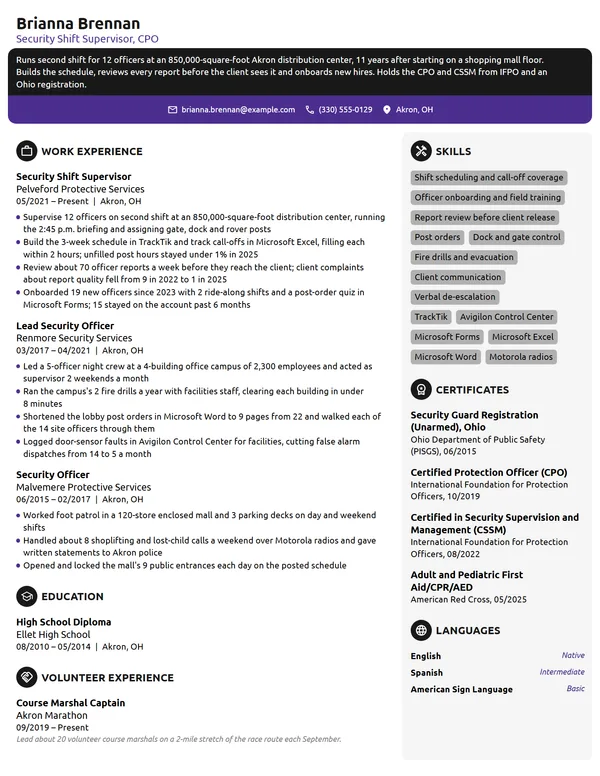
A supervisor role is filled from officers who already did part of the job. Under your current post, move the bullets about training new officers, running the shift briefing, covering the schedule or reviewing other officers' reports to the top, each with a count, such as officers on the shift or reports checked a week. Write Lead Officer or Acting Shift Supervisor as its own title line with dates if you held it, even inside the same company, so the step shows.
First post, military and career-change security officer resumes
Without security experience, use an entry-level resume layout: an objective that gives your license status, Certificates high on the page, and every job that shows alertness, patience with the public and careful notes. Training finished and an application filed count as evidence, so give both their dates.
- Retail, restaurant or hotel jobs: store openings and closings, cash counts, shoplifting calls and the hardest customers you dealt with.
- Military service: gate, checkpoint or military police duty, written in civilian words such as access control, patrol and incident reports.
- Event and crowd work: attendance, gates or sections covered, and the size of the team.
- Volunteer work: school crossing, neighborhood watch or event safety roles under Volunteer Experience, with hours or people served.
Don't
Hardworking individual seeking an entry-level security officer position.
Do
Newly licensed security officer seeking a night post at a hospital or office building. Brings 4 years as a retail shift lead, closing the store and handling shoplifting calls, plus first aid and CPR training.
With no security job yet, the objective still names a post, a license and proof from earlier work.
Veterans and former police officers can stay in newest-first order and swap ranks and unit names for duties a private employer knows; the military-to-civilian resume examples show how. From an unrelated field, a career-change resume reads best when each old job opens with its safety, cash or public-facing bullets. The reason for the switch fits better in your cover letter, and our law enforcement cover letter examples show how to open one with your strongest post.
Security Officer resume FAQ
How long should a security officer resume be?
1 page for most officers, even with several posts. A second page makes sense only with 10+ years, or with supervision, training or investigations roles, and your license and current post still belong on page 1.
How do I show incident report writing on a security officer resume?
Count it. Give the number of reports you wrote in a year, how fast you filed them, and any that police, managers or insurers relied on. Then list your reporting system in Skills, since many sites write reports in an app rather than on paper.
How do I list a security license from another state?
Keep it under Certificates with its state, issuing agency and dates, below the license for the state you are applying in. Most states license guards where they work, so if the new license is still pending, write the training you have finished and your application date.
Should I list hospital, campus and corporate posts differently?
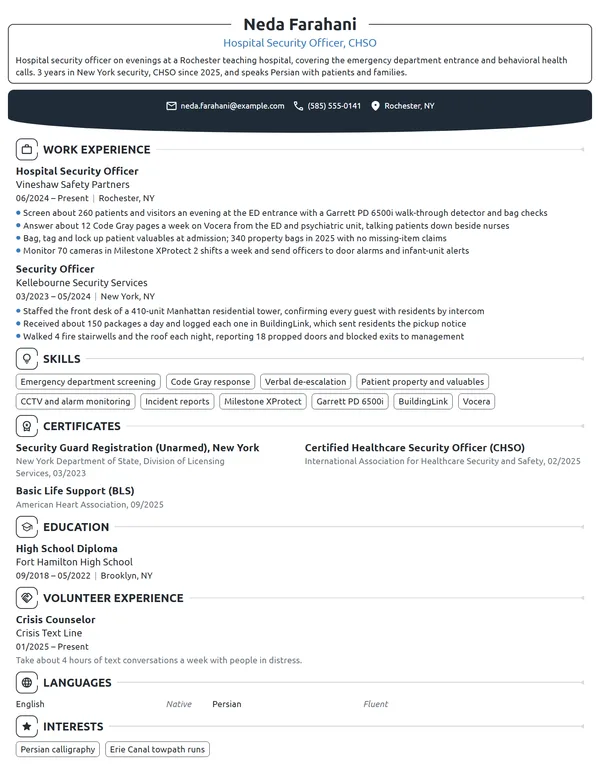
Yes, by naming the setting and the calls it brings. A hospital post shows behavioral and medical calls, a campus post shows escorts and lockouts, and a corporate post shows visitors and badge access. Put the setting that matches the posting first.
How do I show I am ready for a shift supervisor role?
Lead your current job with the supervisory work you already do: officers you trained, shifts you ran as lead, reports you reviewed and schedules you covered. If you held a lead or acting supervisor title, give it its own line with dates.
Can I get a security officer job with no experience?
Yes. The BLS says security guards typically need high school or an equivalent and learn most of the job in a few weeks of training. Finish your state license first, put it under Certificates, and use retail, customer service or military work as your evidence.
Should I include military or police experience on a security officer resume?
Yes, as full Work Experience entries written in civilian terms, such as access control, patrol, incident response and reports. Put any academy under Education and any weapons qualification under Certificates, each with its date.
Do customer service skills belong on a security officer resume?
Yes, when a bullet proves them. Lobby, hotel and corporate officers spend much of a shift helping visitors, so a count of questions answered, escorts given or visitors signed in shows that side of the job better than the words customer service.
How much do security officers make?
Security guards earned a median of $38,020 a year in May 2025, per the BLS. Your pay depends on the state, the setting, your shift and whether the post is armed; keep pay off your resume and talk about it once an offer is near.
Next steps
Choose the example nearest your setting and level, follow how it is laid out, then replace each figure with your own sites, rounds, calls and reports. Make it in our resume builder or begin from a resume template, and send a cover letter along that names the post you want and your license.