
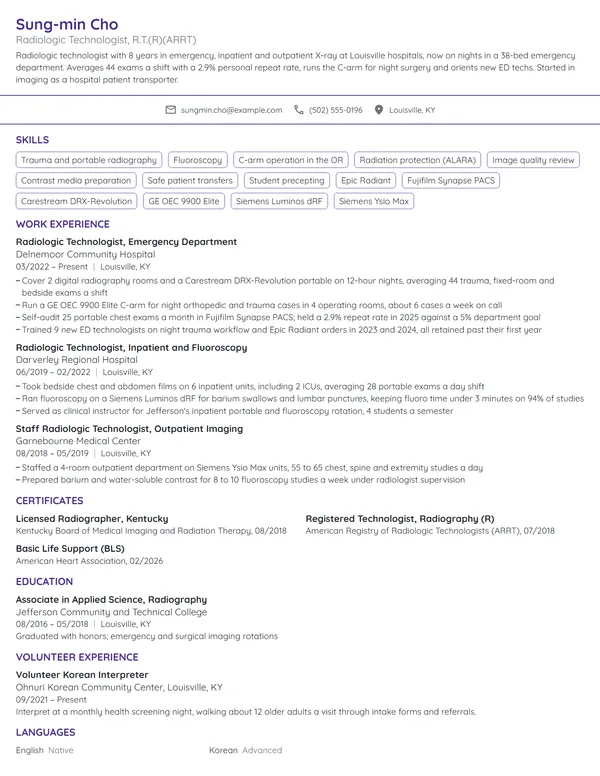
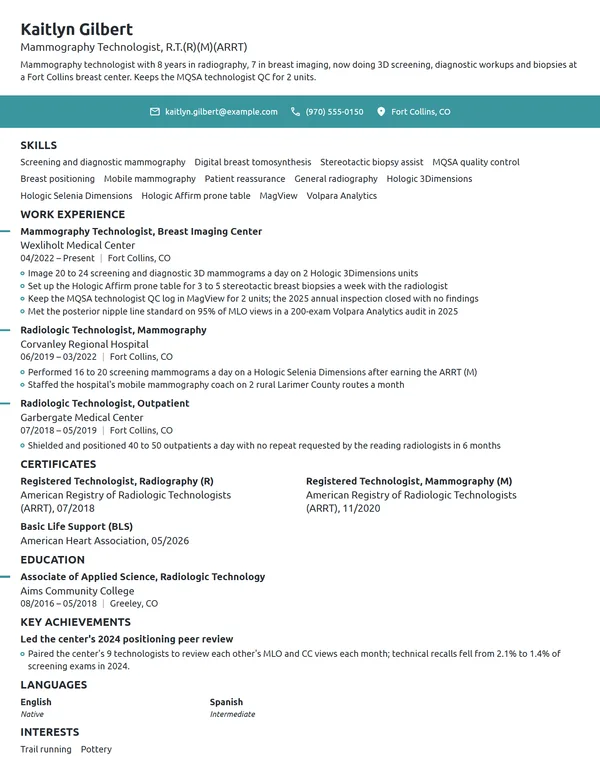
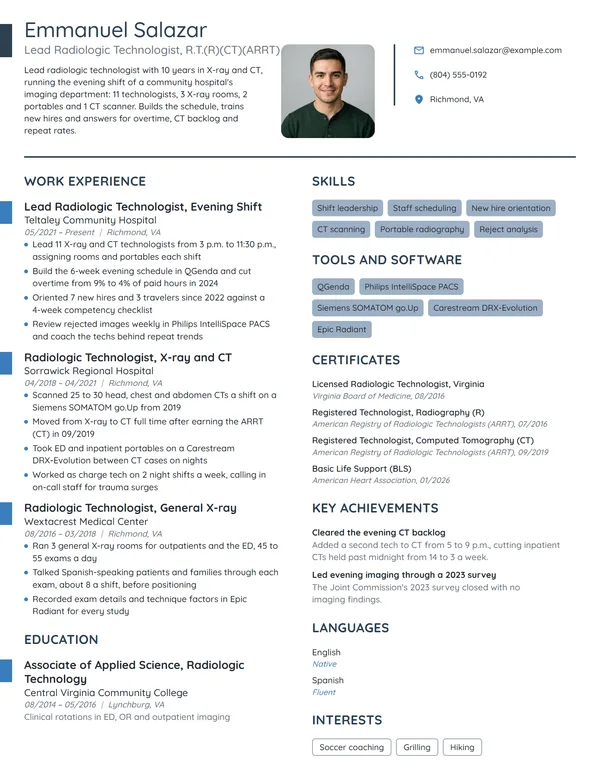
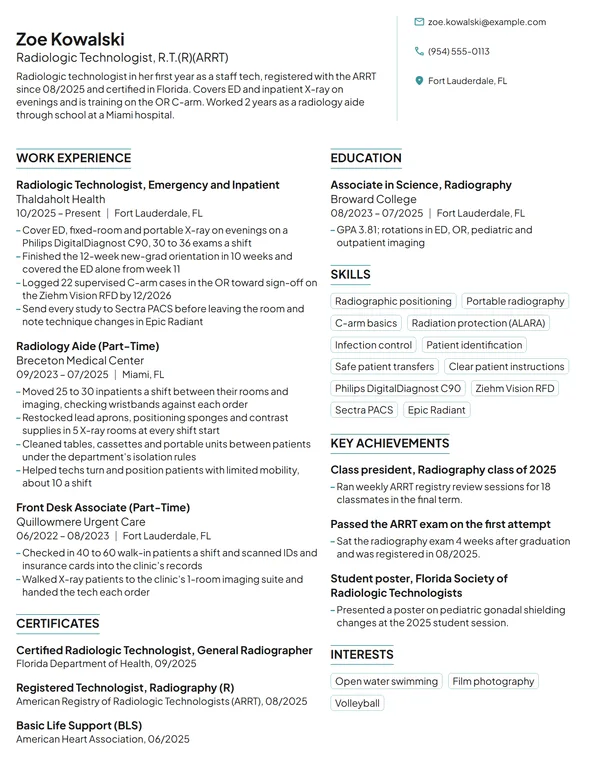
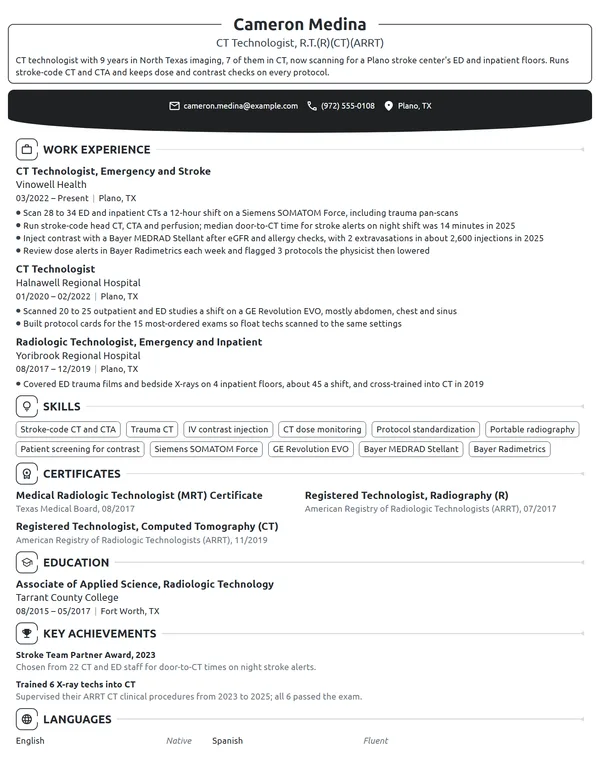
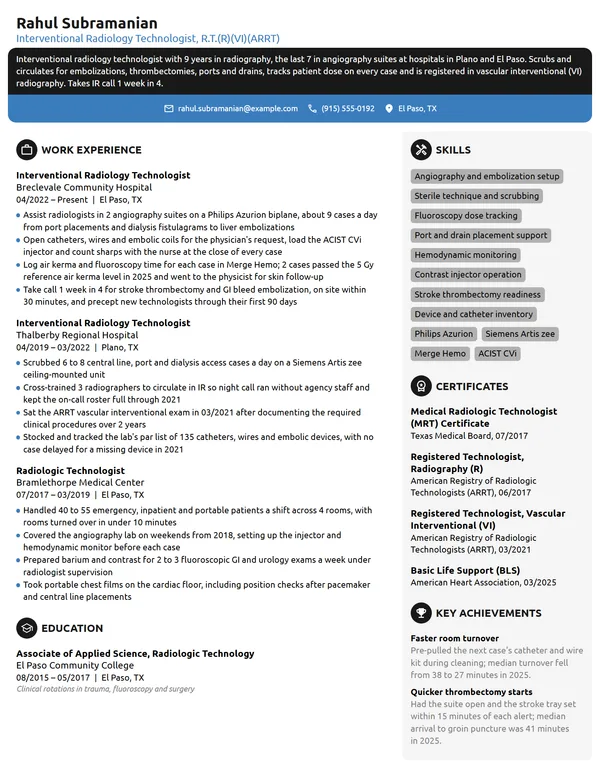
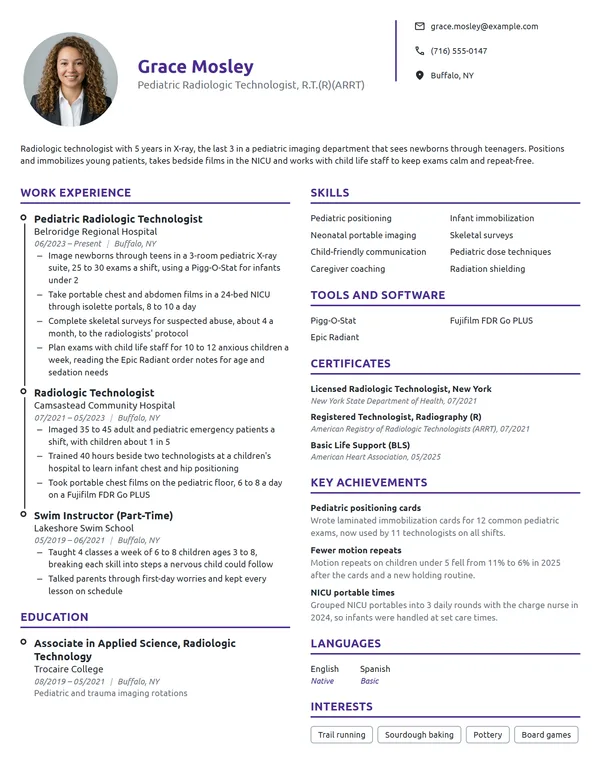
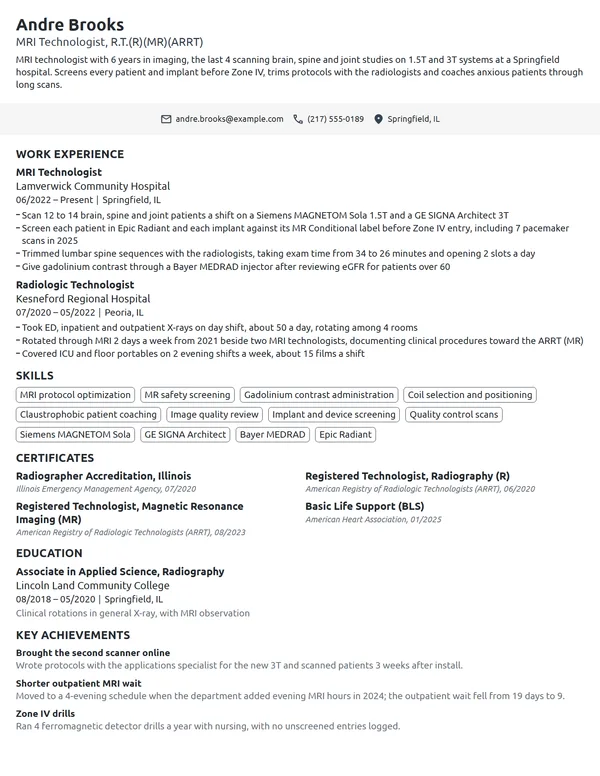
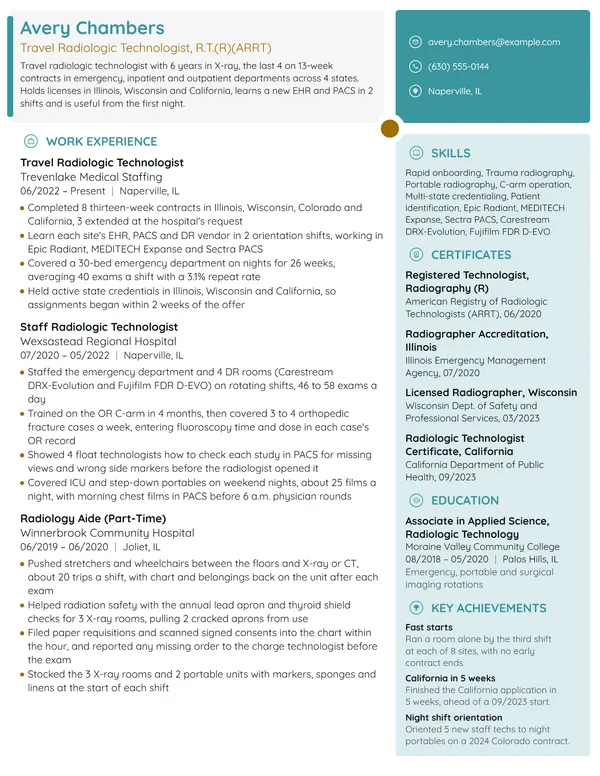
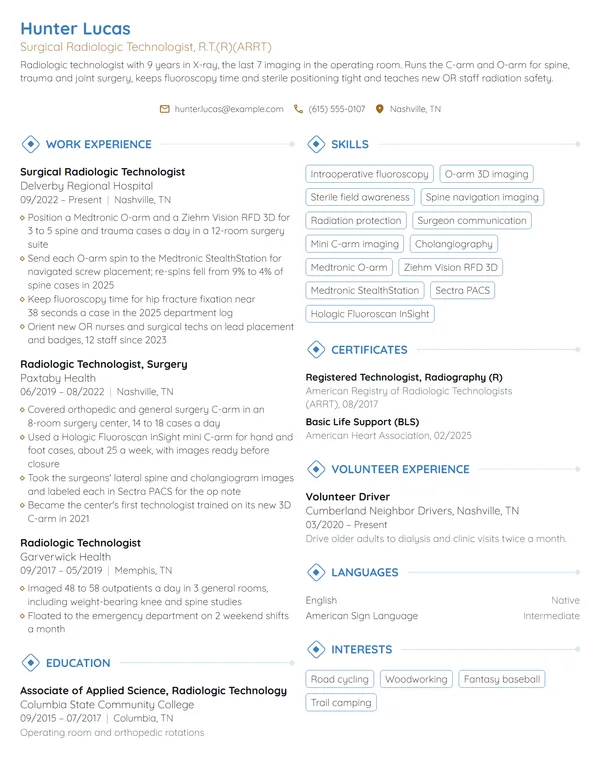
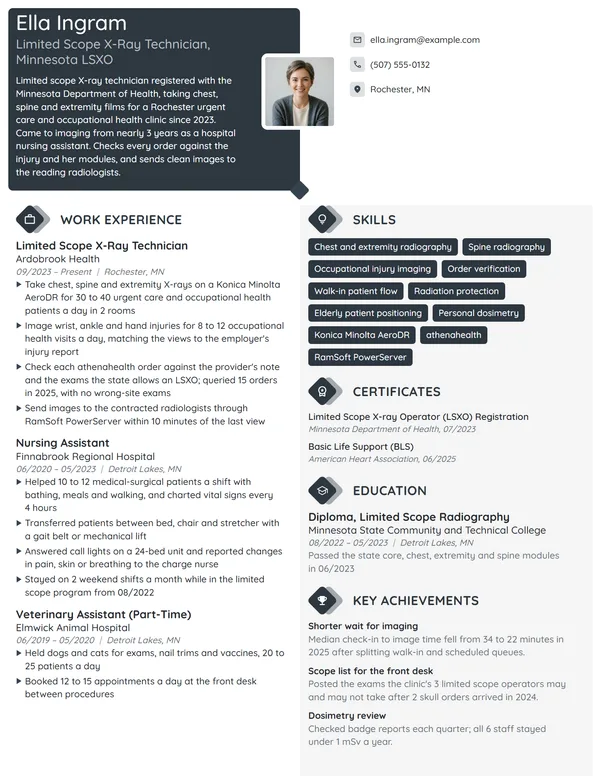
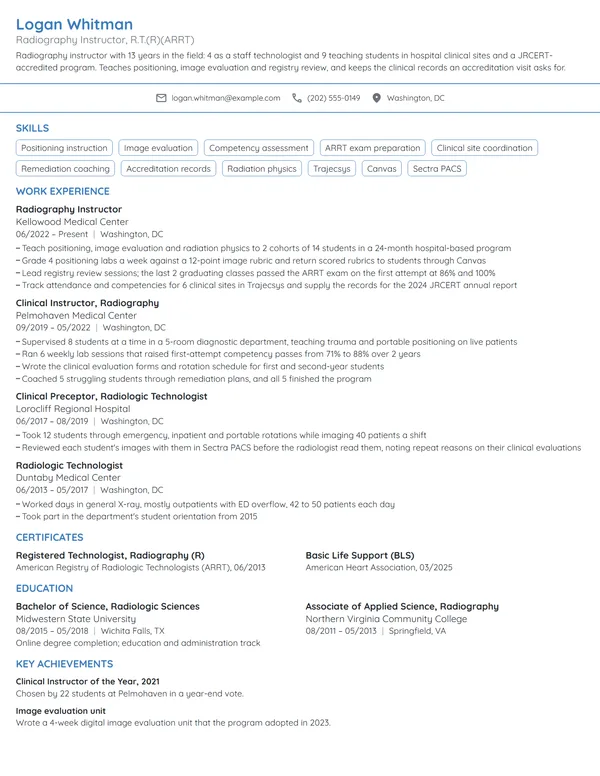
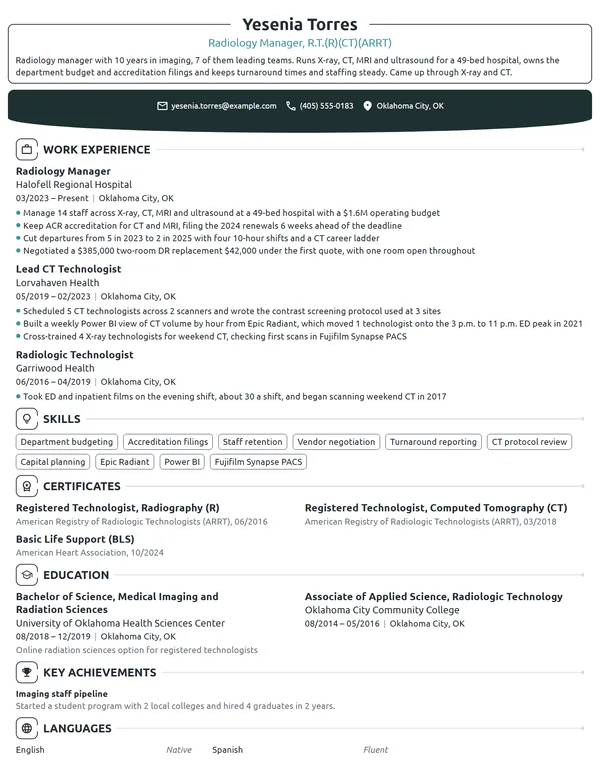
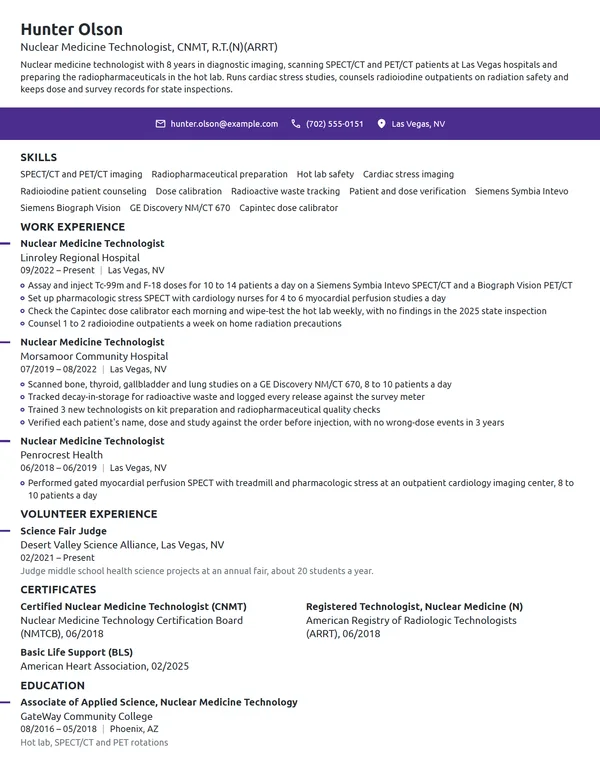
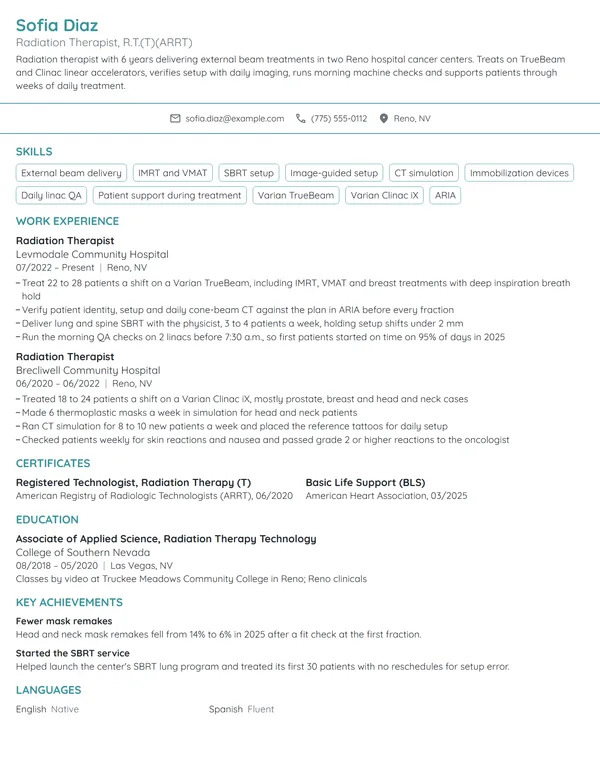
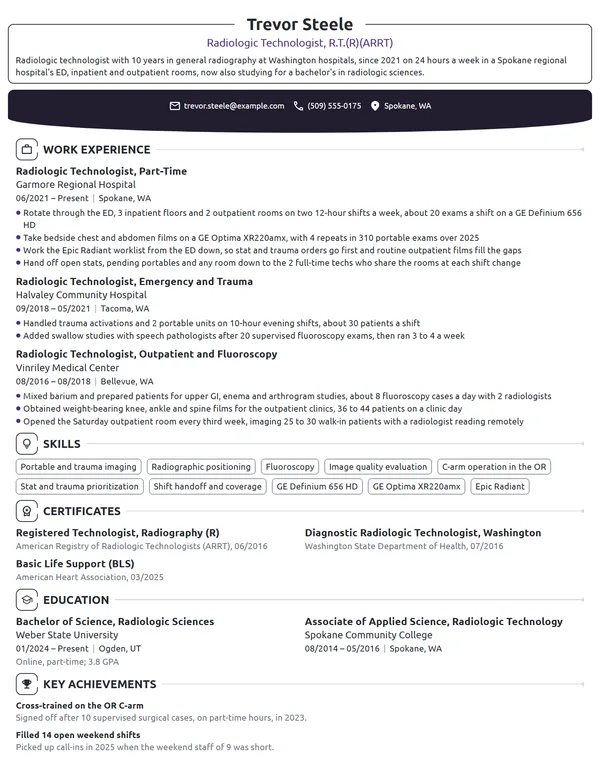
A radiologic technologist's work ends up in other hands: the radiologist who reads the image and the doctor who acts on it. So imaging managers check your registry credential, the modalities you can run on your own, the pace of the department you come from and how often your first image is the one that gets read. Exam counts, repeat rates and turnaround times already sit in your department's reports, and those figures turn a list of exams into proof of how well you work.
How to Write a Radiologic Technologist Resume - Key Takeaways
- Keep to reverse-chronological order on 1 page; a second page fits only after 10+ years across several modalities or a lead role.
- Put the modality or department in each job title, such as CT Technologist, Emergency Department, so a manager can match it to their own service.
- Count what your department already tracks: exams a shift, repeat or reject rate, order-to-image time, dose checks and students precepted.
- List your state license, where your state issues one, and your ARRT registration first under Certificates, and write your ARRT string, such as R.T.(R)(ARRT), after your name.
- Add each post-primary credential, such as CT or mammography, with the month and year you earned it.
- Screen the file in an ATS resume checker before you apply, since health system portals screen for credential and modality keywords.
What imaging managers look for in a radiologic technologist resume
An imaging manager or radiology director wants to know 3 things: which credentials you hold, which exams you can run without help, and how you handle patients and radiation. The Bureau of Labor Statistics lists following physicians' orders on what to image, positioning the patient and the equipment, operating the imaging equipment and keeping detailed patient records as core duties. O*NET adds equipment quality control and the radiation safety measures that protect patients and staff. Your bullets should show those tasks in a named setting, with the volume you covered.
Health system portals parse standard headings cleanly, so build the resume from these sections:
- Name, a headline with your credential string (for example, Radiologic Technologist, R.T.(R)(CT)(ARRT)) and contact details
- A summary of 2 to 3 lines under your name, which prints without a heading
- Work Experience, newest job first, with the modality or department in each title
- Certificates: state license and ARRT registration first, then post-primary and life support credentials
- Skills, with the PACS, RIS and equipment you use
- Education, with your radiography program
- Optional: Languages, and Key Achievements or Volunteer Experience where you have something to show
Best format for a radiologic technologist resume
Use the reverse-chronological resume format: your current job first, each entry with its title, the facility and its location, plus MM/YYYY dates. Imaging careers usually move from general radiography into a second modality such as CT, mammography or interventional work, and from there into lead or supervisor roles, so this order shows each step where a manager expects it. If you rotate across modalities in one job, keep them in 1 entry and name each in a bullet.
- Best for most radiologic technologistsReverse-chronologicalYour jobs, newest first, with your results under each one.Best for: A steady work history in your field
- FunctionalSkills grouped up top, with a short work history below.Best for: Gaps or very little experience
- CombinationA skills section first, then your full work history.Best for: A career change with strong skills
Several post-primary credentials, a lead or supervisor role, or teaching in a radiography program can justify a second page, provided your credentials and current job stay on page 1.
| Setting | What to use |
|---|---|
| Length | 1 page; 2 only with 10+ years, several modalities or a lead role |
| Dates | MM/YYYY for jobs and credentials, with Present on your current post |
| Job title line | Title plus modality or department: Radiologic Technologist, Emergency Department |
| Headline | Your ARRT string after your name, such as R.T.(R)(M)(ARRT) |
| Typeface | 1 sans serif typeface throughout, sized between 10 and 12 pt in the body |
| Photo, age and ID numbers | Skip the photo, your age, family status and SSN |
| File type | PDF, unless the health system's career site requests a Word document |
Most US and Canadian resumes carry no photo. Hospital career sites often copy your file into their own application form, so plain headings and dates typed as text come through that step better than text boxes or graphics.
Radiologic technologist resume summary vs. objective
Registered and already working as a tech? Write a resume summary: your years in imaging, your modalities, your setting and 1 result. Still in your program, waiting on the registry exam or moving in from another healthcare job? Write a resume objective naming the role you want, your exam date or credential status and your clinical experience. Draft it last, and take its number from a bullet further down.
Radiologic technologist resume summary formula
Credential string radiologic technologist with X years in modalities, the last Y at a setting and size. 1 result your department measures, with a number. Next credential or role in progress.
Example
R.T.(R)(ARRT) radiologic technologist with 7 years in general radiography and fluoroscopy, the last 4 at a 410-bed teaching hospital. Cut portable chest repeats on 5 inpatient units from 7% to 4%. Completing CT clinical requirements for the ARRT post-primary exam in 2027.
Don't
Dedicated and detail-oriented radiologic technologist seeking to provide quality imaging in a fast-paced hospital.
Do
Radiologic technologist, R.T.(R)(ARRT), with 4 years in a Level I trauma center's emergency department, covering 2 trauma bays and 120 portables a week. Precepts radiography students on day shift.
The second version names the setting, the volume and a responsibility beyond the exam room.
How to write radiologic technologist work experience bullets with numbers
Your present job takes 3 to 4 bullets, and earlier ones take 1 to 4, fewer as they age. Open with the setting and your volume: exams a shift, the modalities, and whether you cover the ED, the OR or outpatient rooms. Then write achievements from your repeat rates, turnaround times, dose reviews or students trained.
| Area | What to count | Example bullet |
|---|---|---|
| Exam volume | Exams a shift, modalities, areas covered | Performed 35 to 40 general and portable exams a shift across the ED, the ICU and 2 inpatient floors. |
| Image quality | Repeat or reject rate, images sent back by radiologists | Lowered the reject rate on 3 digital radiography rooms from 9% to 5% through monthly reject analysis. |
| Turnaround | Order-to-image time, stat exams, ED waits | Brought median order-to-image time for ED stat X-rays from 31 to 18 minutes. |
| Radiation safety | Exposure index checks, protocol reviews, shielding audits | Kept 96% of pediatric exams within the target exposure index range for 18 months. |
| Quality control | Daily QC, equipment faults, service calls | Ran daily QC on 2 fluoroscopy rooms with 0 missed checks across 2 accreditation surveys. |
| Training | Students precepted, new hires oriented, competencies signed off | Signed off 140 clinical competencies for radiography students over 3 academic years. |
The entry below puts those figures to work: the setting and volume lead, the results follow, and the older job keeps a single line.
Work Experience
- Perform 30 to 35 radiographic and fluoroscopic exams a shift for a 410-bed teaching hospital's ED, inpatient units and 2 operating rooms.
- Led a positioning refresher for 14 techs that cut repeats on portable chest exams from 6.8% to 3.9% in 6 months.
- Run daily quality control on 3 digital radiography rooms and report faults to biomedical engineering, with no missed QC log in 2 years.
- Precept 6 radiography students a year through their clinical competencies.
- Took 50 to 60 extremity and spine exams a day for 5 orthopedic surgeons, including standing long-leg and scoliosis series.
Don't
Performed X-rays on patients as ordered by physicians.
Do
Performed about 35 portable and in-room X-rays a night at a Level II trauma center, with every stat image in PACS within 20 minutes of the order.
This version adds the setting, the load and a time standard a radiology manager tracks.
Don't
Responsible for radiation safety and equipment quality control.
Do
Checked the exposure index on every pediatric study and reset default techniques on 4 rooms with the medical physicist, bringing 93% of exams into the target range.
Specialty and lead roles change what you count. A mammography technologist counts screening and diagnostic exams a day and keeps the exam count the federal mammography rules require. A CT technologist counts scans a shift, contrast studies and protocols built with a radiologist, and a lead adds the staff scheduled, the rooms covered and the new hires oriented.
Radiologic technologist skills and imaging software for your resume
Pick 6 to 8 hard skills for your resume from the posting, and keep the ones a bullet already proves. Positioning and radiation protection belong on nearly every radiologic technologist resume; C-arm work, trauma imaging or pediatric technique only where your department used them.
Hard skills for radiologic technologists
- Radiographic positioning
- Fluoroscopy
- Portable and trauma imaging
- C-arm operation in the OR
- Radiation protection (ALARA)
- Exposure technique selection
- Contrast media preparation
- Image quality evaluation
- Equipment quality control
- Safe patient transfers
Soft skills imaging managers value
- Clear instructions for patients
- Calm with patients in pain
- Attention to detail
- Teamwork with radiologists and nurses
- Pacing on a busy shift
- Adaptability across settings
List your PACS, RIS and equipment with your skills, and name each one again in the bullet where you used it. O*NET lists DICOM modality management and diagnostic image review software among the tools of radiologic technologists and technicians, and MEDITECH as a hot technology. A system you only watched others use stays off the list.
ARRT registration, state license and post-primary credentials on a resume
Credentials are the first thing an imaging manager checks. The BLS states that most states require radiologic technologists to be licensed or certified, and that employers typically require or prefer certification even where the state does not. The national credential is registration with the American Registry of Radiologic Technologists (ARRT), and some states build on it: Wisconsin, for one, accepts active ARRT certification as proof of passing its licensing exam. List certifications on your resume with each issuer and the month you earned it.
| Credential | Issued by | What it takes |
|---|---|---|
| Radiography, R.T.(R)(ARRT) | American Registry of Radiologic Technologists (ARRT) | An ARRT-approved radiography program, an associate's degree or higher in any subject, the ethics requirement and the exam. |
| Computed Tomography (CT) | ARRT (post-primary) | A current ARRT credential in Radiography, Nuclear Medicine Technology or Radiation Therapy, 16 hours of structured education in the 24 months before you apply, documented clinical procedures and the exam. |
| Mammography (M) | ARRT (post-primary) | A current ARRT credential in Radiography, 16 hours of structured education, documented clinical procedures and the exam. |
| MQSA qualification for mammography | Federal rule (FDA, 21 CFR 900.12) | A state license or general certification, 40 contact hours of mammography training with 25 supervised exams, then 15 mammography continuing education units every 36 months and 200 exams every 24 months. |
| State license or certificate | Your state's licensing agency | Rules vary: Wisconsin licenses radiographers through its Department of Safety and Professional Services, and California issues separate certificates for diagnostic and mammographic work plus a fluoroscopy permit. |
| BLS (Basic Life Support) | American Heart Association | A provider course in a classroom or blended format; renew the card before it lapses. |
How to write the ARRT credential line
ARRT's own format puts each discipline in parentheses after R.T., in the order you earned them, and ends with (ARRT), with no spaces: R.T.(R)(CT)(ARRT). Write that string after your name in the headline, and use it only while your certification and registration are current. Under Certificates, give each credential its own line with a month and year, and leave registry and license numbers off, since employers check both with ARRT and the state.
Certificates
- Licensed Radiographer, Wisconsin, Wisconsin Department of Safety and Professional Services, 09/2019
- Registered Technologist in Radiography, R.T.(R)(ARRT), American Registry of Radiologic Technologists, 08/2019
- Computed Tomography (CT), ARRT post-primary, clinical requirements in progress, exam planned for 2027
- Basic Life Support (BLS), American Heart Association, 04/2026
Keeping the credential is part of the job too. ARRT asks most registered technologists for 24 approved continuing education credits each biennium, and anyone who earned a credential in 2011 or later also completes its Continuing Qualifications Requirements every 10 years. These stay off the resume unless a posting asks; what matters on the page is that every credential listed is current.
How to list a radiography associate degree or certificate program
The BLS names an associate's degree as the education typically required for radiologic technologists. ARRT asks for an associate's degree or higher plus an ARRT-approved program in radiography; the degree can be in any subject, and it must be earned before you sit for the exam. If you finished a hospital-based radiography program after a degree in another field, list both, with the radiography program first.
Write the program, the school, its city and the graduation month, as in any education section on a resume. New graduates can add 1 line on clinical sites and competencies, and a GPA of 3.5 or above; after 2 years in a department, trim the entry to the degree, school and date.
Education
Clinical rotations at 3 hospital sites, including emergency and surgical imaging.
New grad and career-change radiologic technologist resumes
As a new graduate, start with an objective naming the setting you want and your registry status: exam scheduled, passed, or R.T.(R) issued, with the month. ARRT gives you 3 years after finishing your program to establish eligibility and apply, so write the date you plan to test rather than leaving the line out. Put your clinical rotations where an imaging lead can count them, and use the entry-level resume layout if you have no paid work yet.
- Clinical rotations: each site's setting (ED, outpatient, OR) and the competencies you completed there, in 1 or 2 lines under Education.
- Patient transporter, radiology aide or CNA jobs: a full Work Experience entry with the patients you moved or assisted each shift.
- Program leadership: a class officer role or a registry review group you ran, under Key Achievements.
- Health fairs or community screenings: under Volunteer Experience, with the number of people you helped.
Don't
Recent radiography graduate eager to begin my career in a hospital imaging department.
Do
Radiography graduate, R.T.(R)(ARRT) since 07/2026, seeking a staff technologist role in an emergency department. Completed rotations at 3 hospitals with 280 portable and trauma exams, after 2 years as a patient transporter.
A new grad objective can still carry a credential date, a setting and a count.
If you come from another healthcare job, such as patient transport, medical assisting or a limited X-ray operator role, stay in reverse-chronological order, leading with your radiography program and ARRT status. Under older jobs, keep the bullets that carry over: patient handling, positioning, charting and infection control. The career-change resume layout fits this route, and a short cover letter paragraph can explain the move, the way these healthcare cover letter examples do.
Radiologic Technologist resume FAQ
Should I put my ARRT number on my resume?
No. Write the credential string, such as R.T.(R)(ARRT), in your headline and list the registration under Certificates with the month you earned it. Employers verify your status with ARRT and your state themselves, so the number adds nothing and travels through every portal your file reaches.
How do I list ARRT credentials after my name?
Use ARRT's own format: your name, a comma, then R.T. followed by each discipline in parentheses in the order you earned them, ending with (ARRT) and no spaces. A technologist with radiography and CT writes R.T.(R)(CT)(ARRT).
Can I write R.T.(R) on my resume before I pass the ARRT exam?
No. ARRT designations are for technologists whose certification and registration are current. Before you pass, write your program and graduation date under Education and state your exam status with a date in your objective, such as ARRT Radiography exam scheduled for 11/2026.
Do radiologic technologists need a state license?
In most states, yes. The Occupational Outlook Handbook says most states require radiologic technologists to be licensed or certified, and employers usually want certification even where the state does not. List the license by state and issuing agency first under Certificates, and add each state you hold one in.
How do I show CT or mammography training before I am certified?
Add the credential under Certificates with the words clinical requirements in progress and the year you plan to test. In your current job, write a bullet with the scans or exams you have performed in that modality, so a manager can see the training behind the plan.
How long should a radiologic technologist resume be?
1 page for new graduates and most staff technologists. Move to 2 pages after 10+ years, several post-primary credentials or a lead, supervisor or teaching role, and keep your credentials and current job on page 1.
What is the average radiologic technologist salary?
Radiologic technologists and technicians earned a median of $80,110 a year in May 2025, per the BLS. Modality, shift, state and post-primary credentials all move the figure; leave pay off your resume and raise it once an offer is on the table.
Next steps
Start from the example that matches your modality and the step you are at. Replace its figures with yours: the credential string, the setting, your exams a shift and 1 or 2 results. Finish it in our resume builder or a template, and send it with a short cover letter naming the department you want.