
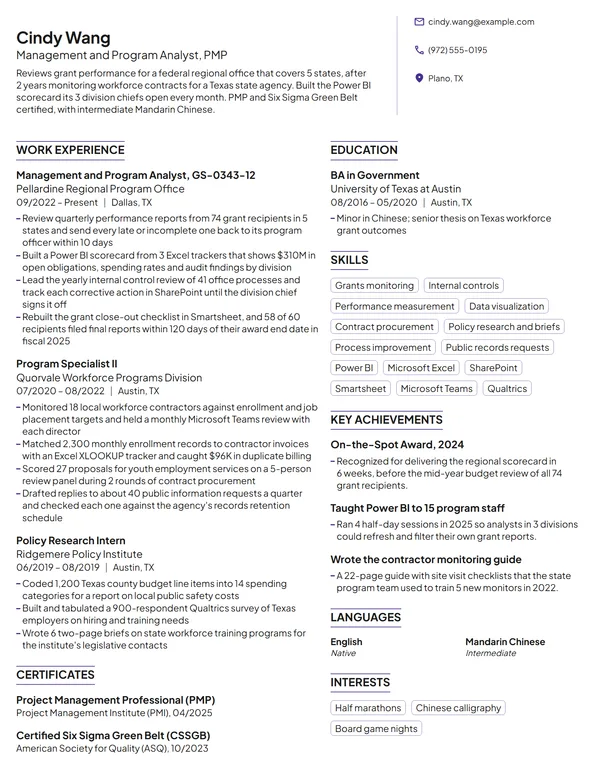
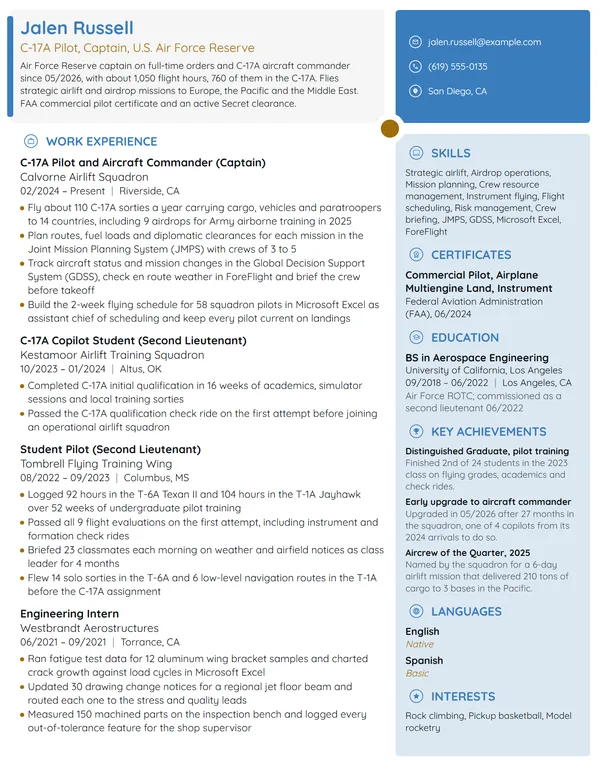
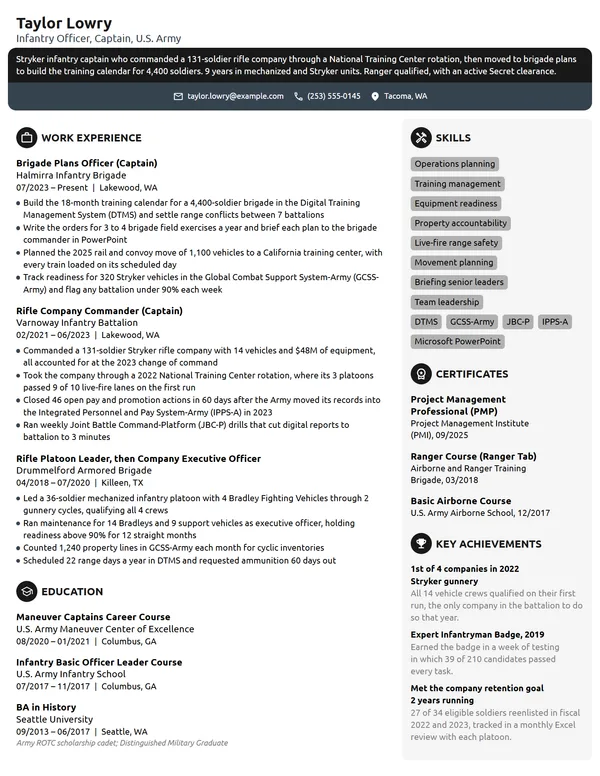
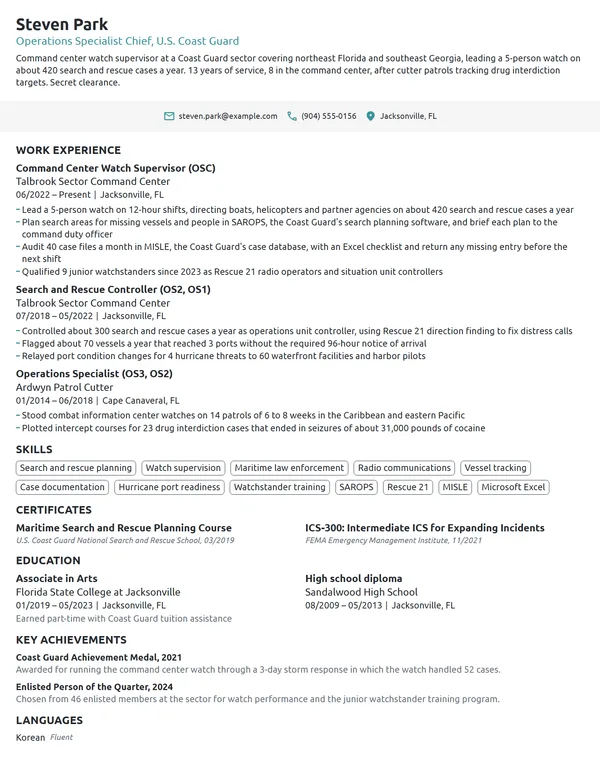
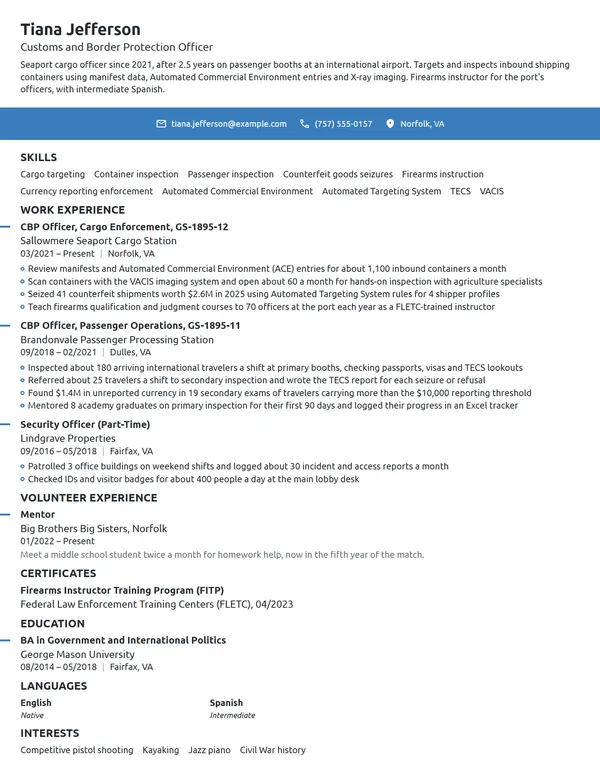
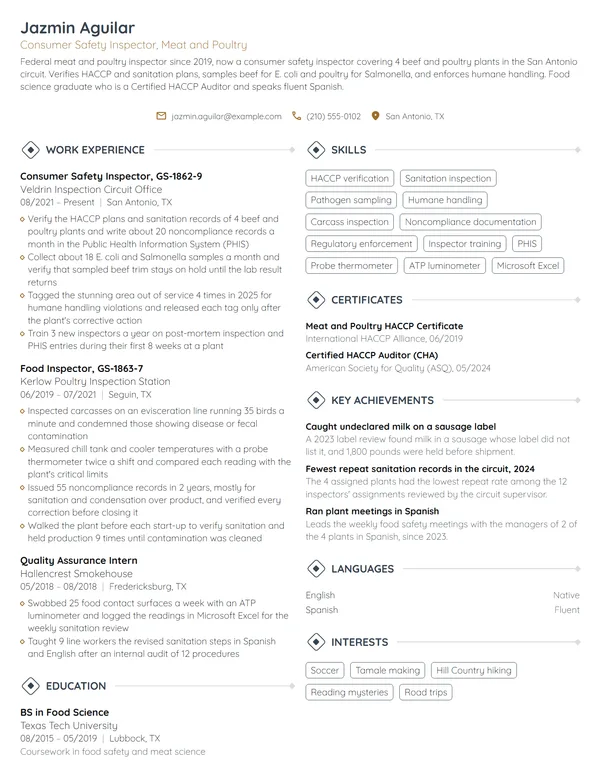
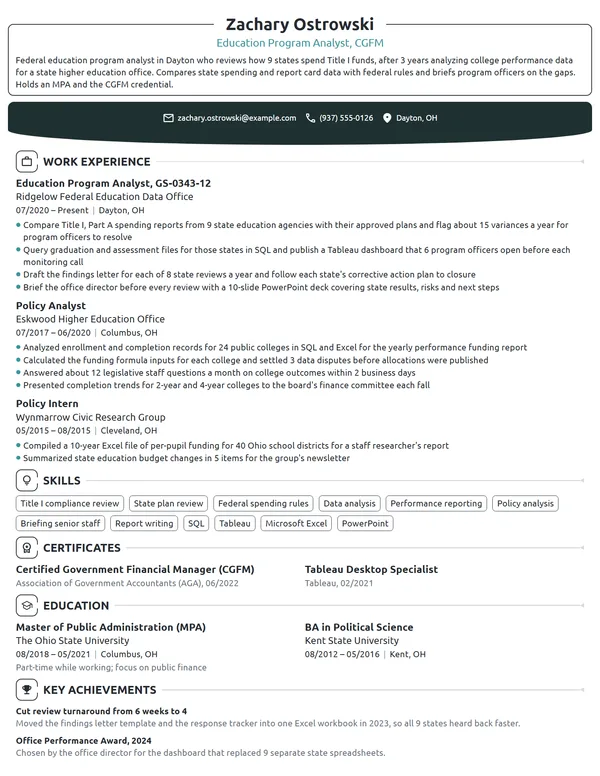
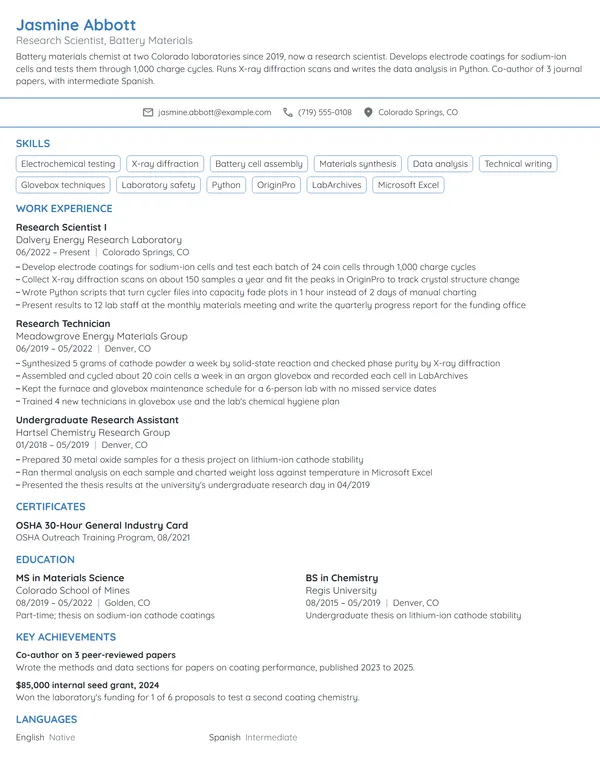
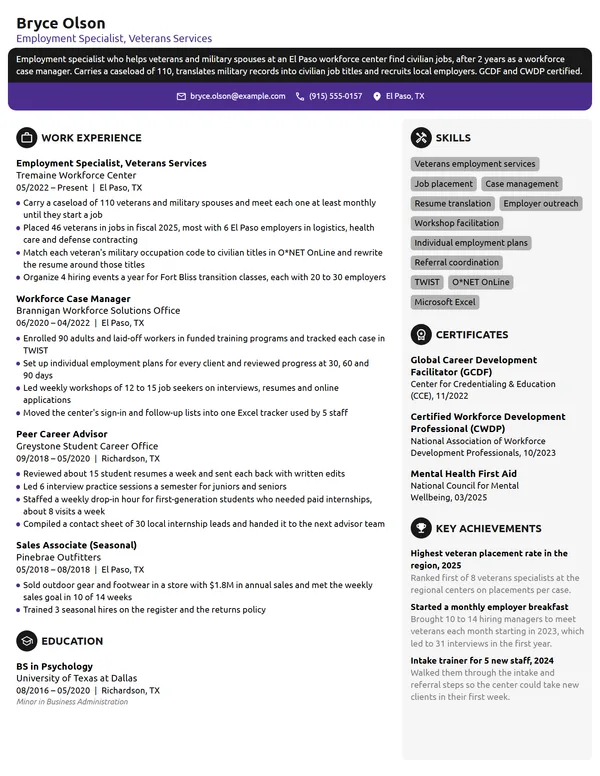
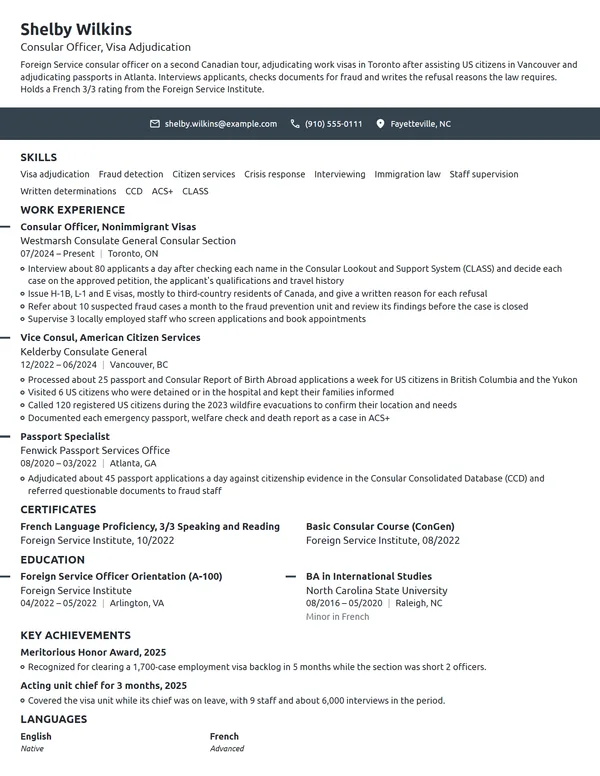
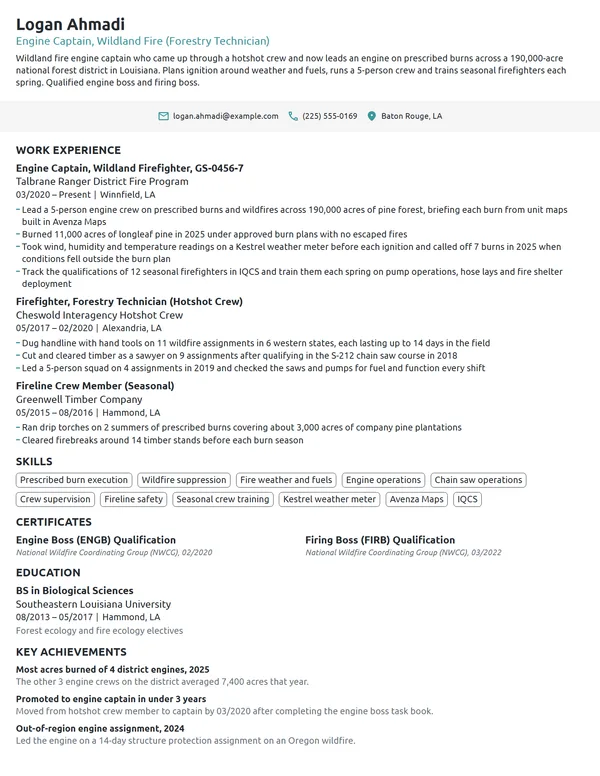
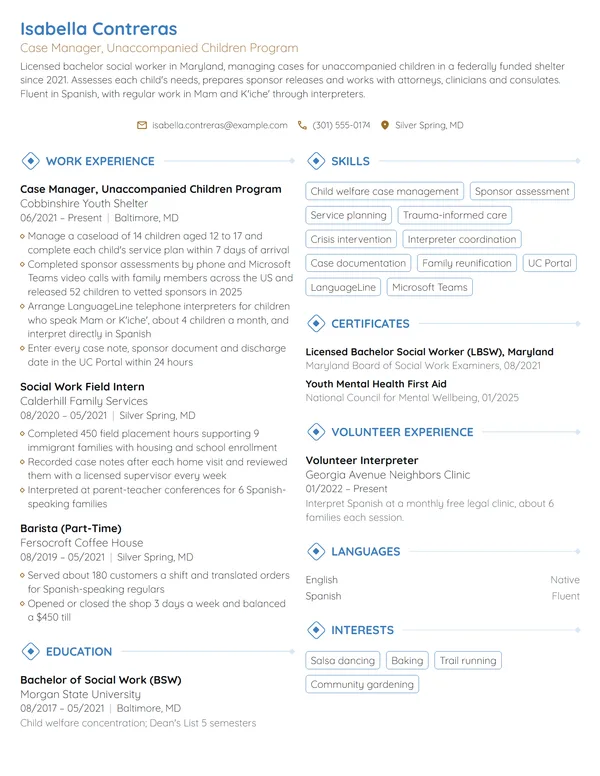
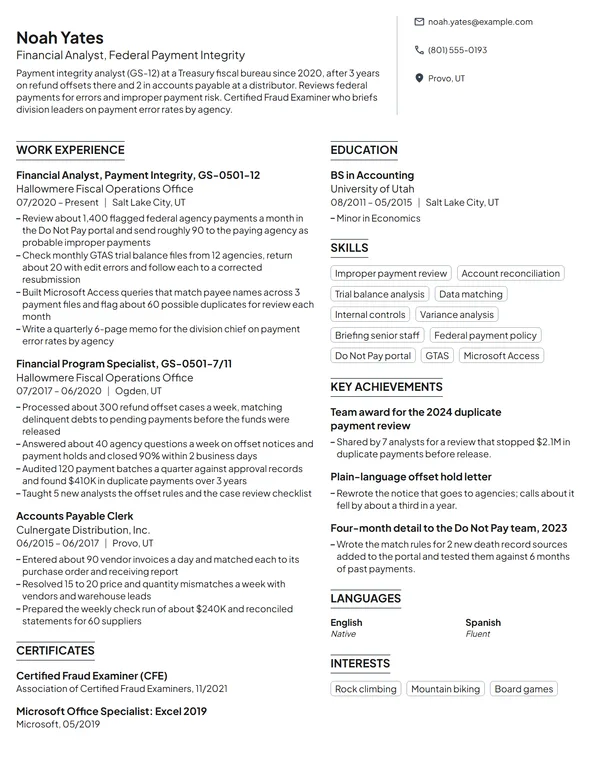
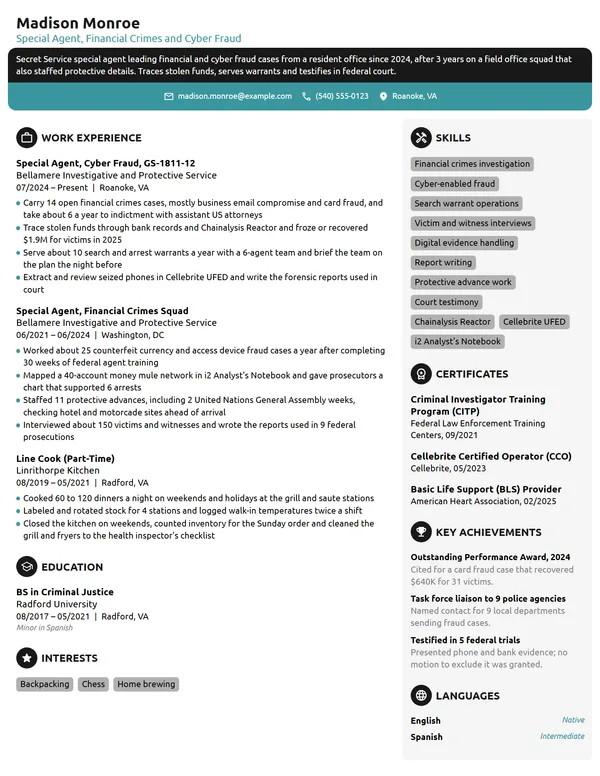
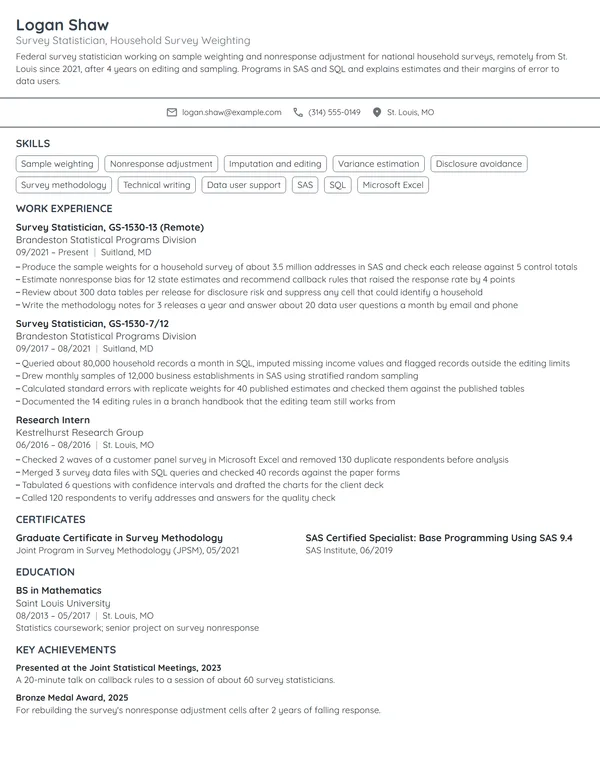
A US resume follows its own rules. US employers expect a short document built around results: usually no photo, no birth date, and 1 or 2 pages showing what you achieved and where. That can feel unfamiliar if you learned to write one in another country, built your career in the military or are applying for a federal job. Most of it comes down to translating your experience into job titles, numbers and plain terms a US recruiter already recognizes, starting with the format.
How to Write a US Resume - Key Takeaways
- Choose the reverse-chronological format on US Letter paper, 1 page under 10 years of experience and 2 at most for nearly everyone else.
- Leave off your photo in most cases, plus your birth date, nationality, marital status and any ID number; city, state, phone and email are enough.
- Write a 2- to 3-line summary that gives the US version of your title, your years and your best result in dollars or US units.
- Give every bullet a number with a before and after or a total, and spell out every acronym a US reader would not know, military and foreign ones included.
- Add the US equivalent of a degree earned abroad, and list languages with a plain proficiency level.
- Keep a federal resume to 2 pages, then run any version through an ATS resume checker before you upload it.
What US hiring managers look for in a US resume
A US hiring manager reads your resume to answer 3 questions fast: what you do now, how well you did it, and whether that work matches their opening. They expect the newest job first, a title they recognize, and bullets that carry results rather than duties. Anything that does not help answer those questions, such as your age, family or hometown, is left out.
A US resume is also shorter than the CV many countries use. It is a sales document for a single opening, not a full record of your education and career, so you cut older and unrelated work instead of listing everything. Organize it under these headings, which recruiters and hiring software both expect:
- Your name and target job title at the top, then a contact line with city, state, phone, email and LinkedIn
- A short profile of 2 to 3 lines under your name, which takes no heading
- Work Experience, with the newest post at the top
- Skills, with the software and systems you use
- Certificates, with any US license listed first
- Education, with the US equivalent of any degree from abroad
- Optional: Languages, Key Achievements or Volunteer Experience
Best format for a US resume: layout, length and Letter paper
Use the reverse-chronological resume format: your latest job first, each with the title, the employer, the city and state or country, and MM/YYYY dates. US employers read it fastest because it shows your current level in the first lines. Choose a combination format, with a skills block above your history, only when you are switching fields and your past titles say little about the job you want.
- Best for most US job seekersReverse-chronologicalYour jobs, newest first, with your results under each one.Best for: A steady work history in your field
- FunctionalSkills grouped up top, with a short work history below.Best for: Gaps or very little experience
- CombinationA skills section first, then your full work history.Best for: A career change with strong skills
Keep the page to 1 sheet with under 10 years of experience, and to 2 with more. The longer, complete document many countries call a CV is a different thing in the US: knowing the difference between a CV and a resume matters, because a US curriculum vitae is mostly reserved for academic, medical and research roles. Set your file to US Letter size (8.5 x 11 inches), since an A4 page prints with clipped margins in a US office.
| Setting | What to use |
|---|---|
| Paper size | US Letter, 8.5 x 11 inches |
| Length | 1 page under 10 years of experience; 2 pages at most for most jobs, federal ones included |
| Dates | MM/YYYY for every job and degree; write Present as the end date of the post you still hold |
| Location line | City and state abbreviation (Albuquerque, NM); city and country for a job abroad |
| Personal details and photo | In the US and Canada, usually no photo; leave off your birth date, nationality, marital status and Social Security number |
| Money and measures | Dollars, with the local currency only if the reader needs it, plus miles and pounds |
| File type | PDF, unless the posting or the portal asks for a Word file |
Most US and Canadian resumes carry no photo. The EEOC, the federal agency that enforces job discrimination law, says employers should not ask for an applicant's photograph, and may ask for one for identification only after an offer has been made and accepted. Acting and modeling are the main jobs where including a photo on your resume is expected; federal resumes leave it off.
What to leave off a US resume: photo, birth date and other personal details
US law bars employers from discriminating on the basis of race, color, religion, sex, national origin, age (40 or older), disability or genetic information, according to the EEOC, which adds that race, sex, national origin, age and religion have no bearing on your qualifications. So US recruiters prefer not to see those details at all. Keep your contact information on your resume to your name, city and state, phone number, email and a LinkedIn URL.
| Common on a CV abroad | On a US resume |
|---|---|
| Date of birth, age, nationality, marital status, children | Left off |
| A heading that says Curriculum Vitae | Your name is the heading |
| DD.MM.YYYY or written-out dates | MM/YYYY, such as 07/2021 |
| Salary in the local currency, metric units | Dollars, miles and pounds, with the original only where it helps |
| References with names and phone numbers | Left off; send them on a separate page when the employer asks |
| Every job since school, at equal length | The last 10 to 15 years, with the most space for the newest job |
Don't
Date of birth: 14.03.1991 | Nationality: Mexican | Married, 2 children | Calle Hidalgo 210, Guadalajara
Do
Albuquerque, NM | (505) 555-0148 | name@example.com | linkedin.com/in/yourname
A US contact line holds only what a recruiter needs to reach you.
Your right to work in the US is checked after you are hired, not on the resume. USCIS says every US employer must complete Form I-9 for each new hire to verify identity and employment authorization. If your history abroad might raise the question, add 1 line to your summary, such as authorized to work in the US, and never a visa number, passport number or Social Security number.
US resume summary vs. objective
Write a summary if you have done the job you are applying for, in the US or anywhere else: 2 to 3 lines with your US-equivalent title, your years, your field and 1 measured result. Write an objective only if you are new to the field, such as a recent graduate or someone leaving the military for a different line of work, and name the role you want plus your best proof. Either way, write it after your bullets and reuse their strongest figure.
US resume summary formula
US-equivalent title with X years in field, where you did the work. Your best result, in dollars or US units. Language, license, clearance or work authorization, if the job asks for it.
Example
Operations analyst with 10 years in freight logistics across Mexico and New Mexico. Raised on-time arrivals for 38 cross-border carriers from 87% to 94% in 12 months. Fluent in Spanish and English and authorized to work in the US.
Don't
Motivated professional with international experience, looking for new challenges in a dynamic American company.
Do
Procurement specialist with 7 years at a Toronto auto parts supplier, buying $12M a year in steel and resin from 40 vendors. Relocating to Detroit, MI, in 2027.
Naming the job, the scale and the move says far more than calling the experience international.
How to write US resume work experience bullets with numbers
Under your current job, write 3 to 4 bullets; give older jobs 1 to 3. Start each with a past-tense verb (present tense for ongoing duties in your current job), and end it with a result a US manager can weigh: dollars, people, volume, time or error rates. US readers expect achievements on your resume rather than a list of duties, and they read a bare duty as the minimum the job required.
| Area | What to count | Example bullet |
|---|---|---|
| Budget | Dollars managed, saved or recovered | Ran a $1.2M annual operating budget and closed the year 3% under plan. |
| People | Team size, hires, turnover | Supervised a 9-person team and cut yearly departures from 5 to 1. |
| Volume | Cases, orders, permits, calls per month or year | Processed 4,800 permit applications a year and cut the backlog from 21 to 9 days. |
| Quality and compliance | Inspections, audit findings, error rates | Led 62 site inspections with 0 repeat findings at the follow-up visit. |
| Service | Resolution rates, response times | Answered 1,150 calls a month at a 96% first-contact resolution rate. |
| Systems | Rollouts, users trained, time to go live | Moved 220 users to a new case system in 6 weeks. |
Here is how a job abroad and a US job sit together in one Work Experience section. The employer line gives the city and country for the foreign job, every figure is in dollars or plain counts, and the older role gets fewer lines.
Work Experience
- Track on-time performance for 38 cross-border carriers moving about 2,600 loads a month, and raised on-time arrivals from 87% to 94% in 12 months.
- Cut average customs holds from 31 to 18 hours by checking commercial invoices before each truck reached the border.
- Recovered $214K in carrier overcharges in 2025 through a monthly freight-bill audit.
- Scheduled 140 truckloads a week from 3 Jalisco plants to US border crossings.
- Trained 6 new coordinators on the dispatch system and the export paperwork.
How to list a job you held outside the US
Give the employer's name as it was registered, then the city and country, and add a few words on what the firm does if a US reader would not know it, such as a 900-truck carrier. Convert money to dollars in the bullet, and keep the local figure only where the exact amount matters. If the firm has since closed or changed its name, use the name it had while you worked there.
Don't
S-3 Air NCOIC for BN; planned CONOPS and managed AVN support for FTXs.
Do
Planned air operations for a 600-person Army battalion, scheduling 45 helicopter training flights across 3 field exercises with 0 safety incidents.
The rewrite replaces unit codes with the size of the unit, the work and the result.
Skills and keywords for a US resume
Choose 6 to 8 hard skills for your resume from the job posting, using its exact wording, and make sure a bullet proves each one. Write them in US English (organize, analyze, center, license, program), because hiring software matches the spelling the recruiter typed. These skills cover much of the public-service and operations work US employers post:
Hard skills US employers search for
- Microsoft Excel (PivotTables, XLOOKUP)
- Data analysis and reporting
- Budget tracking
- Regulatory compliance
- Inspection and quality control
- Logistics and supply planning
- Case management
- Technical and report writing
- Project scheduling
- Bilingual customer service
Soft skills US hiring managers value
- Clear written English
- Cross-cultural communication
- Leadership under pressure
- Adaptability
- Attention to detail
- Teamwork across agencies
List your software with your skills, by its US product name, then show it again inside a bullet: Power BI dashboard, SAP order entry, Salesforce case queue. A system built in-house abroad or in the military means nothing to a new reader, so describe what it did instead, such as a fleet maintenance tracking system.
How to list education, degrees from abroad and languages on a US resume
The basics of listing education on a resume apply here: the degree, then the school and its city, then the graduation month in MM/YYYY. Add a GPA only if you finished in the last 2 to 3 years and it is 3.5 or higher on the US 4.0 scale; never convert a foreign grade into a GPA yourself. After a few years of work, Education moves below Work Experience.
Write a degree from abroad under its original name, then add its US equivalent. For federal jobs, OPM requires education completed outside the US to be shown equivalent to accredited US programs, through a private credential evaluation service that states its level in relation to the US system. Many private employers ask for the same report, so if you have one, add the US equivalent and the year of evaluation to the degree line.
Education
Evaluated as equivalent to a US bachelor's degree in international business (2021).
Put any US license first under Certificates, with its state and status, then certifications with the issuer and year. A credential issued abroad still belongs there, with its country, as long as it is relevant to the job. Languages get their own section, each with a plain level a US reader understands, and language skills on a resume carry the most weight when the job ad lists them.
Languages
- Spanish: native
- English: full professional proficiency
US resumes for military, federal and career-change applicants
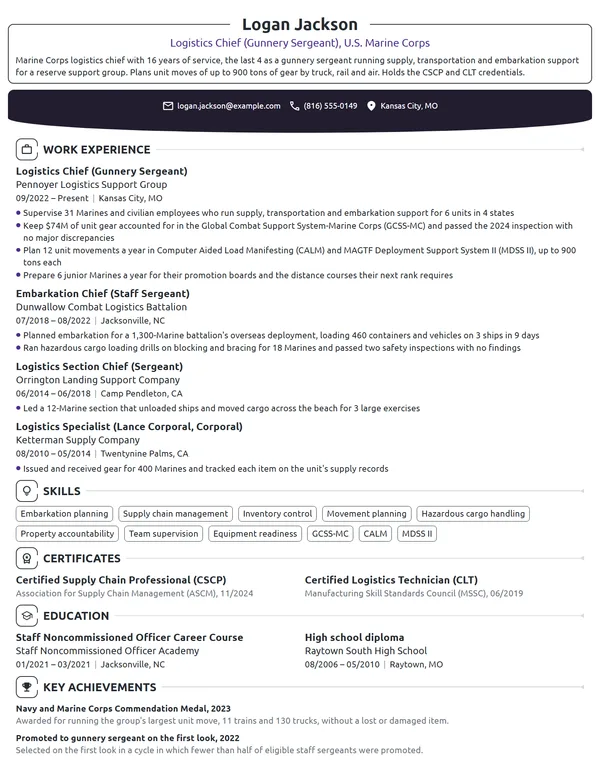
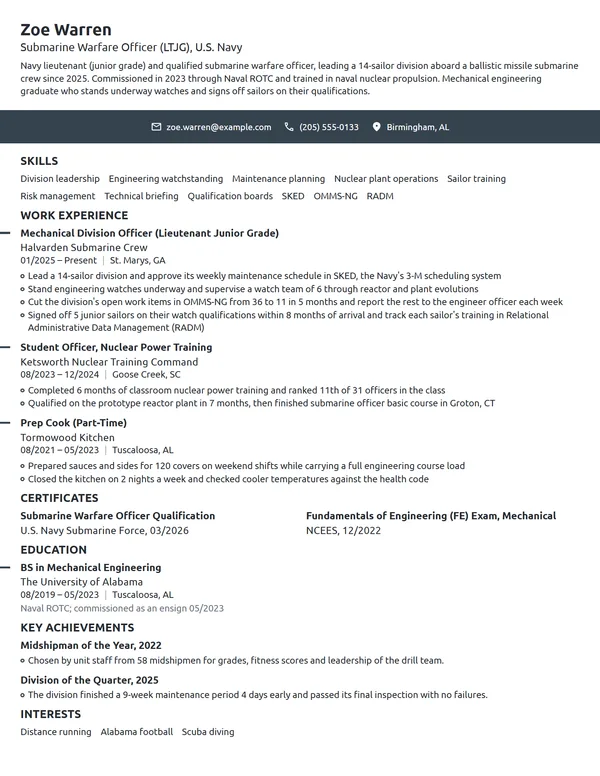
Leaving the military, the hard part is the vocabulary. O*NET OnLine's Military Crosswalk takes your code or title from any branch, from an Air Force AFSC or an Army or Marine Corps MOS to a Navy or Coast Guard rating, and shows matching civilian occupations, so you can borrow their job titles and task wording. A military-to-civilian resume then uses those titles, your rank only where it shows the size of your command, and numbers for people, equipment and budgets.
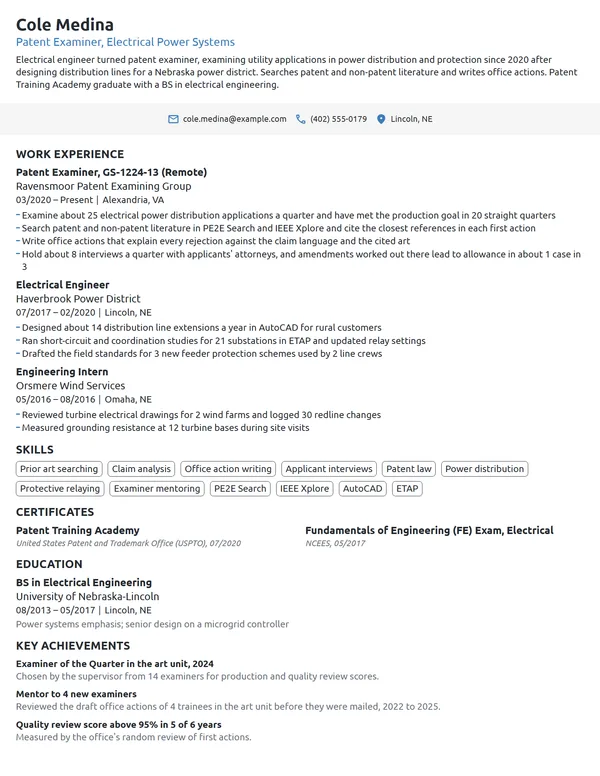
A federal job on USAJOBS follows the same American format with stricter rules. OPM's guidance says USAJOBS has limited every resume to 2 pages since September 27, 2025, and an applicant whose only resume runs longer is ineligible for the job. A federal resume also names the series and grade for any federal post and may list a current security clearance. Before you send either version, check these points:
- Titles: each job carries a US or civilian title, with the military or foreign title in parentheses only where it helps.
- Numbers: every bullet counts people, dollars, equipment or volume, in US units.
- Clearance: the level and status only, such as Secret, active, in your headline or summary.
- Length: 1 to 2 pages, with older posts cut to 1 line or left off.
- Dates: MM/YYYY on every job, with no gaps hidden by year-only dates.
Don't
Transitioning service member seeking a position where I can use my skills and leadership.
Do
Navy logistics specialist with 4 years managing a 1,900-line parts inventory at 99.2% accuracy, seeking a civilian inventory analyst role after separating in 03/2027.
Even a career-switch objective has to name the target job and the proof.
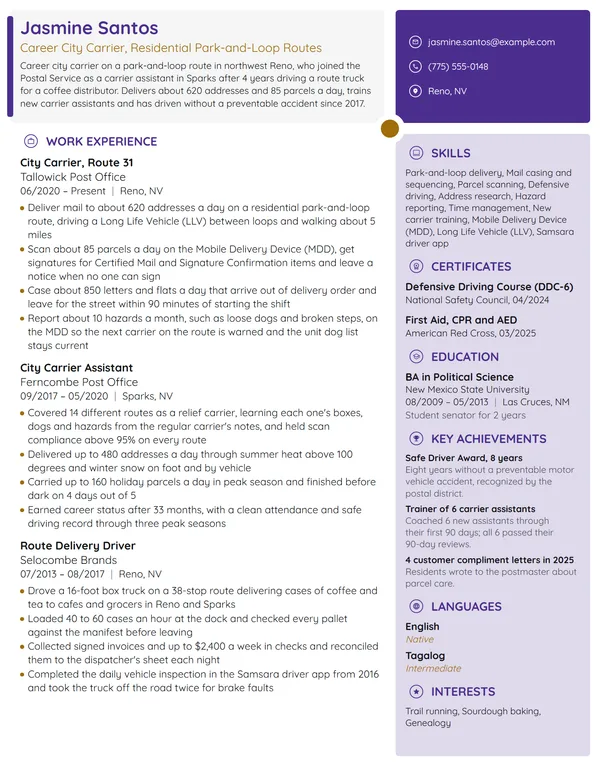
Changing fields after a move to the US or out of uniform, keep the reverse-chronological order unless your titles hide what you can do, and lead each recent job with the bullets closest to the new work. A career-change resume shows that layout. Explain the move itself in a cover letter, not on the resume: 2 or 3 sentences on why you relocated or left the service are enough.
US resume FAQ
What is the difference between a US resume and a CV?
Length and purpose. A US resume is 1 to 2 pages aimed at a single opening, with no personal details and only recent, relevant work. In the US, a CV is the long academic record used for teaching, research and medical posts, which lists every publication and position.
How long should a US resume be?
1 page if you have under 10 years of experience, and 2 pages at most for nearly everyone else. Federal applications on USAJOBS are capped at 2 pages by OPM's rule, so a longer resume from another country needs cutting, not smaller type.
Should I put a photo on a US resume?
No, unless you are applying for acting, modeling or similar work where your look is part of the job. US employers avoid photos because the EEOC advises them not to ask for one before an offer, and federal resumes leave it off too.
Do I need to list my visa status or citizenship on a US resume?
No. Your employer verifies your work authorization with Form I-9 after hiring. If your foreign history might make a recruiter wonder, add a short line such as authorized to work in the US, and leave visa type details for the application form or interview.
How do I list a foreign degree on a US resume?
Write the degree under its original name with the school, city and country, then add the US equivalent from a credential evaluation if you have one. Federal agencies require such an evaluation for education completed abroad, and many private employers ask for it too.
What date format should a US resume use?
MM/YYYY, such as 07/2021, on every job and degree. Avoid day-month order, which a US reader may misread, and avoid year-only dates, which look like you are covering a gap.
Should I include references on a US resume?
No. US employers ask for references late in the process, so keep 3 names, titles and phone numbers on a separate page and send it when asked. A line saying references are available on request only takes up space.
How do I turn military experience into a US civilian resume?
Start with the civilian titles O*NET's Military Crosswalk lists for your code, then rewrite each bullet without unit codes or jargon. Give the size of the team, the value of the equipment and the result, and put your clearance level in your summary if the job needs one.
Is a federal resume different from a regular US resume?
Yes, in a few details. It follows the same reverse-chronological layout and the same 2-page ceiling, but each federal job lists its series and grade, and every qualification the announcement asks for must be easy to find in your bullets.
Should I put my GPA on a US resume?
Only if you graduated in the last 2 to 3 years with a 3.5 or higher on the US 4.0 scale. If your grades come from another system, leave them off rather than converting them, and let the credential evaluation speak for the degree.
Next steps
Choose the example closest to your field and level, copy its layout, and rewrite every bullet with your own titles, dates and numbers in US terms. Build it in the Novoresume resume builder, or open one of the resume templates, then set the page to Letter size, and save it as a PDF before you apply.