
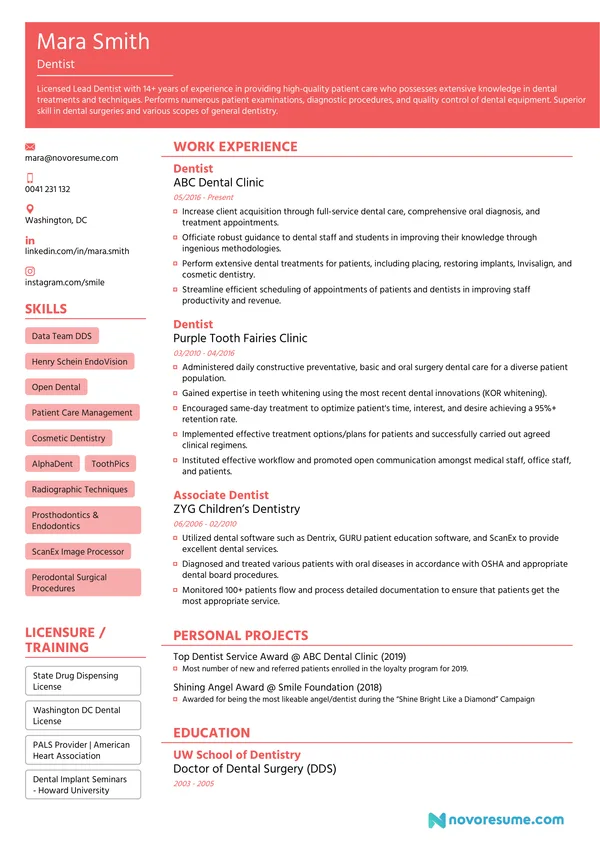
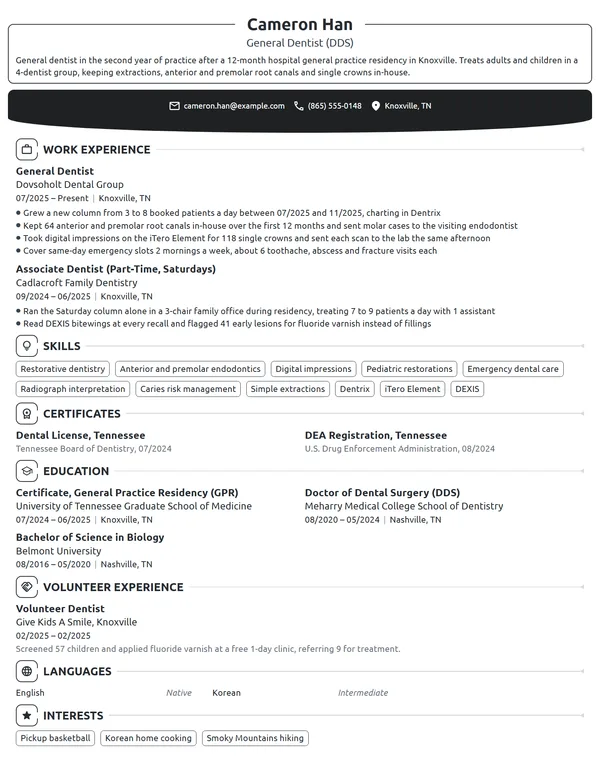
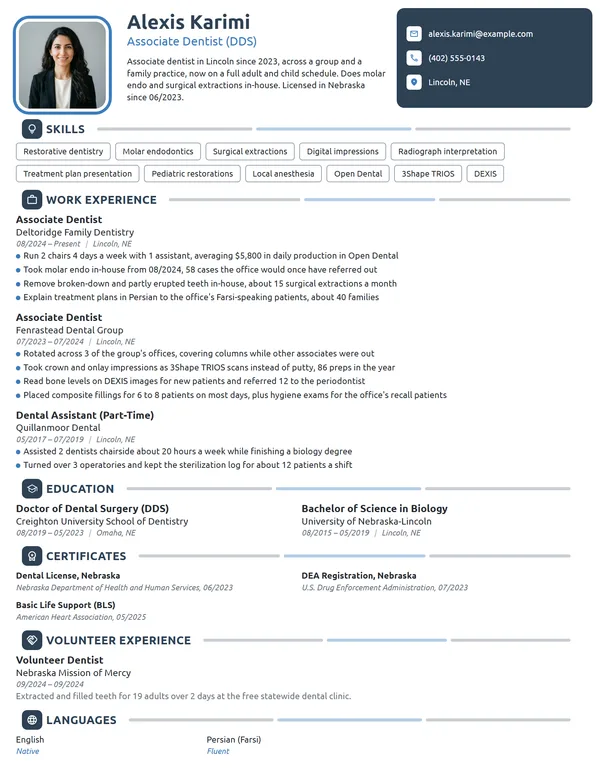
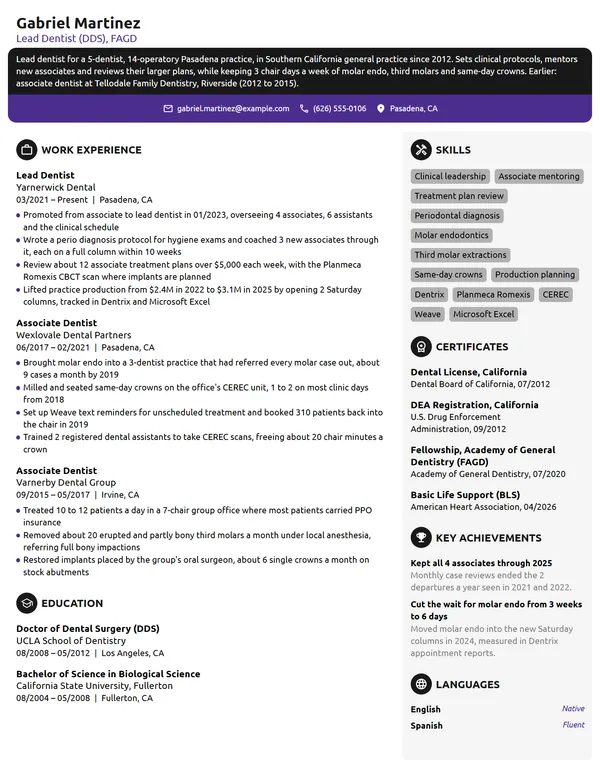
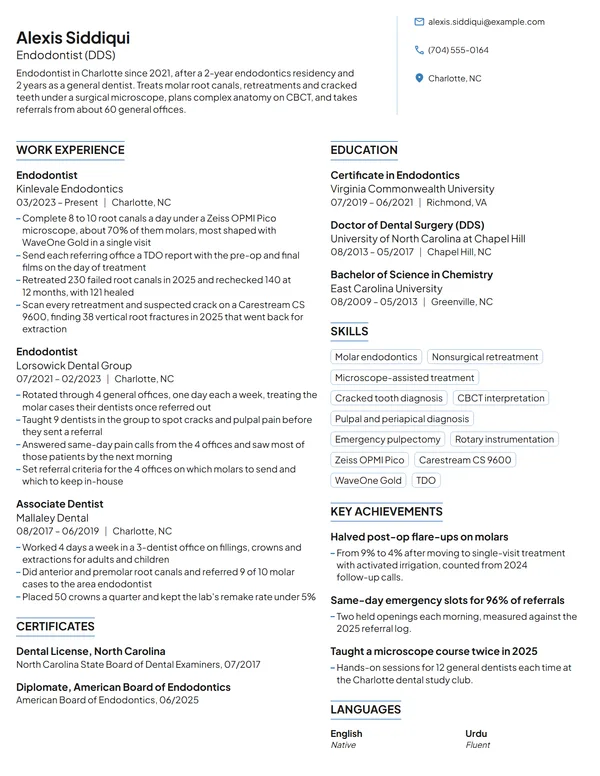
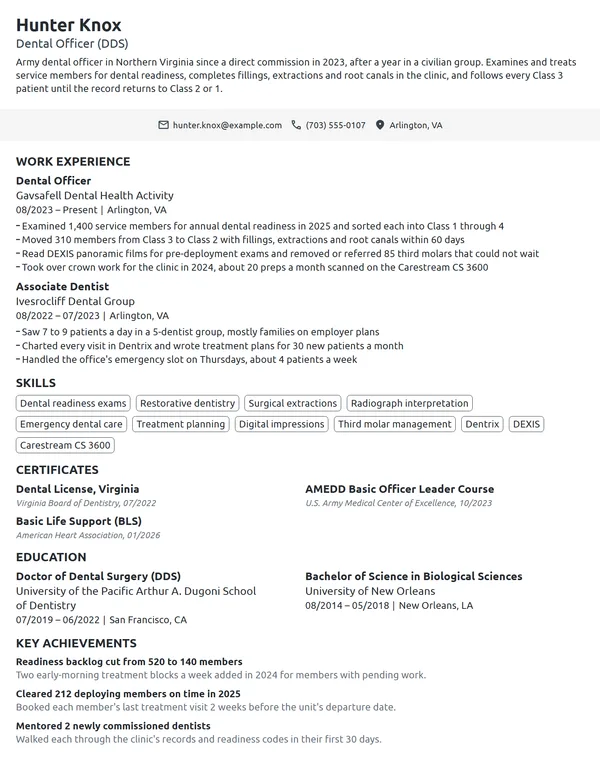
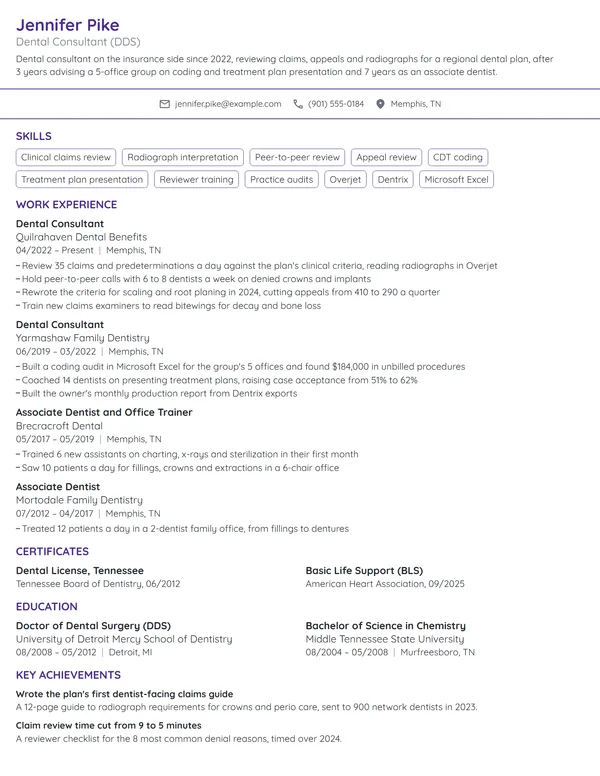
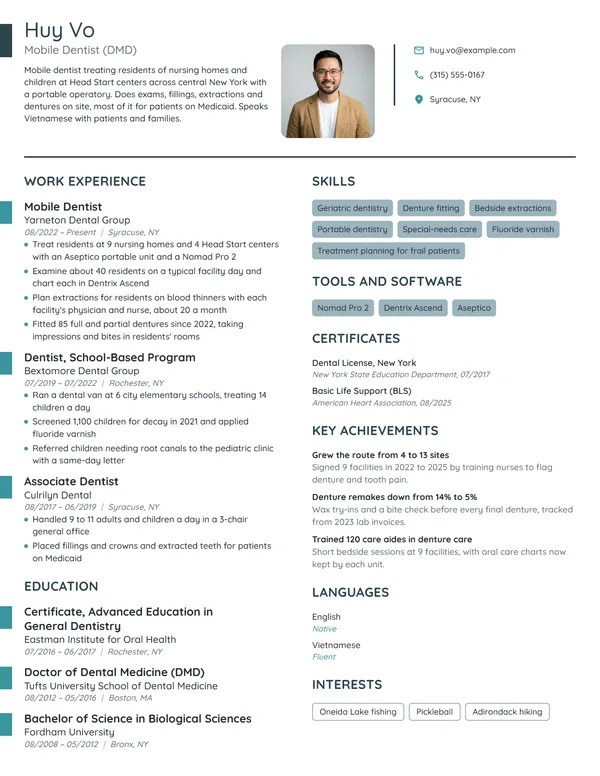
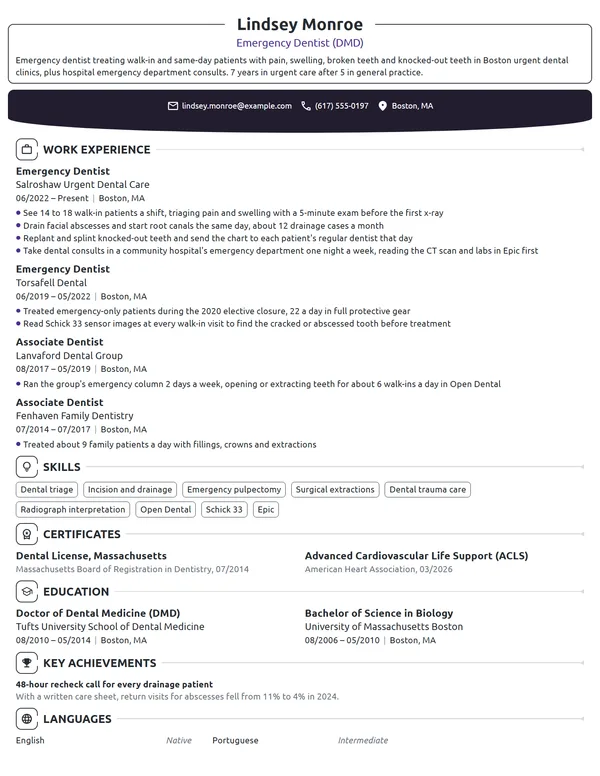
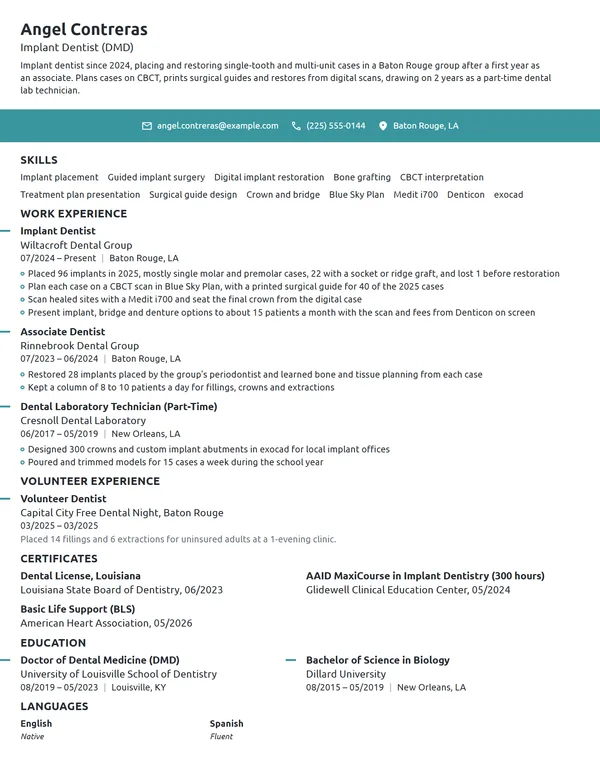
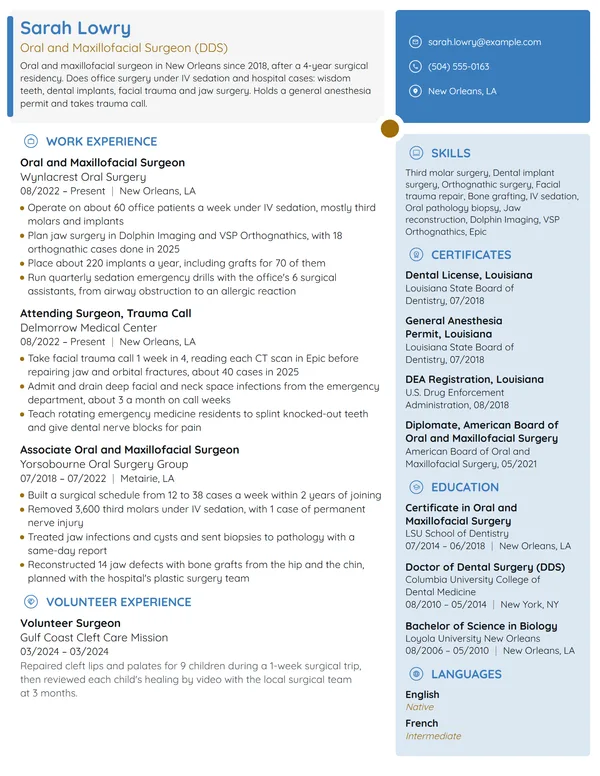
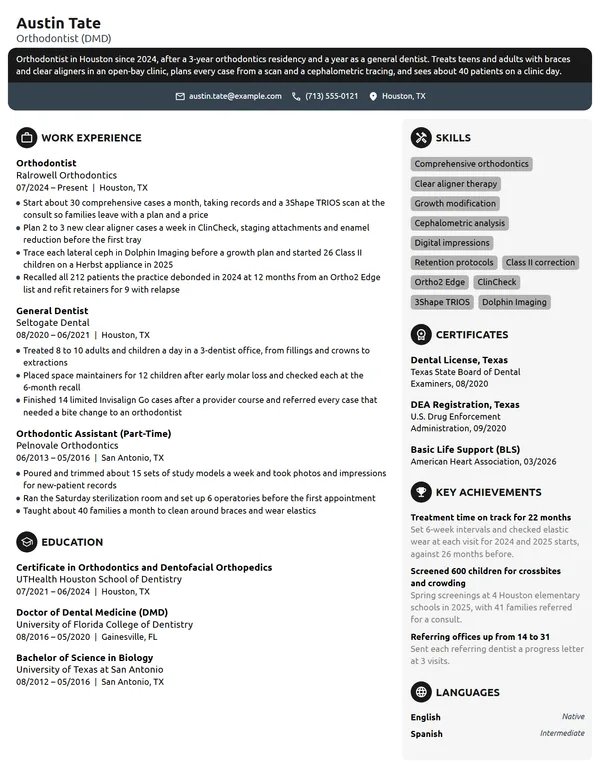
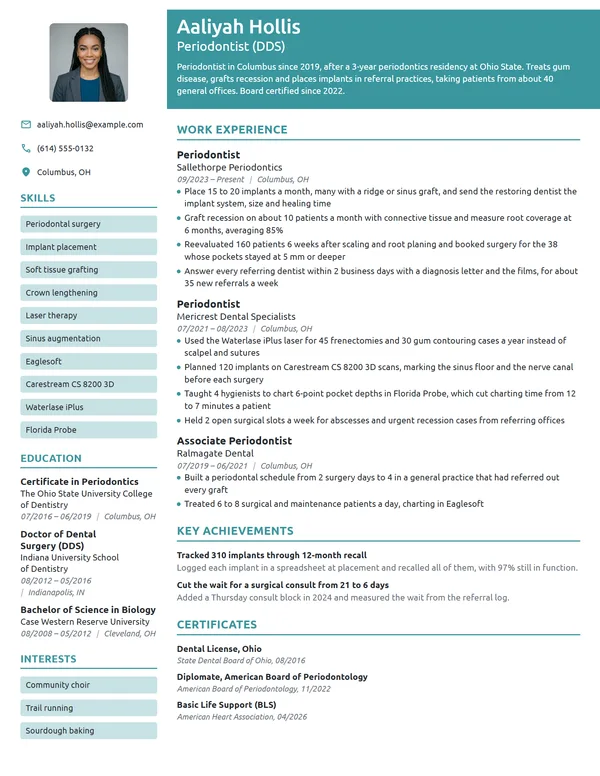
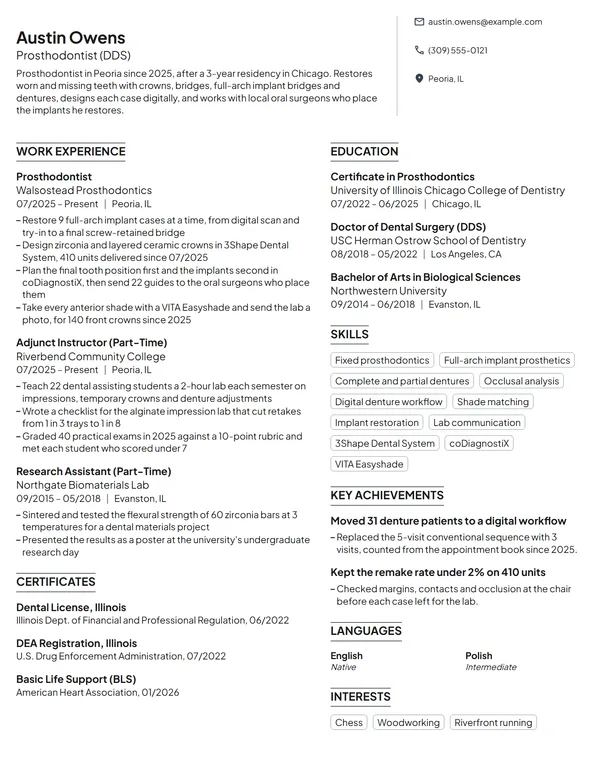
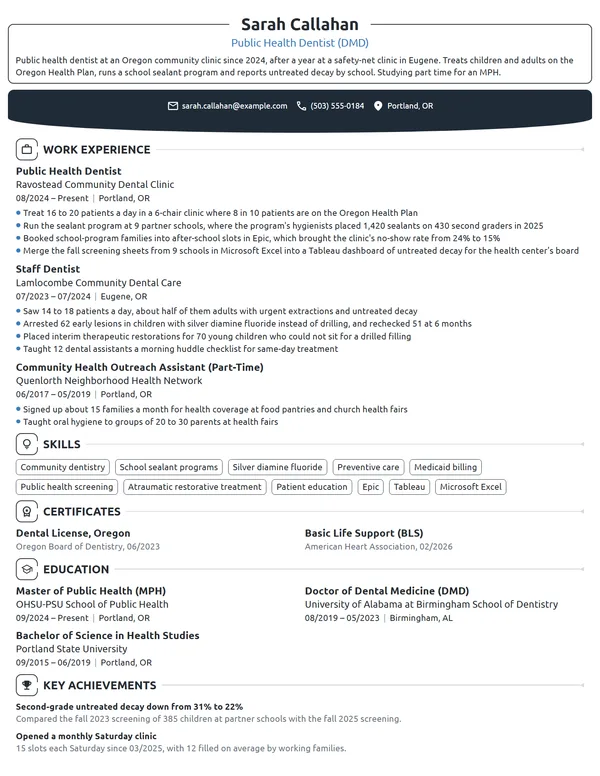
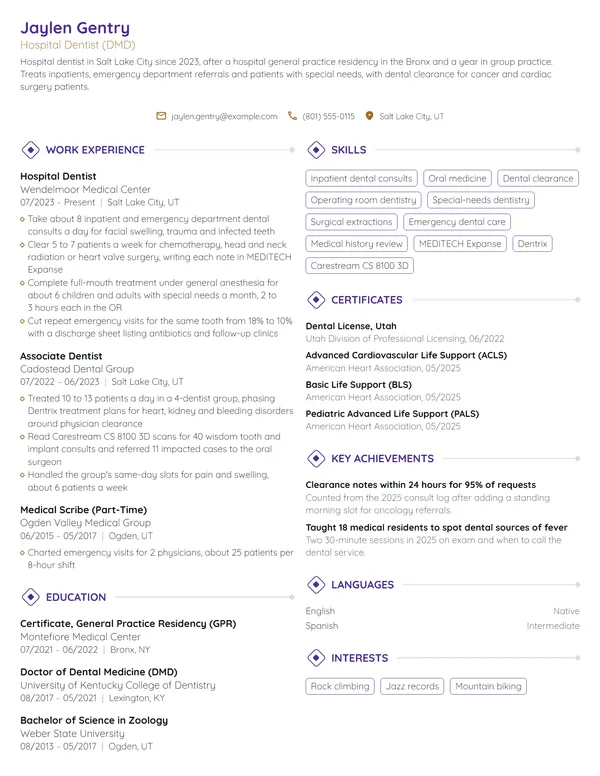
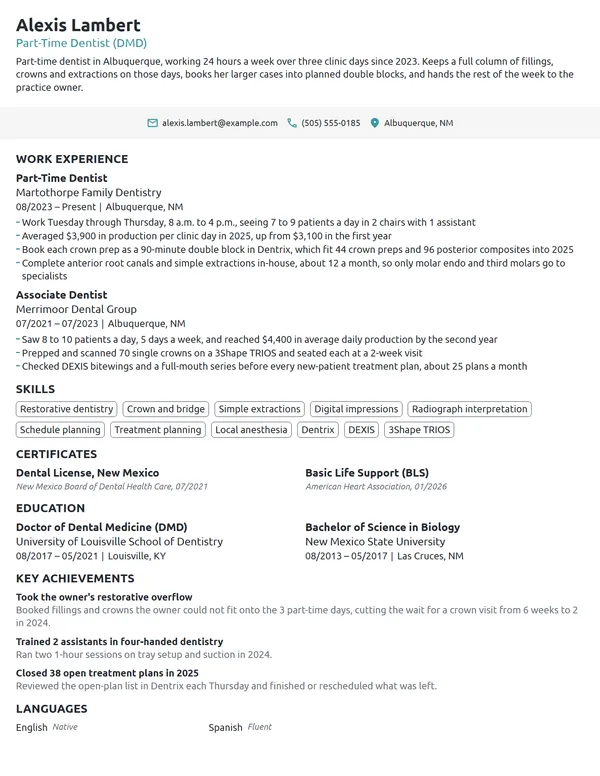
A dentist resume is read by people who know the work as well as you do. They look at what you treat without referring out, how full your schedule runs and whether you hold a license in their state. A list of procedures tells them what you were trained to do. Patient numbers, production and outcomes tell them what you actually do each week, and they carry more weight with a practice owner than any list of skills.
How to Write a Dentist Resume - Key Takeaways
- Order your jobs newest first, reverse-chronologically, on 1 page; a second page fits once you have 10+ years, a specialty residency or practice ownership.
- Put DDS or DMD in the headline under your name, exactly as your school awarded it.
- Name the procedures you complete in-house, such as molar endo, extractions or implants, so an owner knows what you would stop referring out.
- Give bullets numbers a practice already tracks: patients a day, production, case acceptance, procedures completed and recall.
- Open Certificates with your state dental license, then any sedation permit, DEA registration and BLS.
- Check the file with an ATS resume checker before you upload it to a dental group's application portal.
What practice owners look for in a dentist resume
Whoever hires you, a solo owner, a dental group or a community clinic, reads your resume for one thing above all: can you keep a chair busy and patients coming back? The Bureau of Labor Statistics lists filling cavities, examining x-rays to diagnose problems and teaching patients about diet, flossing and fluoride among a dentist's core duties. O*NET adds the business side: supervising staff and handling paperwork and insurance claims. A resume that shows the clinical work and the practice it happened in answers most of a hiring dentist's questions before the interview.
Those questions are practical. Can you take over a full column on day 1? Which cases would you keep in the building? Are you licensed here, or how soon could you be? Use these sections so each answer has an obvious place:
- Name, headline with your degree (for example, General Dentist, DDS) and contact details
- A 2 to 3 line summary right under the headline; it prints without a heading
- Work Experience, newest practice first, with its type and size
- Certificates: your dental license first, then permits, DEA registration and BLS
- Skills, including your practice management and imaging software
- Education, with any residency
- Optional: Languages, Interests, and either Key Achievements or Volunteer Experience
Best format for a dentist resume
Use the reverse-chronological resume format: newest position first, each with your title, the practice name, its city and MM/YYYY dates. Dental careers move from associate to lead or partner, or from general practice into a residency and a specialty, and this order shows that path in a few seconds. Give each employer its own entry; if you split your week between 2 offices of one group, keep 1 entry and name the second office in a bullet.
- Best for most dentistsReverse-chronologicalYour jobs, newest first, with your results under each one.Best for: A steady work history in your field
- FunctionalSkills grouped up top, with a short work history below.Best for: Gaps or very little experience
- CombinationA skills section first, then your full work history.Best for: A career change with strong skills
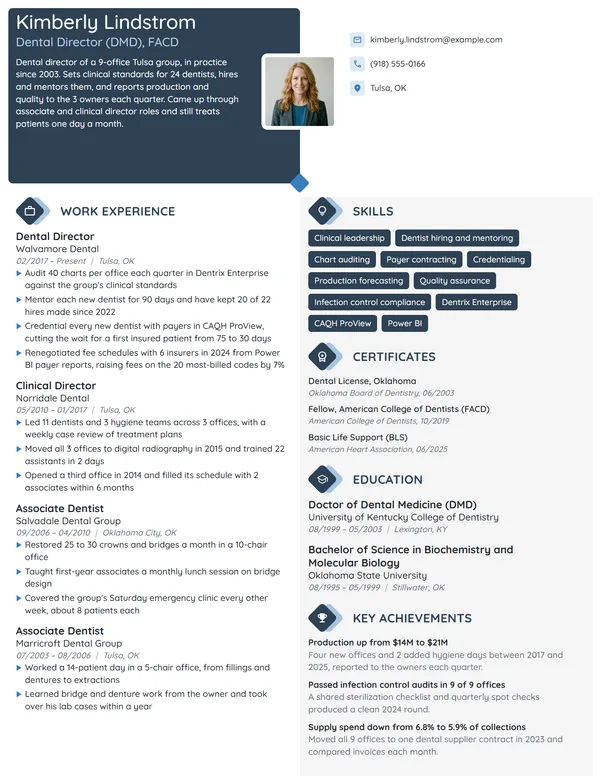
Keep a dentist resume to 1 page for your first 10 years in practice. A second page earns its place once you add a specialty residency, teaching at a dental school, practice ownership or several states of licensure, provided your license and current practice stay on page 1.
| Setting | What to use |
|---|---|
| Length | 1 page; 2 after 10+ years, a residency or ownership |
| Headline | Title plus degree: General Dentist, DMD |
| Dates | MM/YYYY for every job, license and permit |
| Practice line | Practice name and city, with its type and size in the first bullet |
| Procedures | Named in bullets with counts, never as a bare list |
| Photo and private data | A photo is rare in US and Canadian practices; leave off your birth date, marital status and SSN |
| File | A PDF named with your name and degree, unless the group's portal asks for Word |
Most US and Canadian resumes carry no photo. Patients may see your face on the practice website later, but the hiring decision rests on your license, your procedures and your numbers, so spend the space on those.
Dentist resume summary vs. objective
One test decides which to write: have you held a dental license and treated your own patients for a year or more? If yes, write a resume summary with your years, the practice types you know, what you do in-house and 1 result. If you are a new graduate, a resident or a foreign-trained dentist finishing a US program, write a resume objective instead: the role you want, your license status and your strongest clinic numbers.
Dentist resume summary formula
Title with X years in practice types, procedures you complete in-house. 1 counted result. License, permit or residency.
Example
General dentist with 7 years in group and private practice, placing implants and doing molar endo in-house. Placed and restored 260 implants since 2022. Licensed in Iowa, with a moderate sedation permit.
Don't
Caring and detail-oriented dentist committed to helping patients achieve healthy, beautiful smiles.
Do
General dentist with 5 years in a 4-chair rural office where 30% of patients use Medicaid, covering restorative, extractions and dentures. Completing the training for a moderate sedation permit so anxious patients no longer need a referral.
The second version gives the setting, the patient mix and what the dentist adds next.
How to write dentist work experience bullets with numbers
Write 3 to 4 bullets under your current position and 1 to 3 under older ones. Open the first with the practice type, its size and your daily patient load, since every later number reads against it. Then write your achievements with the figures your practice software already reports, such as production, acceptance or recall.
| Area | What to count | Example bullet |
|---|---|---|
| Patient load | Patients a day, operatories, hygiene exams | Saw 12 to 14 patients a day across 2 operatories and completed hygiene exams for 2 hygienists. |
| Production | Yearly or monthly production, days worked | Produced $1.1M in 2025 on a 4-day week, up from $860K the year before. |
| In-house procedures | Root canals, extractions, implants, referral rate | Completed 210 molar root canals in 2 years and referred fewer than 10% of endo cases out. |
| Oral surgery | Extractions, surgical cases, complications | Performed 380 extractions in 2024, including 95 surgical third molars, with 3 dry sockets. |
| Retention | Recall rate, active patients, reactivations | Moved recall scheduling into the operatory and raised the recall rate from 62% to 74%. |
| Leadership and community | Associates trained, staff, screenings | Screened 640 children at 8 schools in a sealant program run with the county health department. |
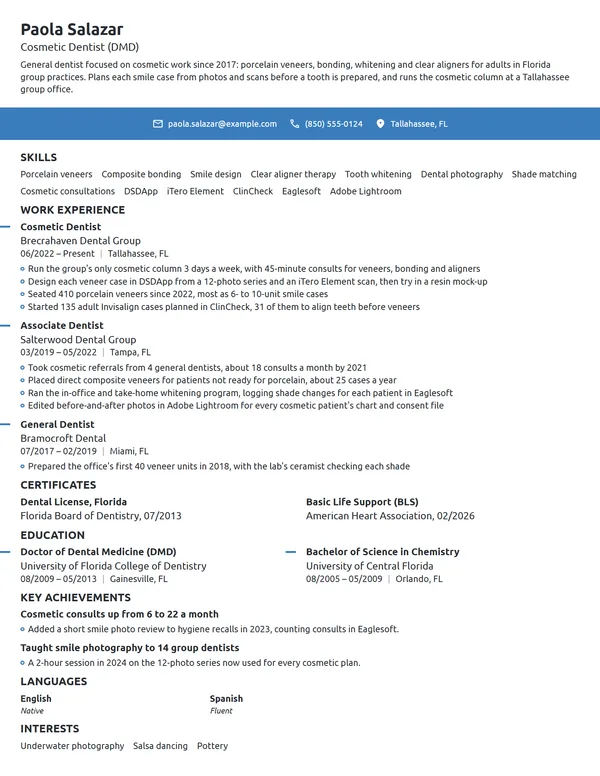
Here is one dentist's history with those numbers in place. The practice size and load come first, the results follow, and the older position keeps fewer lines.
Work Experience
- See 9 to 11 patients a day in a 6-operatory practice with 3 hygienists, from exams and fillings to crowns and molar endo.
- Raised case acceptance on treatment plans over $1,000 from 48% to 63% by presenting each plan with intraoral photos at the chair.
- Placed and restored 74 single-tooth implants in 2025, with 2 failures at the 12-month check.
- Took over 1,150 active patients from a retiring dentist and kept 88% of them past their first recall.
Don't
Performed crowns, bridges and veneers.
Do
Prepped and seated 160 crowns in 2025 from digital scans, with 2 remakes for fit.
This version shows the volume, the method and a quality check an owner understands.
Don't
Managed the dental team and office operations.
Do
Led a team of 11 and rebuilt the schedule template, cutting staff overtime from 22 to 6 hours a week.
Dental skills and practice software for your resume
Pick 6 to 8 hard skills for your resume from the job posting and keep only those a bullet proves. Restorative dentistry and local anesthesia belong on almost every dentist resume; implants, sedation, aligners or pediatric behavior management only where you do them.
Hard skills for dentists
- Restorative dentistry
- Local anesthesia
- Crown and bridge
- Endodontics (anterior and molar)
- Simple and surgical extractions
- Implant placement and restoration
- Removable prosthodontics
- Digital impressions
- Radiograph interpretation
- Treatment planning
Soft skills practice owners value
- Chairside manner with anxious patients
- Plain-language case presentation
- Steady hands and fine detail
- Leading assistants and hygienists
- Time management on a full column
- Patience with children
Name your practice management system with your skills, then prove it in a bullet that shows what you did in it. O*NET flags Henry Schein Dentrix and eClinicalWorks EHR software as hot technologies for general dentists, along with Microsoft Office and Excel. Many offices run Eaglesoft or Open Dental instead, so copy the posting's spelling. Name your intraoral scanner, imaging software or milling unit there too, and give each one a bullet with a count.
Dental license, DEA registration and sedation permits on a resume
The BLS states that dentists must be licensed in the state where they work and that requirements vary by state. The ADA names 3 basic requirements: the dental degree, a written exam, which every US jurisdiction sets as the Integrated National Board Dental Examination (INBDE), and in most jurisdictions a clinical assessment. Add the permits your state board issues for sedation, and your DEA registration, which the DEA requires separately in each state where you prescribe controlled substances. List certifications on your resume below the license line, each with its issuer and the month it was granted.
| Credential | Issued by | What it takes |
|---|---|---|
| State dental license | The state's dental board, such as the Iowa Dental Board | A DDS or DMD from an accredited program, the INBDE and, in most states, a clinical exam; for a license by exam, Iowa accepts a clinical exam passed within the previous 5 years. |
| INBDE | Joint Commission on National Dental Examinations (JCNDE) | A 2-day exam, given since 08/2020; it replaced NBDE Part I (last given 07/2020) and Part II (last given in 2022). |
| Moderate sedation or general anesthesia permit | The state's dental board | Training and an application under state rules; Iowa issues both permits and needs none for minimal sedation. |
| DEA registration | U.S. Drug Enforcement Administration | A state license first, and a separate registration in each state where you prescribe. |
| Fellowship, Academy of General Dentistry (FAGD) | Academy of General Dentistry | 3 continuous years of AGD membership, 500 hours of approved continuing education and the Fellowship Exam. |
Specialist title or focus area: how to word it
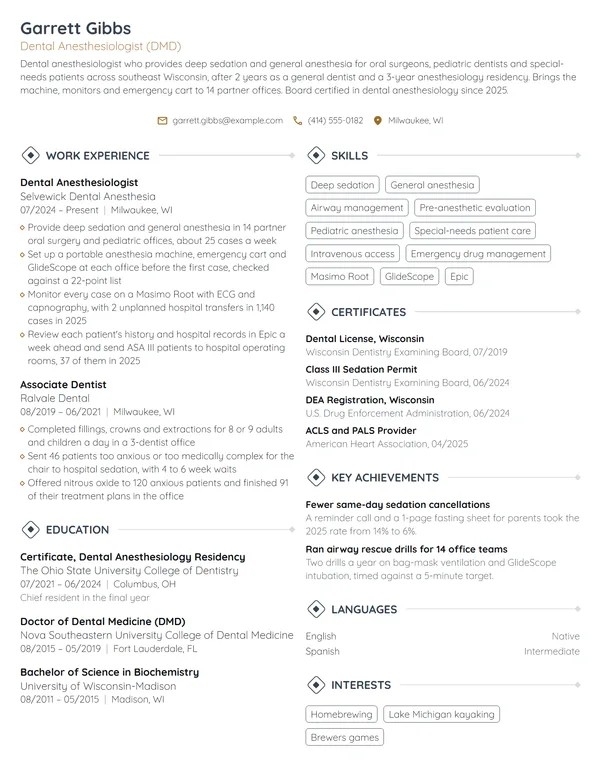
The National Commission on Recognition of Dental Specialties and Certifying Boards recognizes 12 specialties, from endodontics and periodontics to pediatric dentistry and prosthodontics. Cosmetic and implant dentistry are not among them. Use a specialty title such as Endodontist only after its accredited residency, which the BLS says usually runs 2 to 4 years. A general dentist with a cosmetic practice writes General Dentist with the focus in the summary, or Cosmetic Dentist as the role an employer gave you.
Certificates
- Dental License, Iowa, Iowa Dental Board, 06/2019
- Moderate Sedation Permit, Iowa Dental Board, 04/2023
- DEA Registration, Iowa, U.S. Drug Enforcement Administration, 07/2019
- Basic Life Support (BLS), American Heart Association, 03/2026
How to list a DDS or DMD, residency and specialty training
The BLS notes that dentists typically need a DDS or DMD from an accredited dental program, and most programs want a bachelor's degree first, in no required major. The ADA's patient site says both degrees carry the same education and that each university chooses which one it awards. Write your degree exactly as your school named it, and use that same abbreviation in your headline.
Follow the standard order for listing education on a resume: degree, school, city and month of graduation, newest first. A general practice residency (GPR) or an Advanced Education in General Dentistry (AEGD) program, both accredited by the Commission on Dental Accreditation, goes in Education with its dates. New York requires one: every applicant for initial licensure must complete an approved dental residency of at least 1 year.
Education
New grad and career-change dentist resumes
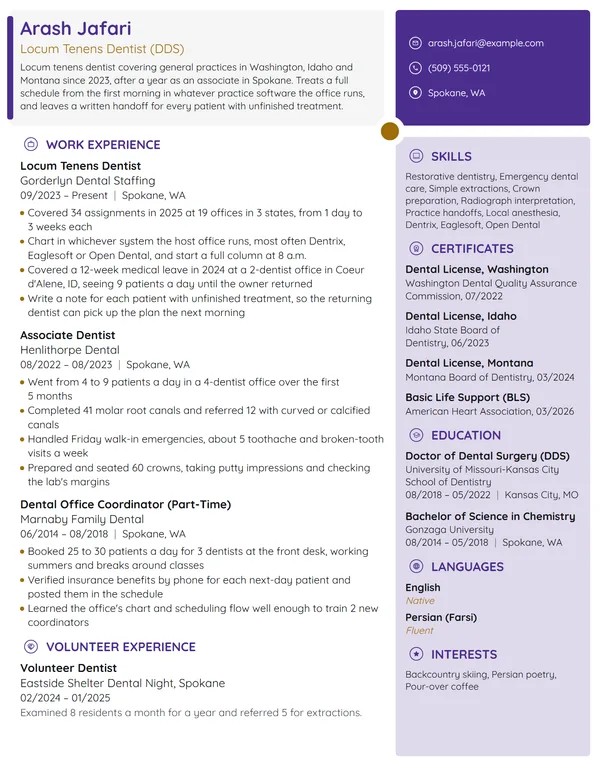
Fresh out of dental school, open with an objective stating the role you want and your license status: INBDE passed, clinical exam scheduled or license issued, with the month. Your clinic numbers do the work a practice history would, so count them. If you are still applying to dental school, start from the entry-level resume layout instead.
- Clinic requirements: restorations, crowns, extractions, dentures and root canals completed in the student clinic, with counts.
- Community rotations: the clinic type, its city and the weeks you spent there.
- Dental assistant or hygienist jobs: a full Work Experience entry with patients a day and the software you used.
- Mission trips and screening events: under Volunteer Experience, with the number of patients you treated or screened.
Don't
Recent dental graduate seeking an associate position where I can grow my clinical skills.
Do
DDS graduate (05/2026) seeking an associate role in a family practice. INBDE passed; clinical exam scheduled for 11/2026. Completed 120 restorations and 35 extractions in clinic after 2 years as a dental assistant.
A new graduate's objective still needs proof: a license status with a date, clinic counts and any chairside history.
Career changes in dentistry usually run one of 2 ways: from hygienist or assistant to dentist, or from private practice into public health, teaching or a dental group's leadership. In both, stay with reverse-chronological order, lead with the new degree or role, and cut older bullets to what carries over, such as patient volume, team leadership or treatment you planned. The career-change resume examples show that layout, and a short cover letter explains the move; the healthcare cover letter examples show where that explanation goes.
Dentist resume FAQ
Should I put my dental license number on my resume?
No. Write Dental License, the state, the issuing board and the month it was issued. Employers verify licenses with the board directly, and the number has no use on a file that passes through recruiters and portals.
Should I write DDS or DMD on my resume?
Write the one your school awarded, in your headline and your Education entry. The ADA says both degrees carry the same education and that each university chooses the name, so neither reads as stronger to an employer.
How do I list the INBDE or NBDE on a dentist resume?
Only as a new graduate, with the month you passed, in your objective or under Certificates. Once you hold a license, the license line replaces it. If you tested during the switch, which ran from 08/2020 to the last NBDE Part II in 2022, write each exam by the name you passed it under.
Can I call myself a cosmetic dentist on my resume?
Yes, as a job title an employer gave you, or as a focus in your summary. Cosmetic dentistry is not one of the 12 specialties the National Commission recognizes, so never describe yourself as a specialist in it; let your veneer, whitening and smile design counts show the depth.
How long should a dentist resume be?
1 page for new graduates, associates and most general dentists. Move to 2 pages after 10+ years, a specialty residency, faculty work or practice ownership, keeping your license and current practice on page 1.
Should a new dentist list an AEGD or GPR residency?
Yes. List it under Education with the program, the sponsoring hospital or school and its dates, and put its case counts in a bullet. In New York, a residency of at least 1 year is required for initial licensure, so employers there look for it first.
How do I show production numbers on a dentist resume?
Round them and give the base: yearly production, the days a week you worked and the change against an earlier year. If your contract or the owner treats exact figures as private, use percentages such as a rise in case acceptance or recall instead.
What is the average salary for a general dentist?
BLS wage data put the median for general dentists at $170,950 a year in May 2025. Pay depends on your state, the practice model and how you are paid, by the day or as a share of collections; leave it off your resume and raise it once an offer is on the table.
Next steps
Choose the example closest to your practice and stage, keep its structure, and swap in your own procedures, patient load, license and numbers. Build it in our resume builder, or take one of our templates as the base, then send it with a short cover letter naming the practice and what you would bring to its schedule.