
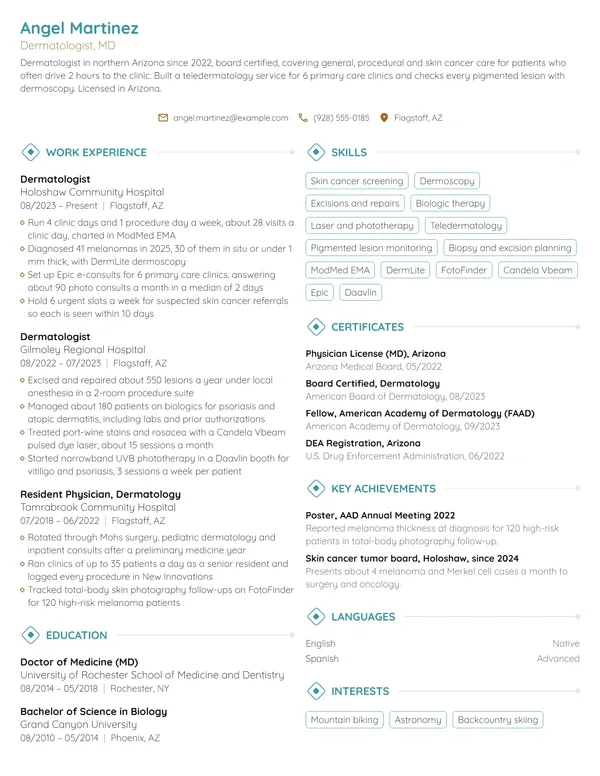
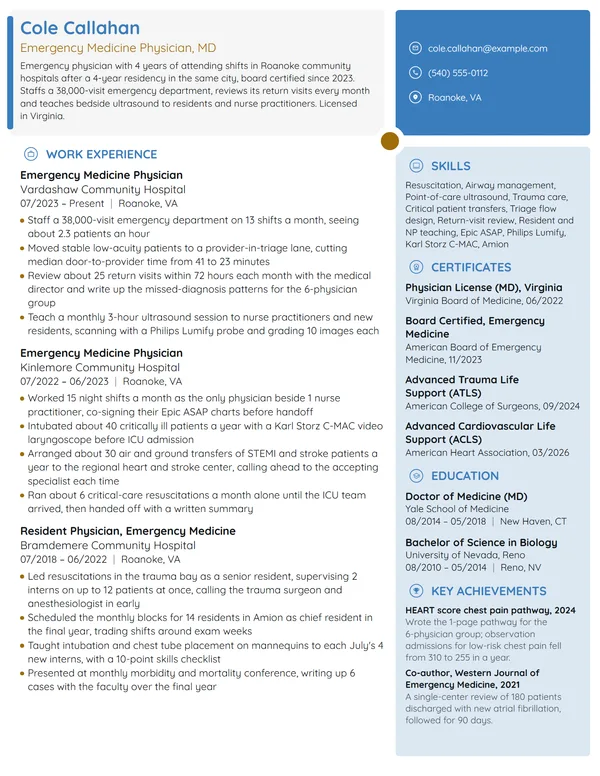
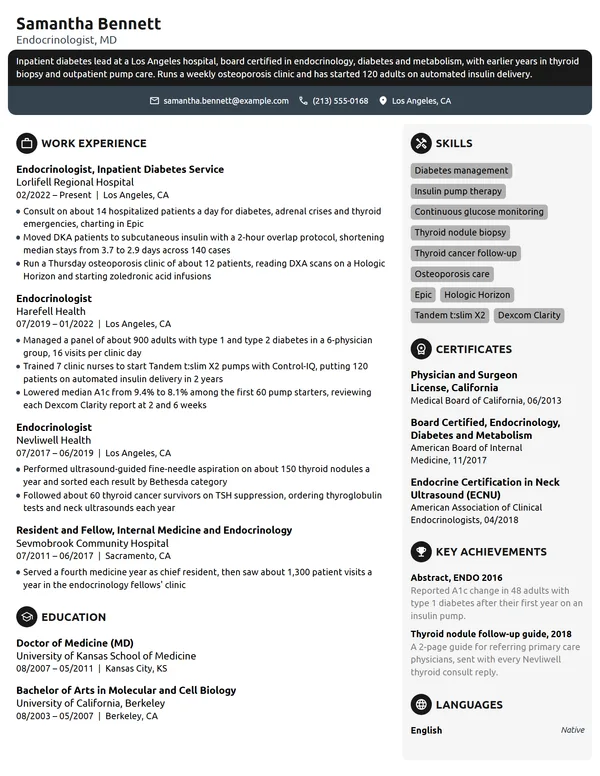
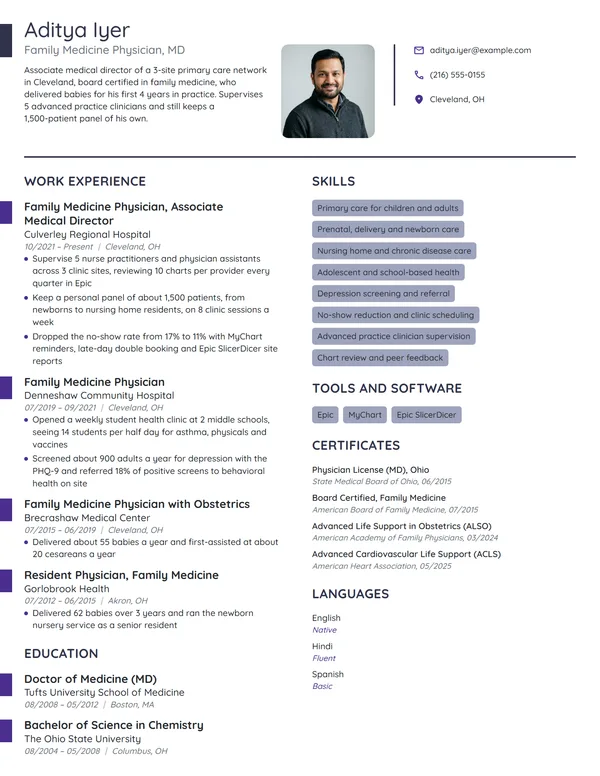
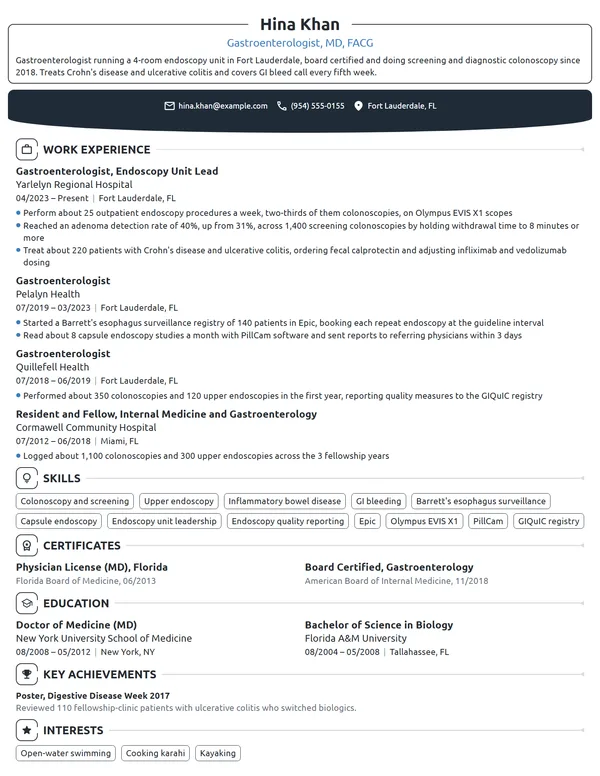
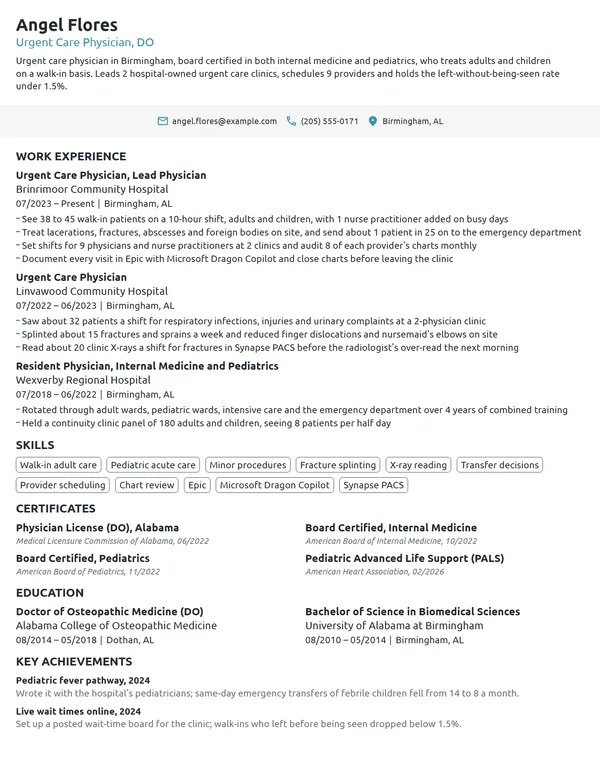
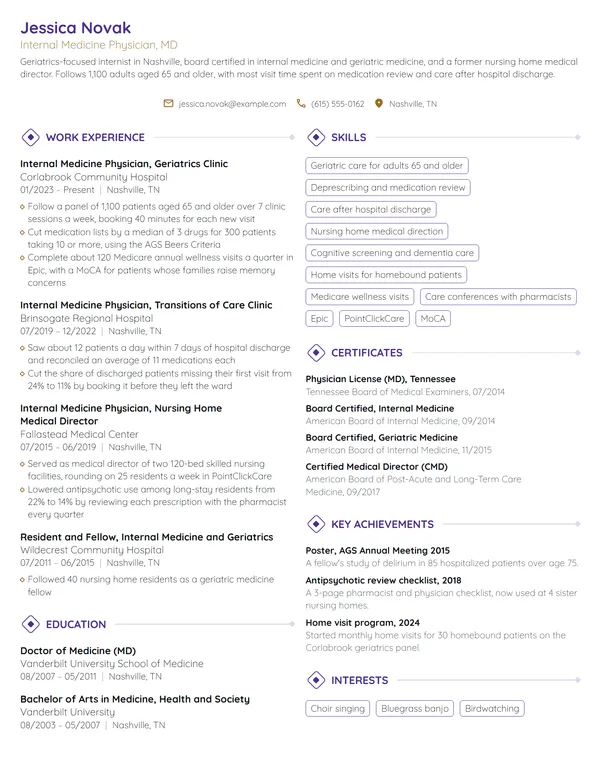
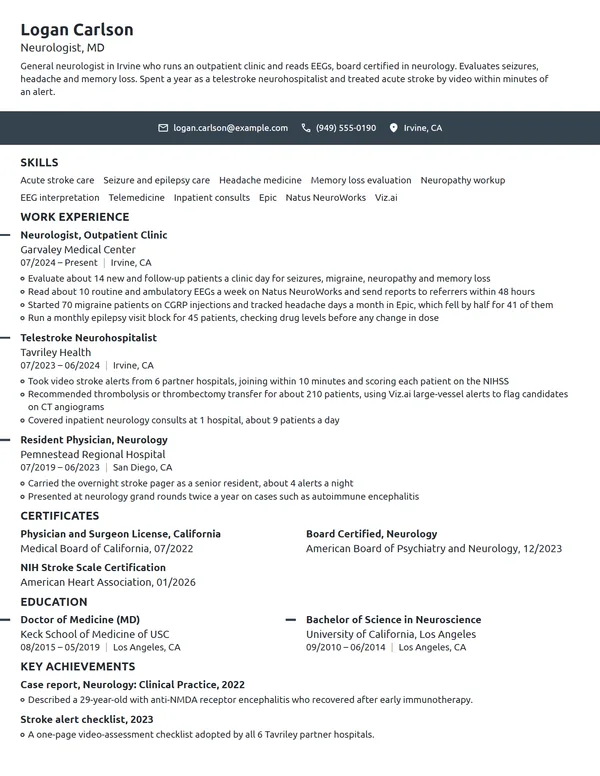
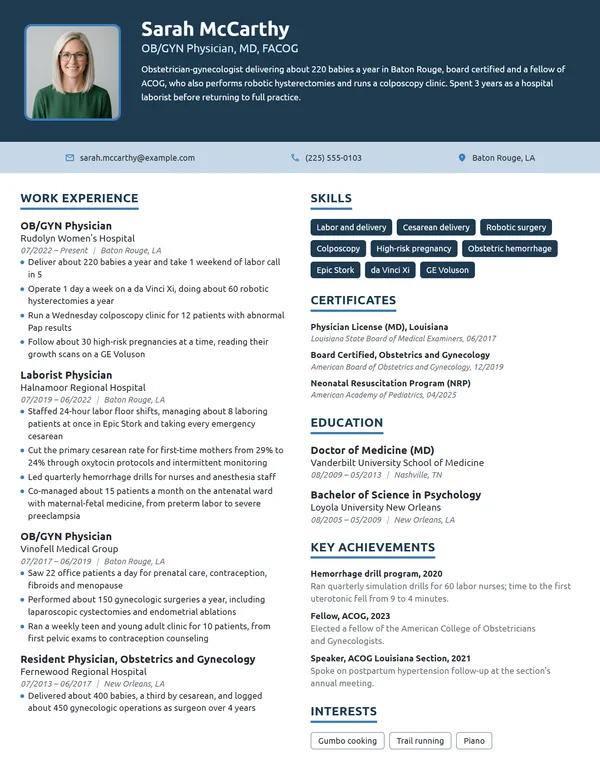
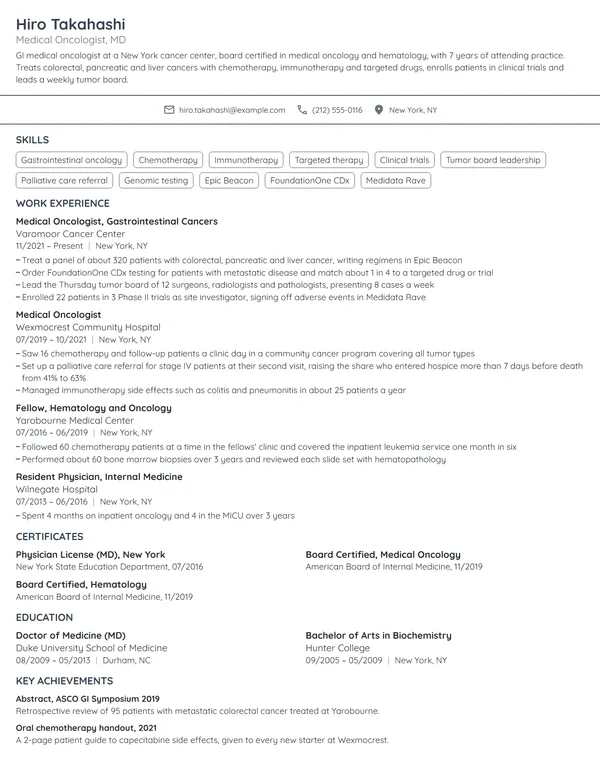
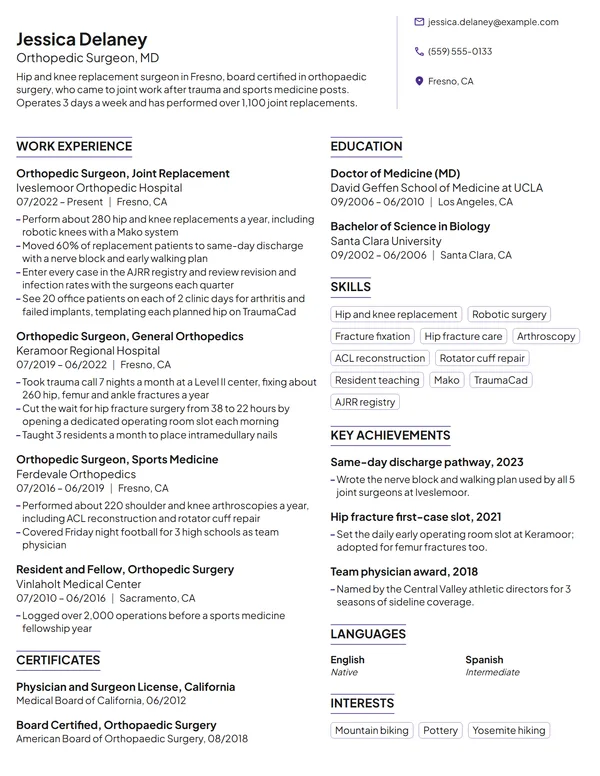
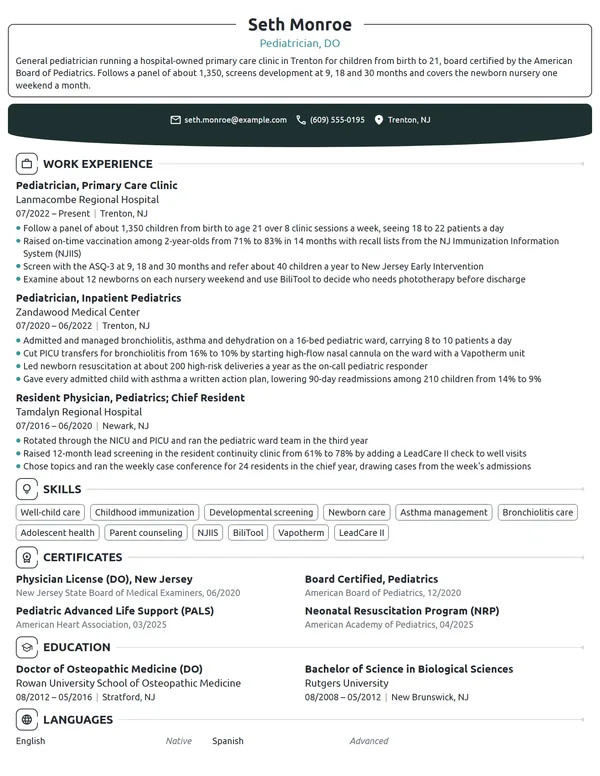
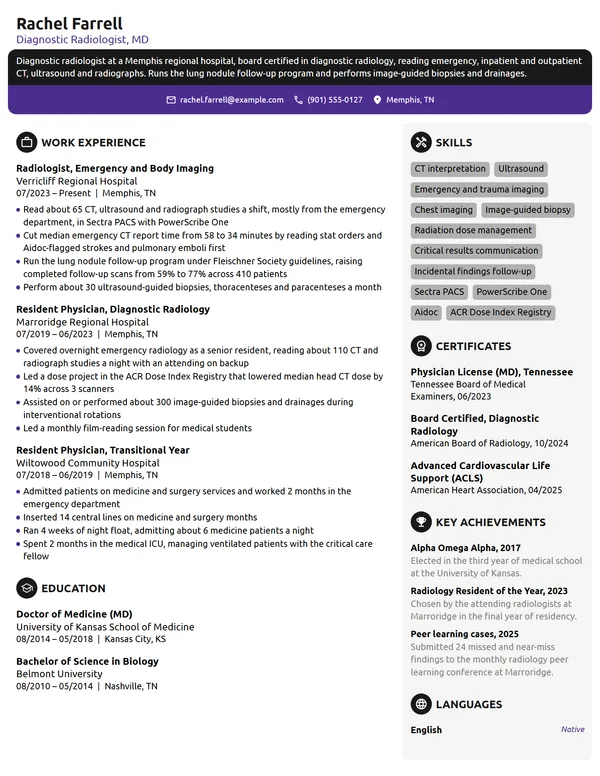
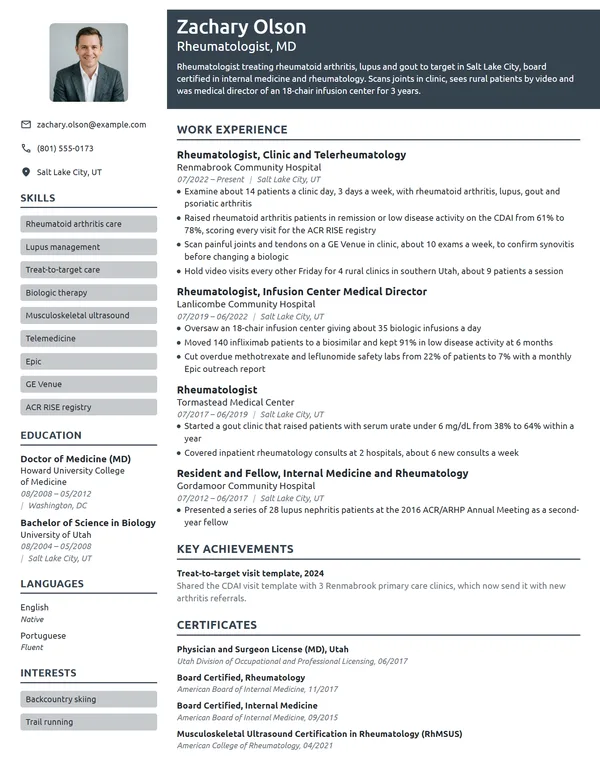
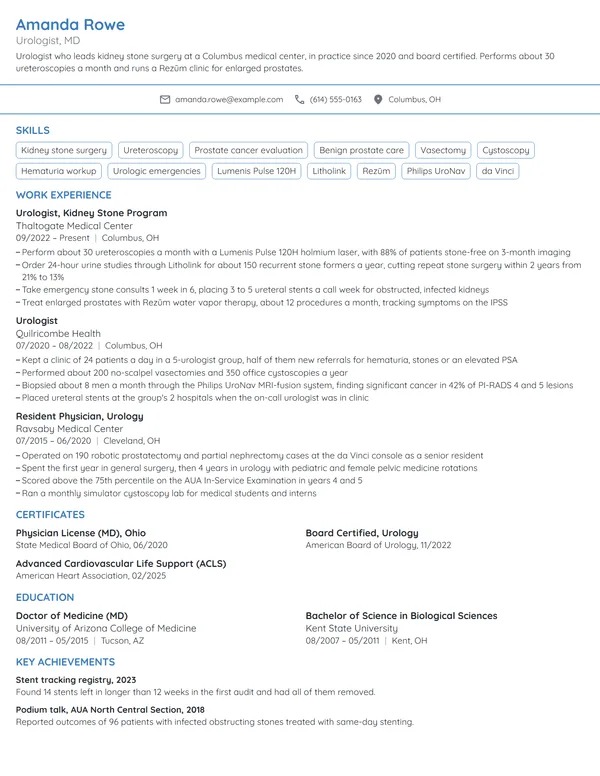
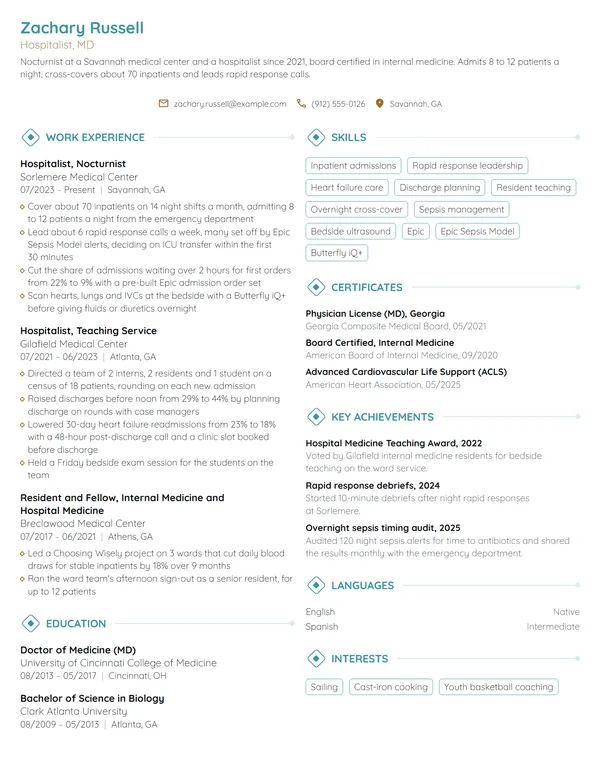
A doctor resume is a shorter document than the academic CV you built through medical school and residency. A hospital or group hiring a physician wants 4 answers fast: your specialty, the states you are licensed in, your board status and how many patients you see. Years of rotations, posters and committee work can bury those answers. Put them at the top, give every job a patient count and a quality result, and keep the full research record for the posts that ask for it.
How to Write a Doctor Resume - Key Takeaways
- List jobs newest first in a reverse-chronological layout, kept to 1 page through residency and early practice and 2 pages once you have 10+ years or a publication record.
- Write your specialty and degree in the headline, such as Family Medicine Physician, MD.
- List residency and fellowship as Work Experience entries, with the program's hospital, city and dates.
- Give each job a volume figure (patients a day, panel size or census) and 1 quality result with its before and after.
- Put your medical license first under Certificates, then board certification in the board's exact wording, DEA registration and ACLS.
- Run the file through an ATS resume checker, since health system portals screen for specialty, license state and board terms.
What physician recruiters look for in a doctor resume
A physician recruiter screens first, then a medical director or department chair decides, and credentialing staff check every license and date later. The Bureau of Labor Statistics lists taking a patient's history and doing a physical exam, reviewing test results to find abnormal findings, and designing and carrying out a treatment plan as core physician duties. O*NET adds referring patients to specialists and directing nurses, students and other medical staff.
Your resume has to show those duties at the volume and in the setting the practice runs: clinic or hospital, adult or pediatric, academic or community. Build it from these sections:
- Name, headline with specialty and degree (for example, Internal Medicine Physician, DO) and contact details
- A 2 to 3 line profile under your name
- Work Experience: attending jobs, then fellowship and residency, newest first
- Certificates: your medical license first, then board certification, DEA registration and life support courses
- Education: MD or DO, then your bachelor's degree
- Skills, including the EHR you chart in
- Optional: Key Achievements for 1 to 3 publications or honors, Volunteer Experience, Languages you use with patients
Best format for a doctor resume
Use the reverse-chronological resume format: your current post first, each with the job title and specialty, the hospital or practice and its city, and start and end dates as MM/YYYY. A physician's path runs in fixed stages from residency to fellowship to attending, and this order lets a medical director see where you trained and what you do now in a few seconds. Moonlighting or locum shifts during training go in a bullet under the residency, not as separate jobs.
- Best for most doctorsReverse-chronologicalYour jobs, newest first, with your results under each one.Best for: A steady work history in your field
- FunctionalSkills grouped up top, with a short work history below.Best for: Gaps or very little experience
- CombinationA skills section first, then your full work history.Best for: A career change with strong skills
Keep a resume for a clinical post to 1 page while you are in training or in your first years as an attending. A second page fits once you have 10+ years, leadership roles such as medical director, or publications a hiring committee will read. Academic and research posts ask for a full CV instead, with every paper, grant and presentation.
| Setting | What to use |
|---|---|
| Length | 1 page through early practice; 2 pages with 10+ years or leadership roles |
| Headline | Specialty plus degree, such as Pediatrician, MD or Hospitalist, DO |
| Residency and fellowship | Work Experience entries naming the hospital, its city and the start and end months |
| Dates | MM/YYYY on every job and credential, with Present for your current post |
| Typeface | One clean sans serif for the body, about 10.5 to 12 pt, with bold only for job titles |
| Personal details | Skip birthdays, marital status and Social Security numbers |
| File | A PDF named with your name and specialty, unless the recruiter's portal asks for Word |
Most US and Canadian resumes carry no photo. Large health systems load physician resumes into the same applicant tracking systems they use for every other hire, so plain section headings help your license and board terms land in the right fields.
Doctor resume summary vs. objective
Once you have finished training, write a resume summary: your specialty, board status, setting, patient volume and 1 result. While you are still a resident or fellow, a resume objective works better, because the reader needs your finish date and the post you want before anything else. End either one with the states you are licensed in.
Doctor resume summary formula
Board status specialty physician (MD or DO) with X years in setting. Panel size or patients a day. 1 quality, access or teaching result, as a figure. Licensed in state or states.
Example
Board-certified family physician (MD) with 5 years in outpatient primary care. Cares for a panel of 1,900 patients of all ages. Raised colorectal cancer screening from 58% to 71% in 2 years. Licensed in Missouri.
Don't
Dedicated physician committed to delivering compassionate, high-quality care to every patient.
Do
Hospitalist (DO), board certified in internal medicine, covering 16 to 18 inpatients a shift at a 300-bed teaching hospital. Cut average length of stay for pneumonia admissions from 5.2 to 4.4 days.
This version names the setting, the census and a result the hospital already measures.
How to write doctor work experience bullets with numbers
Your current post takes 3 to 4 bullets; earlier posts take up to 4, fewer as they age. Open with volume, such as patients a day, panel size or inpatient census, since a medical director reads every other number against it. Then add results from the measures your practice already reports: screening and control rates, readmissions, wait times, wRVUs or residents trained. Write each as an achievement on your resume, with the before, the after and the time it took.
| Area | What to count | Example bullet |
|---|---|---|
| Productivity | Patients a day, panel size, wRVUs against target | Saw an average of 19 patients a day and finished the year at 5,400 wRVUs, 108% of target. |
| Quality measures | Screening rates, blood pressure and diabetes control | Raised blood pressure control among hypertensive patients from 64% to 75% in 18 months. |
| Hospital care | Census, length of stay, 30-day readmissions | Lowered 30-day readmissions for COPD patients on the hospitalist service from 19% to 14%. |
| Procedures | Procedures a year, by type | Performed 120 joint injections and 45 skin biopsies a year in clinic. |
| Access | Days to a new-patient visit, same-day slots | Cut the wait for a new-patient appointment from 34 to 12 days by adding 2 evening sessions a week. |
| Teaching and leadership | Residents and students precepted, committees chaired | Precept 4 residents a week and chair the clinic's 9-member quality committee. |
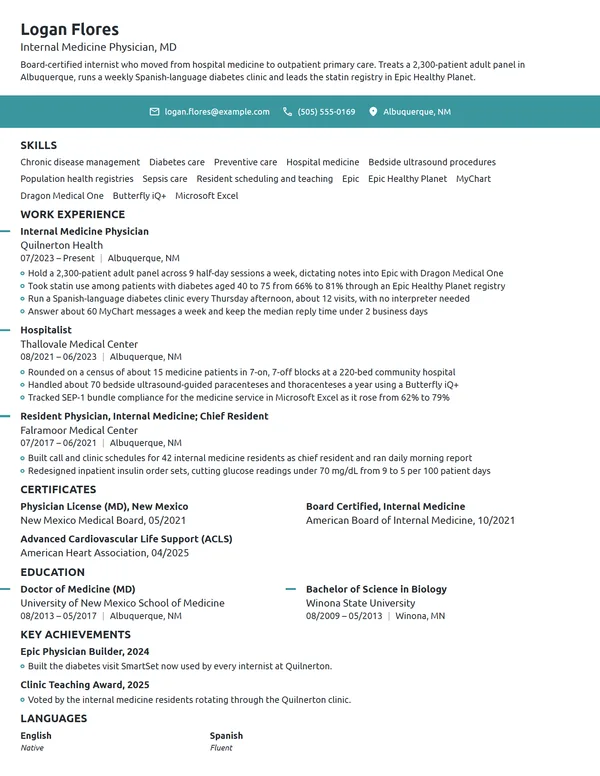
This is how a family physician's entry reads with volume first and quality results after it. The residency stays below as its own entry, with fewer lines.
Work Experience
- See about 21 patients a day across a panel of 1,900 adults and children, holding same-day slots for acute visits.
- Raised the clinic's colorectal cancer screening rate from 58% to 71% in 2 years with a nurse-led outreach list.
- Lifted the share of diabetic patients with an HbA1c under 8% from 63% to 74% after starting quarterly group visits.
- Teach 6 third-year medical students a year on 4-week family medicine rotations.
- Managed up to 10 inpatients a day on the family medicine service and performed 40 deliveries under supervision.
Don't
Saw patients in the clinic.
Do
Saw 22 to 24 patients a day in a 4-provider rural clinic, covering same-day sick visits and annual wellness exams.
Volume and setting tell a practice whether you can carry its schedule.
Don't
Responsible for supervising residents.
Do
Supervised 3 second-year residents on night float, reviewing every admission note before the 7 a.m. handoff.
Clinical skills and EHR software for a doctor resume
Pick 6 to 8 hard skills for your resume from the posting and keep only those a bullet backs up. Chronic disease management and preventive care belong on a primary care resume; procedural skills, ventilator management or a named imaging modality belong only where your specialty uses them.
Hard skills for doctors
- Diagnosis and treatment planning
- Physical examination
- Chronic disease management
- Preventive care and screening
- Interpreting labs and imaging
- Medication management
- In-clinic procedures
- Hospital admissions and discharges
- Care coordination and referrals
- Clinical documentation and E/M coding
Soft skills medical directors value
- Plain-language explanations for patients
- Shared decision-making
- Leading the care team
- Composure in emergencies
- Teaching residents and students
- Cultural humility
Name the EHR you chart in under Skills and again in a bullet that shows what you did with it. O*NET lists Epic Systems as an in-demand technology for family medicine physicians and flags eClinicalWorks, MEDITECH and Microsoft Office as hot technologies. If you charted in Cerner, write Oracle Health (Cerner) so either name finds you in a search.
Medical license, board certification and DEA on a doctor resume
The license comes first. The BLS states that all states require physicians to be licensed, that requirements vary by state, and that they include passing standardized national exams. Those exams are the USMLE and, for osteopathic physicians, COMLEX-USA. Board certification is not required to practice, the BLS notes, though it can widen your job options. List certifications on your resume under the license, each with its issuer and month, and add a DEA registration with its expiration month if you prescribe controlled substances.
| Credential | Issued by | What it takes |
|---|---|---|
| Medical license | The state medical board (or osteopathic board) where you practice | A medical degree, passing national licensing exams and the state's own requirements, which vary by state. |
| USMLE | Federation of State Medical Boards and National Board of Medical Examiners | 3 Steps: Step 1, Step 2 CK and Step 3. Step 1 is reported pass/fail only for exams taken on or after January 26, 2022. |
| COMLEX-USA | National Board of Osteopathic Medical Examiners (NBOME) | 3 levels taken in order: Level 1, Level 2-CE, and Level 3 during residency. |
| Board certification | An ABMS Member Board, such as the American Board of Internal Medicine, or an osteopathic specialty board | Accredited residency training in the specialty and the board's exam. ABMS has 24 Member Boards covering 38 specialties and 90 subspecialties. |
| ACLS (Advanced Cardiovascular Life Support) | American Heart Association | A provider course; list it with the month you completed it. |
If you plan to work in several states, the Interstate Medical Licensure Compact offers qualified physicians an expedited pathway to licensure; its commission listed 44 member states and 2 US territories as of 09/2026. Each license still goes on its own line, with its state.
Board certified or board eligible: what to write
Write Board Certified, then the specialty and the board's full name, with the month you passed. Before you pass, use board eligible only if your board allows it: ABMS policy gives a board eligibility period of 3 to 7 years after accredited training, and each board decides whether a candidate may use the term during that period. Where yours does not allow the term, write the exam and its scheduled date.
Certificates
- Physician and Surgeon License, Missouri, Missouri State Board of Registration for the Healing Arts, 06/2021
- Board Certified, Family Medicine, American Board of Family Medicine, 07/2021
- DEA Registration, Missouri, U.S. Drug Enforcement Administration, 07/2021 (expires 07/2027)
- Advanced Cardiovascular Life Support (ACLS), American Heart Association, 03/2026
How to list an MD or DO, residency and fellowship
The BLS describes the route as a bachelor's degree, 4 years of medical school and then 3 to 9 years of internship and residency, depending on the specialty. It also notes the 2 degrees: M.D. (Medical Doctor) and D.O. (Doctor of Osteopathic Medicine). Write the degree in full with its letters, the school and the graduation month, and put your bachelor's degree below it.
Residency and fellowship go under Work Experience, since residents and fellows are employed. List education on your resume as degrees alone, the medical degree above the bachelor's. Once you are an attending, drop class rank and medical school GPA; a medical school honor can move to Key Achievements.
Education
Resident physician and first attending job resumes
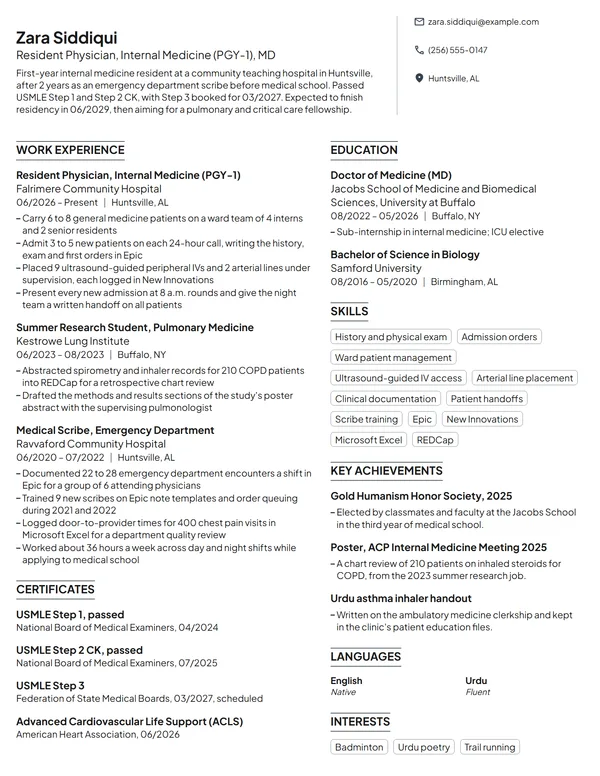
The residency application itself goes through ERAS, the Electronic Residency Application Service, which has its own format. A resident needs a resume for moonlighting, fellowship interviews and the first attending search, usually in the last year of training. Open with an objective stating your specialty, your finish date and the post you want, and list each of these where it fits:
- Residency and any fellowship: Work Experience entries with the service, your census and what you supervised.
- Chief resident or committee roles: a bullet under the residency, with how many residents you scheduled or led.
- Quality improvement project: a bullet with the measure, its before and after, and the months it took.
- Research: 1 to 3 publications or posters under Key Achievements, with the journal or meeting and the year.
- Free clinic or medical mission work: under Volunteer Experience, with the patients seen.
- Languages you use with patients: under Languages, with your level.
Don't
Recent medical graduate seeking a position where I can continue to grow as a physician.
Do
Internal medicine resident (DO) finishing training in 06/2027 and planning to sit the internal medicine boards that year, seeking a hospitalist post. Chief resident for 12 months, managing up to 14 ward patients a day.
A resident objective still needs a finish date, a target role and a number.
Your USMLE or COMLEX-USA results go under Certificates as Steps or Levels passed, with the month. If you are moving from a clinical post into medical administration or industry, keep the reverse-chronological order and lead with the leadership bullets. Send every application with a short letter that names the post and your strongest number, as in these physician cover letter examples.
Doctor resume FAQ
Should a doctor use a resume or a CV?
Use a resume for clinical jobs at hospitals, health systems and group practices, where recruiters want your specialty, licenses, board status and volume on 1 or 2 pages. Use a full CV for academic posts, research roles and fellowships that ask for every publication, grant and presentation.
How long should a physician resume be?
1 page while you are in training or early in practice, and 2 pages once you have 10+ years, leadership roles or publications the reader will want. Keep your license, board status and current post on page 1.
Can I write board eligible on my resume?
Only if your specialty board allows it. ABMS policy sets the eligibility period at 3 to 7 years after accredited training, and each board decides whether candidates may call themselves board eligible. If yours does not, write the exam name and its scheduled date instead.
Should I put USMLE or COMLEX scores on my resume?
No, list each Step or Level as passed with its month, and give scores only when a fellowship or employer asks for them. USMLE Step 1 has been reported as pass/fail only for exams taken on or after January 26, 2022, so many recent graduates have no Step 1 score to show.
Where does residency go on a doctor resume?
Under Work Experience, as a job with the title Resident Physician and the specialty, the hospital and its city, and start and end months. Give it 1 to 3 bullets with your census, procedures or chief resident role. Fellowship goes above it in the same way.
Should I include my medical license number?
No. Write the license type, the state, the issuing board and the month it was issued. Credentialing teams verify the license directly with the board and ask for the number on their own forms, so it adds nothing on a document that passes through several portals.
Should I list publications on a clinical resume?
Yes, but only 1 to 3, under Key Achievements, with the journal and year. Pick the ones closest to the post, such as a quality improvement paper for a hospital role. Keep the full list for an academic CV or a fellowship application.
What does a family medicine doctor earn?
Family medicine physicians earned a median of $244,180 a year in May 2025, according to BLS wage estimates. Pay varies by specialty, state, setting and production targets; leave it off your resume and raise it once an offer is on the table.
Next steps
Open the example nearest your specialty and career stage, keep its order, and replace its figures with your own patient volume, license states, board status and results. Then build your version in our resume builder or adapt one of our templates, and send it with a short letter naming the post and your best result.