
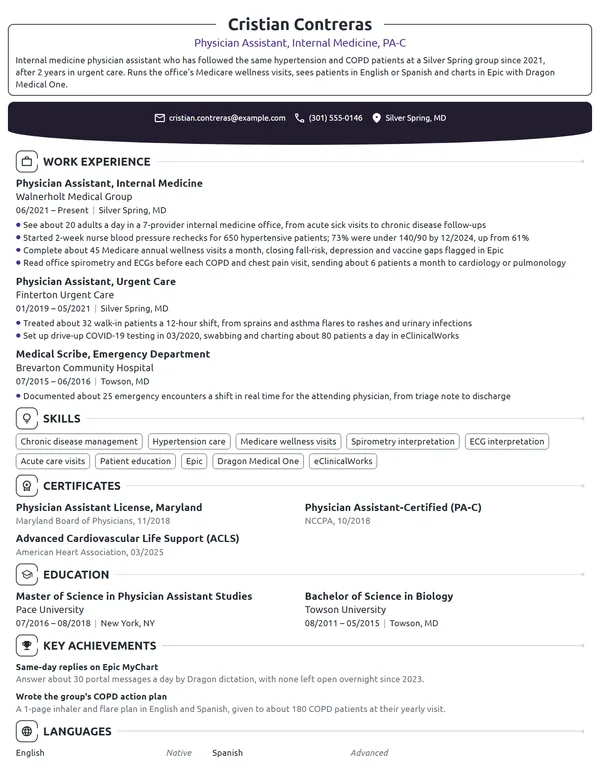
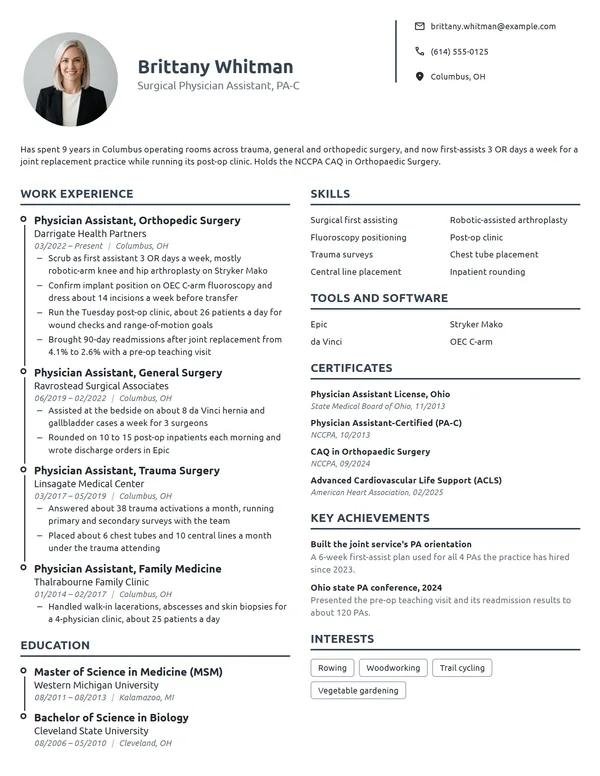
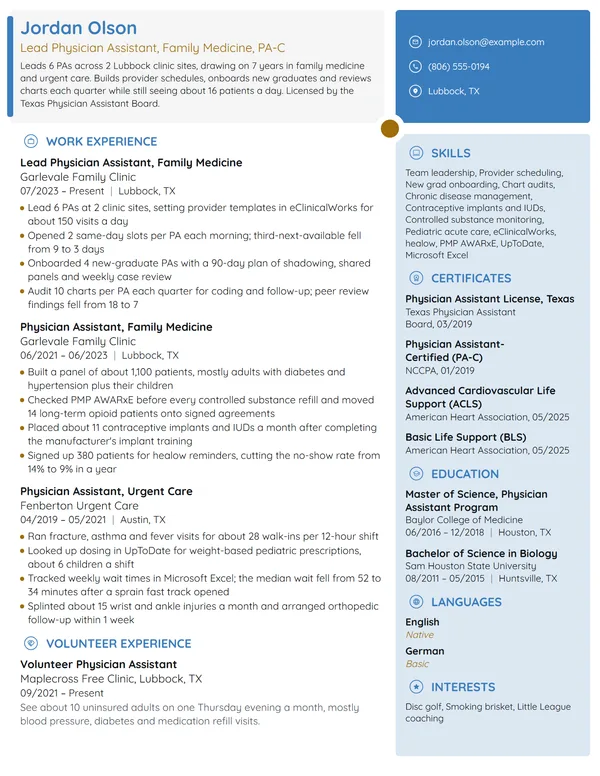
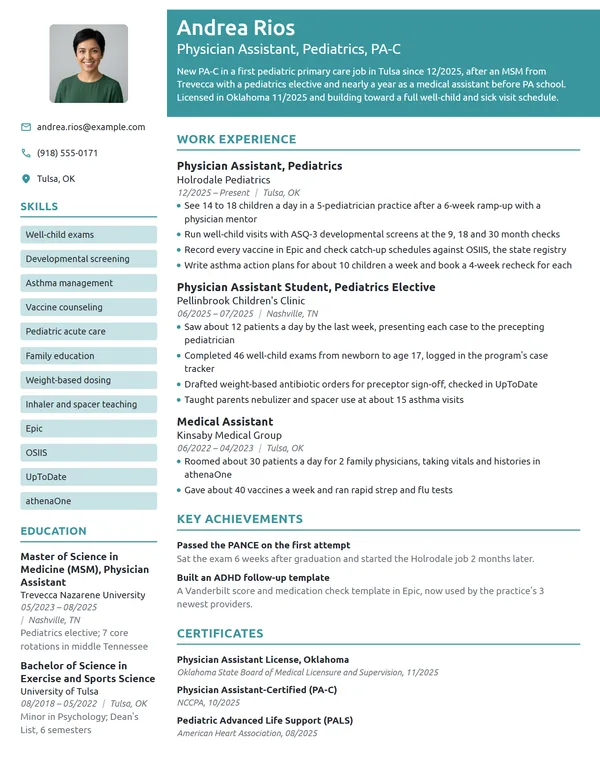
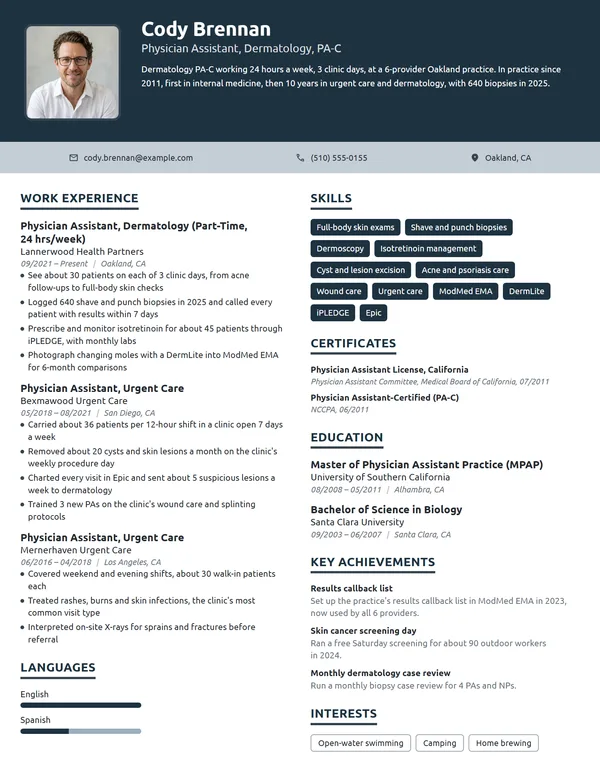
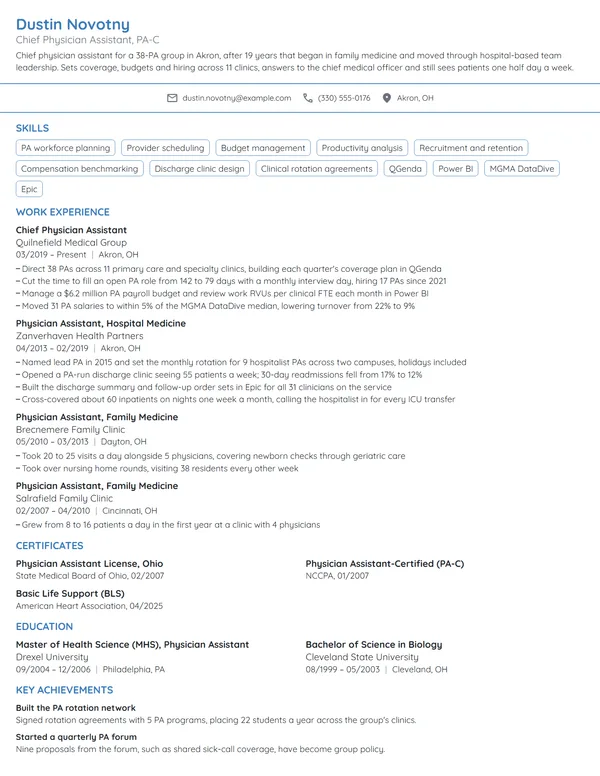
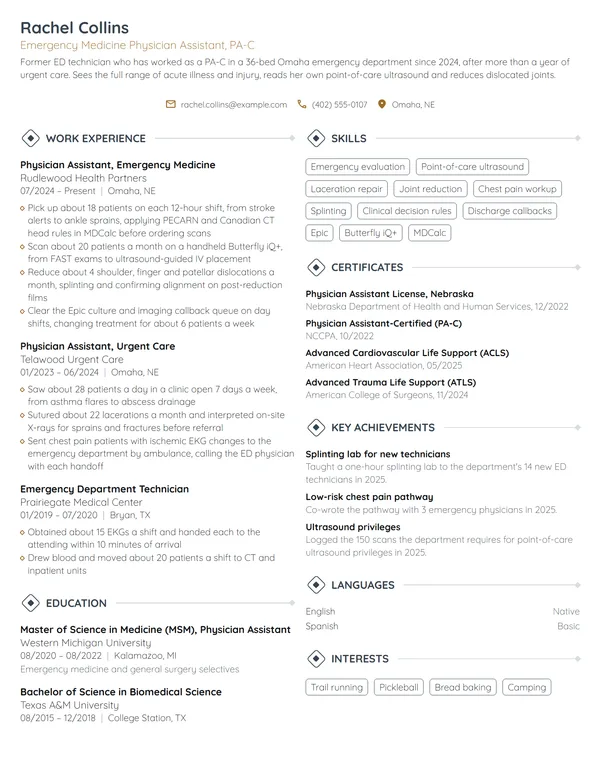
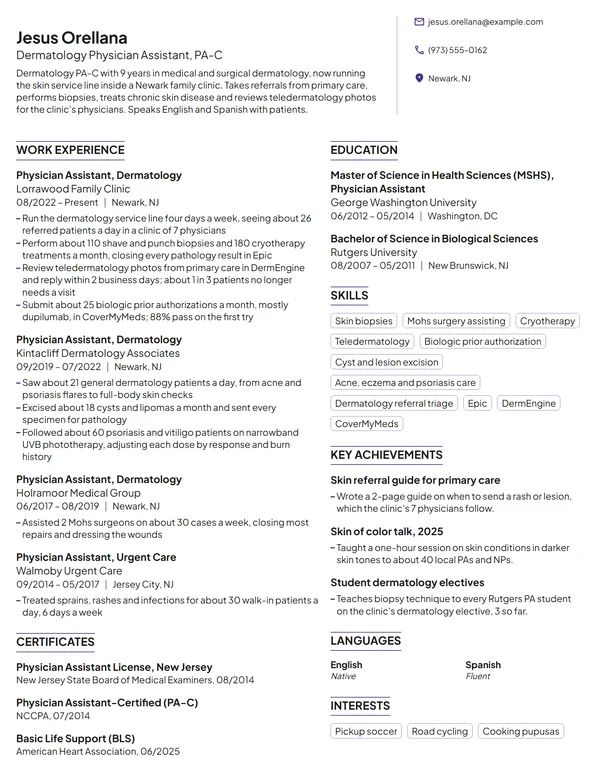
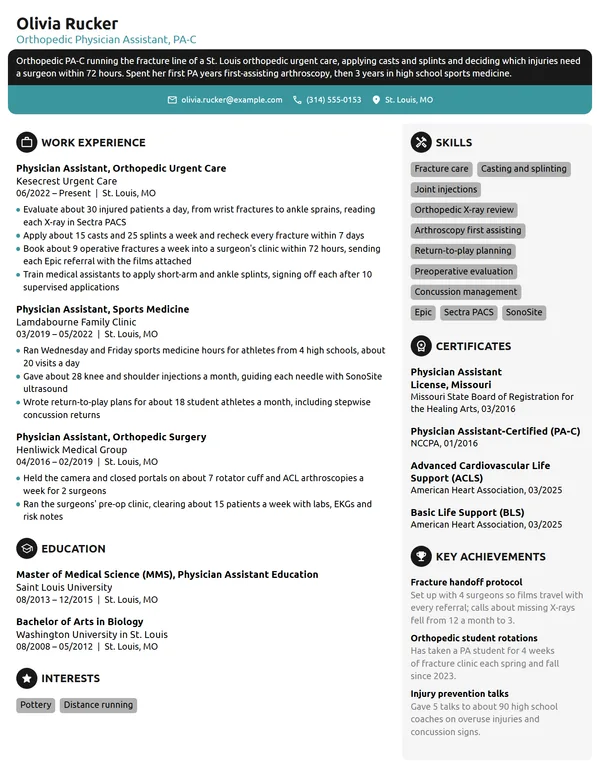
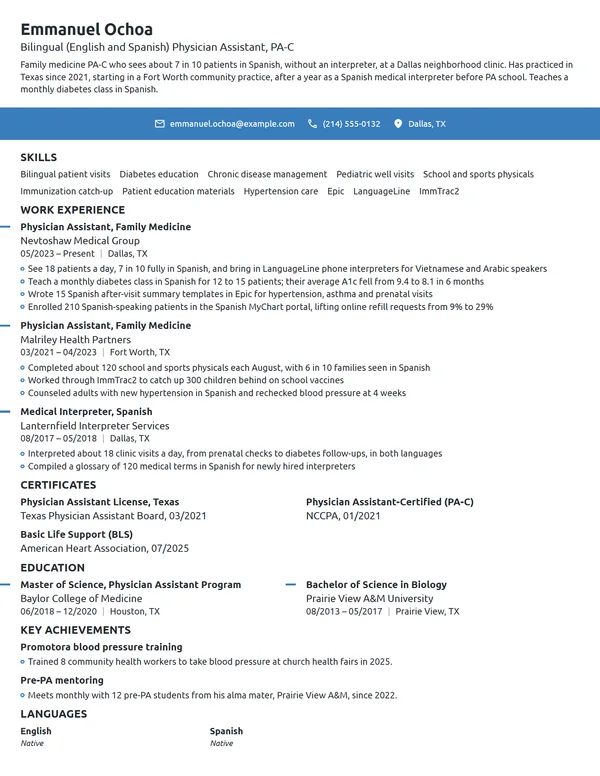
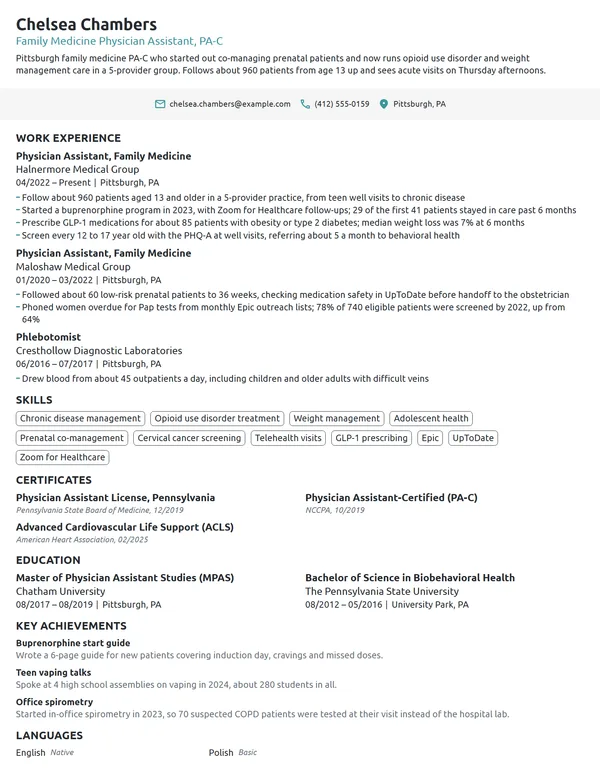
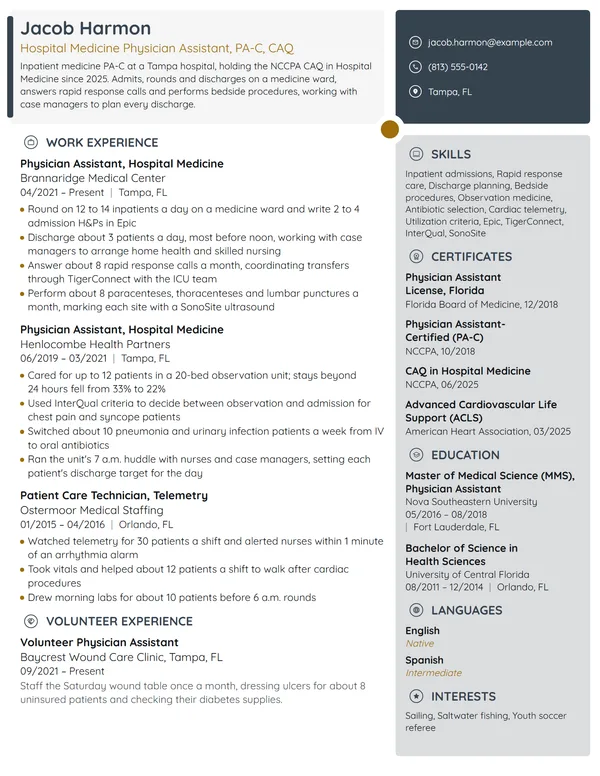
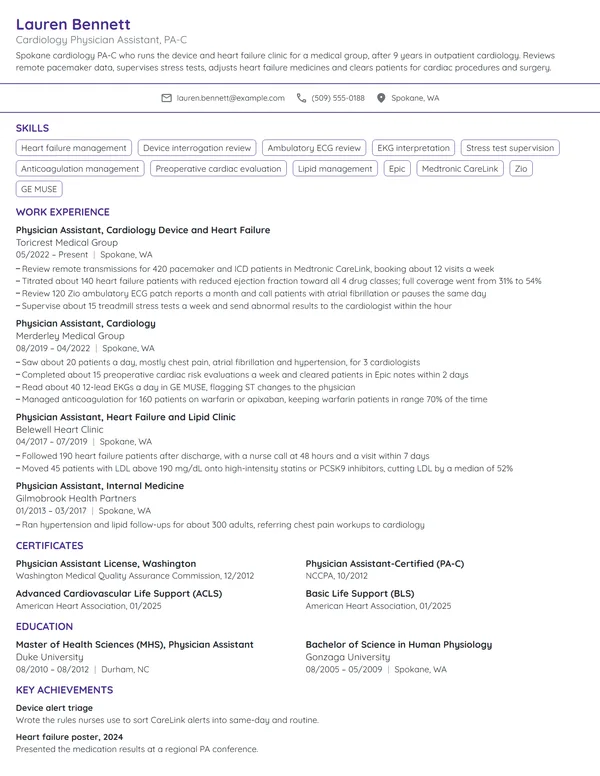
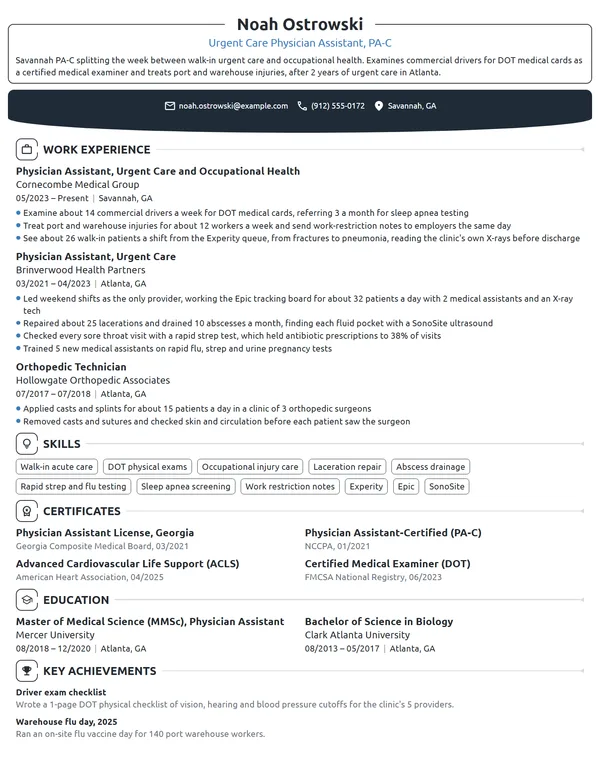
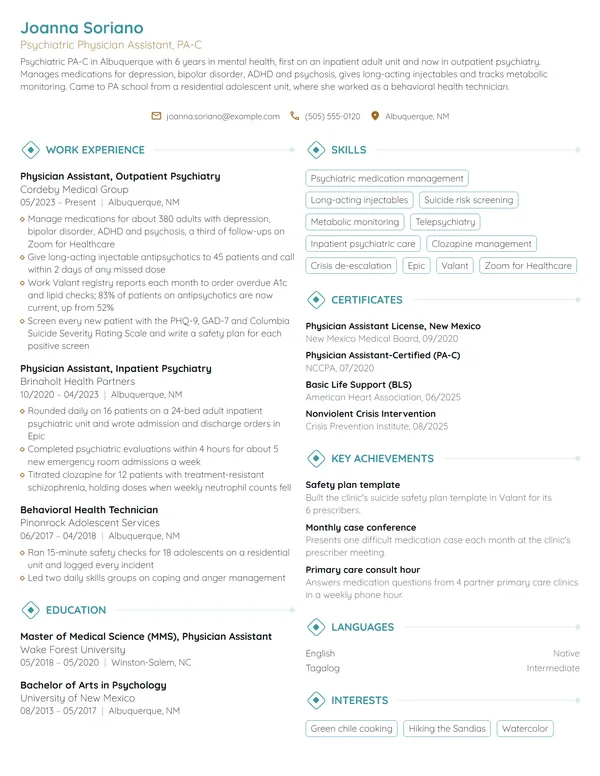
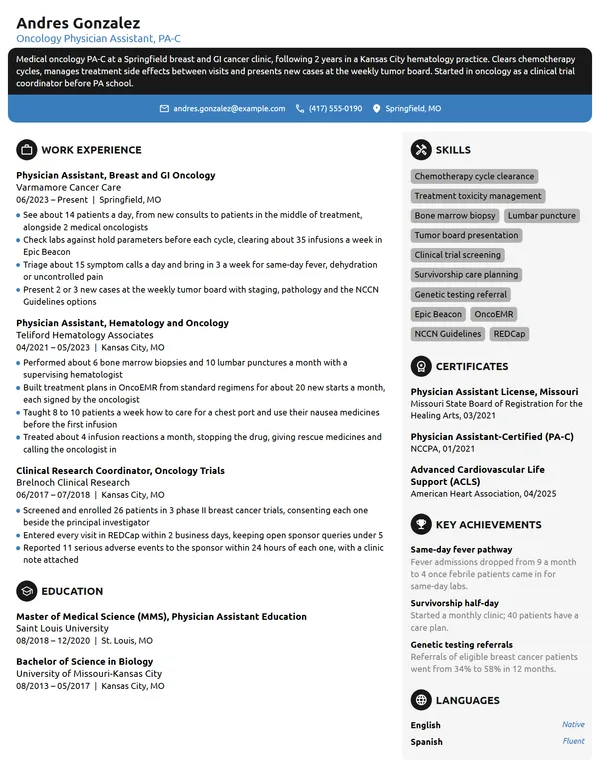
Physician assistants diagnose, treat and prescribe as part of a medical team. Practice managers and supervising physicians want your specialty, how many patients you see, which procedures you perform and whether your certification and state license are current. Because every PA works alongside physicians, how much you handle on your own can be hard to see. Patient volume and procedure counts show most of it, and a specialty named in each job title shows the rest.
How to Write a Physician Assistant Resume - Key Takeaways
- Choose reverse-chronological order on 1 page; a second page makes sense after 10+ years or a move across specialties.
- Put the specialty in every job title line, such as Physician Assistant, Emergency Department.
- Open each current job with your patient volume, then add procedure counts and a quality or throughput result.
- Under Certificates, put your state PA license at the top, then PA-C with NCCPA, then any CAQ and life support courses.
- Write PA-C after your name only once you have passed the PANCE and your certification is current.
- Run the final file through an ATS resume checker, because health system portals filter on credential and EHR keywords.
What hiring teams look for in a physician assistant resume
A PA resume usually lands with a practice manager or recruiter first, then with the physicians you would work beside. Both want to know what kind of patients you have managed, how independently, and how many a day. The BLS lists ordering and interpreting diagnostic tests, diagnosing injuries and illnesses, providing treatment and prescribing medication as core PA duties. O*NET adds performing procedures such as injections, suturing and wound care, and assisting physicians in surgery.
Those duties are the same on every PA resume, so the reader looks for what changes from one PA to the next: the specialty, the setting, the volume and the procedures. Build the page from these sections:
- Name, headline (for example, Physician Assistant, PA-C) and contact details
- A short summary of 2 to 3 lines under your name, which takes no heading
- Work Experience, newest job first, with the specialty in each job title
- Certificates: your state PA license first, then PA-C, CAQs and life support courses
- Skills, with your EHR system and the procedures you perform
- Education, with your PA degree and the program's city
- Optional: Languages, plus Volunteer Experience or Key Achievements
Best format for a physician assistant resume
Use the reverse-chronological resume format: your current job first, then each earlier one with its title and specialty, the employer, its city, and the months you started and left, as MM/YYYY. PAs often move between specialties during a career, from urgent care to emergency medicine or from family medicine to dermatology, and listing jobs newest first puts each move on the page with its dates. It also keeps your most recent patient volume at the top, where a supervising physician reads first.
- Best for most physician assistantsReverse-chronologicalYour jobs, newest first, with your results under each one.Best for: A steady work history in your field
- FunctionalSkills grouped up top, with a short work history below.Best for: Gaps or very little experience
- CombinationA skills section first, then your full work history.Best for: A career change with strong skills
Stay on 1 page for your first 10 years in practice. A second page fits a PA with several specialties, a lead or chief PA role, or teaching and research work, provided page 1 carries your license, your PA-C and your current job.
| Setting | What to use |
|---|---|
| Length | 1 page; 2 once you pass 10 years or several specialties |
| Job title line | Title plus specialty: Physician Assistant, Hospital Medicine |
| Headline | Your name, then PA-C once certified, then any CAQ |
| Dates | Month and year as MM/YYYY; Present on the job you hold now |
| Photo and private data | In the US and Canada a photo is normally left off, as are your birth date, marital status, Social Security number and license numbers |
| File type | PDF by default; a Word file only where the health system's portal requests it |
Most US and Canadian resumes carry no photo. Large health systems load your file into their own application forms, so standard section headings and a single column of dates help the portal place each job where it belongs.
Physician assistant resume summary vs. objective
The test is whether you have held a PA job yet. If you have, write a resume summary with your years in practice, your specialty, the setting and 1 result with a number. If you are a new graduate, write a resume objective: the specialty you want, your PANCE and license status, and the rotation or prior patient care work that prepared you for it.
Physician assistant resume summary formula
Specialty PA-C with X years of practice, including X in setting and size. 1 result with a number. License, CAQ or the next credential.
Example
Emergency medicine PA-C with 6 years of practice, including almost 5 in a 48-bed community emergency department. Cut fast-track door-to-provider time from 41 to 23 minutes. Licensed in Georgia and preparing for the Emergency Medicine CAQ.
Don't
Dedicated physician assistant with excellent clinical skills seeking to provide quality care to patients of all ages.
Do
PA-C with 5 years in family medicine, seeing about 22 patients a day in a 3-physician practice. Keeps 76% of the practice's diabetic patients under an A1c of 8 and runs its weekly diabetes clinic.
The rewrite gives a specialty, a daily volume and an outcome the practice measures.
How to write physician assistant work experience bullets with numbers
Your current job takes 3 to 4 bullets; each earlier one takes 1 to 3. The first bullet sets the scale: patients a shift or day, or your panel size, and the size of the department or practice. The rest should turn duties into achievements with the counts your clinic or hospital already reports, such as procedures logged for credentialing, wait times or quality measures.
| Area | What to count | Example bullet |
|---|---|---|
| Patient volume | Patients a shift or day, panel size, providers in the practice | Managed a panel of 1,400 adults in a 4-provider internal medicine practice. |
| Procedures | Injections, biopsies, sutures, splints a month | Performed about 40 joint injections a month under ultrasound guidance. |
| Prevention and quality | Screening rates, chronic disease targets, care gaps closed | Raised colorectal cancer screening in a 1,200-patient panel from 58% to 71% in 18 months. |
| Prescribing | Antibiotic stewardship, controlled substance reviews | Lowered antibiotic prescribing for acute bronchitis visits from 44% to 19% in a year with a delayed-prescription plan. |
| Operating room | Cases first-assisted a week, closures, case types | First-assisted on about 12 total joint replacements a week and closed each incision. |
Below is how those numbers sit in an emergency medicine PA's entry. Volume and department size come first, the results follow, and the earlier urgent care job gets 1 line.
Work Experience
- See about 24 patients per 10-hour shift across fast track and the main department of a 48-bed ED with about 70,000 visits a year.
- Cut fast-track door-to-provider time from 41 to 23 minutes by setting up a provider-in-triage rotation with 2 attending physicians.
- Perform about 30 laceration repairs, 12 splints and 8 incision and drainage procedures a month, logged for credentialing.
- Precept 6 PA students a year on 5-week emergency medicine rotations.
- Treated about 35 patients a shift in a 3-provider clinic, ordering and reading on-site X-rays for injuries.
Don't
Responsible for seeing patients and completing documentation.
Do
Closed every chart in Epic before the end of shift for 18 months, down from a 3-day backlog.
A documentation bullet earns its place when it shows a change someone noticed.
Don't
Assisted the surgeon in the operating room.
Do
First-assisted in about 9 spine cases a week, handling positioning, retraction and multilayer closure.
Physician assistant skills and EHR software for your resume
Pick 6 to 8 hard skills for your resume that the posting names and your bullets back up. History and physical exams and test interpretation fit almost every PA resume; first assisting, joint injections or ventilator management belong only where your specialty uses them.
Hard skills for physician assistants
- History and physical exams
- Differential diagnosis
- Ordering and interpreting labs and imaging
- ECG interpretation
- Prescribing and medication management
- Laceration repair and suturing
- Splinting and fracture care
- Joint injections
- Chronic disease management
- First assisting in surgery
Soft skills supervising physicians value
- Knowing when to escalate
- Concise case presentations
- Bedside manner
- Working well with nurses and techs
- Keeping pace on a full schedule
- Steady in urgent situations
Name your EHR in Skills, then prove it in one of your bullets, such as charting speed or an order set you built. O*NET lists Epic Systems as both an in-demand and a hot technology for physician assistants, with eClinicalWorks and MEDITECH also flagged as hot. Write the system the way the employer does, since a clinic on eClinicalWorks and a hospital on Epic will search for those exact names.
PA-C, state license and CAQs on a physician assistant resume
The BLS states that all states and the District of Columbia require physician assistants to be licensed, and that a qualifying exam is part of getting the license. That exam is the PANCE: NCCPA admits graduates of ARC-PA accredited programs, and passing it earns the PA-C, which NCCPA describes as a requirement for licensure in all US states. List certifications on your resume in this order: license, PA-C, then any specialty credential.
| Credential | Issued by | What it takes |
|---|---|---|
| PA-C (Physician Assistant-Certified) | National Commission on Certification of Physician Assistants (NCCPA) | Graduation from an ARC-PA accredited program and a passing PANCE score; kept with 100 CME credits every 2 years and a PANRE or PANRE-LA pass by the end of each 10-year cycle. |
| State PA license | The state's medical board or PA board | NCCPA certification plus the state's own application, with a license from every state where you see patients. |
| CAQ in Emergency Medicine | NCCPA | A current PA-C, an unrestricted license, 3,000 hours in emergency medicine and 75 Category I CME credits in the specialty within 6 years, a physician or PA attestation and the exam. |
| CAQ in Orthopaedic Surgery | NCCPA | The same base requirements with 4,000 hours in orthopaedic surgery within 6 years. |
| CAQ in Hospital Medicine | NCCPA | The same base requirements with 3,000 hours managing hospitalized adults within 6 years. |
How to write the PA-C and license line
NCCPA calls PA-C a legally protected mark that applies only while your certification is current, so use it in your headline only after you pass the PANCE. Before that, write PA-S if you are still a student, or name your degree and give your exam date in the objective. For each license, write the state, the issuing board and the month it was issued, and leave the license number off: credentialing staff verify it with the board.
Certificates
- Physician Assistant License, Georgia, Georgia Composite Medical Board, 02/2020
- Physician Assistant-Certified (PA-C), National Commission on Certification of Physician Assistants (NCCPA), 01/2020
- Advanced Trauma Life Support (ATLS), American College of Surgeons, 04/2024
- Advanced Cardiovascular Life Support (ACLS), American Heart Association, 09/2025
- Pediatric Advanced Life Support (PALS), American Heart Association, 09/2025
How to list a PA master's degree, clinical rotations and patient care hours
The BLS says physician assistants typically need a master's degree from an accredited program, and applicants usually arrive with a bachelor's degree and experience caring directly for patients. Programs name the degree differently (MPAS, MSPAS, MMS, MHS or MPA), so copy the exact name from your diploma. Augusta University, for example, awards a Master of Physician Assistant through its College of Allied Health Sciences.
Follow the basic rules for listing education on a resume: the degree name, the school and its city, and the month you graduated. PA programs include supervised clinical training in several specialties (the BLS names family, internal and emergency medicine among them), so new graduates can add their rotations in 1 line under the degree. Experienced PAs keep the PA degree and their bachelor's, and drop the rotations once they have 2 or more years in practice.
Education
Rotations: family medicine, emergency medicine, general surgery, pediatrics, women's health and behavioral health. Before PA school: 2,000 hours of patient care as an EMT.
New grad and career-change physician assistant resumes
A new graduate PA resume has 2 strengths to show: the rotations, and the patient care work you did before PA school. Lead with an objective stating the specialty you want and your PANCE status with a date. If your earlier role was as a medical scribe or an EMT, give it a full Work Experience entry with its patient numbers, since it shows clinical work with real patients.
- Elective or final rotation: the specialty, the setting and the number of patients you saw a day by the end, written as a Work Experience entry if it matches the job.
- Core rotations: 1 line under Education, listing the specialties.
- Patient care before PA school: CNA, EMT, medical assistant, scribe or medic jobs, each with patients a shift and the skills you used.
- Free clinics and health fairs: under Volunteer Experience, with the number of patients you saw or screened.
Don't
Recent PA graduate seeking a challenging position where I can grow my clinical skills.
Do
MPAS graduate who passed the PANCE in 09/2026, seeking a hospital medicine role. Completed 2 inpatient rotations totaling 10 weeks and spent 3 years as an emergency department scribe before PA school.
An objective works when it gives a date, a specialty and experience a reader can check.
If you are moving into PA practice after another healthcare career, such as nursing, paramedic work or military medicine, stay with reverse-chronological order, and let the PA job or degree head the page. Under the older jobs, keep the bullets that carry into PA work: assessments, procedures, patient volume and teaching. The career-change resume examples show how to cut an earlier career to a few lines. Your cover letter is where to explain the move, and the healthcare cover letter examples show how to keep that to 1 paragraph.
Physician Assistant resume FAQ
Can I write PA-C on my resume before I pass the PANCE?
No. NCCPA issues the PA-C only after you pass the PANCE and calls it a legally protected mark that applies while your certification is current. Until then, write your degree after your name and give your exam date in the objective, such as PANCE scheduled for 12/2026.
Should I write physician assistant or physician associate on my resume?
Use the title your state license and the job posting use. Oregon, for example, changed the title to physician associate in its statutes effective June 6, 2024, for PAs licensed and practicing there, with no change to scope. The initials PA work under either title.
Should I put my PA license number or DEA number on my resume?
No. Give the state, the issuing board and the month of issue for each license. Credentialing staff verify licenses and registrations directly, and leaving the numbers off keeps them out of every job portal and inbox your file passes through.
How long should a physician assistant resume be?
1 page for new graduates and most PAs with under 10 years in practice. A second page is fine for lead and chief PAs or for PAs with several specialties, teaching or research, as long as page 1 shows your license, PA-C and current job.
How do I list clinical rotations on a new grad PA resume?
Put your core rotations in 1 line under your degree. Write the rotation that matches the job you want as a fuller entry with the setting, your daily patient count and the procedures you did, so the hiring physician sees direct exposure to their service.
Should I include patient care experience from before PA school?
Yes, on a new grad or early-career resume. CNA, EMT, medical assistant or medic work shows hands-on time with patients, and scribe work shows clinical exposure, so give it a Work Experience entry with numbers. After 3 to 5 years as a PA, cut it to 1 line or drop it.
How do I show a move to a new specialty on a PA resume?
Put the new specialty in your summary and job title, then use your older entries to show what transfers, such as procedures, patient volume or the same patient population. Specialty CME and a CAQ in progress go under Certificates with their dates.
Do I need a CAQ to work in a PA specialty?
No. A CAQ from NCCPA is optional and proves experience you already have. Emergency Medicine, for example, takes 3,000 hours in the specialty and 75 Category I CME credits within 6 years, plus an attestation and the exam. List one under Certificates if you hold it.
How much do physician assistants make?
The BLS puts the median yearly pay for physician assistants at $135,880 as of May 2025. Specialty, state, setting and shift work all move that figure; keep pay off your resume and raise it once an offer is on the table.
Next steps
Pick the example nearest your specialty and career stage, keep its layout, and replace the details with your own patient volume, procedures, license and results. Start from one of our templates or open the resume builder, then pair the finished file with a short letter naming the service you hope to join and your strongest number.