
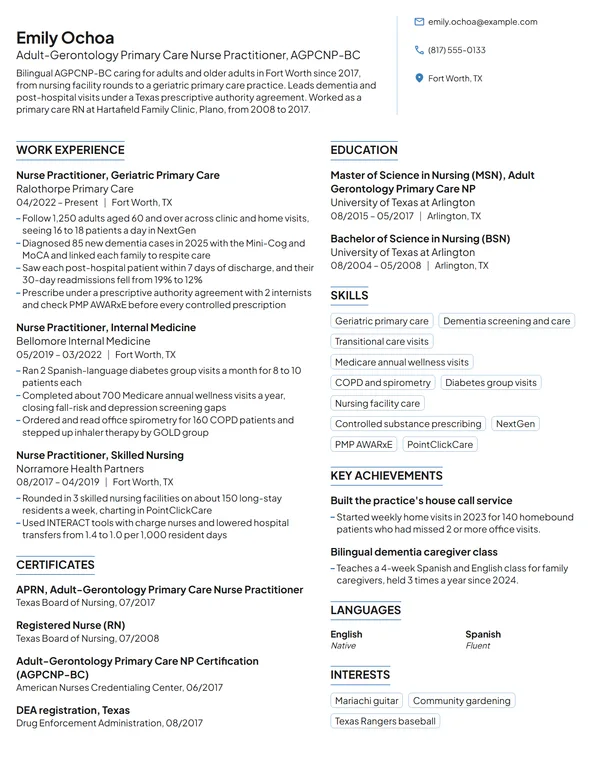
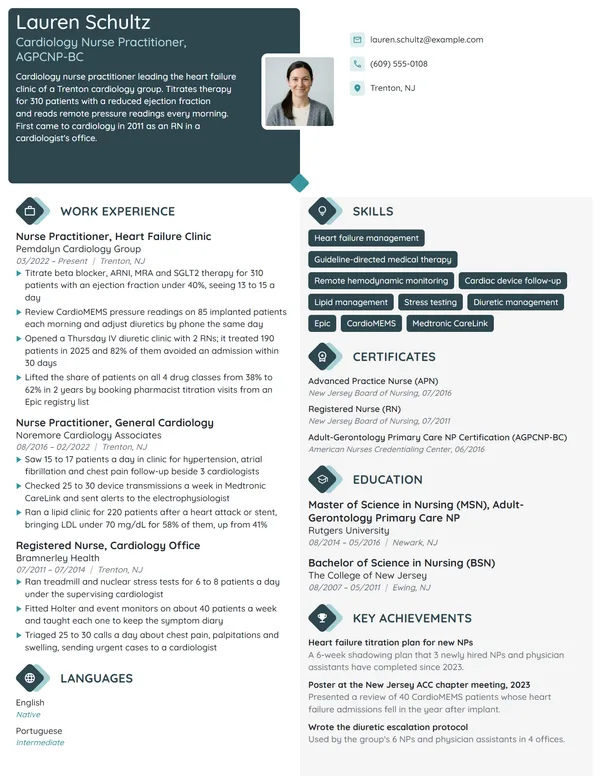
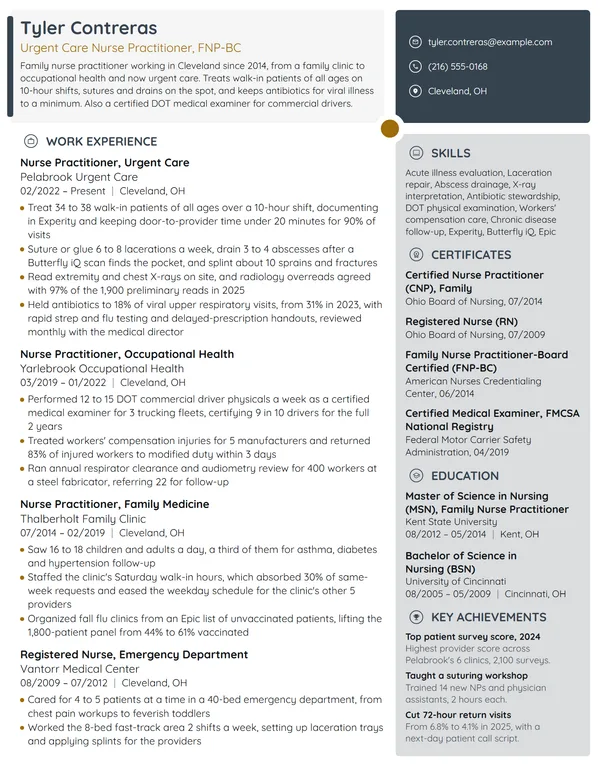
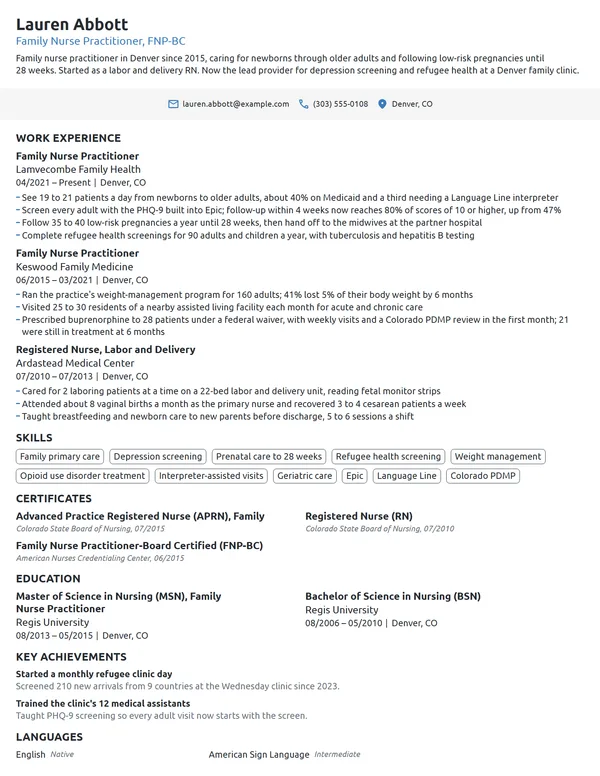
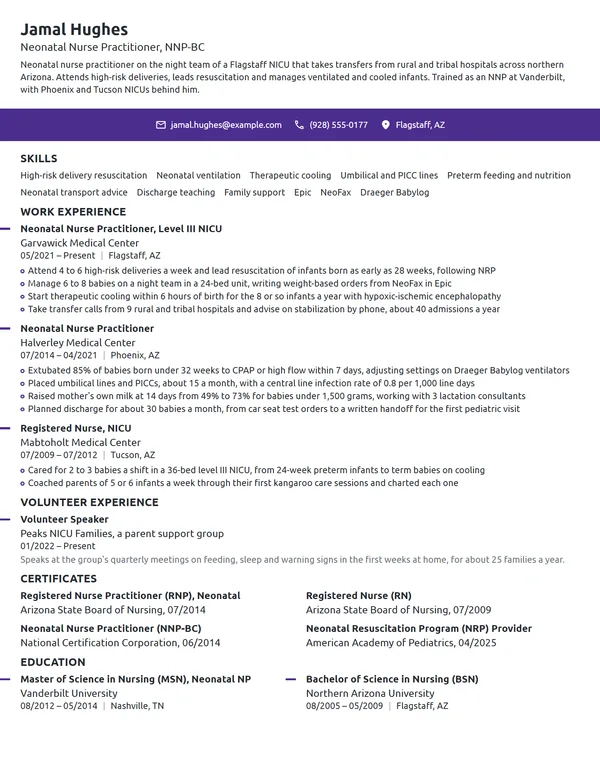
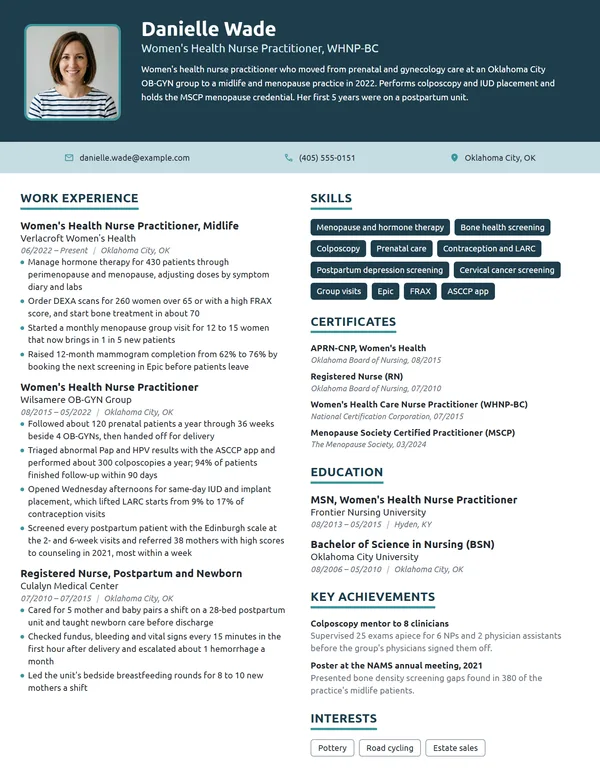
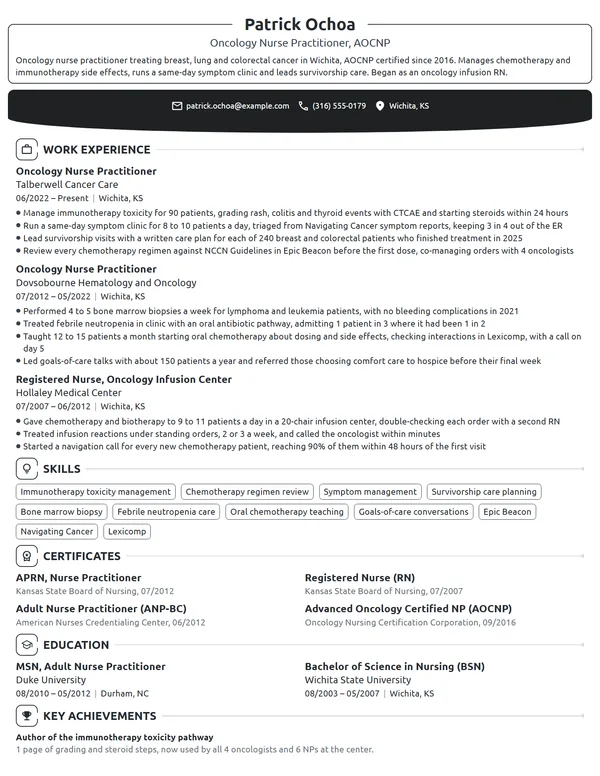
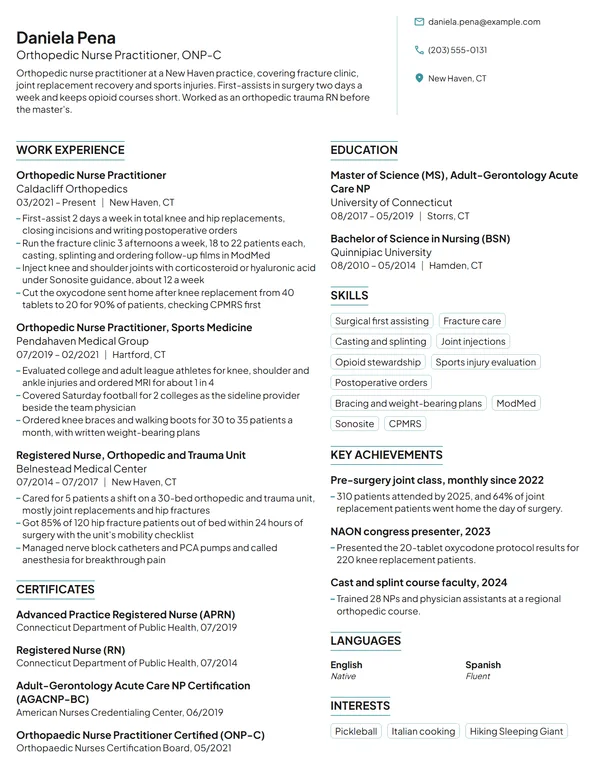
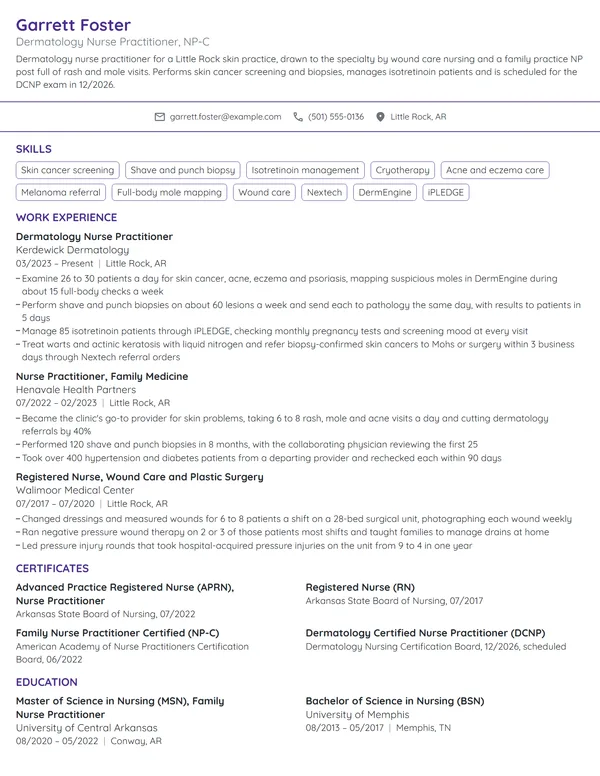
Nurse practitioners diagnose patients, plan their treatment and often prescribe. A practice reads your resume for the patients you treat, how many you see a day and what improved under your care. Most NPs also bring years of RN work, and those bedside years can blur into your NP practice. Listing NP roles first, with the switch from RN easy to spot, lets both parts of your career count.
How to Write a Nurse Practitioner Resume - Key Takeaways
- Order jobs newest first in a reverse-chronological layout, NP roles above RN roles, and keep to 1 page until you have 10+ years.
- Put your population focus and board credential in the headline under your name, such as Family Nurse Practitioner, FNP-BC.
- Open each NP job with your patient volume, then add outcomes your practice tracks: A1C or blood pressure control, screening rates, wait times.
- Put the APRN license at the top of Certificates, followed by the RN license, the board certification and the DEA registration, all without numbers.
- Write your MSN or DNP with its track, and give new grad clinical hours by setting.
- Run the file through an ATS resume checker, since health systems filter on credential letters and EHR names.
What hiring managers look for in a nurse practitioner resume
A practice manager or physician lead reads an NP resume for 4 things: your population focus, your license and certification for that focus in their state, the setting you have practiced in, and your patient volume. The Bureau of Labor Statistics describes nurse practitioners as primary and specialty care providers, and notes that in most states they can prescribe medications, order medical tests and diagnose health problems. O*NET adds developing treatment plans and treating chronic problems such as high blood pressure and diabetes. Your bullets should show that work with the numbers behind it.
Build the page from sections an applicant tracking system can parse:
- Name, headline with your role and credential (Adult-Gerontology Acute Care Nurse Practitioner, AGACNP-BC) and contact details
- A 2 to 3 line summary at the top, under your name
- Work Experience, NP roles first, with the setting in each job title
- Certificates: APRN license, RN license, board certification, DEA registration, BLS or ACLS
- Skills, with your EHR named
- Education: MSN or DNP with its track, then your BSN
- Optional: Languages, and either Key Achievements or Volunteer Experience
Best format for a nurse practitioner resume
Choose the reverse-chronological resume format: your current NP role on top, then earlier NP roles, then your RN jobs. Each entry gets the title with its setting, the employer and its location, and start and end months as MM/YYYY. This order puts your advanced practice years where a reader looks first and still shows the bedside experience that sits behind them.
- Best for most nurse practitionersReverse-chronologicalYour jobs, newest first, with your results under each one.Best for: A steady work history in your field
- FunctionalSkills grouped up top, with a short work history below.Best for: Gaps or very little experience
- CombinationA skills section first, then your full work history.Best for: A career change with strong skills
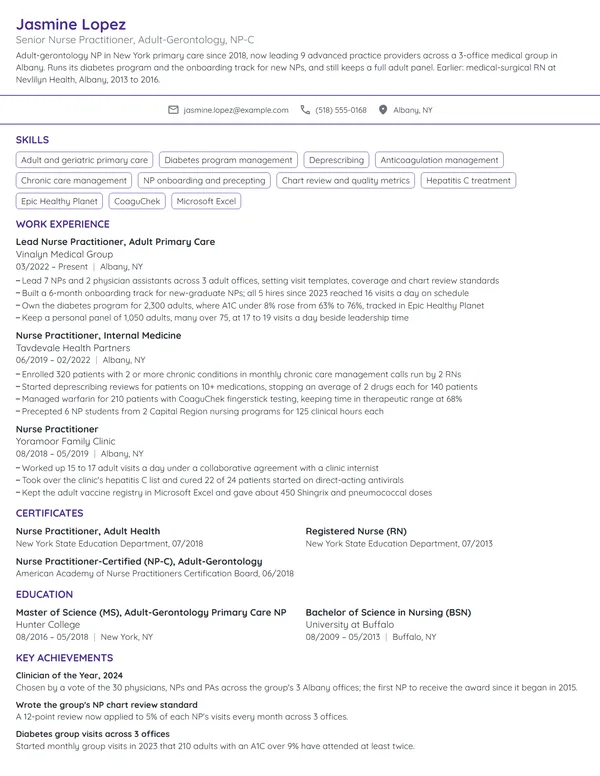
Hold it to 1 page through your first several years as an NP, with older RN jobs cut to 1 bullet each. Go to 2 pages once you have 10+ years in practice, a mix of primary and acute care, or teaching, research and leadership work, but keep your licenses and current role on page 1.
| Setting | What to use |
|---|---|
| Length | 1 page early in your NP career; 2 pages with 10+ years or several practice settings |
| Job title line | Role plus setting: Family Nurse Practitioner, Primary Care |
| RN years | Below your NP jobs, 1 to 2 bullets each, with the unit named |
| Dates | MM/YYYY for every job and credential; Present for the role you hold now |
| Typeface | Calibri, Arial or a similar sans serif, 10.5 to 12 pt in the body |
| Personal data | Most US and Canadian employers expect no photo; leave off your date of birth, SSN and marital status |
| File | A PDF named with your name and credential, unless the employer wants a Word file |
Most US and Canadian resumes carry no photo. Large health systems load your file into a credentialing workflow as well as a hiring one, so plain headings and credential letters written in full matter more than design flourishes.
Nurse practitioner resume summary vs. objective
Once you have held an NP role, write a resume summary with your credential, your years in practice, your setting and 1 outcome. If you are a new graduate waiting on your board exam or your first APRN license, write a resume objective that names the role you want, your certification status and your clinical hours. Either way, keep it to 2 or 3 lines and pull its number from your bullets.
Nurse practitioner resume summary formula
Credential population focus nurse practitioner with X years in setting. Panel size or patients a day. 1 outcome with a number.
Example
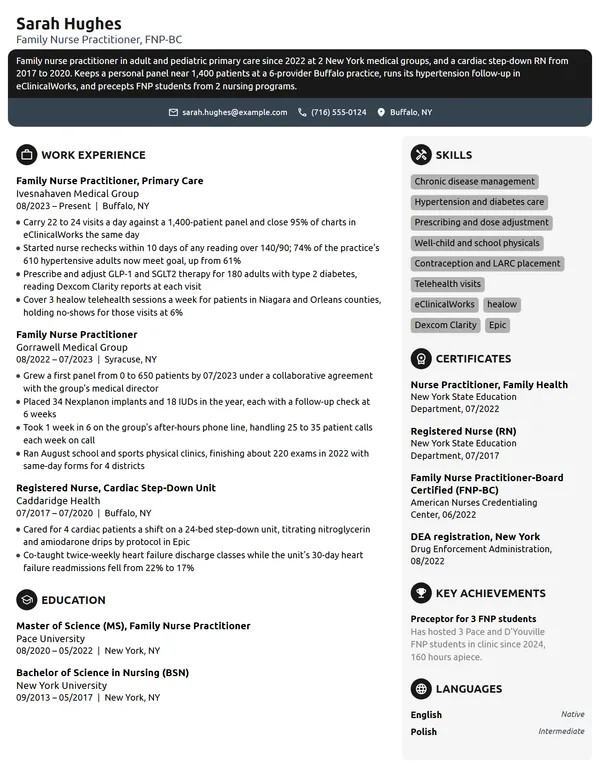
Board-certified family nurse practitioner with 5 years in primary care, after 5 years as an emergency department RN. Carries a panel of about 1,150 patients. Brought the practice's childhood immunization rate at age 2 from 71% to 84%.
Don't
Dedicated nurse practitioner passionate about delivering high-quality, patient-centered care across the lifespan.
Do
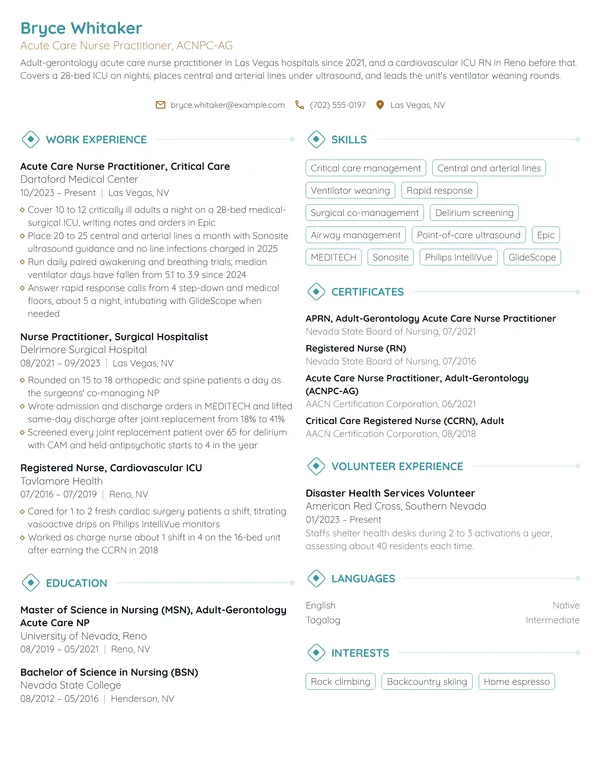
AGACNP-BC with 3 years on a hospitalist team at a 300-bed hospital, managing 14 to 16 inpatients a day. Led weekly sepsis reviews that raised 3-hour bundle compliance from 71% to 86%.
This rewrite names the focus, the setting, the daily load and a result a medical director can check.
How to write nurse practitioner work experience bullets with numbers
Your current NP role gets 3 to 4 bullets; earlier roles get 1 to 4, fewer the further back they go. Lead with volume (patients a day, panel size or inpatient census), because every outcome reads against it. Then pick results your practice or hospital already reports, and write them as achievements on your resume, with a before and after figure and a time frame.
| Area | What to count | Example bullet |
|---|---|---|
| Patient volume | Patients a day or shift, panel size, visit mix | Saw 18 to 20 patients a day in a 3-provider internal medicine office, half of them chronic care visits. |
| Chronic disease control | A1C, blood pressure, registry size | Raised blood pressure control under 140/90 from 58% to 70% across a 420-patient hypertension registry. |
| Preventive care | Screening and immunization rates | Lifted colorectal cancer screening for patients aged 45 to 75 from 52% to 66% with standing orders and mailed FIT kits. |
| Access | Wait for a new patient visit, same-day slots | Cut the wait for a new patient visit from 5 weeks to 9 days by opening 4 same-day slots a day. |
| Hospital practice | Census, admissions, consults | Managed 12 to 14 patients a day on a hospitalist team and completed about 6 admissions a shift. |
| Prescribing | Antibiotic and opioid stewardship, monitoring checks | Brought antibiotic prescribing for acute bronchitis down from 48% to 21% of visits in 1 year. |
In this NP entry, volume leads and outcomes follow. The RN job underneath keeps a single line with its unit and load.
Work Experience
- See 20 to 22 patients a day in a 4-provider family practice, from newborn checks to Medicare annual wellness visits.
- Lowered the share of adult diabetes patients with an A1C above 9% from 24% to 15% in 18 months through 2-week medication follow-ups.
- Perform about 30 skin biopsies and 40 joint injections a year in the office, work the practice used to refer out.
- Triaged and cared for 10 to 12 patients a shift in a 32-bed emergency department, including stroke and sepsis alerts.
Don't
Diagnosed and treated patients with acute and chronic conditions.
Do
Saw 28 to 32 urgent care patients a 12-hour shift and repaired about 15 lacerations a week on site.
Any NP could write the first line; the rewrite gives the setting, the pace and the procedures.
Don't
Responsible for prescribing medications.
Do
Tapered 38 long-term opioid patients to under 50 morphine milligram equivalents a day over 12 months, checking the state prescription monitoring program at every visit.
Nurse practitioner skills and EHR software for your resume
Choose 6 to 8 hard skills for your resume that match the posting, and cut any skill none of your NP bullets demonstrates. Differential diagnosis and prescribing fit almost any NP role; procedures such as suturing, biopsies or central lines belong only where you perform them.
Hard skills for nurse practitioners
- Advanced health assessment
- Differential diagnosis
- Chronic disease management
- Prescribing and medication reconciliation
- Ordering and interpreting labs and imaging
- Preventive screening
- Minor procedures (suturing, incision and drainage, biopsies)
- Care coordination and specialist referrals
- Visit documentation and coding
- Patient education
Soft skills employers hire NPs for
- Decisions with incomplete information
- Explaining a diagnosis in plain words
- Working alongside physicians
- Keeping a full schedule on time
- Shared decision-making
- Steadiness in an acute visit
Name your EHR in Skills, then prove it in a bullet about something you built or ran in it, such as a diabetes registry or an order set. O*NET lists eClinicalWorks, Epic Systems and MEDITECH software as hot technologies for nurse practitioners, along with Microsoft Office. Write each system the way the posting does; if you charted in Cerner, Oracle Health (Cerner) covers a search for either name.
APRN license, board certification and DEA registration on a resume
The Bureau of Labor Statistics lists 3 requirements for nurse practitioners: an RN license in their state, a passed national certification exam and a state APRN license. NCSBN's APRN model ties each certification to a population focus: family/individual across the life span, adult-gerontology, pediatrics, neonatal, women's health/gender-related or psychiatric/mental health, and adult-gerontology and pediatrics can each be split into primary or acute care. List certifications on your resume with the focus written out, since an adult-gerontology primary care credential does not qualify you for an acute care role.
| Credential | Issued by | What it takes |
|---|---|---|
| FNP-BC (Family Nurse Practitioner-Board Certified) | American Nurses Credentialing Center (ANCC) | A current RN license, an FNP master's, post-graduate certificate or DNP with at least 500 faculty-supervised clinical hours, and the exam; valid for 5 years. |
| AGPCNP-BC (Adult-Gerontology Primary Care) | American Nurses Credentialing Center (ANCC) | A current RN license and an AGPCNP master's, post-graduate certificate or DNP with at least 500 faculty-supervised clinical hours; valid for 5 years. |
| AGACNP-BC (Adult-Gerontology Acute Care) | American Nurses Credentialing Center (ANCC) | A current RN license and an AGACNP master's, post-graduate certificate or DNP with at least 500 faculty-supervised clinical hours; valid for 5 years. |
| ACNPC-AG (Acute Care NP, Adult-Gerontology) | AACN Certification Corporation | A current, unencumbered RN or APRN license and a graduate adult-gerontology acute care NP program. |
| NP-C (Family or Adult-Gerontology Primary Care) | American Academy of Nurse Practitioners Certification Board (AANPCB) | Meeting the board eligibility rules for the focus and passing its national exam; certification runs in 5-year periods. |
How to write the APRN license line
Copy the license title your state board prints, with the focus, the board and the month of issue, and list your RN license on its own line below it. Add your DEA registration with its state: the DEA requires a separate registration in each state where you prescribe controlled substances, and grants it only where the state authorizes you. Leave license and DEA numbers off, since credentialing staff verify them at the source.
Certificates
- Certified Nurse Practitioner (APRN), Family, Maine State Board of Nursing, 08/2021
- Registered Nurse (RN), Maine State Board of Nursing, 06/2016
- Family Nurse Practitioner-Board Certified (FNP-BC), American Nurses Credentialing Center, 07/2021, renewed 2026
- DEA registration, Maine, Drug Enforcement Administration, 09/2021
- Basic Life Support (BLS), American Heart Association, 03/2026
How to list your MSN or DNP on a nurse practitioner resume
The BLS says nurse practitioners typically need at least a master's degree in an advanced practice nursing field, and that some go on to a Doctor of Nursing Practice (DNP) or a PhD. Write the degree with its track, such as Master of Science in Nursing (MSN), Family Nurse Practitioner, because the track is what qualifies you for the board exam. A post-graduate certificate in a second focus gets its own entry with its date.
Apply the standard advice for listing education on a resume: the degree with its track, the school and its location, and the month you finished, newest first, with your BSN under the graduate degree. New graduates add 1 line of clinical hours by setting; once you have a year or 2 of NP practice, the degree, school and date are enough.
Education
New grad nurse practitioner resumes and the move from RN to NP
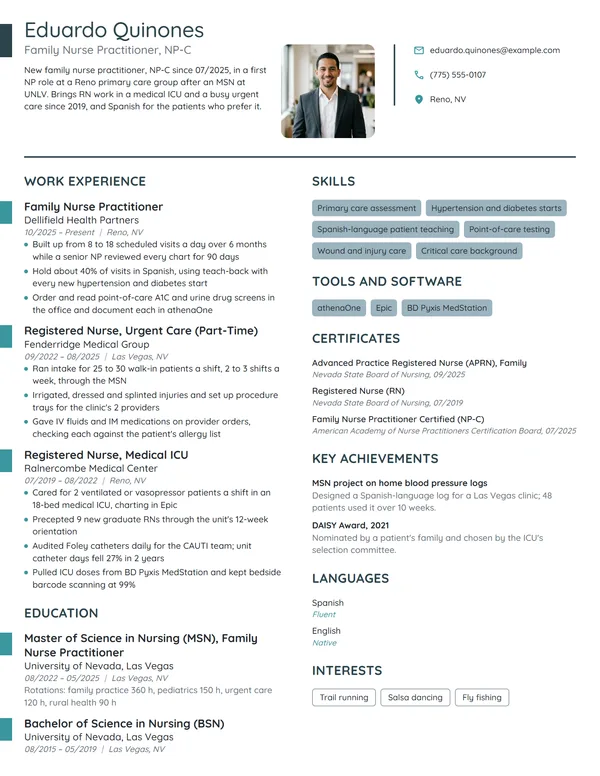
As a new NP, your RN years are your strongest work history, and your clinical rotations show the population you trained for. ANCC's family and adult-gerontology certifications require at least 500 faculty-supervised clinical hours, so a hiring team expects to see where those hours were spent. Put your certification status in Certificates with the exam date, and keep the RN jobs as full entries with their units.
- Clinical rotations: 1 line under your MSN with each setting and its hours, such as family practice 240, pediatrics 120.
- RN experience: a Work Experience entry per job, with the unit, the patient load and 1 result.
- Board exam and license: under Certificates, marked scheduled or passed with the month, and the APRN license once it is issued.
- Free clinics and screening events: under Volunteer Experience, with the number of patients you assessed.
Don't
Recent NP graduate seeking a position where I can use my skills and continue to grow.
Do
Family nurse practitioner, MSN 05/2026, ANCC exam scheduled for 11/2026, seeking a primary care role at a federally qualified health center. 640 supervised clinical hours in family practice, pediatrics and women's health, after 6 years as a med-surg RN.
An objective earns its place when it gives the focus, the exam date and the hours.
Switching focus, for example from primary care to acute care, takes the matching graduate education and board exam, which ANCC accepts through a post-graduate certificate. List the certificate as its own Education entry and the new credential under Certificates, then let your cover letter explain the move: the nurse practitioner cover letter examples show how to do it in a short paragraph. If you are still working as an RN, the nurse resume examples fit your current search.
Nurse Practitioner resume FAQ
Should I put my DEA number on a nurse practitioner resume?
No. List the DEA registration with its state and the month it was issued, and leave the number off. Credentialing teams verify it directly, and the number has no business sitting in every applicant portal your file passes through.
Do I still list my RN license on an NP resume?
Yes. Nurse practitioners must hold an RN license in their state, per the BLS, and every board certification requires a current RN license. Put it on its own line under your APRN license, with the board and issue date.
How do I list NP board certification before I pass the exam?
Write the credential's full name and letters under Certificates with the word scheduled and the exam month, such as Family Nurse Practitioner-Board Certified (FNP-BC), exam scheduled 11/2026. Leave the letters out of your headline until you pass, and update the line the week your result arrives.
What is the difference between FNP-BC and NP-C on a resume?
They come from different boards. ANCC awards FNP-BC, and AANPCB awards the NP-C credential for its family and adult-gerontology primary care exams. For the family focus they certify the same population; write the letters exactly as your certificate shows them.
How long should a nurse practitioner resume be?
1 page for new graduates and NPs with a few years of practice, with RN jobs trimmed to a line or 2. Use 2 pages once you have 10+ years, several practice settings, or teaching and research roles, as long as page 1 shows your licenses and current job.
Should a new grad NP resume list clinical rotation hours?
Yes, in 1 line under your MSN, with each setting and its hours. ANCC requires at least 500 faculty-supervised clinical hours for its family and adult-gerontology exams, so the hours and settings show a hiring team what you have already practiced on.
Do nurse practitioners need a DNP?
No. The BLS says nurse practitioners typically need at least a master's degree in an advanced practice nursing field, and that some choose a Doctor of Nursing Practice. If you hold a DNP, list it above your MSN and name your DNP project in 1 line.
Should I mention full or restricted practice authority on my resume?
Only in a bullet where it shaped your work. AANP sorts states into full, reduced and restricted practice, the other 2 requiring a collaborative agreement or supervision. If you managed a panel independently or under a collaborative agreement, say so in plain words.
What is the average nurse practitioner salary?
Nurse practitioners earned a median of $132,300 a year in May 2025, according to BLS wage data. Your pay depends on your state, your focus and your setting; keep it off your resume and bring it up once an offer is on the table.
Next steps
Open the example closest to your focus and setting, follow its layout, and replace the details with your own volume, outcomes and credentials. Put it together in our resume builder, or pick one of our templates as a base, and add a cover letter about the patients you want to serve.