
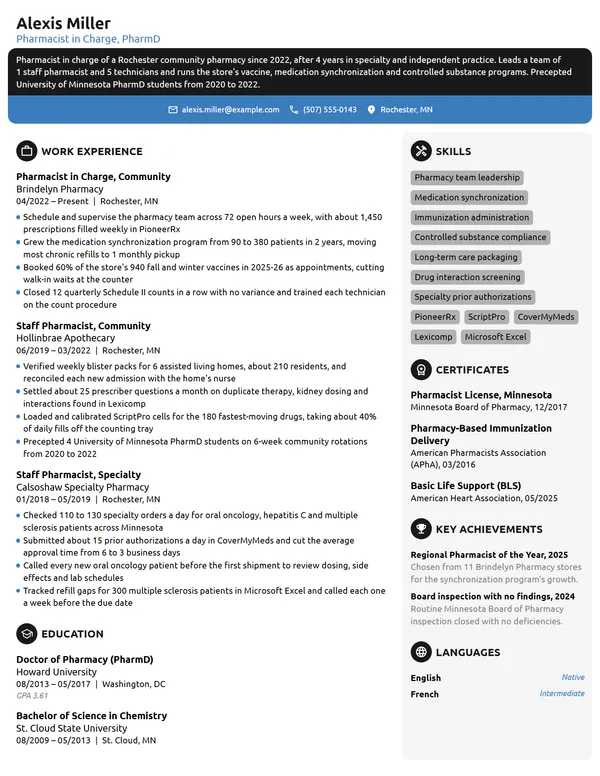
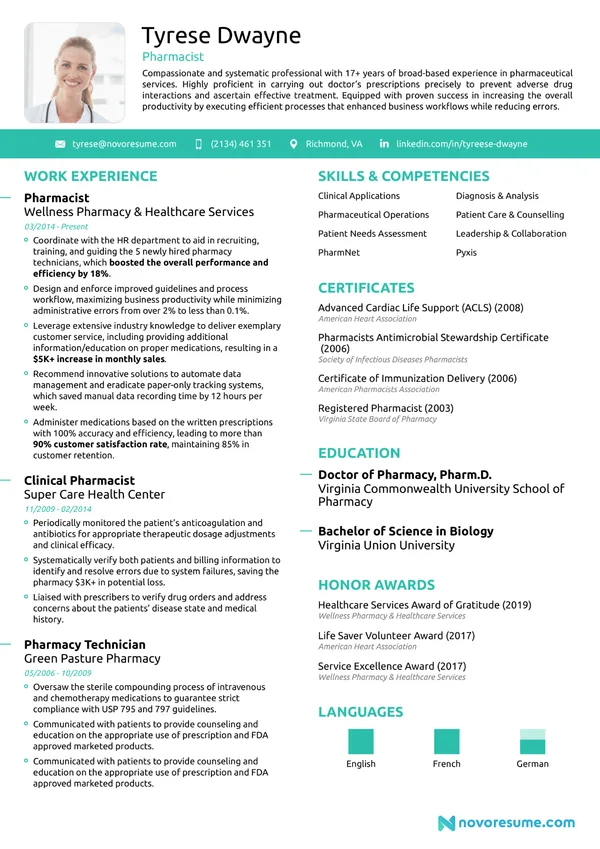
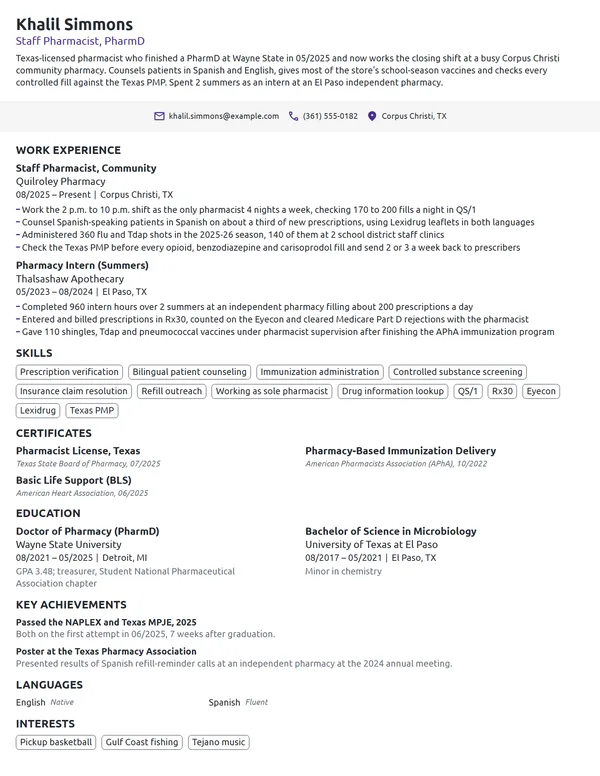
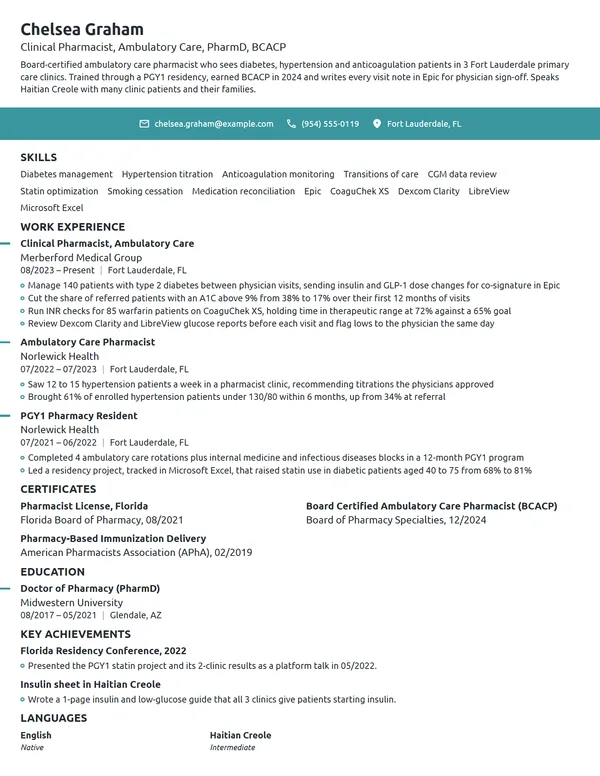
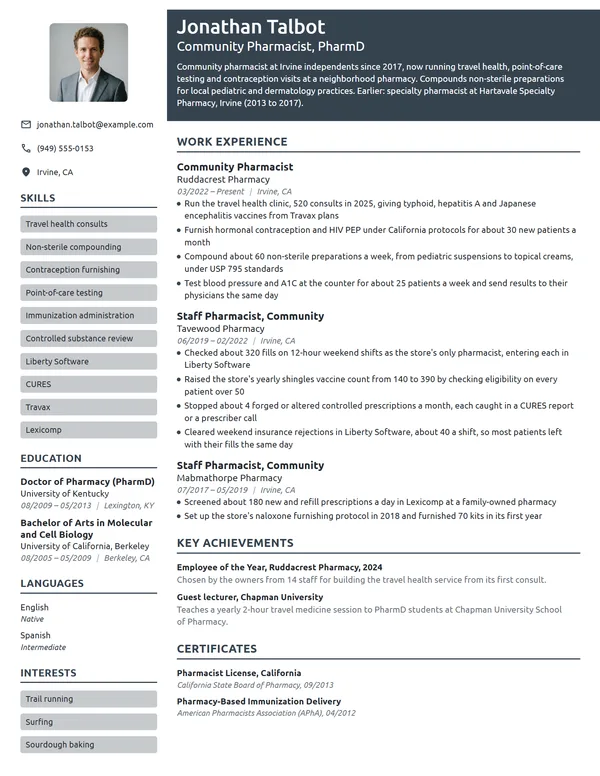
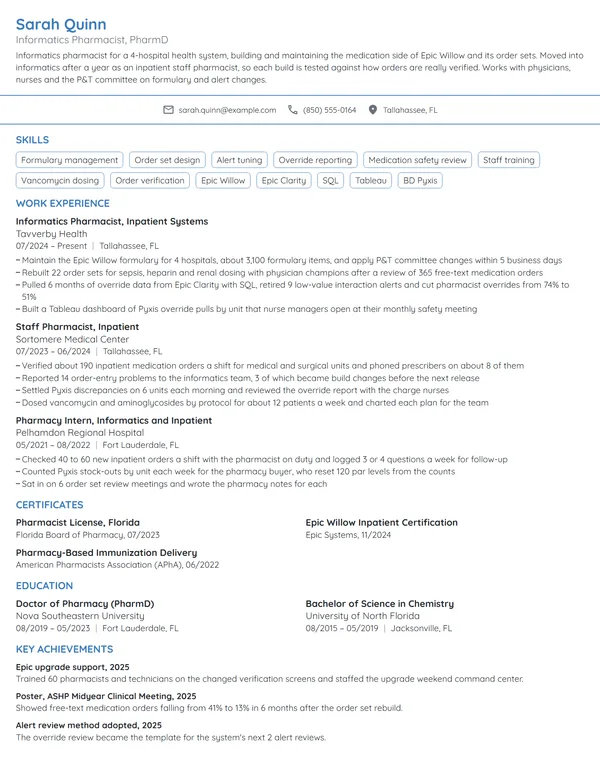
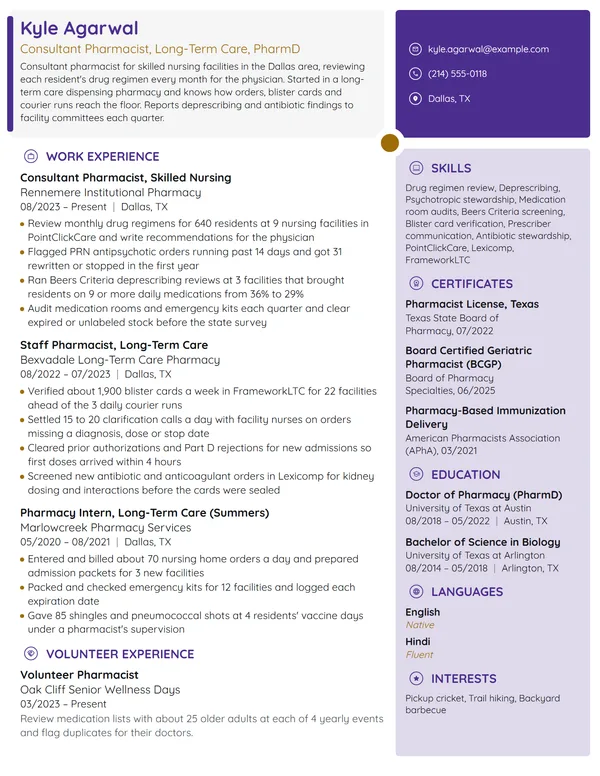
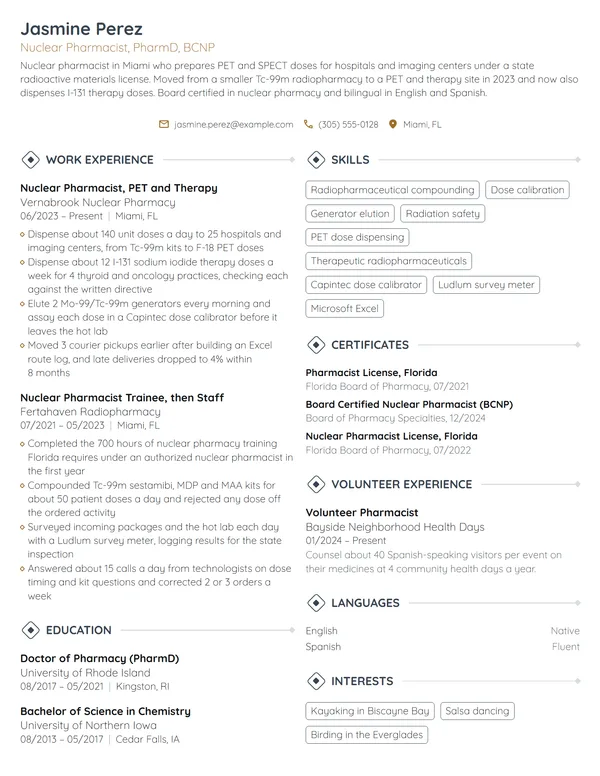
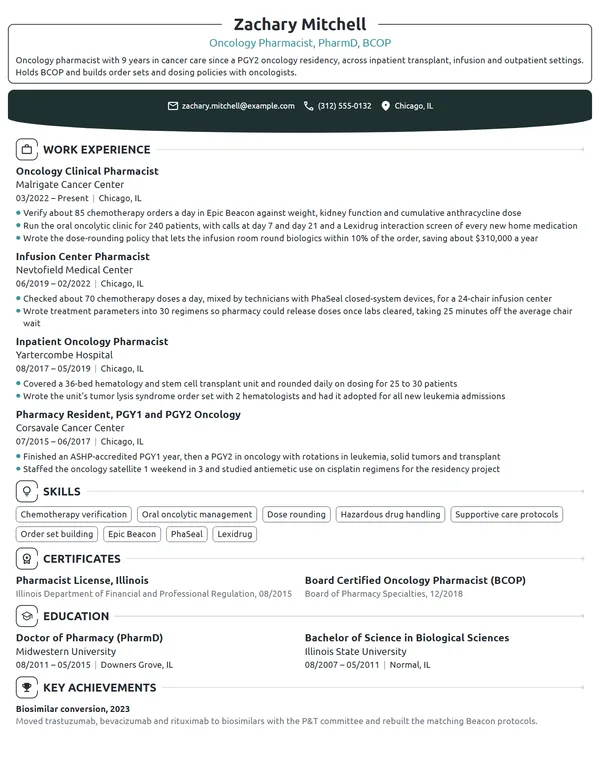
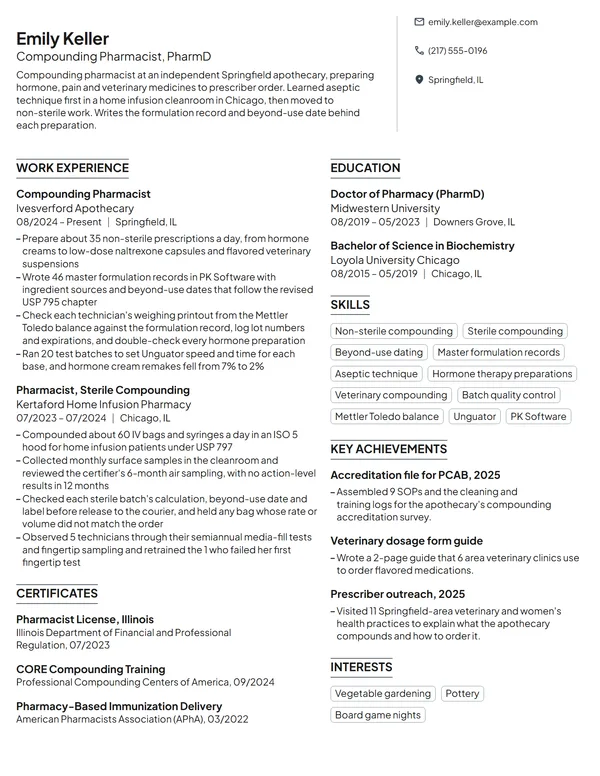
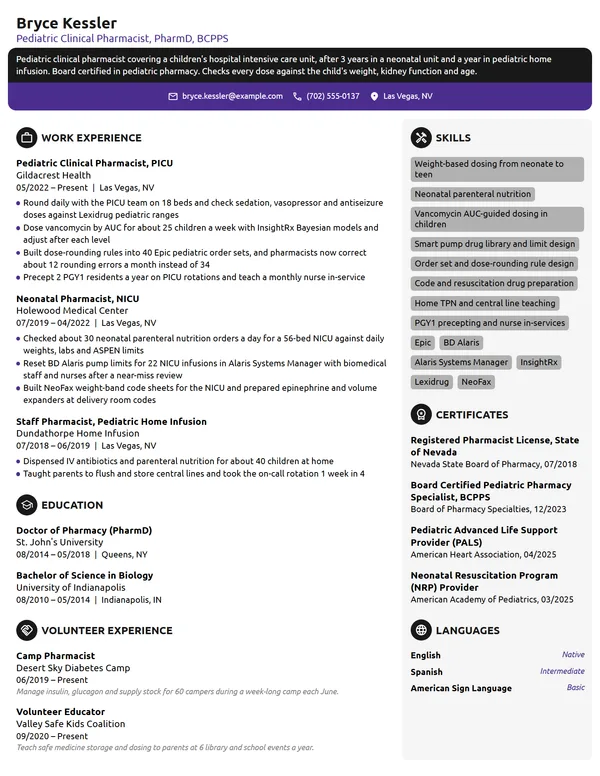
A pharmacist's job comes down to getting the right drug and dose to each patient, with advice they can follow. Employers start with your license and its state, then look at where you have practiced and how much volume you handle safely. A retail counter asks for different strengths than a hospital or an ambulatory care clinic, so every job you list should name its setting and 1 result, such as vaccines given or dosing problems caught before they reached a patient.
How to Write a Pharmacist Resume - Key Takeaways
- Order jobs newest first on 1 page; a residency and board certification with 8+ years can justify 2.
- Name the practice setting in every job title line, such as Staff Pharmacist, Community or Clinical Pharmacist, Internal Medicine.
- Count what pharmacies track: prescriptions verified a shift, vaccines given, problems resolved with prescribers and patients kept on their medication.
- List your pharmacist license first under Certificates, with the state board and the month, and give each state license its own line.
- Put a PGY1 or PGY2 residency under Work Experience and your PharmD under Education with its graduation date.
- Run the file through an ATS resume checker, since pharmacy postings screen for license, immunization and system keywords.
What pharmacy directors and managers check on a pharmacist resume
Whoever reads your resume, from a district manager at a retail chain to a hospital's director of pharmacy, starts with the same question: can this person practice here next month without supervision? The Bureau of Labor Statistics lists checking patients' allergies and other drugs, instructing patients on proper use and side effects, giving vaccinations such as flu shots and supervising technicians and interns as typical pharmacist duties. O*NET adds reviewing prescriptions for accuracy and working with other clinicians to plan and monitor drug regimens. Your bullets should show which of those you do most, and at what volume.
Build the resume from these sections, each under a plain heading that screening software can read:
- Name, headline (for example, Clinical Pharmacist, PharmD, BCPS) and contact details
- Summary of 2 to 3 lines up top, printed without a heading
- Work Experience, newest job first, with the setting in each title and any residency as its own entry
- Certificates: your pharmacist license or licenses first, then immunization, life support and board certifications
- Skills, with the pharmacy and EHR systems you use
- Education: your PharmD and any earlier degree
- Optional: Key Achievements, Volunteer Experience or Languages
Best format for a pharmacist resume
Pick the reverse-chronological resume format, newest job at the top, giving each one its title, setting, employer, city and MM/YYYY dates. Employers want to follow your route from intern to staff pharmacist to pharmacist in charge, or from residency to a clinical specialty, and this order shows it without any explaining. If you floated between several stores of one chain, keep them as 1 entry and name the number of stores in a bullet.
- Best for most pharmacistsReverse-chronologicalYour jobs, newest first, with your results under each one.Best for: A steady work history in your field
- FunctionalSkills grouped up top, with a short work history below.Best for: Gaps or very little experience
- CombinationA skills section first, then your full work history.Best for: A career change with strong skills
A staff pharmacist with under 8 years fits on 1 page. Go to 2 pages once you combine a residency and a board certification with 8+ years, and keep your license and current job on page 1 either way.
| Setting | What to use |
|---|---|
| Length | 1 page for most staff pharmacists; 2 with a residency and board certification plus 8+ years |
| Dates | MM/YYYY for every job and credential, and Present for the job you hold now |
| Job title line | Title plus setting: Staff Pharmacist, Community or Clinical Pharmacist, Emergency Medicine |
| Headline credentials | PharmD, then any BPS credential, such as BCPS or BCACP; RPh optional once licensed |
| Typeface | A readable font such as Calibri or Lato, 10 to 12 points |
| Photo and personal data | Most US and Canadian employers expect none; leave off your date of birth, marital status or SSN |
Most US and Canadian resumes carry no photo. Large pharmacy chains and health systems take applications through online portals, so send a PDF with standard headings unless the portal asks for a Word file.
Pharmacist resume summary vs. objective
Licensed pharmacists write a resume summary: the setting you practice in, your years, your license and the result you are proudest of. A student about to graduate or a pharmacist leaving the field and coming back writes a resume objective instead, naming the role you want, your exam and license status and your intern hours. Either way, keep it to 2 to 3 lines and take the number from a bullet further down.
Pharmacist resume summary formula
Setting pharmacist with X years in type of practice, licensed in state or states. 1 result with a number. Certificate, residency or service you run.
Example
Community pharmacist with 5 years in high-volume retail practice, licensed in Iowa. Raised the store's diabetes medication adherence rate from 81% to 90% with monthly refill calls. Completed APhA's immunization certificate program and precepts 2 PharmD students a year.
Don't
Detail-oriented pharmacist dedicated to patient safety and excellent customer service.
Do
Hospital pharmacist with 4 years verifying orders for a 220-bed community hospital, including overnight shifts as the only pharmacist on site. Completed a PGY1 residency and leads the vancomycin dosing service.
This version names the setting, the size, the hardest shift and a service the reader can picture.
How to write pharmacist work experience bullets with numbers
Give your current job 3 to 4 bullets and each older job 1 to 4, fewer as it ages. Open with your volume, since a reader judges every other number against it: prescriptions a shift at a store, or orders a shift and beds covered in a hospital. Then add achievements on your resume that your pharmacy already reports, such as vaccines given, adherence rates, wait times or interventions logged.
| Area | What to count | Example bullet |
|---|---|---|
| Dispensing volume | Prescriptions verified a shift or day, store volume, staff supervised | Verified about 350 prescriptions a day at a 24-hour store and supervised 4 technicians on the evening shift. |
| Immunizations | Vaccines given per season, clinics run | Ran 14 off-site flu clinics at local employers and gave 820 vaccines in 1 season. |
| Clinical interventions | Dosing and interaction problems caught, prescriber calls, therapy changes | Flagged 6 to 10 dosing or interaction problems a week and settled each one with the prescriber before pickup. |
| Adherence | Patients enrolled in refill sync or reviews, adherence rates | Enrolled 410 patients in refill synchronization and lifted the store's statin adherence rate from 79% to 88%. |
| Hospital order verification | Orders a shift, beds covered, IV doses checked | Verify 450 to 500 medication orders a shift for a 300-bed hospital and check IV admixtures in the clean room. |
| Inventory and controlled substances | Dollars on hand, expired stock, count discrepancies | Cut annual expired-stock write-offs from $22,000 to $9,500 with a monthly review of short-dated items. |
Here is how one community pharmacist's entry reads with those numbers. Volume comes first, the clinical and service results follow, and the earlier float job keeps 1 line.
Work Experience
- Verify about 280 prescriptions a shift at a store filling 2,100 a week, working with 3 technicians and 1 intern.
- Gave 1,160 flu, COVID-19 and shingles vaccines from 09/2025 to 03/2026, the most of the district's 9 stores.
- Run medication therapy management reviews for 260 Medicare Part D patients a year; resolved 84 drug therapy problems with prescribers in 2025.
- Cut the average wait for new prescriptions from 31 to 18 minutes by splitting drop-off and verification at peak hours.
- Covered 5 stores as a float pharmacist and ran 2 of them as pharmacist in charge for 6 weeks each.
Don't
Dispensed medications and counseled patients.
Do
Counseled about 45 patients a day on new prescriptions, with a short insulin pen demonstration for every new start.
Now the bullet shows the daily load and the kind of counseling a manager can check.
Don't
Responsible for supervising pharmacy technicians.
Do
Trained 6 new pharmacy technicians in 2025; all 6 earned PTCB certification within their first year.
Pharmacist skills and pharmacy software for your resume
Choose 6 to 8 hard skills for your resume that the posting names and that one of your bullets proves. Prescription verification and patient counseling fit almost every pharmacist; sterile compounding, pharmacokinetic dosing or anticoagulation management belong only where you do them now.
Hard skills for pharmacists
- Prescription verification
- Drug interaction screening
- Patient counseling
- Immunization administration
- Medication therapy management
- Sterile compounding
- Pharmacokinetic dosing
- Medication reconciliation
- Controlled substance inventory
- Prior authorizations and claims
Soft skills pharmacy managers value
- Accuracy at high volume
- Plain-language counseling
- Calm with upset patients
- Confident calls to prescribers
- Leading a technician team
- Judgment when working alone
Name your systems in Skills and again in the bullet that shows what you did with them. For pharmacists, O*NET flags Epic Systems, MEDITECH software and eClinicalWorks EHR software as hot technologies, along with Microsoft Office. Retail dispensing systems differ by chain, so copy the product name exactly as the posting writes it, and add automated dispensing cabinets or IV workflow software only where you used them.
Pharmacist license, immunization and BPS certifications on a resume
The Bureau of Labor Statistics notes that all states require pharmacists to be licensed, typically after 2 exams and a state-set number of intern hours. The exams are NABP's NAPLEX, which tests general practice knowledge, and a law exam, such as NABP's state-specific MPJE or the uniform UMPJE it launched in 2026. The BLS adds that most states require certification before a pharmacist gives vaccines. List certifications on your resume under your license, each with its issuer and month.
| Credential | Issued by | What it takes |
|---|---|---|
| Pharmacist license (RPh) | Your state board of pharmacy, such as the Iowa Board of Pharmacy | A PharmD from an ACPE-accredited program, the state's intern hours, the NAPLEX and a law exam. |
| Pharmacy-Based Immunization Delivery | American Pharmacists Association (APhA) | A certificate program: 12 hours of self-study and an 8-hour live seminar, 20 hours of continuing education in total. |
| BCACP (Board Certified Ambulatory Care Pharmacist) | Board of Pharmacy Specialties (BPS) | An active license and, within 7 years, 4 years of ambulatory care practice at 50%+ of your time, a PGY1 plus 2 such years, or a PGY2 in ambulatory care; then the exam, with recertification over each 7-year cycle. |
| Other BPS credentials, such as BCPS | Board of Pharmacy Specialties (BPS) | Each specialty sets its own practice or residency route and exam; check the current requirements on the BPS site. |
Listing licenses in 2 or more states
Write each license as Pharmacist License, the state, the board and the month it was issued, with the state you work in now first. Leave license numbers off, since employers look them up with the board. Add RPh to your headline only after a board has issued your first license.
Certificates
- Pharmacist License, Iowa, Iowa Board of Pharmacy, 07/2021
- Pharmacy-Based Immunization Delivery, American Pharmacists Association (APhA), 03/2020
- Basic Life Support (BLS), American Heart Association, 01/2026
How to list a PharmD, residency and intern hours
The Bureau of Labor Statistics says pharmacists typically need a Doctor of Pharmacy (PharmD) from an accredited program, and ACPE is the body that accredits them. Most programs take 4 years after at least 2 years of prerequisite courses, some run 3 years, and others admit high school graduates into a 6-year program. Write the degree as Doctor of Pharmacy (PharmD), with the school, its city and your graduation month, and add an earlier bachelor's degree below it only if it relates to the job.
Follow the standard rules for listing education on a resume, and add 1 line for your advanced rotations while you are within about 3 years of graduating. Residencies, which the BLS says last 1 to 2 years with the second year in a specialty, are paid training jobs, so give each one its own Work Experience entry with its title, such as PGY1 Pharmacy Resident. ASHP accredits PGY1 and PGY2 programs; write ASHP-accredited in the entry if yours was.
Education
APPE rotations: community, ambulatory care, internal medicine and long-term care.
New grad and setting-change pharmacist resumes
As a new graduate, your exam and license dates do the work a job history does later: NAPLEX passed, law exam scheduled or license issued, each with a month. Put that status in the objective and your intern job under Work Experience, since an intern job with real volume is the closest thing to a pharmacist job you have. If you worked as a technician before or during school, the pharmacy technician resume examples show how to put counts on that job.
- Pharmacy intern jobs: a full Work Experience entry with prescriptions a shift, vaccines you gave under supervision and the hours you logged.
- Advanced rotations: 1 line under Education, or a bullet with a number for the rotation closest to the job you want.
- Research and posters: under Key Achievements, with the topic and where it was presented.
- Health fairs and free clinics: under Volunteer Experience or Key Achievements, with the number of people screened or vaccinated.
Don't
Recent PharmD graduate seeking a challenging role where I can use my clinical knowledge.
Do
PharmD graduate, 05/2026, with the NAPLEX passed and an Iowa license expected in 11/2026, seeking a staff pharmacist role in community practice. Logged 1,700 intern hours, 1,100 of them at a 24-hour retail pharmacy.
Even an objective needs dates and hours a manager can check.
Moving from retail to a hospital, or from either into ambulatory care, keep the reverse-chronological order and bring forward what the new setting uses: drug interaction work, anticoagulation or diabetes counseling, or any IV and sterile compounding you did. A short-term or per diem shift in the new setting earns its own entry. Your cover letter is where you say why you are changing settings, and these healthcare cover letter examples show how to do that in a few lines. If you are leaving pharmacy practice altogether, the career-change resume layout puts your transferable skills above your history.
Pharmacist resume FAQ
Should I put my pharmacist license number on my resume?
No. List the license, its state, the board that issued it and the issue month. Employers verify a pharmacist license with the board themselves, and keeping the number off means it does not travel through every job portal you apply on.
Can I write RPh after my name before I am licensed?
No. Add RPh to your headline only once a state board has issued your license. Until then, write PharmD, or PharmD candidate before graduation, and give your NAPLEX and law exam status with dates in your objective.
Where does a PGY1 or PGY2 residency go on a pharmacist resume?
Under Work Experience, as its own entry with the title PGY1 or PGY2 Pharmacy Resident, the hospital, the city and the dates. Use the bullets for your rotations, staffing shifts and the project you led, and note ASHP accreditation if the program has it.
How long should a pharmacist resume be?
1 page for new graduates and most staff pharmacists. A second page is fine once you combine a residency and a board certification with 8+ years, as long as page 1 holds your license and current job.
Do I need board certification to get a pharmacist job?
Not for most staff roles in community or hospital pharmacy, where your license and immunization certificate are what postings ask for. Clinical specialist and ambulatory care roles often ask for a BPS credential, such as BCPS or BCACP, or for eligibility to sit for one within a set time.
How do I move from retail to a hospital pharmacist job on my resume?
Lead each retail job with the clinical work a hospital uses, such as interaction screening, dosing questions settled with prescribers and any sterile compounding. Add hospital per diem or residency shifts as their own entry, and use the cover letter to name the unit or service you want.
What is the average pharmacist salary?
The BLS puts the median annual wage for pharmacists at $140,910 as of May 2025. Pay varies with your state, your setting and whether you work nights or as a pharmacist in charge; keep it off your resume and raise it once an offer is on the table.
Next steps
Pick the example closest to your setting and stage, copy its structure, and replace the details with your own license, volume and results. Build it in our resume builder or begin with one of our templates, then send it alongside a short letter naming the pharmacy or service you want and your best number.