
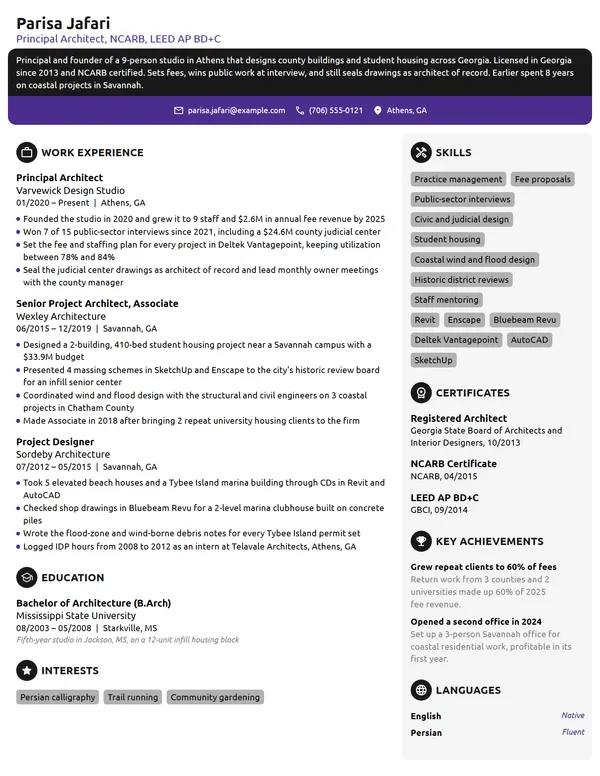
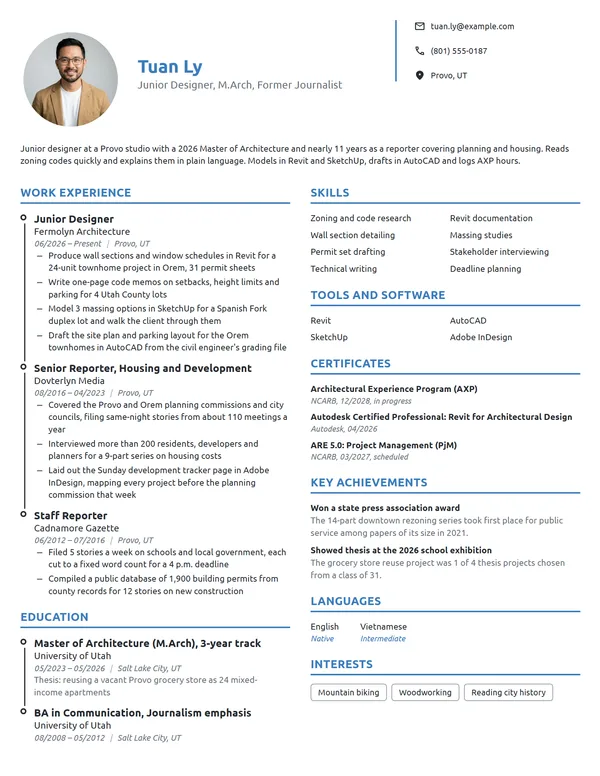
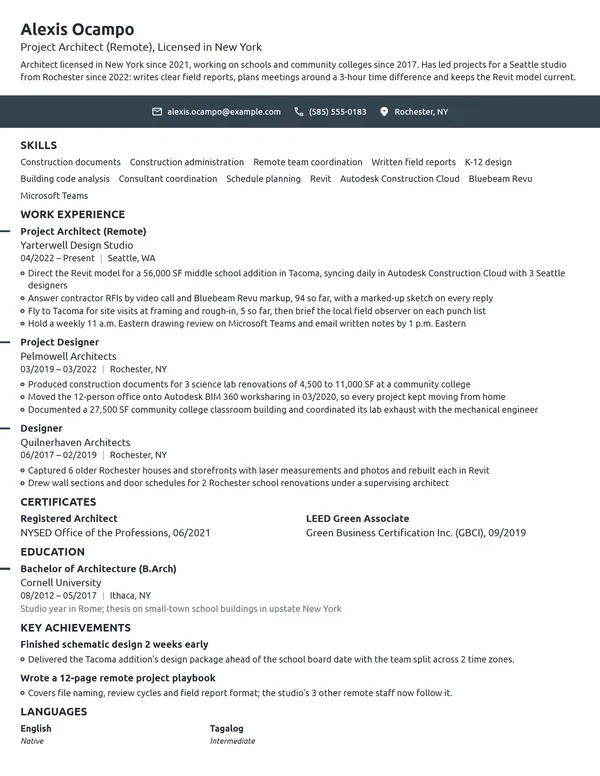
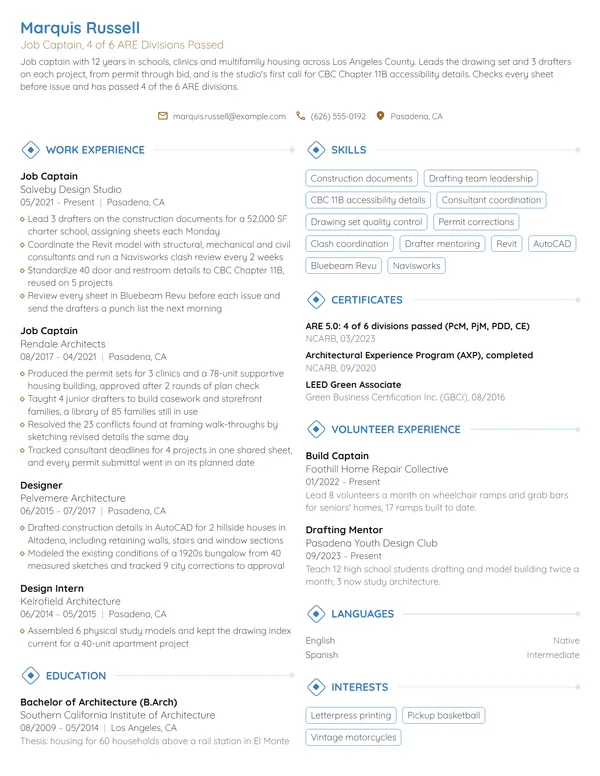
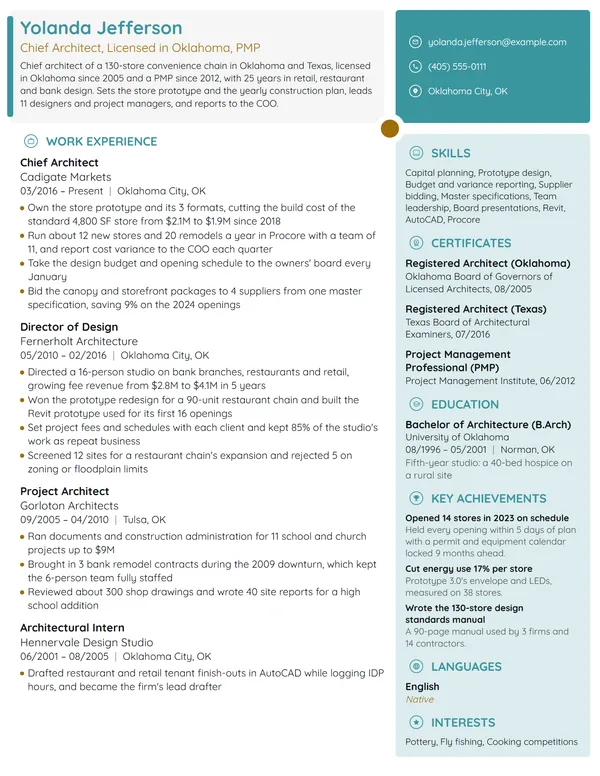
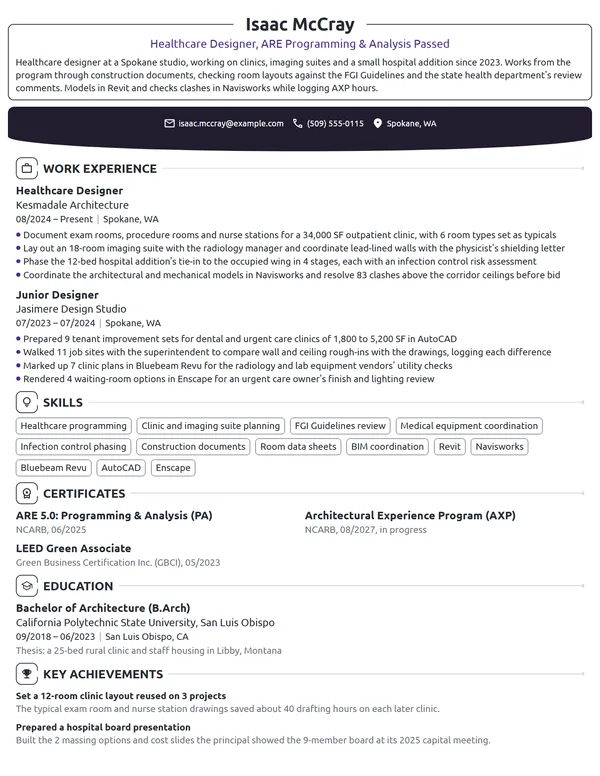
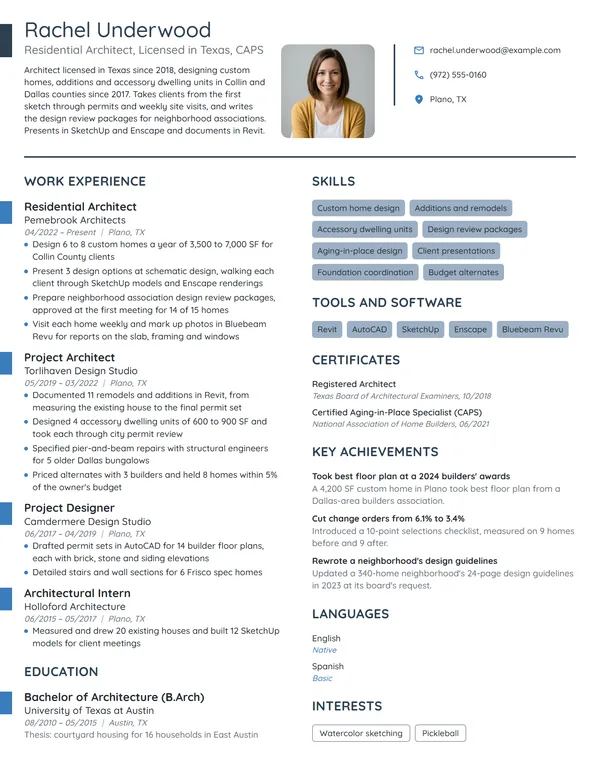
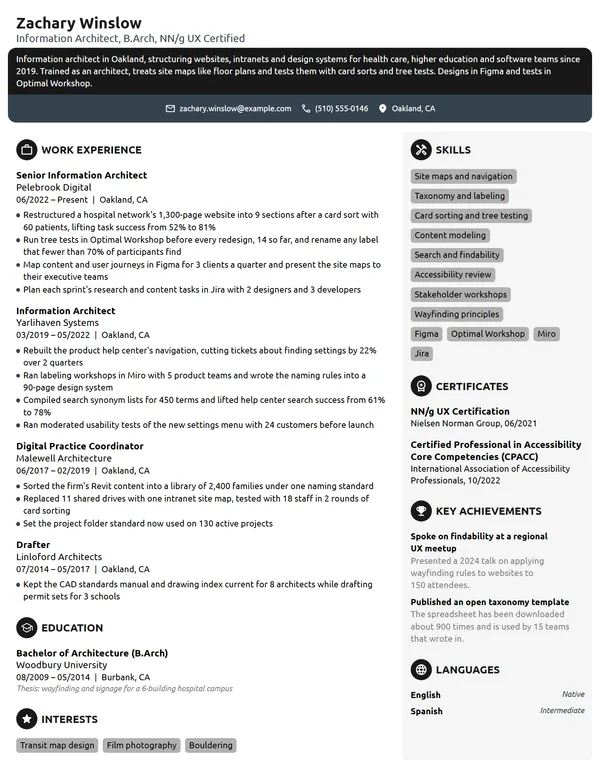
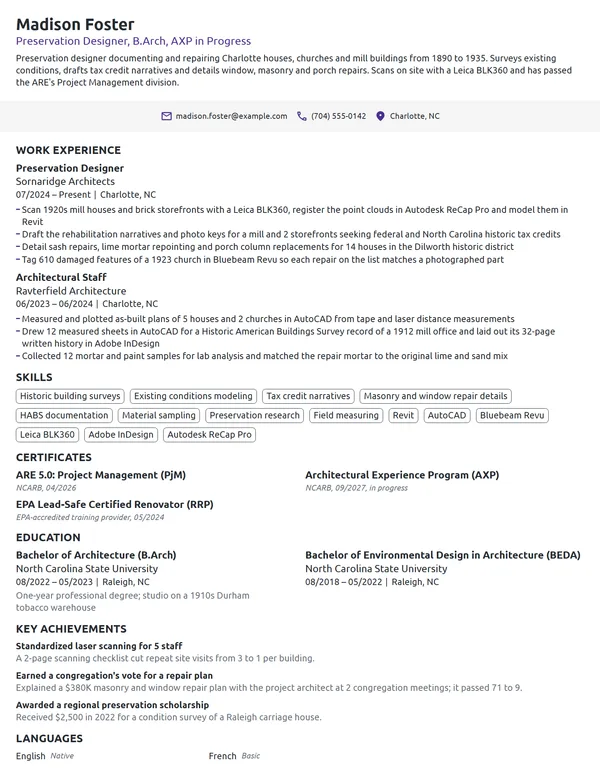
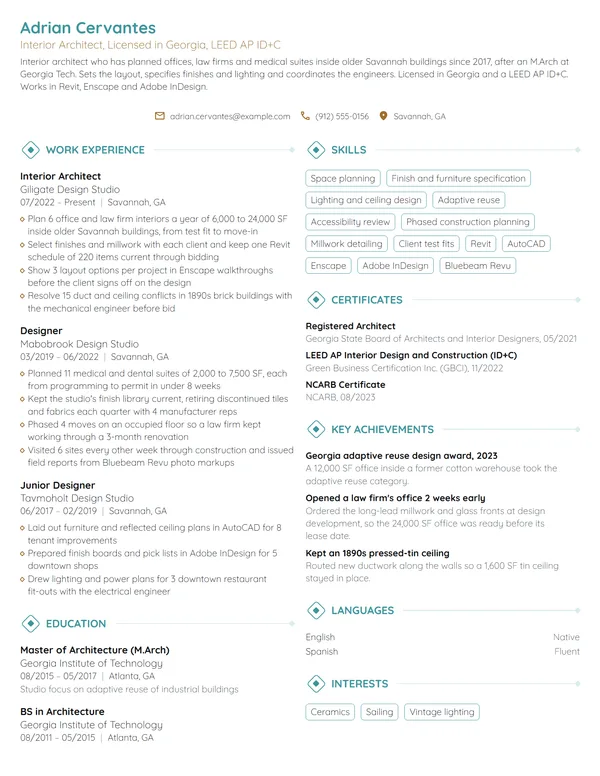
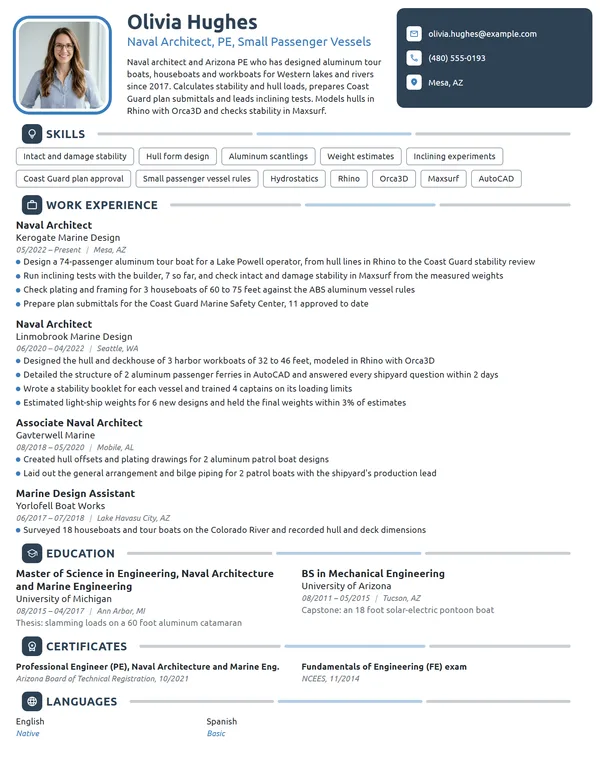
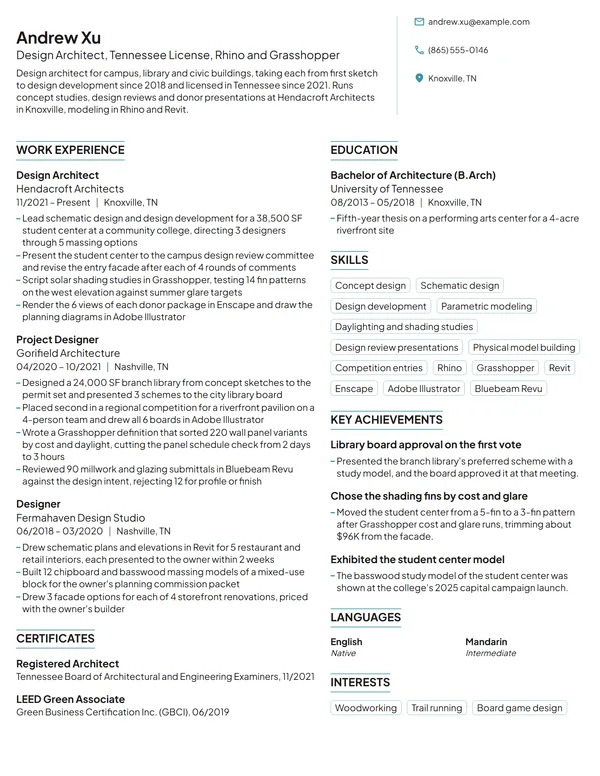
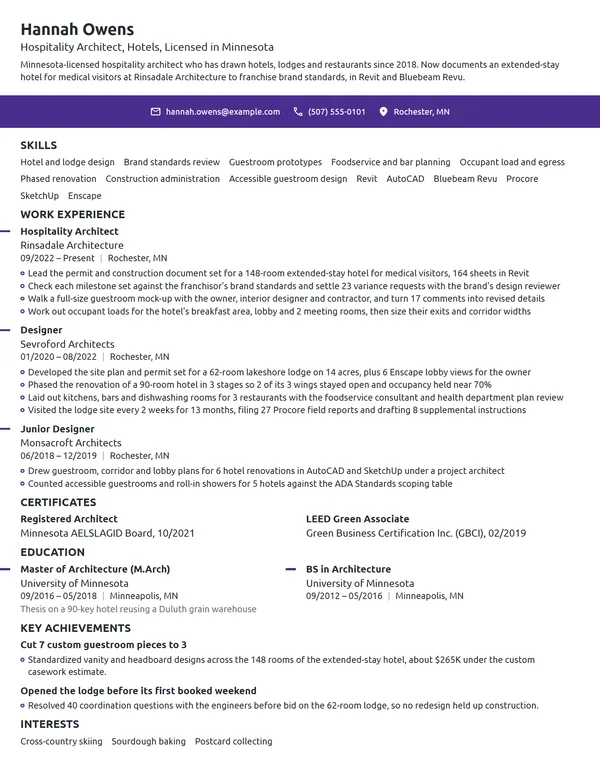
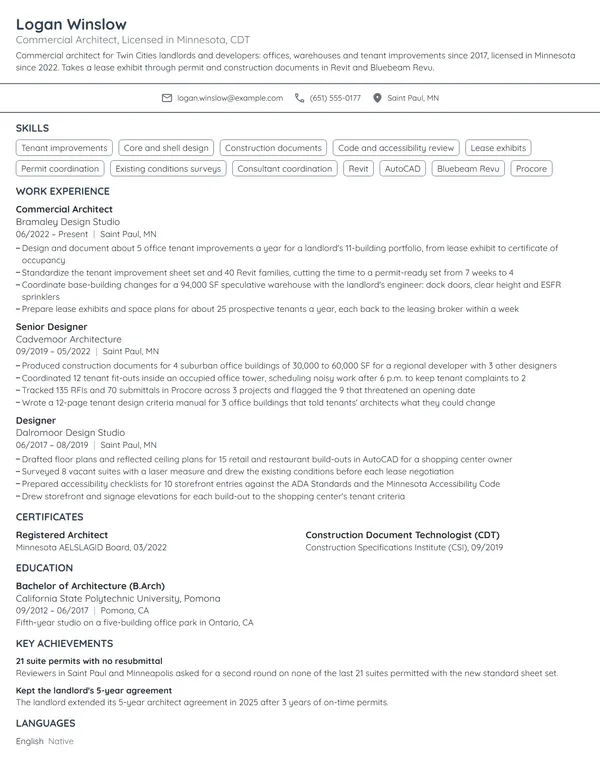
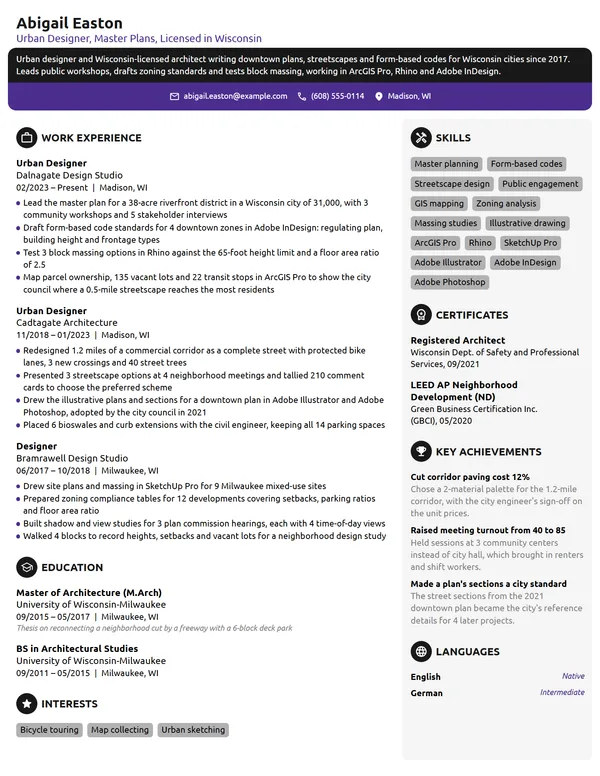
No building is the work of one person, so an architect's resume has to show which part was yours. Principals scan for the building types you know, project size, the phases you worked on, your design software and where you stand on licensure. When years of studio and site work shrink into a few bullets, your own role tends to blur into the team's. Naming your phase, your deliverables and the project's size in every entry keeps it in focus.
How to Write an Architect Resume - Key Takeaways
- Pick reverse-chronological order, kept to 1 page early in your career and 2 once you have 10+ years of projects worth naming.
- Give each project its size, construction cost and the phases you owned, from schematic design to construction administration.
- List Revit, AutoCAD, SketchUp, Rhino or Enscape only where a bullet shows what you produced in it.
- Open the Certificates section with your state license; until you hold one, list ARE divisions passed and AXP hours there instead.
- Keep the word architect out of your title line until a state board licenses you, and link your portfolio in the contact line.
- Run the final PDF through an ATS resume checker, since large firms screen for software and license keywords.
What principals look for in an architect resume
A principal or studio director reads your resume to decide whether you can take a project like theirs from sketch to site. The BLS lists meeting clients to set a building's requirements, preparing contract documents for contractors and visiting worksites to check that construction follows the plans as core duties. O*NET adds preparing scale drawings with computer-aided design and observing construction for compliance. Each bullet should show one of those tasks on a named building type, with its size.
This page covers architects who design buildings. If you design software, cloud or network systems, the solutions architect examples fit your work better. For building architects, use these sections:
- Name, headline (for example, Project Architect, licensed in Colorado), contact details and a portfolio link
- A 2- to 3-line profile under your name, with no section title
- Work Experience, newest firm first, with project types in the bullets
- Certificates, led by your state license, then NCARB, LEED or ARE progress
- Skills, with your design and documentation software
- Education, with the degree's full name
- If space allows: Languages, plus Key Achievements for competitions or Volunteer Experience for design-build work
Best format for an architect resume
Use the reverse-chronological resume format: current firm first, with your title, the firm's office location and month-and-year dates (MM/YYYY) on every entry. An architecture career is read as a climb in responsibility, from designer to job captain, project architect and project manager, and listing jobs newest first makes each step visible. Firms also want to see how recent your construction administration work is, which a dated list makes plain.
- Best for most architectsReverse-chronologicalYour jobs, newest first, with your results under each one.Best for: A steady work history in your field
- FunctionalSkills grouped up top, with a short work history below.Best for: Gaps or very little experience
- CombinationA skills section first, then your full work history.Best for: A career change with strong skills
A single page fits most architects with under 10 years in practice. A 2-page resume suits a senior project architect, an architectural project manager or a principal with a long record of built work, as long as page 1 holds your current firm and your largest projects. Your portfolio carries the images, so the resume can stay text.
| Setting | What to use |
|---|---|
| Length | 1 page for under 10 years; 2 pages for a long list of built projects |
| Dates | MM/YYYY for every job, and Present for the firm you are with now |
| Job title line | The title your firm uses, such as Job Captain or Project Architect; Architect only once you hold a license |
| Portfolio | A short link in the contact line; send the PDF portfolio as its own file |
| Type and layout | One clean sans serif for body text, wide margins, and no renderings on the resume itself |
| Headshot and private details | Rarely expected by US and Canadian firms, so leave it off; age, family status and SSN stay off too |
| File type | PDF, unless the firm's job portal wants a .docx file |
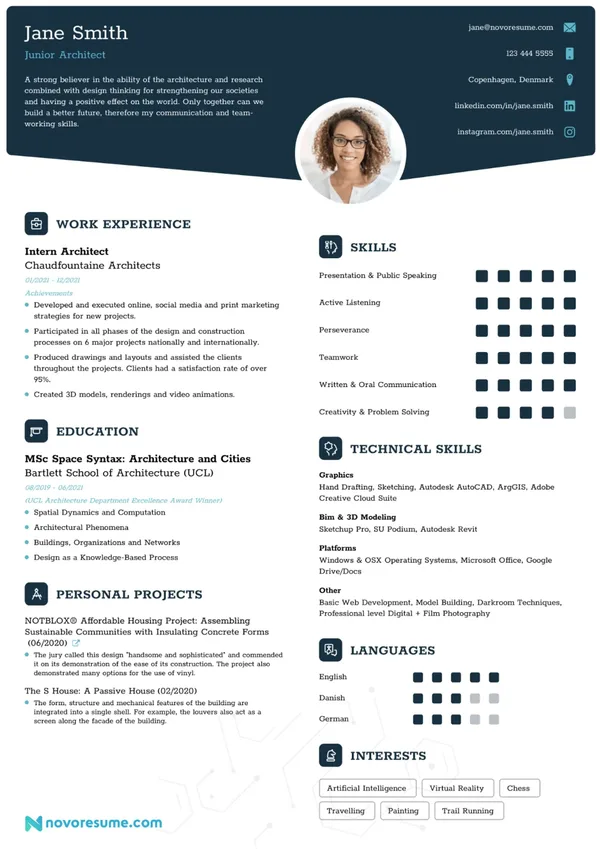
Most US and Canadian resumes carry no photo. In architecture your design sense shows in a tidy, well-spaced page and in the portfolio, so put your effort there instead of into a headshot.
Architect resume summary vs. objective
Use one test: if you have worked on a building that got built or permitted, write a summary; if you have only studio, internship or competition work, write an objective. A summary names your license status, your project types, your largest project and your software. An objective names the role you want and your strongest proof so far. The architecture summary and objective examples show both at different career stages.
Architect resume summary formula
Title with X years in building types, license status. The largest project you carried, with its size and the phases you ran. Software and credential named in the job ad.
Example
Project architect with 9 years in multifamily housing, licensed in Oregon. Took a 140-unit affordable housing project from schematic design through construction administration. Works daily in Revit and Enscape; LEED AP BD+C.
Don't
Creative and passionate architect with a strong eye for design and excellent AutoCAD skills, seeking to grow with an innovative firm.
Do
Architect licensed in Washington with 6 years in healthcare and lab work, documenting in Revit and Bluebeam. Ran construction administration for a $52M outpatient surgery center, reviewing 180 submittals across 95 site visits.
This version adds the license state, the building types, the project size and the construction-phase volume.
How to write architect work experience bullets with numbers
Your current role gets 3 to 4 bullets and earlier roles 2 to 4, each opening with a verb. Architecture already runs on numbers: square feet, units, construction cost, sheets, RFIs, review cycles. Put them in so each line reads as one of your achievements on a resume, not a copy of your job description.
| Area | What to count | Example bullet |
|---|---|---|
| Project scale | Square feet, units or rooms, construction cost | Documented a 36,000 SF community center with a $17M construction cost. |
| Phases | SD, DD, CD and CA phases you led, months from start to occupancy | Led a fire station from schematic design through construction administration in 26 months. |
| Drawing sets | Sheets, addenda, bid packages | Issued a 190-sheet permit set and 3 addenda for a 4-story dormitory. |
| Construction administration | Submittals, RFIs, site visits, change orders as a share of cost | Reviewed 260 submittals on a $30M lab renovation, with change orders at 1.8% of construction cost. |
| Permits and code | Plan review comments, resubmittals, approvals | Cleared 57 plan review comments in 1 resubmittal for a 120-room hotel. |
| Sustainability | LEED level, modeled energy use intensity (EUI) | Reached a modeled EUI of 28 on a 3-story office designed to LEED Gold. |
| Team | Designers you directed, consultants you coordinated | Directed 4 designers and coordinated 7 consultants on a $45M housing project. |
Here is one project architect's entry. The current role carries the scale and the construction numbers, and the earlier role gets 2 shorter lines.
Work Experience
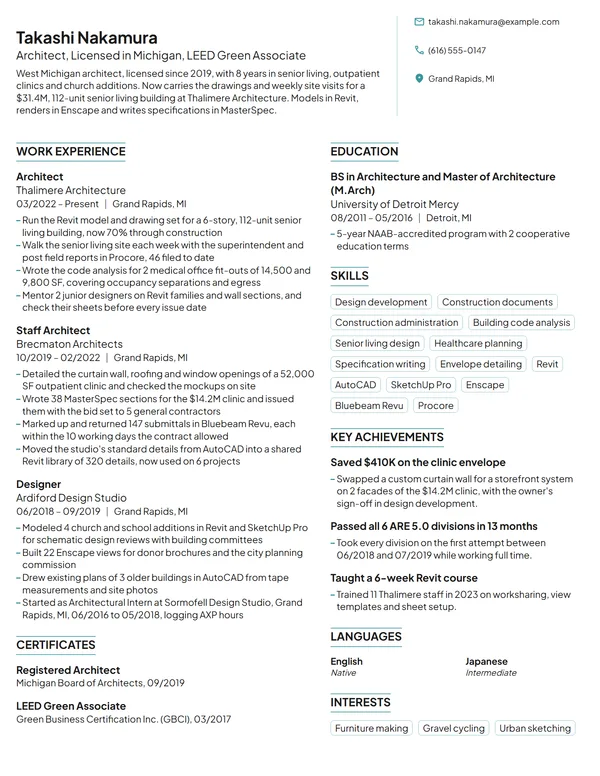
- Led construction documents for a 5-story, 64-unit mixed-use building with a $38M construction cost, coordinating a 9-member consultant team in Revit.
- Answered 212 RFIs during construction with an average turnaround of 3 business days.
- Secured the permit for a 22,000 SF clinic in 1 review cycle by holding a pre-application meeting with city plan reviewers.
- Ran weekly site visits and field reports through 14 months of construction, holding change orders to 2.4% of construction cost.
- Built Revit models and design development sets for 6 K-12 renovation projects of $4M to $19M.
- Produced 30 Enscape renderings for 2 public school board meetings.
Don't
Responsible for construction documents.
Do
Produced 118 sheets of construction documents for a 3-story, 48,000 SF library and resolved 41 plan review comments before the permit was issued.
Now the line carries the set's size, the building and a result a principal checks.
Don't
Worked closely with clients throughout the design process.
Do
Ran 6 programming workshops with a 30-person faculty committee and trimmed the space program from 62,000 to 54,000 SF to fit a $21M budget.
Architecture skills and software for your resume
Choose 6 to 8 hard skills for your resume that the listing names and a bullet already proves. Code analysis and construction documents fit almost any architect resume; healthcare planning, historic preservation or energy modeling only where you have done that work.
Hard skills for architects
- Schematic design
- Design development
- Construction documents
- Construction administration
- Building code analysis
- BIM coordination
- Space programming
- Specifications
- Building envelope detailing
- Accessibility (ADA) review
Soft skills architecture firms value
- Client presentations
- Sketching ideas in meetings
- Consultant coordination
- Clear written field reports
- Deadline planning across phases
- Mentoring junior designers
Name your software with your skills, and repeat each tool inside a work line next to what you made with it. Architects produce designs and construction drawings in computer-aided design and drafting (CADD) and building information modeling (BIM) tools, the BLS says, and O*NET lists Autodesk Revit, AutoCAD, Trimble SketchUp Pro, McNeel Rhinoceros 3D, Chaos Enscape and Adobe InDesign, Illustrator and Photoshop among the in-demand tools for architects. Write the names as the posting does, and say what you did in each: Revit families and worksharing, Rhino with Grasshopper scripts, InDesign for proposal and competition boards.
Architect license, ARE and AXP: how to list them on a resume
All states and the District of Columbia license architects, the BLS says, and every state board asks graduates to complete a lengthy paid internship first. NCARB runs both pieces: the Architectural Experience Program (AXP), which asks for 3,740 documented hours, and the Architect Registration Examination (ARE), which all 55 US jurisdictions require. List certifications on your resume under Certificates with the issuer and the date, putting the license first.
| Credential | Issued by | What it takes |
|---|---|---|
| Architect license | Your state's architecture licensing board | Meet the state's education rule, complete the AXP's 3,740 hours and pass all 6 divisions of ARE 5.0. |
| NCARB Certificate | NCARB | A degree from a NAAB- or CACB-accredited program (or NCARB's Education Alternative), the AXP, the ARE and a license from a US board. NCARB calls it the easiest route to a reciprocal license in another state. |
| LEED Green Associate | USGBC (GBCI) | Pass the Green Associate exam, then report 15 continuing education hours every 2 years. |
| LEED AP BD+C, ID+C or O+M | USGBC (GBCI) | Pass the Green Associate exam and a specialty exam, then report 30 continuing education hours every 2 years. |
How to show ARE progress before you are licensed
NCARB says you can only call yourself an architect once you are licensed, and state rules back that up: in Texas, the board's rules reserve any form of the word architect for registered architects and let a person enrolled in the AXP use the title architectural intern. Until your license arrives, keep your firm's title (Designer, Job Captain) on the job title line and list each ARE division you have passed, with its date, plus your AXP hours. Passed divisions stay valid for as long as NCARB delivers the exam version you took them under, so older passes still count.
Certificates
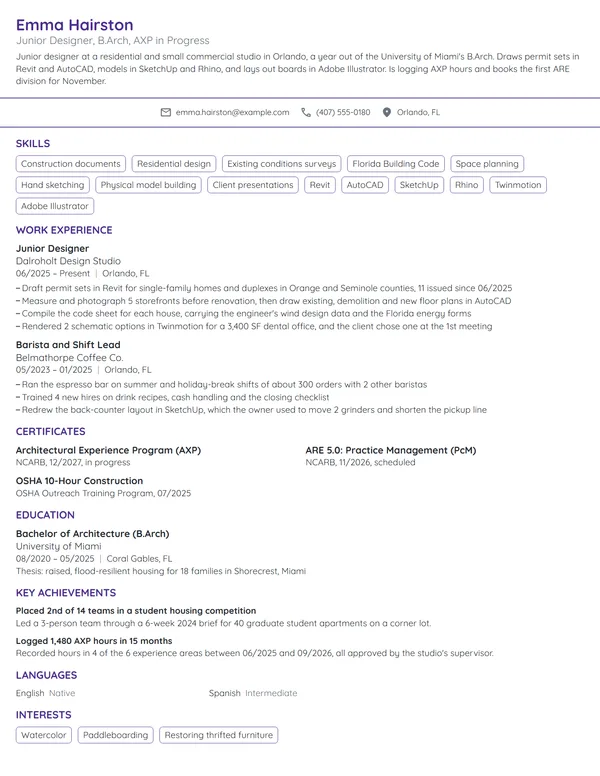
- ARE 5.0: Practice Management (PcM), NCARB, passed 02/2026
- ARE 5.0: Project Management (PjM), NCARB, passed 05/2026
- ARE 5.0: Programming & Analysis (PA), NCARB, passed 08/2026
- ARE 5.0: Project Planning & Design (PPD), NCARB, scheduled 12/2026
- AXP, NCARB, 3,120 of 3,740 hours reported
- LEED Green Associate, GBCI, 04/2024
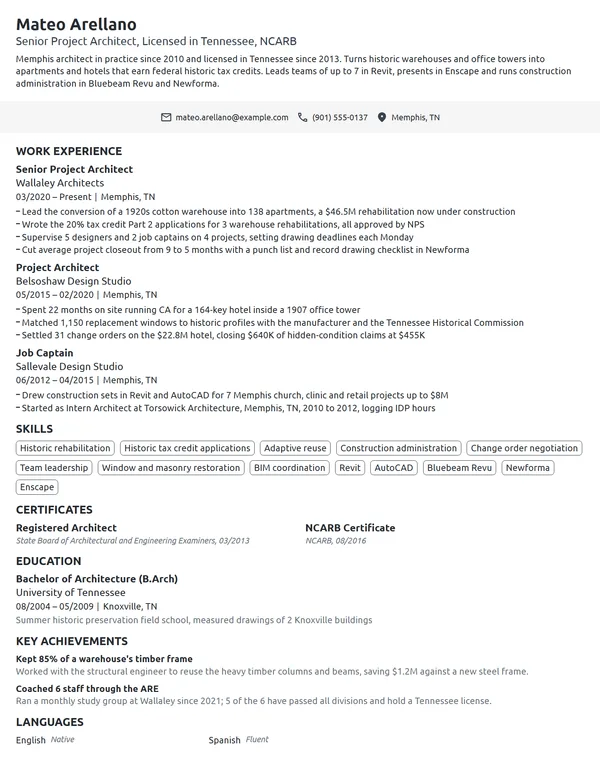
Once licensed, write the license as its own line, such as Architect, Oregon, with the year, and add the NCARB Certificate if you hold it. AIA after your name belongs only to Architect members in good standing; an unlicensed member of the AIA writes Assoc. AIA.
How to list a B.Arch or M.Arch on an architect resume
The BLS names a bachelor's in architecture as the typical entry degree. NCARB describes the 2 usual accredited routes as a 5-year Bachelor of Architecture or a Master of Architecture taken after a 4-year undergraduate degree, and notes that many, but not all, jurisdictions require a degree from a NAAB-accredited program, while 17 jurisdictions offer other pathways. Write the degree's full name, since a B.S. in Architecture and a B.Arch are different degrees to a licensing board.
When listing education on a resume, write out the degree name, then the university, its city and the month you graduated. Add a thesis or comprehensive studio project in 1 line while you are within 3 years of graduating, and a GPA only if it is 3.5 or higher. List a pre-professional degree as well as an M.Arch, newest first.
Education
Thesis studio: an 8,000 SF library branch on a 0.6-acre infill site.
Entry-level and career-change architect resumes
Without a full-time design job yet, follow the architecture intern examples: lead with a short objective, move Education up to second place, and fill the rest with work that proves you can produce drawings a firm can use. Each item gets a number, just as a paid job would.
- Internships: AXP hours logged, drawing sets you worked on, the software you used.
- Studio and thesis work, under Education: building type, size and site, only for your strongest 1 or 2 projects.
- Design competitions: the brief, your team size and any placing, listed under Key Achievements.
- Design-build or community projects: what you built and for whom, listed under Volunteer Experience.
Don't
Motivated architecture graduate eager to learn and contribute to a design-focused firm.
Do
M.Arch graduate with 1,100 AXP hours from 2 summer internships, seeking a designer role in a housing studio. Modeled 3 townhouse projects in Revit and passed PcM in 2026.
Hours, projects and an exam division turn a wish into a case.
Moving in from drafting, interior design or construction management, keep the reverse-chronological order and lead your current job with its most architectural tasks, such as drawing sets, code reviews or submittals. A career-change resume also needs a clear licensure line: AXP hours and any ARE divisions under Certificates. Save the story of why you switched for the letter that goes with it; the architect cover letter examples show how to cover it in a short paragraph.
Architect resume FAQ
Can I call myself an architect on my resume before I am licensed?
No. NCARB says the title architect comes with the license, and states such as Texas reserve the word for registered architects. Use your firm's title, such as Designer or Job Captain, and list ARE divisions and AXP hours under Certificates.
Should I send my portfolio with my architect resume?
Yes, whenever the listing requests one or the portal takes attachments. Put a short portfolio link in your contact line and send the PDF portfolio as its own file, with project names that match your resume bullets so a reader can move between them.
How long should an architect resume be?
One page for most architects with under 10 years of experience. Senior project architects and principals with a long record of built work can use 2 pages, as long as page 1 holds the current firm and the largest projects.
What software should I list on an architect resume?
List the design and documentation tools the posting names that you can work in from day 1, usually Revit, AutoCAD, SketchUp, Rhino, Enscape and Adobe InDesign. Pair each one with a work line describing a set, model or rendering you produced in it.
How do I list ARE divisions I have passed?
List each division under Certificates by its ARE 5.0 name with the month and year you passed it, such as Project Management, NCARB, 05/2026. Add any scheduled division with its date and your AXP hours reported, and drop the list once you are licensed.
Should I put AIA after my name on my resume?
Only if you are an Architect member of the AIA in good standing, which requires a license. Unlicensed members use Assoc. AIA. The AIA says a nonmember using its designation infringes its trademark, so leave it off if your membership has lapsed.
Is a LEED credential worth listing on an architect resume?
Yes, if the firm does sustainable or certified work. List LEED Green Associate or LEED AP with its specialty, such as BD+C, under Certificates, and pair it with a bullet naming a project's LEED level or modeled energy use.
Can I list projects from a previous firm on my resume?
Yes, under that firm's Work Experience entry, with your own role in each. Write what you did, such as the construction documents or the CA phase, not that you designed the building, and check that any project shown in your portfolio is cleared for sharing.
How much do architects make?
In May 2025, half of US architects earned more than $99,280 a year, BLS wage figures show. Pay varies with license status, region and project type, and it stays off your resume; raise it once an offer is near or a form asks.
Next steps
Pick the example nearest your career stage, then swap in your own buildings, square footage, phases and license status. Build it in our resume builder, or open one of the resume templates if you want a ready layout, and send it with a matching portfolio and a short letter that opens with your strongest project.