
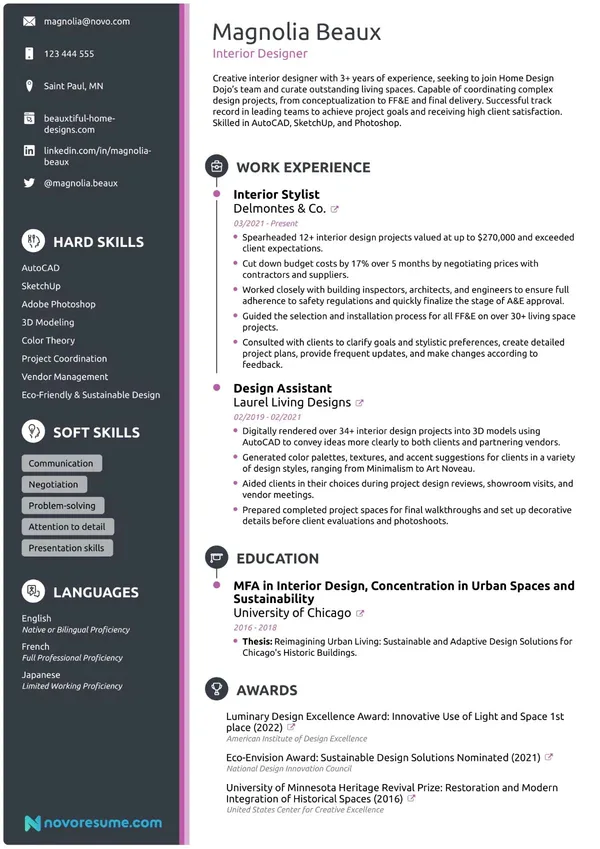
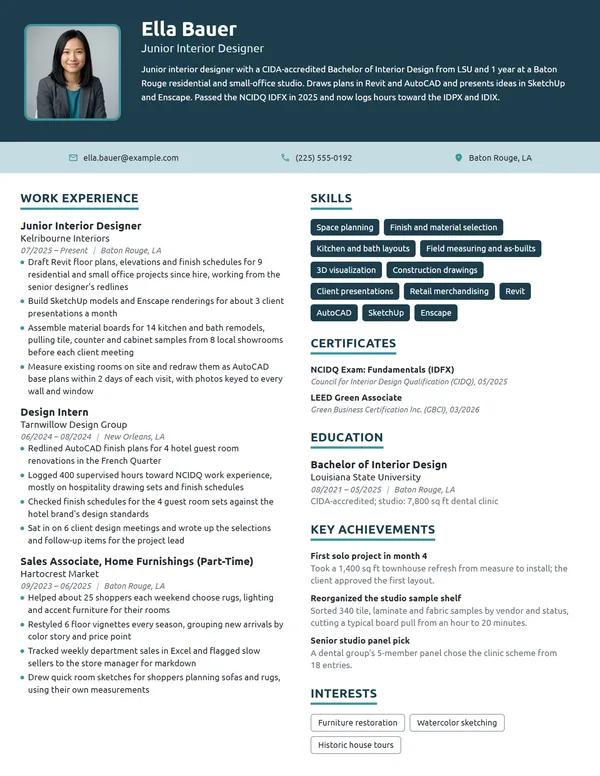
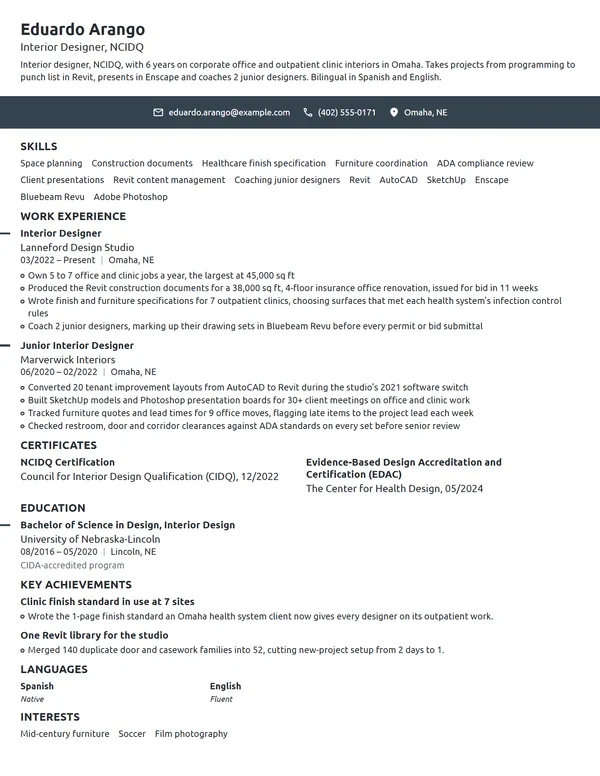
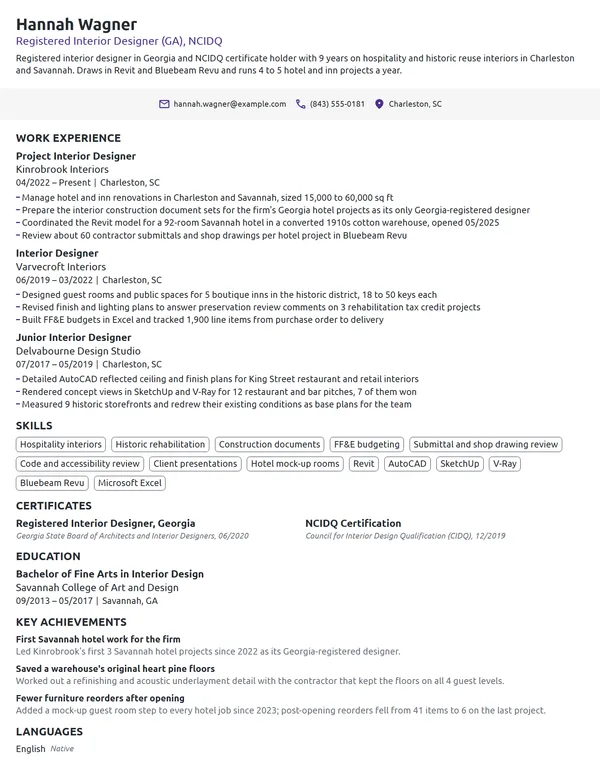
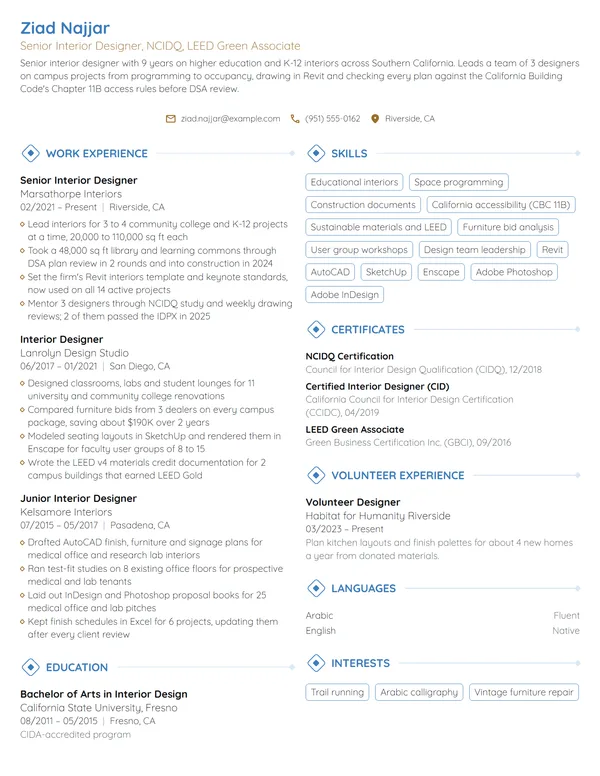
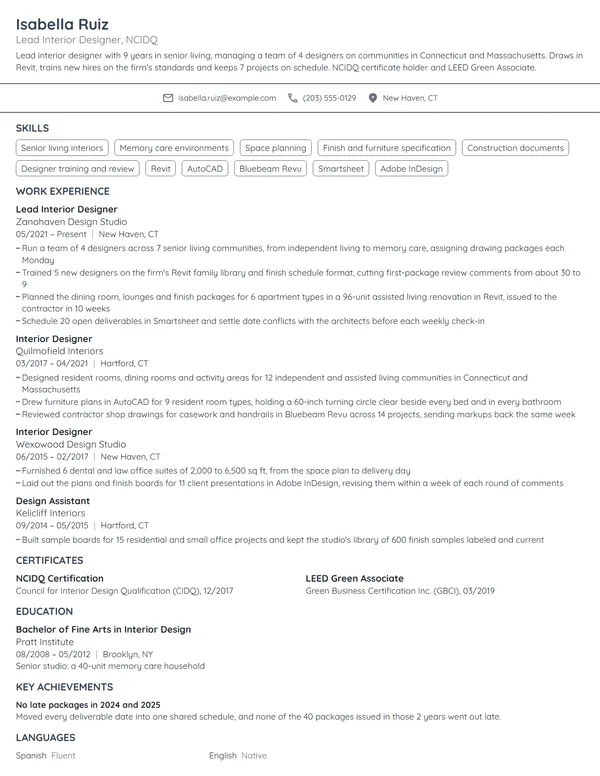
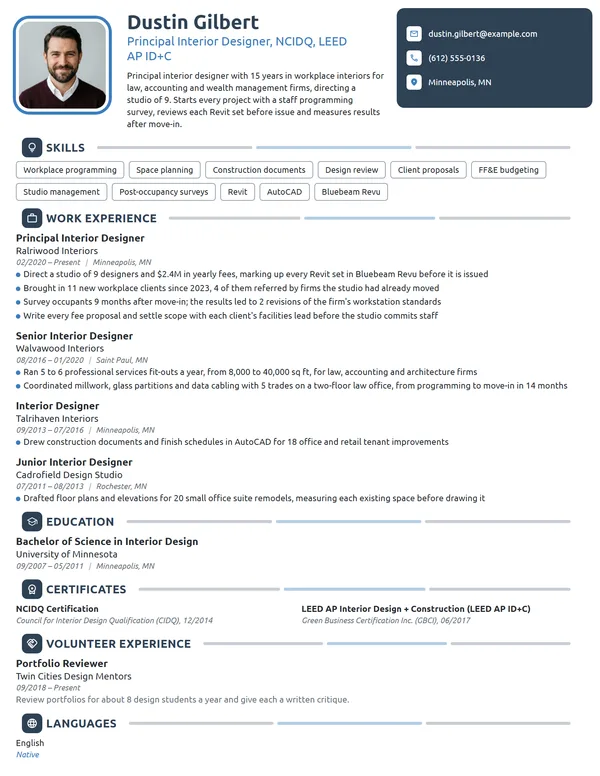
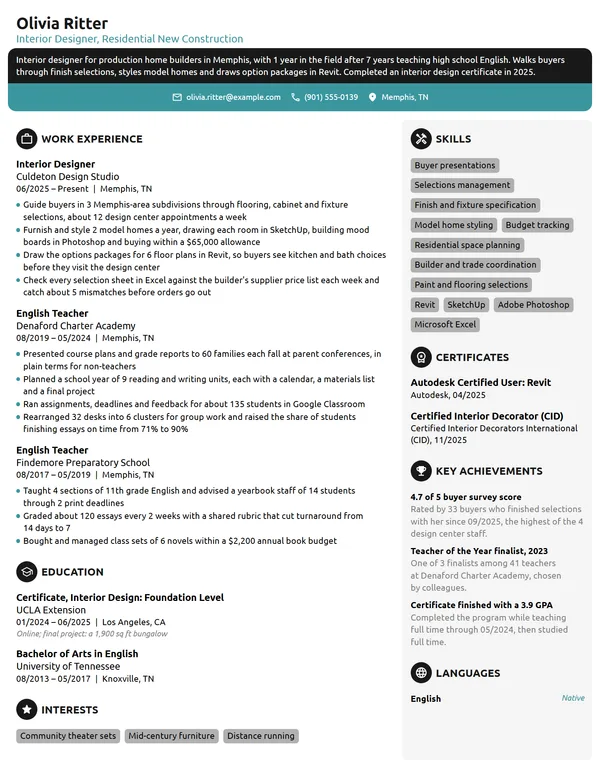
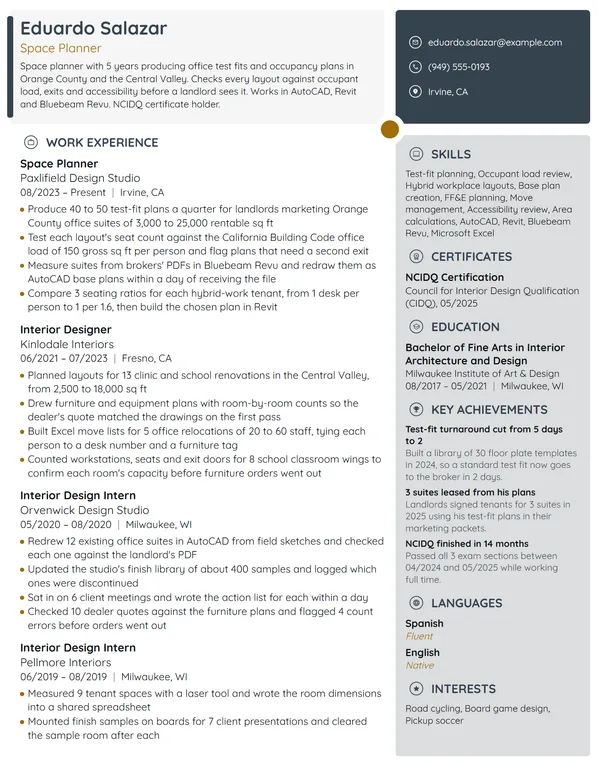
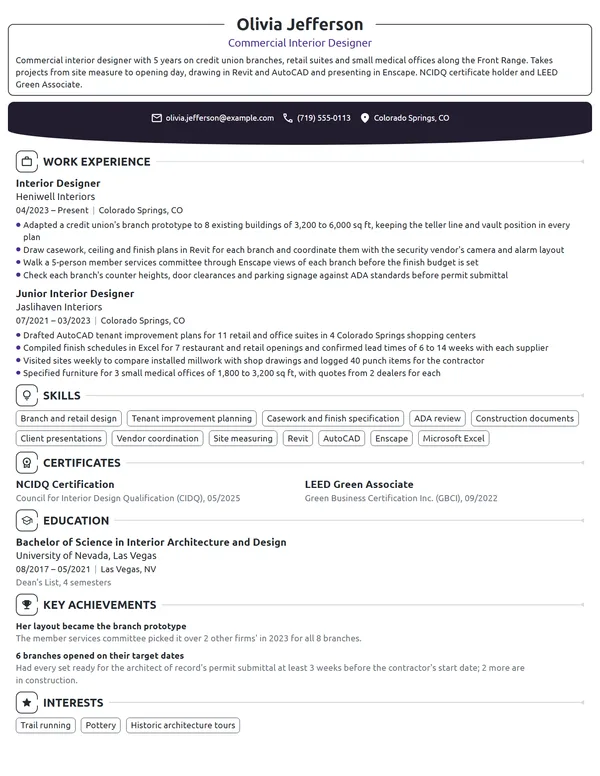
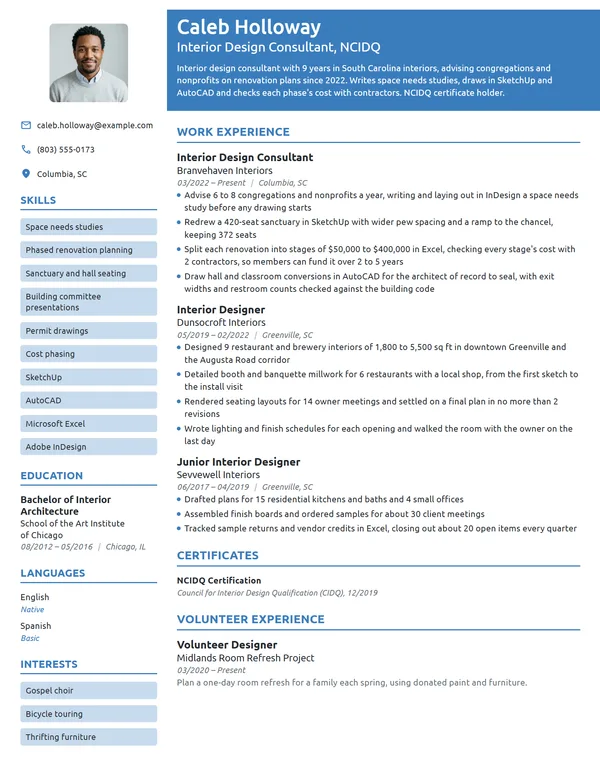
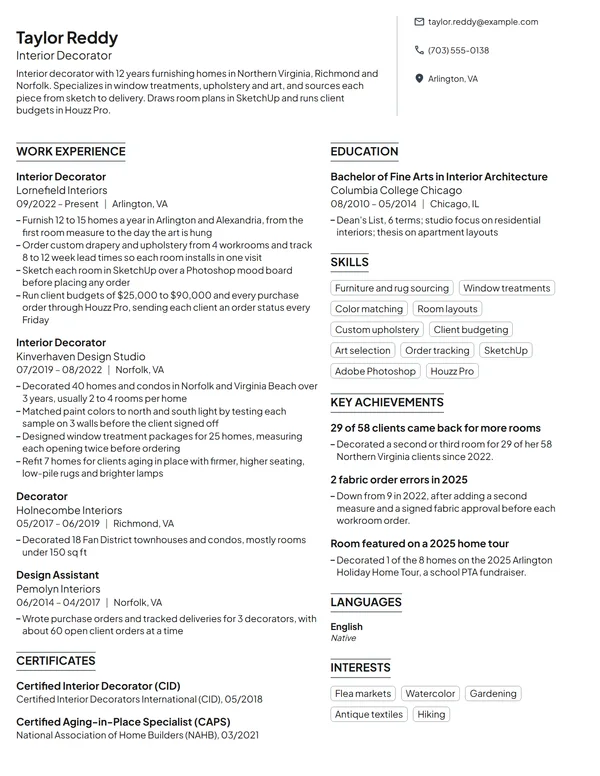
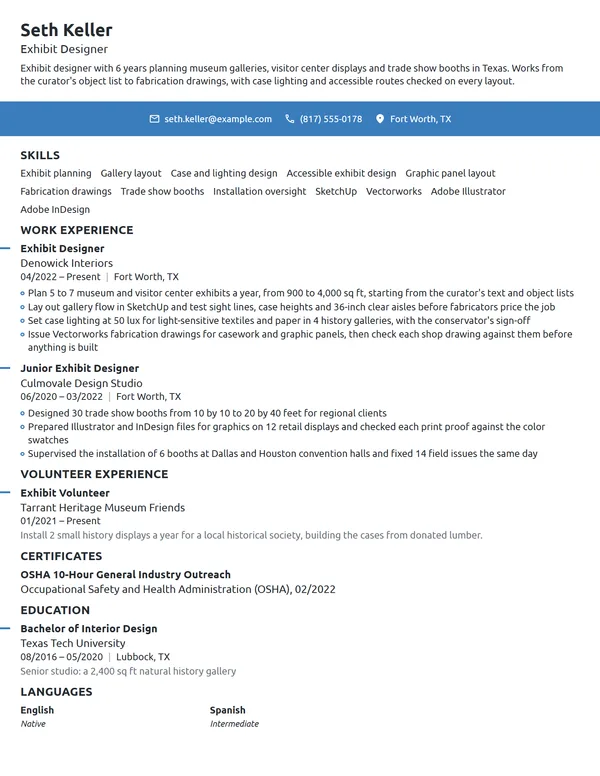
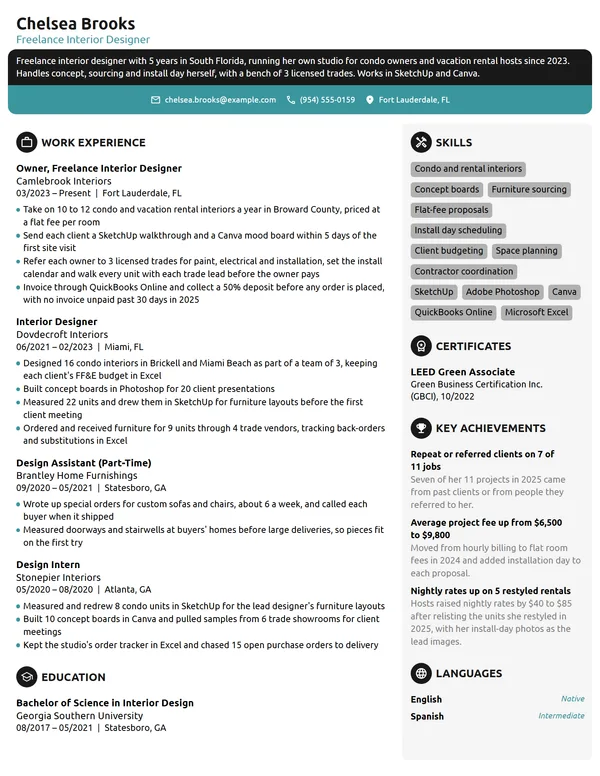
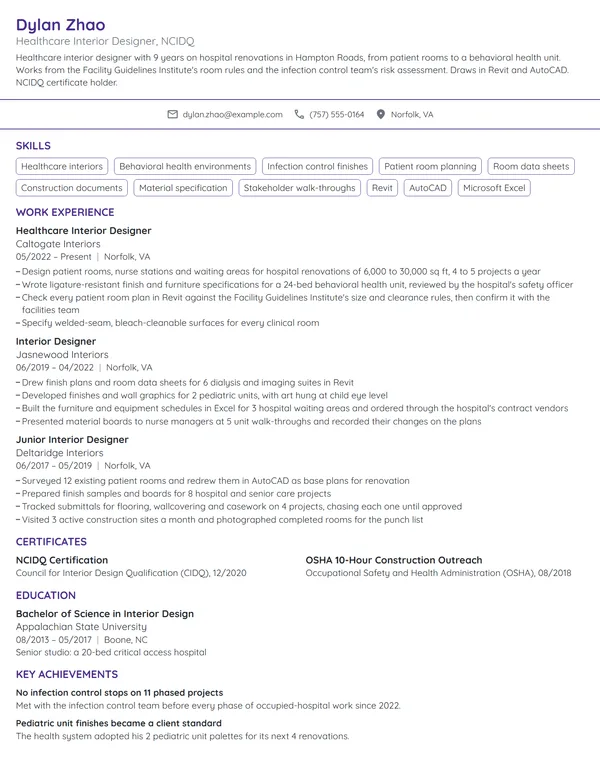
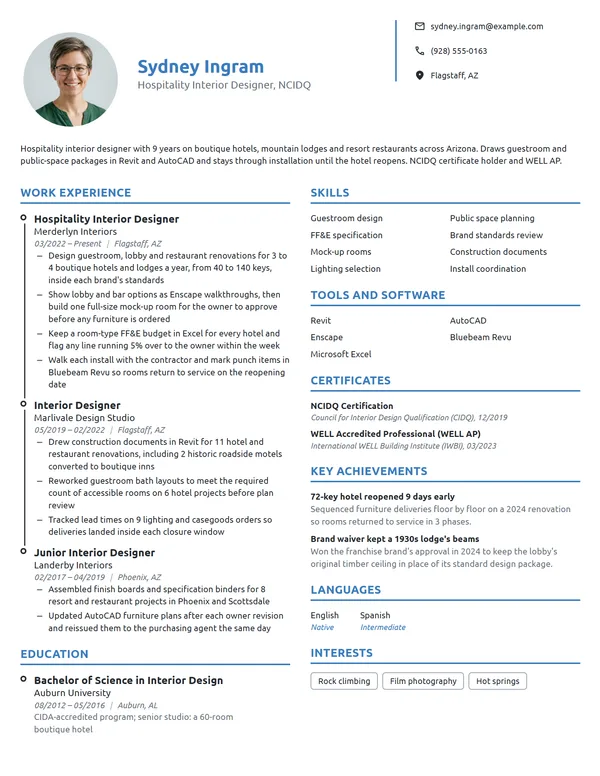
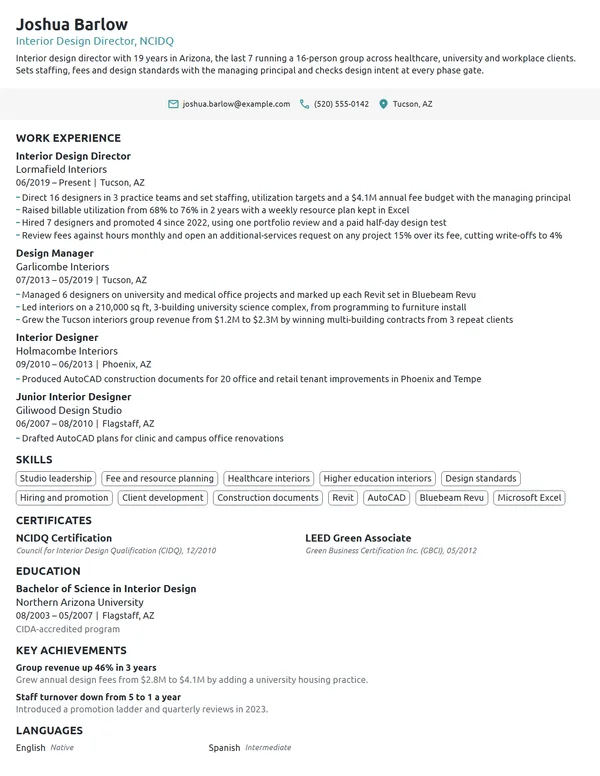
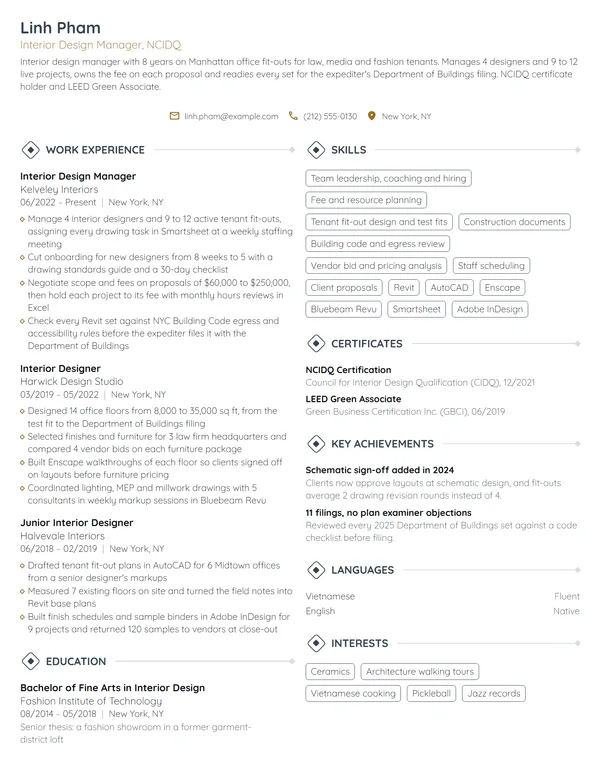
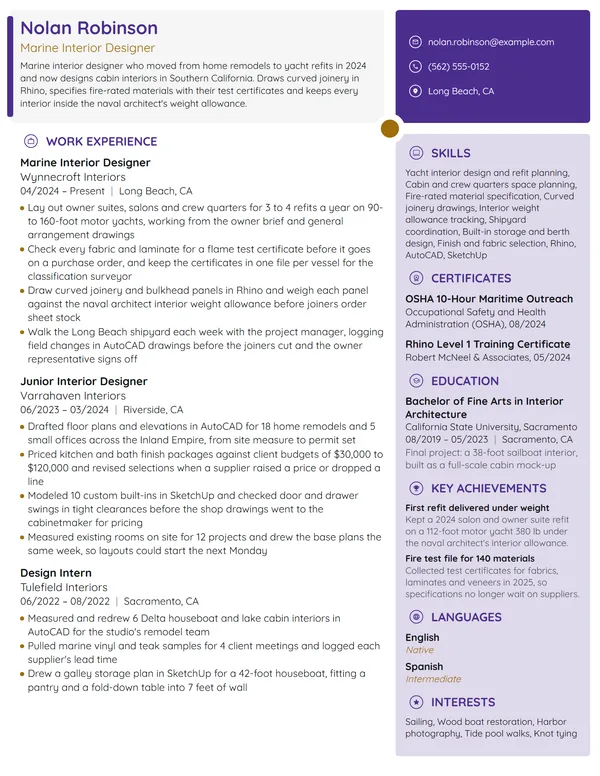
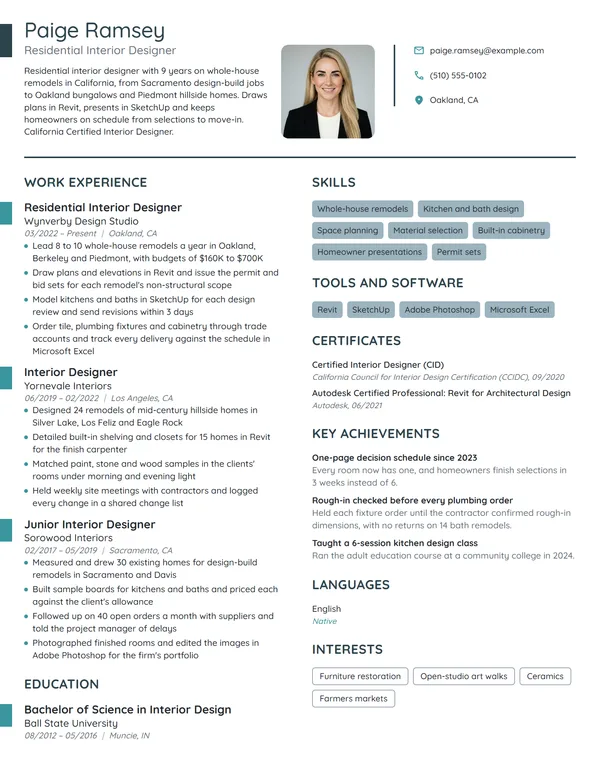
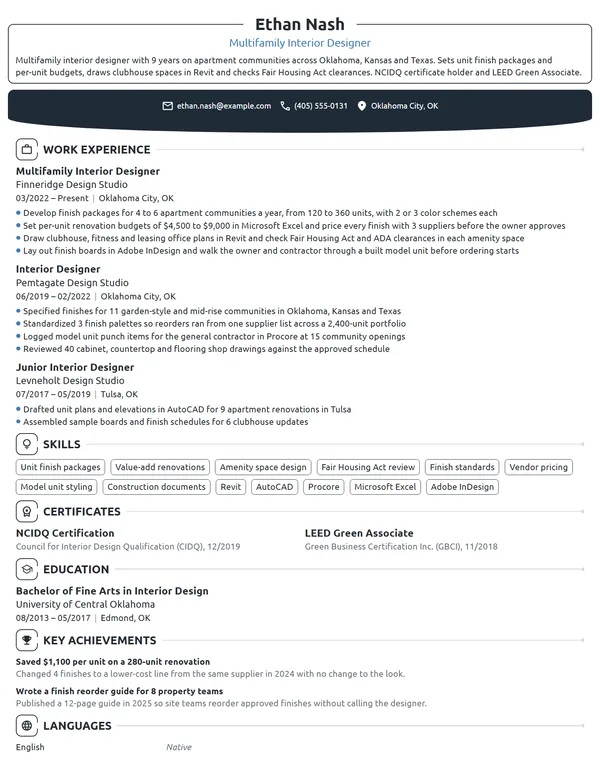
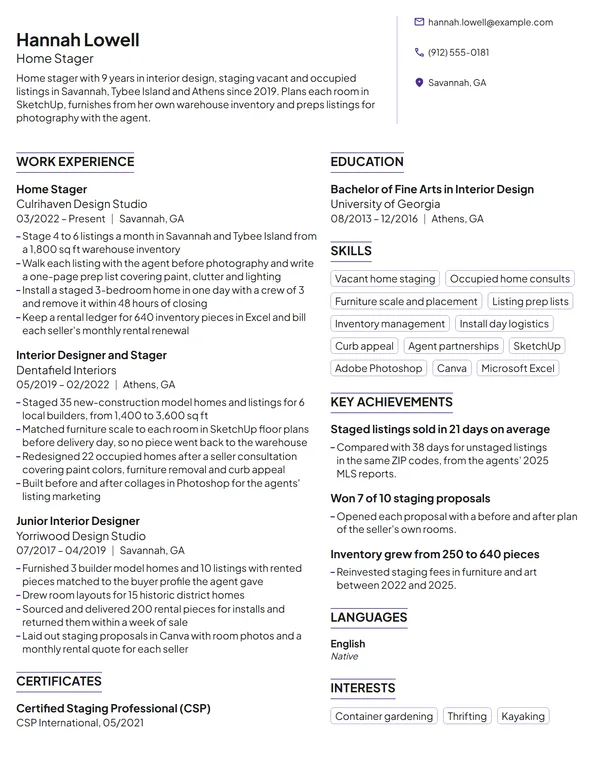
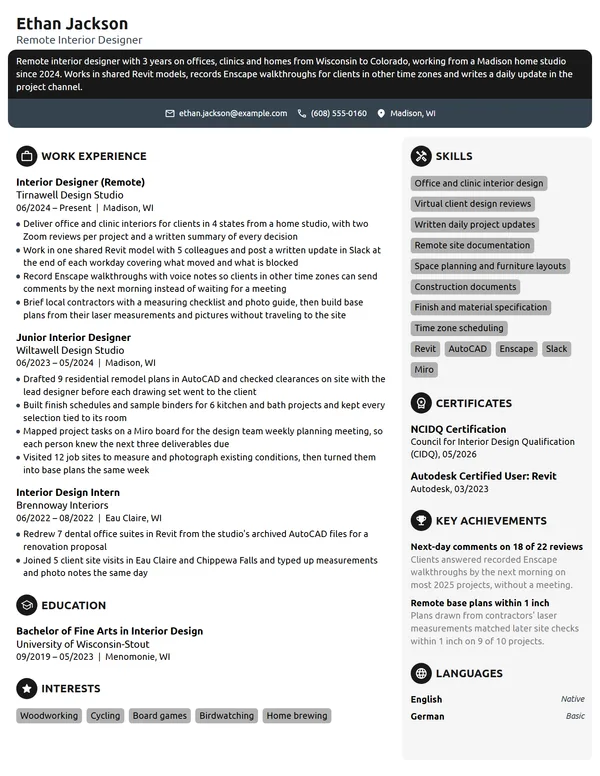
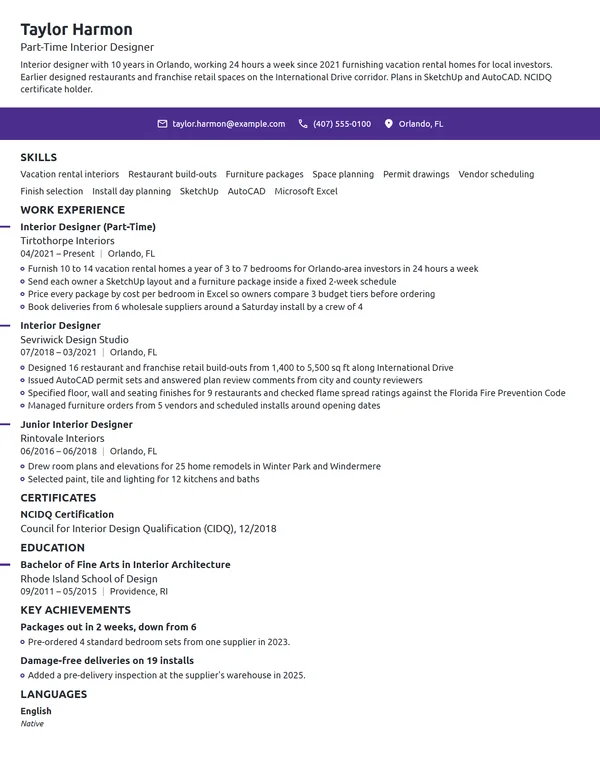
Interior design is judged by how a finished space looks and works, and a design firm reads your resume with the same eye. A principal scans it for spaces like the firm's own, at a similar size and drawn in the same software, and for where you stand on certification. Your portfolio shows the rooms themselves. The resume has to put them into words: the project type, its square footage and budget, and the part of the work that was yours, from first concept to installation day.
How to Write an Interior Designer Resume - Key Takeaways
- Use the reverse-chronological format on 1 page, or 2 once you have 10+ years of projects behind you.
- Open with a 2- to 3-line summary that names your sector, your years, your main software and 1 project with its size or schedule.
- Give each bullet a measure a studio tracks: square feet, FF&E budget, project count, permit rounds or change orders.
- List Revit, AutoCAD, SketchUp or Enscape with your skills, and name each one again in the bullet where you used it.
- Write NCIDQ after your name only once CIDQ issues your certificate; until then, list the exam sections you have passed under Certificates.
- Send your portfolio link with the application, then check the resume file with an ATS resume checker before you apply.
What design firms look for in an interior designer resume
A design principal reads your resume to see whether you have worked on spaces like theirs, at their scale, and whether you can produce drawings a contractor can build from. The BLS lists sketching preliminary plans, including electrical and partition layouts, and specifying materials and furnishings such as lighting, flooring and plumbing fixtures as core duties. O*NET ranks designing plans that meet the ADA, producing construction documents in CAD software and researching health and safety codes among the most important tasks.
That means your bullets carry drawings, codes and budgets as much as color and style. Build the page from these sections, with headings an applicant tracking system can read:
- Name, headline (such as Interior Designer, NCIDQ) and contact details
- Summary of 2 to 3 lines below the headline, printed without a section title
- Work Experience, newest role first, with the project types in each entry
- Skills, with your design software listed alongside
- Certificates, with any state registration at the top
- Education
- Optional: Key Achievements, Languages or Volunteer Experience
Best format for an interior designer resume
Use the reverse-chronological resume format: your current role first, each entry with the job title, the firm, its city and MM/YYYY dates. Interior design careers climb from junior designer to designer, senior designer and project lead, and this order lets a principal follow that climb and the projects that came with it. Choose a combination format only if you are moving in from a related field, such as kitchen showroom sales or architectural drafting, and your design skills need to sit above an unrelated job history.
- Best for most interior designersReverse-chronologicalYour jobs, newest first, with your results under each one.Best for: A steady work history in your field
- FunctionalSkills grouped up top, with a short work history below.Best for: Gaps or very little experience
- CombinationA skills section first, then your full work history.Best for: A career change with strong skills
Stay on 1 page for your first 10 years in the field. A senior designer or design director with a long run of large commercial projects can use 2 pages, provided page 1 holds the current role and the biggest projects. Keep the resume design restrained, with one accent color and clean headings: your taste shows in the spacing and alignment, and a busy layout can trip the parser that reads your file first.
| Setting | What to use |
|---|---|
| Length | 1 page under 10 years in the field; 2 pages for long commercial careers |
| Dates | MM/YYYY start and end months, with Present for your current studio |
| Project line | Sector, space type and size up front: 18,000 sq ft medical office |
| Headline | Title plus credentials you hold today: Interior Designer, NCIDQ, LEED Green Associate |
| Portfolio | A link sent with the application, with projects named as they are on the resume |
| Photo and personal details | Usually no photo in the US and Canada; leave off your birth date and marital status |
| File type | A PDF, or a Word file if the firm's portal asks for one |
Most US and Canadian resumes carry no photo, and a design studio judges your eye from the portfolio, not from a headshot. Use that space for project names a reviewer can match to the captions in your portfolio.
Interior designer resume summary vs. objective
If a firm or a client has paid you to design a space, write a resume summary that names your sector, your years, your software and 1 project. If you are still a student or moving in from another field, write a resume objective instead: the role you want, your degree or program, and your strongest studio or internship work. Write it after your bullets, and borrow its project from them.
Interior designer resume summary formula
Title, credentials with X years designing sector interiors in software. 1 project with its size and a schedule or budget result. Registration, certification or exam status.
Example
Interior Designer, NCIDQ, with 7 years designing workplace and hospitality interiors in Revit and Enscape. Led a 22,000 sq ft headquarters fit-out for a 140-person engineering firm, handed over 2 weeks ahead of schedule. Registered interior designer in Florida and a LEED Green Associate.
Don't
Creative and passionate interior designer with a keen eye for detail and a love of beautiful, functional spaces.
Do
Commercial interior designer with 4 years on healthcare and education projects, drawing in Revit and AutoCAD. Produced construction documents for 9 outpatient clinics of 6,000 to 15,000 sq ft. Passed the IDFX and IDPX, with the IDIX scheduled for 04/2027.
The rewrite gives the sector, the software, a project count with its size and the exact NCIDQ status.
How to write interior designer work experience bullets with numbers
Under the role you hold now, write 3 to 4 verb-first bullets; earlier roles get 1 to 3. Open with your project mix, the sectors, sizes and number of projects a year, because every later number reads against that scale. Then pick achievements for your resume that a studio already measures: budgets held, schedules met, permit rounds and change orders.
| Area | What to count | Example bullet |
|---|---|---|
| Space planning | Square feet, headcount, seats or workstations | Planned a 9,500 sq ft call center floor for 118 workstations, up from 96 in the old layout. |
| Construction documents | Drawing sets, projects, permit rounds | Issued permit sets for 5 restaurant build-outs, each approved by the city on the first submittal. |
| FF&E | Dollars specified, rooms or items, budget variance | Specified $410K in FF&E for a 64-room boutique hotel and closed the package 3% under budget. |
| Budget and change orders | Project budget, change orders, cost savings | Kept change orders on a $2.1M clinic renovation to 4, all of them owner-requested. |
| Codes and accessibility | Layouts reviewed, plan-review comments | Checked 12 tenant layouts against ADA and egress rules before permit, with 0 accessibility comments from plan review. |
| Clients and presentations | Clients a year, concepts shown, first-round approvals | Presented 3 concepts per project to 20+ residential clients a year; 17 chose the first scheme. |
In the sample below, the first bullet sets the scale of the studio's work, the next 2 each name a project, and the older role keeps 2 lines.
Work Experience
- Lead design on 6 to 8 workplace and hospitality projects a year, from 4,000 to 30,000 sq ft, in a 12-person studio.
- Led the 22,000 sq ft headquarters fit-out for a 140-person engineering firm, completing the Revit construction documents in 9 weeks.
- Specified $680K in FF&E across 3 hotel lobby renovations, keeping each package within 2% of the client's budget.
- Run shop drawing reviews and weekly site walks with the contractor; closed all 31 punch-list items on the last project before move-in.
- Drew AutoCAD and Revit sets for 14 medical office and retail tenant build-outs.
- Kept the studio's sample library of 1,200 finishes current, working with 15 manufacturer reps.
Don't
Responsible for selecting furniture and finishes for clients.
Do
Selected finishes and furniture for 11 dental suites, staying inside each practice's FF&E budget of $150K to $240K.
The rewrite names the space, the volume and the budget range a principal can compare with their own projects.
Don't
Worked with contractors and architects on various projects.
Do
Coordinated each week with the architect, MEP engineer and general contractor on a 3-floor library renovation, answering 46 RFIs within 2 business days.
Interior design skills and software for your resume
Pick 6 to 8 hard skills for your resume, taking each from the job ad and keeping only those a project bullet backs up. Space planning, construction documents and FF&E specification fit almost every interior designer; kitchen and bath planning or lighting design belong only where you have done the work, and a full-time specialist is better served by the layouts on the kitchen designer and lighting designer pages.
Hard skills for interior designers
- Space planning
- Construction documents
- FF&E specification
- Materials and finish selection
- ADA and building code compliance
- Reflected ceiling and lighting plans
- 3D rendering and visualization
- Shop drawing and submittal review
- Budget and schedule tracking
- Client presentations
Soft skills design principals value
- Listening to client needs
- Visual judgment
- Clear presentation of ideas
- Coordination with trades
- Vendor negotiation
- Composure when plans change
Software goes with your skills, and each program should reappear in a line of your work history that says what you made in it. O*NET flags Autodesk Revit, Autodesk AutoCAD, Trimble SketchUp Pro, Adobe Photoshop, InDesign and Illustrator as hot and in-demand technology for interior designers, and lists Chaos Enscape as in demand. Write the product name a firm searches for, such as Revit or Enscape, instead of 3D modeling software, and add Microsoft Excel where you built FF&E budgets or finish schedules in it.
NCIDQ, state registration and LEED: how to list interior design credentials
According to the BLS, licensure requirements for interior designers vary by state: some states let only licensed designers do interior design work, and others restrict the title. Florida is one example of a title rule. Under its 2026 statutes, nobody may use the title registered interior designer without registration, though the plain title interior designer is not restricted, and registration requires passing the exam prescribed by the Council for Interior Design Qualification (CIDQ). List certifications on your resume under Certificates, each with its issuer and the month you earned it.
| Credential | Issued by | What it takes |
|---|---|---|
| NCIDQ Certification | Council for Interior Design Qualification (CIDQ) | Pass the IDFX, IDPX and IDIX (the IDIX replaced the PRAC in 2026). With a CIDA-accredited bachelor's or master's degree, you need 3,520 hours of work experience, about 2 years full time, before the last 2 sections. Renew every year. |
| State registration or license, such as Registered Interior Designer in Florida | Your state board, such as the Florida Board of Architecture and Interior Design | Rules differ by state. Florida requires proof that you passed the CIDQ qualification exam. |
| LEED AP Interior Design + Construction (LEED AP ID+C) | GBCI | A current LEED Green Associate credential, or both exams taken together, and you must be 18 or older. USGBC strongly recommends experience on LEED-registered projects. |
| Certified Kitchen and Bath Designer (CKBD) | National Kitchen & Bath Association (NKBA) | At least 30 credit hours of interior design or architecture coursework, or kitchen and bath industry experience, plus NKBA's exams. NKBA no longer awards the CKD or CBD to new candidates. |
How to list NCIDQ exam sections before you are certified
CIDQ's candidate agreement says you may not present yourself as NCIDQ certified until you receive the official certificate. Until then, list each section you have passed with its month under Certificates, and the next one with its exam window: the exam runs every April and October. Keep NCIDQ out of your headline until your certificate number arrives, and drop it again if you let the yearly renewal lapse.
Certificates
- Registered Interior Designer, Florida, Florida Board of Architecture and Interior Design, 08/2022
- NCIDQ Certification, Council for Interior Design Qualification (CIDQ), 06/2022
- LEED Green Associate, GBCI, 03/2024
How to list an interior design degree on your resume
Interior designers typically need a bachelor's degree, according to the BLS, and programs run at the associate's, bachelor's and master's levels, with coursework in drawing and CAD. The type of degree also sets your path to NCIDQ: CIDQ's handbook asks for 3,520 hours of work experience after a CIDA-accredited bachelor's or master's, and 5,280 hours after an associate degree with 60 semester credit hours of interior design. If your program is CIDA-accredited, add that to the degree line: it tells a firm you qualify for CIDQ's shortest work-experience route.
Follow the usual order for listing education on a resume: degree, school, city and graduation month. In your first 2 or 3 years, add a GPA of 3.5 or above and 1 line on your senior studio project with its size; after that, keep the entry to the degree, the school and the date.
Education
CIDA-accredited program. Senior studio: a 12,000 sq ft public library branch.
Entry-level and career-change interior designer resumes
Without a full-time design job yet, use an entry-level resume layout: a short objective, Education near the top, and every piece of design work with the same numbers a paid project would get. Internship hours do double duty: CIDQ lets up to 1,760 hours of interior design work earned before graduation count toward the experience you need for the IDPX and IDIX.
- Design internships: the firm's sector, the weeks, the drawings you produced and the software you used.
- Studio and capstone projects: listed under Education, with the space type and its size.
- Furniture, tile or kitchen showroom work: client consultations a week, layouts drawn and sales closed.
- Pro bono redesigns for a school, shelter or nonprofit: the space, the budget and the result, under Volunteer Experience.
- The IDFX: under Certificates once you pass it, since final-year students can sit it.
Don't
Recent interior design graduate eager to bring my creativity and passion to a reputable design firm.
Do
Interior design graduate with a 12-week internship at a hospitality design firm, drafting in Revit and SketchUp, seeking a junior designer role. Drew finish plans for 2 restaurant renovations and passed the IDFX in 04/2026.
An objective still needs evidence: the internship, the software, a deliverable and an exam result.
Moving in from architecture, drafting, home staging or kitchen and bath sales, keep reverse-chronological order and lead with your design education and the work that already overlaps, such as client meetings, CAD drawings or material selections. A career-change resume works best when the first bullets under your current job are its most design-heavy tasks. Explain the switch itself in your cover letter, and our interior designer cover letter examples show how to fit that story into a short paragraph.
Interior Designer resume FAQ
Can I put NCIDQ after my name before I pass all 3 sections?
No. CIDQ allows the NCIDQ appellation only once you hold an active certificate, and its candidate agreement bars you from presenting yourself as certified before then. List the sections you have passed with their months under Certificates, and name the next one with its April or October exam window.
Do I need a license to work as an interior designer?
Not in every state. The BLS says licensure requirements vary by state: some states let only licensed designers do interior design work, others restrict the title, such as registered interior designer. Check your state board before you write any registration on your resume, and name the state when you do.
Should I include a portfolio link with my interior designer resume?
Yes. Send the link with every application, in the portal's field or your cover letter, and give each project the same name in the portfolio and on the resume so a reviewer can find it fast. A focused set of 6 to 10 projects that match the firm's sectors reads better than everything you have drawn.
How long should an interior designer resume be?
1 page for most designers with under 10 years in the field. A senior designer, studio lead or design director with a long list of large projects can use 2 pages, as long as page 1 carries the current role, the biggest projects and the credentials.
What software should I list on an interior designer resume?
List the programs the posting names that you can work in from your first day, usually Revit, AutoCAD and SketchUp, plus a renderer such as Enscape and the Adobe tools you use for presentation boards. Back each one with a bullet that names a drawing set, model or rendering you made in it.
How do I list residential and commercial projects on one resume?
Lead each job with the sector the target firm works in. Applying to a commercial studio, put the workplace, healthcare or hospitality projects first and fold residential work into 1 bullet; for a residential firm, reverse that order and count the homes, rooms and budgets instead of square feet of office space.
Is a LEED credential worth adding to an interior designer resume?
Yes, for commercial work. USGBC describes the LEED AP ID+C as serving people who design and build commercial interiors, and it requires a current LEED Green Associate credential. List either one under Certificates with GBCI as the issuer, and name a LEED-registered project in a bullet if you have worked on one.
What is the average salary for an interior designer?
The BLS puts the median pay for interior designers at $67,190 a year as of May 2025. Pay varies with your state, your sector and your credentials, so keep salary off your resume and raise it once the firm makes an offer.
Next steps
Pick the example closest to your sector and level, keep its order, and replace every project with your own spaces, square footage and budgets. Build it in our resume builder or start from one of the resume templates, send your portfolio link with it, and add a cover letter that opens with your strongest project.