
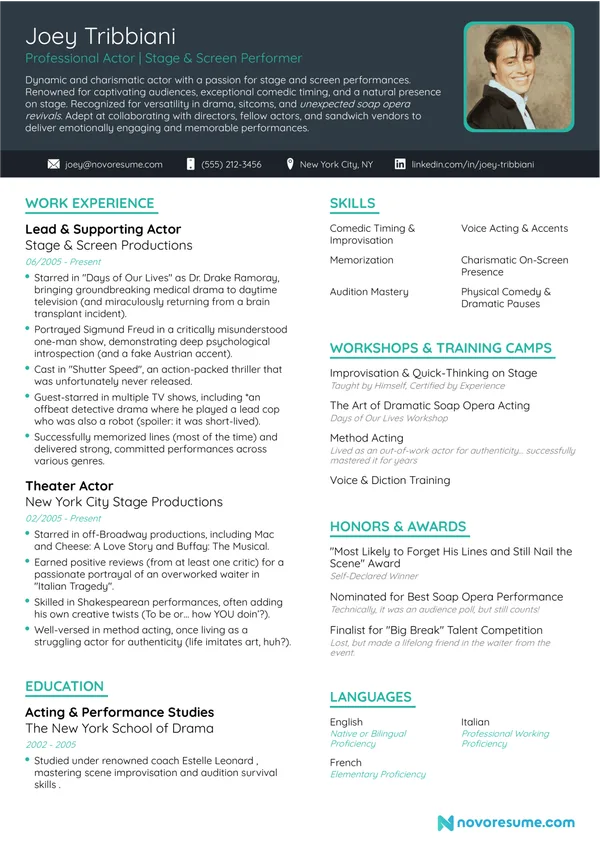
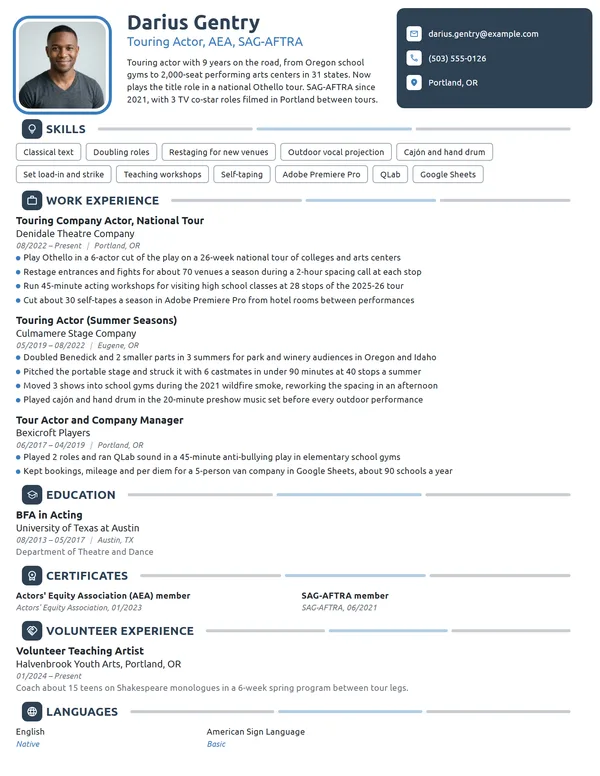
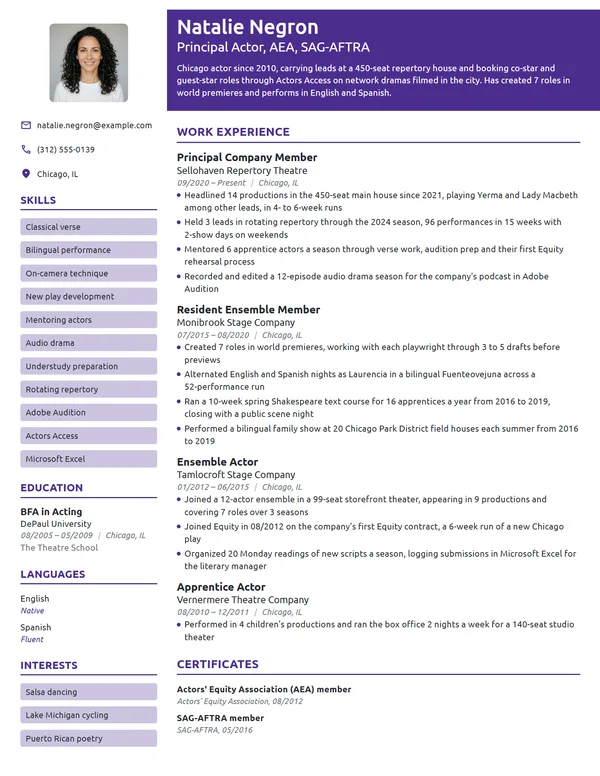
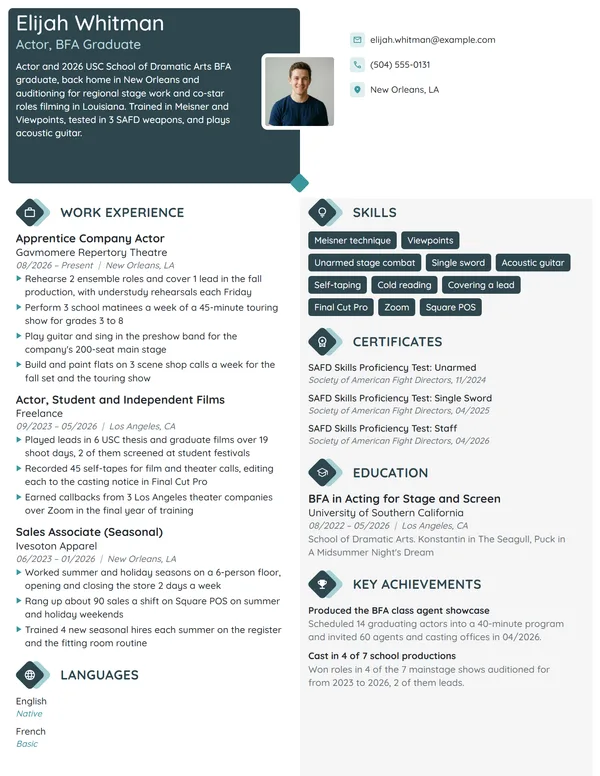
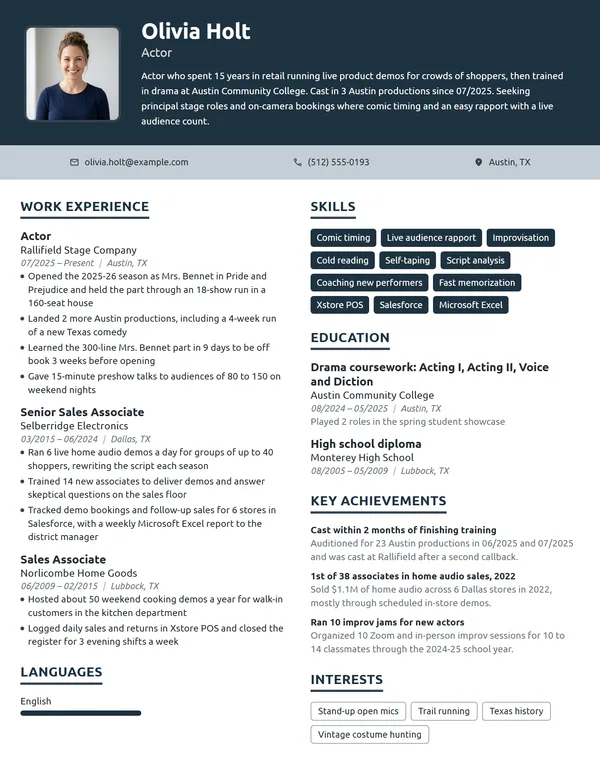
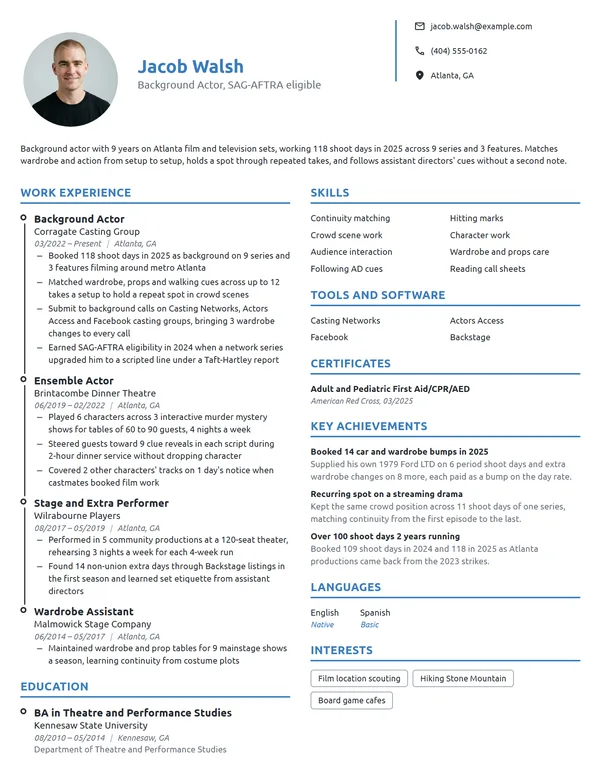
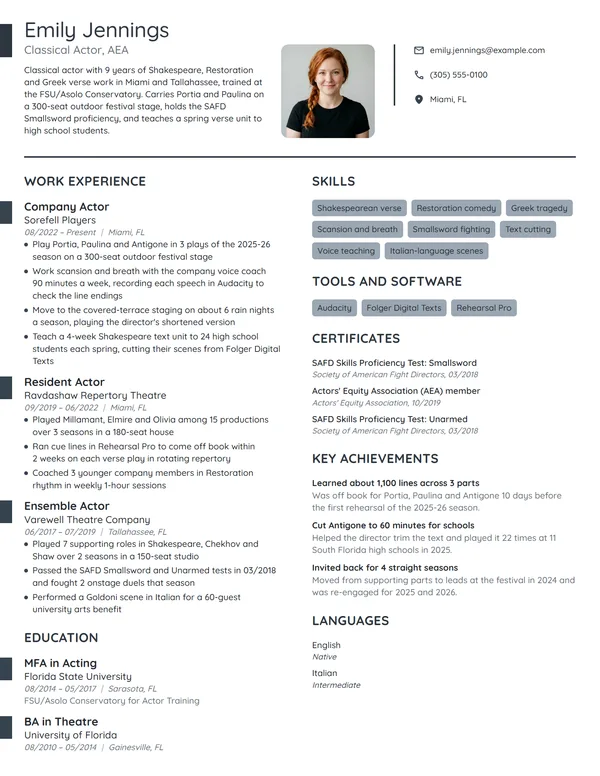
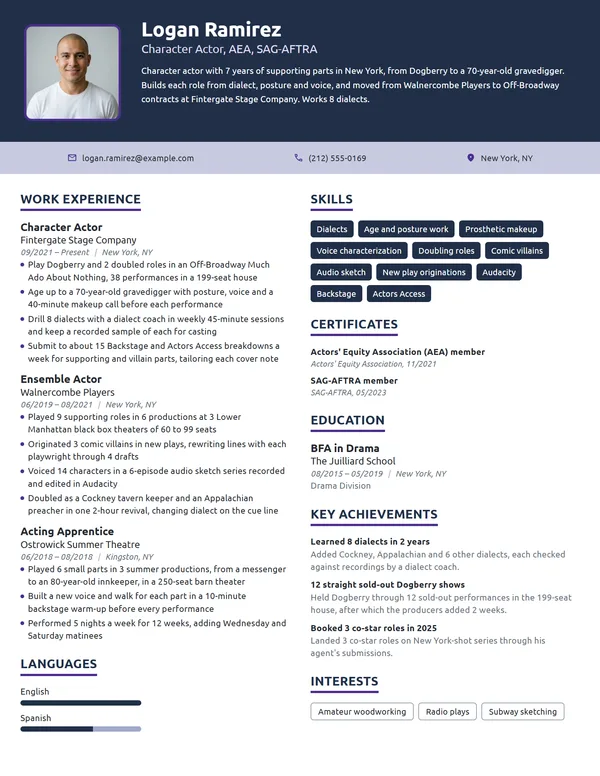
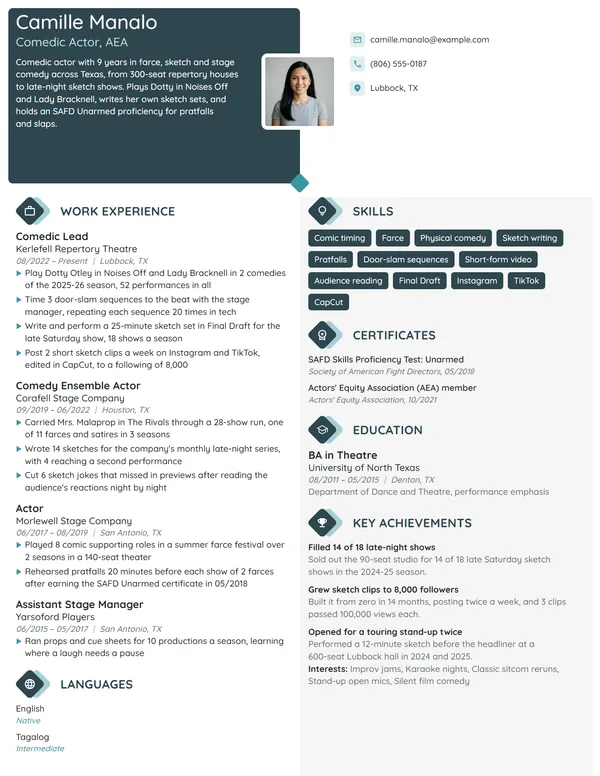
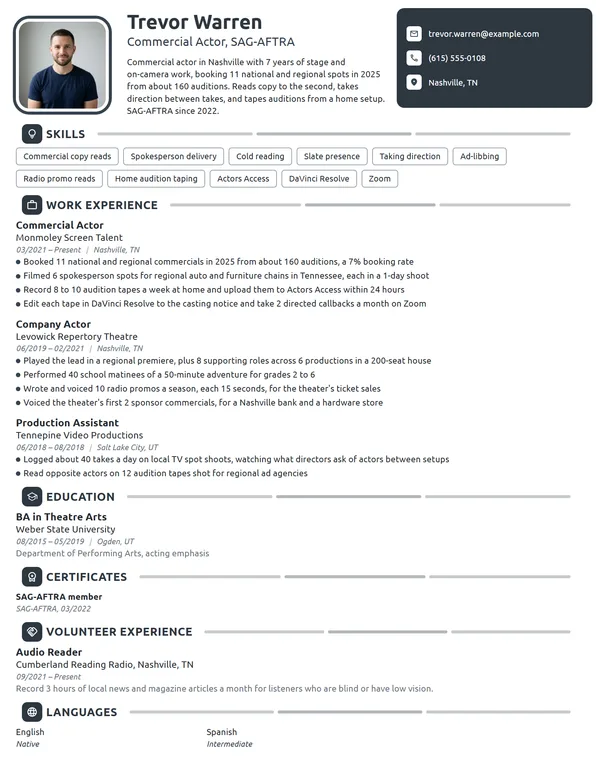
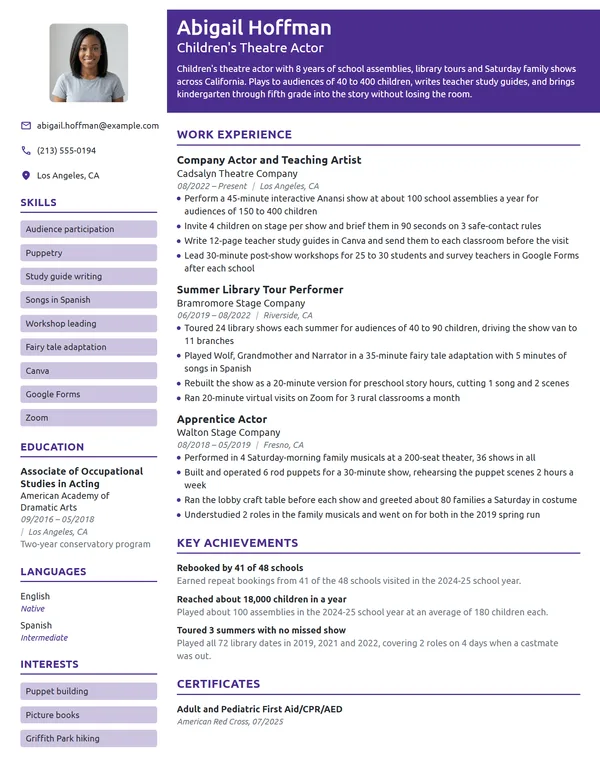
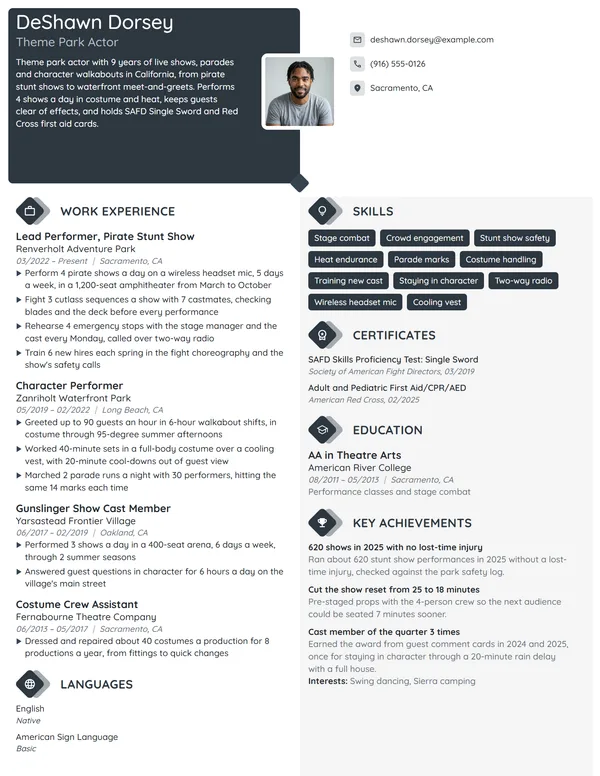
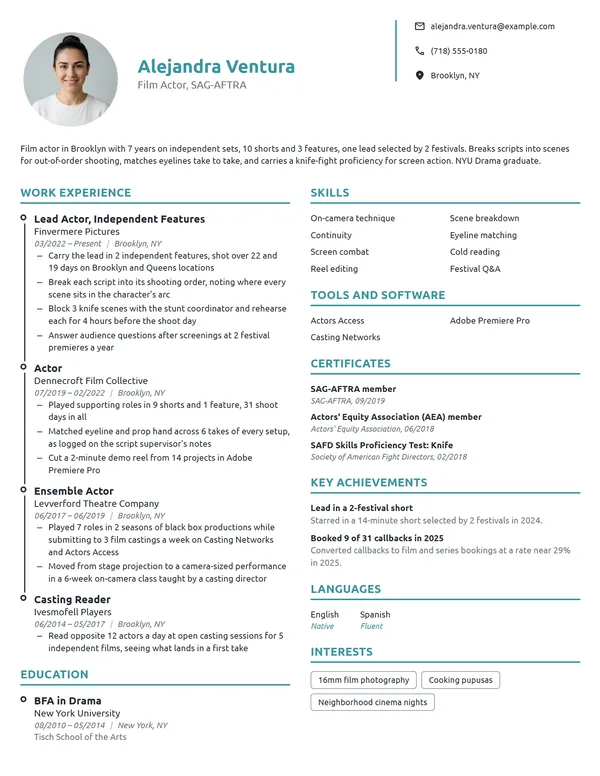
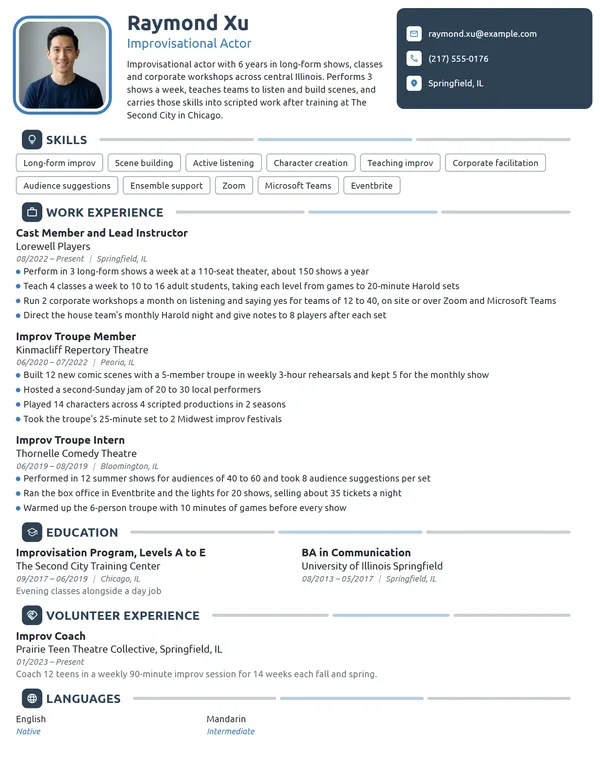
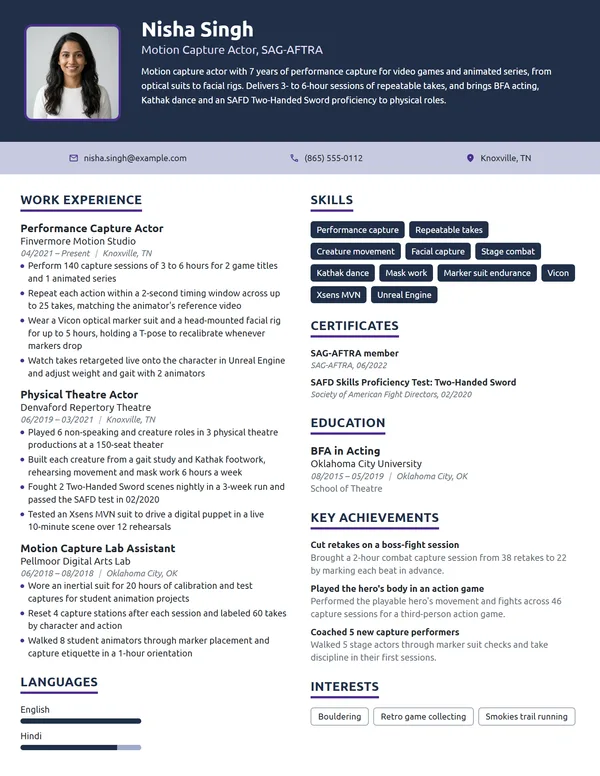
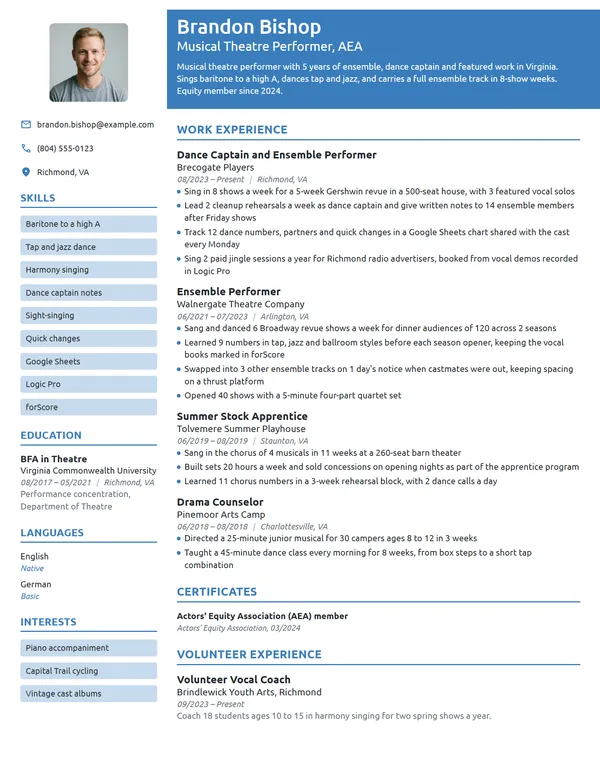
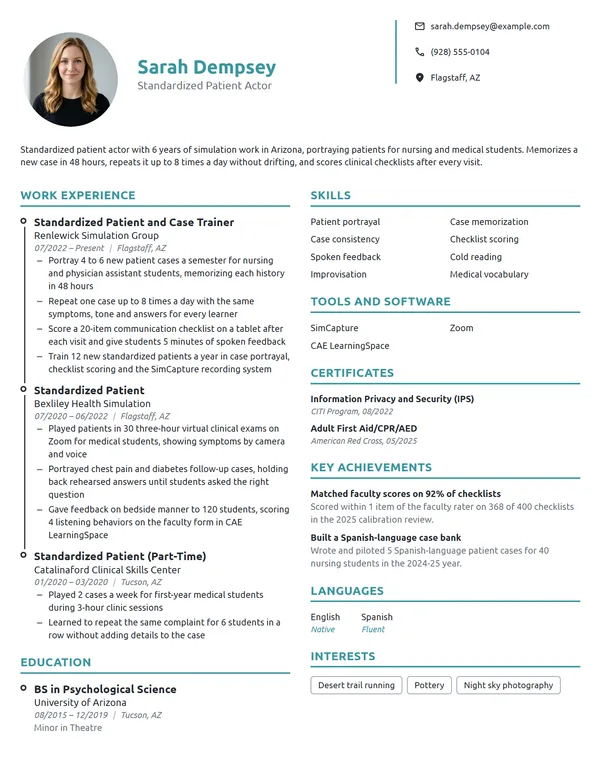
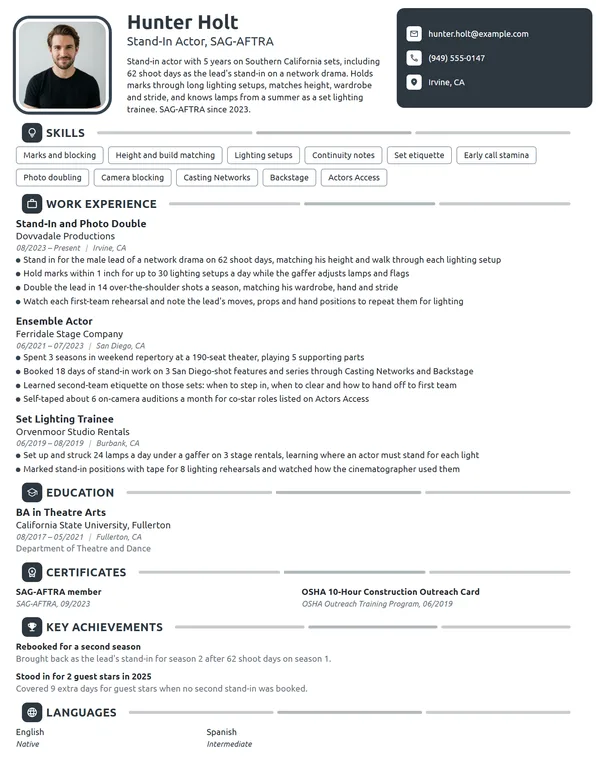
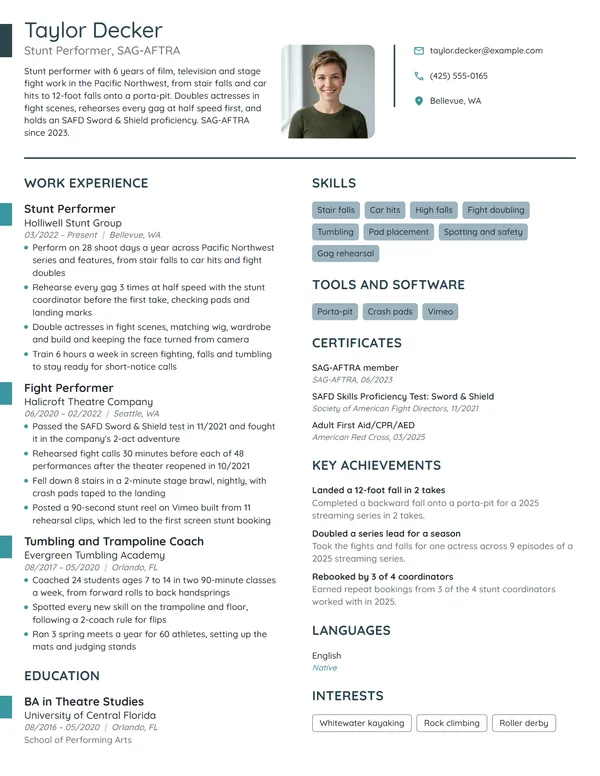
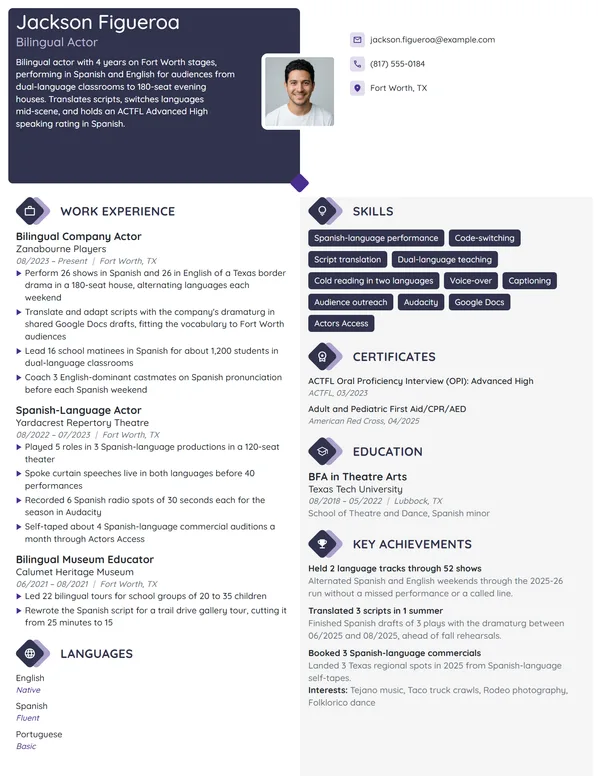
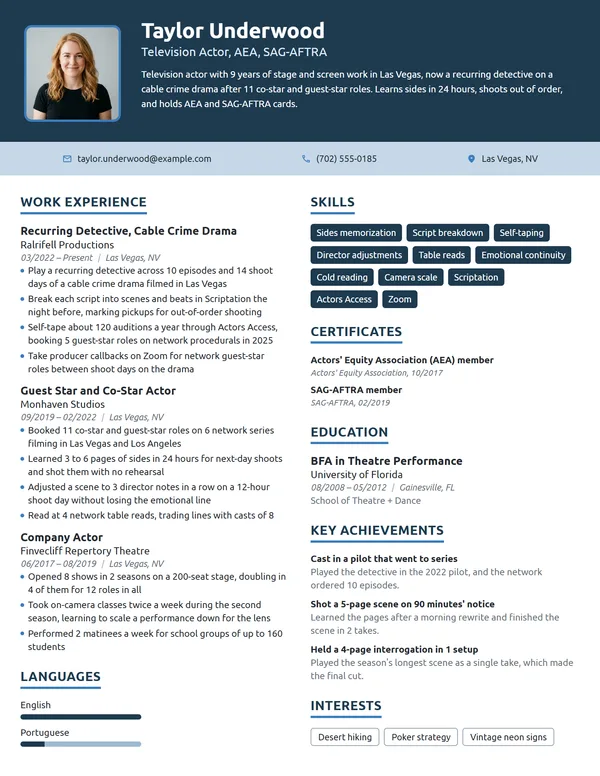
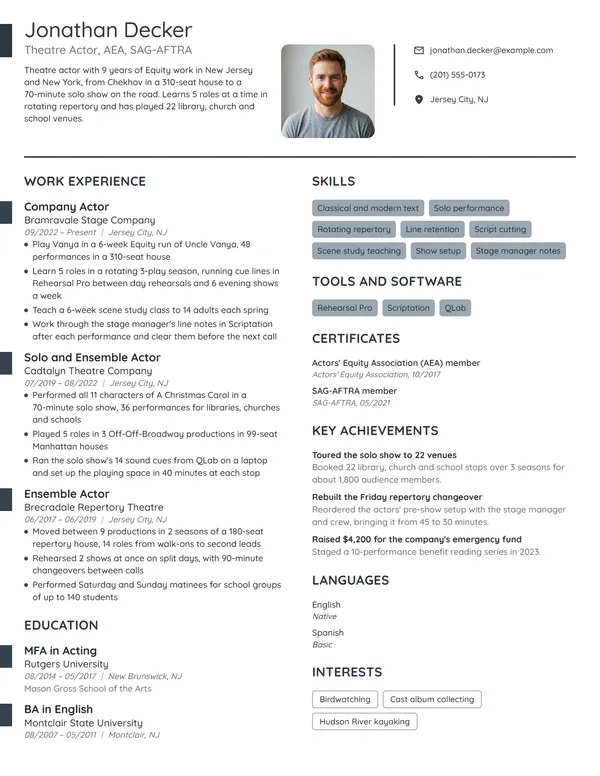
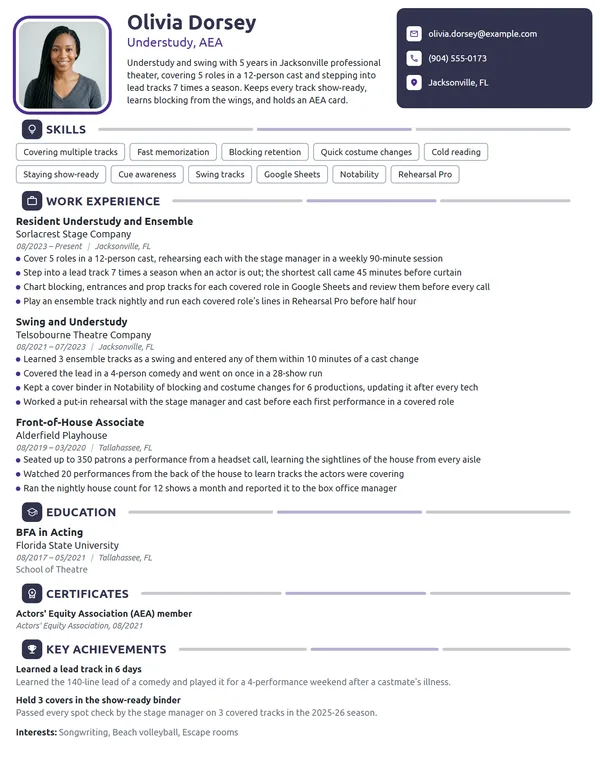
Your resume auditions before you do. A casting director or agent reads it right after your headshot, to see whether the face fits the credits. This page shows how to write each role and run as a credit, newest first, where your Equity or SAG-AFTRA status goes, which special skills belong on the page, and how to cut one master resume down for each submission.
How to Write an Actor Resume - Key Takeaways
- Use the reverse-chronological format on 1 page, with a current headshot in the header.
- Write each credit with the role or company position, the production, the theater or producer and MM/YYYY dates.
- Give bullets the numbers you already know: performances, house size, tour cities, times you went on and shoot days.
- Put union status in the headline (AEA, SAG-AFTRA) and list each membership under Certificates with the month you joined.
- List special skills that a breakdown can ask for, such as dialects, instruments, stage combat or a second language.
- Keep 1 master resume and cut a version for each submission.
What casting directors look for in an actor resume
A casting director, an agent or a theater's artistic director reads your resume after your headshot, to see whether the face fits the experience. O*NET lists attending auditions, working with directors on the interpretation of a role, rehearsing lines, stunts and cues, and collaborating as part of an ensemble as the core tasks of the job. Your resume should show each of them through named roles in named productions, with the scale of each one.
The BLS notes that acting jobs are usually short assignments and that many actors hold other jobs between them. So a strong actor resume reads as a list of bookings, not a list of employers. Build it from these sections:
- Name, headline with your union initials (for example, Actor, AEA, SAG-AFTRA), contact details and headshot
- A short summary of 2 to 3 lines under your name; it needs no section heading
- Work Experience: your credits, newest first, each with the role, the production and the producing company
- Skills: acting techniques, dialects, singing range, instruments, combat and sports
- Certificates: union memberships and SAFD stage combat proficiencies
- Education: your degree, conservatory or ongoing classes
- Optional: Languages, Volunteer Experience for community theater, or Key Achievements
Best format for an actor resume
Use the reverse-chronological resume format: your latest booking first, each with the role or position, the production, the theater or production company, its city and MM/YYYY dates. A resident company contract becomes 1 entry with the roles in its bullets, and a run of short screen jobs can sit under 1 entry for on-camera work. This keeps your current work at the top, where an agent or casting assistant starts reading.
- Best for most actorsReverse-chronologicalYour jobs, newest first, with your results under each one.Best for: A steady work history in your field
- FunctionalSkills grouped up top, with a short work history below.Best for: Gaps or very little experience
- CombinationA skills section first, then your full work history.Best for: A career change with strong skills
Keep the resume to 1 page. Casting readers want your best and latest credits, so once the page is full, drop the oldest and smallest roles rather than shrinking the type. For a teaching artist or tour application, keep the order and lead each entry with its most relevant bullets.
| Setting | What to use |
|---|---|
| Length | 1 page; cut the oldest and smallest credits first |
| Credit line | Role and production, or your company position: Company Actor, Ensemble, Co-Star |
| Dates | MM/YYYY for each contract or run, with Present for a current company season |
| Headshot | A recent headshot in the header that looks like you on the day you audition |
| Personal details | Never a birth date, age range, weight, marital status or Social Security number |
| File type | PDF named with your full name, unless the casting portal asks for another file |
Most US and Canadian resumes carry no photo. Acting is one of the few exceptions: casting starts from your face, so each actor example on this page shows a headshot in its header. Use a current, professional shot, and send the full-size headshot as a separate file whenever a notice asks for one.
Actor resume summary vs. objective
Use 1 test: if you have paid or union credits, write a resume summary with your union status, your years, your medium and your biggest booking. If you are fresh out of training or moving into acting from another career, write a resume objective that names the kind of contract you want and the training behind it. Either way, it sits in 2 to 3 lines under your name and takes its numbers from your credits.
Actor resume summary formula
Union status actor with X years in stage, screen or both, trained in program or technique. Your biggest credits, with a number. The special skill or credential casting asks you for.
Example
Actors' Equity and SAG-AFTRA actor with 7 years on regional stages and on camera, trained in a BFA program built on classical text. Played 11 stage roles since 2019, including 4 seasons with a resident company, and booked 2 regional commercials. SAFD-recognized in Unarmed and Rapier & Dagger.
Don't
Passionate and versatile actor who loves bringing characters to life on stage and screen.
Do
Actor with 3 years in children's touring theater and 150+ performances in schools and community centers. Trained in Viewpoints and fluent in Spanish for bilingual casting.
The second version gives the medium, the volume and a skill a breakdown can ask for.
How to list acting credits with numbers
Write 3 to 4 bullets under your current and recent contracts and 1 to 2 under the oldest ones. Start with the roles and the run, then add the size of the house or the tour, then the work around the performance: covering, talkbacks, teaching. Each of these numbers turns a credit into one of your achievements on a resume, which is what separates 2 actors with the same title.
| Area | What to count | Example bullet |
|---|---|---|
| Stage runs | Performances, weeks, seats in the house | Played Nora in A Doll's House for 32 performances in a 299-seat house. |
| Touring | Cities, weeks, performances, cast size | Toured 14 cities in 10 weeks with a 4-actor children's show, 61 performances in all. |
| Covering | Roles covered, times on, notice given | Understudied 2 leads and went on 5 times, once with 2 hours' notice. |
| Screen work | Bookings, episodes, shoot days | Booked 3 regional commercials and 2 co-star roles in 1 year of on-camera work. |
| Voice and narration | Finished hours, titles, sessions | Recorded 40 finished hours of narration across 6 audiobooks. |
| Teaching and outreach | Classes, students, workshops | Taught 12 weekly improv classes for 18 teens in a term. |
Here is how an actor's 2 most recent contracts read with those numbers in place. The current company job carries the roles and the work around them; the older one stays short.
Work Experience
- Played 6 roles over 4 seasons on a 640-seat thrust stage, including Viola in Twelfth Night for 46 performances.
- Covered 3 principal roles and went on 9 times without a canceled performance.
- Led 22 post-show talkbacks and taught 14 school workshops for about 380 students through the education department.
- Performed in 5 productions and 2 streamed readings while the theater was closed in 2020.
Don't
Performed in several productions at a local theater.
Do
Played 4 roles in a 6-show season at a 220-seat theater, including Laura in The Glass Menagerie for 24 performances.
The rewrite names the part, the size of the house and the length of the run.
Don't
Responsible for understudying roles.
Do
Covered 3 roles in Our Town and went on as Emily 4 times after 1 put-in rehearsal.
Acting skills and special skills for your resume
Pick 6 to 8 hard skills for your resume that casting can test in the room: a technique you trained in, the dialects you can hold through a scene, your singing range, an instrument, a sport or a combat discipline. Skip anything you could not do at a callback tomorrow, since a director may ask for it on the spot.
Hard skills for actors
- Cold reading
- Script and scene analysis
- Meisner technique
- On-camera technique
- Self-taping
- Dialects (name each one)
- Stage combat
- Improvisation
- Singing (give your range)
- Voice-over and narration
Soft skills directors value
- Taking direction quickly
- Ensemble work
- Punctuality on call times
- Resilience after rejection
- Consistency from take to take
- Calm on a live stage
Tools matter less here than for most jobs, but name the ones you use. O*NET flags Zoom, TikTok and Microsoft Office as hot technologies for actors: name Zoom if you audition by video call and TikTok only if you post performance work there. Put self-taping and your home recording setup in Skills if you submit tapes, and add motion capture work only with a credit that proves it.
Union membership and stage combat on an actor resume
Union status tells a producer which contracts can hire you, so state it plainly. Actors' Equity Association covers stage actors and stage managers, while SAG-AFTRA covers screen, commercial and broadcast performers; SAG-AFTRA was formed in 2012 from the merger of the Screen Actors Guild and AFTRA. List certifications on your resume under Certificates, union memberships first, each with the month you joined.
| Credential | Issued by | What it takes |
|---|---|---|
| Equity membership, Open Access | Actors' Equity Association (AEA) | Professional work as an actor or stage manager in a theatrical production within Equity's jurisdiction, a copy of the contract with proof of earnings, and an initial payment of at least $600. |
| Equity membership, Four A's route | Actors' Equity Association (AEA) | At least 1 year in a sibling union (SAG-AFTRA, AGMA, AGVA or GIAA), a principal contract or 3 days of extra work there, and a crossover letter. |
| SAG-AFTRA membership | SAG-AFTRA | Write the month you joined; for a membership that ended before the 2012 merger, write SAG or AFTRA. |
| SAFD Skills Proficiency Test | Society of American Fight Directors (SAFD) | At least 30 hours of training with an SAFD Certified Teacher in 1 of 8 weapons, then a staged fight; renewed through a Skills Proficiency Renewal (SPR). |
| SAFD Actor Combatant | Society of American Fight Directors (SAFD) | Active SAFD membership with proficiency in several weapon disciplines. |
How to write your union status
Put the union initials after your title in the headline, such as Actor, AEA, SAG-AFTRA, and spell each union out once under Certificates. If you are not a member, leave the union line off rather than writing a status the union does not use. The Equity Membership Candidate program was phased out when Equity introduced Open Access, so write EMC only as a past credit, never as your current status. For SAFD tests, name each weapon, since the SAFD recognizes proficiency in 8 of them: Unarmed, Rapier & Dagger, Two-Handed Sword, Single Sword, Smallsword, Sword & Shield, Staff and Knife.
Certificates
- Actors' Equity Association (AEA), member, 09/2022
- SAG-AFTRA, member, 03/2024
- SAFD Skills Proficiency Test: Unarmed, Society of American Fight Directors, 04/2019
- SAFD Skills Proficiency Test: Rapier & Dagger, Society of American Fight Directors, 04/2019
How to list a BFA, drama school or acting classes
According to the BLS, most actors get some formal preparation through a conservatory or a college drama program, although a degree usually isn't required. That makes training a real part of an actor resume, but a short one. Follow the general rules for listing education on a resume: degree or program, school, city and date.
Under a BFA or MFA, add 1 line with the program's focus and your mainstage roles while you have few professional credits. Ongoing classes, such as an on-camera or Meisner studio, go in Education as a separate entry with the studio's name and dates. Once your credits fill the page, cut the Education entry back to the degree, school and date.
Education
University of Minnesota/Guthrie Theater BFA Actor Training Program. 5 mainstage roles, including Rosalind in As You Like It.
Actor resumes with no experience or a career change
The BLS notes that actors often start in school plays or local theater, and on screen with small roles or independent films. All of that counts. With no paid credits yet, lead with an objective and your training, then list the roles you have played anywhere, with the production and the run:
- Student and showcase roles: mainstage roles in 1 line under your degree, with the part and the play.
- Community theater: each production as an entry under Volunteer Experience on your resume, with your role and the number of performances.
- Student films and web series: a Work Experience entry with the role, the project and the shoot days.
- Classes and workshops: the studio, the technique and the months you trained, under Education.
Don't
Aspiring actor seeking an opportunity to showcase my talent and grow as a performer.
Do
BFA acting graduate seeking a non-union season contract or an apprentice company spot. Played 5 mainstage roles in training, including Hedda in Hedda Gabler, and passed the SAFD Unarmed test.
An objective still needs proof: training, named roles and a skill a theater can use.
Moving into acting from another career, keep your earlier jobs in Work Experience, but give each only 1 or 2 bullets that carry over to performing: presenting to groups, live demonstrations, customer-facing work under pressure. Your first credits and your acting classes go above them. The career-change resume examples show that layout, and our actor cover letter examples show how to explain the switch in a short paragraph.
Actor resume FAQ
Should an actor resume have a headshot on it?
Yes. Most US and Canadian resumes carry no photo, but acting is the exception, because casting starts from your face. Put a current headshot in the resume header, and send the full-size headshot as its own file whenever a casting notice or portal asks for one.
How do I list SAG-AFTRA or Equity membership on my resume?
Add the union initials to your headline, such as Actor, AEA, SAG-AFTRA, and list each membership under Certificates with the month you joined. A membership that ended before the 2012 merger is written as SAG or AFTRA, the name it had then.
How do I write an acting resume with no professional credits?
Lead with a 2-line objective and your training, then list every role you have played: school mainstage roles under your degree, community theater under Volunteer Experience, and student films in Work Experience with shoot days. Add special skills a casting notice can ask for.
How long should an acting resume be?
1 page. Casting readers look for your strongest and latest credits, so when the page fills, cut the oldest and smallest roles first. Keep the full list in 1 master file and choose from it for each submission.
Should I put background or extra work on my acting resume?
Only while you have few speaking roles. Group background work into 1 entry with the number of productions and shoot days, and drop it once principal, co-star or stage credits fill the page, since casting reads it as a different kind of booking.
What special skills should I list on an actor resume?
List skills a director could ask you to show on the spot: dialects you can hold through a scene, your singing range, instruments, stage combat weapons, sports, dance styles and languages. Leave off anything you would need a week of practice to perform.
Should I list height, hair color and eye color on an acting resume?
Only when a casting notice asks for them, and then in your submission note or casting profile. Your headshot already shows your look. Never add weight, age, a birth date or marital status to the resume itself.
How do I list understudy or swing work?
Write Understudy or Swing in the credit line with the production, then give the roles you covered and how many times you went on. A count of performances you played tells a director more than the title alone.
How much do actors make?
The BLS reports that the median hourly wage for actors was $29.05 in May 2025. The BLS also notes that work assignments are usually short, so many actors hold other jobs between bookings. Leave pay off your resume and discuss it with the producer or your agent.
Next steps
Pick the example closest to your medium and stage, keep its structure, and swap in your own roles, runs, union status and special skills. Build it in our resume builder or start from one of our templates, then send it with a fresh headshot and a cover letter that names the role you are submitting for.