
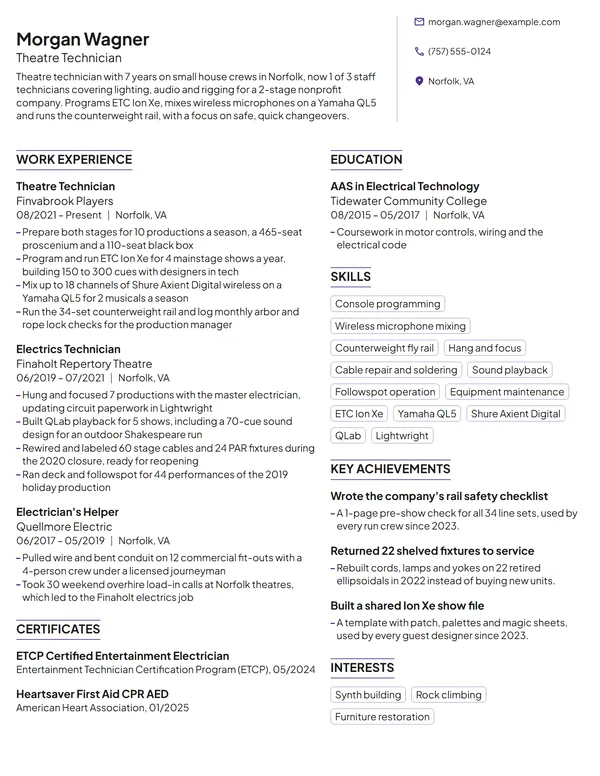
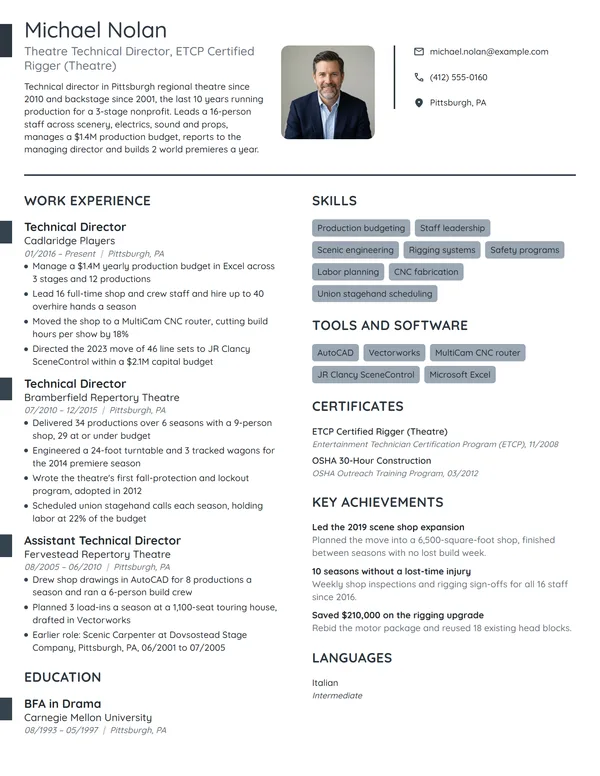
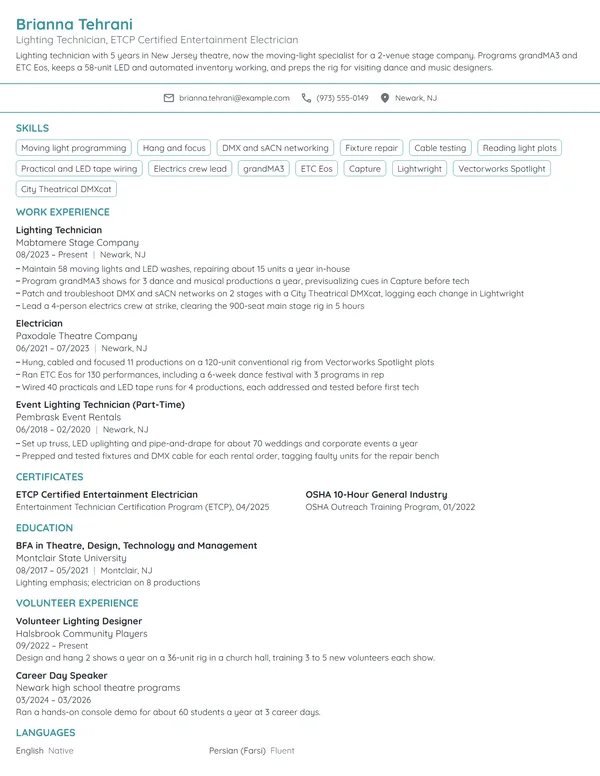
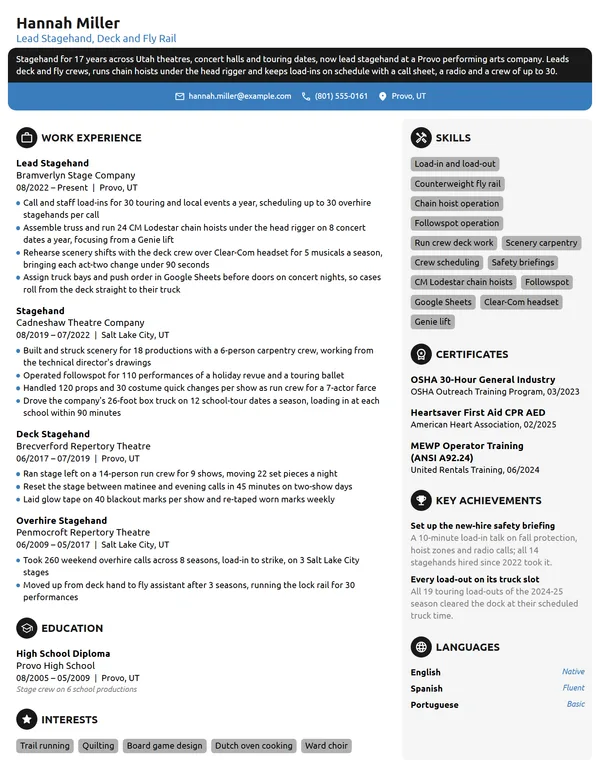
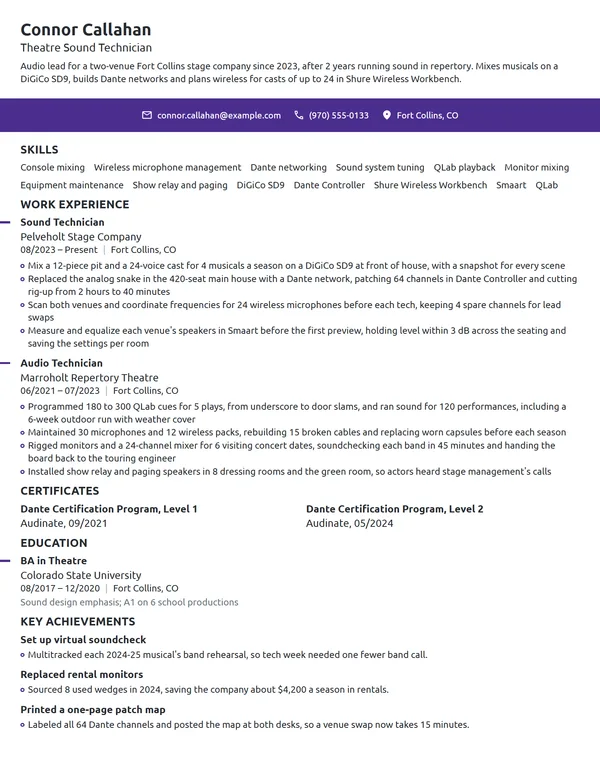
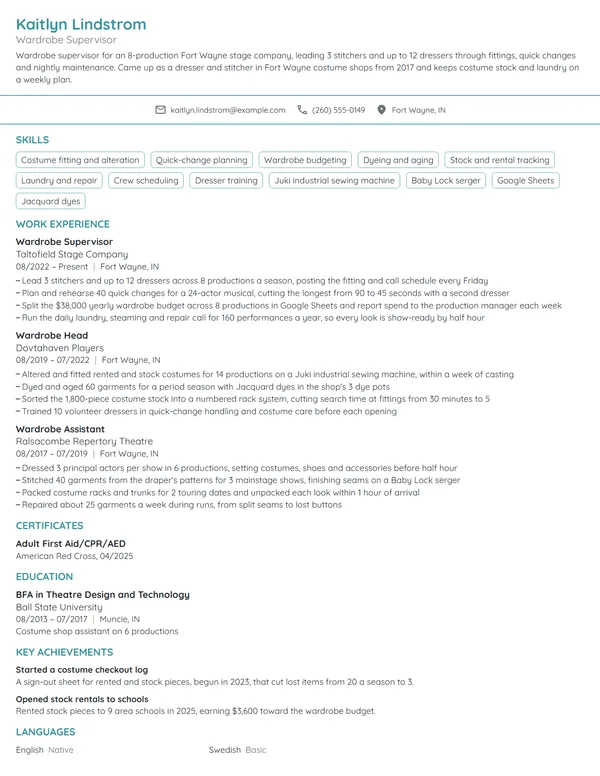
Technical theatre covers everything that makes a show run: lighting, sound, scenery, rigging and props. A production manager or technical director hiring for the next season checks which departments you have worked in, the size of the shows you have loaded in, the consoles and shop tools you can run, and how safely you work at height and around power. A theatre career rarely comes as 1 long job; it comes as seasons, short contracts and overhire calls. Lead with the credits that carry real numbers: fixtures hung, scenic units built, performances run.
How to Write a Technical Theatre Resume - Key Takeaways
- List jobs newest first and keep to 1 page, grouping short contracts and overhire calls under 1 entry per venue or employer.
- Put your department in every job title line, such as Master Electrician, Scenic Carpenter or Props Artisan, so a production manager sees your track at a glance.
- Attach a show number to every bullet: fixtures, circuits, scenic units, performances run, crew size or hours to load in.
- Name your consoles, drafting software and shop tools exactly as the posting does, in Skills and once more in the bullet where you used them.
- List ETCP credentials with their full category and year under Certificates, and write OSHA 10 or 30 as a course completion card.
- Keep the file clean and readable, then run it through an ATS resume checker before you send it to a theatre's job portal.
What production managers look for in a technical theatre resume
A production manager reads a technician's resume to staff a crew: who can hang the plot, build the deck, run the rail or track the props, and who can be trusted on a ladder or a lift. O*NET's profile for lighting technicians shows what that looks like in 1 department: setting up, maintaining and dismantling fixtures and control devices for live productions, matching fixture settings to the design plans, and assessing wiring for fire and shock risk. Every department has its own version of that list, and your bullets should show it with a number.
Build the page from these sections, named the way most resume software and theatre job portals read them:
- Name, headline with your department (for example, Master Electrician or Technical Director) and contact details
- Summary of 2 or 3 lines under your name, printed without a heading
- Work Experience, newest first, with your show credits as bullets
- Skills, with your consoles, drafting software and shop tools
- Certificates, for ETCP credentials and OSHA cards
- Education
- Room permitting: Languages and Interests, then 1 extra block, either Key Achievements or Volunteer Experience
Best format for a technical theatre resume
Choose the reverse-chronological resume format: newest job first, each with your title, the venue or company, the city, and the months you began and finished (MM/YYYY). Theatre crews move up in steps a production manager recognizes, from overhire and run crew to department head, assistant technical director and technical director, and this layout shows each step in order. Use a combination format only if you are coming into theatre from another trade and need your transferable skills on top.
- Best for most theatre techniciansReverse-chronologicalYour jobs, newest first, with your results under each one.Best for: A steady work history in your field
- FunctionalSkills grouped up top, with a short work history below.Best for: Gaps or very little experience
- CombinationA skills section first, then your full work history.Best for: A career change with strong skills
Fit it on 1 page, even with a long list of shows; only a technical director or production manager with 15+ years and several venues runs to 2. Group contract work by employer instead of by show. Summer stock seasons, repeat overhire calls at the same house and a run of tours with 1 company each become 1 entry with a date range and 3 to 4 bullets that name the biggest productions inside them.
| Setting | What to use |
|---|---|
| Length | 1 page; 2 only for technical directors and production managers with 15+ years |
| Dates | MM/YYYY ranges, with Present for the job you hold now |
| Job title line | Department plus level: Master Electrician, Assistant Technical Director, Props Artisan |
| Short contracts and overhire | 1 entry per employer with a date range; name the shows inside the bullets |
| Typeface | A clean sans serif, 10 to 12 pt in the body |
| Photo, age and ID numbers | Skip the headshot, as most US and Canadian crews expect; never add your date of birth, marital status or SSN |
| File type | PDF, or a Word file if the theatre's application portal asks for one |
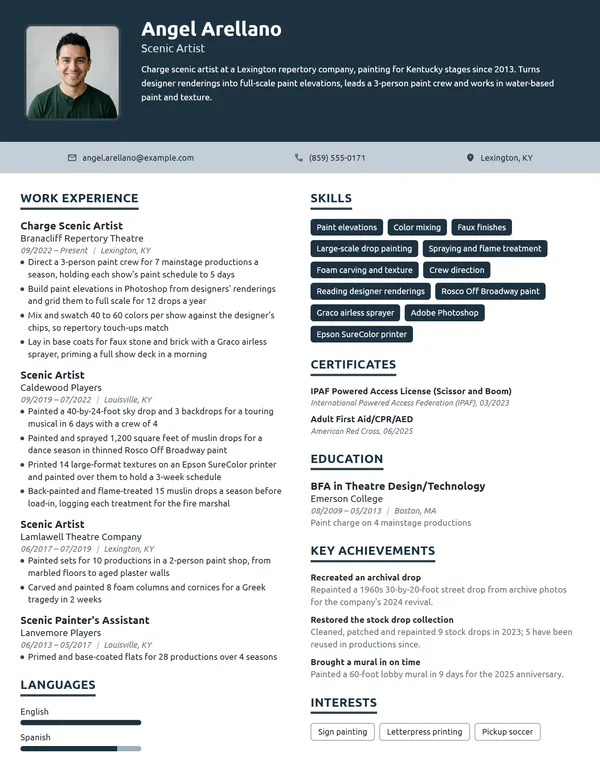
Most US and Canadian resumes carry no photo, and a crew resume is judged on the shows and skills it lists, not on a headshot. Headshots belong to performers' resumes, not to the people running the show.
Technical theatre resume summary vs. objective
If you have been paid for crew or shop work, write a resume summary: your department, your years, the venues you know and your largest show. If every credit so far comes from school or community productions, a resume objective works better: the role you want, then the strongest production you have worked on. Both run 2 or 3 lines and take their number from a bullet further down.
Technical theatre resume summary formula
Department title with X years in venue type, working with console, drafting or shop tools. Largest show, plot or build, with a number. ETCP credential, OSHA card or union local.
Example
Master electrician with 11 years in repertory and summer stock theatre, programming ETC Eos and drafting in Vectorworks Spotlight. Maintains a 380-fixture rep plot across 6 productions a season. ETCP Certified Entertainment Electrician since 2023.
Don't
Passionate theatre technician with a strong work ethic and a love of live performance, looking to join a creative team.
Do
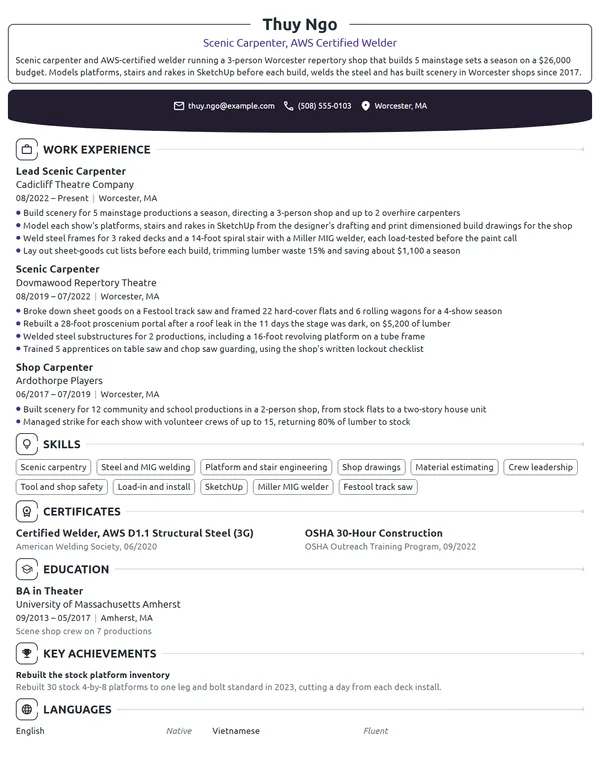
Scenic carpenter with 5 years in regional theatre and opera, building in a shop with a CNC router. Built and installed sets for 14 productions, 2 of them with automated wagons. Holds an OSHA 30-Hour card.
The second version names a department, a venue type, a tool, a volume and a safety credential.
How to write technical theatre work experience bullets with numbers
Your current job gets 3 to 4 bullets and each earlier job 1 to 3, every one opening on a verb. Theatre work is already counted in fixtures, circuits, units, cues, performances and hours, so nearly every credit can carry a figure a technical director will recognize. Write titles and dates as you would when listing work experience on a resume in any field, and put the production names inside the bullets.
| Area | What to count | Example bullet |
|---|---|---|
| Load-in and load-out | Hours, crew size, trucks | Loaded in a 2-truck touring set with a crew of 8 in 6 hours. |
| Electrics | Fixtures, circuits, cues, days to focus | Circuited and focused a 140-fixture plot for a 220-seat thrust stage in 2 days. |
| Scenery | Units built, build weeks, budget | Built 23 scenic units in 4 weeks and came in $1,900 under a $28,000 materials budget. |
| Rigging and fly system | Line sets, points, inspections | Inspected 38 counterweight line sets before each season and replaced rope on 6. |
| Running crew | Performances, shifts, cues per show | Ran 42 scenery shifts a night across 96 performances of a musical. |
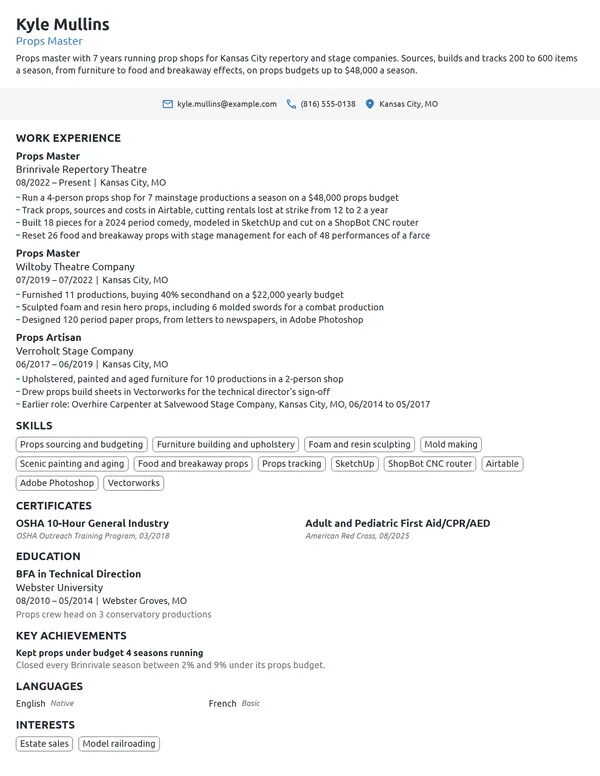
| Props | Items built or sourced, budget, shows | Built or sourced 310 props for a period musical on a $6,500 budget. |
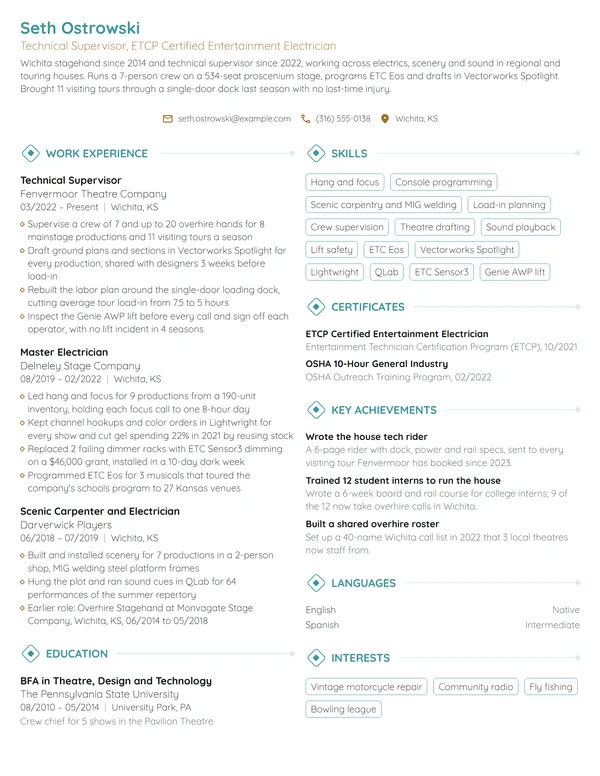
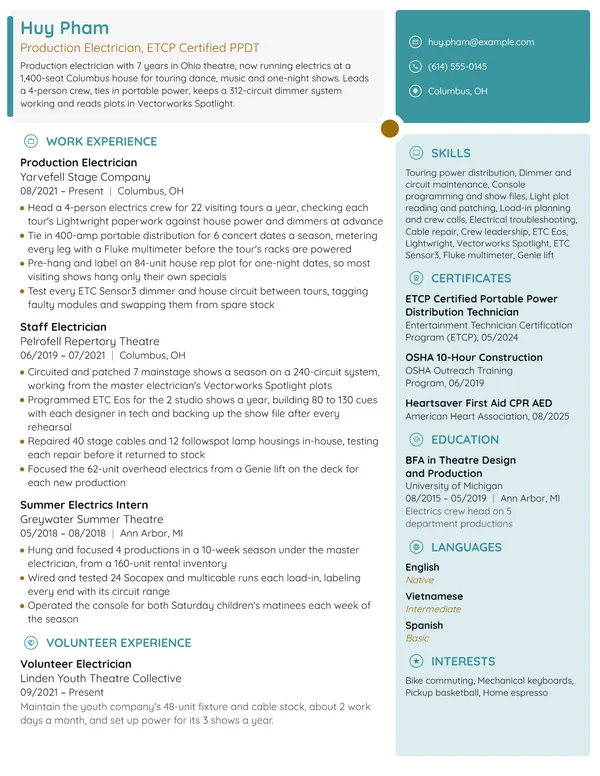
Here is how 1 master electrician's entry looks once the rig, crew and run figures are filled in. The current job carries the size of the rig and the crew; the earlier summer stock job is shorter and grouped as 1 entry across 5 seasons.
Work Experience
- Hang, circuit and maintain a 380-fixture repertory plot for 6 mainstage productions a season.
- Lead a crew of 5 electricians through each changeover, completing the hang and focus between 2 shows in 9 hours.
- Converted 96 incandescent fixtures to LED, cutting lamp and gel spending by $7,400 a year.
- Keep Lightwright paperwork for 412 circuits current within 24 hours of every design change.
- Ran the light board for 214 performances over 5 summer seasons.
- Programmed 3 musicals a season on an ETC Ion console, averaging 260 cues per show.
Don't
Responsible for setting up lights for shows.
Do
Hung and focused 180 fixtures for 4 one-night stands a week on a national tour, with load-out finished in under 2 hours.
The rewrite gives the rig size, the pace of the tour and the time the crew beat.
Don't
Worked on the run crew for a musical.
Do
Ran fly rail for 72 performances of a musical with 31 line set cues a show and 0 missed cues.
Technical theatre skills and software for your resume
Pick 6 to 8 hard skills for your resume that match the posting and your own department, and prove each one in a bullet. A props master and a rigger share very few skills, so write the list for the job you are applying to, not for the field.
Hard skills for theatre technicians
- Hanging and focusing lighting fixtures
- Console programming
- Reading light plots and ground plans
- Scenic carpentry and welding
- Counterweight and motorized rigging
- Fly rail operation
- Portable power distribution
- Sound system setup and mixing
- Props building and sourcing
- Paperwork and shop drawings
Soft skills production managers value
- Calm during tech and live performance
- Safety awareness
- Clear communication on headset
- Teamwork on a crew
- Problem solving under deadline
- Flexibility across departments
Name your tools with your skills and again inside the bullet where you used them. For electrics, write the console family (ETC Eos or Ion, grandMA3) and your paperwork tool, such as Lightwright. For drafting, write Vectorworks Spotlight or AutoCAD; O*NET flags AutoCAD as a hot technology for lighting technicians. For sound, name the playback software, such as QLab, and the mixing consoles you have run. Shop tools count too: a CNC router, MIG welding or a specific automation system tells a technical director more than "power tools" does.
ETCP, OSHA and rigging certifications on a technical theatre resume
Put certifications on your resume in a Certificates section with the issuer and the year, so a production manager scanning for rigging or electrical credentials finds them in 1 place. The main credential in this field comes from the Entertainment Technician Certification Program (ETCP), which ESTA runs. It covers 4 areas: Rigger (Arena), Rigger (Theatre), Entertainment Electrician and Portable Power Distribution Technician. Each exam has 165 multiple-choice questions, 150 of them scored, with 3 hours to finish.
| Credential | Issued by | What it takes |
|---|---|---|
| ETCP Certified Entertainment Electrician | ETCP (ESTA) | 30 eligibility points, earned mainly through work experience, with degrees, apprenticeships and internships also counting, then a passed exam. Valid for 5 years. |
| ETCP Certified Rigger (Theatre) or Rigger (Arena) | ETCP (ESTA) | 30 eligibility points from a point system focused on work experience, then a passed exam in the chosen category. Valid for 5 years. |
| ETCP Certified Portable Power Distribution Technician | ETCP (ESTA) | 20 eligibility points and a minimum age of 21, then a passed exam. Valid for 5 years. |
| OSHA 10-Hour or 30-Hour course card | An OSHA-authorized Outreach trainer | A 10-hour class on common job hazards, or a 30-hour class OSHA describes as more suited to supervisors; you receive a course completion card. |
ETCP renewal takes 40 renewal credits over the 5-year period, or at least 10 education credits plus a retake of the exam. Write the year you first certified, and keep the credential on your resume only while it is current.
Where OSHA cards and union membership go
OSHA states that none of its Outreach courses is a certification, so list the class as a course card (OSHA 30-Hour General Industry, with the year) rather than calling yourself OSHA certified. Union membership is not a credential either: put your local and its number in your headline or summary line, where a production manager hiring union crew will look first.
Certificates
- ETCP Certified Entertainment Electrician, Entertainment Technician Certification Program (ESTA), 2023
- OSHA 30-Hour General Industry, course completion card, OSHA Outreach Training Program, 2022
- Adult First Aid/CPR/AED, American Red Cross, 2025
How to list a BFA, BA or MFA in technical theatre
Many theatre technicians hold a BFA or BA in theatre, technical theatre or design and production, and some technical directors and production managers go on to an MFA. Others come up through crew work, a trade or an apprenticeship, and an empty Education section does not stop a strong show history. Follow the standard rules for listing education on a resume: degree and concentration, then the school, its city and the month you graduated, with your GPA only if it is 3.5 or higher and you graduated in the last 2 to 3 years.
Write the degree with its concentration, such as Lighting or Scenic Technology, because that tells a technical director which shop you trained in. Add 1 line on the biggest school production you headed a department for. After your first paid season, move school shows out of Work Experience and keep only that 1 Education line.
Education
Master electrician on 4 school productions.
Entry-level and career-change technical theatre resumes
With no paid crew job yet, use an entry-level resume layout: a short objective, Education placed second, and every production you have worked on with the same numbers a paid job would get. Overhire calls count as work experience from your very first one.
- University and high school productions: your department role, the venue size and the fixtures, units or cues you handled.
- Overhire and load-in calls: grouped under each venue, with the number of calls and the biggest show.
- Community theatre: listed under Volunteer Experience when unpaid, with the shows and your role on each.
- Summer stock or festival internships: the season length, the number of productions and the shop you worked in.
Don't
Recent theatre graduate looking for an opportunity to grow in technical theatre.
Do
Theatre production graduate seeking an overhire electrician role. Hung and focused 9 university productions, programmed 2 of them on an ETC Element, and hold an OSHA 10-Hour card.
Evidence turns an objective into a pitch: productions, a console and a safety card.
Electricians, carpenters, welders and AV technicians already have most of what a theatre crew needs. On a career-change resume, keep reverse-chronological order, lead each entry with the work that transfers (wiring, framing, rigging, live events), and add any community or overhire shows as their own entry. Use the cover letter to explain the move to theatre; a cover letter of 3 short paragraphs is enough to connect your trade to the shop you want to join.
Technical Theatre resume FAQ
How do I list overhire and short contracts on a technical theatre resume?
Group them by employer. Give each venue or production company 1 entry with your department title and a date range covering your first and last call, then use 2 or 3 bullets to name the biggest shows, the number of calls and what you did on them.
Should I list every show I have worked on?
No. Name the productions that show your range or your biggest rig, build or crew, inside the bullets of each job. A list of every title fills the page without telling a production manager what you did on any of them.
Do I need ETCP certification to work in technical theatre?
Not unless a theatre requires it in the posting, which happens most often in rigging and electrical roles. ETCP, run by ESTA, certifies entertainment electricians, theatre and arena riggers, and portable power distribution technicians. Candidates need 20 or 30 eligibility points, earned mostly through work experience, and the credential is valid for 5 years.
Should I put union membership on a technical theatre resume?
Yes, if you are a member. Write your local and its number in your headline or summary line, not under Certificates, since membership is not a credential. A production manager hiring union crew looks for it there first.
How long should a technical theatre resume be?
1 page for most technicians, including those with many seasons of contract work, since grouping shows by employer keeps it short. Technical directors and production managers with 15+ years across several venues can use 2 pages.
Should I include student productions on my resume?
Only until you have paid credits to replace them. While you are in school or just graduated, list the productions where you held a department role, with the numbers you handled. After your first paid season, keep 1 line about your strongest school show in the Education entry.
What software should a theatre technician list?
List the programs for your department that a theatre lists in its posting and that you have used on a show: a console family such as ETC Eos for electrics, Vectorworks Spotlight or AutoCAD for drafting, Lightwright for paperwork, and QLab for sound playback. Back each one with a bullet.
Next steps
Pick the example closest to your department and level, keep its structure, and swap in your own shows, rig sizes, builds and crew numbers. Build it in our resume builder, or pick one of the resume templates as a starting point, then send it with a short cover letter that names the production you are proudest of.