
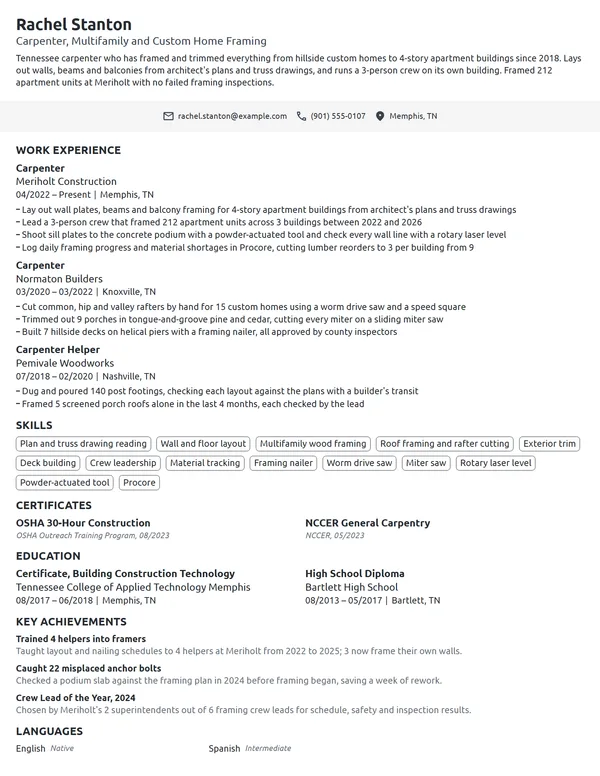
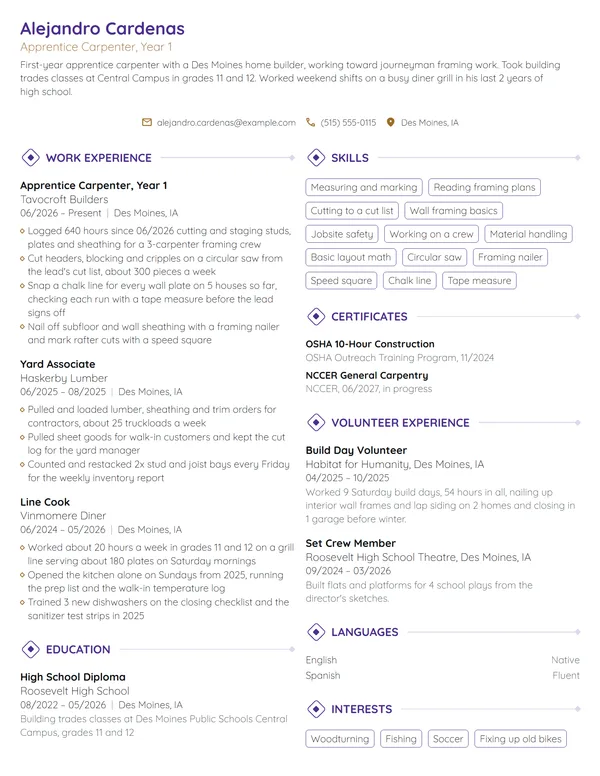
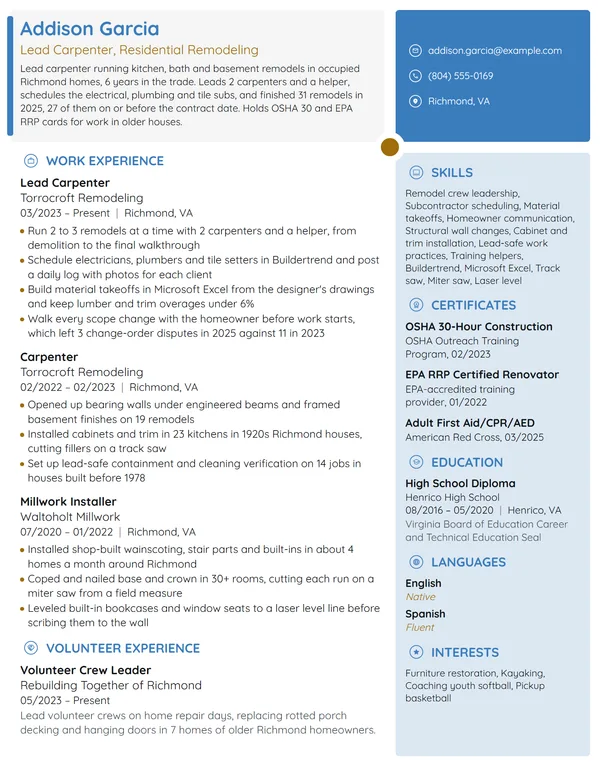
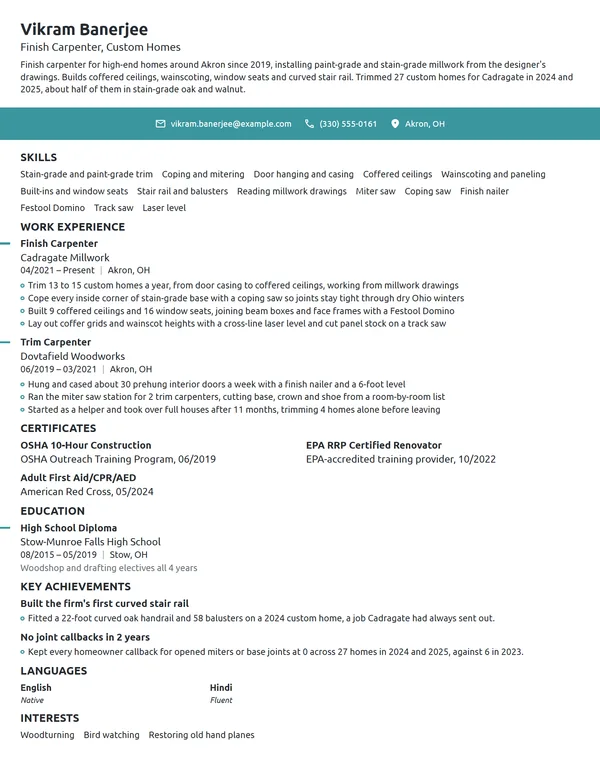
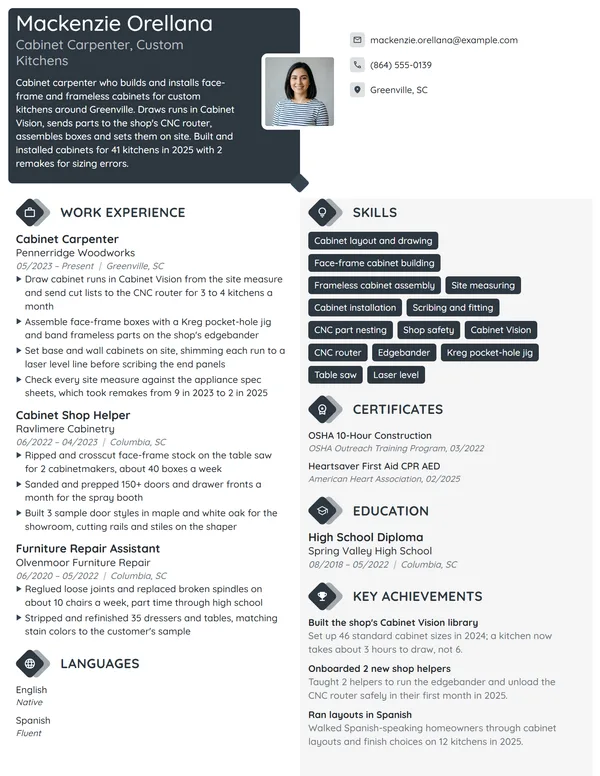
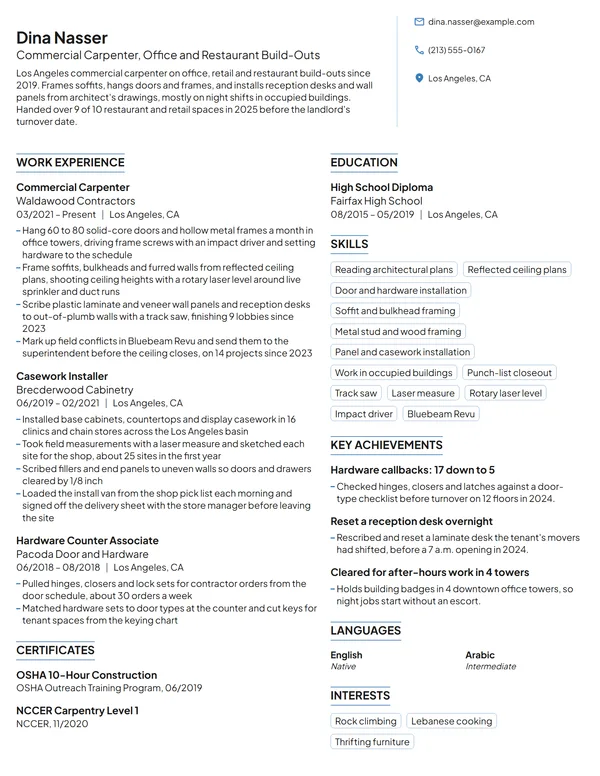
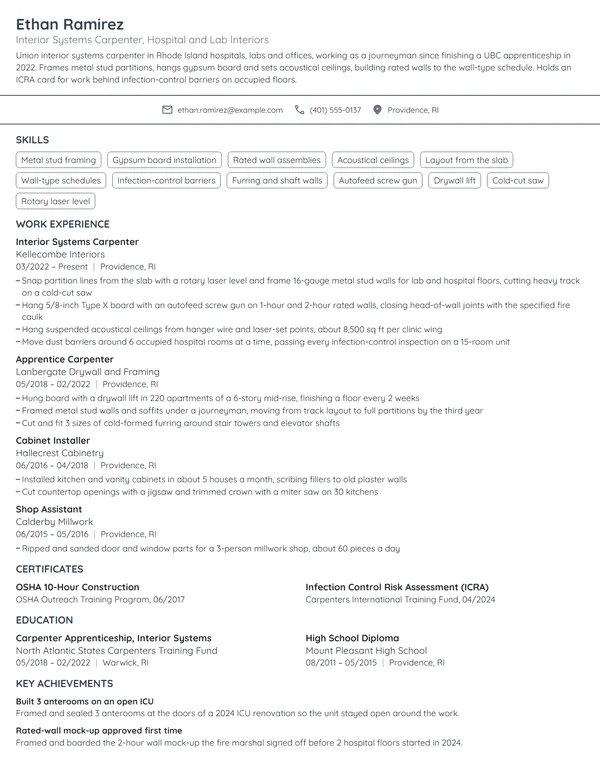
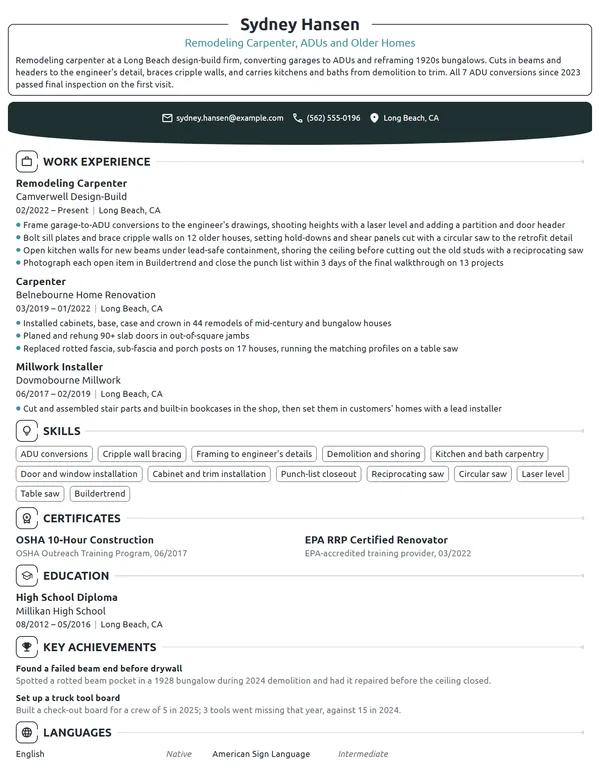
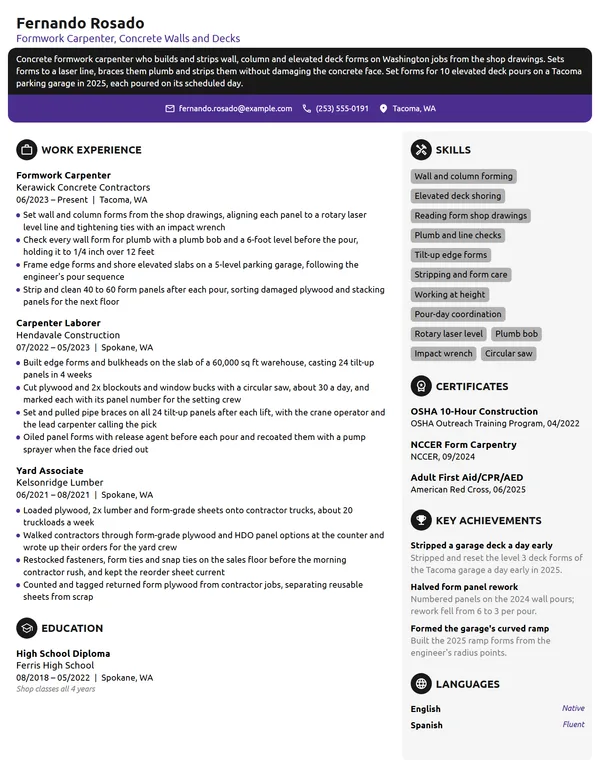
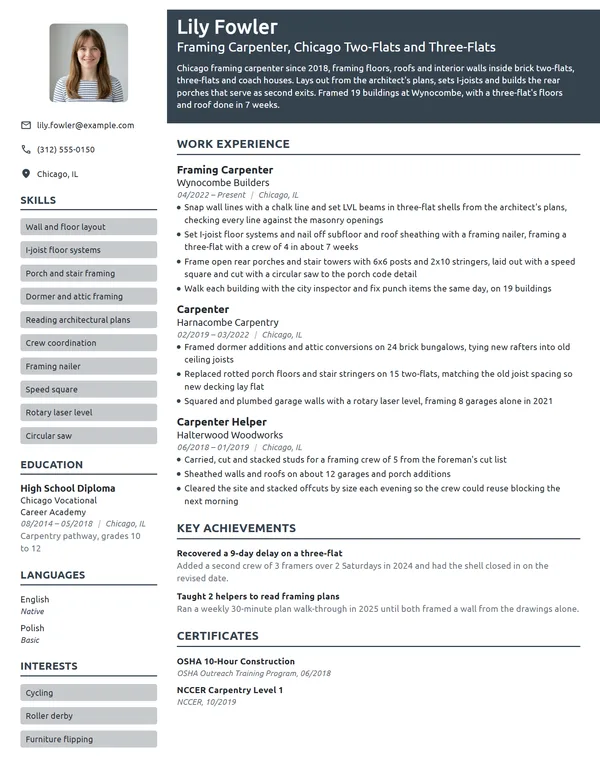
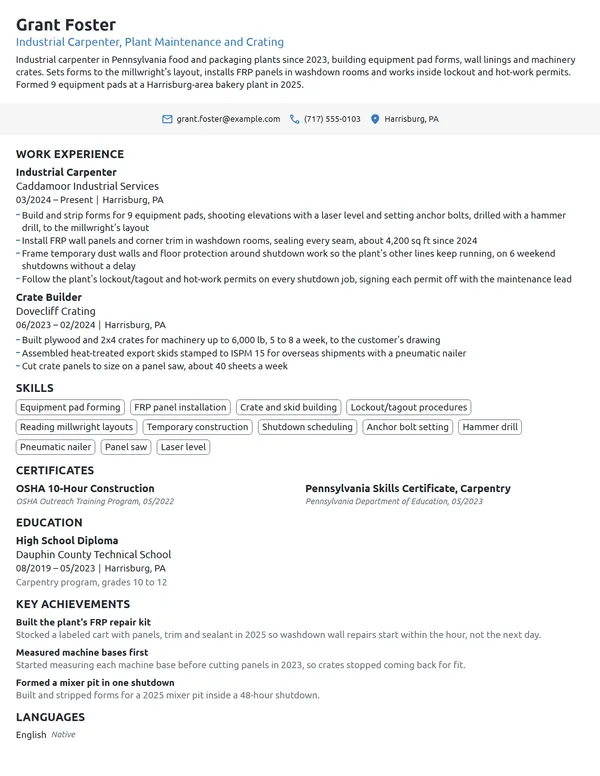
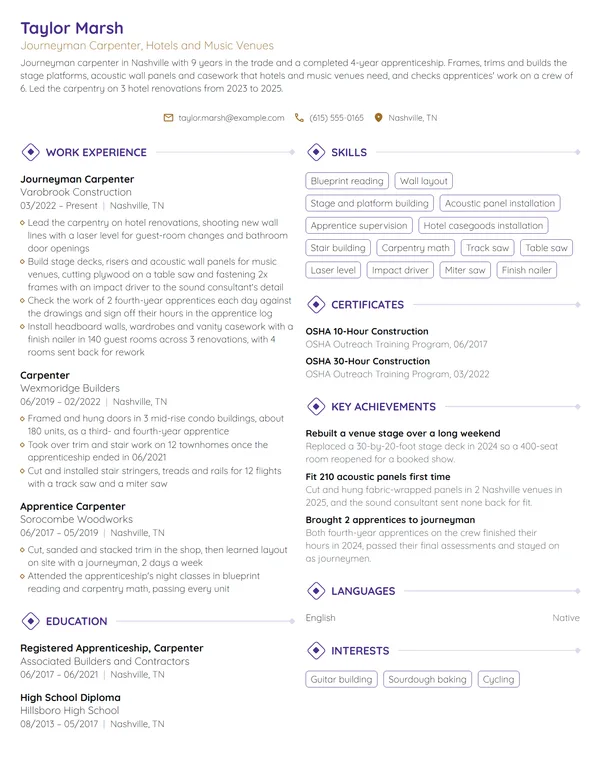
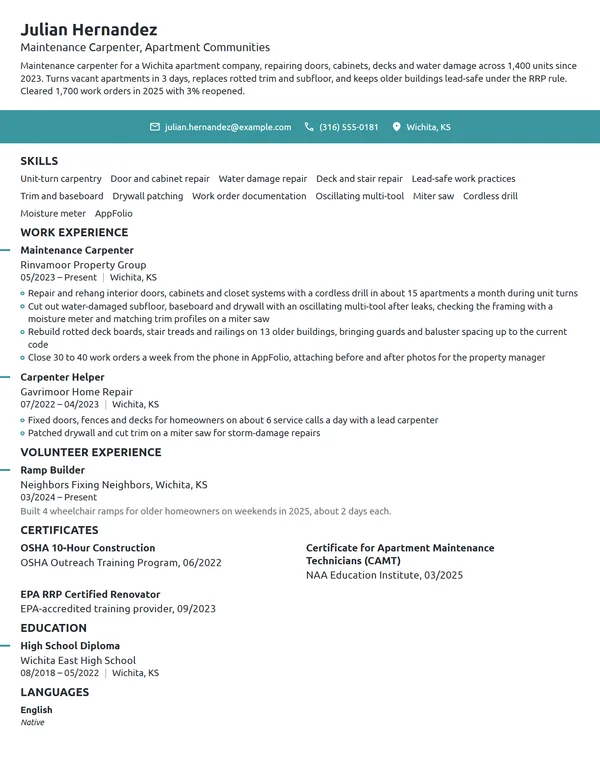
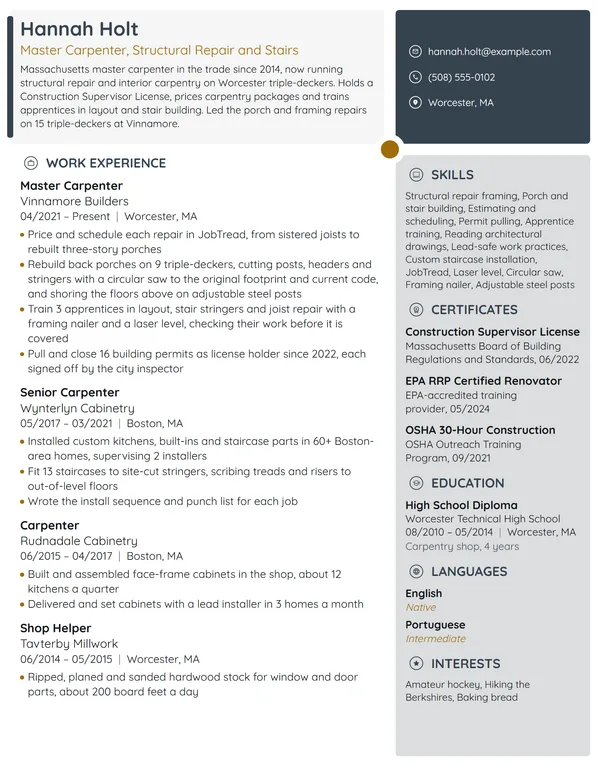
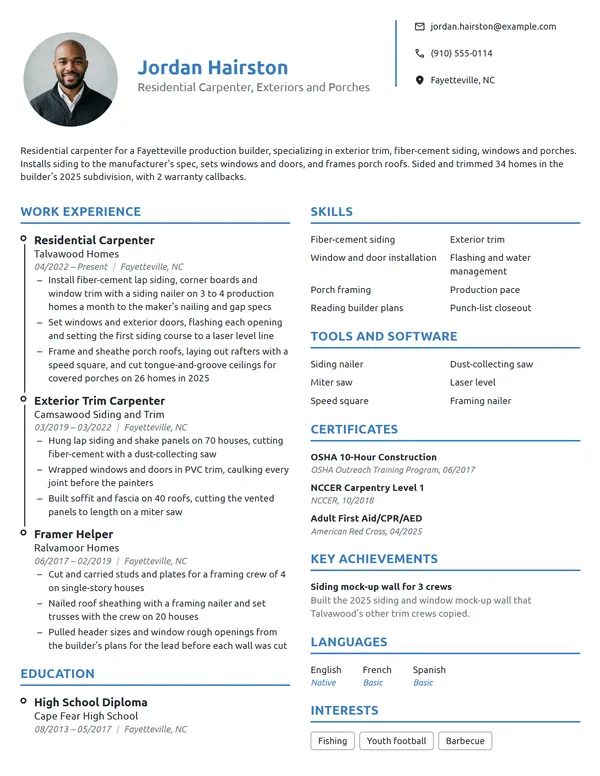
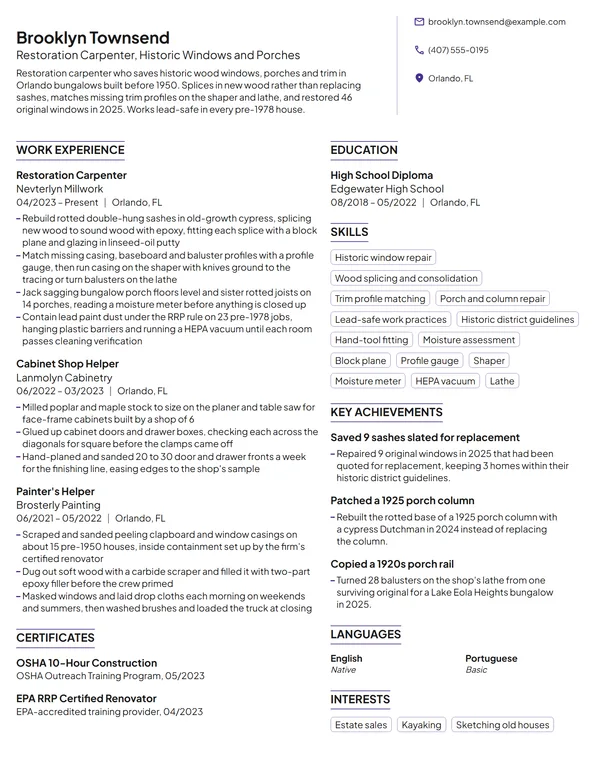
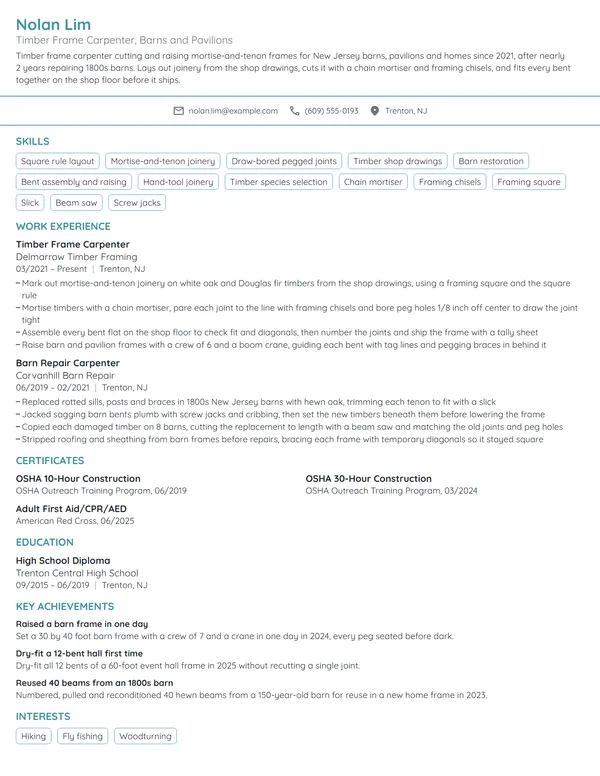
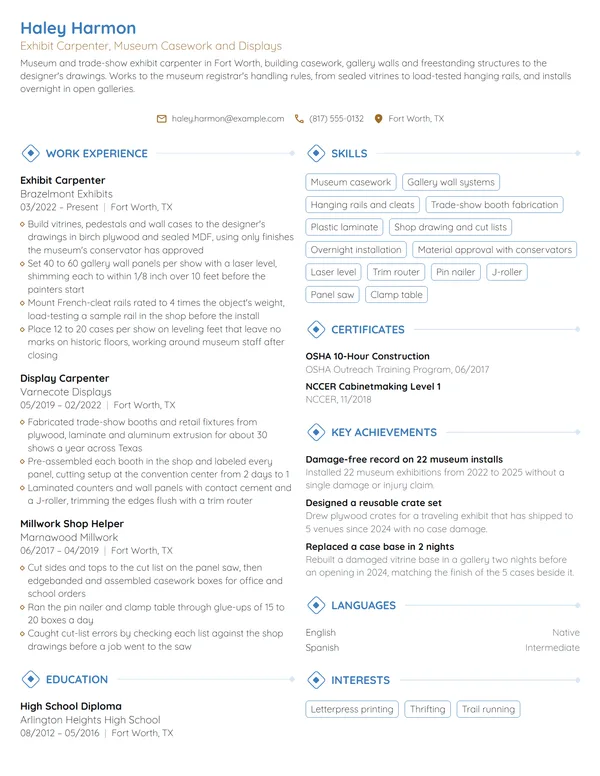
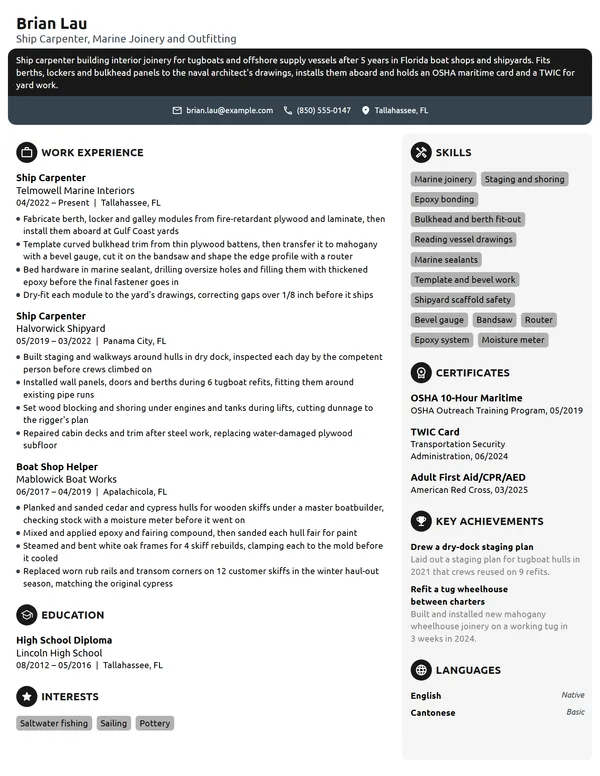
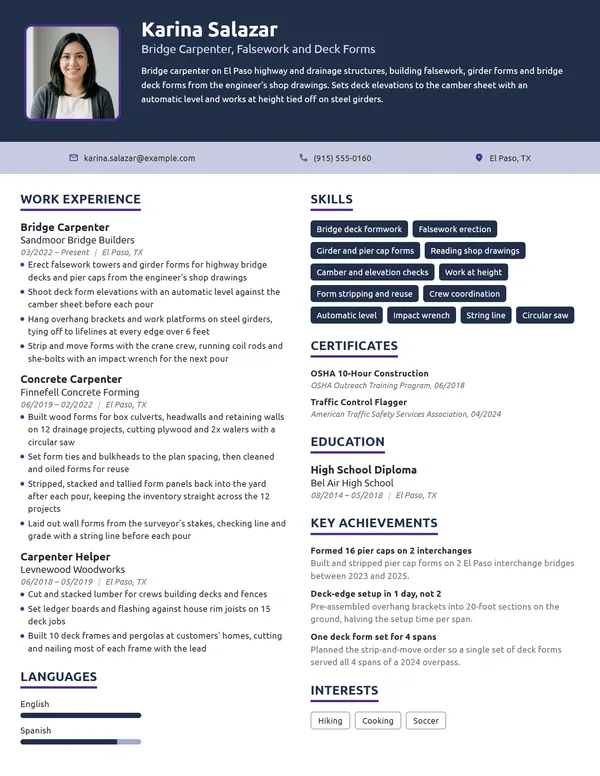
Carpentry is judged by the finished work: square walls, clean joints, doors that close the way they should. A resume can't show any of that, so the foreman or contractor reading yours looks for the next best signs. They want to know what kind of carpentry you do, from framing to finish and cabinets, how much of it you lay out yourself, which tools you run, and the safety cards you carry. Sizing each job in houses, square feet or linear feet gives them that proof.
How to Write a Carpenter Resume - Key Takeaways
- Order jobs newest first in a reverse-chronological layout, keep it to 1 page, and name your kind of carpentry in the headline, such as Finish Carpenter or Framing Carpenter.
- Open with a 2- to 3-line summary that gives your years in the trade, your type of work, your best build with a number and, if you hold one, your safety card.
- Size every bullet in the trade's own units: homes or square feet framed, linear feet of trim, doors hung, cabinet boxes set, pours, punch-list items and callbacks.
- Write "laid out" only for work you marked from the plans yourself, since a foreman reads it as proof you can work without close supervision.
- List OSHA 10 or OSHA 30, NCCER training and any EPA RRP or state contractor license under Certificates, each with the body that issued it and the month and year.
- Check the file with an ATS resume checker before you apply to a large builder or contractor.
What contractors and foremen look for in a carpenter resume
A foreman or superintendent hiring a carpenter is asking 3 things: what you can build, whether you can do it from the plans without being walked through it, and whether you work safely. The BLS lists following blueprints and building plans, building frameworks such as walls, floors and doorframes, installing windows and molding, and directing laborers as core duties. O*NET adds measuring and marking cutting lines and checking a structure for plumb and level, the work a crew leader trusts you with once you have proven yourself.
Use these sections, in this order:
- Your name and a headline naming your kind of carpentry, plus contact details with your city and a portfolio link if you have one
- A 2- to 3-line summary under the headline, with no section title above it
- Work Experience, starting with the crew you are on now
- Skills, with your power tools and any estimating software
- Certificates: OSHA cards, NCCER training, EPA RRP and any contractor license
- Education, where an apprenticeship or trade school program also goes
- If space is left: Languages, then Key Achievements or a Volunteer Experience entry
Best format for a carpenter resume
Use the reverse-chronological resume format: your current job first, each entry with your title, the company, where it is based, and the MM/YYYY dates you started and left. Carpentry careers climb in steps a reader recognizes, from helper or apprentice to journeyman, lead carpenter and foreman, and this order puts your latest step at the top. A combination format, with skills above your history, rarely helps a carpenter, even one changing careers.
- Best for most carpentersReverse-chronologicalYour jobs, newest first, with your results under each one.Best for: A steady work history in your field
- FunctionalSkills grouped up top, with a short work history below.Best for: Gaps or very little experience
- CombinationA skills section first, then your full work history.Best for: A career change with strong skills
Keep it to 1 page. A lead carpenter, foreman or master carpenter with 15+ years of varied projects can run to 2 pages, as long as page 1 holds the 2 latest jobs. Short jobs on the same kind of work, such as 3 framing subcontractors in 2 years, read better grouped under one entry with the range of dates.
| Setting | What to use |
|---|---|
| Length | 1 page; 2 only for a lead or master carpenter with 15+ years of projects |
| Dates | MM/YYYY on every job, and Present on the one you hold now |
| Job title line | Your kind of carpentry, such as Finish Carpenter, Framing Carpenter or Lead Carpenter, not a pay grade like Carpenter II |
| Contact line | City and state, phone, email, and a link to photos of your work |
| Photo and private data | No photo on most US and Canadian resumes; leave off your age, family status and SSN |
| File type | PDF, or a Word file if the builder's application portal asks for one |
Most US and Canadian resumes carry no photo, so for a carpenter the pictures that do the most work are photos of finished builds, kept behind the link in your contact line.
Carpenter resume summary vs. objective
If you have worked as a carpenter, even as a helper on a framing crew, write a resume summary: 2 to 3 lines naming your years, your type of carpentry, one build with a number and, if you hold one, your top safety card. If you have never been paid for carpentry, write an objective instead. Write the summary after your bullets, and take its number from one of them.
Carpenter resume summary formula
Type of carpenter with X years in residential, commercial or industrial work. Your strongest build, with a count, a size or a schedule result. Safety card or certification, plus a tool or system you run.
Example
Carpenter with 8 years in residential framing and finish work, from layout to final trim. Framed and trimmed 40+ semi-custom homes and brought the final punch list down to 9 items per home. OSHA 30 and EPA RRP certified.
Don't
Hardworking carpenter with great attention to detail and a strong work ethic, looking for a long-term position.
Do
Commercial carpenter with 5 years in office tenant fit-outs: metal stud framing, drywall, doors and hardware. Hung about 900 doors across 26 suites. Holds an OSHA 30 card and a valid driver's license.
The second version names the setting, the scope of work, a volume and the cards a superintendent checks.
How to write carpenter work experience bullets with numbers
Your current job gets 3 to 4 bullets, each led by a verb, and the jobs before it get 1 to 3. Carpentry already runs on counts: homes per year, linear feet, boxes per kitchen, days on the schedule. Pull those into your bullets, and follow the basic rules for listing work experience on a resume: your title, the company, its city and your dates on each entry.
| Area | What to count | Example bullet |
|---|---|---|
| Framing | Homes or square feet framed, crew size, weeks per house | Framed 6 homes with a 4-person crew in 5 months, each passing its framing inspection. |
| Trim and finish | Linear feet of trim, doors hung, rooms completed | Installed 420 linear feet of crown and hung 64 interior doors in a 2-story remodel. |
| Cabinets and millwork | Kitchens, cabinet boxes set, tolerance held | Set 310 cabinet boxes in 22 kitchens, level to within 1/16 inch. |
| Formwork | Square feet of form, pours, rework | Built 3,800 sq ft of wall form for 14 pours with no blowouts. |
| Schedule and quality | Days ahead or behind, punch-list items, callbacks | Finished a duplex remodel 2 days early and cut warranty callbacks from 8 to 2 a year. |
| Safety and crew | Scaffolds built, recordable injuries, helpers trained | Erected and tagged 14 scaffolds on a school addition with 0 recordable injuries. |
In the residential carpenter's entry below, the current job carries 4 bullets that cover framing, stairs, trim and safety, and the older framing job keeps 2.
Work Experience
- Frame, sheathe and stand walls for 18 semi-custom homes a year, 2,400 to 3,900 sq ft, on a 5-person crew.
- Laid out and built the stairs for 11 homes from the architect's plans, checking rise and run with a laser level before each install.
- Run about 1,600 linear feet of base and casing per home and brought the final punch list down from 31 to 9 items per home.
- Lead the morning scaffold and ladder check; the crew has logged 0 lost-time injuries in 3 years.
- Framed 2 homes a month and stood walls 1 day ahead of the builder's schedule on most houses.
- Cut sheathing waste from 12% to 7% by writing a cut list for each floor plan.
Don't
Responsible for framing houses.
Do
Framed floors, walls and roofs for 9 townhomes in 6 weeks from the engineer's truss and layout plans.
Now the bullet shows the scope, the count, the time and the plans used.
Don't
Did trim work and punch list items.
Do
Trimmed out 38 homes and kept the final punch list under 5 items per home at the superintendent's walk.
Carpentry skills, tools and software for your resume
Choose 6 to 8 technical skills for your resume that match the posting and that a bullet already proves. A framing posting wants layout, wall and roof framing and sheathing; a finish or cabinet posting wants trim, doors, hardware and cabinet setting. The soft skills in the list show best through results, such as a short punch list or a helper you trained.
Hard skills for carpenters
- Blueprint reading
- Layout and squaring
- Wall and roof framing
- Stair layout and building
- Interior trim and casing
- Door and hardware installation
- Cabinet installation
- Concrete formwork
- Scaffold erection
- Material takeoffs
Soft skills foremen value
- Working from verbal instructions
- Crew coordination
- Problem solving on site
- Reliable attendance
- Clear talk with homeowners
- Teaching helpers
Name your tools by type with your skills, then show each one at work in a bullet: framing and finish nailers, miter, table and track saws, a laser level or a builder's transit. O*NET's software list for carpenters is short and aimed at the business side: it flags Intuit QuickBooks and Microsoft Excel as hot technology and lists estimating, job costing and drafting software. Those matter for a lead carpenter or anyone who bids work, so list them only if you price jobs or order materials yourself.
OSHA cards, NCCER and other carpenter certifications
The BLS lists no trade license for carpenters, only a driver's license that some jobs need, so your safety cards and training records carry this section. List certifications on your resume under Certificates, each with its issuer and month and year, in the order the job ad lists them. The BLS says all carpenters must pass the OSHA 10-hour safety course and notes optional programs that certify by specialty. OSHA describes its 10-hour construction class as hazard awareness for workers and the 30-hour class as better suited to supervisors, so a lead carpenter or foreman should list the 30.
| Credential | Issued by | What it takes |
|---|---|---|
| OSHA 10-Hour Construction | An OSHA Outreach authorized trainer | A 10-hour class on common jobsite hazards; the trainer or online provider issues the card. |
| OSHA 30-Hour Construction | The same Outreach trainers | A 30-hour class OSHA says fits supervisors and workers with some safety responsibility. |
| NCCER Carpentry | NCCER | Training in 3 tiers: General Carpentry (247.5 hours), Advanced Carpentry: Frame & Finish (297.5 hours) and Form Carpentry (165 hours). |
| EPA RRP Certified Renovator | An EPA-accredited training provider | A certified renovator course, whose completion certificate is the credential; EPA requires certification for paid work that disturbs paint in housing or child-occupied facilities built before 1978. |
| State contractor license | Your state's licensing board, such as California's CSLB (C-5 Framing and Rough Carpentry, C-6 Cabinet, Millwork and Finish Carpentry) | Only for carpenters who contract work in their own name; each state sets its own exam and experience rules. |
Write each card the way it is printed, such as OSHA 30-Hour Construction rather than OSHA certified, and give NCCER training its tier name. EPA RRP belongs near the top for remodeling and restoration jobs in older houses. If you hold a contractor license, put it first, with the license number and the state.
Certificates
- OSHA 30-Hour Construction, OSHA Outreach Training Program, 09/2023
- NCCER Advanced Carpentry: Frame & Finish, NCCER, 05/2024
- EPA RRP Certified Renovator, EPA-accredited training provider, 02/2025
How to list an apprenticeship, trade school or high school diploma
The BLS says you can enter the trade with a high school education or its equivalent, and some vocational-technical schools offer associate's degrees in carpentry. Most carpenters learn on the job or through an apprenticeship, which the BLS says unions and contractor associations sponsor, with paid on-the-job training and technical classes each year in blueprint reading, math, building code and safety. List each one the standard way for listing education on a resume: credential, school or program, city and the month and year you finished.
A completed registered apprenticeship goes first under Education, with its sponsor and the year you finished. Apprenticeship.gov describes the completion certificate as a portable, nationally recognized credential, so name the program the way it appears on that certificate. With no apprenticeship or trade school, the diploma line alone is fine.
Education
How to list an apprenticeship in progress
List the apprenticeship as a job under Work Experience, with your year in the job title line, such as Apprentice Carpenter, Year 2, and the contractor you are placed with as the employer. Add the program itself under Education with your expected completion date, or under Certificates if its classroom part ends in a credential such as an NCCER level, and give the hours you have logged so far in 1 bullet.
Apprentice, helper and career-change carpenter resumes
With no paid carpentry yet, use an entry-level resume layout and open with a short objective: the role you want plus your best evidence. Our resume objective examples show how to keep it to 2 lines. Then give each item below the same kind of number a carpentry job would get.
- Helper or laborer work on a crew: what the crew built and what you did on it, with counts.
- Shop class, a pre-apprenticeship or a trade school program: hours and projects, listed under Education.
- Paid home repair jobs: decks, fences, sheds or siding, with the number of jobs.
- Volunteer builds: days on a Habitat for Humanity site or a community build, under Volunteer Experience.
Don't
Motivated individual seeking an apprenticeship to learn the carpentry trade.
Do
High school graduate seeking a carpentry apprenticeship. Worked 2 summers on a home repair crew, building 3 decks and replacing rotted siding, and completed OSHA 10 in 2025.
Even a first objective needs a count and a card.
Moving over from construction labor, handyman work, painting, warehouse jobs or the military, keep the reverse-chronological order and put the hands-on tasks closest to carpentry first in each entry: framing you helped with, layout, measuring, tools you ran. A career-change resume reads best when your summary names the carpentry work you can already do. Keep the story of why you switched for the cover letter; our construction cover letter examples show how to open with a build you are proud of.
Carpenter resume FAQ
Do carpenters need a license?
Usually not to work for someone else. A contractor license is set by each state and matters when you bid and contract work in your own name; California's CSLB, for example, has C-5 and C-6 carpentry classifications. You may also need a driver's license to reach jobsites, the BLS adds.
Should I put OSHA 10 or OSHA 30 on my carpenter resume?
List whichever card you hold under Certificates with its month and year. The BLS says all carpenters must pass the OSHA 10-hour course, and OSHA describes the 30-hour class as better suited to supervisors, so a lead carpenter should show the 30.
How do I list a carpentry apprenticeship on my resume?
Put the placement under Work Experience with your year in the title, such as Apprentice Carpenter, Year 3, and the program under Education with its sponsor, or its NCCER level under Certificates, with your expected completion date. Once you finish, list the completed apprenticeship first under Education.
What tools should I list on a carpenter resume?
List the tools the posting names that you can run without help, grouped by type: nailers, saws, levels and layout tools. Back each one with a bullet where you used it. Add estimating or job costing software only if you have priced jobs or ordered materials.
How long should a carpenter resume be?
One page for nearly everyone, including journeyman carpenters with 10 years in the trade. A lead or master carpenter with 15+ years of varied projects can use 2 pages if the first page holds the 2 latest jobs.
Can I list side jobs or self-employed carpentry work?
Yes. The BLS counts self-employed workers as the largest group of carpenters, at 25%. Give your own business a Work Experience entry with your business name, your city and dates, then size it like any other job: jobs completed, types of work and repeat customers.
How much do carpenters make?
Carpenters earned a median of $60,580 a year in May 2025, per the BLS. Leave pay off your resume; talk about it on the application form or in the interview, where your specialty, your state and your union status will shape the offer.
Next steps
Open the example nearest your kind of carpentry and level, keep how it is laid out, and put your own homes, feet, pours and punch-list numbers in place of its figures. Then build yours in our resume builder or from one of the resume templates.