
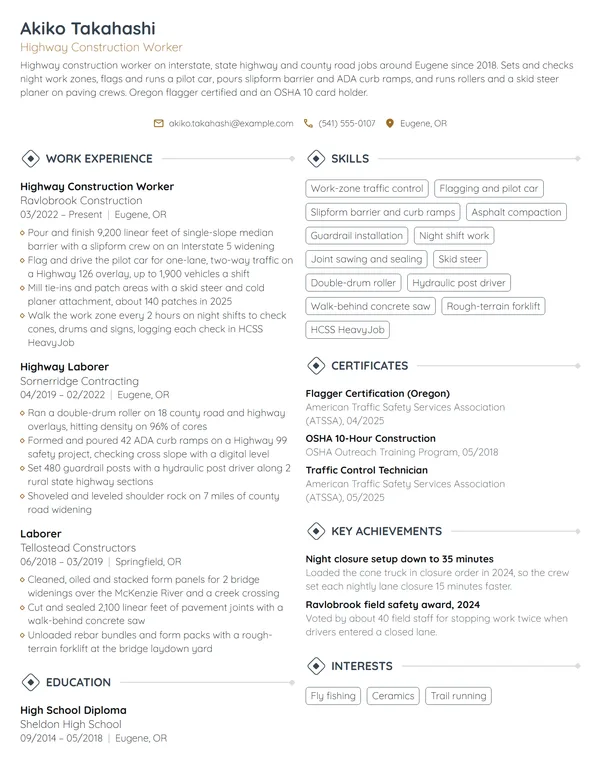
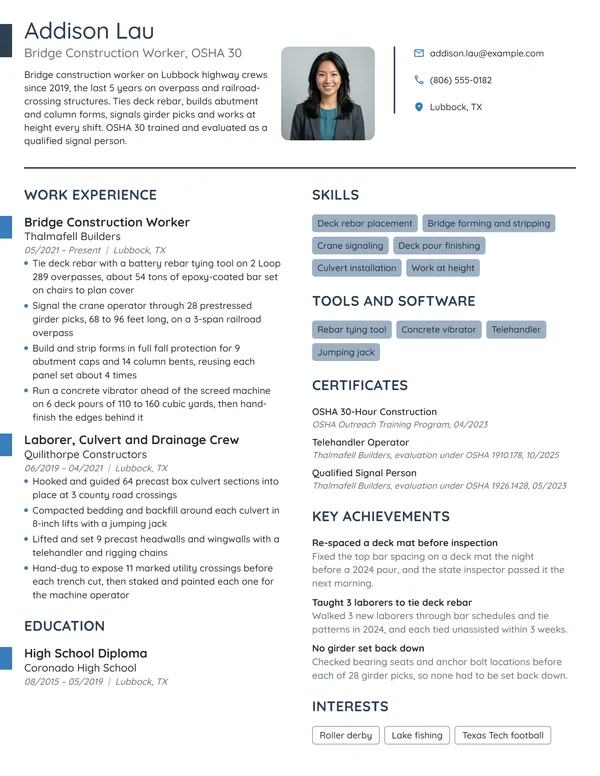
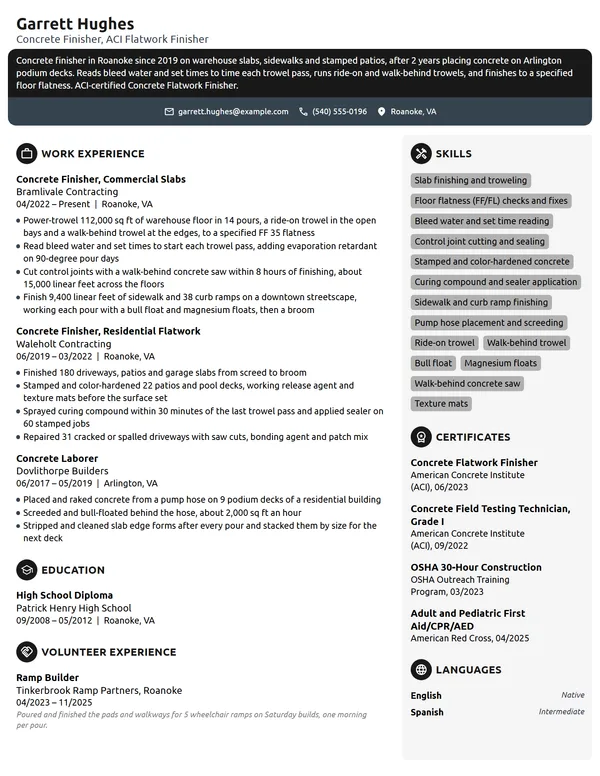
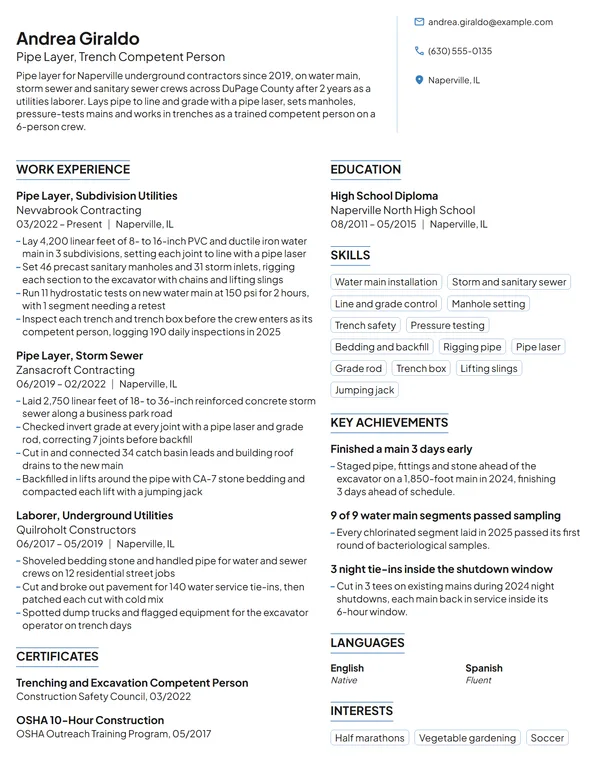
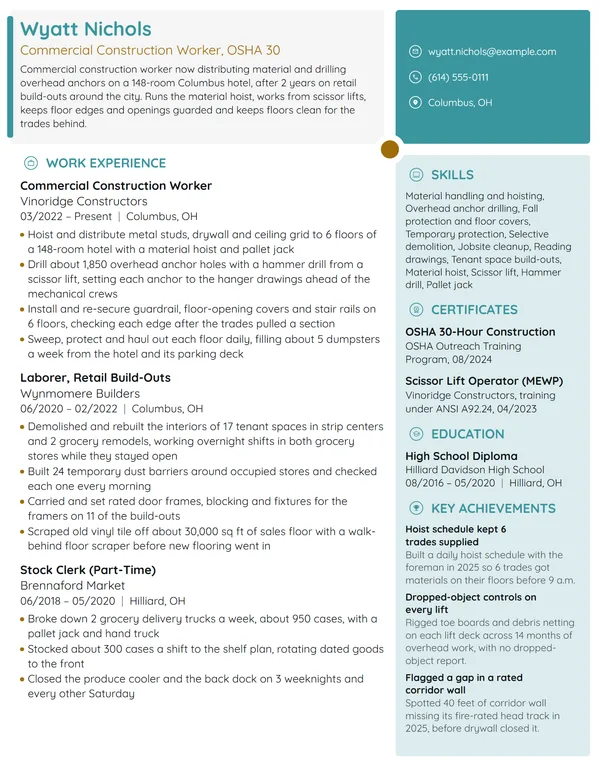
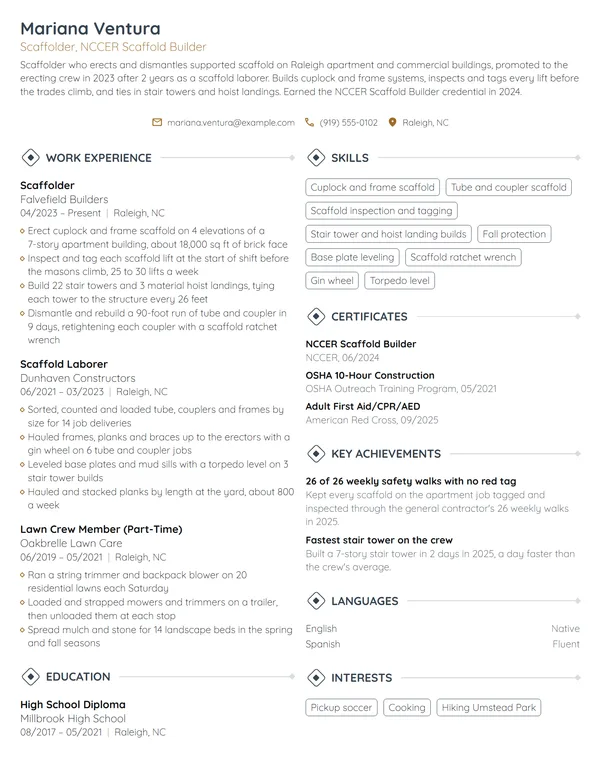
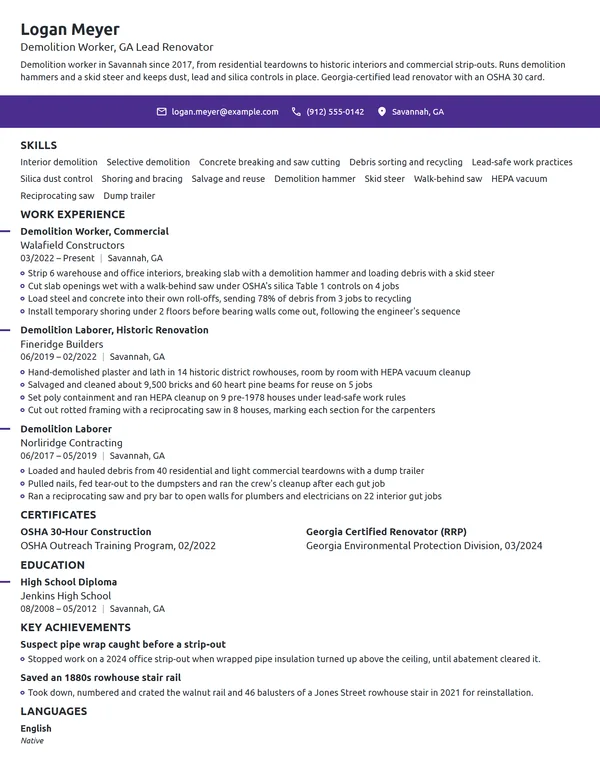
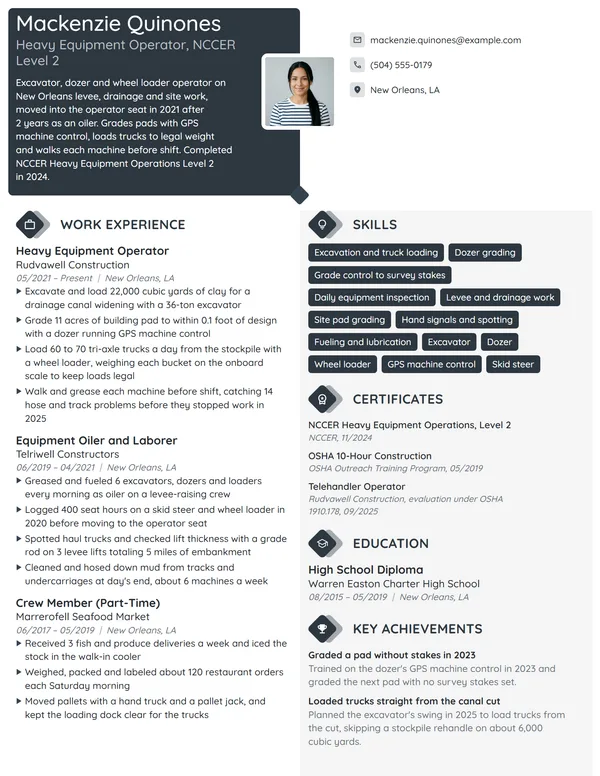
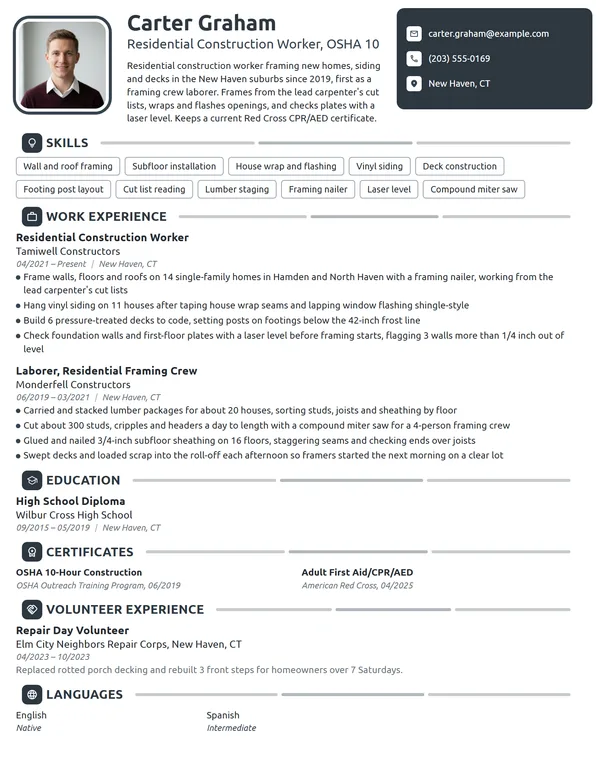
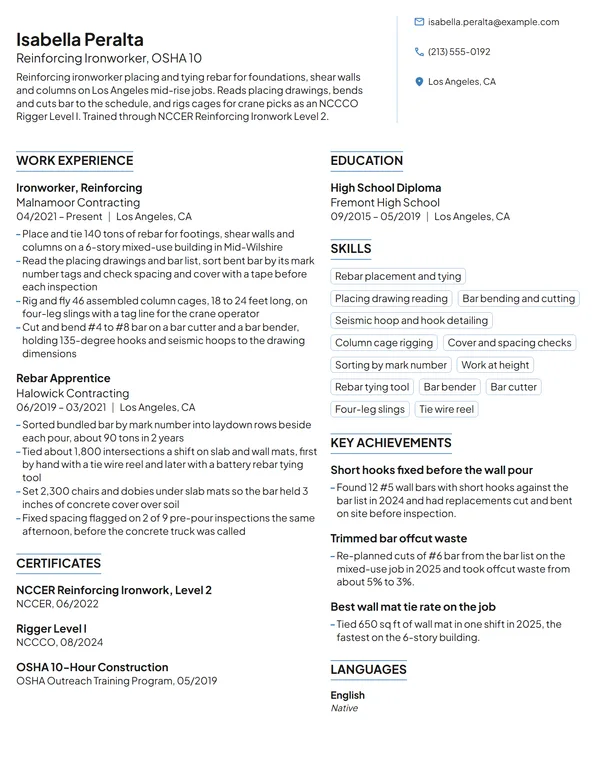
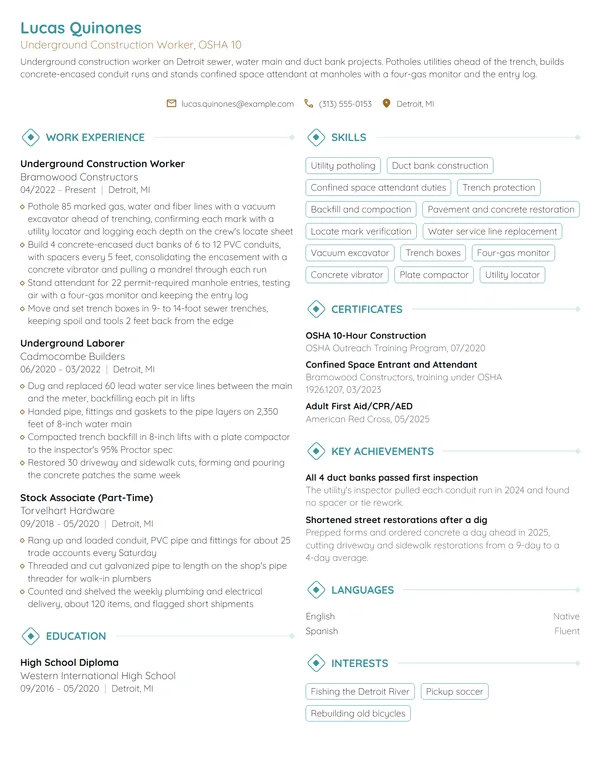
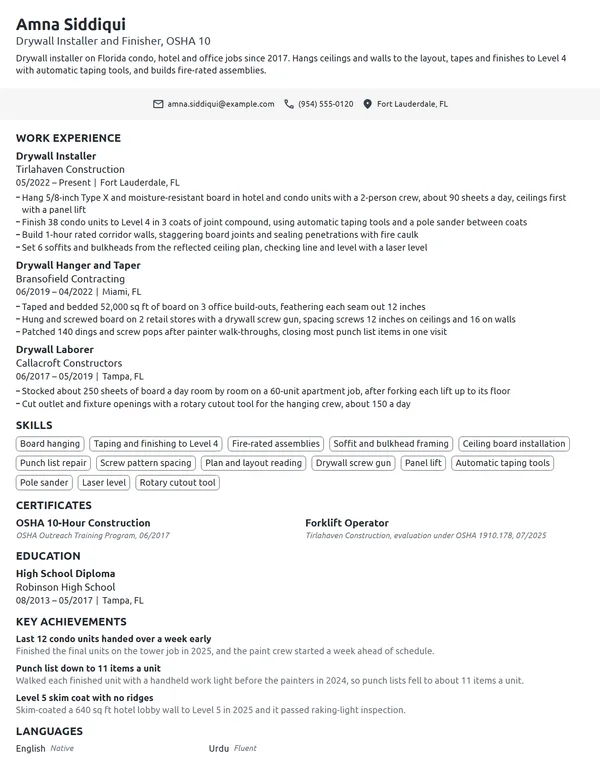
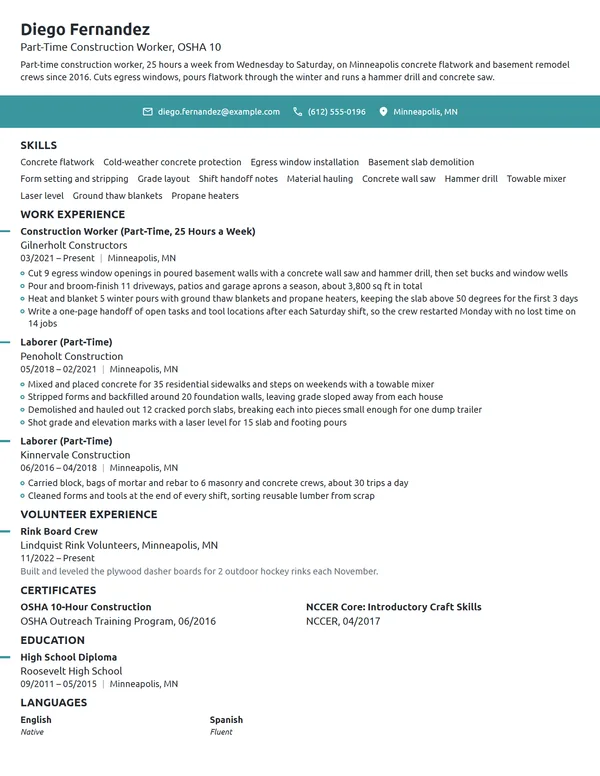
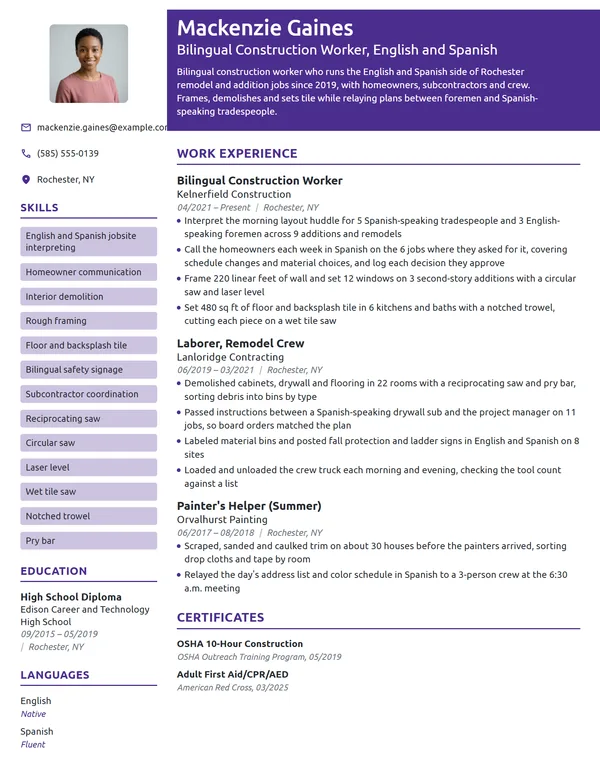
Contractors hiring for construction need three things from you: safe work, steady attendance and a sure hand with tools and heavy equipment. Most of what you do well happens on the job, far from any paperwork, so it does not describe itself. A strong resume puts it in numbers from actual projects, the machines you can run and the safety cards you carry.
How to Write a Construction Worker Resume - Key Takeaways
- Keep it to 1 page in reverse-chronological order, listing each employer with its location and month-and-year dates.
- Open with 2 to 3 lines that name your years on site, the projects you have worked on, the equipment you run and your safety card.
- Give each bullet a site number, such as linear feet of trench, cubic yards placed, crew size or days without a recordable injury.
- Name the machines and tools you can run, such as a skid steer, mini excavator or plate compactor, and prove each one in a bullet.
- List OSHA 10 and OSHA 30 under Certificates as course completion cards with the year, never as OSHA certified.
- Keep your photo, birth date and SSN off the page, and run your finished resume through an ATS resume checker before applying.
What hiring managers look for in a construction worker resume
The BLS lists preparing and cleaning sites, building and taking apart bracing and scaffolding, digging trenches and compacting earth, running power tools and assisting tradesworkers such as electricians and plumbers as typical duties for construction laborers. O*NET adds signaling equipment operators and reading plans or specifications to decide the work. Your bullets should show those tasks on real projects, with a size attached.
A superintendent or foreman reading your resume asks 3 questions: will you work safely, what can you run, and have you built this kind of project before. Give each answer its own place on the page, in sections that hiring software reads cleanly:
- Name, headline (for example, Construction Laborer, OSHA 30) and contact details
- Summary: 2 to 3 lines under your name, no heading required
- Work Experience, from your current job backward
- Skills, with the equipment and tools you can run
- Certificates, for safety cards, flagger, forklift and a CDL
- Education
- Optional: Key Achievements, Volunteer Experience or Languages
Best format for a construction worker resume
Use the reverse-chronological resume format: your latest job at the top, then each earlier one with its title, employer, location and MM/YYYY start and end dates. Contractors want to see steady work and a clear path from helper or laborer to experienced hand or lead, and this order shows both. Short seasonal or project jobs can sit in the same list, each with its own dates.
- Best for most construction workersReverse-chronologicalYour jobs, newest first, with your results under each one.Best for: A steady work history in your field
- FunctionalSkills grouped up top, with a short work history below.Best for: Gaps or very little experience
- CombinationA skills section first, then your full work history.Best for: A career change with strong skills
A 1-page resume is right for almost every construction worker. Go to 2 pages only with 10+ years across several trades or lead roles, such as on a construction superintendent track, and keep your 2 latest jobs on page 1.
| Setting | What to use |
|---|---|
| Length | 1 page; 2 only with 10+ years across several trades or lead roles |
| Dates | MM/YYYY on every job, and Present for the one you hold now |
| Job title line | The title your employer used, plus the crew if it helps: Construction Laborer, Concrete Crew |
| Certificates order | The card the job ad asks for first, then the rest by date |
| Photo, birth date and other private data | Usually left off in the US and Canada, along with marital status and an SSN |
| File type | PDF, or Word if the contractor's application portal asks for it |
Most US and Canadian resumes carry no photo.
Construction worker resume summary vs. objective
The test is simple: if you have been paid to work on a construction site, write a resume summary. Name your years, the projects, the equipment you run and your safety card. If this would be your first site job, write one of these resume objective examples instead: the job you want plus the strongest proof you can lift, learn and show up.
Construction worker resume summary formula
Title with X years on project types, running equipment. Your best production, schedule or safety result, counted, on a named project. Safety card or certification.
Example
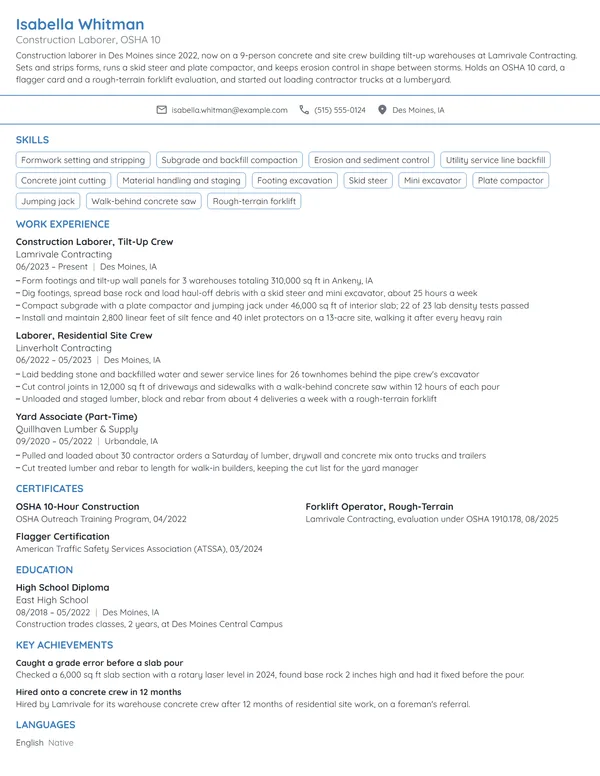
Construction laborer with 7 years on commercial building and asphalt paving crews, running skid steers, plate compactors and walk-behind concrete saws. Helped place 2,400 cubic yards of concrete for a 4-story hospital parking garage with 0 recordable injuries on a 14-person crew. Holds an OSHA 30-Hour Construction card and ATSSA flagger certification.
Don't
Hardworking construction worker with a strong work ethic, looking for steady work with a growing company.
Do
Construction laborer with 3 years on residential framing and site prep crews, comfortable with nail guns, laser levels and mini excavators. Set forms and pulled stakes on 40 homes in a subdivision build. OSHA 10 card holder.
Here the work, the tools, the scale and the safety card are all in view, and a foreman checks those first.
How to write construction worker experience bullets with numbers
Write 3 to 4 bullets for your current site job and 1 to 3 for older ones, opening each with a verb. Site work is measured all day in feet, yards, loads, pours and days, so use the counts your crew already keeps. Follow the basics of listing work experience on a resume (title, employer, city, dates), then put a number in every bullet.
| Area | What to count | Example bullet |
|---|---|---|
| Site prep and excavation | Linear feet of trench, cubic yards moved, protective systems used | Dug 600 linear feet of utility trench inside a trench box and passed every daily inspection. |
| Concrete and forms | Cubic yards placed, square feet finished, pours a week | Finished 9,000 sq ft of sidewalk and curb on a school expansion in 6 weeks. |
| Safety | Days without a recordable, citations, toolbox talks | Worked 3 years with 0 recordable injuries and 0 OSHA citations on assigned crews. |
| Equipment | Machines run, hours a year, pre-use checks | Ran a mini excavator and skid steer for about 900 hours a year and logged every pre-use check. |
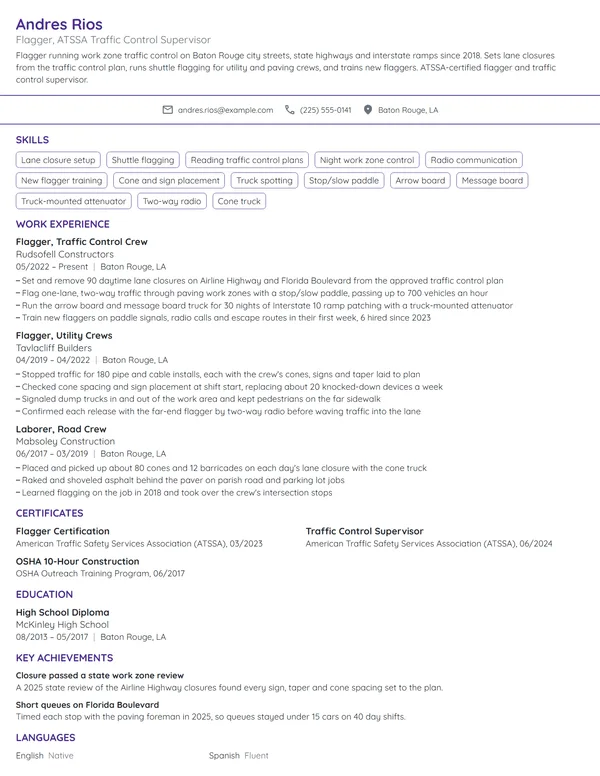
| Traffic control | Shifts flagged, lane closures, length of work zone | Set up and removed lane closures for 60 night shifts on 2 miles of interstate shoulder work. |
| Crew and schedule | People trained, days ahead or behind, phases finished | Trained 4 new laborers on scaffold setup, and the framing crew finished its phase 2 days early. |
Here is how those numbers look in a real entry. The current job carries the project and its size, and the paving job before it gets 2 shorter lines.
Work Experience
- Set and stripped wall and column forms for a 4-story, 520-space hospital parking garage, keeping the concrete crew on a 3-pours-a-week schedule.
- Ran a skid steer and plate compactor to backfill 1,100 linear feet of foundation drain, passing all 6 density tests on the first try.
- Led the morning toolbox talk 2 days a week for a 14-person crew; the site reached 410 days without a recordable injury.
- Raked and tamped asphalt behind the paver on 35 parking lot and subdivision street jobs a season.
- Cleaned and greased 2 rollers and a paver after every shift; the crew lost 0 days to breakdowns in 2021.
Don't
Helped with concrete pours.
Do
Placed and screeded concrete for 18 slab-on-grade pours on a 60,000 sq ft distribution center, with 0 sections torn out for cracking.
A foreman sees the task, the count, the building and the quality in 1 line.
Don't
Responsible for site cleanup.
Do
Sorted job-site scrap into wood, metal and cardboard bins on a 5-acre retail build, cutting dumpster pulls from 12 to 7 a month.
Construction skills, tools and equipment for your resume
Pick 6 to 8 hard skills for your resume from the posting, each one something a bullet below already shows. The BLS names physical stamina, physical strength, mechanical skills and math skills among the qualities this work needs, so let your numbers show those instead of listing them as words.
Hard skills for construction workers
- Site preparation and cleanup
- Trenching and excavation support
- Concrete placement and finishing
- Formwork setting and stripping
- Scaffold erection and dismantling
- Hand and power tools
- Reading plans and specifications
- Signaling equipment operators
- Traffic control and flagging
- Erosion and sediment control
Soft skills foremen value
- Reliability and punctuality
- Following instructions
- Teamwork on a crew
- Safety awareness
- Working in heat and cold
- Clear hand signals and radio calls
On a construction resume, the equipment you run does the job that software does on an office resume. Write each machine by its common name, such as skid steer, mini excavator, plate compactor, jumping jack, walk-behind concrete saw or rotary laser level, and add the make only if the posting lists one. O*NET's technology list for construction laborers is short, mostly Microsoft Office plus Autodesk Revit and Oracle Primavera, which matter mainly if you move toward a lead or office role.
OSHA 10, OSHA 30 and other construction cards on a resume
The BLS reports that employers often require construction laborers to complete safety training that meets OSHA guidelines, and a valid driver's license may be required too. List certifications on your resume in the Certificates section, each with the issuer and the month and year, so a foreman checking for OSHA 10 or a flagger card finds it in seconds. Some states make the training a condition of the job: Nevada, for one, mandates OSHA training for construction workers, according to a 2021 release from its Department of Business and Industry.
| Credential | Issued by | What it takes |
|---|---|---|
| OSHA 10-Hour Construction | OSHA Outreach Training Program, through an authorized trainer | A 10-hour course on common job-site hazards, meant for workers. You get a course completion card. |
| OSHA 30-Hour Construction | OSHA Outreach Training Program, through an authorized trainer | A 30-hour course that OSHA calls more appropriate for supervisors or workers with some safety responsibility. |
| Flagger certification | ATSSA, or a program your state accepts | A flagger course and test. ATSSA's industry standard is a 4-year certification, with shorter or different periods in some states. |
| Forklift operator | Your employer, under OSHA 1910.178 | Training plus a hands-on evaluation that the employer certifies, repeated at least once every 3 years. |
| NCCER Construction Craft Laborer | NCCER, through an accredited training sponsor | Level 1 runs 160 hours, including NCCER Core, and covers basics from carpentry and masonry to heavy equipment. |
How to write the OSHA card line
OSHA states that none of its Outreach courses is a certification, so write the course name with the month and year on the card, such as OSHA 10-Hour Construction, 03/2025, rather than OSHA certified. If you hold both cards, list OSHA 30, the longer course, unless an ad asks for OSHA 10 by name. A first aid and CPR card, a forklift evaluation and a CDL with its class go on the lines below it.
Certificates
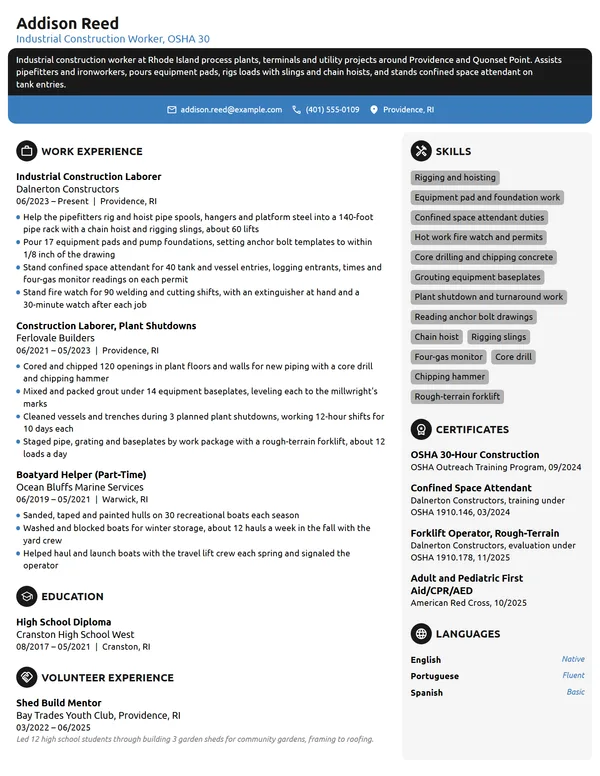
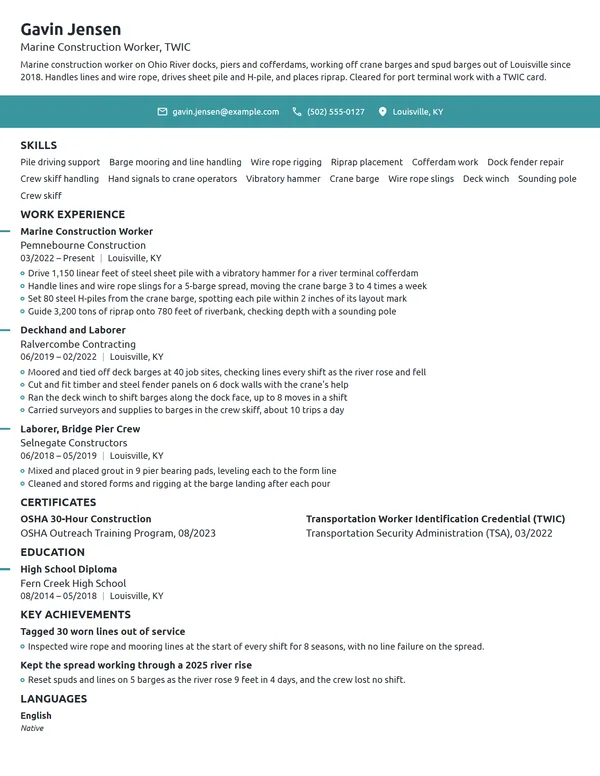
- OSHA 30-Hour Construction, OSHA Outreach Training Program, 02/2024
- Flagger Certification, American Traffic Safety Services Association (ATSSA), 05/2023
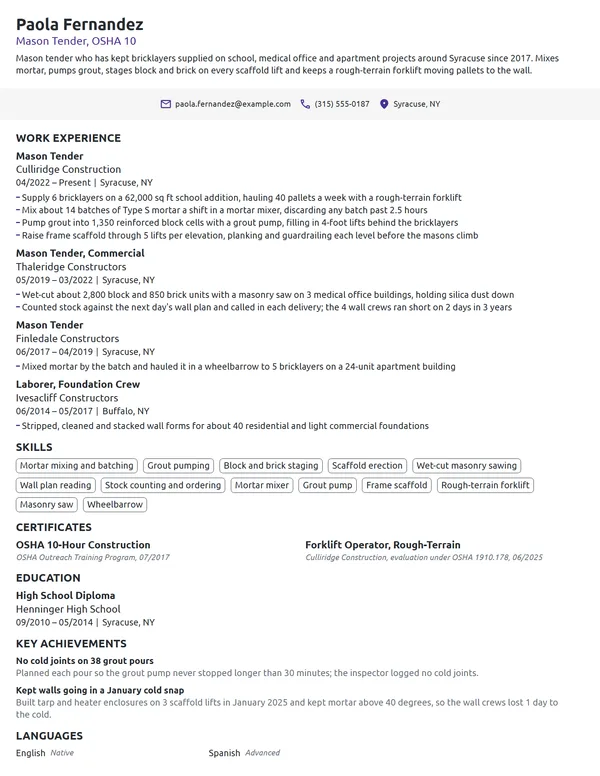
- Forklift Operator, trained and evaluated by employer under OSHA 1910.178, 09/2024
- Adult First Aid/CPR/AED, American Red Cross, 01/2026
How to list a high school diploma, NCCER training or apprenticeship
The BLS finds that formal education is not typically required for construction laborers, though employers may prefer applicants who finished high school or hold a GED, and math or career and technical education classes help. Most people learn on the job. Keep the entry short, as with listing education on a resume for any job: the diploma or GED, the school, the city and the year.
The BLS also notes that some construction laborers complete apprenticeships; LIUNA runs one for construction craft laborers. A paid apprenticeship goes under Work Experience as a job, with the program named under Education. An NCCER course such as Core: Introduction to Basic Construction Skills, taken in high school or at a training center, belongs on the Education entry too.
Education
Entry-level and career-change construction worker resumes
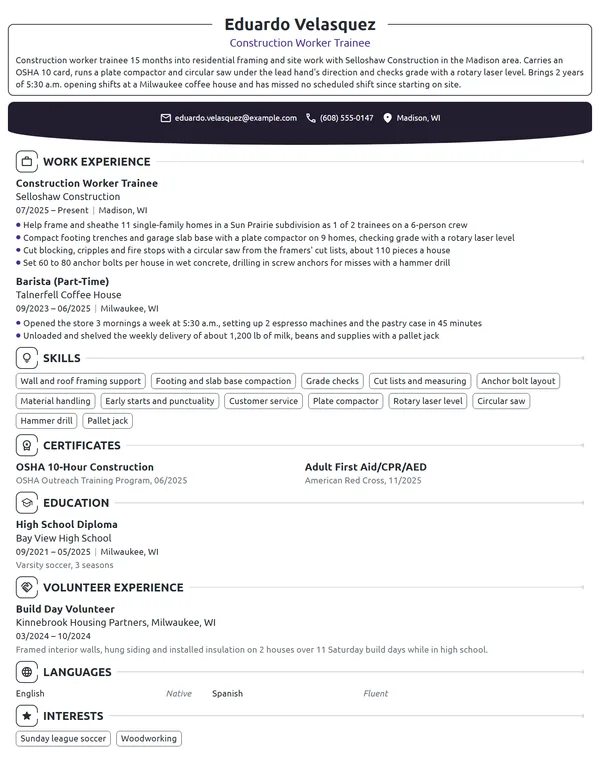
With no paid site work yet, use an entry-level resume layout: a short objective, then the jobs and activities that prove you can do hard physical work, use tools and follow a crew lead. Earn an OSHA 10 card before you apply, since employers often require OSHA safety training. Then give each item below a number:
- Physical jobs: landscaping, moving, farm or warehouse work, with the loads, hours or equipment involved.
- Volunteer home builds: such as Habitat for Humanity, with the hours and the tasks, under Volunteer Experience.
- Shop classes or NCCER training: the course and the tools you used, under Education.
- Military service: engineering, motor pool or logistics work, written in civilian terms.
Don't
Motivated individual seeking an entry-level construction job to learn new skills.
Do
Recent high school graduate with an OSHA 10 card, 2 summers of farm work running a tractor and skid steer, and 120 hours of volunteer home building, seeking a laborer job on a residential crew.
Even a first resume can show the card, the machines and the hours.
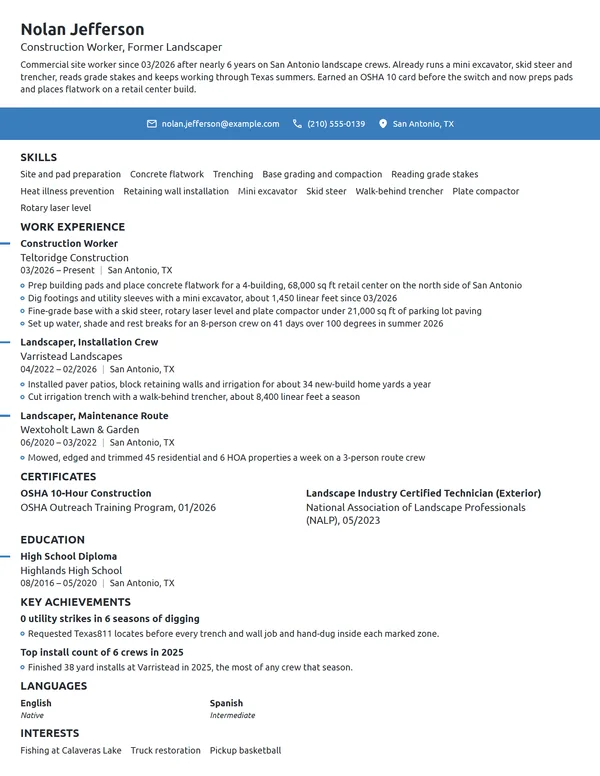
Coming from landscaping, warehouse work, manufacturing or the military, stay with reverse-chronological order, and move the most site-like tasks to the top of each job: running equipment, lifting and moving materials, following safety rules. A career-change resume opens with a summary of the site-like work you already do. If you plan to move into a trade later, such as carpenter, name that goal in 1 line. Give the reason for the switch in a cover letter; these construction cover letter examples keep it to a few lines.
Construction Worker resume FAQ
Do I need an OSHA 10 card to get a construction job?
Often, yes. The BLS says employers often require safety training that meets OSHA guidelines, and some states, such as Nevada, mandate it. Even where it is optional, a current OSHA 10-Hour Construction card on your resume removes one reason to pass you over.
Is OSHA 10 a certification?
No. OSHA says none of its Outreach Training Program courses is a certification, and the course gives you a completion card. List it under Certificates as OSHA 10-Hour Construction with the month and year, not as OSHA certified.
How long should a construction worker resume be?
Use 1 page for nearly everyone. Move to 2 pages only with 10+ years across several trades or lead roles, and keep your 2 latest jobs and your safety cards on page 1.
What should I put on a construction worker resume with no experience?
Start with a 2-line objective, your OSHA 10 card and any physical work you have done, such as landscaping, moving or farm jobs, with the loads, hours or machines involved. Add shop classes, NCCER training or volunteer home builds, each with a number.
Should I list the equipment I can operate on my resume?
Yes. Name each machine you can run safely without supervision, such as a skid steer, mini excavator or plate compactor, in Skills, and prove it in a bullet with the hours or the job you used it on.
Should I put my driver's license or CDL on a construction resume?
Yes, if the job ad mentions one. A valid driver's license may be required, per the BLS. Write a CDL under Certificates with its class and endorsements, and add a valid driver's license line only when an ad requires one.
How do I show lead or foreman experience on a construction resume?
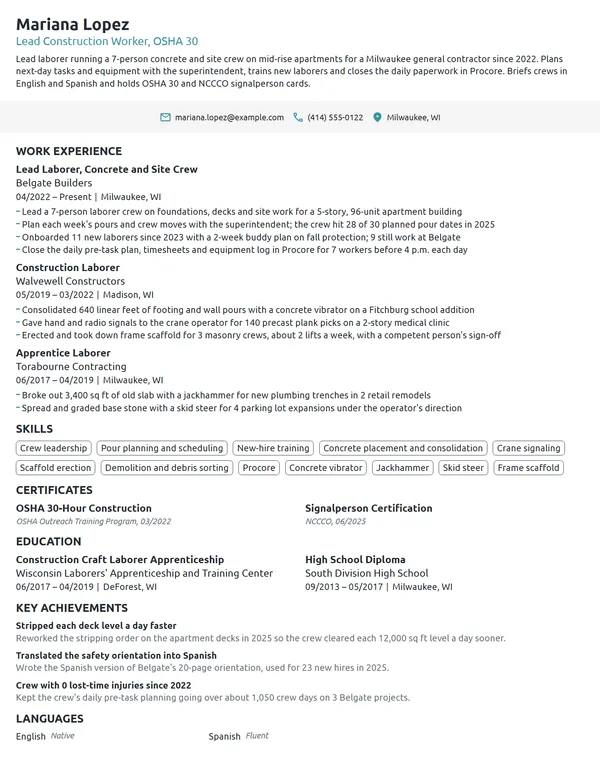
Use the title you held and back it with numbers: crew size, workers trained, tasks you assigned and the schedule or safety result. If you led informally, keep the official title and open the first bullet with the crew you ran, such as a 5-person concrete crew.
Construction worker or construction laborer: which title should I use?
Use the title your employer gave you, then mirror the job ad in your headline. O*NET lists Construction Laborer, Construction Craft Laborer and Site Work Laborer among the titles for this work, so any of them reads correctly to a contractor.
How much do construction workers make, and should I put pay on my resume?
The BLS reports that the median annual wage for construction laborers was $47,120 in May 2025, and your rate will depend on your state, your trade and whether the job is union. Keep pay off the resume itself; it belongs in the offer conversation.
Next steps
Pick the example nearest your own experience, copy its structure, and replace every project, machine, card and number with yours. Our resume builder and resume templates get it on the page quickly. Then add a short cover letter that names the project you are proudest of.