
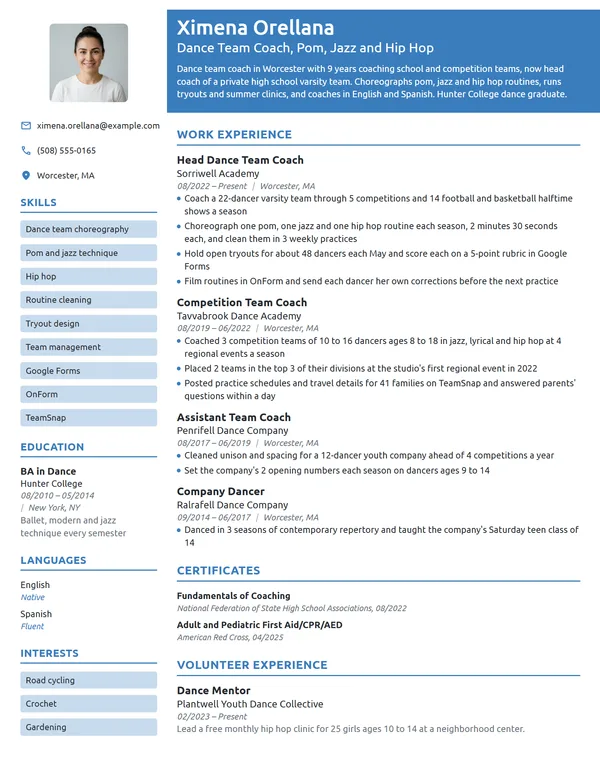
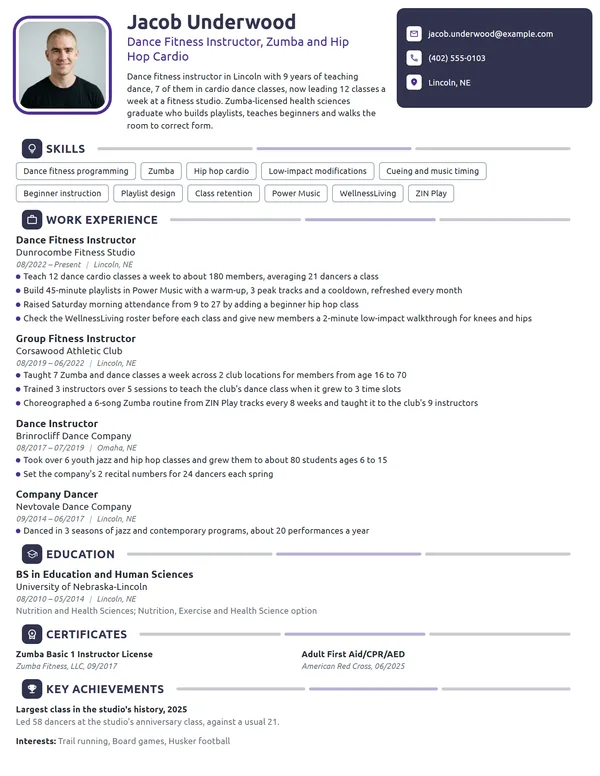
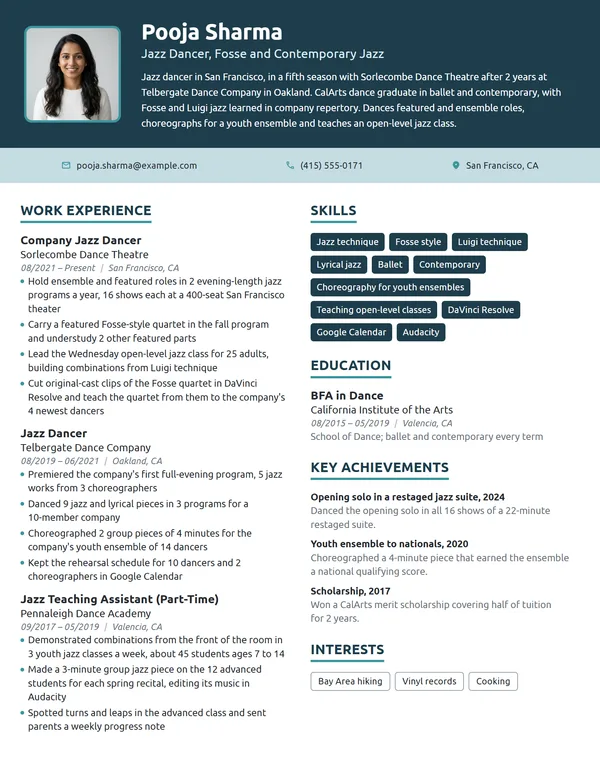
One page has to hold your company seasons, freelance projects and the classes you taught in between. Artistic directors and studio owners read it for stage experience, solid technique in more than one style and signs that you learn new work quickly. Contracts and gigs from different years can crowd each other out. Put the seasons, roles and choreographers in a clear order, and your range becomes easy to see.
How to Write a Dance Resume - Key Takeaways
- Put your newest contract first, keep it to 1 page, and add a recent headshot at the top.
- Write each company or contract as its own entry: your position, the company and its home city, with start and end dates as MM/YYYY.
- Count what you already know: shows a season, works learned, choreographers, tour cities and roles you understudied.
- Name your styles in Skills in the order the audition lists them, and prove the top ones in your bullets.
- List AGMA, Equity or SAG-AFTRA membership and teacher certifications under Certificates with the month you earned them.
- Give TV, film and commercial work its own entry instead of tucking it under a stage company.
What artistic directors look for in a dance resume
An artistic director, a rehearsal director or a studio owner reads your resume next to your photos and audition video, to see whether your experience matches what they saw in the room. The Bureau of Labor Statistics describes dancers as auditioning for shows and company jobs, rehearsing several hours each day and working closely with choreographers to interpret their routines. O*NET adds coordinating with partners or ensembles as a core task. Your bullets should show those things through named companies, named works and the number of times you performed them.
Part-time work is common, the Bureau also reports, and some dancers hold other jobs. A dance resume therefore often mixes a company contract, freelance projects and teaching. Organize it into these sections:
- Name, headline with your main style or position (for example, Company Dancer, Contemporary and Ballet), contact details and a headshot
- Profile: 2 or 3 lines right below your name (the designs print it with no heading)
- Work Experience: company contracts, freelance projects, screen work and teaching, newest first
- Skills: your dance styles first, then partnering, pointe or tumbling, then any software you use
- Certificates: union memberships and teacher certifications
- Education: your BFA or BA, conservatory or pre-professional program
- Optional: Key Achievements for competition titles and scholarships, Languages or Interests
Best format for a dance resume
Use the reverse-chronological resume format: your current contract first, then each earlier one, every entry with your position, the company, where it is based and its MM/YYYY dates. Your seasons with one company make 1 entry, with the works and roles in its bullets. Short freelance projects can share 1 entry under a heading such as Freelance Dancer, so a busy year does not push your company work off the page.
- Best for most dancersReverse-chronologicalYour jobs, newest first, with your results under each one.Best for: A steady work history in your field
- FunctionalSkills grouped up top, with a short work history below.Best for: Gaps or very little experience
- CombinationA skills section first, then your full work history.Best for: A career change with strong skills
Keep it to 1 page. When it fills up, cut the oldest student shows and one-off gigs before you shrink the type. A teaching application to a school or university can run to 2 pages if it adds classes taught and pieces you set on students. Pick one of the creative resume templates with a photo slot in the header, since a dance resume needs one.
| Setting | What to use |
|---|---|
| Length | 1 page for performing jobs; 2 for a teaching post that lists classes and student works |
| Position line | Your title in that company: Apprentice, Corps de Ballet, Company Dancer, Soloist, Swing |
| Dates | MM/YYYY per contract or season, with Present for the one you are in |
| Photo | A current headshot in the header; a full-length dance photo goes in as a separate file |
| Personal details | No birth date, weight, marital status or Social Security number; height only if the notice asks |
| File type | A PDF named with your full name, sent with your reel link if the notice asks for video |
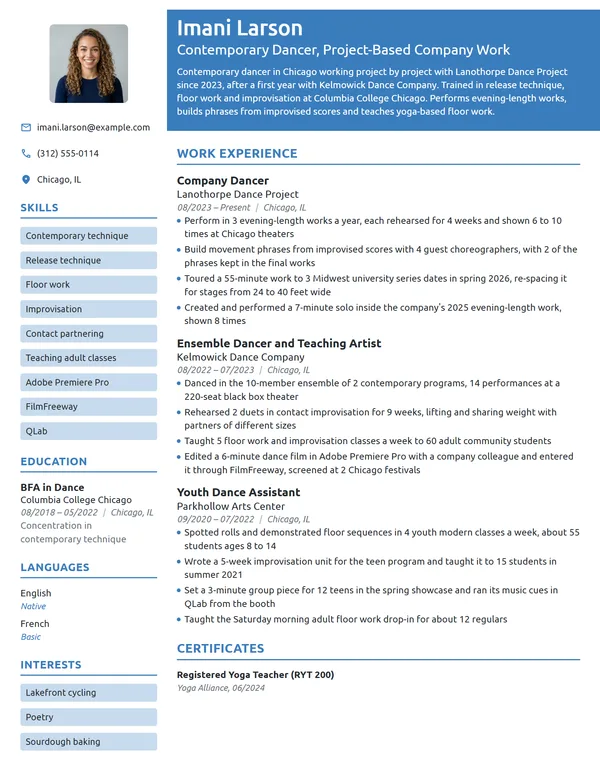
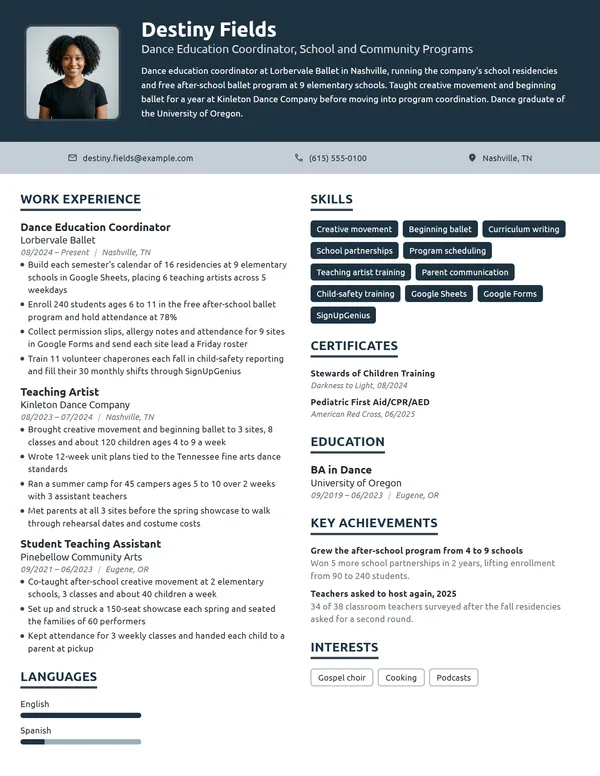
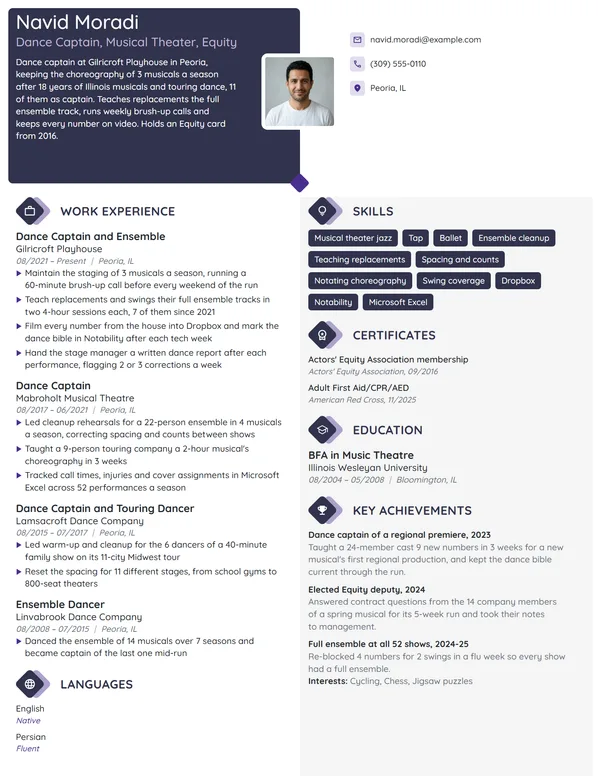
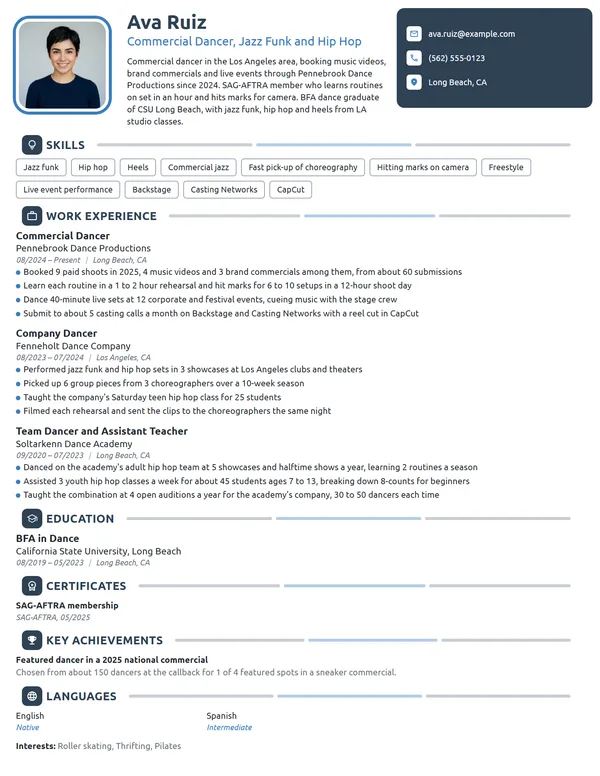
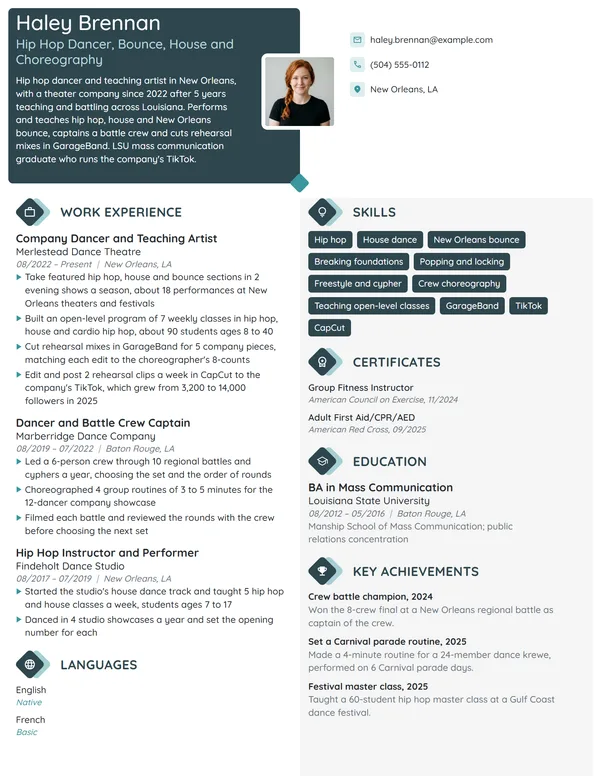
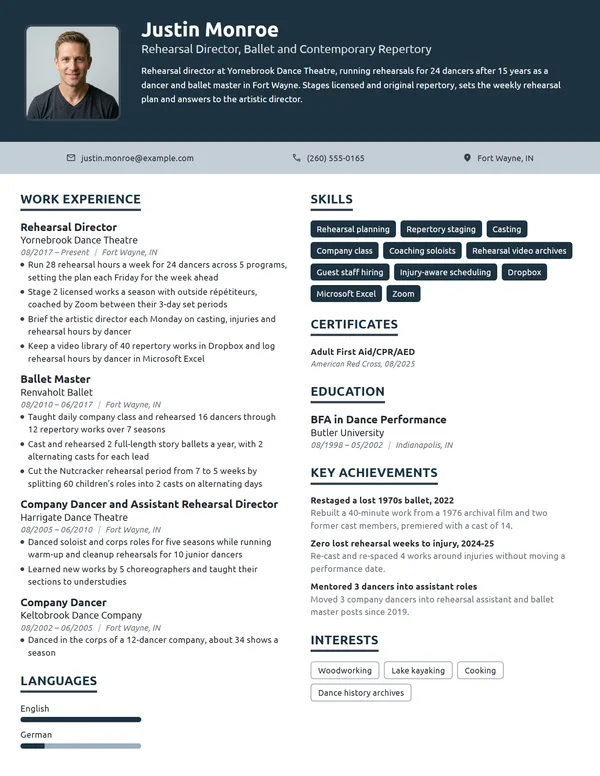
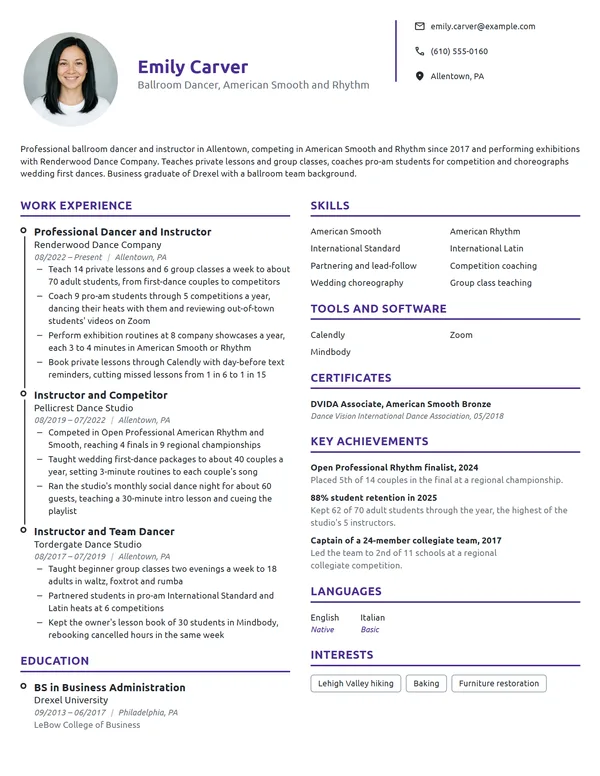
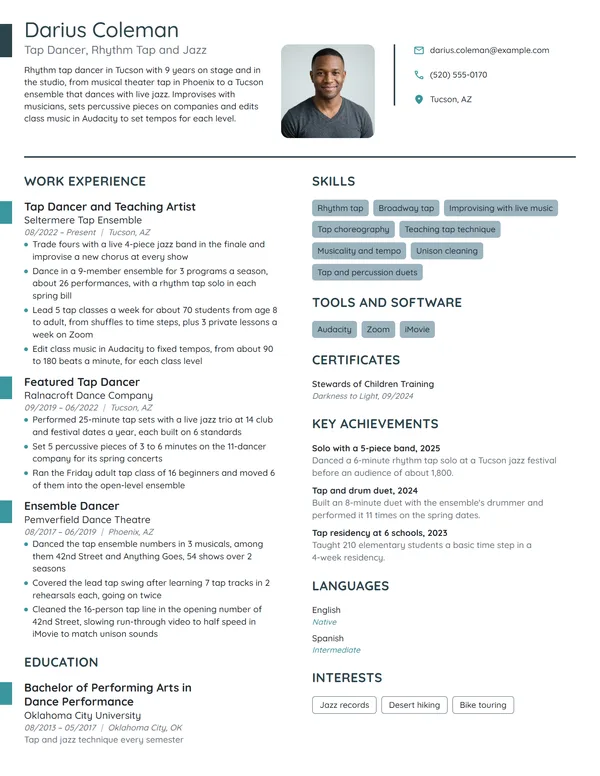
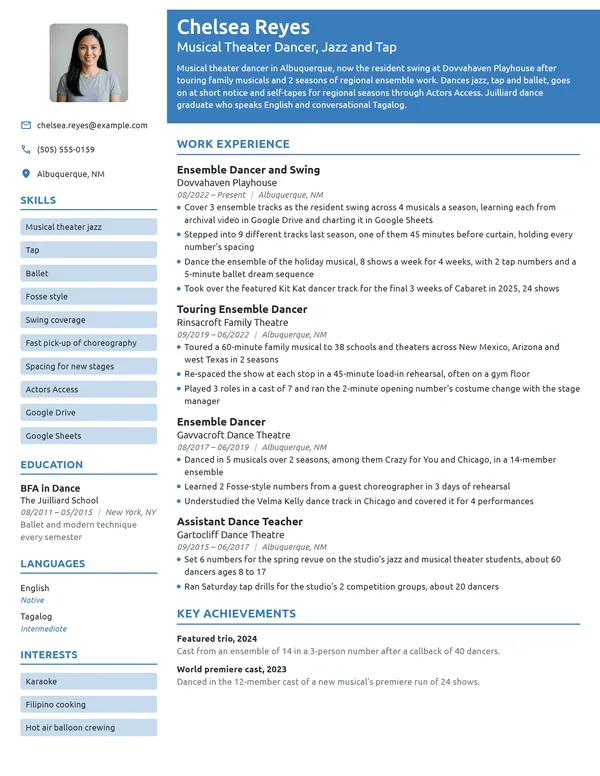
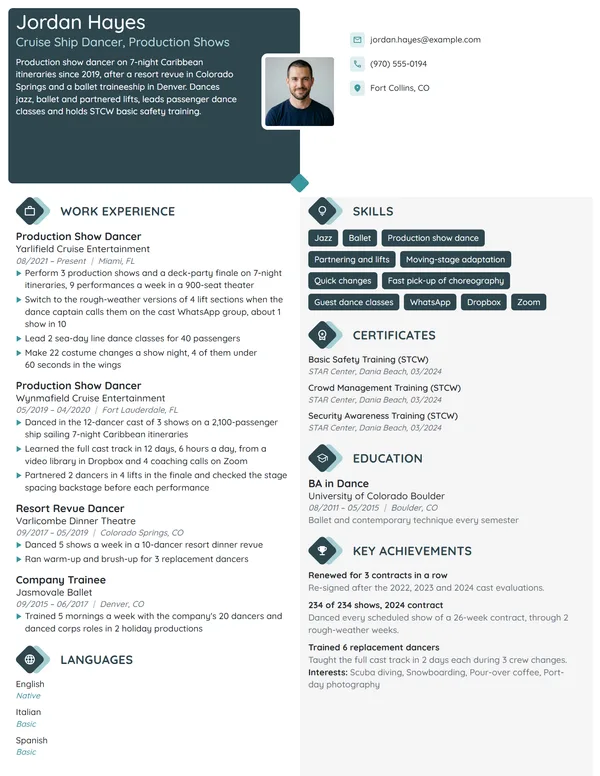
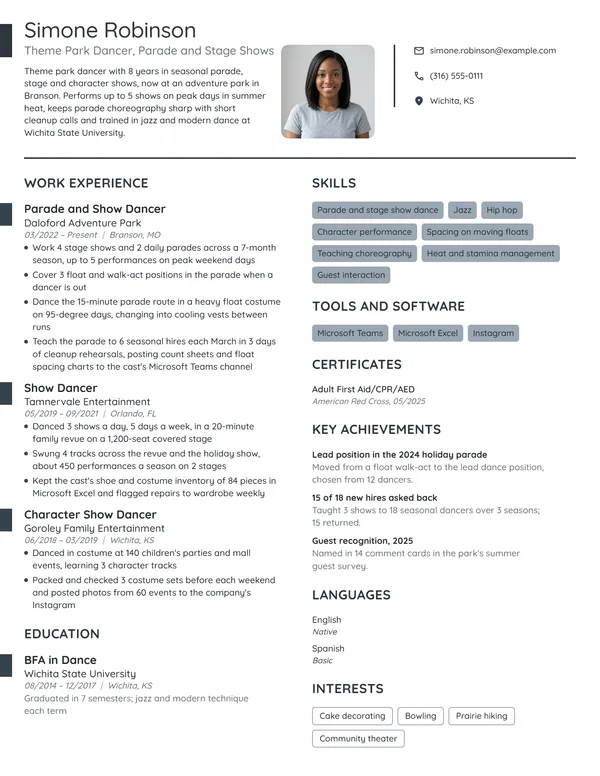
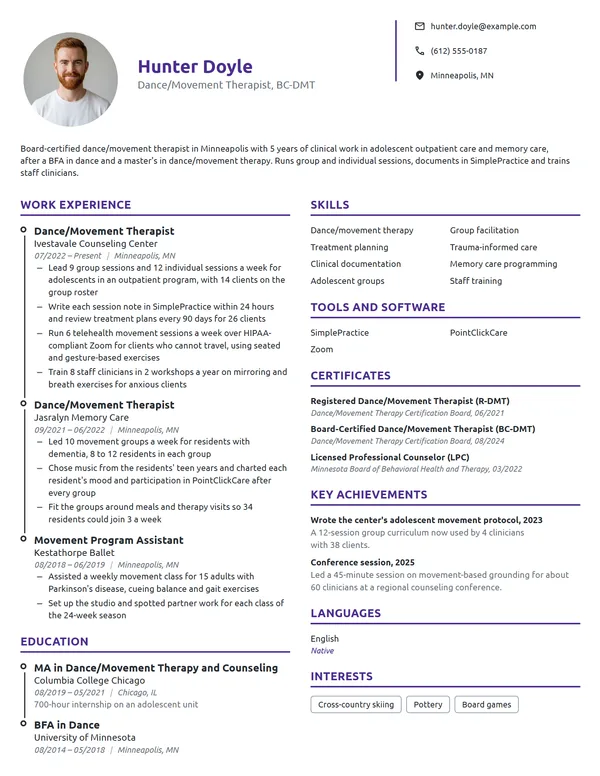
Most US and Canadian resumes carry no photo. Dance is an exception, because a company or agent hires a body and a way of moving as well as a work history, so every dance example on this page shows a headshot. Choose a recent shot that looks like you at the audition, with your hair as you usually wear it, and send any action photos the notice requests separately.
Dance resume summary vs. objective
If you have danced under a paid contract or with a company, write a resume summary that names your styles, your years, the kind of company and 1 credit. If you are still training or between school and your first contract, write a resume objective instead, naming the position you are auditioning for and your strongest performance experience.
Dance resume summary formula
Style dancer with X years in type of company or setting, trained in techniques. Your strongest credit, with a number. Union status or the next step you are working toward.
Example
Contemporary dancer with 8 years in ballet and repertory companies, trained in Limón, Horton and classical ballet. Danced a principal role in a 3-week run of a new evening-length work in 2025. AGMA member since 2019.
Don't
Passionate and dedicated dancer with a love for movement and a strong work ethic.
Do
Jazz and commercial dancer with a ballet base and 4 years of cruise and theme-park contracts, performing 6 shows a week. Teaches hip-hop between contracts.
The second version names the styles, the setting and how much the dancer performs.
How to write dance work experience with numbers
Your current contract gets 3 to 4 bullets; earlier ones get 1 to 3. Lead with the scale of the job: how many shows, which programs, how big the house or how far the tour went. Then add what shows your range and your reliability, such as works learned, choreographers, roles you covered and times you went on. These are the achievements on your resume that a director can check against a program or a season brochure.
| Area | What to count | Example bullet |
|---|---|---|
| Performances | Shows a season, house size, length of a run | Performed 36 shows in a 2-week holiday run at a 2,000-seat theater. |
| Repertory | Works learned, rehearsal time, styles | Learned 4 new works in a 6-week rehearsal period for a spring mixed bill. |
| Touring | Cities, weeks on the road, festivals | Toured 9 cities in 6 weeks with a 70-minute program, including 2 festival dates. |
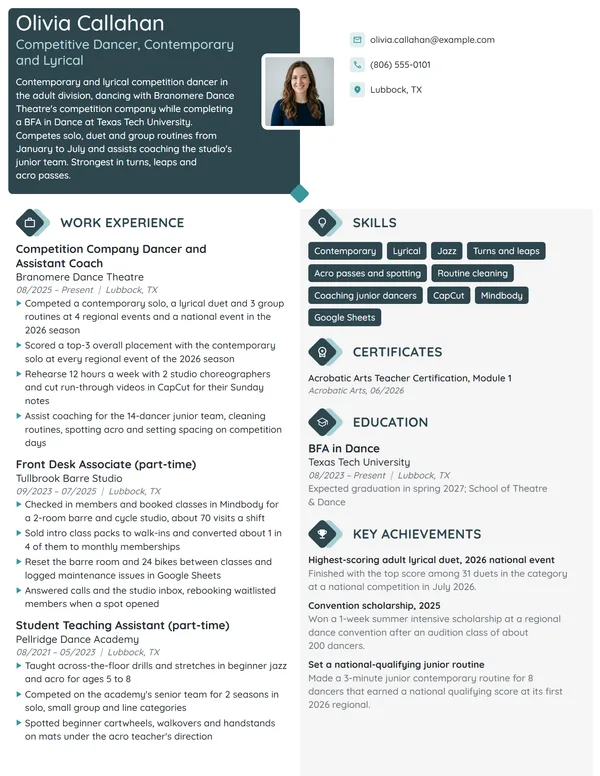
| Competitions | Categories entered, placements, season | Placed 1st in 3 of 5 regional senior solo categories in the 2025 season. |
| Teaching | Classes a week, students, ages, styles | Taught 6 classes a week to 85 students ages 6 to 14 in ballet and jazz. |
| Choreography | Pieces made, length, cast size | Choreographed 3 pieces of 8 to 12 minutes for a 16-dancer student company. |
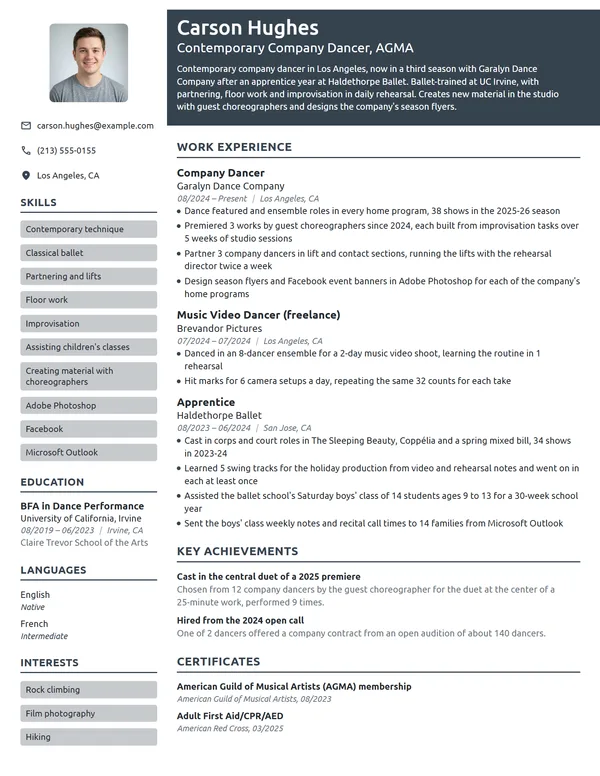
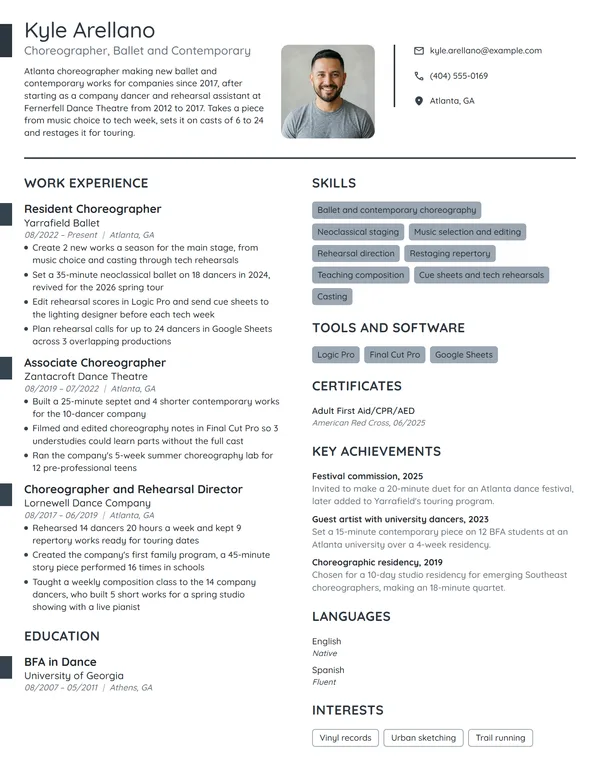
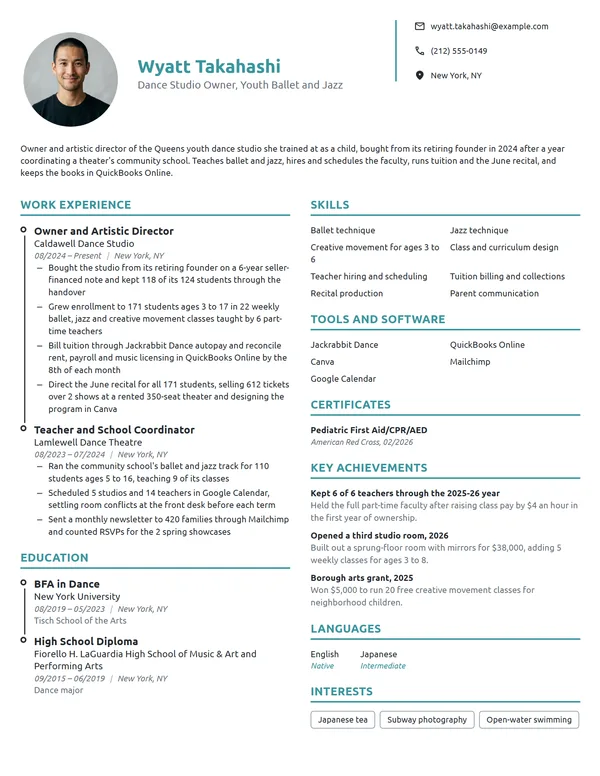
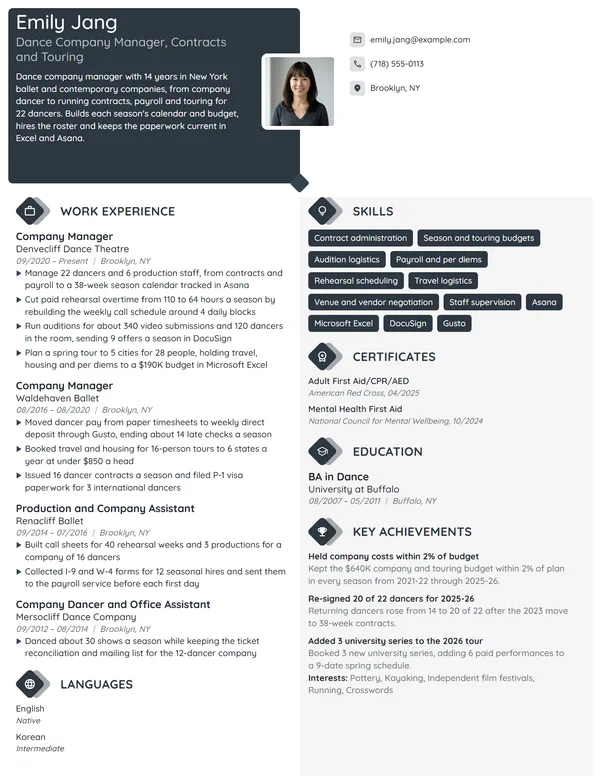
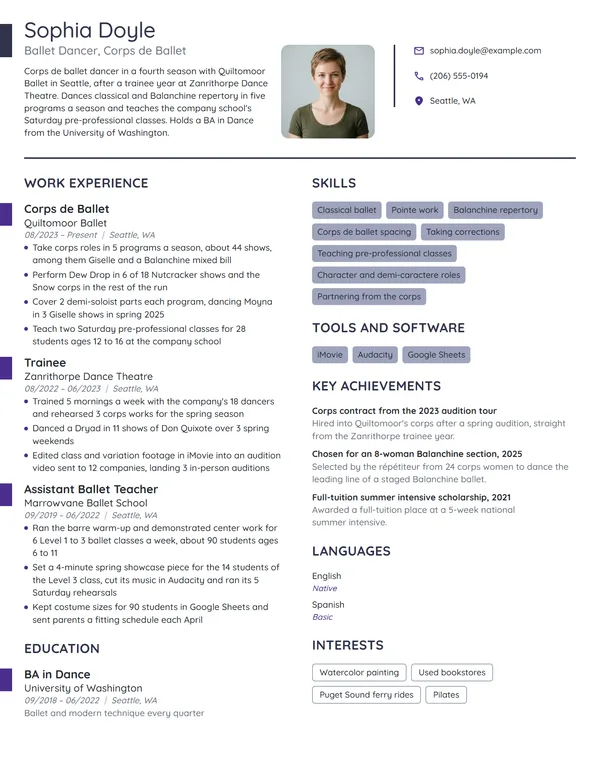
Here is how a company dancer's history reads with those numbers in place. The current job carries the full season and the older contract keeps its 2 strongest lines.
Work Experience
- Perform 48 shows a season across 4 programs in a 600-seat house and on a 5-city regional tour.
- Learned and performed 11 repertory works by 7 choreographers in 5 seasons, including 2 world premieres.
- Cover 3 soloist roles as understudy; went on 6 times, twice on 1 day's notice.
- Teach 2 outreach classes a week for about 40 middle school students in partner schools.
- Danced corps roles in 3 full-length ballets a season, about 30 performances a year.
- Promoted from apprentice to corps after 1 season and danced all 22 shows of the company's Nutcracker run.
Don't
Performed in company productions.
Do
Danced 4 roles across 2 programs in the fall season, including a featured duet in a new work by the artistic director.
The rewrite gives the count, the season and the role that shows trust.
Don't
Taught dance classes to children.
Do
Taught 4 weekly tap and jazz classes for 52 students ages 7 to 12, and staged their numbers for the spring recital.
Dance styles, skills and software for your resume
Pick 6 to 8 hard skills for your resume, starting with the styles the audition names. Write techniques the way dancers say them, such as Horton, Limón or Cecchetti, and add partnering, pointe, tumbling or floor work only when you can show them in a credit.
Hard skills for dancers
- Classical ballet
- Pointe work
- Contemporary and modern technique
- Jazz
- Tap
- Hip-hop and commercial
- Partnering and lifts
- Improvisation
- Floor work and inversions
- Teaching technique classes
Soft skills directors value
- Musicality
- Fast pick-up of choreography
- Taking corrections
- Stamina through long rehearsals
- Ensemble awareness
- Professional conduct on tour
Software matters less than technique. O*NET flags Adobe Photoshop, Microsoft Office, Microsoft Outlook and Facebook as hot technologies for dancers, and lists Apple Final Cut Pro, YouTube and choreography software among the tools of the job. Name a program only where a bullet shows it at work, such as editing a studio's recital video or running a company's social posts.
Union membership and teaching certifications on a dance resume
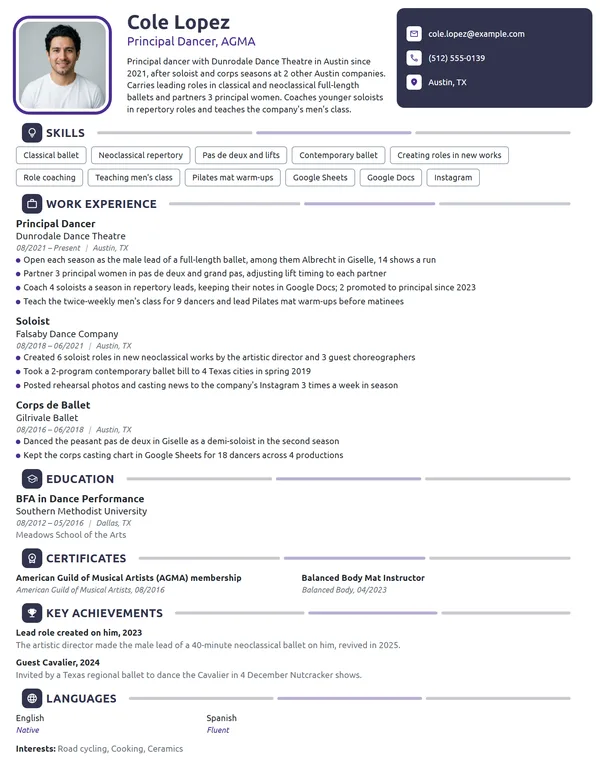
On a dance resume, the Certificates section holds your union memberships and any teacher certifications. List the union that covers your contracts: AGMA for ballet, opera and concert dance, Actors' Equity for stage shows such as musicals, or SAG-AFTRA for on-camera work. List certifications on your resume with the issuer and the month you earned each one.
| Credential | Issued by | What it covers or takes |
|---|---|---|
| AGMA membership | American Guild of Musical Artists | The labor union of singers, dancers and staging staff in opera, ballet and concert dance in the US. |
| Equity membership | Actors' Equity Association | The stage union of more than 51,000 members, including actors, singers, dancers and stage managers. |
| SAG-AFTRA membership | SAG-AFTRA | The union for on-camera and media work, formed in 2012 by the merger of the Screen Actors Guild and AFTRA. |
| ABT Certified Teacher, Pre-Primary to Level 3 | American Ballet Theatre | A 9-day intensive in the ABT National Training Curriculum and a written and oral exam; candidates must be 17 or older with at least 5 years of professional classical ballet training. |
| ABT Certified Teacher, Levels 4 to 5 | American Ballet Theatre | A 6-day intensive and its exam, open only to teachers already certified in Pre-Primary to Level 3. |
How to list union status and screen work
Put your union initials in the headline (Company Dancer, AGMA) and list each membership under Certificates with the month you joined. A TV spot, music video or film day belongs in its own Work Experience entry under the production company, or in your profile, never as a bullet under a stage company that did not hire you for it. ABT levels are earned in order, so list each level you passed as its own line.
Certificates
- American Guild of Musical Artists (AGMA), member since 09/2019
- ABT Certified Teacher, Pre-Primary to Level 3, American Ballet Theatre, 07/2023
- ABT Certified Teacher, Levels 4 to 5, American Ballet Theatre, 07/2025
How to list a BFA, conservatory or studio training
BLS data shows that many dancers start training young and that it usually takes years of practice to build a career, while some employers require or prefer a bachelor's degree in dance or another performing arts field. Teaching dance in a school or college may also require a degree. So list your BFA, BA or conservatory program first under Education, and add pre-professional programs or summer intensives in 1 line below it.
Follow the usual rules for listing education on a resume: the degree title, the school and its city, and the month you graduated. Write the degree as it reads on your diploma, even if the school has renamed it since: the University of Utah's BFA in Modern Dance became the BFA in Contemporary Dance in fall 2026, so a 2018 graduate keeps the old title. Childhood studio training drops off once you have a degree or 2 professional seasons.
Education
Senior concert: choreographed and performed a 12-minute trio.
Apprentice, student and career-change dance resumes
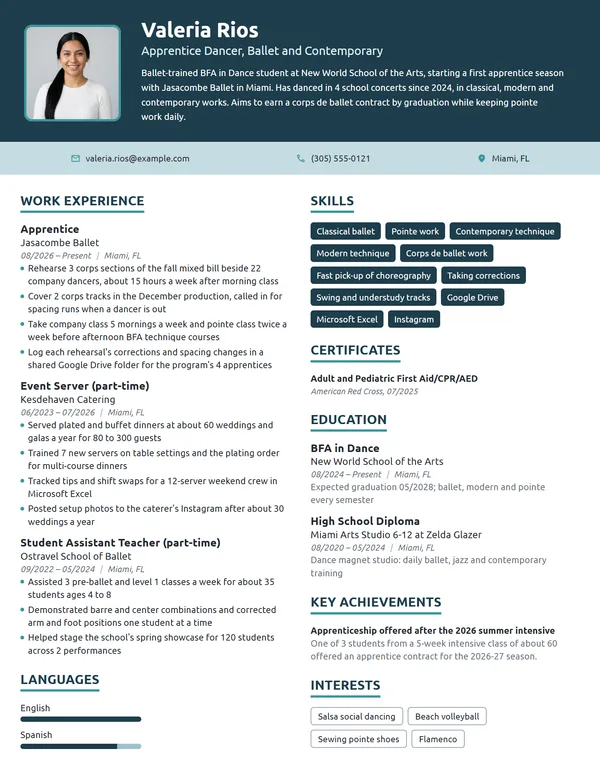
Before your first contract, your training and student performances carry the resume. Write an objective that names the position you want, such as apprentice, trainee or second company, and list school and festival performances as Work Experience entries with the work, the choreographer and the number of shows. The entry-level resume layout works for dancers coming straight out of a BFA or a pre-professional program.
- Student and faculty concerts: each work with its choreographer and the number of performances.
- Summer intensives and trainee programs: 1 line under Education with the program and the year.
- Competition placements and scholarships: under Key Achievements, with the category and the season.
- Teaching assistant or studio jobs: a full Work Experience entry with classes a week and students' ages.
Don't
Hardworking dance student looking for a chance to develop as a performer.
Do
BFA dance senior graduating 05/2027, seeking a trainee or second-company contract. Performed in 5 faculty and guest works and completed 2 summer intensives.
Even before a first contract, an objective can give a date, a target position and a count.
Dancers also work as dance teachers, fitness instructors or in other arts and recreation jobs, the BLS points out, and those are the usual career changes. If you move into teaching, keep the order and bring teaching bullets to the top of each entry; the dance teacher resume shows that layout, and the career-change resume shows how to lead with transferable work. Use your cover letter to say why you are moving, and follow the steps for writing a cover letter to keep that reason to 1 short paragraph.
Dance resume FAQ
Should a dance resume have a photo?
Yes. Most US and Canadian resumes carry no photo, but dance companies and agents usually expect a headshot, because they cast how you look and move. Put a recent headshot in the header and send full-length or action photos as separate files when the notice asks for them.
How long should a dance resume be?
1 page for company, commercial and theater auditions. A teaching application to a school or college can run to 2 pages if the second page lists classes taught and works you set on students, with your performing career kept on page 1.
Should I put my height on a dance resume?
Only when the audition notice asks for it, and then in the contact line. Leave off weight and measurements, which an employer does not need from a resume, and let your photos and the audition itself show the rest.
How do I list freelance and project-based dance work?
Group short gigs into 1 entry titled Freelance Dancer with the full date range, then give each project its own bullet with the choreographer or company, the venue and the number of shows. A longer project with one company, such as a full season, gets its own entry.
Should I list every dance competition I have entered?
No. List only placements and titles, under Key Achievements, with the category and the season, and keep the 3 to 4 strongest. For a company audition, a strong placement in a senior or elite category carries more weight than a long list of junior results.
Do I include childhood studio training on a professional dance resume?
Only until you have a degree or 2 professional seasons. Before that, a pre-professional program or a studio with a known training track shows where your technique came from; after that, your BFA and your contracts do that job.
How do I list AGMA, Equity or SAG-AFTRA membership?
Add the initials to your headline, such as Company Dancer, AGMA, and list each union under Certificates with the month you joined. A director or casting office then sees at a glance which contracts you can work under.
Does a dance teaching job need a different resume?
Yes, a reordered one. Keep reverse-chronological order, but put teaching bullets first under each job, add classes a week, students' ages and the styles you teach, and list teacher certifications such as ABT's above your union memberships.
How much do dancers earn?
BLS figures put the median hourly wage for dancers at $24.80 in May 2025. Part-time work is common, so yearly earnings depend on how many weeks you are under contract. Leave pay off your resume and discuss it when a company makes an offer.
Next steps
Pick the example closest to your style and stage of career, keep its structure, and fill it with your own companies, works, choreographers and show counts. Build it in our builder, or choose one of our templates with room for a photo, and send it with a short cover letter that names the position you are auditioning for.