
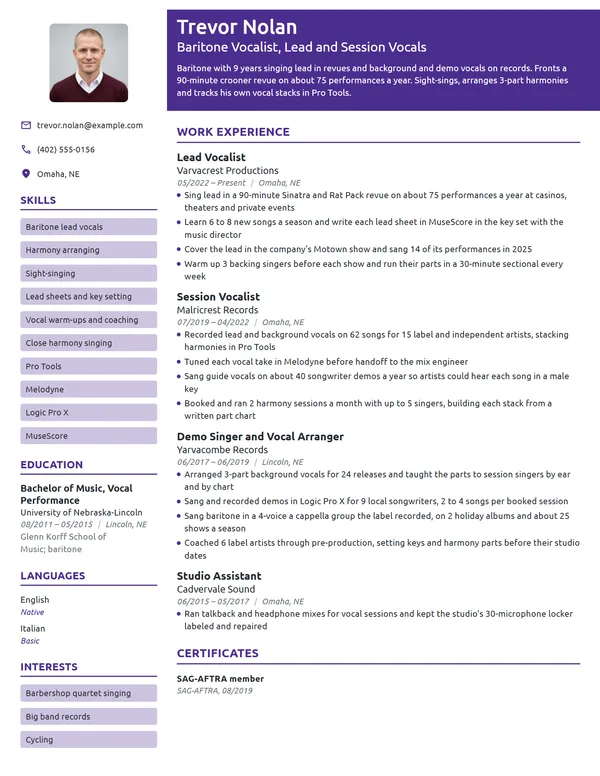
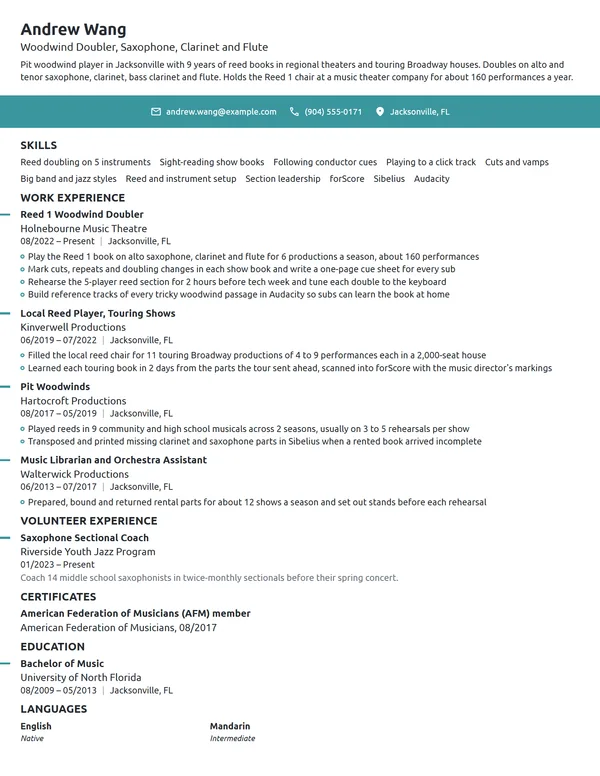
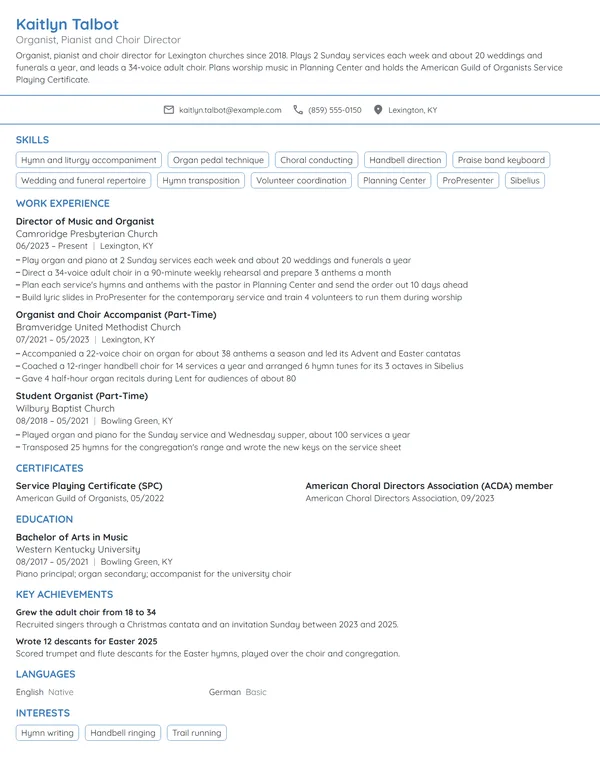
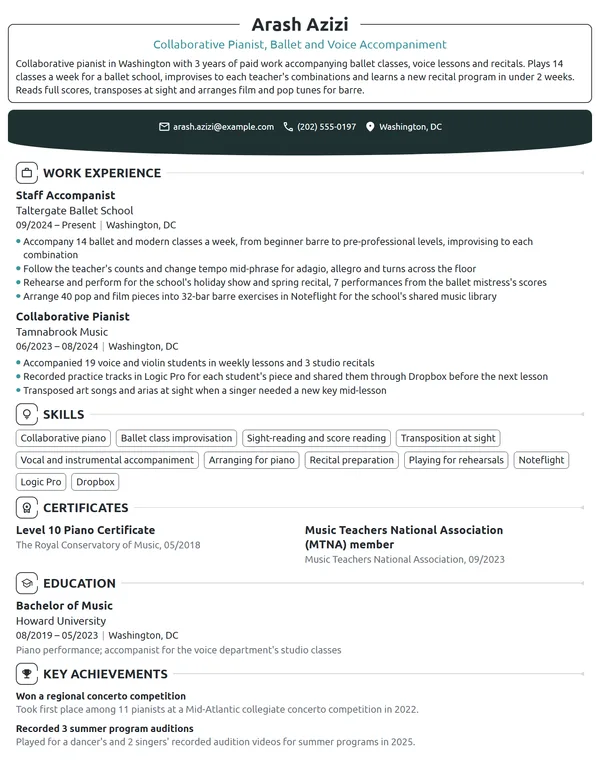
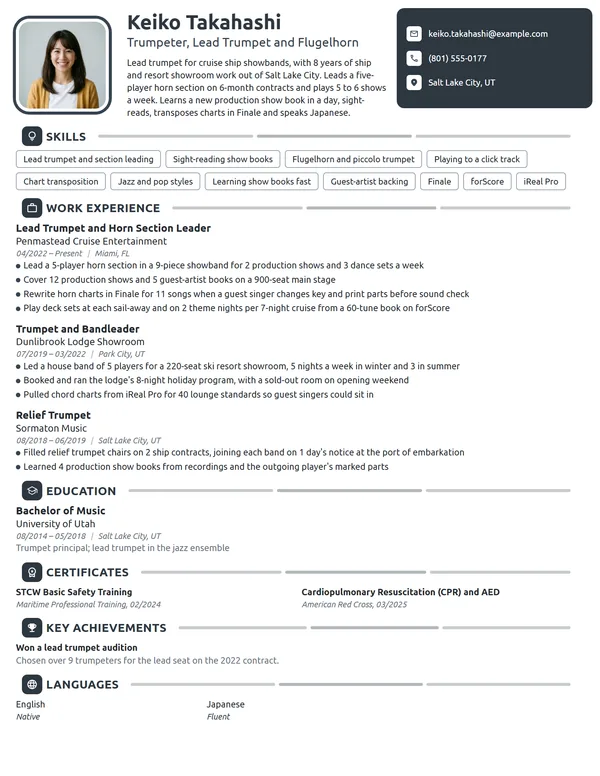
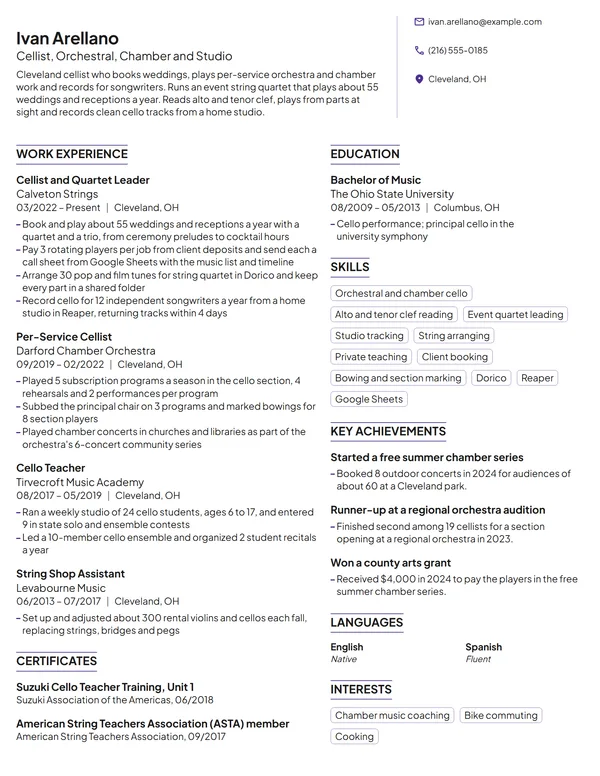
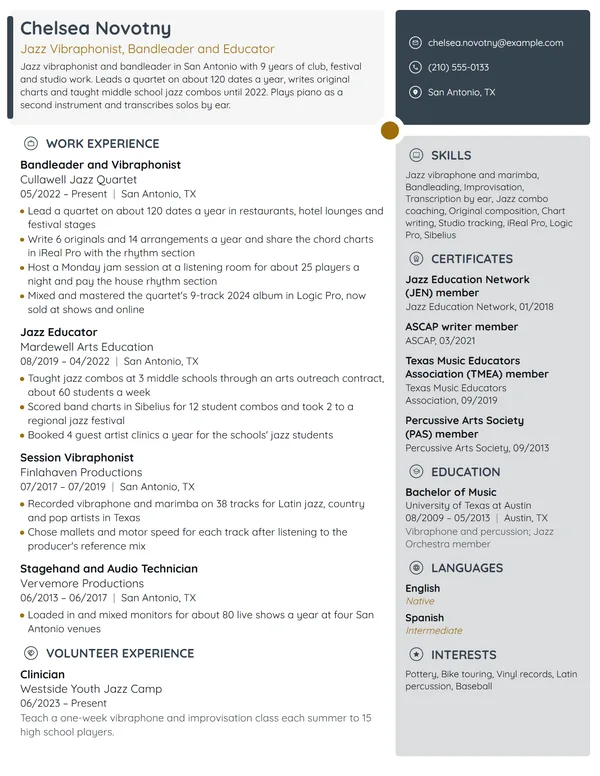
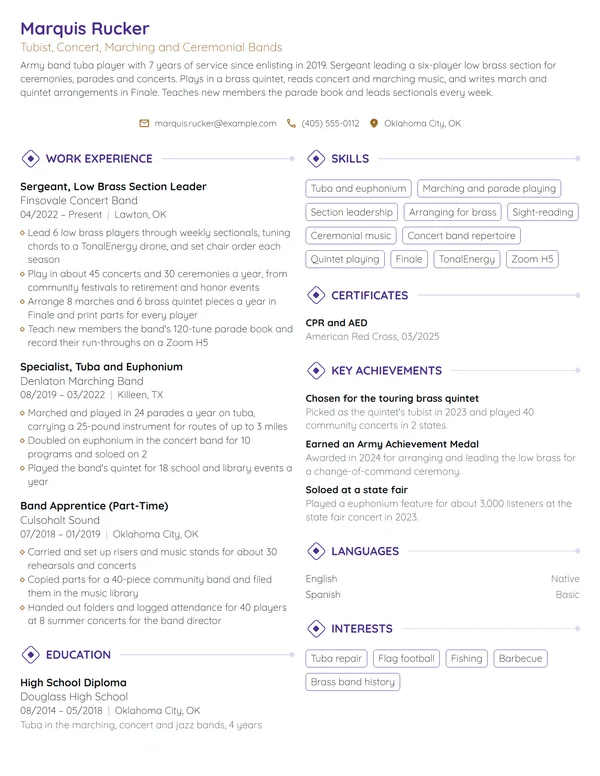
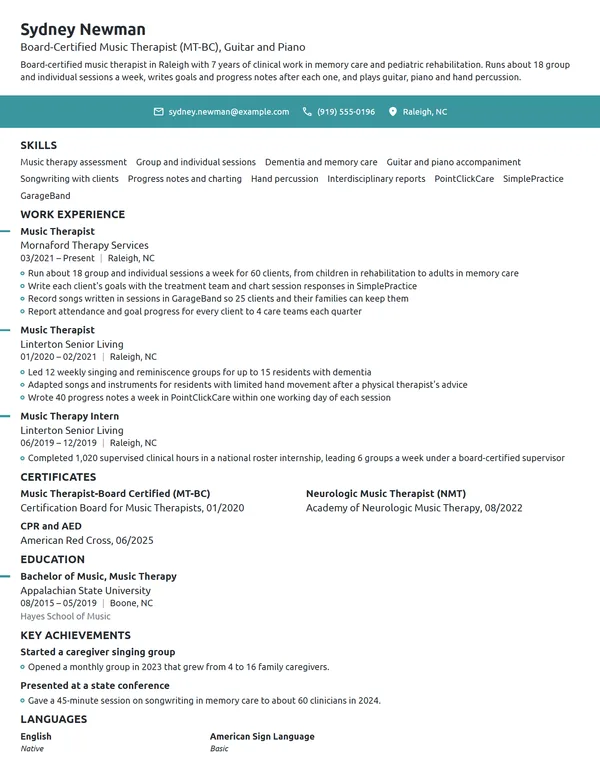
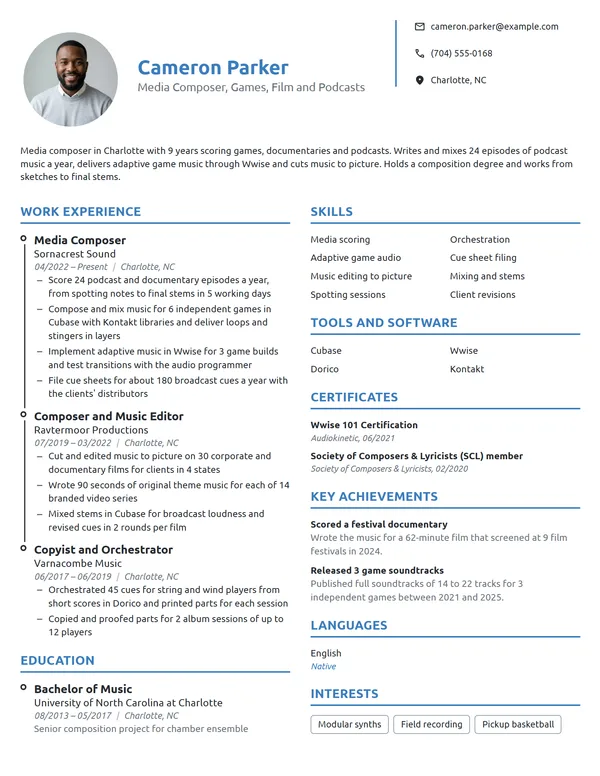
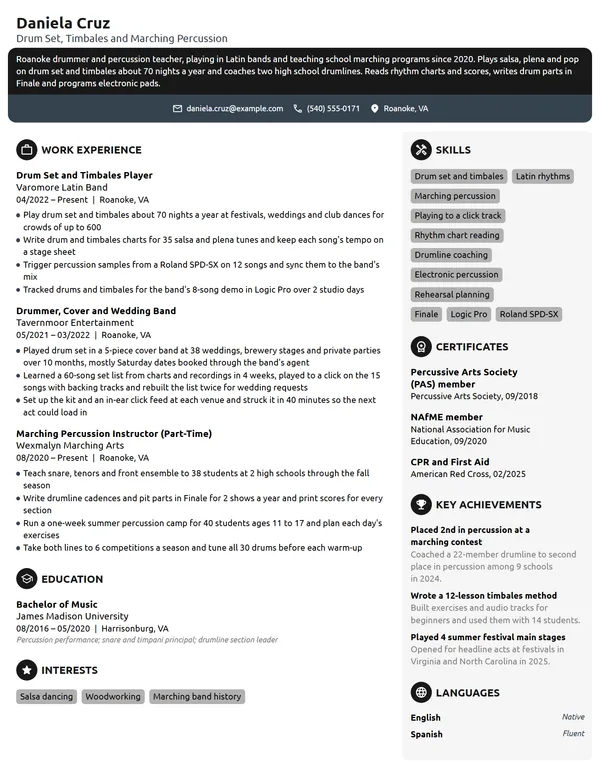
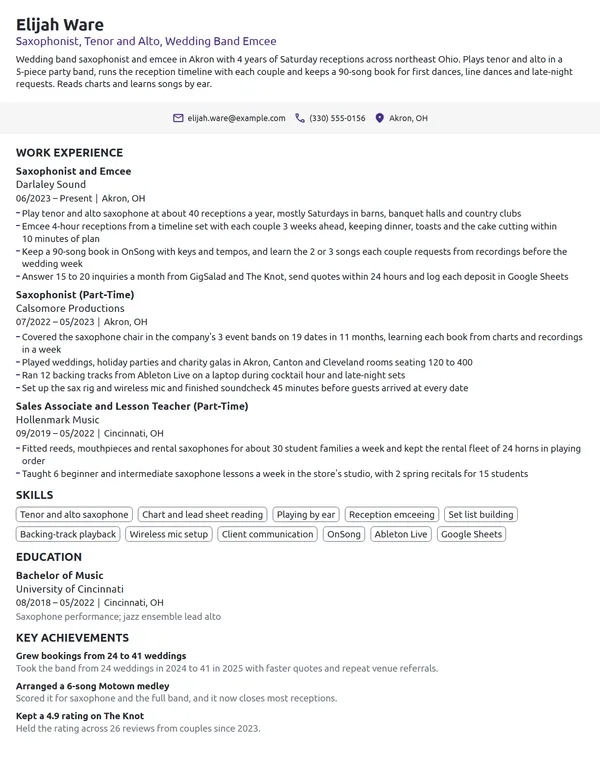
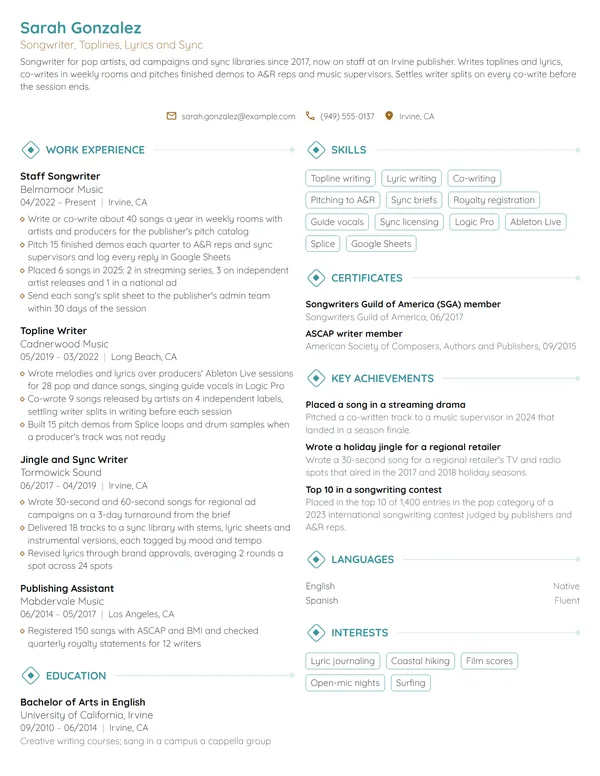
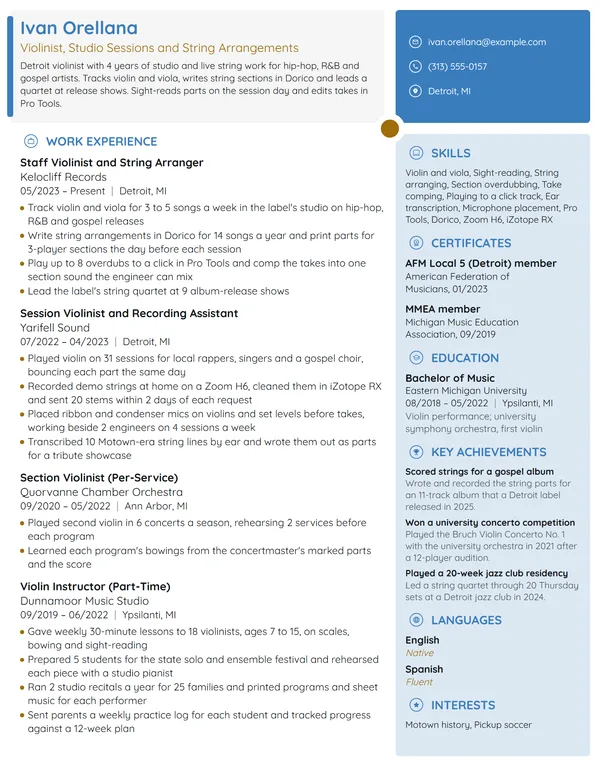
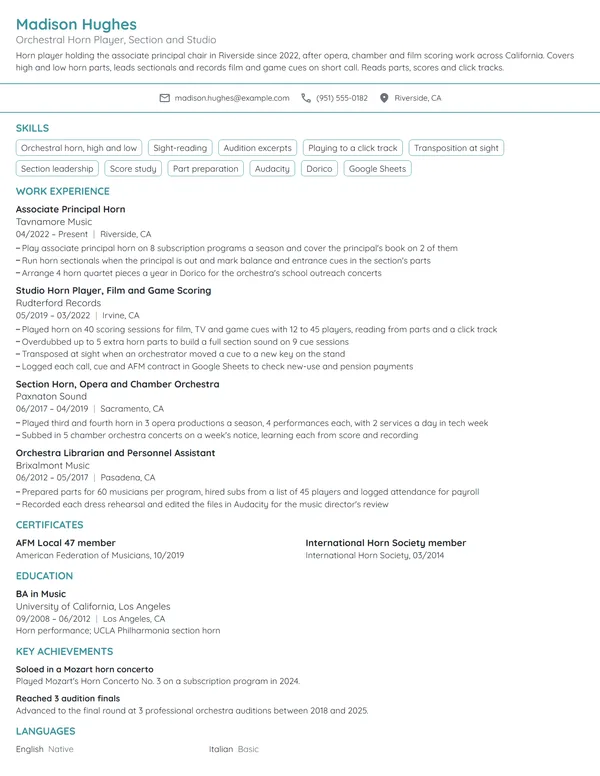
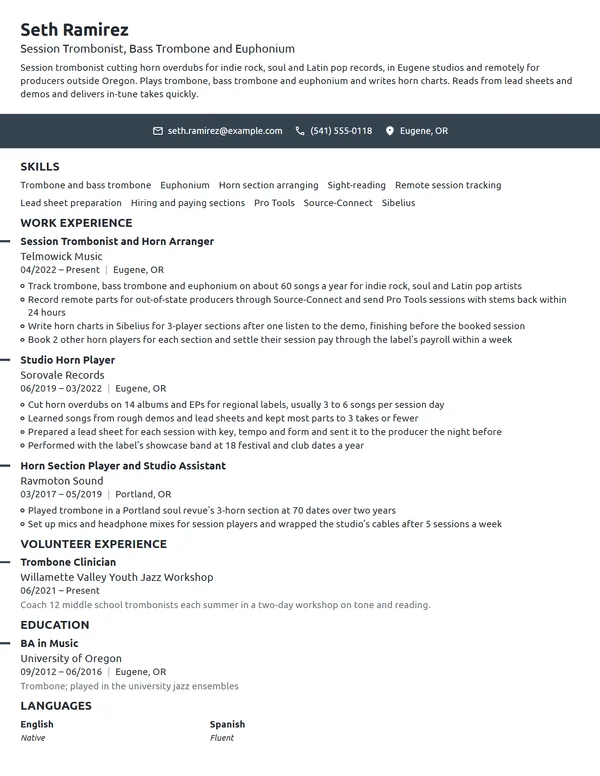
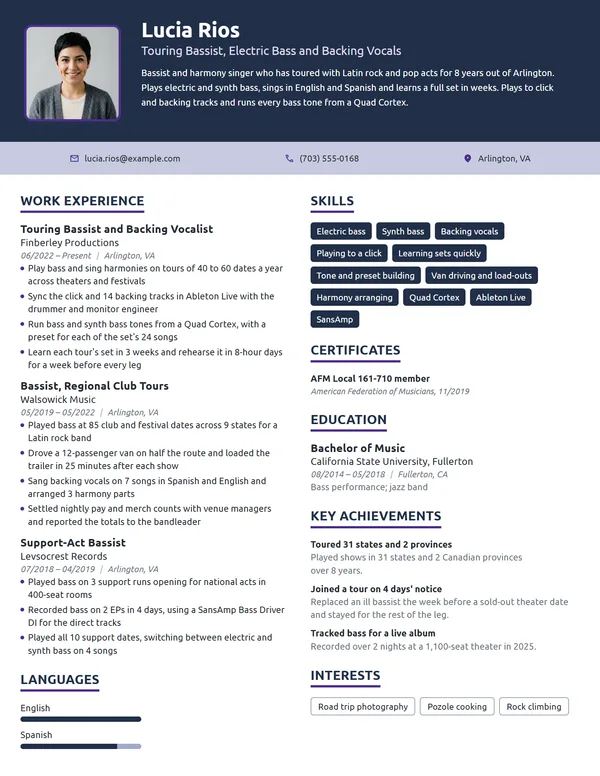
A working musician often performs, teaches and records in the same year, sometimes for several employers at once. Bandleaders and music directors scan for the instruments and styles you play, how well you sight-read, and the ensembles and gigs you have worked. So much short-term work is hard to put in a clear order. Grouping it by type keeps your best credits near the top.
How to Write a Musician Resume - Key Takeaways
- List your posts newest first on a single page, and group short-term gigs into one freelance entry instead of listing each date.
- Put your instrument or voice type and your doubles in the headline, such as Bassist, Upright and Electric.
- Give each bullet a number a music director checks: dates a year, performances in a run, concerts a season, tracks recorded or students taught.
- Name the reading and style skills the job ad calls for, such as sight-reading or the Nashville Number System, in Skills and inside at least 1 bullet.
- List AFM, AGMA or SAG-AFTRA membership and BMI or ASCAP affiliation under Certificates, each with the month you joined.
- Run the file through an ATS resume checker before you upload it to a school district, cruise line or university portal.
What music directors look for in a musician resume
The BLS lists performing for live audiences and recordings, auditioning for orchestras, choirs and bands, rehearsing parts, and booking and promoting performances as core duties of musicians and singers. O*NET adds playing from memory or from scores and providing the music for ballets, operas, musical theater and cabarets. A bandleader, contractor or church music director reads your resume to see which of those you have done, at what level and how often.
They are filling a chair, so they check 3 things first: the instrument or voice part, the kind of gig you have played, and whether you can learn the music fast. Many musicians learn several instruments or styles to stay marketable, the BLS notes, so your doubles and styles belong high on the page. Use these headings:
- Name and contact details, with a headline under your name giving your instrument or voice type (for example, Lyric Soprano or Bassist, Upright and Electric)
- A short summary under your name, 2 or 3 lines long and printed without a heading
- Work Experience: ensembles, venues, studios and teaching posts, newest first
- Skills, with your instruments, styles, reading skills and music software
- Certificates, for union memberships and royalty affiliations
- Education, with your concentration and principal instrument
- Optional: Key Achievements for competitions and releases, Volunteer Experience, Languages or Interests
Best format for a musician resume
Use the reverse-chronological resume format, with your current chair, residency or teaching post first and each entry carrying the title, employer, location and dates in MM/YYYY form. Musicians juggle many short engagements, so give standing jobs such as a church post, an orchestra chair or a house band their own entries, and fold one-off gigs into a single freelance entry with a date range. That keeps the order readable without hiding the variety.
- Best for most musiciansReverse-chronologicalYour jobs, newest first, with your results under each one.Best for: A steady work history in your field
- FunctionalSkills grouped up top, with a short work history below.Best for: Gaps or very little experience
- CombinationA skills section first, then your full work history.Best for: A career change with strong skills
Keep a performing resume to 1 page and cut the oldest, smallest gigs first. A 2-page version suits a college teaching post or a music teacher role that lists courses, ensembles directed and recitals. Your full repertoire list is a separate document you send when a panel asks for it.
| Setting | What to use |
|---|---|
| Length | 1 page for gigs, sessions and auditions; 2 for a teaching post with courses and recitals |
| Headline | Instrument or voice type plus doubles: Trombonist, Tenor and Bass Trombone |
| Freelance work | 1 entry for all one-off gigs, with your region, the date range and the kinds of gigs in the bullets |
| Dates | MM/YYYY for each post, with Present for a current chair, residency or church job |
| Personal data | No photo for most US and Canadian hirers, and no age, family status or Social Security details |
| File type | A PDF titled with your name and instrument, unless the portal asks for a Word file |
Most US and Canadian resumes carry no photo, so when a booking agent or a cruise line asks for a promo shot, send it as its own file with your recordings.
Musician resume summary vs. objective
If anyone has paid you to perform, record or teach, write a resume summary that names your instrument, your settings and your busiest number. If school ensembles and unpaid shows are all you have so far, write a resume objective instead: the chair you want plus your best proof. Either way, borrow the number from a bullet lower on the page.
Musician resume summary formula
Instrument or voice type with X years in settings or styles. Your busiest performance, recording or teaching number. Doubles, reading skills, union or software.
Example
Bassist with 10 years in theater pits and event bands, on upright and electric. Plays 64 dates a year with a 7-piece event band after 3 seasons in a theater pit. Reads charts on sight, is an AFM member and records remote bass tracks in Pro Tools.
Don't
Passionate and versatile musician with a lifelong love of music, looking to share my talent with new audiences.
Do
Drummer with 7 years in cover bands and regional theater, reading charts and playing to a click. Plays about 90 dates a year and tracks drums for 2 local studios. AFM member since 2021.
Now the reader knows the instrument, the settings, the workload and a membership a contractor can check.
How to write musician work experience bullets with numbers
Start with the basics of listing work experience on a resume: title, employer, city and dates. Then add the musical detail a director needs, such as the instrument you played, the style, the size of the room and how often you played it. Write 3 to 4 bullets under recent posts and fewer under the oldest ones, each starting on an action verb.
| Area | What to count | Example bullet |
|---|---|---|
| Live dates | Dates a year, set length, venue capacity | Played 110 dates in 2025 with a 4-piece country cover band in rooms of 200 to 900 seats. |
| Theater and pit work | Performances in a run, books learned, notice given | Subbed on 3 reed books in 1 season, covering 22 performances on 48 hours' notice. |
| Orchestra and ensemble seasons | Concerts a season, programs, the chair you hold | Held the second oboe chair for 14 subscription concerts and 6 education programs. |
| Recording | Sessions, songs tracked, releases, turnaround | Tracked guitar on 26 songs for 5 independent releases and delivered edited stems within 3 days. |
| Teaching | Students, lessons a week, recitals, audition results | Taught 28 piano students a week and prepared 6 for all-state auditions. |
| Booking and promotion | Shows booked, tickets sold, share of capacity | Booked a 12-city Midwest tour and sold 1,350 tickets, 70% of capacity. |
Here is how a bassist's last 2 posts read once the counts are added. The current job carries the most lines, and each bullet tells a bandleader something about reliability or range.
Work Experience
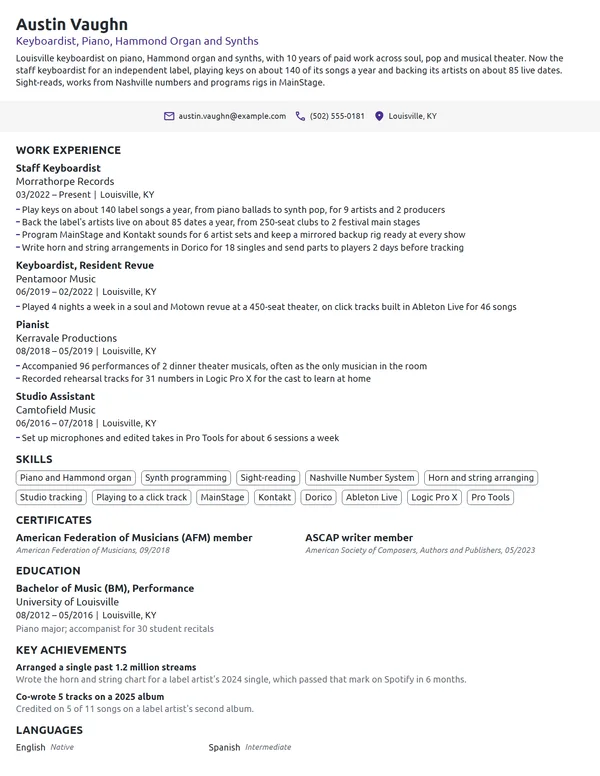
- Play upright and electric bass in a 7-piece event band booked for 64 weddings, galas and corporate dates a year.
- Lead the band on about 20 of those dates: call the set list, run the timeline with the planner and brief up to 3 subs.
- Chart 12 to 15 client song requests a season in Sibelius, so the band can play each one after 1 rehearsal.
- Played 4 musicals a season, about 30 performances each, switching between upright and electric bass.
- Learned a full show book in 5 days to replace a departing player, with no missed performances.
TV, commercial or film work goes in its own entry under the production company that hired you, or in your summary, never as a bullet under a band or theater that had nothing to do with it. Session work you booked yourself fits under your freelance entry.
Don't
Performed at weddings and events.
Do
Played 48 weddings in 2025 as keyboardist in a 6-piece band, covering ceremony music and 3 dance sets at each.
Now a planner can see the volume, the instrument and what each booking involves.
Don't
Taught private guitar lessons.
Do
Taught 22 guitar students a week, ages 9 to 60, and staged 2 recitals a year with 18 performers each.
Musician skills and music software for your resume
Choose 6 to 8 hard skills for your resume that the posting names and your bullets prove. Order them the way a director reads: instruments and doubles first, then styles, then reading and studio skills.
Hard skills for musicians
- Sight-reading
- Chord charts and lead sheets
- Nashville Number System
- Improvisation
- Playing to a click track
- Instrument doubles
- Transcription and arranging
- Ear training
- Studio tracking
- In-ear monitor mixing
Soft skills bandleaders value
- Punctuality at load-in and soundcheck
- Learning music quickly
- Listening inside an ensemble
- Composure on stage
- Taking direction
- Clear communication with clients
Put your music software in the Skills list, then mention it once more inside a bullet that shows what you made with it. O*NET lists Avid Pro Tools, Avid Sibelius, Apple GarageBand, Audacity and iZotope Ozone among the music and sound editing software musicians and singers use. If a session or production listing names Logic Pro or Ableton Live and you work in it, write that exact name and back it with the songs you tracked or the stems you delivered.
AFM, AGMA and BMI: union and royalty memberships on a musician resume
Most musician jobs need no license, so the Certificates section holds the memberships that tell an employer which contracts you work under and where your songwriting royalties go. List certifications on your resume in this order: the organization's full name once, then your status and the month you joined.
| Membership | Organization | What it covers |
|---|---|---|
| AFM membership | American Federation of Musicians of the United States and Canada | The labor union for professional musicians in the US and Canada. |
| AGMA membership | American Guild of Musical Artists | The union of singers, dancers and staging staff in opera, ballet and dance, and concert choral performance. |
| SAG-AFTRA membership | SAG-AFTRA | The media union formed in 2012 when the Screen Actors Guild and AFTRA merged; relevant for TV, radio, recording and commercial work. |
| BMI affiliation | Broadcast Music, Inc. | A US performing rights organization that collects license fees and pays royalties to songwriters, composers and publishers. |
| ASCAP membership | American Society of Composers, Authors and Publishers | A not-for-profit performing rights organization that licenses members' works to venues, broadcasters and streaming services. |
How to write union and royalty lines
Add the union initials to your headline only when the listing calls for union players, such as Violinist, AFM. Under Certificates, write each organization with your status (member, or songwriter affiliate for a royalty organization) and the month it began. If you are not a member, leave the line off rather than writing a status the organization does not use.
Certificates
- American Federation of Musicians (AFM), member, 10/2017
- Broadcast Music, Inc. (BMI), songwriter affiliate, 03/2020
How to list a music degree, conservatory or private study
Formal schooling is optional in this field: the BLS says musicians and singers typically do not need formal postsecondary education to enter the job, though people in classical music or opera may choose to earn a bachelor's or higher degree, and degree programs usually ask for an audition. When you do have a degree, give its name, the school with its location, and the month and year you finished, as with any education section on a resume. Add your GPA only in the first 2 years after school, and only when it is 3.5 or higher.
Write the degree as your school names it (Bachelor of Music, Bachelor of Arts in Music, Master of Music), then the concentration and your principal instrument. A line on your top ensemble helps a new graduate; after a few years of paid work, Education moves below Work Experience and keeps only the degree line.
Education
Principal instrument: double bass. Played 3 years in the top jazz ensemble.
Entry-level and career-change musician resumes
With no paid music job yet, use an entry-level resume layout: an objective, then Education, then every place you have already played. Count each item the way you would count a paid gig.
- School and youth ensembles: honor or all-state bands, the chair you held, concerts a year.
- Self-booked shows and open mics: dates played, the rooms and the crowd you drew.
- Church and community music: services a week and the size of the choir or band, under Work Experience if paid and Volunteer Experience if not.
- Lessons you teach: students, ages and lessons a week.
- Your own releases: songs released and where, under Key Achievements.
Don't
Recent music graduate seeking a chance to perform professionally and gain experience.
Do
Trumpet player and recent BM graduate seeking a show band or section chair. Played lead trumpet in a university big band for 3 years and 40 paid gigs with a brass quintet.
Proof turns an objective into a pitch: a chair, a count of gigs or a named ensemble.
Coming to music from another job, stay with newest-first order and put your music work at the top, even if it is part time, so the first entry a bandleader reads is a gig. Under your earlier job, keep 1 or 2 bullets on transferable skills that carry over, such as scheduling, client calls or handling cash at the merch table. On a career-change resume, save the story of the switch for your cover letter, where 2 or 3 sentences cover it.
Musician resume FAQ
How do I list freelance gigs on a musician resume?
Group them into 1 Work Experience entry, such as Freelance Trombonist with your region and the date range. Then use the bullets for counts: dates a year, the kinds of gigs, the bands you subbed for and the longest run. Give a standing post, such as a church job or a house band, its own entry.
How long should a musician resume be?
Use 1 page for performing, session and audition work. A 2-page resume fits a college or school teaching post where you list courses, ensembles you directed and student recitals. Cut the oldest and smallest gigs before you cut a strong recent one.
Should I list every instrument I play on my resume?
No. List the instruments you could play on a paid gig this week, with your main instrument first and your doubles after it. An instrument you only played in school belongs in Education, if anywhere.
Should I put a repertoire list on my musician resume?
Not on the resume itself. Keep a separate repertoire list by composer or style and send it when a panel, a church or a teaching post asks. On the resume, name 1 or 2 major works only when they prove the level of a specific engagement.
How do I list AFM union membership on a resume?
Write it under Certificates as American Federation of Musicians (AFM), member, with the month you joined. Add AFM to your headline only when a job ad wants union musicians, and leave it off entirely if your membership has lapsed.
Do you need a music degree to work as a musician?
Not usually. The BLS says no formal postsecondary education is typically needed to enter the occupation, and some classical and opera performers choose a bachelor's or higher degree. Without a degree, list private study and ensembles under Education and let your gig numbers carry the page.
Should I put streaming numbers or followers on a musician resume?
Only when they are real, recent and useful for the job, such as a booking or artist role. Write the platform, the figure and the month, for example monthly listeners in 09/2026, and put it in a bullet or under Key Achievements, never in place of your playing credits.
How do I list teaching and performing on one musician resume?
Give each its own entry if they are separate jobs, newest first. For a performing role, put the performing entries first and keep teaching to 1 or 2 bullets with student counts. For a teaching role, lead with the teaching post and move your strongest performances into the summary.
How much do musicians make?
Musicians and singers earned a median hourly wage of $47.80 in May 2025, according to BLS data, and 48% were self-employed in 2025, so yearly income depends on how many hours you book. Leave pay and rates off your resume and discuss them when a role is offered.
Next steps
Choose the example nearest your instrument and level, follow its layout, and put in your own dates, runs, sessions and students. Our resume builder fills in the same layout, and our resume templates offer other designs to try. When you apply, open your cover letter by naming the chair you want.