
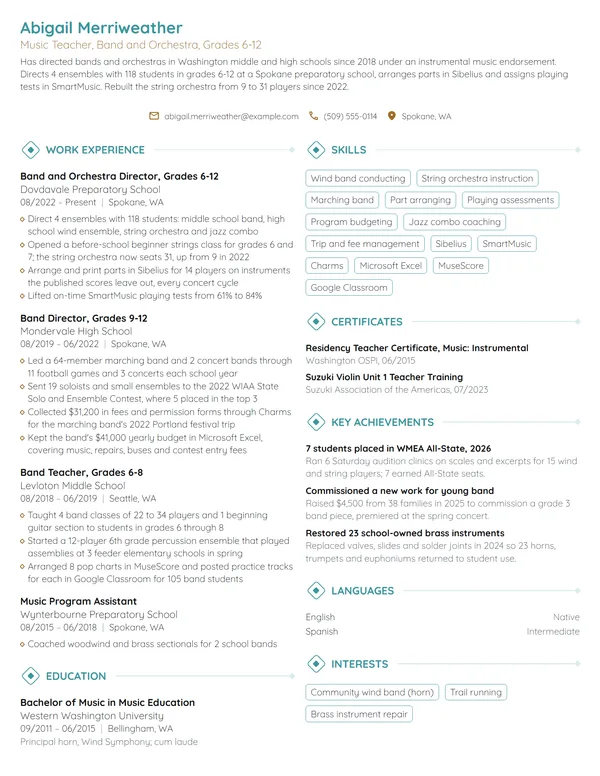
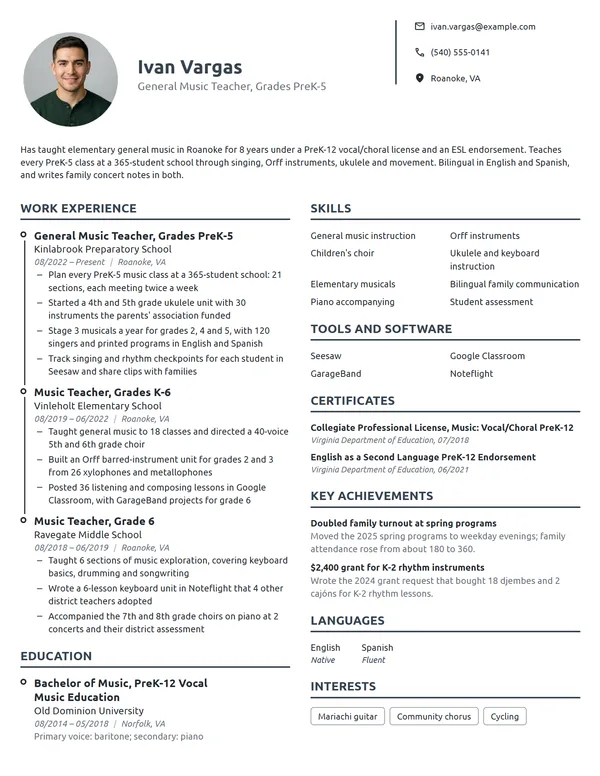
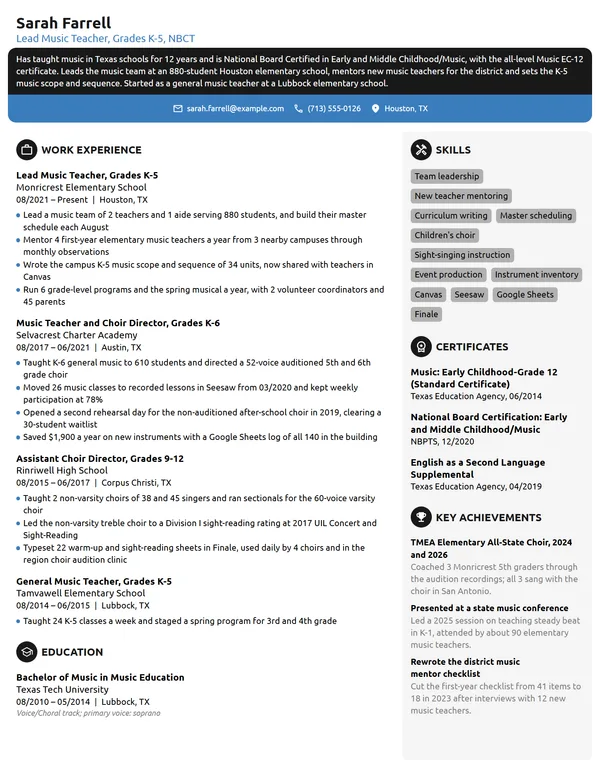
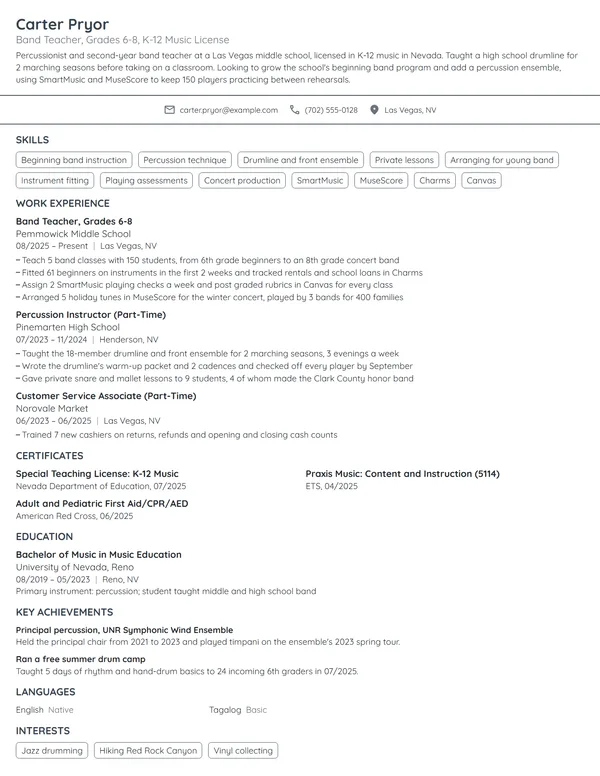
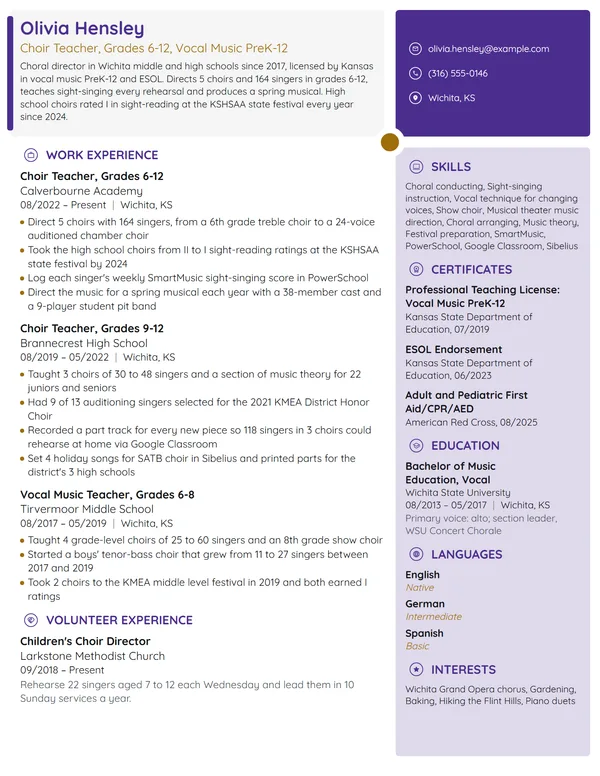
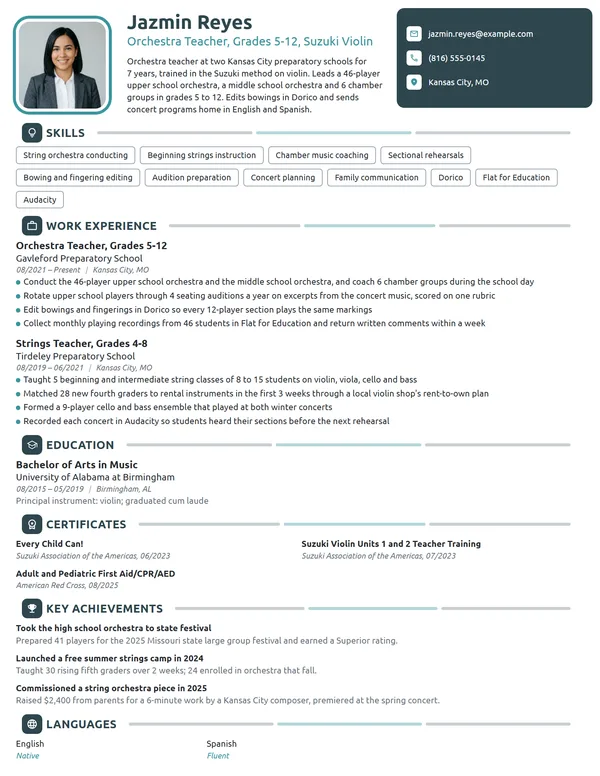
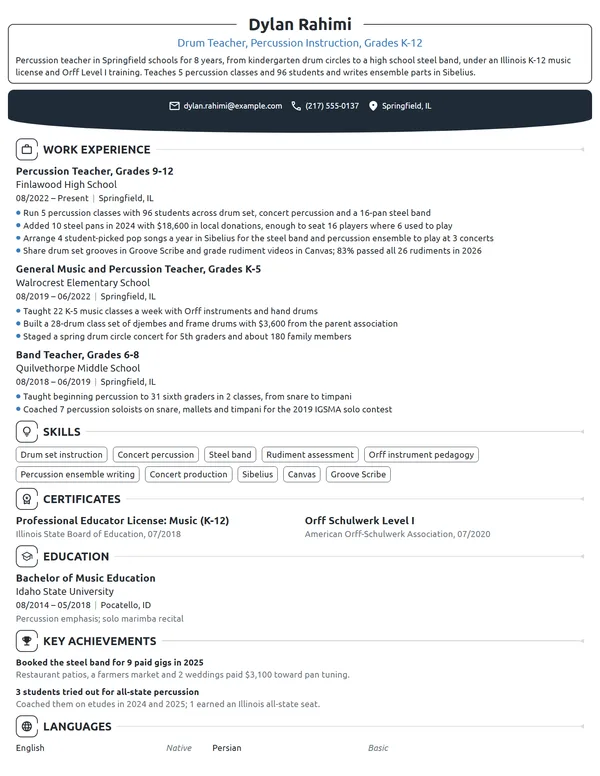
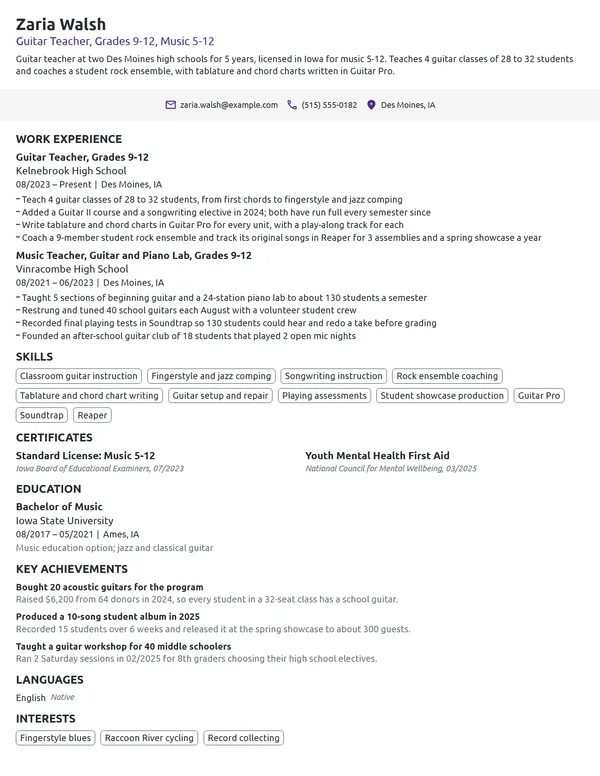
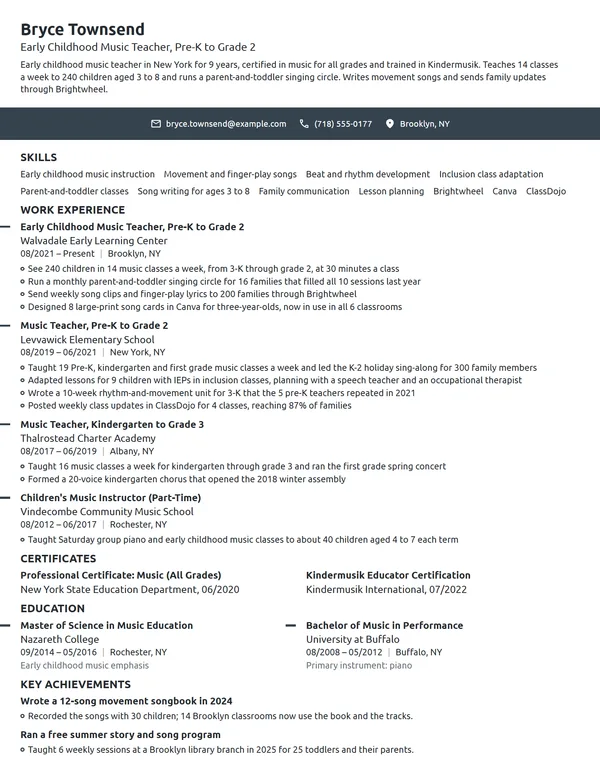
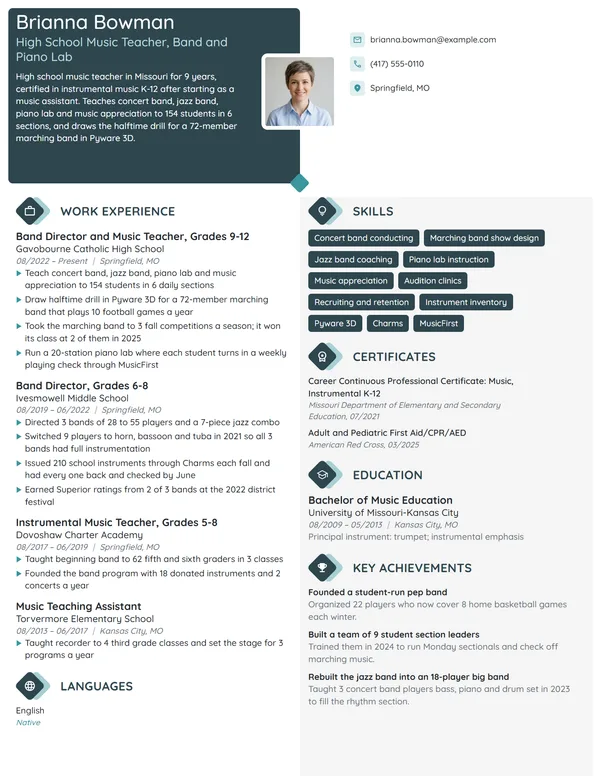
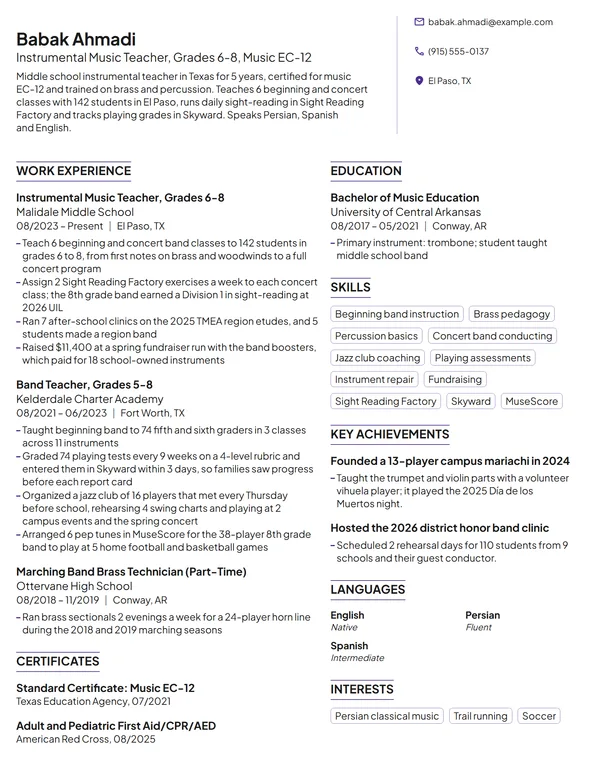
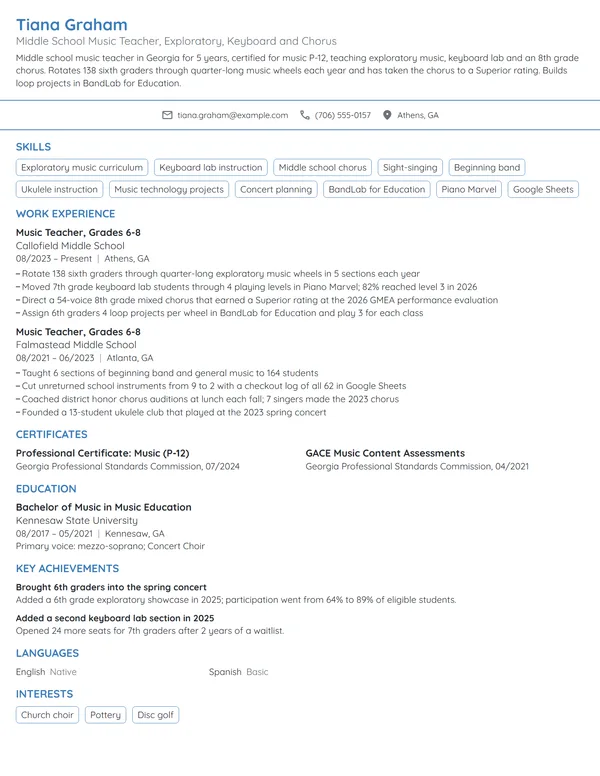
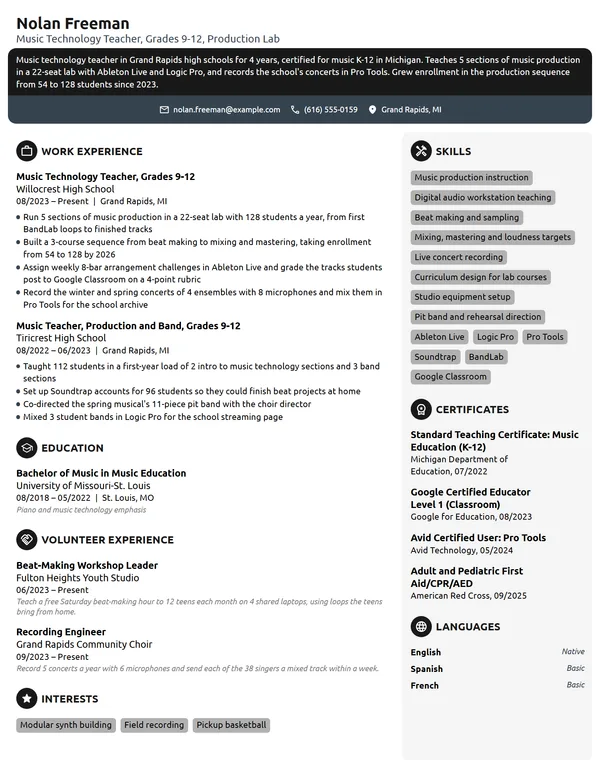
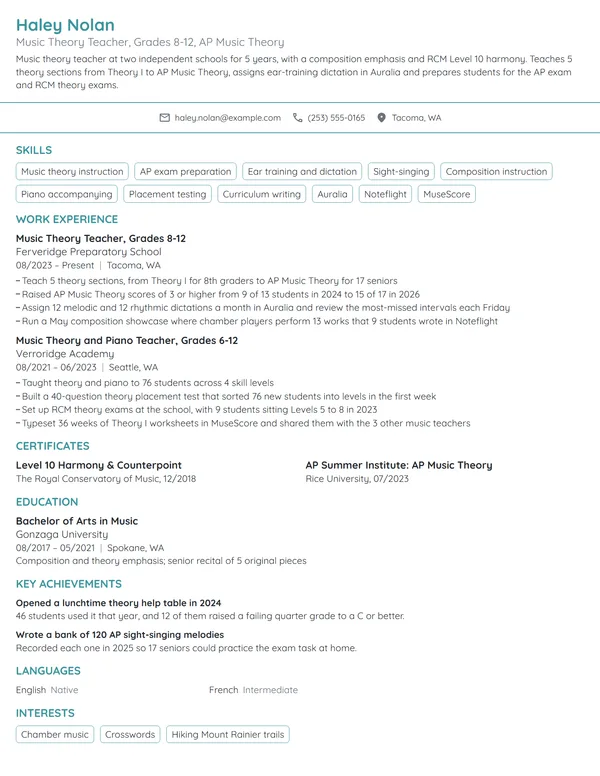
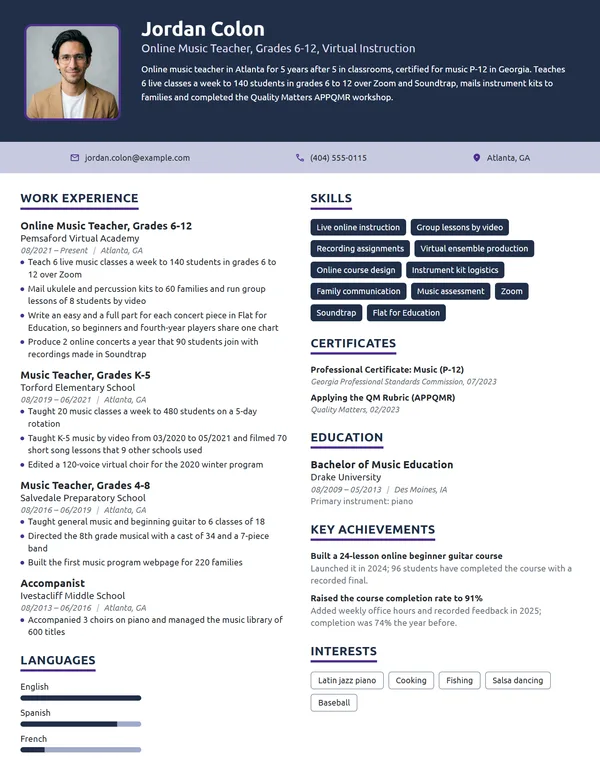
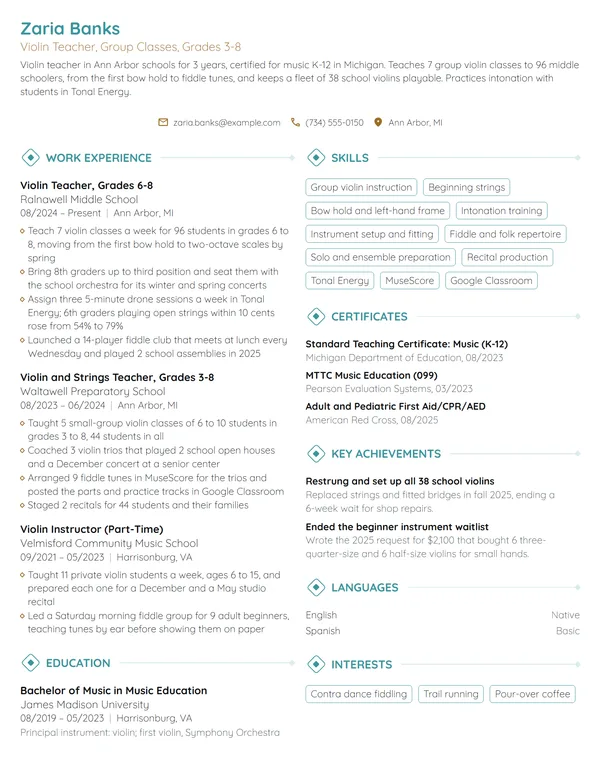
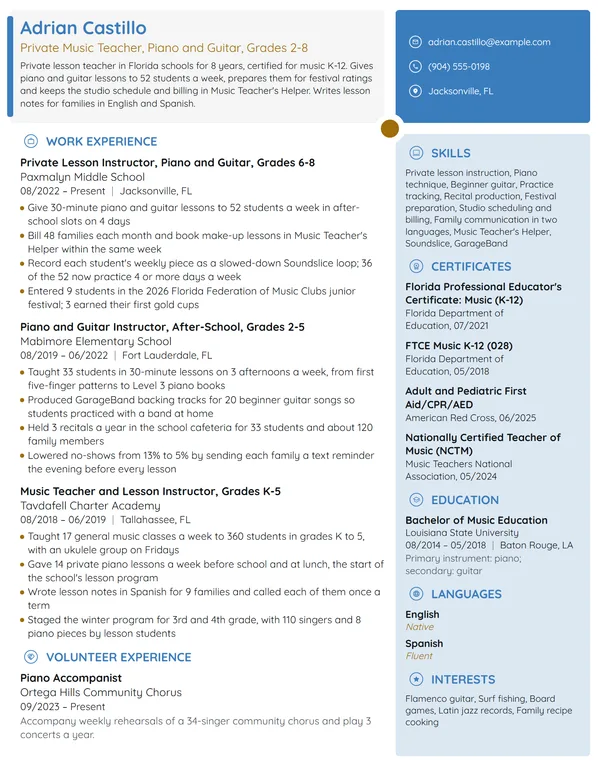
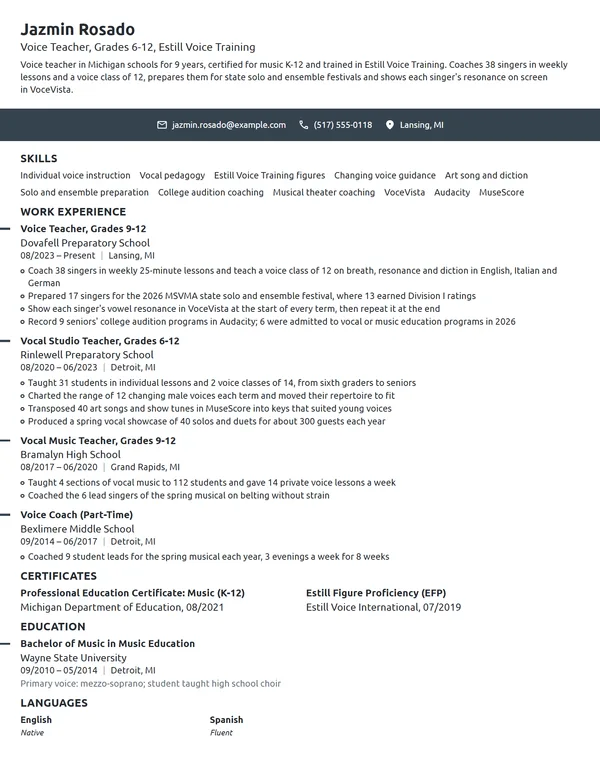
A music teacher is hired to run a program: ensembles, concerts and the students in them. Your grade levels, the groups you can lead, your state license and how your students sounded at the spring concert or district festival are what a principal or fine arts coordinator weighs. Enrollment in band and choir, concerts a year, festival ratings and students chosen for honor ensembles can all be counted, and each one belongs in a bullet with its number.
How to Write a Music Teacher Resume - Key Takeaways
- Use the reverse-chronological format on 1 page, with your ensembles and grade band in every job title.
- Open with 2 to 3 lines that name your music area, grade band, license and 1 counted program result.
- Count what your program did: students a week, ensemble enrollment, concerts, festival ratings and honor ensemble selections.
- List your state license first under Certificates, written as issued, including its vocal, instrumental or general music scope.
- Name your notation and classroom software exactly, such as Sibelius, MuseScore or Google Classroom, and prove each one in a bullet.
- Keep your own performing to 1 line, then test the file with an ATS resume checker before you upload it to a district portal.
What principals look for in a music teacher resume
A music teacher resume usually passes a district HR screener, who checks the license, before it reaches a principal or fine arts coordinator, who asks whether you can take over the band room, the choir or the K-5 rotation next fall. The BLS notes that some high school teachers specialize in electives such as music, and lists assessing students' abilities and communicating with parents about progress among teachers' core duties. O*NET adds adapting teaching methods and materials to students' varying needs, which in a music room means a beginner on clarinet and a senior preparing an audition in the same rehearsal.
Lay the resume out with the headings district application systems already recognize:
- Name, headline (for example, Choir Teacher, K-12 Vocal Music License) and contact details
- A 2 to 3 line opening profile, printed without a heading of its own
- Work Experience, current school first, with ensembles and grades in each job title
- Certificates, with your state music license on the first line
- Skills, covering methods, ensembles and software
- Education, including your primary instrument or voice part
- Key Achievements or Volunteer Experience, plus Languages and Interests if space allows
Best format for a music teacher resume
Choose the reverse-chronological resume format: your current school on top, then each earlier post, each with the job title, the school, its city and MM/YYYY dates. Music teachers often move from elementary general music to a middle or high school ensemble, or from assistant to head director, and a newest-first history makes each move easy to follow. A combination layout makes sense only if you are coming from a performing career and your teaching so far is private lessons.
- Best for most music teachersReverse-chronologicalYour jobs, newest first, with your results under each one.Best for: A steady work history in your field
- FunctionalSkills grouped up top, with a short work history below.Best for: Gaps or very little experience
- CombinationA skills section first, then your full work history.Best for: A career change with strong skills
Most music teachers fit on 1 page for their first 10 years. A 2nd page is fair once you have directed several ensembles at once, chaired a department or run a district honor festival, provided your license and current program still sit on page 1. If you travel between 2 or 3 buildings each week, write it as 1 job and name the schools in a bullet.
| Setting | What to use |
|---|---|
| Length | 1 page; 2 after 10+ years with several ensembles, a department or district roles |
| Job title line | Music area plus grades: Orchestra Teacher, Grades 6-12, or General Music Teacher, Grades K-5 |
| Ensembles | Each one by name and size in the first bullet of the job, such as 3 concert bands of 40 to 60 players |
| Dates | MM/YYYY at every school, with Present for the one you teach at now |
| Font | Arial, Calibri or Georgia at 10 to 12 pt, the same font throughout |
| Photo and personal details | Most US and Canadian schools expect none; leave off birth date, marital status and Social Security number |
Most US and Canadian resumes carry no photo. When a posting asks for a performance or rehearsal sample, send it as a link in the application form or your cover letter, and keep the resume itself a plain file the portal can read.
Music teacher resume summary vs. objective
Decide by one question: have you been the teacher of record for a music class? If you have, write a resume summary that names your music area, grade band, years, license and 1 program result. If you are student teaching, finishing an alternative route or moving over from performing and private lessons, write a resume objective that names the position you want and the strongest teaching you have done so far.
Music teacher resume summary formula
Music area teacher with X years teaching grade band, holding state license and its scope. 1 counted program result. Ensembles you can lead or the next credential you are working toward.
Example
Band and general music teacher with 9 years teaching grades K-8, holding Minnesota's K-12 instrumental and classroom music license. Started a 22-student jazz band that now plays 5 community events a year. National Board candidate in Early Adolescence through Young Adulthood/Music.
Don't
Passionate music educator dedicated to inspiring a lifelong love of music in every student.
Do
Orchestra teacher with 5 years at a 1,600-student high school, directing 3 string orchestras of 25 to 55 players. 11 students earned all-region orchestra seats in the last 2 years.
The second version shows the ensembles, their size and a result another music teacher would respect.
How to write music teacher work experience bullets with numbers
Give your current school 3 to 4 bullets and each earlier one 1 to 3. Lead with the load (ensembles, students, grade levels, classes a week), because every result reads against it, then show what the program did in public: enrollment that held, concerts staged, festival ratings, students selected for honor groups and money raised. Write achievements on your resume as what changed while you ran the program, not as the duties in the job posting.
| Area | What to count | Example bullet |
|---|---|---|
| Teaching load | Students a week, classes, ensembles, grade levels | See 430 students a week in 19 general music classes across grades K-5. |
| Enrollment and retention | Students per ensemble, share who sign up again | Kept 90% of 6th grade band students in 7th grade band, up from 81%. |
| Performances | Concerts a year, audiences, venues | Produce 7 concerts a season, with 1,100 tickets sold across them. |
| Festivals and contests | Entries, ratings, soloists | Prepared 14 solo and ensemble entries, and 10 earned the top rating. |
| Honor ensembles | Students who auditioned, students selected | Coached 6 singers who won seats in the all-state choir. |
| Budget and equipment | Budget, grants, funds raised, instruments | Raised $8,200 at 2 benefit concerts to replace 2 school tubas. |
Below is one teacher who moved from an elementary rotation to a middle school band program. The current job opens with the load and covers enrollment, a festival result and the instrument inventory; the older job keeps 2 lines.
Work Experience
- Teach 3 grade-level bands with 172 students in all, plus 2 sections of 6th grade general music.
- Grew the 7th grade band from 38 to 57 students in 3 years by hosting a 5th grade instrument night at each feeder school.
- Prepared the 7th and 8th grade bands for the district large-group festival, earning Superior ratings in 2025 and 2026.
- Logged 96 school-owned instruments in Charms and cut repair spending from $5,800 to $3,700 a year with in-house pad and cork fixes.
- Taught general music to 540 students a week across 23 classes on a 6-day rotation.
- Wrote a 9-week recorder unit for grades 3 and 4 and staged 2 grade-level programs a year.
Don't
Directed the school concert band.
Do
Directed a 58-member concert band through 4 concerts a year and raised its festival rating from Excellent to Superior in 2 seasons.
Now the reader sees the band size, the concert schedule and a result a festival adjudicator wrote down.
Don't
Responsible for the music department budget.
Do
Managed a $14,500 yearly music budget and won a $3,000 district foundation grant for 12 ukuleles and a classroom set of hand drums.
Music teacher skills and software for your resume
Pick 6 to 8 hard skills for your resume that the posting names and your bullets prove. Start with your ensembles and methods, since a choir opening and a strings opening want different people, then add the classroom skills that keep a room of 60 players working: rehearsal planning, sight-reading instruction and instrument care.
Hard skills for music teachers
- Ensemble conducting
- Band instruction
- Choral instruction
- String instruction
- General music (Orff and Kodály approaches)
- Music theory and ear training
- Sight-reading instruction
- Rehearsal planning
- Instrument repair and inventory
- Concert and festival preparation
Soft skills principals value in music teachers
- Patience with beginners
- Classroom management in large ensembles
- Clear modeling and demonstration
- Communication with families
- Event organization
- Teamwork with other arts staff
Put your software in Skills and back each program with a bullet where you used it for something countable, such as parts printed or practice assignments graded. O*NET's technology list for secondary school teachers flags Microsoft PowerPoint, Word and Excel as hot technologies and also lists Google Classroom. Music rooms add notation software such as Sibelius, Dorico, MuseScore or Noteflight, practice tools such as SmartMusic, and program records in Charms. MakeMusic ended Finale's development in August 2024, so name the notation program you use now on your current job and keep Finale on the jobs where you used it.
Music teaching licenses, Praxis and National Board on a resume
A public school hires on your license. The BLS states that all states require public school teachers to be licensed or certified in the grade level they will teach, which generally takes a bachelor's degree with a minimum GPA, student teaching, a background check and a general teaching test, and that teachers often must complete professional development to keep the license. Private schools can hire outside that system, since the BLS notes that their teachers do not need to meet state requirements. List certifications on your resume under Certificates, license first, each with its issuer and month.
| Credential | Issued by | What it takes |
|---|---|---|
| State music license or certificate | Your state's education agency or standards board | A bachelor's degree, student teaching, a background check and the tests your state lists; some states license vocal and instrumental music separately. |
| Praxis Music: Content Knowledge (5113) | ETS | 120 selected-response questions in 2 hours, 30 of them on recorded musical excerpts. |
| Praxis Music: Content and Instruction (5114) | ETS | 84 selected-response and 3 constructed-response questions in 2 hours, with about half the test on teaching music. |
| National Board Certification in Music | National Board for Professional Teaching Standards (NBPTS) | A bachelor's degree, a valid state license and 3 years of teaching; 4 components finished within 3 years. Early and Middle Childhood/Music covers ages 3 to 12, Early Adolescence through Young Adulthood/Music ages 11 to 18+. |
| Kodály certificate | An OAKE-endorsed teacher training program | At least 225 contact hours, covering pedagogy, musicianship, folk music materials, choir and special topics. |
Vocal, instrumental or general music: how to write the license line
Copy the license name exactly as your state prints it, because the scope matters to a music hire. Minnesota, for example, issues 2 separate licenses, K-12 Vocal and Classroom Music and K-12 Instrumental and Classroom Music, and a state advisory group recommended in February 2026 that they be replaced by a single PK-12 Music license. Write the tier or level, the license name, the issuing board and the month, leave the license number off, and list a pending license or National Board candidacy with the date you expect it.
Certificates
- Tier 4 License: K-12 Instrumental and Classroom Music, Minnesota Professional Educator Licensing and Standards Board (PELSB), 08/2020
- Kodály Certificate, OAKE-endorsed teacher training program, completed 07/2019
- National Board Certification candidate: Early Adolescence through Young Adulthood/Music (Band), components 1 and 2 submitted 2026; result expected 2027
How to list a music education degree on your resume
Most public school music teachers come through a bachelor's in music education, which pairs applied lessons, ensembles, conducting and methods courses with student teaching. The BLS adds that many states require high school teachers to have majored in a content area, and that all states offer an alternative route to licensure for people who already hold a bachelor's degree, which is the usual path for a performance or music business graduate.
Follow the standard order for listing education on a resume: degree, school, city and graduation date. Then add the 2 details a music hiring team checks: your primary instrument or voice part, and your student teaching placements with grade levels and weeks. After 3 or 4 years in the classroom, the placements can go and the instrument stays.
Education
Primary instrument: trumpet. Student teaching: 8 weeks of high school band and 8 weeks of K-5 general music.
Student-teacher and career-change music teacher resumes
Without a music room of your own yet, follow the first-year teacher resume layout: an objective, then Education with your placements, then every place you have taught music to a group. Count each one as you would a full-time job.
- Student teaching: both placements, the ensembles or grades, the weeks, and a concert or unit you prepared on your own.
- Private lessons: a Work Experience entry with the number of students, their levels and how many went on to region or all-state auditions.
- Marching band or summer camp staff: the section you taught, its size and the season or session count.
- Church, community or youth choirs: singers directed or accompanied and services or concerts a year, under Volunteer Experience if unpaid.
Don't
Recent music education graduate looking for a position where I can share my love of music.
Do
Vocal music education graduate licensed in 06/2026, seeking a middle school choir position. Student taught 16 weeks in a grades 6 to 8 choir program of 140 singers and led its sectionals for the spring concert.
An objective still needs evidence: the placement, its size and something you ran yourself.
Moving into teaching from performing, church music or a music store, keep reverse-chronological order and put your license or alternative-route program at the top of Certificates. Under your earlier jobs, keep the bullets that carry into a school: students you taught, groups you rehearsed, events you ran to a date. A career-change resume leaves the reason for the switch out of the bullets, and a short cover letter is where you explain it in 2 or 3 sentences.
Music Teacher resume FAQ
Do I need a music education degree to become a music teacher?
Not always. Public schools need a state license, which the BLS says generally takes a bachelor's degree, student teaching, a background check and licensing tests, and a music education degree covers those in one program. With a performance or other degree, the alternative route every state offers is the usual way in. Private schools do not have to follow state licensing rules.
Should I list my own performing experience on a music teacher resume?
Yes, briefly. Put 1 line in your summary, such as a principal chair in a community orchestra, or 1 item under Key Achievements. Keep the bullets for teaching, since a school hires you for what your students can do, and give gigging its own job entry only when it fills a gap in your dates.
Which Praxis test do music teachers take?
The one your state lists, if it uses Praxis. ETS offers Music: Content Knowledge (5113), 120 questions with 30 on recorded excerpts, and Music: Content and Instruction (5114), 84 selected-response and 3 constructed-response questions. Check your state's testing page before you register, and list a passed test under Certificates with its name and month.
How do I show both choir and band experience on one resume?
Name both in the job title line, such as Music Teacher, Choir and Band, Grades 6-12, and give each ensemble its own bullet with its size and a result. If your license covers only vocal or only instrumental music, write it exactly as issued, and put any second license on its own line under Certificates.
How should a general music teacher show their workload?
Write the weekly total in your first bullet: students a week, number of classes, grade levels and how often each class meets. Then add the programs you staged, the units you wrote and any instruments you introduced, such as recorders or ukuleles, each with its grade level.
Can I put student concert recordings on my resume?
Only with your school's permission. Student recordings fall under the school's privacy rules, so link one only after your principal has cleared it, and send it with the application rather than inside the resume. Otherwise, describe the performance in a bullet: the ensemble, the event and the rating it earned.
How long should a music teacher resume be?
1 page for most music teachers in their first 10 years. A 2nd page fits after 10+ years that include several ensembles, a department chair role or district festival work, as long as your license and current program stay on page 1.
What is the average music teacher salary?
Music teachers have no separate wage in BLS data. The BLS reports a median annual wage of $72,040 in May 2025 for secondary school teachers, except special and career/technical education. Keep salary figures off a music teacher resume and bring pay up once the district makes an offer.
Next steps
Choose the example closest to your ensembles and grade band, keep its structure, and swap in your own student counts, concerts and festival results. Build it in our resume builder or start from one of the resume templates, then send it with a cover letter that names the program you want to run.