
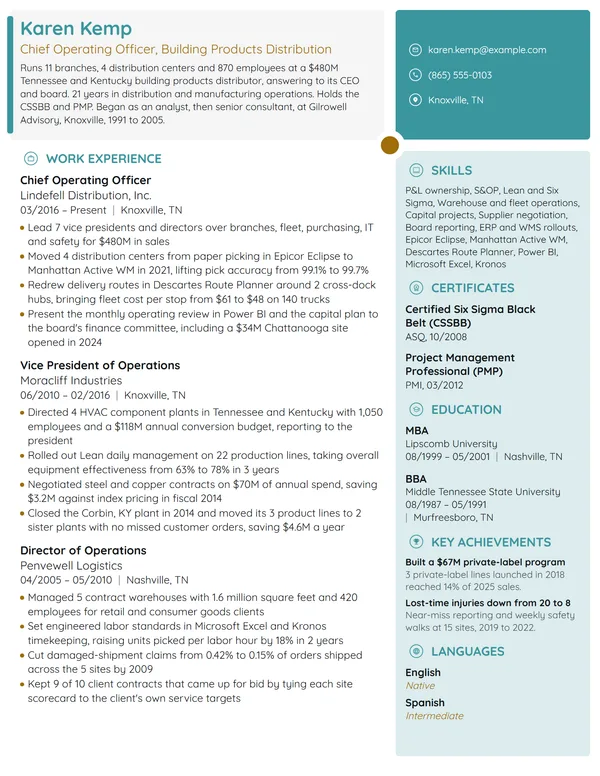
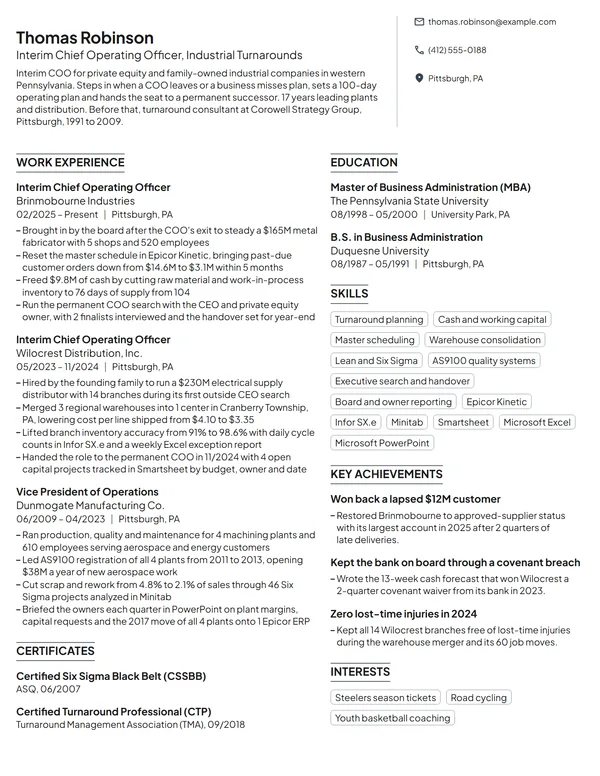
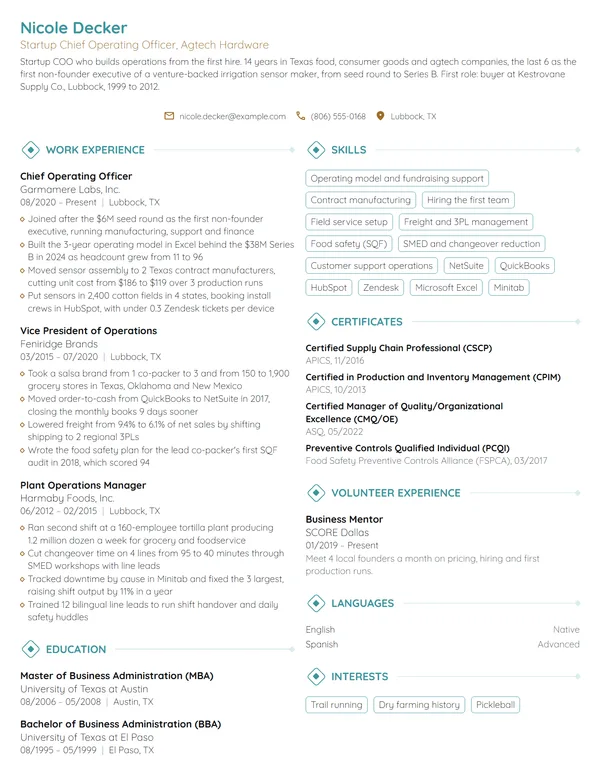
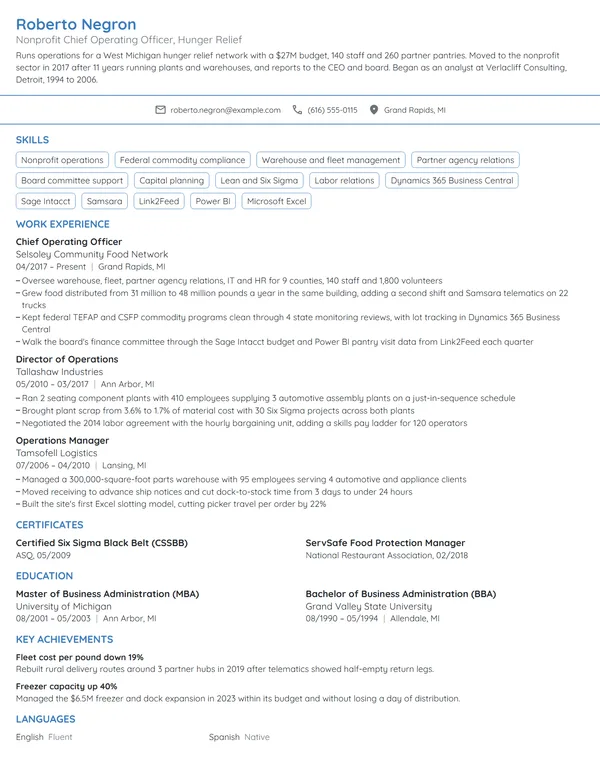
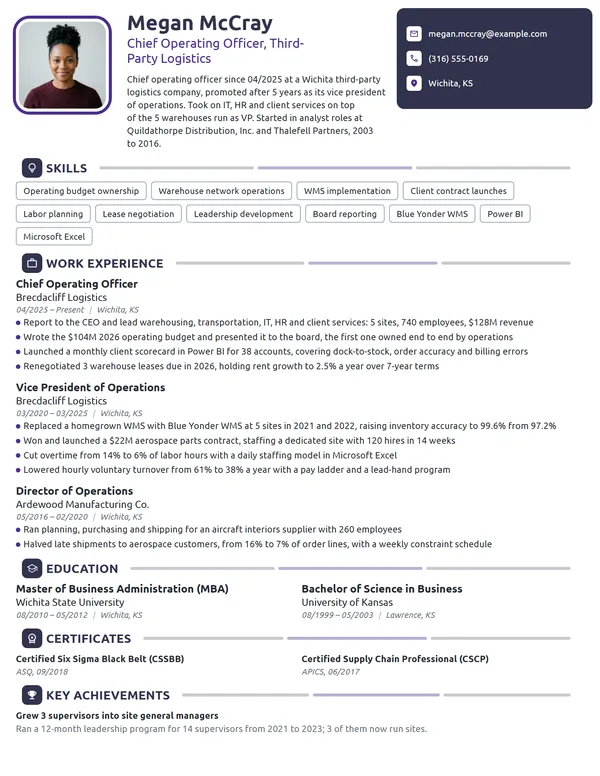
A COO turns the company's plan into what actually happens across its sites, teams and numbers. The CEO and board want to see how big an operation you ran, who reported to you, and what got cheaper, faster or safer while you ran it. Because the job touches every function, a COO resume can drift into a list of departments. Keep it a record of what changed, with the scope and a result in every entry.
How to Write a Chief Operating Officer (COO) Resume - Key Takeaways
- List roles newest first, reverse-chronological, on 1 or 2 pages, and fold anything older than about 15 to 20 years into 1 Earlier experience line.
- Open each job with a scope line: sites, headcount, revenue or budget, your direct reports and who you reported to.
- Give every bullet an operating number with its base, such as cost taken out of a stated spend, on-time delivery, fill rate, inventory days, margin or safety rate.
- Write a 2- to 3-line summary with your years, your industry, the size of what you run and your strongest result.
- List each interim engagement as its own entry with a start date, an end date and the result you handed back.
- Put the MBA and credentials such as CSSBB or PMP where a recruiter scans for them, then test the PDF with an ATS resume checker before it goes to a search firm.
What a CEO and board check on a chief operating officer resume
The BLS describes COOs as a type of chief executive who manages a specific part of the organization, and notes that top executives often report to a board of directors. O*NET's task list for chief executives includes directing financial and budget activities, conferring with board members and analyzing operations for cost reduction or program improvement. A COO resume is read against those tasks: what you ran, what you changed, and how you reported it.
Search partners and CEOs also check fit. The BLS says chief executives typically need extensive managerial experience in the organization's own area of specialty, so a distribution COO reads differently from a hospital or software COO. Use these sections, named so hiring software files each one under the right label:
- Name, headline (for example, Chief Operating Officer, Industrial Manufacturing) and contact details
- A 2- to 3-line summary under your name, with no section title above it
- Work Experience, current role first, each job opening with its scope
- Skills, with your ERP and planning systems
- Certificates
- Education, MBA first
- Optional: Volunteer Experience for nonprofit boards, Key Achievements or Languages
COO resume format: reverse-chronological, 1 or 2 pages
Use the reverse-chronological resume format: your current role first, each with its title, employer, city and its MM/YYYY start and end. The path to COO usually runs through plant, regional or functional leadership and then a vice president role, and a board wants to see that climb in order. A skills-first layout hides the dates and the scope of each job, which are the 2 things an operations hire checks first.
- Best for most COOsReverse-chronologicalYour jobs, newest first, with your results under each one.Best for: A steady work history in your field
- FunctionalSkills grouped up top, with a short work history below.Best for: Gaps or very little experience
- CombinationA skills section first, then your full work history.Best for: A career change with strong skills
On resume length, 2 pages are normal for a COO with 15+ years in leadership roles, and 1 page works when your last 3 roles carry the story. Either way, give full entries to roughly the last 15 to 20 years and fold anything older into 1 Earlier experience line with the title, employer and years. Page 1 should hold your summary and your current and previous roles.
| Setting | What to use |
|---|---|
| Length | 1 page if 3 roles tell it, 2 pages with 15+ years of leadership |
| Headline | Your title plus your industry: Chief Operating Officer, Healthcare Services |
| Scope line | First bullet of each executive job: sites, headcount, revenue or budget, reporting line |
| Dates | MM/YYYY for each role; 1 Earlier experience line for roles older than about 15 to 20 years |
| Photo and private data | Usually no photo for US and Canadian roles; skip date of birth, marital status and any street address |
| File type | PDF for search firms and email; a Word file only when a portal asks for one |
Most US and Canadian resumes carry no photo. At this level the resume often goes from a search firm straight to a CEO or a board committee, so a plain layout that prints and forwards cleanly matters more than design.
COO resume summary vs. objective
Every COO candidate writes a resume summary, not an objective: you already have the operating record, and the summary's job is to show its size in 2 or 3 lines. Name your title, years and industry, the scale you run now, and 1 result with its base. The test for each word is whether a CEO in your industry would recognize it from their own operating reviews.
Chief operating officer resume summary formula
Title with X years in industry, running sites, headcount and revenue or budget. Your biggest operating result, with its base. A second result, an integration or a board-level responsibility.
Example
Chief operating officer with 19 years in industrial manufacturing and distribution, running 3 plants, 2 distribution centers and 640 employees for a $212M components maker. Raised on-time delivery from 81% to 96% in 18 months while taking 2.8 points out of cost of goods sold. Integrated 1 acquired plant in 2024.
Don't
Strategic operations leader with a proven track record of improving efficiency and building high-performing teams across multiple industries.
Do
COO of a 300-person home-health provider with 5 branches and $41M in revenue. Raised visits per clinician from 4.2 to 5.1 a day by redesigning routing and scheduling, and reports operating results to the board each quarter.
This version shows the size, the industry, a measured result and the reporting line.
How to write COO work experience bullets with operating numbers
Give your current role 3 to 4 bullets and each older one 2 to 4. Open with the scope line, then give each result its base: dollars out of which spend, percentage points of which margin, days of which inventory. Those achievements on your resume are what separate you from a candidate with the same title and a similar company.
| Area | What to count | Example bullet |
|---|---|---|
| Scope | Business units, sites, headcount, budget or revenue | Ran operations for 4 business units with 1,150 employees and a $310M budget. |
| Cost | Dollars taken out, against which cost base, over what time | Took $8.4M out of a $96M operating cost base in 2 years. |
| Delivery and service | On-time delivery, fill rate, cycle time, wait times | Raised order fill rate from 89% to 97.5% across 6 warehouses. |
| Margin | EBITDA or gross margin, before and after, fiscal years | Lifted EBITDA margin from 9% to 13% over 3 fiscal years. |
| Growth and scale | Headcount growth, new sites or markets, months | Scaled the team from 45 to 210 people and opened 3 new markets in 24 months. |
| Integration | Acquisitions, employees moved, systems merged, months | Integrated 2 acquisitions, moving 380 employees onto 1 ERP and 1 payroll in 9 months. |
Here is how a manufacturing COO's current and previous roles read with those numbers in place.
Work Experience
- Run 3 plants and 2 distribution centers with 640 employees and $212M in revenue; report to the CEO, with 6 direct reports.
- Raised on-time delivery from 81% to 96% in 18 months by moving 2 scheduling systems into 1 SAP S/4HANA instance.
- Cut cost of goods sold by 2.8 points of revenue ($5.9M a year) by consolidating suppliers from 140 to 85.
- Built a monthly sales and operations planning cycle that brought finished goods inventory from 71 to 48 days on hand.
- Opened a 180,000-square-foot facility in Janesville, WI 6 weeks early and $1.1M under its $24M budget.
- Lowered the OSHA recordable rate from 4.1 to 1.9 per 100 full-time workers across 4 sites.
Don't
Oversaw all day-to-day operations of the company.
Do
Ran daily operations for 5 clinics and 290 staff, cutting average patient wait time from 34 to 19 minutes in 1 year.
Oversaw tells a board nothing; sites, staff and a measured change do.
Don't
Responsible for streamlining processes and reducing costs.
Do
Replaced 3 regional purchasing teams with 1 shared service, saving $2.7M a year on $64M in annual spend.
How to list interim and fractional COO roles
Give each interim engagement its own Work Experience entry: Interim Chief Operating Officer, the client company and city, and the real start and end months, even for a 7-month assignment. Write why you were brought in and what state you left it in, so the short tenure reads as a finished mandate rather than a quick exit. Several fractional clients at once can sit under 1 entry for your own firm, with a bullet per client.
Operations leadership skills and software for a COO resume
Pick 6 to 8 skills from the posting that your results back up. At this level, the leadership skills a board wants, such as building a team of directors or running a reorganization, should show up in results rather than as adjectives, so keep the list to named capabilities.
Hard skills for COOs
- P&L and operating budget ownership
- Sales and operations planning (S&OP)
- Lean and Six Sigma
- Supply chain and procurement strategy
- Mergers and acquisitions integration
- KPI design and operating reviews
- Capital project planning
- Organizational design
- Vendor and contract negotiation
- Risk and compliance oversight
Soft skills CEOs and boards value
- Executive judgment
- Board communication
- Change leadership
- Building leadership teams
- Cross-functional alignment
- Composure in a crisis
List your systems with your skills and name each in a bullet. In O*NET's technology data for chief executives, Microsoft Excel and Microsoft PowerPoint carry the in-demand tag, and O*NET lists SAP software, Oracle PeopleSoft, Microsoft Project and Atlassian JIRA among its hot technologies. Name the ERP, planning or BI system the posting names if you ran a rollout or reporting cycle in it, and write the exact product, not just ERP.
Six Sigma, PMP and other certifications for a COO resume
No license is required to be a COO, so certifications are proof of method rather than a gate. List certifications on your resume under Certificates, each with its issuing body and year, and keep only those the role uses: a Six Sigma Black Belt for manufacturing and logistics, a PMP for program-heavy operations, a quality credential where the board cares about audits.
| Credential | Issued by | What it takes |
|---|---|---|
| Certified Six Sigma Black Belt (CSSBB) | ASQ | A full-time paid role, then 3 years of work in the CSSBB Body of Knowledge with 1 completed project and signed affidavit, or 2 completed projects with signed affidavits; a 165-question computer-based exam. |
| Certified Manager of Quality/Organizational Excellence (CMQ/OE) | ASQ | 10 years of work in its Body of Knowledge, 5 of them in a decision-making position; a college or technical degree waives part of the 10 years. |
| Project Management Professional (PMP) | Project Management Institute (PMI) | A bachelor's degree or higher plus 3 years managing projects (4 with an associate's, 5 with a high school or GED diploma), and 35 hours of project management training or an active CAPM. |
Certificates
- Certified Six Sigma Black Belt (CSSBB), ASQ, 2014
- Project Management Professional (PMP), Project Management Institute (PMI), 2012
How to list an MBA and education on a COO resume
The BLS expects top executives to hold a bachelor's or master's degree in a related field such as business or engineering, and says those at large corporations may have an MBA. When listing education on a resume at this level, put the newest degree first, then the school, the town it sits in and the month you finished. Leave the GPA off; at this level nobody asks for it.
An MBA earned part-time while you worked goes in Education like any other degree, with no note about the schedule. If you completed a university executive education program, list it after your degrees with the school's name for the program and the year.
Education
First-time, startup and nonprofit COO resumes
Many top executives, the BLS says, move up inside their own organizations from lower level management roles, while some companies hire from outside. A first COO application usually comes from a VP of operations, a general manager or a director of operations, and the resume has to show that you already carry COO-sized pieces of the job:
- Budget ownership: the operating or capital budget you set and answered for, in dollars.
- Board exposure: the reports or plans you presented to the board or its committees, and how often.
- Span beyond your function: quality, IT, HR or customer service teams that reported to you.
- Company-level change: an acquisition you integrated, a site you opened or closed, a system you rolled out.
Don't
VP of Operations seeking my first COO role where I can apply my leadership skills.
Do
Vice president of operations with 12 years in contract manufacturing, running 2 plants and 430 people for a $150M business. Owned the operating budget and wrote the board's quarterly operations report for the last 3 years.
Write a summary, not an objective: the COO-sized pieces you already hold make the case.
A startup COO resume swaps scale for speed: headcount growth, markets or locations opened, the first processes and systems you put in, and the funding stage the company was at. A nonprofit COO resume names the budget, such as $18M across 14 programs, along with grant or contract compliance and the board committees you worked with. Coming in from another industry or role, the career-change resume approach applies: lead with the operating work that transfers, and explain the move in your cover letter, where the management cover letter examples show how to open with a result.
Chief Operating Officer (COO) resume FAQ
How long should a COO resume be?
Use 2 pages if you have 15+ years in leadership roles, or 1 page if your last 3 roles carry the story. Give full entries to about the last 15 to 20 years, fold older roles into 1 Earlier experience line, and keep your summary and current role on page 1.
How do I list an interim or fractional COO role on my resume?
Give each interim role its own entry with the title Interim Chief Operating Officer, the company, the city and the real start and end months. Say why you were hired and what you handed back. Ongoing fractional work for several clients can sit under your own firm, with 1 bullet per client.
What numbers should a chief operating officer put on a resume?
Start with scope: sites, headcount, revenue or budget, and your direct reports. Then give results with their base, such as cost taken out of a stated spend, on-time delivery or fill rate before and after, inventory days, EBITDA margin, safety rates and the size of any integration.
Do I need an MBA to become a COO?
No, but it is common at large companies. The BLS expects a bachelor's or master's degree in a related field such as business or engineering, says executives at large corporations may have an MBA, and that those promoted from lower level positions may be able to substitute experience for education.
How do I go from VP of operations to COO on my resume?
Show the parts of the COO job you already do. Put your budget in dollars, the functions outside operations that report to you, any board or committee reporting, and a company-level change such as an acquisition or a new site near the top of your current role.
Where do board seats go on a COO resume?
Put a nonprofit board seat under Volunteer Experience with the organization, your role and years, and a corporate or advisory board seat under Key Achievements. Name any committee you chaired.
What is the median salary for a chief operating officer?
The BLS publishes no separate COO figure; it counts COOs among chief executives, whose median annual wage was $213,990 in May 2025. Pay varies widely with company size and industry, and it stays off your resume: discuss it with the search firm or in the offer stage.
Next steps
Start from the example that matches your seat, whether permanent, interim, startup, nonprofit or a first COO role, and rebuild its scope line and results with your own sites, headcount and numbers. Finish it in our resume builder or one of the resume templates, then pair it with a short letter that opens on your strongest operating result.