
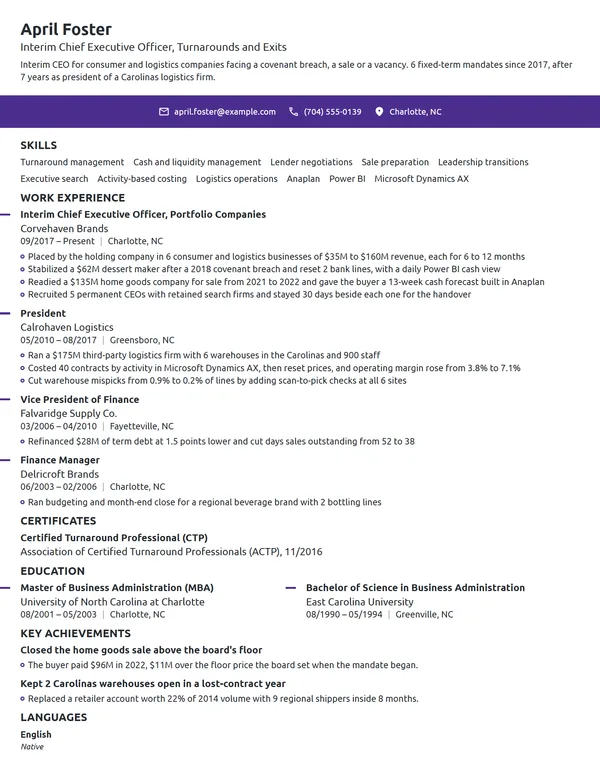
The CEO seat is filled by a board, and boards hire on track record. They read your resume for scale and outcome: the revenue and people you led, the capital you raised or returned, and the state of the business when you handed it on. After years in charge, it is easy to blur what you drove with what the market handed you, and only the first earns a line. Write those results in the numbers your board already tracks.
How to Write a CEO Resume - Key Takeaways
- Pick reverse-chronological order and 1 to 2 pages, with your current CEO role and its results in full on page 1.
- Start each top job with 1 line of context: company revenue, headcount, sites and who owned it, such as a private equity sponsor or a founder.
- Write bullets in board metrics, such as revenue, EBITDA, cash runway, capital raised and exit value, each with a before, an after and a time frame.
- List interim and founder roles as real jobs, opening with the mandate you were given or the stage the company was at.
- Put a corporate board seat in Work Experience and a nonprofit board seat under Volunteer Experience.
- Before a search firm sees it, test the file in an ATS resume checker so the headings, titles and dates parse cleanly.
What boards look for in a CEO resume
The BLS says CEOs manage company operations, formulate and implement policies, and make sure goals are met, and they typically report to a board of directors. O*NET's top tasks for chief executives are directing the organization's financial and budget activities, conferring with board members, and preparing budgets for approval. A board reading your resume is checking whether you have done that work at a company like theirs, and what happened to the business while you did it.
The BLS lists president, managing director and executive director among the other names for a CEO, so the title alone says little. Give the reader these sections, so the scale and the results are easy to find:
- Name, headline (for example, President and CEO, Building Products) and contact details with your LinkedIn URL
- A 2- to 3-sentence summary directly under the headline, which needs no section title
- Work Experience, current role first, each top job opening with the company's size and ownership
- Key Achievements, for 2 or 3 company-level results such as an exit, a turnaround or a raise
- Skills, including any system you picked or launched
- Certificates, when a credential backs the seat
- Education, highest degree first
- Optional: Volunteer Experience for nonprofit boards, Languages for international roles
Best format and length for a CEO resume
Choose the reverse-chronological resume format: current role at the top, then each earlier one with its title, company, location and the month and year you began and left. A board wants to see the run of mandates that led to this seat and how long you stayed in each, and date order shows both at a glance. A combination layout fits only a candidate coming to the CEO role from medicine, law or another profession, with the career still listed by date under the skills.
- Best for most CEOsReverse-chronologicalYour jobs, newest first, with your results under each one.Best for: A steady work history in your field
- FunctionalSkills grouped up top, with a short work history below.Best for: Gaps or very little experience
- CombinationA skills section first, then your full work history.Best for: A career change with strong skills
Most CEO candidates need a 2-page resume, while a first-time CEO with a shorter record can often keep to 1. Give your last 15 to 20 years full entries and compress anything older into 1 Earlier experience line with the role, employer and years. Page 1 should hold the headline, the summary and your current role complete with its bullets.
| Setting | What to use |
|---|---|
| Length | 2 pages for most CEOs; 1 page for a first seat or a short record |
| Headline | Seat plus sector: President and CEO, Industrial Distribution |
| Company line | Revenue, headcount and ownership: $140M, 600 employees, PE-backed |
| Dates | MM/YYYY for every role, Present for the seat you hold |
| Earlier roles | 1 Earlier experience line for jobs older than 15 to 20 years |
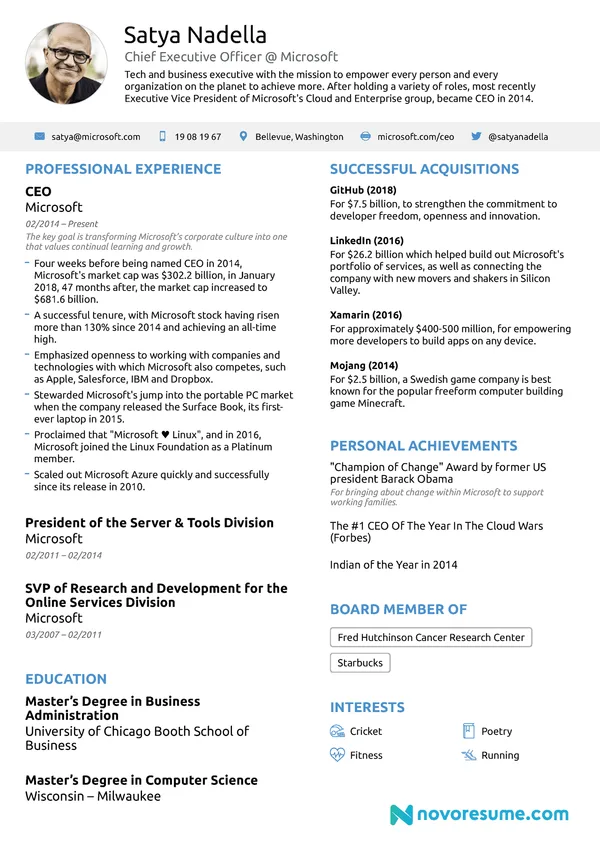
| Personal details | No photo for most US and Canadian searches; leave age, marital status and any Social Security digits off |
| File | PDF to a board or search firm, with an editable copy if the firm asks |
Most US and Canadian resumes carry no photo. Directors and search consultants will look you up anyway, so the profile they find should match the resume: follow the usual LinkedIn profile tips and check that every title and date agrees with what you send.
CEO resume summary vs. objective
If you have held a CEO, president or general manager seat with its own P&L, write a resume summary. It names the company you run, its size and owner, and 1 result from your tenure. An objective fits only someone who has never held that kind of seat, and it still needs a number. Keep either one to 3 sentences, and write it after your bullets so it borrows their best figure.
CEO resume summary formula
Title of a revenue industry company owned by ownership type. Company-level result over your tenure, with a before and an after. Deal, capital or board experience.
Example
CEO of a $260M building products manufacturer owned by a private equity sponsor. Grew EBITDA from $21M to $39M in 6 years across 3 plants. Completed 1 add-on acquisition and a 2024 recapitalization that returned 2.1x invested capital.
Don't
Strategic, people-first chief executive who builds winning cultures and delivers shareholder value.
Do
President and CEO of a founder-owned, $90M specialty chemicals company with 2 plants and 310 employees. Raised export sales to 34% of revenue in 4 years and sold 1 non-core division.
That version names the owner, the size, a result with a time frame and a deal.
How to write CEO work experience bullets with numbers
Give your current role 3 to 4 bullets and each earlier role 1 to 3. The first bullet under a top job sets the frame (revenue, people, sites, owner), and each one after it carries a result with a before, an after and the years it took. Write achievements on your resume, not the duties a board already knows a CEO has.
| Area | What to count | Example bullet |
|---|---|---|
| Growth | Revenue before and after, years, new markets | Took annual revenue from $64M to $118M in 4 years by entering federal and Canadian markets. |
| Profitability | EBITDA, operating profit, free cash flow | Turned a $5.3M operating loss into $7.9M of operating profit within 2 fiscal years. |
| Capital | Rounds closed, amount raised, months of runway | Closed a $22M Series B and extended cash runway from 9 to 30 months. |
| Exits and acquisitions | Deal value, EBITDA multiple, return to owners | Sold the company to a strategic buyer at 11x EBITDA after 6 years, 3x the entry valuation. |
| Board and investors | Board size, earnings calls, audit or covenant results | Reported to a 9-member public board through 16 earnings calls with 0 restatements. |
| Leadership team | Executives hired, months taken, engagement scores | Rebuilt an 8-person executive team in 18 months as engagement scores rose from 61 to 78. |
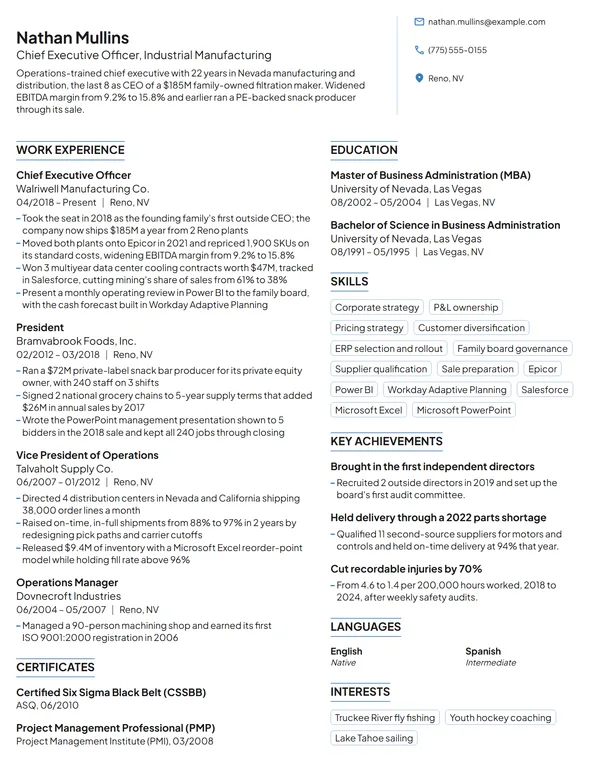
Below is one CEO's history written that way. The current role opens with its frame and the board it answers to, and the president role before it keeps 2 bullets.
Work Experience
- Lead a $260M building products manufacturer with 3 plants and 820 employees, reporting to a 7-member private equity board.
- Grew revenue from $172M to $260M in 6 years, including 1 add-on acquisition that opened 2 new states.
- Raised EBITDA from $21M to $39M by exiting 2 low-margin product lines and repricing contractor accounts.
- Led the 2024 recapitalization that returned 2.1x invested capital to the sponsor and kept the management team in place.
- Took a 4-branch distributor from a $2.4M loss to $6.1M in operating profit in 3 years.
- Opened 3 branches in Arkansas and Kansas that added $38M in annual sales.
Don't
Led the company through a period of rapid growth.
Do
Expanded a regional HVAC services company from 11 to 26 locations in 5 years, lifting revenue from $48M to $131M.
Don't
Managed relationships with the board and investors.
Do
Prepared the monthly board pack for a 5-member board and kept 3 lenders' covenants in compliance through a 2023 downturn in orders.
Name the board, the lenders and the hard moment, and the reader can judge how you handled pressure.
How to list interim, founder and startup CEO titles
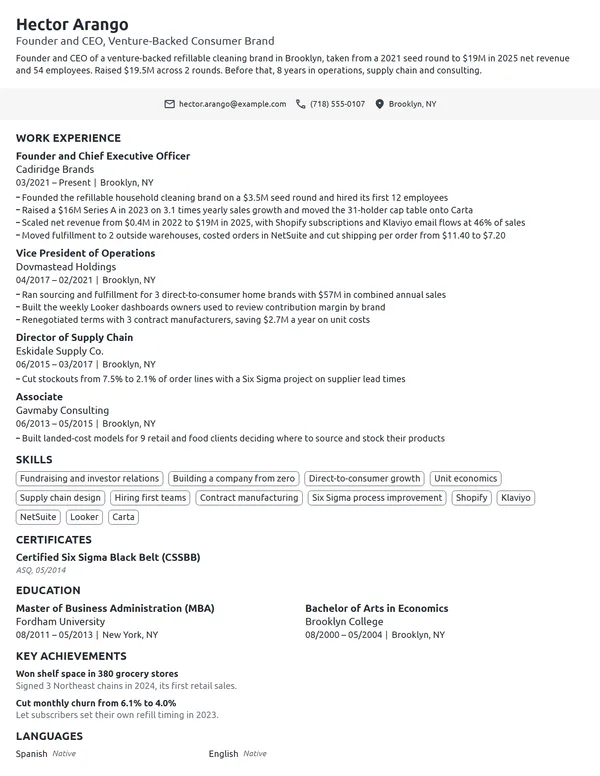
An interim CEO role is a full entry with the title Interim Chief Executive Officer, exact dates and a first bullet stating why the board brought you in and what you handed over. A founder writes Founder and CEO, and opens with the stage, funding and headcount, because readers judge a 12-person seed company and a 400-person growth company differently. If a startup closed or sold early, keep it on the page with what you built and learned in numbers; a short tenure without an explanation looks worse than an honest outcome.
CEO skills and software for your resume
Choose 6 to 8 skills named in the posting, each one backed by a result further down the page. At this level, a skill should be a business capability such as capital allocation or acquisition integration, while your leadership skills come through in what the teams under you achieved.
Hard skills for CEOs
- Corporate strategy
- P&L ownership
- Capital allocation
- Mergers and acquisitions
- Fundraising and investor relations
- Board governance
- Turnaround management
- Pricing strategy
- Enterprise risk management
- Operating cadence and KPIs
Soft skills boards value in a CEO
- Decision-making under uncertainty
- Candor with boards and investors
- Hiring and developing leaders
- Building trust across functions
- Composure in a crisis
- Focus on a few priorities
O*NET's technology list for chief executives marks Microsoft PowerPoint, Excel and Outlook as in demand, and flags SAP software, Oracle PeopleSoft and Intuit QuickBooks as hot technology. A board will assume you can use office software, so name a system only where it carried a result or you made a call about it: an ERP you chose, a planning tool you brought in, a reporting dashboard the board now reads. Whatever system you list should appear in a bullet that says what changed.
Board certifications and credentials for a CEO resume
No license makes you a CEO, so a credential earns its place only when it fits the seat. The BLS gives one case: some employers may require their chief executive officer to be a CPA. Add certifications to your resume under Certificates, naming each issuer and the month and year, and keep an operations credential such as a Six Sigma Black Belt or a PMP only when the posting stresses operations or large programs.
| Credential | Issued by | What it takes |
|---|---|---|
| NACD.DC (NACD Directorship Certification) | National Association of Corporate Directors (NACD) | A current seat on a private, public or nonprofit board, NACD membership, NACD's experience criteria, a foundation course and a comprehensive assessment, then continuing education. |
| FACHE (ACHE Fellow) | American College of Healthcare Executives (ACHE) | 1 year of ACHE membership, a master's or other post-baccalaureate degree, a current healthcare management position with 5 years of experience, 36 continuing education credits in 3 years, 4 volunteer activities, 2 references and the Board of Governors Exam. |
| CPA (Certified Public Accountant) | Your state Board of Accountancy | A state license after the CPA Exam and the state's education and experience rules; useful when a CEO seat grows out of finance. |
Keep the section to 2 to 4 lines, newest first, and drop course badges unless a posting names them.
Certificates
- NACD Directorship Certification (NACD.DC), National Association of Corporate Directors, 04/2024
- Certified Six Sigma Black Belt (CSSBB), ASQ, 08/2011
How to list an MBA and other degrees on a CEO resume
The BLS says top executives typically need at least a bachelor's degree and considerable work experience, and that those at large corporations may have an MBA. When listing education on a resume at CEO level, write the degree, the school, the city and the graduation month, highest degree first, with no GPA, coursework or high school.
A business school's executive program belongs under Education too, with its full program name and the year you finished. Education sits at the end of a CEO resume unless the posting names a degree.
Education
First-time CEO and career-change CEO resumes
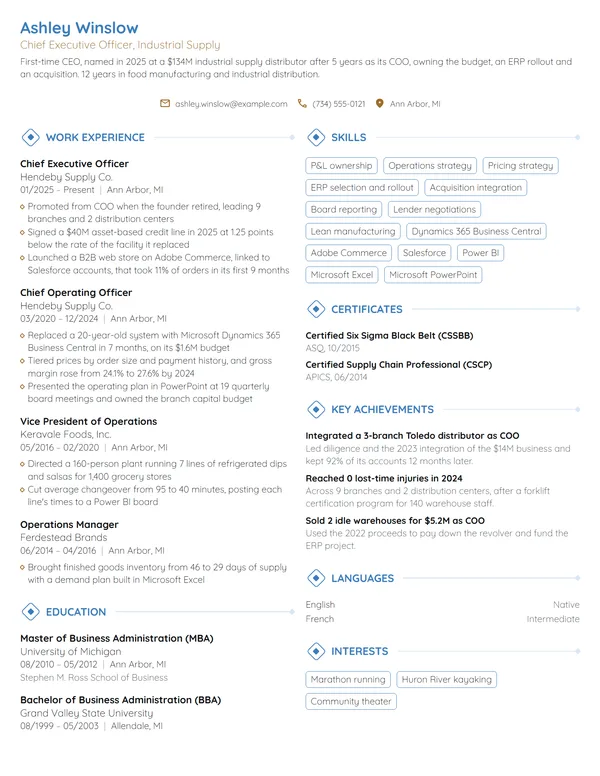
The BLS says many top executives advance within their own organizations, and that chief executives typically need extensive managerial experience. For a first CEO seat, often from a COO, CFO or division president role, the resume has to show you have already carried company-level weight. Bring this evidence into your summary and the first bullets of your current role:
- A P&L of your own: the revenue and profit you answered for, even if a CEO sat above you.
- Time in front of the board: how many meetings you presented at, and which decisions you brought.
- Acting or interim cover: weeks or months you ran the company while the CEO was out, written as its own title.
- A deal or raise you led: an acquisition, a refinancing or a funding round, with its value.
Don't
Accomplished leader seeking my first CEO opportunity.
Do
COO with 9 years running a $210M medical supplies distributor, including 14 months as acting CEO. Seeking a first CEO seat at a private equity-backed distribution business.
An objective at this level still needs a scale, a tenure and a seat that tests the claim.
Coming from medicine, law, consulting or another profession, keep your history in date order and lead each role with its business side: budgets, teams, client results and any P&L. The career-change resume examples show how to bring those results forward. Explain the move in a short letter to the board chair or search consultant; the management cover letter examples show how to open with the problem you would solve for the company.
CEO resume FAQ
How long should a CEO resume be?
2 pages for most CEOs, and 1 page for a first-time CEO with a shorter record. Give the last 15 to 20 years full entries, put older jobs in 1 Earlier experience line, and keep your summary and current role on page 1.
Where do board seats go on a CEO resume?
A corporate or advisory board seat with real duties goes in Work Experience as its own entry, such as Independent Director, with the company, city and dates. A nonprofit board seat fits under Volunteer Experience, with any committee you chair.
How do I list an interim CEO role on my resume?
As a full job titled Interim Chief Executive Officer, with the company, its location and the months you started and finished. Open with the mandate the board gave you, such as stabilizing cash or preparing a sale, then show the results and the handover to the permanent CEO.
Can I call myself CEO on a resume if I founded a small startup?
Yes, if that was your title, but write Founder and CEO and open with the company's stage: funding raised, headcount and revenue or users. Readers trust a small company described honestly far more than a big title with no context.
How do I show a company I sold or wound down on a CEO resume?
Keep it, with the outcome in the last bullet. For a sale, give the buyer type, the multiple or the return to owners. For a wind-down, say what you returned to investors, how many staff you placed and what you would carry into the next seat.
Do you need an MBA to become a CEO?
No. The BLS says top executives typically need at least a bachelor's degree plus considerable work experience, and that those at large corporations may have an MBA. A strong P&L record counts for more, but list the MBA if you hold one.
How much does a CEO make?
Chief executives earned a median of $213,990 a year in May 2025, per the BLS. CEO pay moves with company size, sector and the bonus and equity plan, so leave it off your resume and raise it with the board or search firm.
Next steps
Start from the example nearest your seat and ownership model, keep its order, and replace every figure with your own revenue, profit, capital and team results. Build it in our resume builder or on one of our templates, then write a short cover letter to the board chair that opens with the result you are proudest of.