
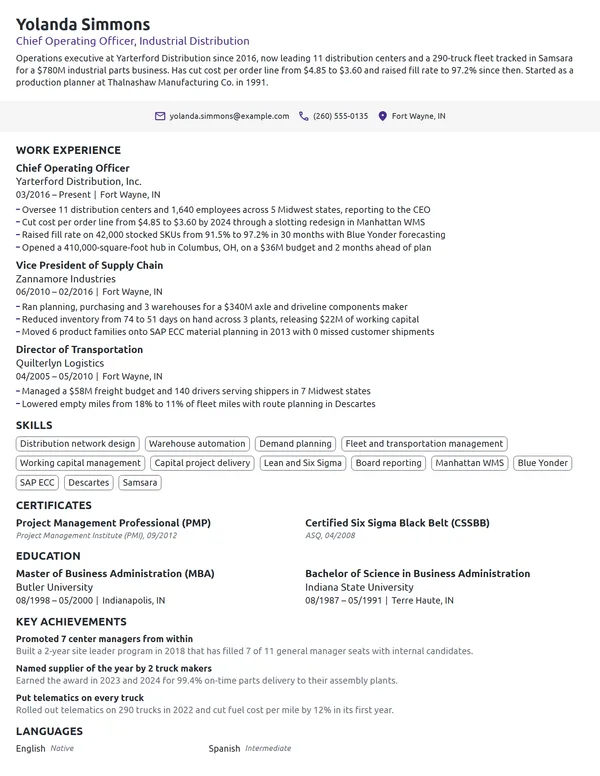
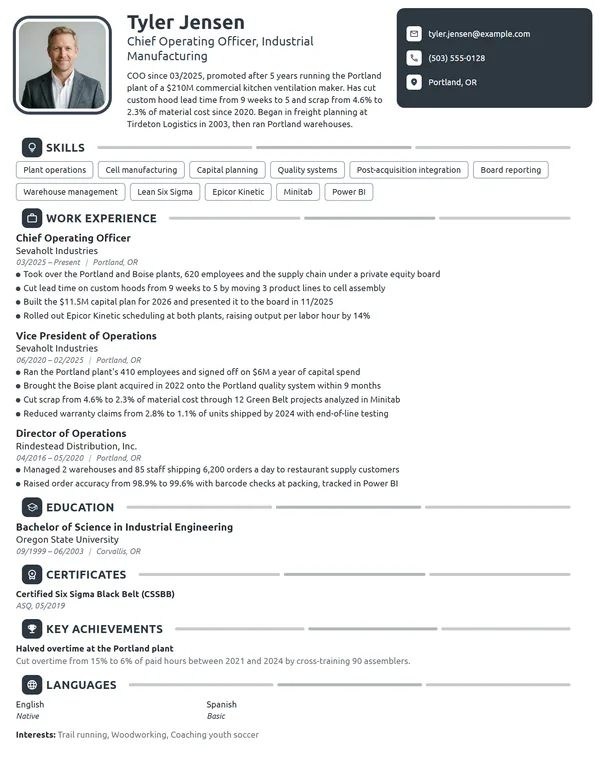
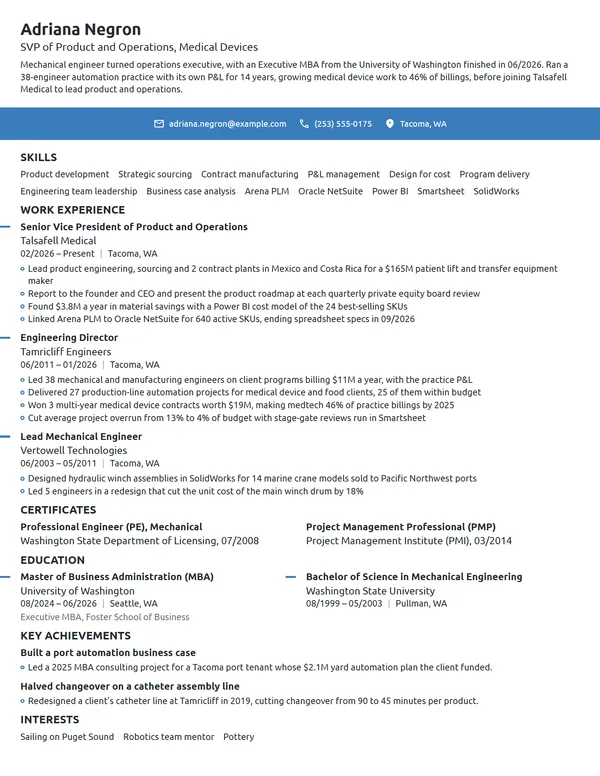
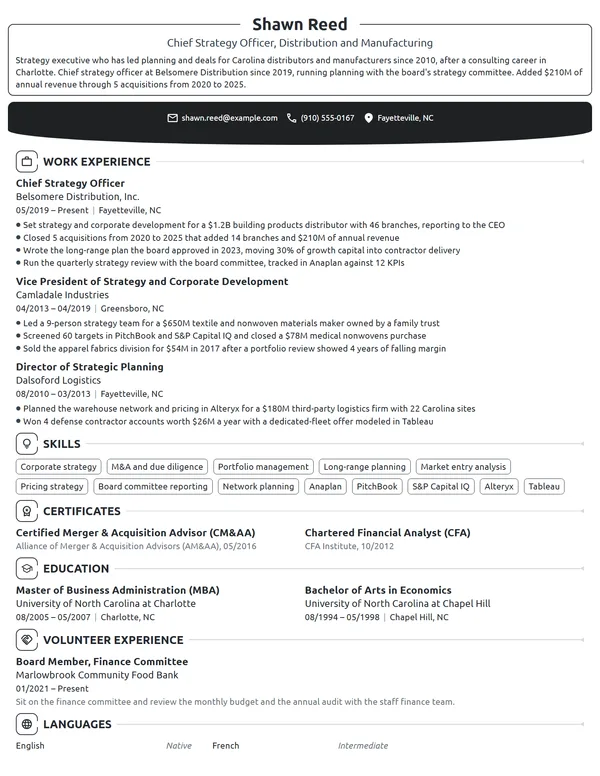
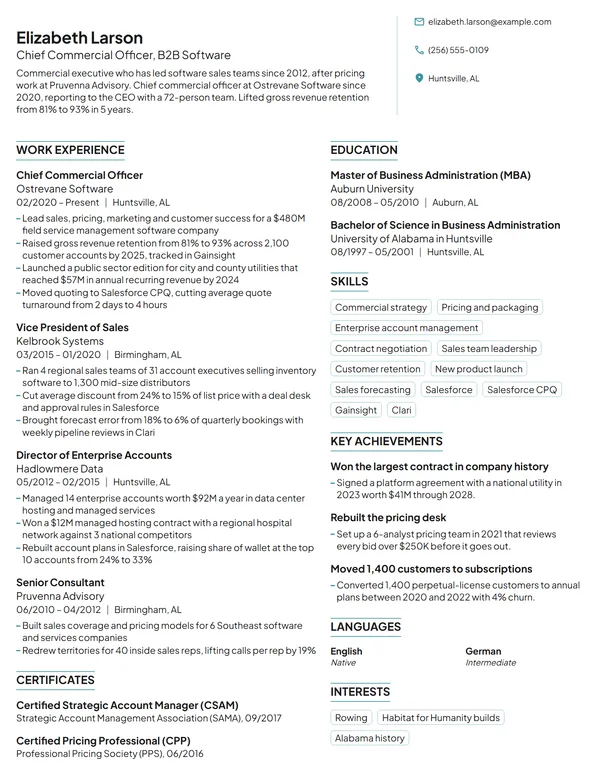
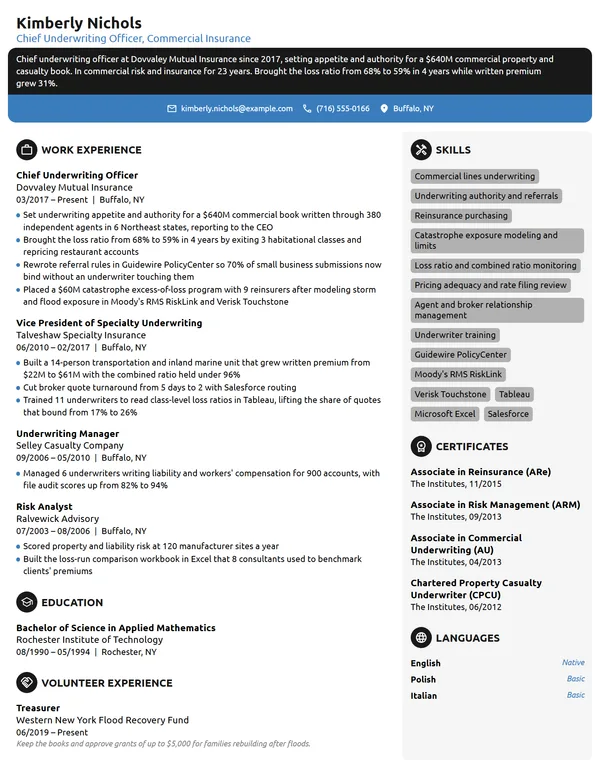
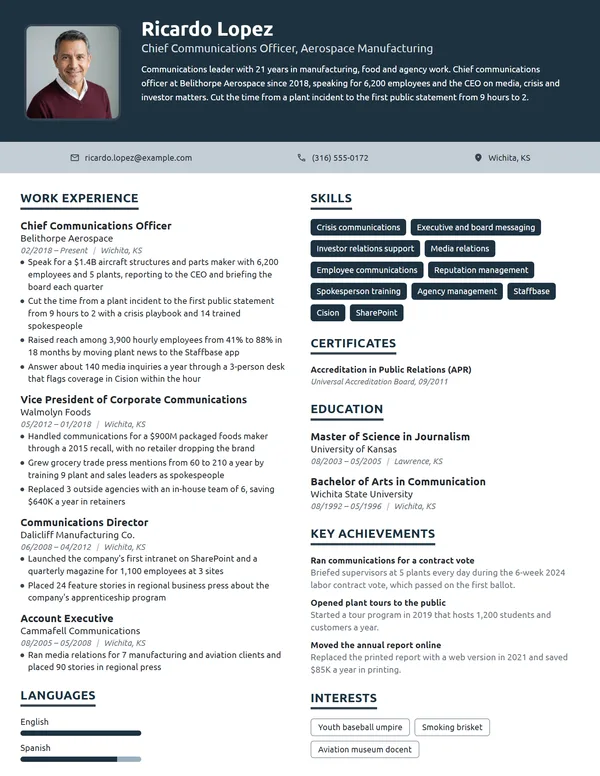
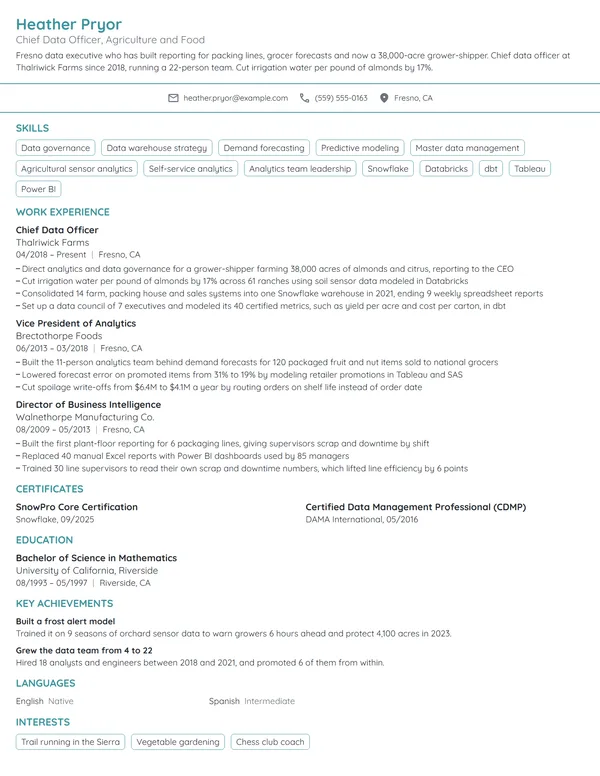
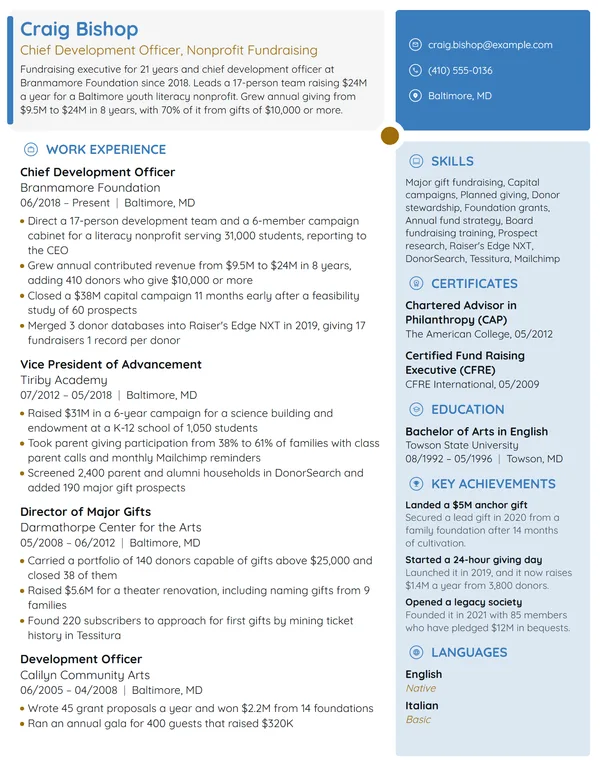
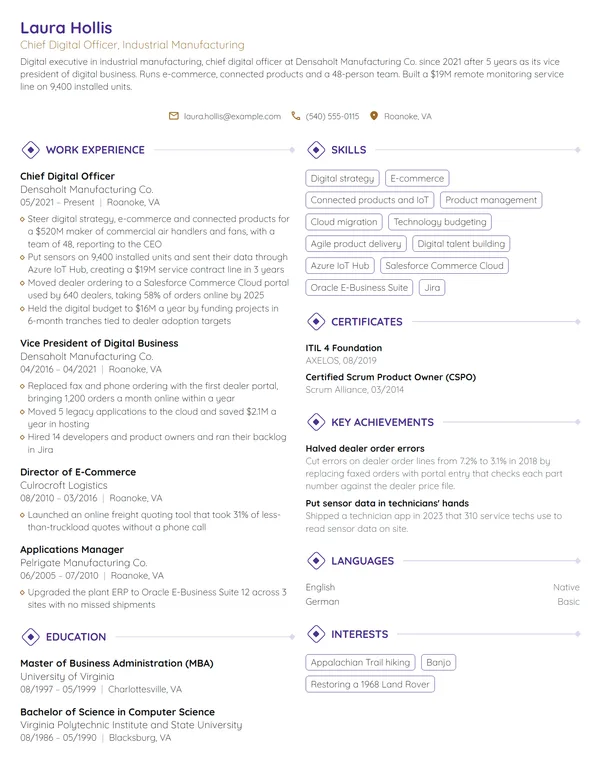
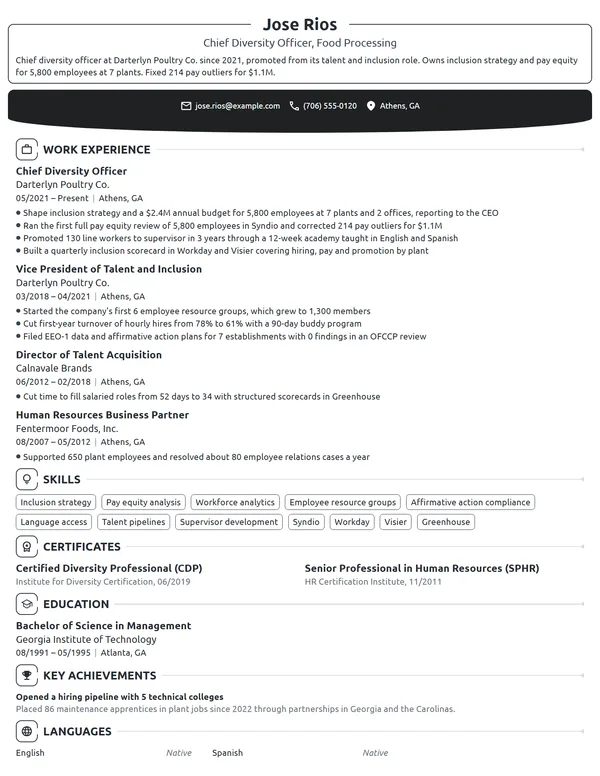
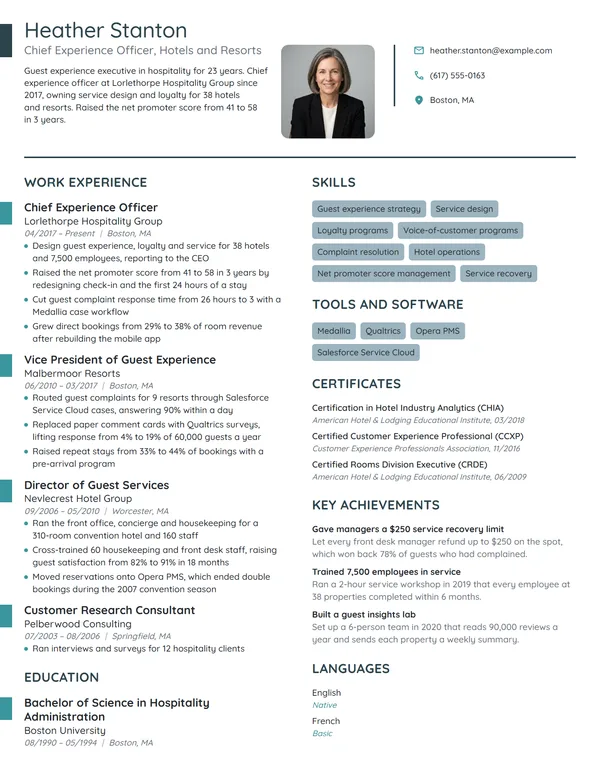
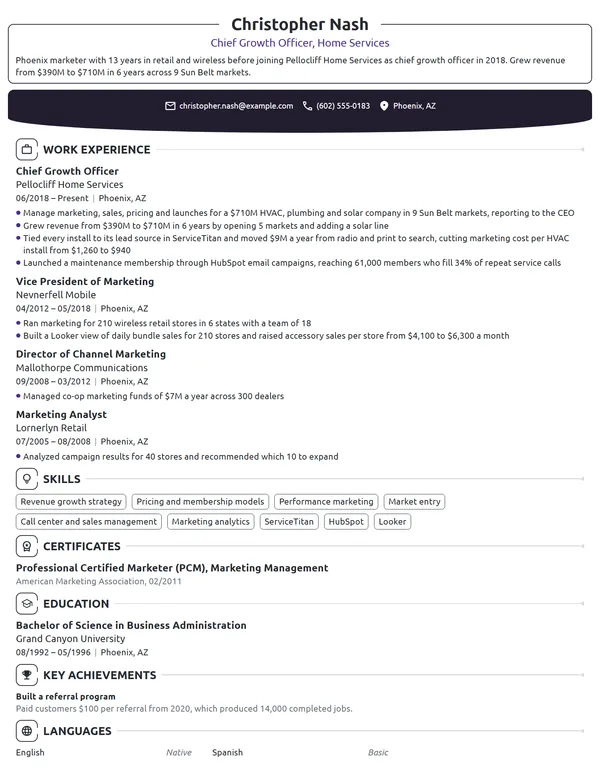
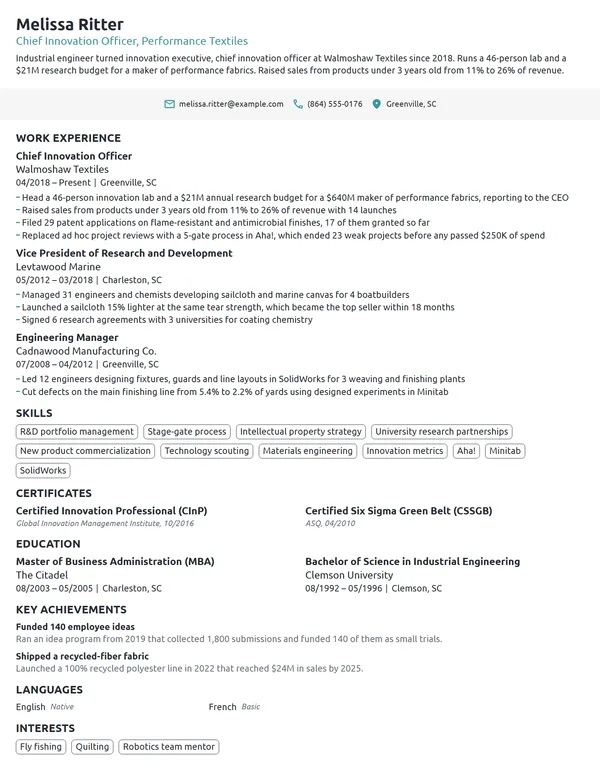
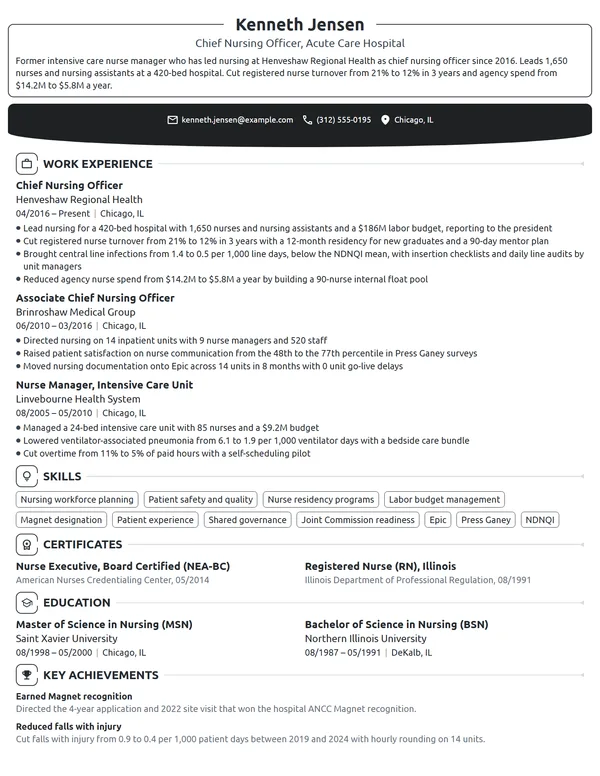
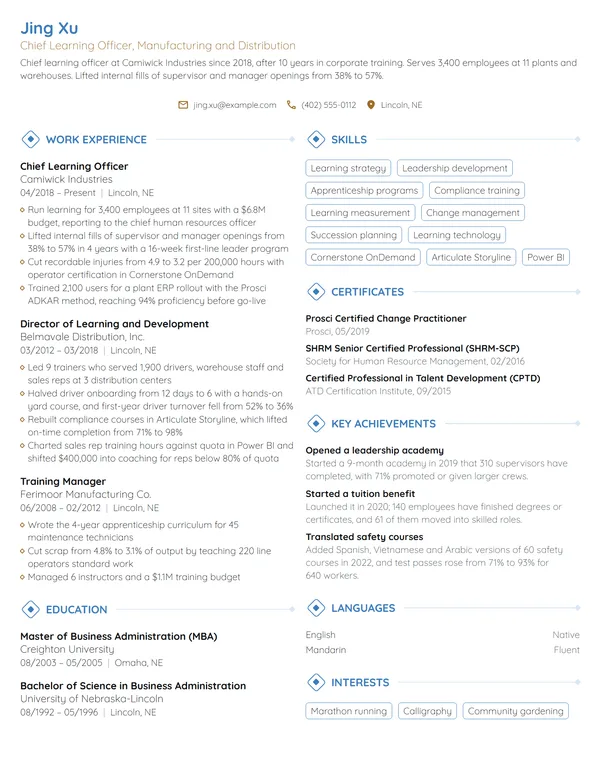
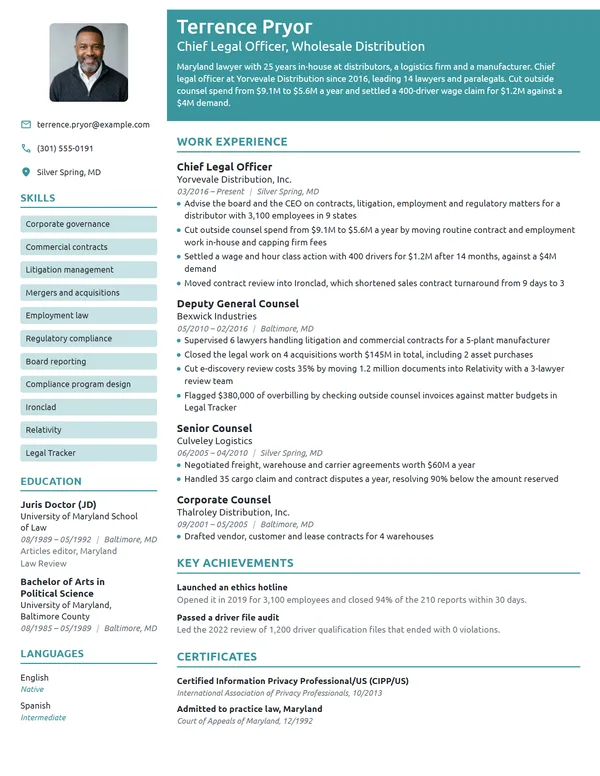
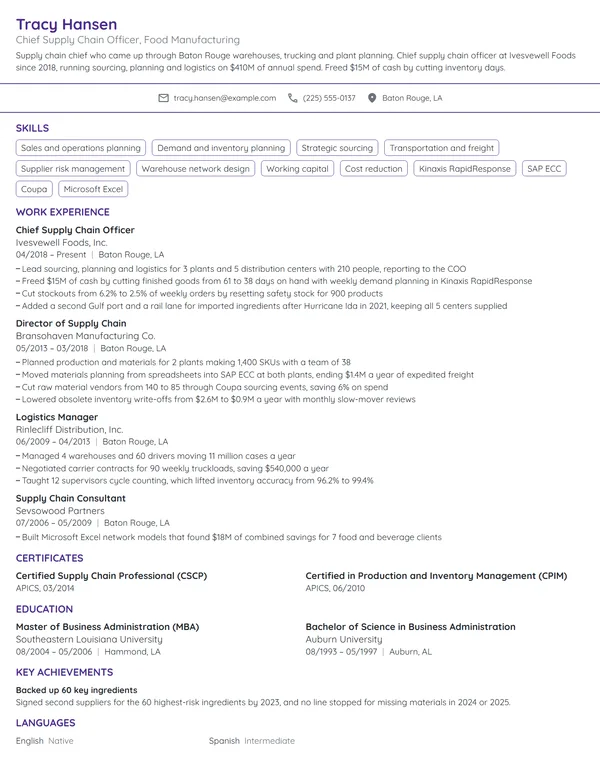
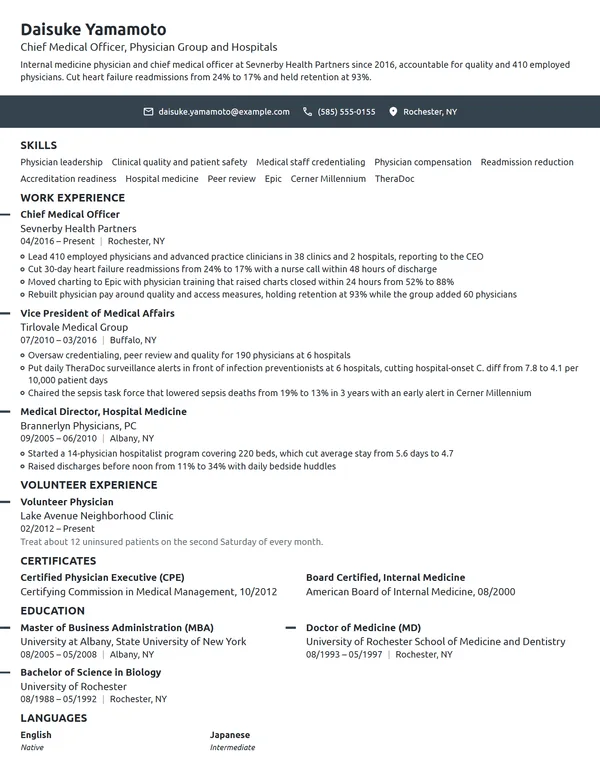
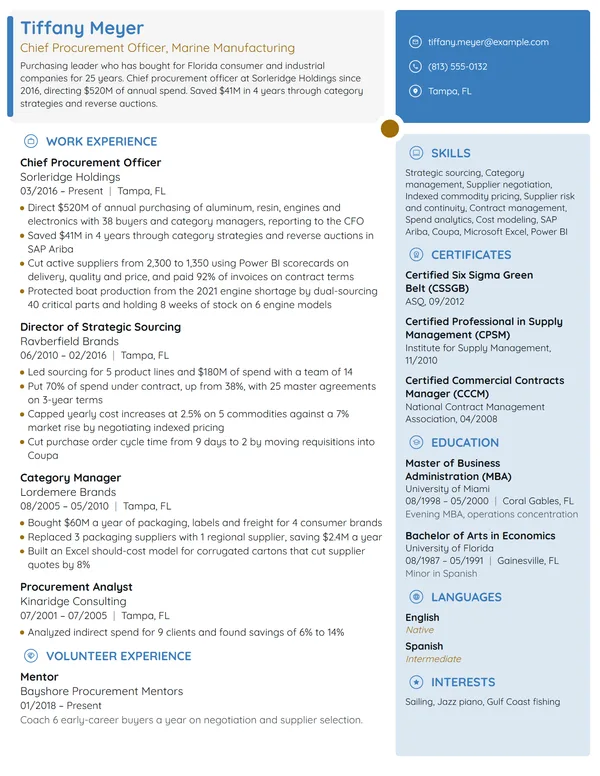
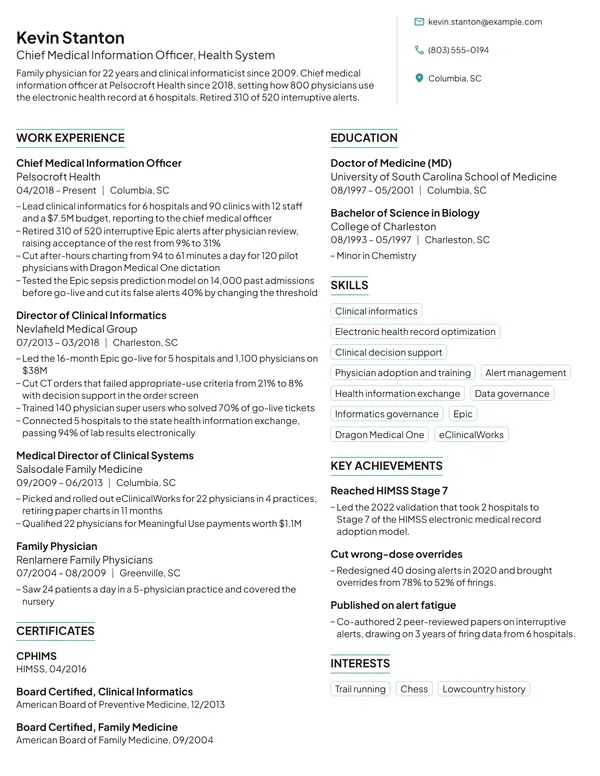
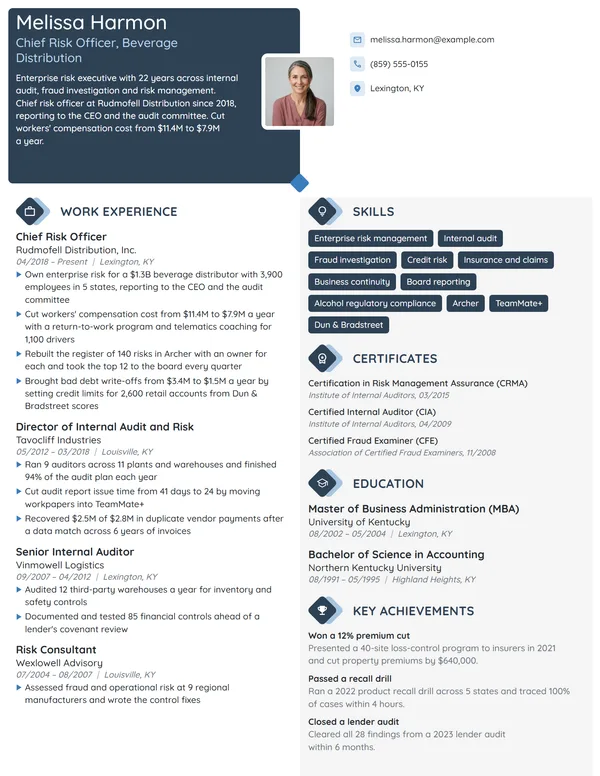
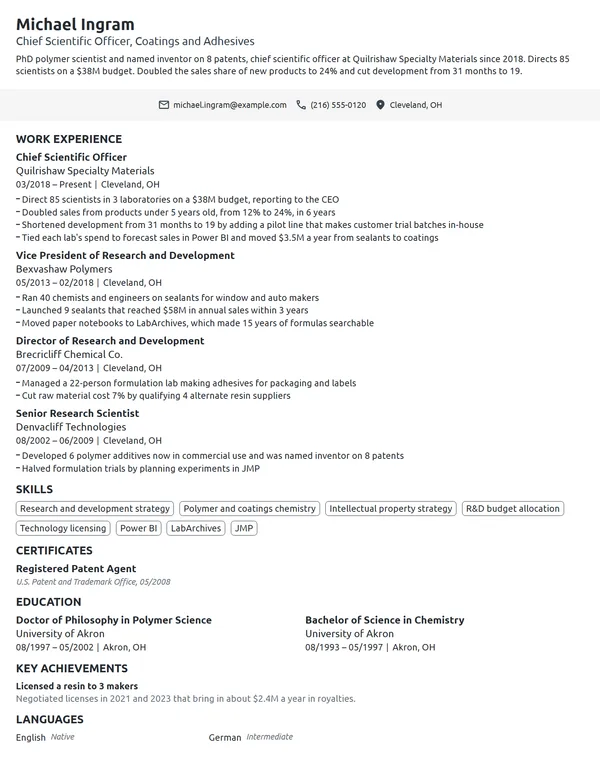
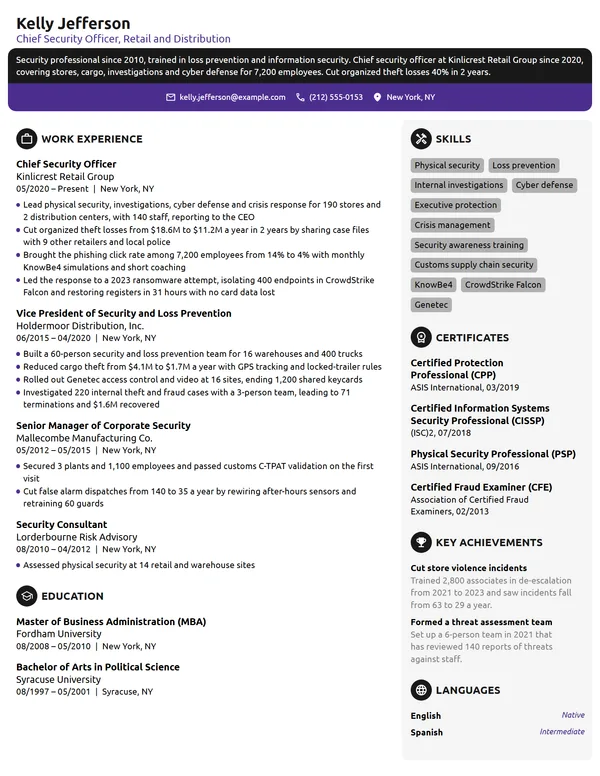
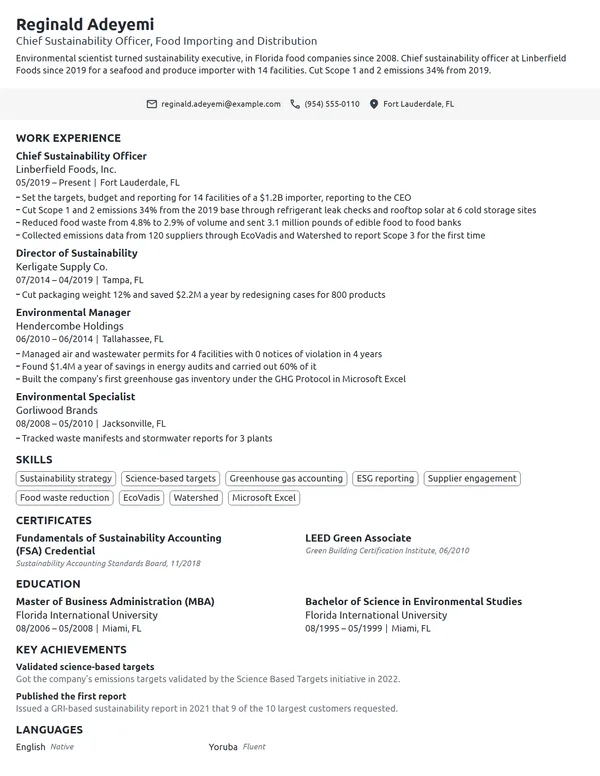
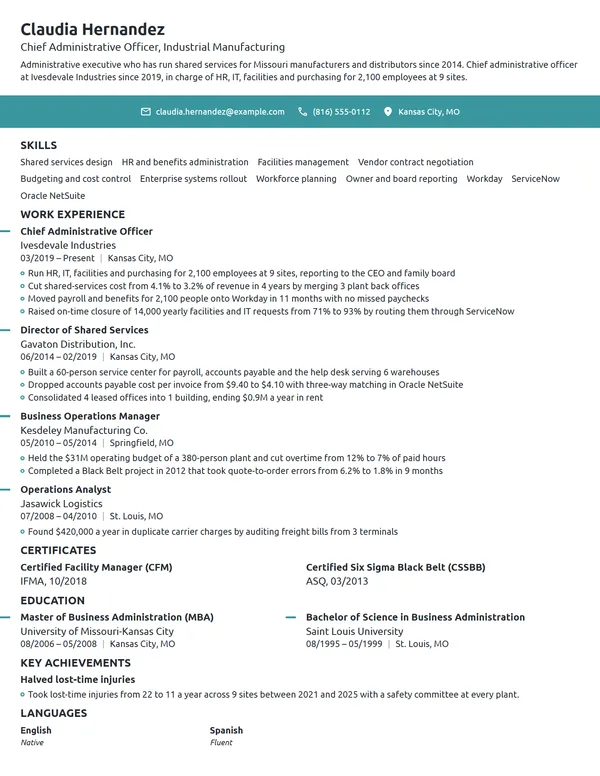
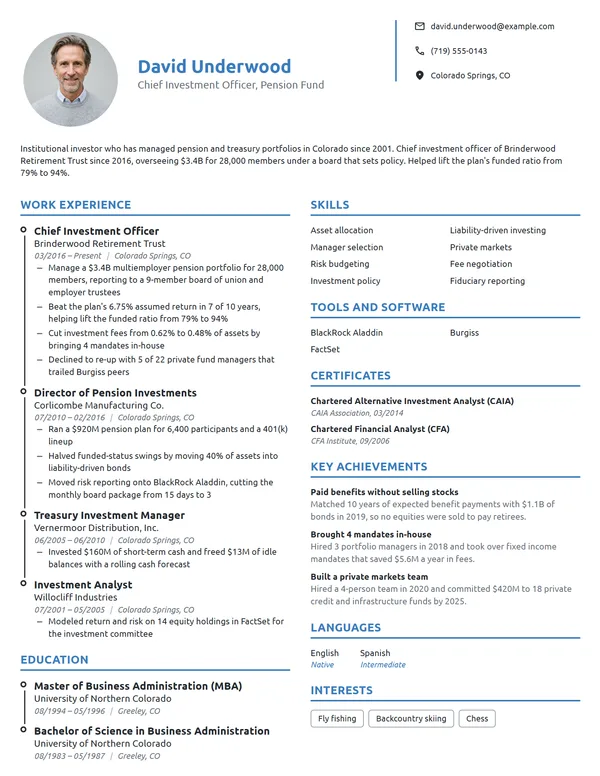
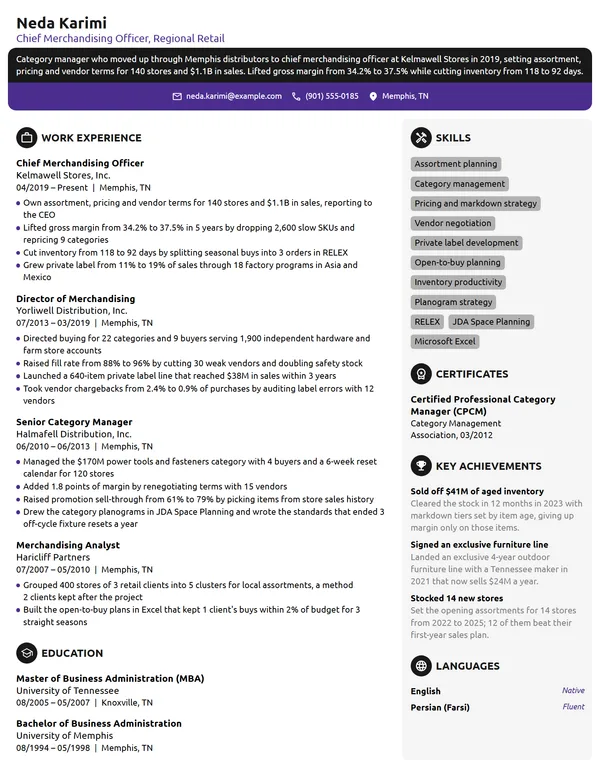
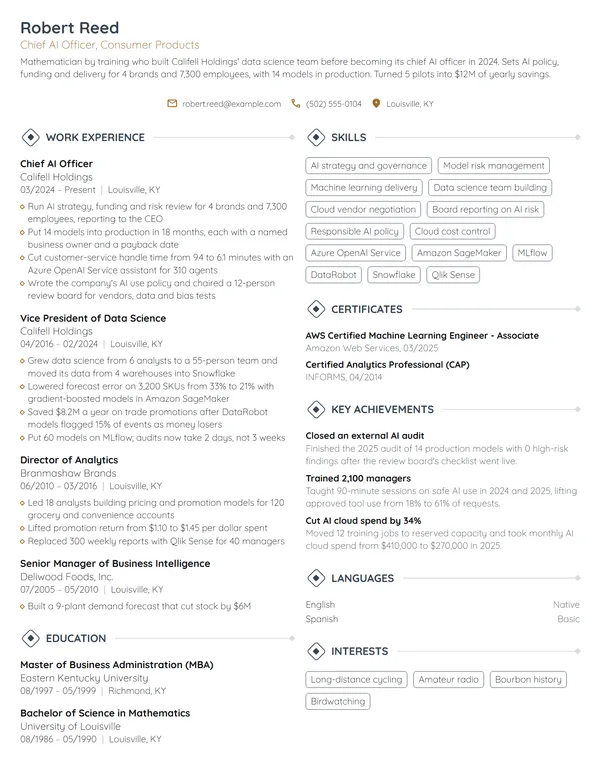
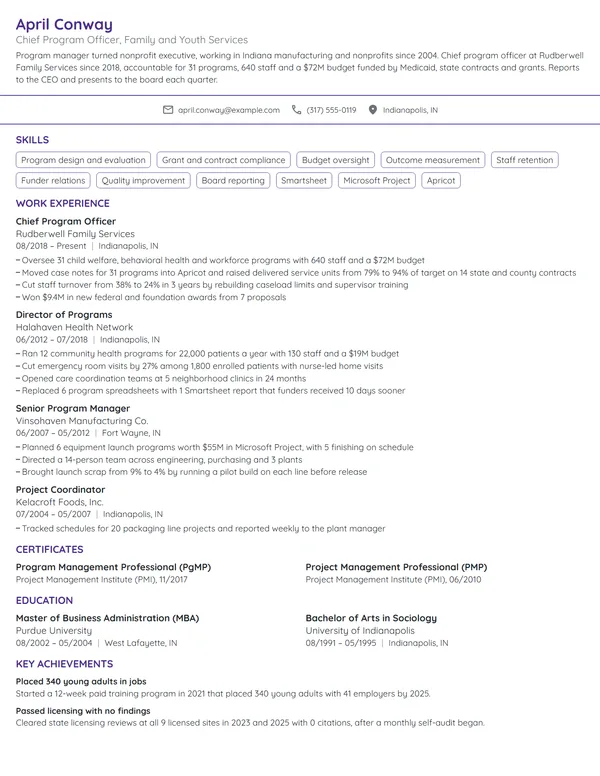
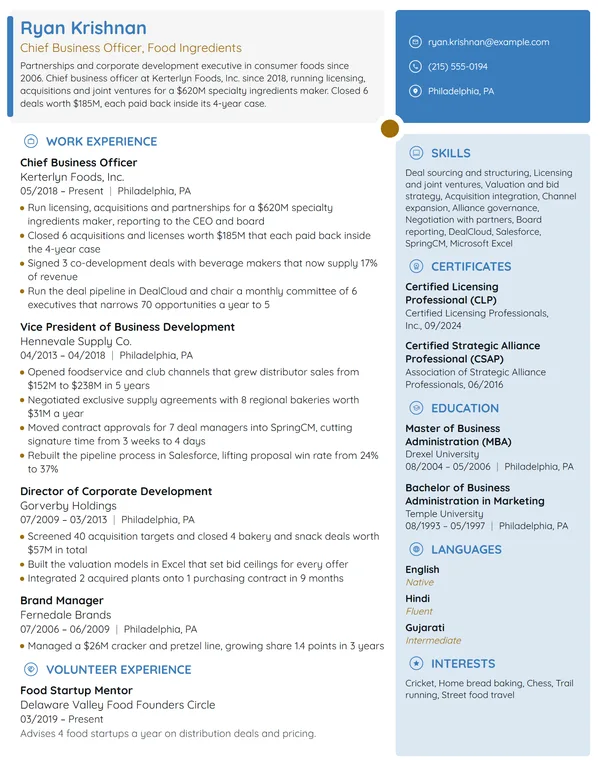
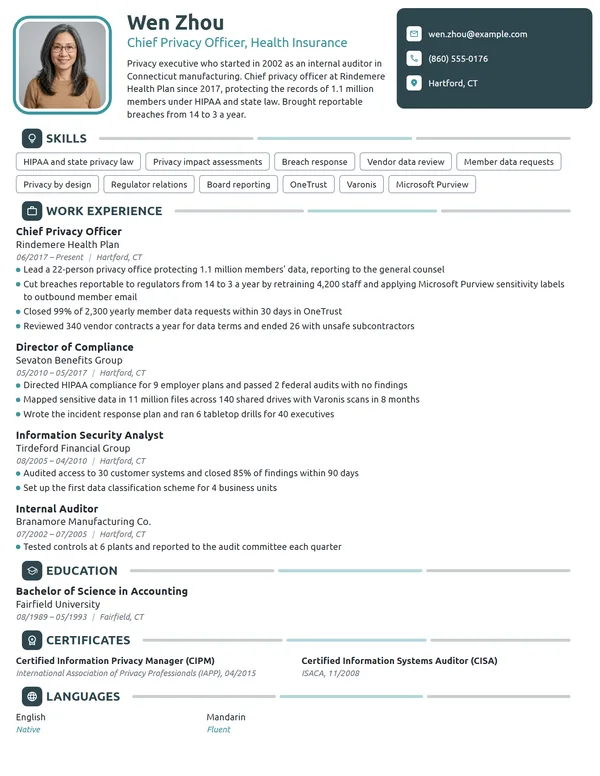
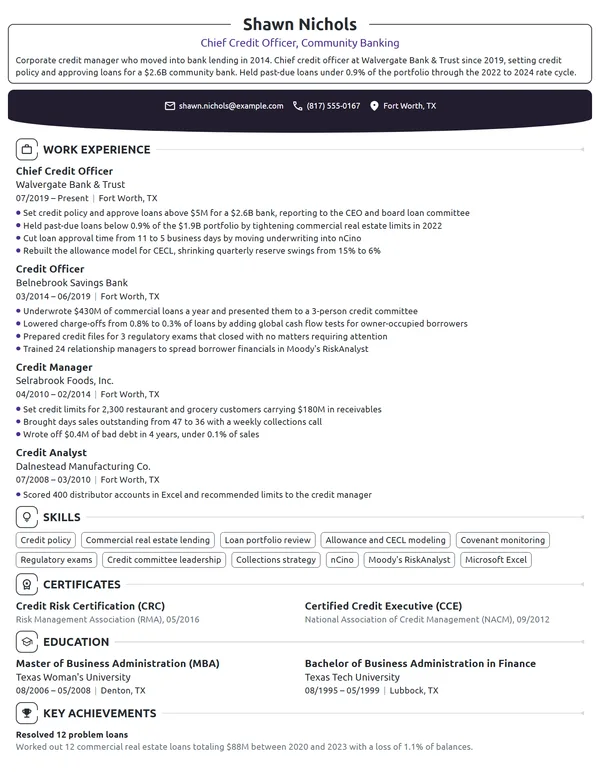
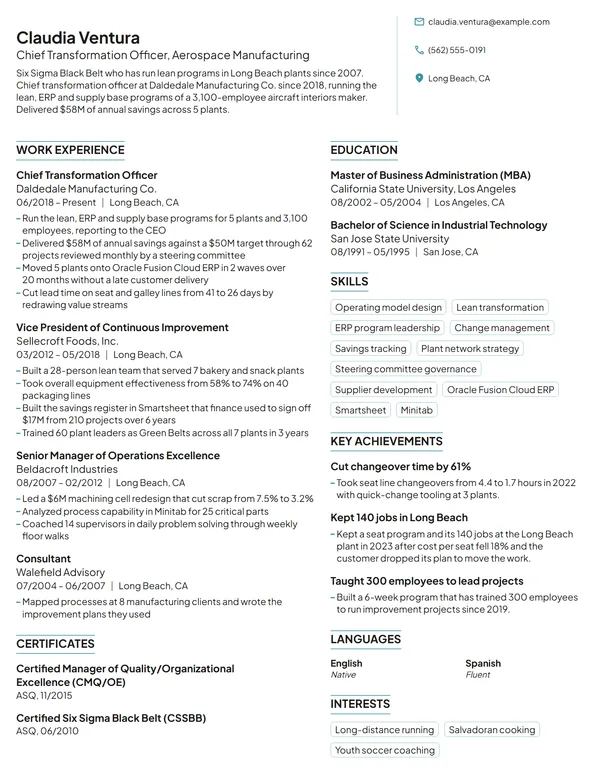
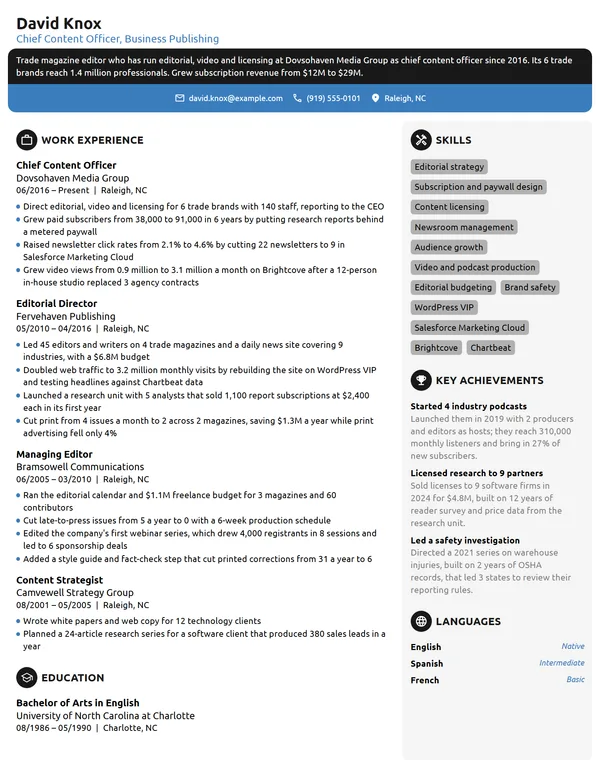
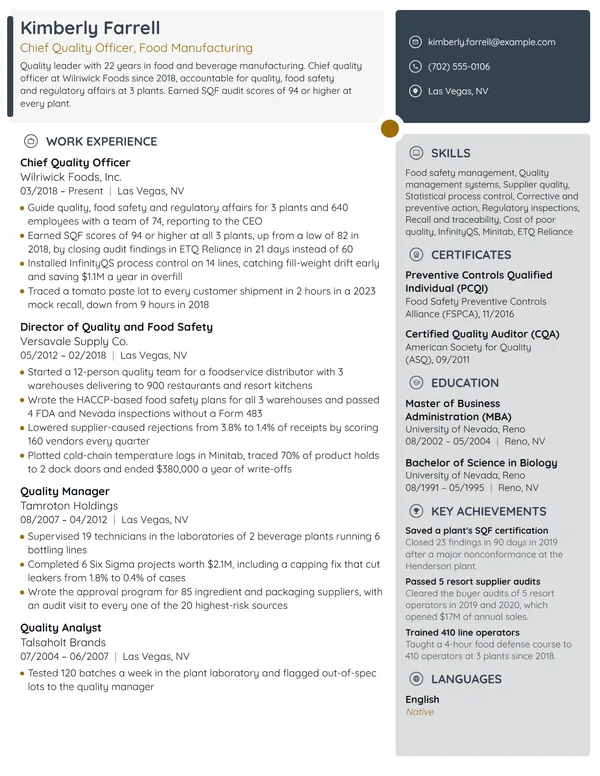
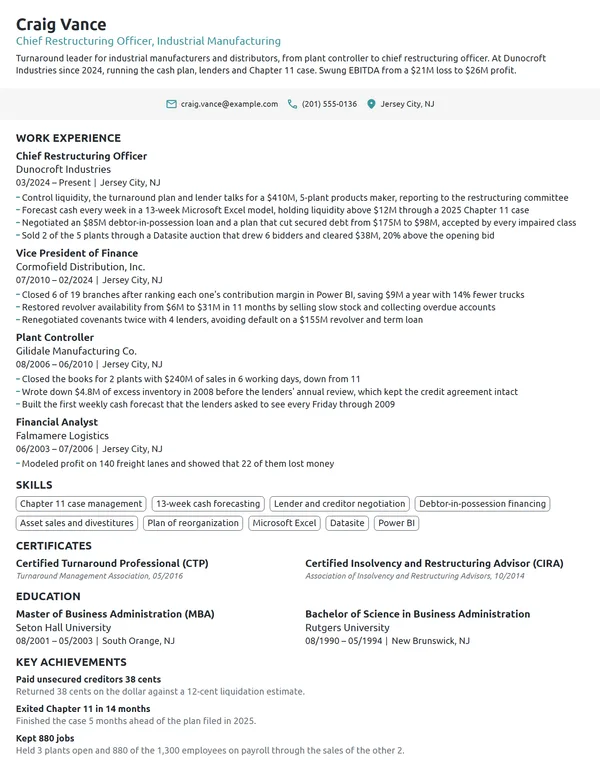
Boards, CEOs and search firms hiring an executive are deciding whether you can run part of their business, and they judge that by what you have run before. The size of what you led comes first, meaning the revenue, budget and team behind each title, followed by results that held over several years. Leadership work slips easily into phrases like "oversaw operations" or "drove strategy," which prove very little. Each title needs its scope spelled out and an outcome measured in dollars or percent.
How to Write an Executive Resume - Key Takeaways
- Use the reverse-chronological format on 1 page if your last 20 years fit, and on 2 if they do not.
- Open with a summary of 3 sentences at most: your seat, the scale you run and 1 result measured over 2 or more years.
- Start each role with a scope bullet (revenue or budget, headcount, sites, reporting line), then 2 to 3 results with a before and an after.
- Put a corporate board seat in Work Experience as its own entry and a nonprofit board seat under Volunteer Experience.
- List only the credentials that back your remit, such as PMP, CSSBB, CPA or NACD.DC, each with its issuer and date.
- Fold roles older than 20 years into 1 Earlier experience line, and run the finished resume past an ATS resume checker before a search firm sees it.
What boards and search firms look for in an executive resume
An executive resume is read for evidence that you can run a business or a function at company level. The BLS lists directing an organization's financial and budgetary activities, appointing department heads and managers, analyzing financial statements and performance indicators, and finding places to cut costs among the core duties of top executives, and notes that they often report to a board of directors. O*NET adds conferring with board members and serving on boards of directors or other governing boards.
So the reader wants 3 things fast: how big your remit was, what moved while you held it, and who you answered to. Organize the page around these sections:
- Name, headline (for example, Chief Operating Officer, Food and Consumer Goods) and contact details, with your LinkedIn URL
- Summary: up to 3 sentences under the headline, printed without a section heading
- Work Experience, current role first, each role opening with its scope
- Skills, with the systems you chose or rolled out
- Certificates, when a credential backs your remit
- Education, highest degree first
- Optional: Key Achievements or Volunteer Experience, plus Languages for international roles
Best format and length for an executive resume
Use the reverse-chronological resume format, with your current role on top and each entry giving your title, the company and its city, plus start and end months as MM/YYYY. A board reads an executive career as a sequence of bigger mandates, and date order shows each step and how long you stayed. A combination layout makes sense only if you are entering the executive suite from a different field, and your history still runs in date order below the skills.
- Best for most executivesReverse-chronologicalYour jobs, newest first, with your results under each one.Best for: A steady work history in your field
- FunctionalSkills grouped up top, with a short work history below.Best for: Gaps or very little experience
- CombinationA skills section first, then your full work history.Best for: A career change with strong skills
Keep it to 1 page when your last 20 years fit with their results; a 2-page resume is fine for a long executive record, as long as page 1 holds your summary and your current role in full. Older jobs do not need full entries: fold everything before your last 20 years into 1 Earlier experience line with the title, the employer and the years.
| Setting | What to use |
|---|---|
| Length | 1 page if your last 20 years fit on it; 2 pages when they do not |
| Headline | Your seat plus your sector or remit: Chief Operating Officer, Food and Consumer Goods |
| Dates | MM/YYYY for each title, with Present for the seat you hold today |
| Older roles | 1 Earlier experience line for jobs before your last 20 years: title, employer, years |
| Personal data | No photo for most US and Canadian applications; no date of birth, family status or SSN |
| File type | PDF, plus an editable copy when a search firm asks for one |
Most US and Canadian resumes carry no photo. Use the top of the page for a headline that names your seat and sector instead, and add your LinkedIn URL to the contact line so the titles and dates there can be checked against the resume.
Executive resume summary vs. objective
Apply one test: if you have already held a VP, general manager or C-level seat, write a resume summary that names the seat, the size of the business and your strongest multi-year result. Write an objective only if you are moving into an executive role from another field, and give it the same evidence a summary would carry. Either way, stop at 3 sentences and take its number from your bullets.
Executive resume summary formula
Executive title of a revenue or size industry company, accountable for P&L, people or sites. Your biggest result over 2+ years, with a before and an after. The seat or remit you want next.
Example
Chief operating officer of a $310M food manufacturer, accountable for 4 plants and 1,150 employees. Raised EBITDA margin from 9.1% to 13.4% in 3 years while revenue grew 22%. Ready to run a multi-site business as president or CEO.
Don't
Dynamic, visionary executive with a proven track record of driving growth and leading high-performing teams.
Do
Took a $140M medical device distributor from a $3.2M operating loss to $9.8M in operating profit in 2 years as president, leading 6 branches and 430 employees under a private equity board.
Seat, size, turnaround and governance, all in 1 sentence.
How to write executive work experience bullets with numbers
Under your current role, write 3 to 4 bullets; earlier roles get 2 to 4. The first bullet sets the scope, and each one after it states a result with a before, an after and a time frame. Pick numbers your CFO or board already reports, and write achievements on your resume instead of the duties in your job description.
| Area | What to count | Example bullet |
|---|---|---|
| Revenue and growth | Revenue before and after, years taken, new markets or channels | Grew revenue from $118M to $176M in 4 years by opening 2 regional markets and a distributor channel. |
| Profit and margin | Gross margin, EBITDA, operating income | Lifted gross margin from 31% to 36% by repricing 1,800 SKUs and exiting 2 loss-making product lines. |
| Cost | Spend under management, savings per year | Took $14M a year out of $190M in supplier spend by consolidating freight and packaging vendors. |
| People | Direct reports, total headcount, regretted attrition | Led 12 direct reports and an organization of 2,400 while regretted attrition fell from 14% to 6%. |
| Deals and capital | Acquisitions, deal value, months to integrate | Integrated 3 acquisitions worth $95M onto 1 ERP and 1 sales team within 18 months. |
| Governance | Board meetings, committees, audit results | Presented operating results at 11 board meetings a year; 2 external audits closed with 0 material weaknesses. |
One executive's history, built the same way: the current role opens with its scope and reporting line, and the VP role below it keeps 2 bullets.
Work Experience
- Run 4 plants, 1,150 employees and a $42M capital budget for a $310M food manufacturer, reporting to the CEO.
- Raised EBITDA margin from 9.1% to 13.4% in 3 years by closing 1 plant and moving its 2 lines into the other 3.
- Lifted on-time-in-full delivery from 86% to 97% for the 3 largest grocery accounts.
- Led the $27M move to SAP S/4HANA across all 4 plants, live in 14 months.
- Took plant utilization from 68% to 84% across 2 plants with a 3-shift production plan.
- Negotiated a 5-year, $64M resin supply contract that capped price increases at 3% a year.
Don't
Responsible for all regional operations and P&L.
Do
Ran a $230M P&L across 64 stores and 9 regional managers, cutting shrink from 2.1% to 1.2% in 2 years.
Don't
Worked with banks to improve the company's financing.
Do
Refinanced a $48M term loan with 3 lenders, saving $1.9M a year in interest and pushing maturity out to 2031.
A finance result reads best as the deal size, the counterparties and the yearly saving.
How to list several titles at one company
A promotion is evidence on its own, so never merge it into your latest title. Give each title its own line and MM/YYYY dates under the company, such as Director of Operations from 02/2011 and VP of Operations from 04/2014, with 2 to 4 bullets for each. If an earlier title sits beyond your last 20 years, it can share the Earlier experience line.
Executive skills and software for your resume
List 6 to 8 skills named in the job ad, each one backed somewhere by a bullet. At this level a skill should name a business capability, such as capital allocation or acquisition integration, and your leadership skills show best through the results under each role rather than as adjectives in a list.
Hard skills for executives
- P&L management
- Strategic planning
- Budgeting and capital allocation
- Acquisition integration
- Board and investor reporting
- Organizational design
- Operational turnaround
- Pricing strategy
- Enterprise risk management
- Change management
Soft skills boards look for
- Decision-making with incomplete data
- Executive presence
- Negotiation with partners and lenders
- Developing successors
- Plain-spoken communication
- Accountability for results
O*NET's technology list for chief executives marks Microsoft Excel, PowerPoint and Outlook as in demand, and SAP software, Oracle PeopleSoft and Microsoft Project as hot technology. Executives rarely need to list office software, so name a system when you owned a decision about it: an ERP rollout, a planning tool you introduced, or the board reporting pack you built. Any tool you put in Skills should also turn up in a bullet about what you changed with it.
Certifications for executives: PMP, Six Sigma, CPA and NACD.DC
Executive roles carry no license of their own, so a credential earns its line only when it backs your remit: the PMP for large programs, a Six Sigma Black Belt for operations, the CPA for finance seats, and the NACD Directorship Certification once you sit on boards. The BLS gives one example: some employers may require their chief executive officer to be a certified public accountant (CPA). Put certifications on your resume with the issuer and the month and year you earned each one.
| Credential | Issued by | What it takes |
|---|---|---|
| PMP (Project Management Professional) | Project Management Institute (PMI) | With a bachelor's degree, 3 years of experience managing projects and 35 hours of project management training, then the exam. |
| CSSBB (Certified Six Sigma Black Belt) | ASQ | 3 years of full-time, paid work in areas of the CSSBB Body of Knowledge, at least 1 completed Six Sigma project with a signed affidavit, and a 165-question exam. |
| CPA (Certified Public Accountant) | Your state Board of Accountancy | A state license, issued after the CPA Exam and your state's education and experience rules; most relevant for CFO and finance seats. |
| NACD.DC (NACD Directorship Certification) | National Association of Corporate Directors (NACD) | A current seat on a private, public or nonprofit board, active NACD membership, NACD's experience criteria and a comprehensive assessment, kept current through continuing education. |
Leave off short course badges and training certificates more than 10 years old unless a job ad names them. Keep 4 credentials at most, newest first; a short list looks deliberate at this level.
Certificates
- NACD Directorship Certification (NACD.DC), National Association of Corporate Directors, 09/2025
- Project Management Professional (PMP), Project Management Institute, 10/2016
- Certified Six Sigma Black Belt (CSSBB), ASQ, 06/2012
How to list an MBA and other degrees on an executive resume
In the BLS's description, top executives usually hold a bachelor's or master's degree in an area tied to their field, such as business or engineering, and those at large corporations may have an MBA. O*NET puts chief executives in Job Zone 5, and 46% of the respondents in its education survey say the job requires a master's degree.
Put your highest degree first, then your undergraduate degree. When listing education on a resume at this level, give the degree, the school, the city and the graduation month, and drop GPA, coursework and honors. An executive education program from a business school fits here or under Certificates, with its full program name and year.
Education
First-time executive and career-change executive resumes
The BLS says many top executives move up within their own organizations from lower-level management roles, and that chief executives typically need extensive managerial experience in the organization's area of specialty. If you are stepping up from a vice president or director seat, your resume has to show you already carried company-level weight. Move this evidence into your summary and your first bullets:
- Budget or P&L ownership: the full amount you were accountable for, not only the projects inside it.
- Board or leadership-team exposure: how often you presented to the board or the executive team, and on what decisions.
- Acting or interim seats: any period you covered the role above you, written as its own title with dates.
- Company-wide programs: an ERP rollout, a reorganization or an acquisition you ran across functions.
Don't
Seasoned professional seeking an executive opportunity to apply my leadership skills.
Do
Engagement partner with 12 years leading 30 operations projects for consumer goods clients, seeking a first COO role at a mid-size manufacturer.
An objective at this level still needs a level, a volume and a named target seat.
Coming from engineering, consulting, medicine or law, keep your history in date order and open with the parts of those roles an executive owns: budgets, teams, client results and any P&L. A career-change resume works best when your summary names a new MBA or executive program and the first bullets under your newest role are its most business-facing results. The story of why you switched belongs in the letter that goes with your resume, and our management cover letter examples show how to open with the problem you solve for the employer.
Executive resume FAQ
How long should an executive resume be?
1 page if your last 20 years of roles fit on it with their results, and 2 pages if they do not. Whatever the length, page 1 should carry your headline, your summary and your current role in full.
How far back should an executive resume go?
About 20 years in full entries. Anything older goes into 1 Earlier experience line with the title, employer and years, or comes off entirely when it adds nothing to the seat you want next.
Should an executive resume have a Key Achievements section?
Yes, when you have 2 to 3 company-level results a reader should see at a glance, such as a turnaround, an acquisition or a market entry. Keep each line to 1 measured result, and word it differently from the matching bullet in Work Experience.
Where do board seats go on an executive resume?
A corporate or advisory board seat goes in Work Experience as its own entry, with a title such as Independent Director, the company, the city and the dates. A nonprofit board seat fits under Volunteer Experience. Add 1 line on any committee you sit on, such as audit or compensation.
How do I show several promotions at the same company?
Write the company once and list every title under it with its own MM/YYYY dates and 2 to 4 bullets. Keeping each step visible shows a reader that the company trusted you with more, which a single merged title hides.
Can I list a private company's revenue on my resume?
Yes, in a form your confidentiality agreement allows. Use a rounded size, such as a $300M+ manufacturer, and write results as percentages or before-and-after changes. Leave out any figure your employer treats as confidential.
Do I need an MBA to become an executive?
No. The BLS gives a bachelor's or master's degree related to the field, such as business or engineering, as the usual route, and says executives of large corporations may have an MBA. In O*NET's survey for chief executives, 46% of respondents say a master's degree is required, so list one if you have it.
Should I write an executive resume differently for a search firm?
No, the content stays the same. Send a PDF unless the firm asks for an editable file, and expect the consultant to rebuild it in the firm's own layout for the client. Make every scope line and date exact, since they get checked against your LinkedIn profile and references.
How much do chief executives earn?
The median annual pay for chief executives was $213,990 in May 2025, according to BLS wage data. Pay varies with company size, industry and bonus or equity terms, so leave compensation off your resume and discuss it with the search firm or in the interview.
Next steps
Start from the example that matches your seat and swap in your own scope lines, figures and dates. Our resume builder or any of the resume templates sets the layout, so your effort goes into the scope line and the results under each role. Pair it with a letter that opens on the problem you were hired to fix last time.