
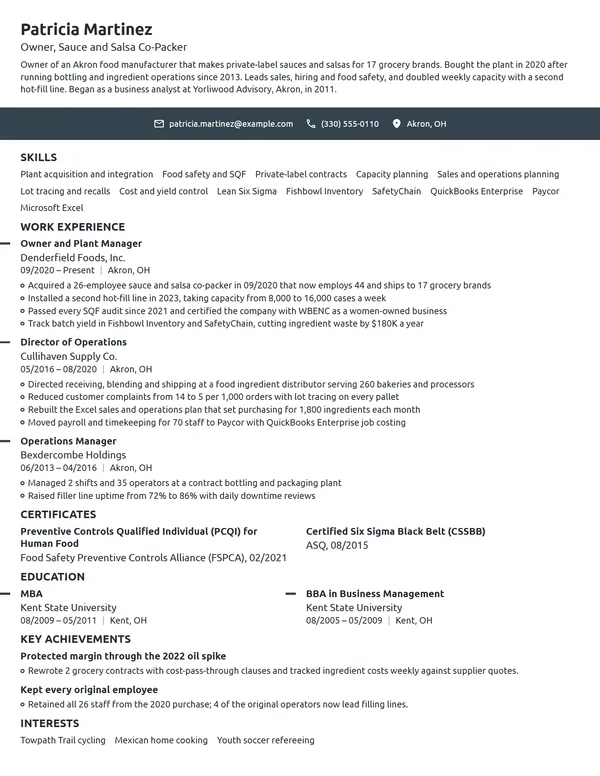
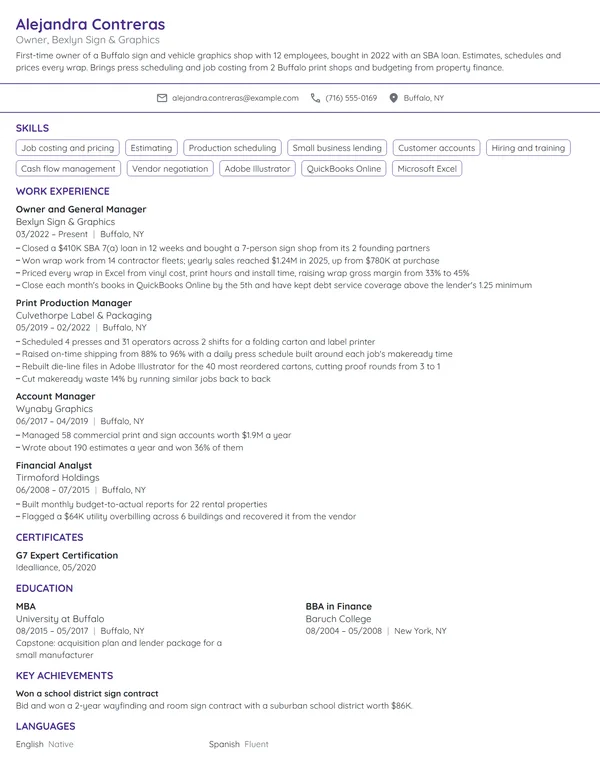
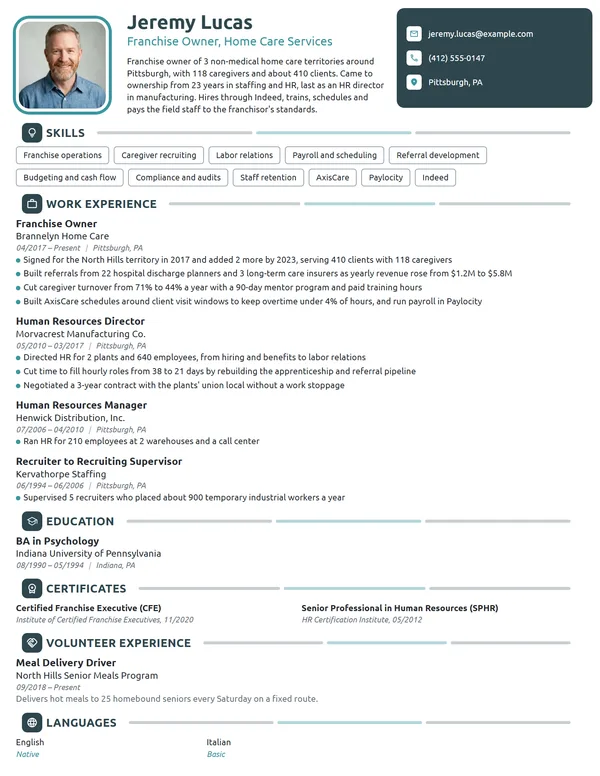
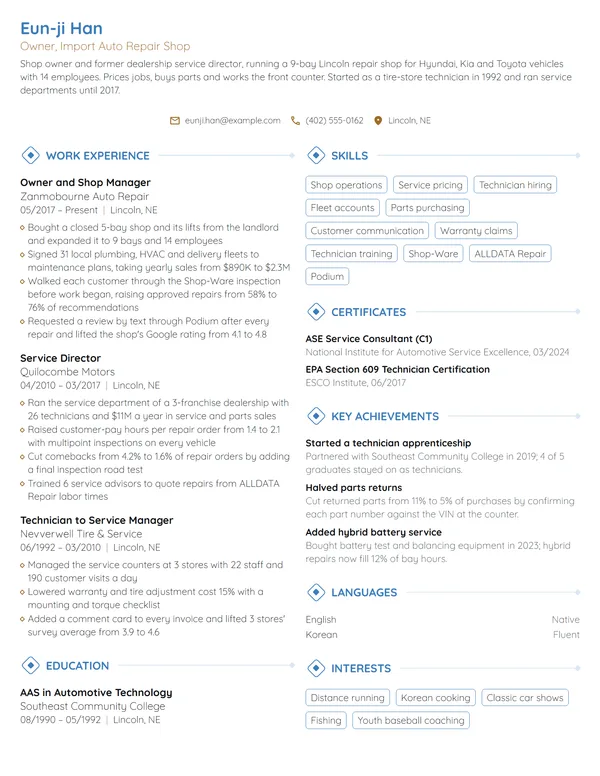
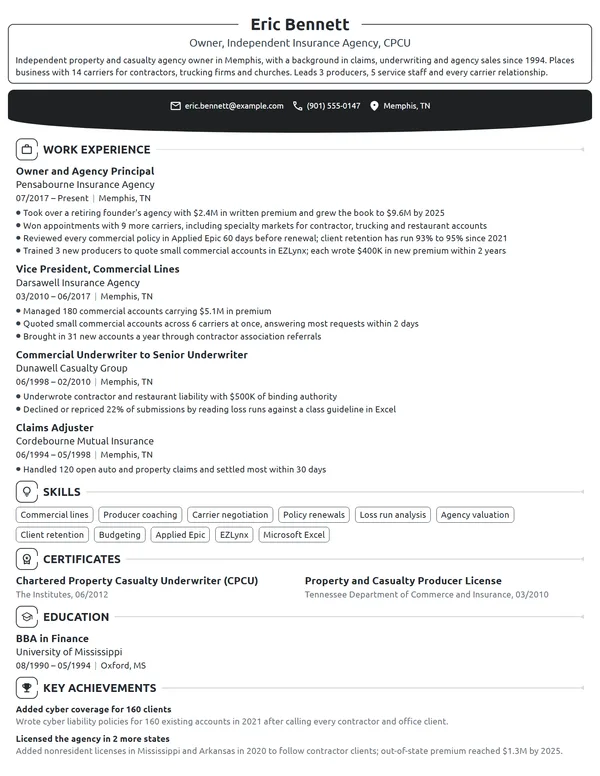
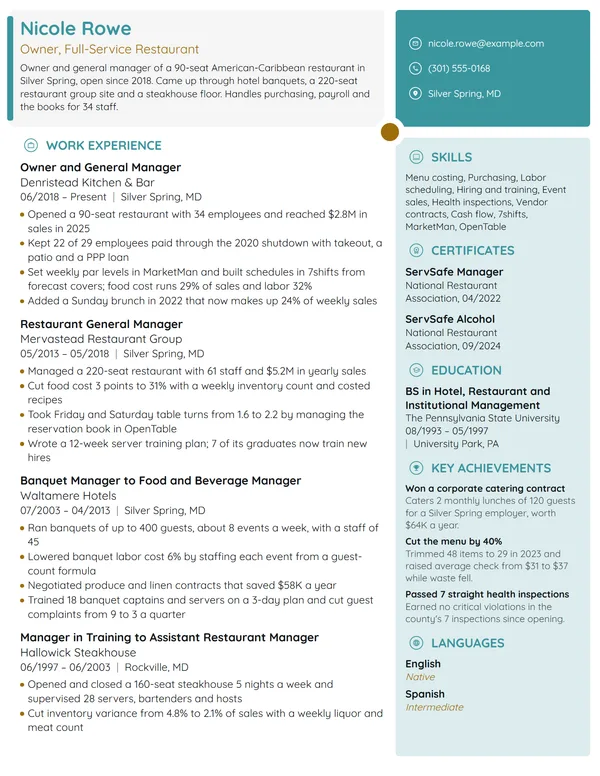
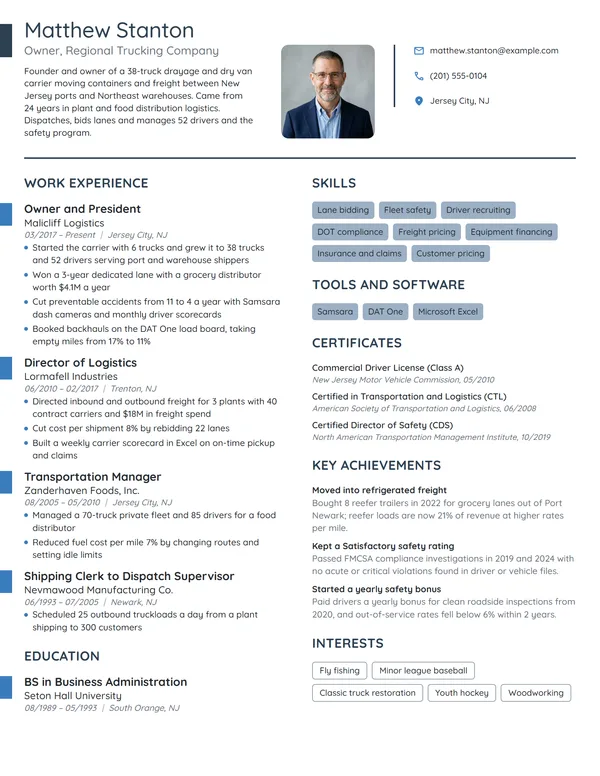
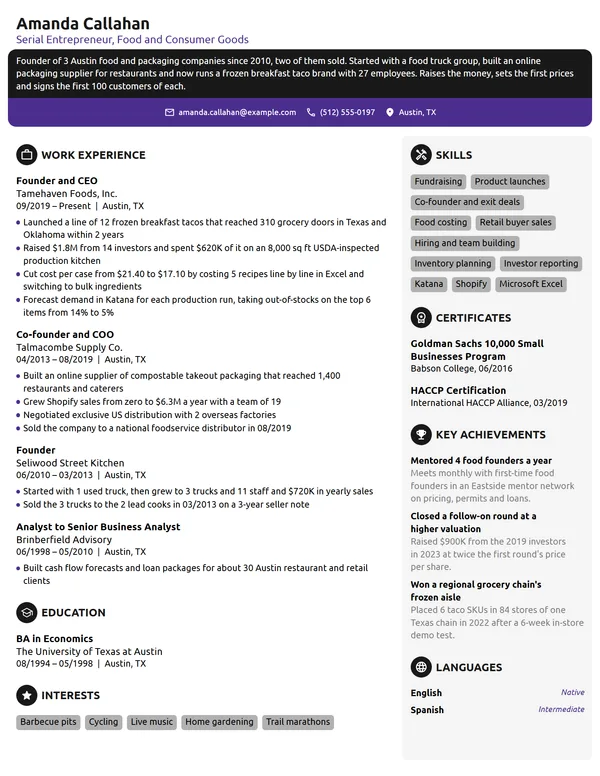
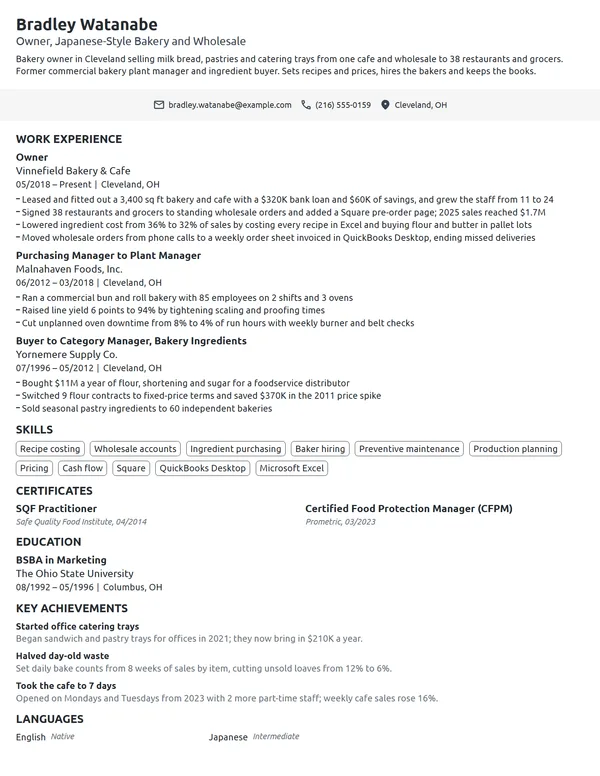
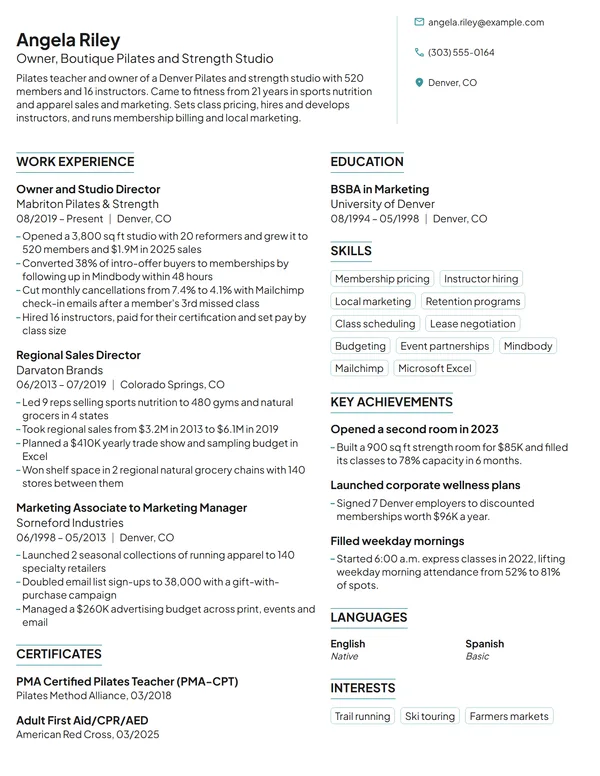
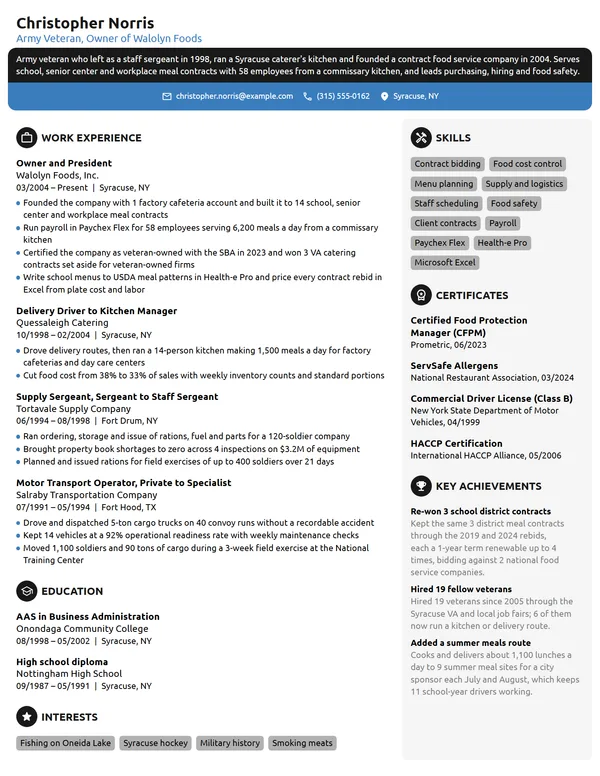
Running your own business means you have done a bit of every job: selling, hiring, pricing, paying the bills and fixing whatever broke that week. An employer or a new client looking at your resume wants that range turned into evidence: what the company does, how big it grew, how many people worked for you and where it stood when you moved on. Owners are used to pitching the company, not themselves, so the proof here comes from figures your books already hold: revenue, payroll, accounts and margin.
How to Write a Business Owner Resume - Key Takeaways
- List jobs newest first, with your business as a single Work Experience entry, on 1 page or 2 if you have 15+ years.
- Write Owner plus the function you ran day to day in the title line, such as Owner and General Manager.
- Make the first bullet under your company describe it: what it sells, who buys, how many employees and its yearly revenue.
- Give every other bullet an owner's number: revenue growth, gross margin, accounts kept, staff hired or a loan paid off.
- Say plainly whether you sold, closed or still run the business, and keep a client, a supplier and your accountant ready as references.
- Name the software from the job ad, then test the file with an ATS resume checker before you apply.
What employers look for in a business owner resume
The BLS describes top executives as the people who plan strategies and policies so an organization meets its goals, and notes that in a small organization the owner often does the hiring, training and day-to-day supervision too. Plenty of people hold that seat: the BLS counts self-employed workers as the largest employer of chief executives, with 27% of those jobs in 2025. O*NET's profile for general and operations managers adds the tasks most owners also carry, from staff schedules and budgets to setting prices.
A reader weighing an owner's resume asks 3 things: what kind of business it was, how big it became under you, and which of its jobs you did yourself. Answer them in these sections, named the way hiring software expects:
- Name, a headline such as Owner and General Manager, and contact details
- A short opening summary of 2 to 3 lines, printed without a heading
- Work Experience, with your business first if you still run it
- Skills, with the software you ran the business on
- Certificates, for credentials you hold yourself
- Education
- Extras if you have room: Volunteer Experience, Languages or Key Achievements
Best format for a business owner resume
Use the reverse-chronological resume format: newest role first, each with your title, the company, its city and the MM/YYYY dates you began and finished. Your business is a single Work Experience entry like any other job, with the jobs you held before it listed underneath. An employer who sees the years you owned the company in date order can tell at once if you still run it, and a format that hides those dates only raises the question.
- Best for most business ownersReverse-chronologicalYour jobs, newest first, with your results under each one.Best for: A steady work history in your field
- FunctionalSkills grouped up top, with a short work history below.Best for: Gaps or very little experience
- CombinationA skills section first, then your full work history.Best for: A career change with strong skills
Keep it to 1 page if your career, ownership included, runs under 15 years. A 2-page resume fits an owner with 15+ years or more than 1 company, as long as page 1 holds your current business and the role before it. Jobs from 20+ years ago can shrink to a title, a company and the years.
| Setting | What to use |
|---|---|
| Length | 1 page, or 2 for 15+ years or more than 1 company |
| Job title line | Owner plus your function: Owner and General Manager, Founder and Lead Consultant |
| Company line | For your own firm, the name customers know it by, plus its city |
| Dates | MM/YYYY from the month you opened or bought the business, Present if you still run it |
| Photo and private details | A photo is rare in the US and Canada; leave off your age, marital status and street address |
| File type | PDF, or Word when an application portal asks for it |
Most US and Canadian resumes carry no photo, so put that space toward your company's numbers. Your business website or LinkedIn page can sit in the contact line if it is current and shows the work.
Business owner resume summary vs. objective
Write a resume summary if your business has at least a year of results: what you run, for how long, its size and your best result. Write an objective only if the company is younger than that or you are applying for a job your business never touched, and make it name the role you want. Either way, take the number from your bullets so the opening and the job entry agree.
Business owner resume summary formula
Owner title with X years running type of business in market. Growth figure with a team of N. Strongest result with customers, contracts or margin.
Example
Owner and general manager with 12 years running a commercial landscaping company in south Louisiana. Grew annual revenue from $1.1M to $2.6M and the crew from 6 to 18 employees. Keeps 91% of maintenance contracts renewing each year.
Don't
Results-driven entrepreneur with a passion for building businesses and exceeding customer expectations.
Do
Owner of a 2-location bakery with 7 years in business and a staff of 15. Built a wholesale line supplying 26 cafes that now brings in 30% of revenue. Selling the business in 2026 to move into multi-unit operations.
The second version gives the business, its size, a result and the reason for the next move.
How to write business owner work experience bullets with numbers
Under your business, write 3 to 4 bullets; older jobs get 1 to 3. After the first bullet that describes the company, each one should start with a verb and end with a figure from your books, so a reader sees achievements on your resume instead of a list of every hat you wore. Round revenue to the nearest $10K or $100K, and give a range rather than an exact figure if the company is still yours and the numbers are private.
| Area | What to count | Example bullet |
|---|---|---|
| Revenue and growth | Yearly revenue, growth rate, new product or service lines | Opened an irrigation repair line that billed $310K in its first year. |
| Profit and cost | Gross or net margin, costs cut, prices changed | Raised gross margin from 31% to 38% by repricing 45 accounts and dropping 2 low-margin suppliers. |
| Customers and contracts | Accounts won, repeat or renewal rate, contract size | Signed 22 new commercial accounts in 2024, each worth $8K to $40K a year. |
| People | Headcount, hires, turnover, promotions | Hired and trained 9 staff in 18 months and promoted 2 to shift leads. |
| Operations | Locations, capacity, turnaround, error rates | Cut order turnaround from 6 days to 3 with a shared production calendar. |
| Financing and exit | Loans repaid, investment raised, how the business ended | Paid off an equipment loan 14 months early and sold the company to a regional competitor in 2025. |
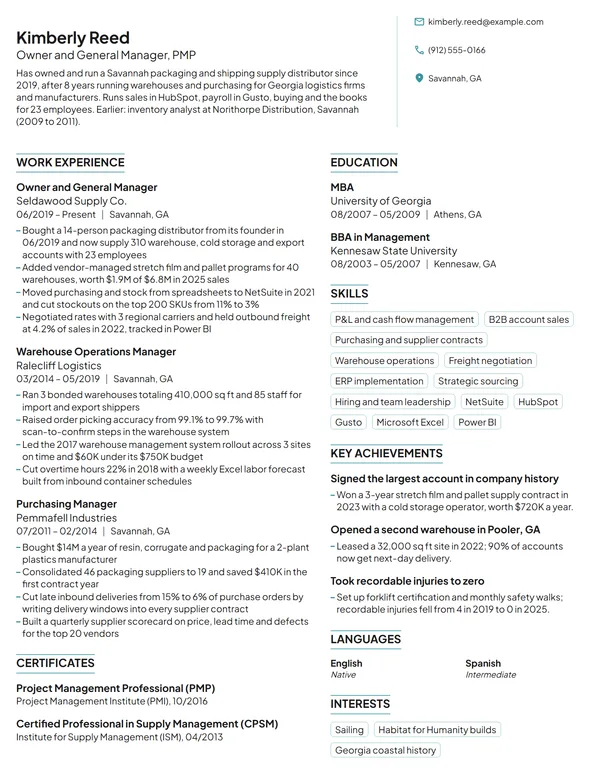
Here is how those numbers sit in one owner's entry. The job before the business gets fewer lines, and its figures show the sales and customer base the owner started from.
Work Experience
- Run a commercial landscaping company with 18 employees and $2.6M in 2025 revenue, maintaining 140 office parks, apartment complexes and schools.
- Grew annual revenue from $1.1M in 2017 to $2.6M in 2025 by adding irrigation and drainage work, now 34% of sales.
- Kept 91% of maintenance contracts renewing each year by giving every account a named crew lead and a monthly site report.
- Priced jobs and tracked labor in QuickBooks Online and Excel, holding labor cost at 41% of revenue for 3 straight years.
- Managed 210 landscaper and golf course accounts buying $3.4M a year in seed, sod and fertilizer.
- Opened 38 new accounts in 2012, the branch's best year for new business.
Don't
Responsible for all aspects of running the business.
Do
Ran daily operations for a 12-person HVAC service company, dispatching about 60 calls a week at an 84% first-visit fix rate.
All aspects tells the reader nothing; the second line names the team, the volume and a quality measure.
Don't
Grew the business and increased profits year over year.
Do
Grew annual sales from $640K to $1.5M in 4 years while keeping net margin above 9%.
How to describe a business you sold or closed
Give the entry its real end date and say how it ended in the last bullet: sold to a competitor, sold to a partner, merged, or closed. A sale is a result, so name the buyer type and the year, and leave the price off unless it was made public. A closure needs 1 calm line with a reason a reader accepts, such as a lease that ended or a market that moved online, followed by what you did with the staff and the customers.
Business owner skills and software for your resume
Pick 6 to 8 skills that the job ad asks for and your bullets already prove. Owners hold a wide spread of skills, so choose the ones the next role needs, and let your results show the leadership skills that matter most to an employer hiring a former owner: hiring, coaching and making the call when nobody else will.
Hard skills for business owners
- P&L management
- Budgeting and cash flow forecasting
- Pricing and quoting
- Sales and business development
- Hiring and staff training
- Payroll and scheduling
- Vendor and supplier negotiation
- Contract management
- Bookkeeping and financial statements
- Local and digital marketing
Soft skills employers value in former owners
- Decision-making
- Accountability
- Customer relationships
- Negotiation
- Problem-solving under pressure
- Working within someone else's plan
List the systems you ran the business on with your skills, then show each one at work in a bullet. O*NET marks Microsoft Excel, Microsoft Office and Microsoft PowerPoint as in demand for general and operations managers, and lists Intuit QuickBooks, Salesforce and HubSpot among its hot technologies. Write the exact product name, such as QuickBooks Online, Square, Shopify or Gusto, and leave off apps you only logged into.
Certifications and licenses for a business owner resume
No license makes you a business owner, so the Certificates section holds only credentials you earned yourself: a trade license your state issues, a food safety manager card, a project or quality certification. List certifications on your resume with the issuer and the year. Certifications that belong to the company are different: government agencies reserve contracts for small businesses certified in SBA's contracting programs, such as HUBZone, Women-Owned Small Business, 8(a) Business Development and veteran-owned, so name the program in a bullet under the business with the contracts it won.
| Credential | Issued by | What it takes |
|---|---|---|
| PMP (Project Management Professional) | Project Management Institute (PMI) | A bachelor's degree plus 3 years of experience managing projects (5 without a bachelor's degree), 35 hours of project management training and the exam. |
| CSSBB (Certified Six Sigma Black Belt) | ASQ | 3 years of full-time, paid work in areas of the Black Belt Body of Knowledge, 1 or 2 completed projects with signed affidavits, and the exam. |
| State trade or contractor license | Your state licensing board | Set by your state and trade; write the license type and state, and add the number only if an employer requests it. |
Put the credential that matches the posting first. A PMP or a Six Sigma belt helps when you move from ownership into operations or project roles, because it shows your methods hold up in a company that is not yours.
Certificates
- Project Management Professional (PMP), Project Management Institute, 2021
- Certified Six Sigma Black Belt (CSSBB), ASQ, 2023
Do business owners need a degree? How to list education
Owning a business takes no degree, but the jobs owners apply for often do: the BLS says top executives typically need at least a bachelor's degree and considerable work experience. Listing education on a resume takes 4 parts (degree, school, city and graduation date), placed below Work Experience once you have run the business for a few years.
An MBA, a business degree or a finished small business program goes here too. Leave out a GPA once you have owned a company for more than 2 years; the business says more. Without a degree, list the highest program you finished, and let the company's numbers carry the rest.
Education
Career-change, first-time and former business owner resumes
If you opened your business after years in another field, that earlier career is your proof. Stay with newest-first order, and write the old job's bullets around the work the business now needs, such as running a team, a budget or a customer base. A career-change resume reads best when the summary connects the 2 in 1 sentence. A first-time owner with under a year of results can show:
- Launch numbers: months from opening to the first paying customer, accounts signed in the first quarter, revenue to date.
- Management in a past job: the team size, budget or locations you ran for an employer.
- Funding and setup: a loan approved, a lease signed or equipment bought, with the dollar figure.
- Training for the business: a small business program, a franchise training course or a trade license, listed under Education or Certificates.
When you move from owner back to employee, the reader's worry is whether you will take direction and stay. Choose bullets that show you working inside rules others set, such as a franchise system, a client's specifications or a lender's covenants, and use a plain title like Owner and Operations Manager. Job titles on your resume should describe the work you did, not impress the reader with Founder and CEO of a 3-person firm.
Don't
Former business owner seeking a new challenge with a stable company.
Do
Former owner of a 9-person print shop seeking an operations manager role. Ran production, purchasing and payroll for 11 years and cut paper waste by 18% in the final 2.
An objective still names the role and gives the proof that you can do it.
With no boss to call, a reference check is the part owners forget to plan. Follow the usual advice on listing references and keep them on a separate page. Use the cover letter to say why you are leaving ownership, in 2 or 3 sentences; these business cover letter examples show the tone.
Business Owner resume FAQ
What job title should a business owner use on a resume?
Use Owner, or Founder if you started the company, plus the function you ran day to day: Owner and General Manager, Owner and Head Chef, Founder and Lead Consultant. Pick the function closest to the job you want, and skip CEO or President for a small firm unless that title helps the reader.
How do I list my own business on a resume?
As a Work Experience entry: your title, the company's trading name, its city and the MM/YYYY dates you owned it. Use the first bullet to say what the company does, its headcount and its yearly revenue, then follow with 2 or 3 results.
Who can I use as a reference if I was my own boss?
Clients, suppliers, business partners and the professionals who saw your numbers, such as your accountant, banker or attorney. A former employee you managed can speak to how you lead. Ask each one first, and bring the list to the interview rather than printing it on the resume.
Should I put my company's revenue on my resume?
Yes, in most cases, because revenue is the quickest way to show the size of what you ran. Round it, such as $2.4M, or give a range if the business is still yours and the figures are private. Headcount and number of accounts can stand in if you would rather not share revenue.
Will employers think I am overqualified after owning a business?
Some will wonder whether you will take direction and stay. Answer that on the page: pick a title that matches the role, choose bullets that show you working within budgets, client rules or a franchise system, and say in your cover letter why you want this job now.
How do I explain a business that closed?
Briefly and in plain words. Give the real end date, add 1 line on the reason, such as a lease that ended or demand that fell, and say what you did for staff and customers. Then let the results from the years it ran carry the entry.
How long should a business owner resume be?
Use 1 page for a career under 15 years, including your time as owner. A 2-page resume works for 15+ years or several companies, as long as page 1 holds your current or most recent business and the role before it.
Next steps
Choose the example closest to your kind of business and the job you want next, then swap in your own revenue, staff and customer figures. Fill it in with our resume builder, or pick one of the resume templates, and pair it with a cover letter explaining in 2 or 3 sentences why you want this role now.