
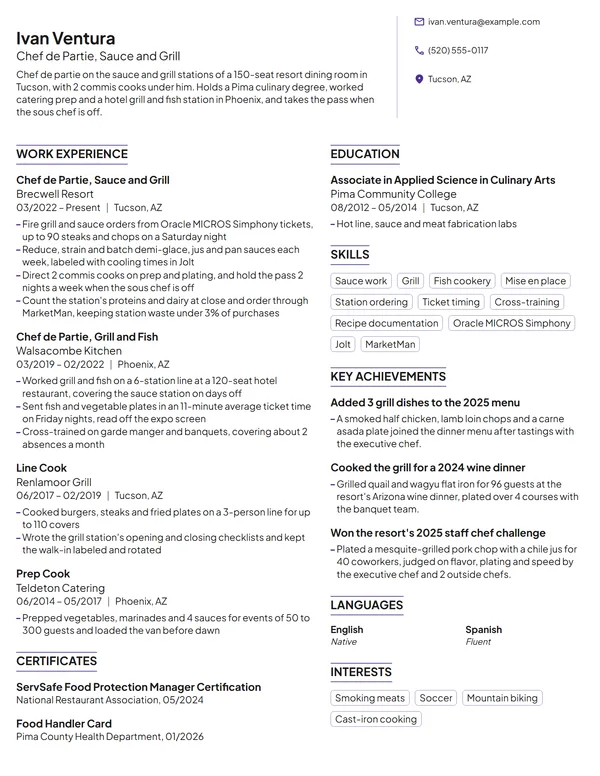
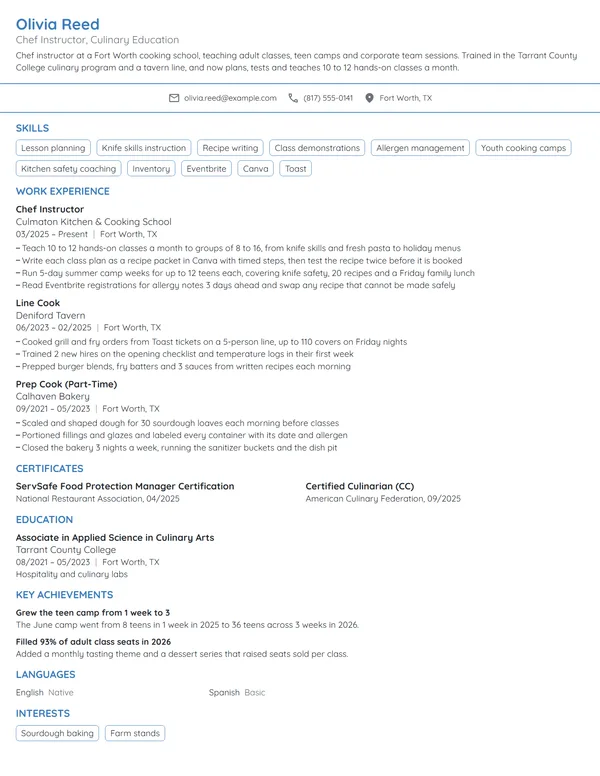
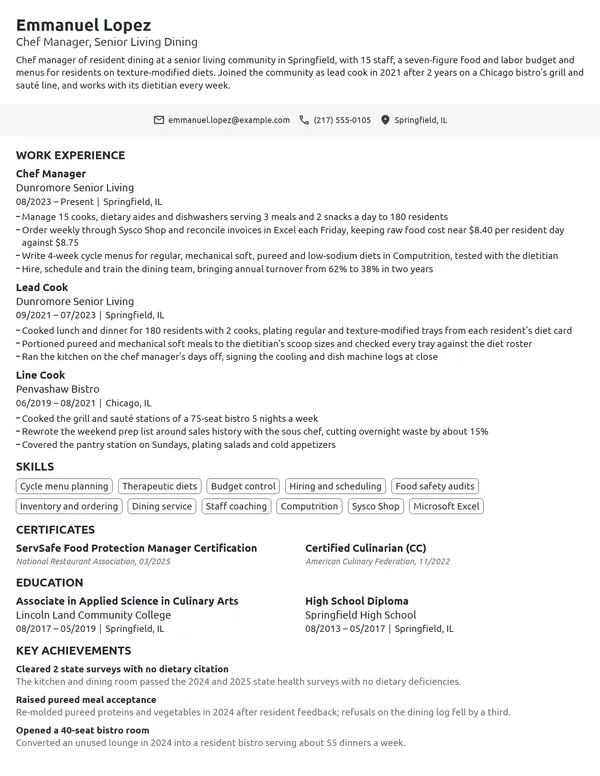
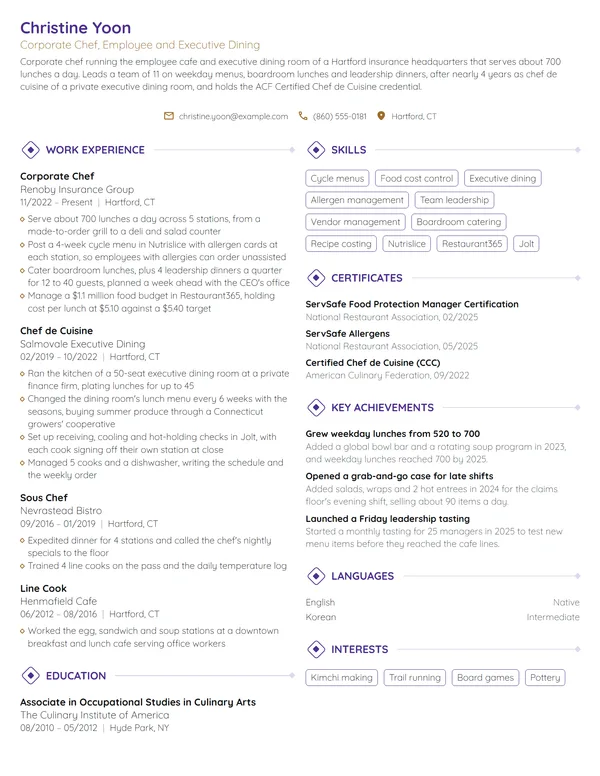
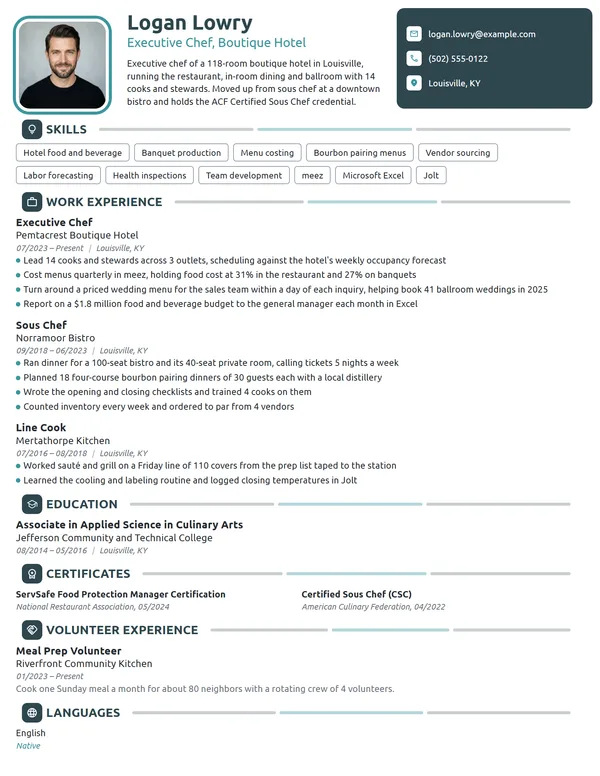
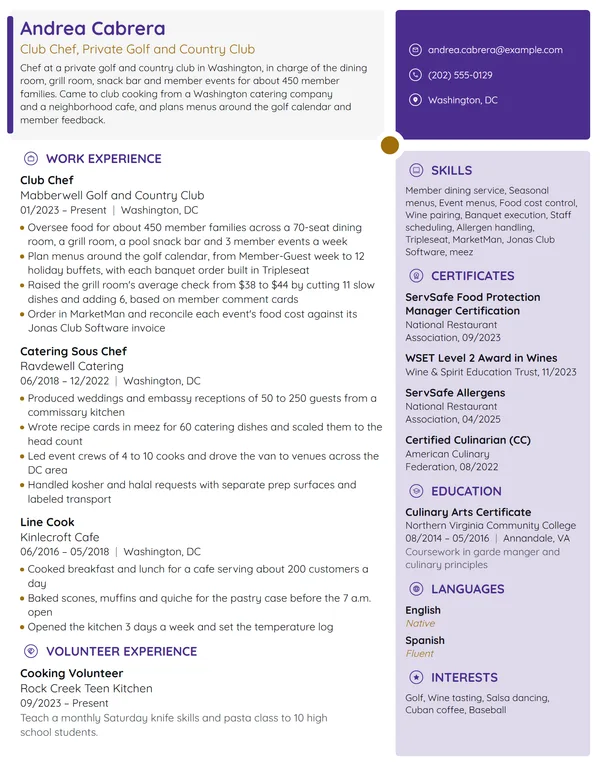
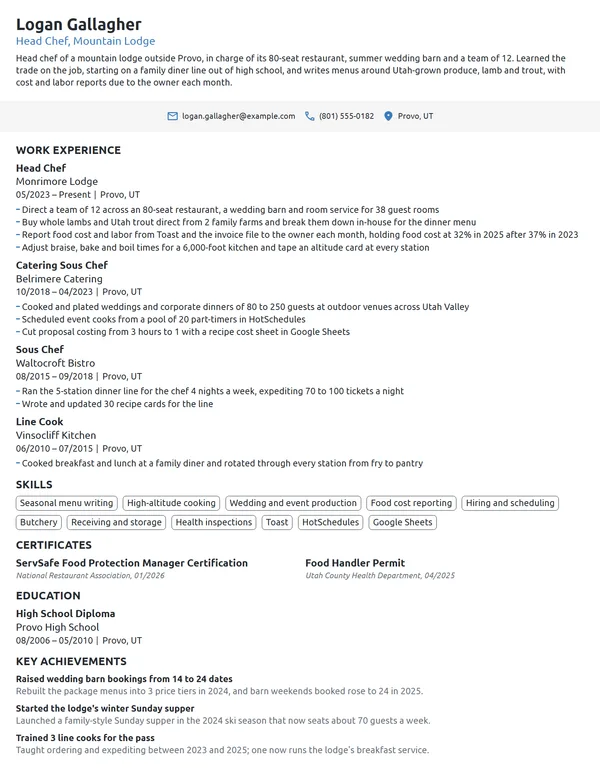
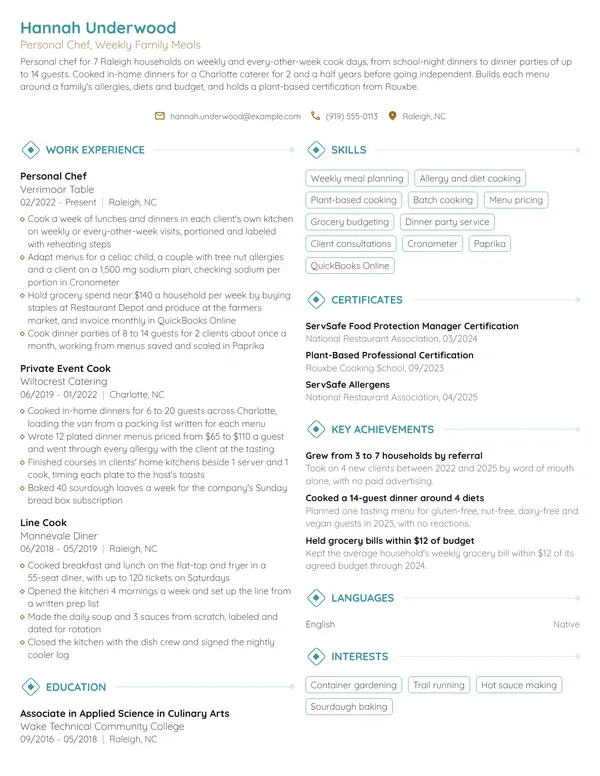
Nobody can taste your cooking on paper, so a chef's resume has one job: getting you invited to cook. Owners and executive chefs read it to learn what kind of kitchen you worked in, how many guests it fed, what happened to food cost while you ran it and whether you kept it safe and clean. Kitchens rarely put any of that in writing, so the numbers take some digging, along with the certificates that prove your food safety training.
How to Write a Chef Resume - Key Takeaways
- Use the reverse-chronological format on 1 page, and go to 2 only with 10+ years across several kitchens or openings.
- Open every job with the kitchen itself: cuisine, seats, covers on a busy night and the size of your team.
- Give bullets numbers a chef already tracks, such as food cost, ticket times, waste, inspection results and cooks trained.
- Write your title and station as the kitchen used them, from Commis and Garde Manger to Junior Sous Chef.
- List your ServSafe Food Protection Manager Certification or state food handler card first under Certificates, then any ACF credential.
- Run the file through an ATS resume checker before applying to hotel and restaurant groups, whose portals scan for certificate names.
What executive chefs and owners look for in a chef resume
The person hiring a chef wants to know 3 things: can you cook at their volume, can you run cooks, and can you protect their margins. The Bureau of Labor Statistics lists supervising cooks, planning menus, ordering and keeping inventory, and monitoring sanitation among a chef's core duties. O*NET adds estimating what food and supplies will cost and pricing menu items from food, labor and overhead. A strong resume shows each of those in a named kitchen, with a figure attached.
Build the page from these sections, in headings any hiring portal can read:
- Name, headline (for example, Chef de Cuisine, ACF CSC) and contact details
- A short summary at the very top, which needs no heading of its own
- Work Experience, latest kitchen first, with the cuisine and size in the opening bullet
- Certificates: food safety certification first, then ACF or allergen credentials
- Skills, with your costing and ordering software
- Education, including a culinary program or apprenticeship
- Optional: Key Achievements, Volunteer Experience or Languages
Best format for a chef resume
Use the reverse-chronological resume format: your newest kitchen first, each entry with your title, the restaurant or hotel, its city and MM/YYYY dates. Kitchen careers climb by rank, from commis or line cook to station chef, sous chef and chef, and putting your newest job first puts the highest rank you reached at the top. If you moved stations inside the same kitchen, keep it as 1 entry and show the moves in your bullets.
- Best for most chefsReverse-chronologicalYour jobs, newest first, with your results under each one.Best for: A steady work history in your field
- FunctionalSkills grouped up top, with a short work history below.Best for: Gaps or very little experience
- CombinationA skills section first, then your full work history.Best for: A career change with strong skills
Keep a chef resume to 1 page for your first 10 years. Page 2 earns its place once you have run several kitchens, opened restaurants or led banquet and catering programs, provided your current role and certificates sit on page 1.
| Setting | What to use |
|---|---|
| Length | 1 page; 2 after 10+ years with several kitchens or openings |
| Dates | MM/YYYY for every job, and Present for the kitchen you work in now |
| Job title line | Your rank or station as the kitchen used it: Commis Chef, Garde Manger, Junior Sous Chef |
| First bullet | Cuisine, seats, covers on a busy night and team size |
| Typeface | 1 clean font for the page, 10 to 12 pt in the bullets |
| Photo and personal details | Usually no photo in the US and Canada; skip age, marital status and your Social Security number |
| File type | PDF, unless a hotel or restaurant group's portal asks for Word |
Most US and Canadian resumes carry no photo. Show plates in the interview; the trial shift is where a chef tastes them.
Chef resume summary vs. objective
Start from your history. If you have already held a cooking job in a professional kitchen, write a resume summary with your years, the kind of kitchen, your volume and 1 result. If you are still in culinary school or moving over from another job, write a resume objective that names the station or role you want and the training that prepares you for it. Keep either one to 2 or 3 lines, and lift its figure straight from a bullet below it.
Chef resume summary formula
Title with X years in type of kitchen, leading team size through covers or seats. 1 result on cost, speed or quality, with a number. Food safety certification or ACF credential.
Example
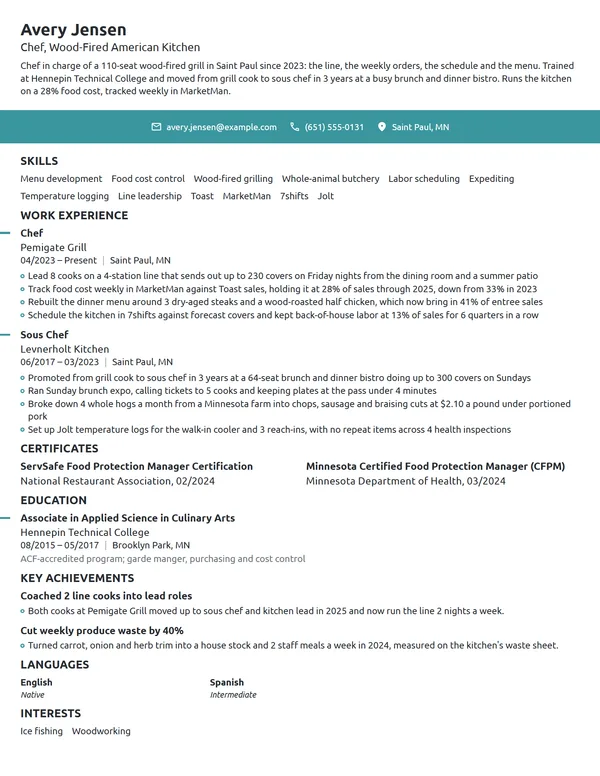
Chef with 11 years in hotel and restaurant kitchens, leading 9 cooks through 140-cover Saturday nights at a New Mexican restaurant. Cut average ticket times from 22 to 14 minutes after redrawing the line's station map. ACF Certified Sous Chef and ServSafe Food Protection Manager certified.
Don't
Passionate chef with a love for food and a creative flair, looking to bring my talents to a great team.
Do
Chef with 7 years in Italian kitchens, the last 3 running a 60-seat trattoria with 6 cooks. Makes every pasta in-house and holds food cost near 30% of sales. ServSafe Food Protection Manager certified.
The rewrite names the cuisine, the size, a cost figure and the certificate an owner checks.
How to write chef work experience bullets with numbers
Your current kitchen gets 3 to 4 bullets; earlier kitchens get 1 to 4 each. Start each entry with the size of the operation, then add results the kitchen already measures: food cost, waste, ticket times, inspections and the cooks you trained. When you list work experience on a resume, begin every bullet with a verb and give each number its base, such as covers a night or percent of sales.
| Area | What to count | Example bullet |
|---|---|---|
| Volume | Covers a night, seats, stations, events | Ran the sauté station for 180 covers on Friday nights in a 95-seat bistro. |
| Purchasing | Vendors, order frequency, price per case, savings | Renegotiated produce and dairy pricing with 2 vendors and saved $1,400 a month. |
| Waste and yield | Pounds wasted, trim yield, spoiled stock | Started a daily waste log that cut weekly food waste from 60 to 35 pounds. |
| Speed | Ticket times, prep done by service | Cut average ticket times from 18 to 12 minutes by moving 3 garnishes to the pass. |
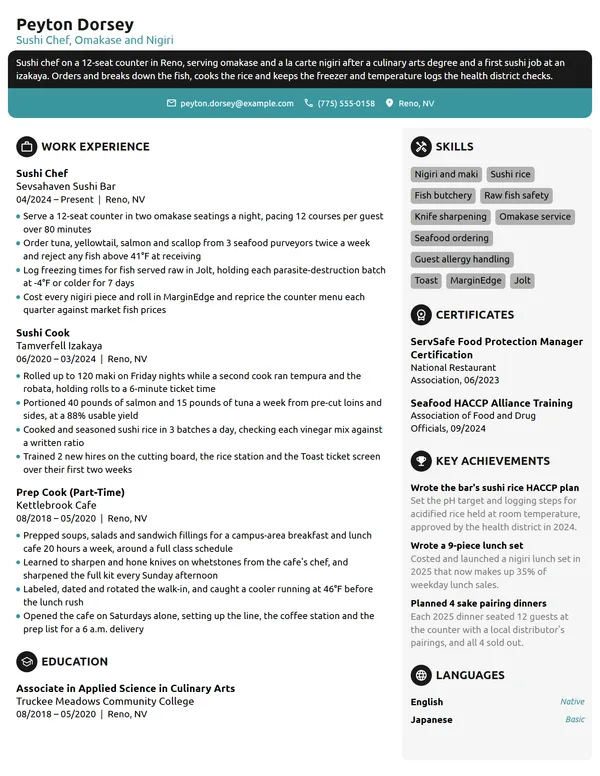
| Food safety and allergens | Inspection results, temperature logs, allergen incidents | Trained 12 cooks on allergen tickets for the 9 major allergens, with no allergen incidents in 18 months. |
| Menu development | Dishes created, menu changes, top sellers | Developed 14 dishes for a spring menu change, 5 of which became top sellers. |
| Team | Cooks hired and trained, openings staffed | Hired and trained 7 cooks for a second location's opening in 6 weeks. |
Open with the scale bullet, follow it with cost, menu and inspection results, and give an older job 2 lines.
Work Experience
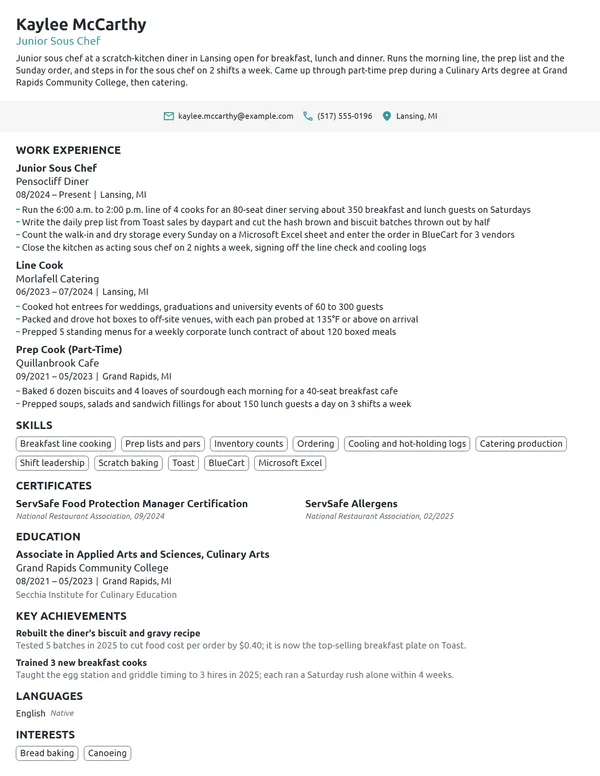
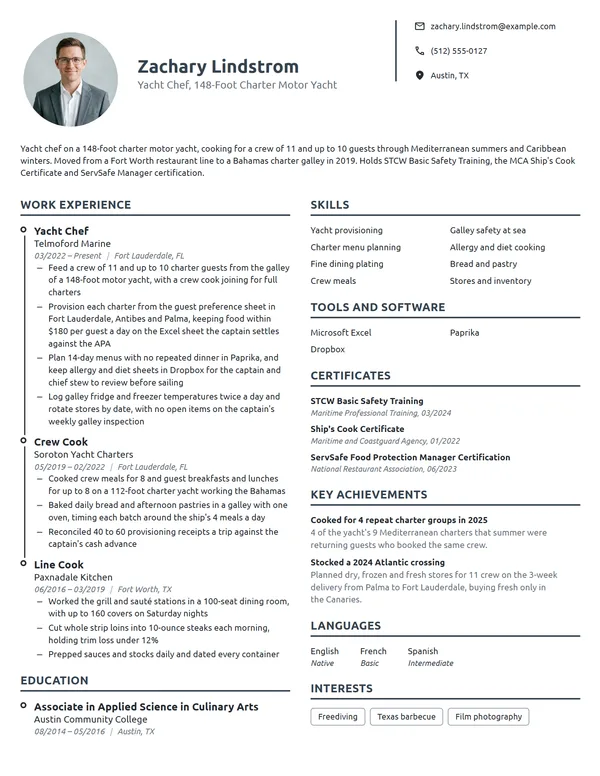
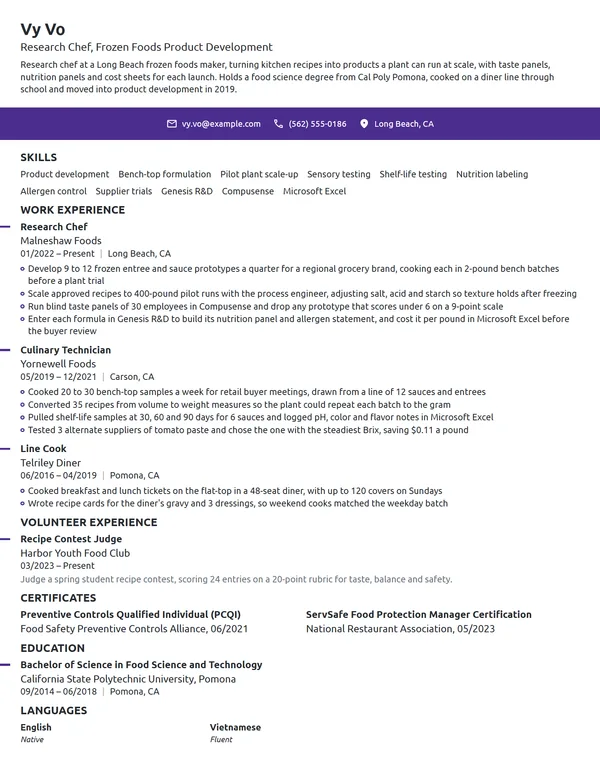
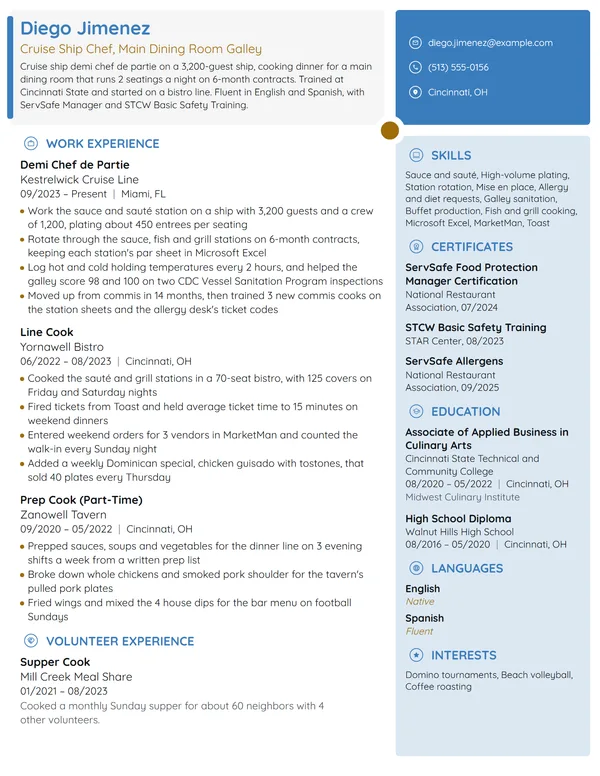
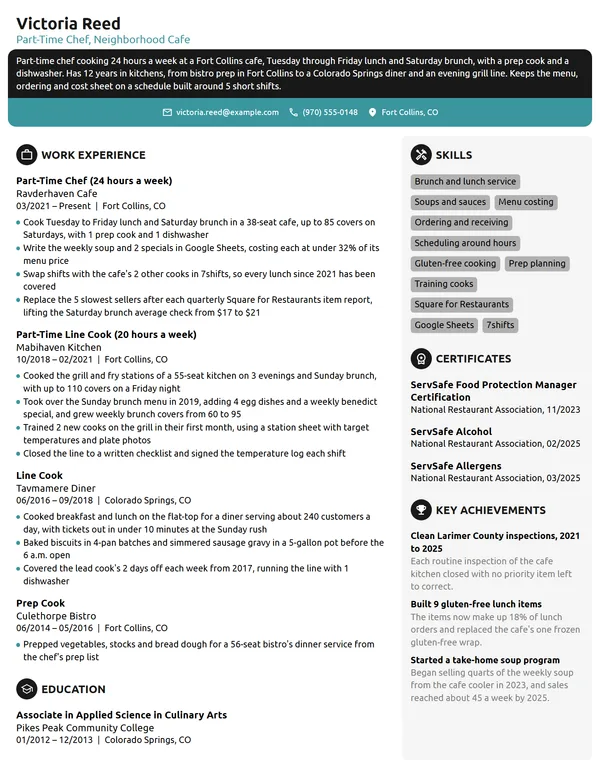
- Run a 72-seat New Mexican kitchen serving up to 140 covers on Saturday nights, with 9 cooks and 2 dishwashers.
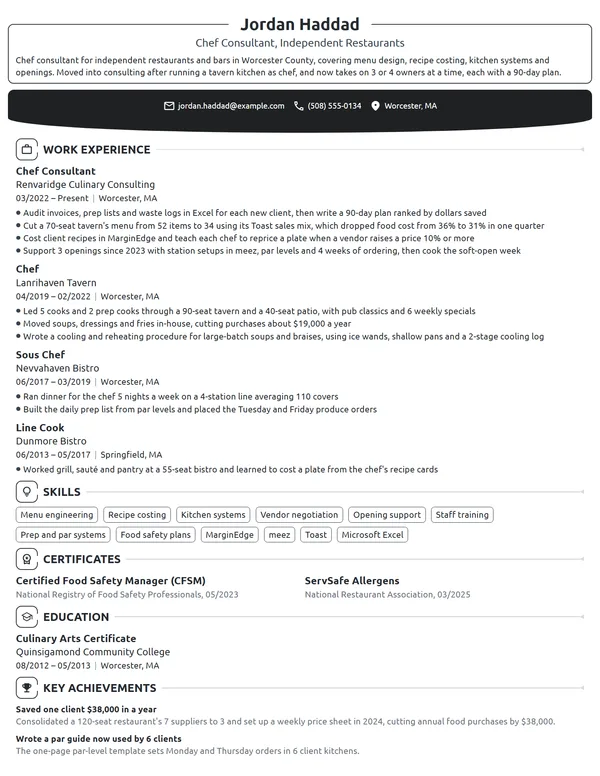
- Re-costed all 26 dinner plates in ChefTec and brought food cost from 34% to 29.5% of sales in 8 months.
- Write 4 seasonal menus a year with produce from 6 local farms; 3 specials moved onto the permanent menu.
- Passed 8 health inspections in a row with no priority violations.
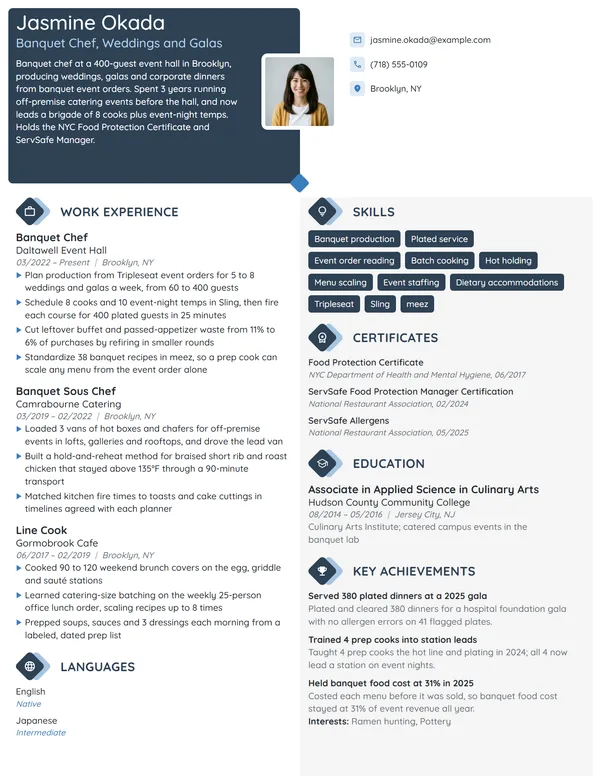
- Ran banquet production for weddings and retreats of up to 220 guests, about 30 events a season.
- Trained 6 line cooks to work all 3 hot stations on the lodge's dinner line.
Don't
Responsible for ordering and inventory.
Do
Placed orders with 5 vendors 3 times a week and held month-end inventory variance under 2%.
The second version shows how often you ordered and how tightly you kept the count.
Don't
Created new menu items.
Do
Created 8 brunch dishes for a weekend launch that grew Sunday covers from 90 to 130 in 3 months.
Kitchen skills and software for a chef resume
Choose 6 to 8 hard skills for your resume that the posting asks for and your bullets back up. Recipe costing and kitchen management fit almost any chef role; butchery, pastry or smoking belong only where you did that work. The BLS counts a sense of taste and smell and physical stamina among the qualities a chef needs, but show them through results rather than listing them.
Hard skills for chefs
- Menu development
- Recipe costing
- Food cost control
- Ordering and inventory
- Butchery and fish fabrication
- Sauces and stocks
- Plating and presentation
- Allergen control
- Banquet and catering production
- Expediting
Soft skills kitchens value
- Leading a line during a rush
- Clear calls at the pass
- Training and coaching cooks
- Staying calm under pressure
- Planning prep against covers
- Creativity within a budget
O*NET lists Microsoft Excel, Microsoft Outlook and Microsoft Office as in-demand technology for chefs and head cooks, and names kitchen programs such as ChefTec, CostGuard and EGS CALCMENU for recipes, costing and inventory. Put the programs you used among your skills, then prove one in a bullet, such as the plates you costed in it. Write your point-of-sale or kitchen display system the way the posting spells it, so a keyword search finds it.
ServSafe, food handler cards and ACF certifications on a chef resume
Food safety comes first. The FDA Food Code 2022, a model that every state has adopted in some edition, says the person in charge of a food establishment shall be a certified food protection manager who passed a test from an accredited program. The BLS adds that some states and localities require a food handler's certification, and that other certifications, while not required, may lead to advancement and higher pay. Put certifications on your resume in that order: food safety, then culinary credentials, each with its issuer and month.
| Credential | Issued by | What it takes |
|---|---|---|
| ServSafe Food Protection Manager Certification | National Restaurant Association | A proctored exam from a program accredited by ANAB under Conference for Food Protection standards; recognized for 5 years. |
| ServSafe Food Handler | National Restaurant Association | Training and an assessment on safe food handling; recognized for 3 years, though your state or county may set its own card. |
| ServSafe Allergens | National Restaurant Association | A course on handling the major food allergens; recognized for 3 years. |
| Certified Culinarian (CC) | American Culinary Federation | An associate's degree in culinary arts, or a diploma plus 2 years of entry-level work; 30-hour courses in nutrition, food safety and sanitation, and supervisory management; written and practical exams. |
| Certified Sous Chef (CSC) | American Culinary Federation | 2 years supervising a shift or station within the last 10 years, plus an education route such as an associate's degree and 3 years of work; the same 3 courses; written and practical exams. |
| Certified Executive Chef (CEC) | American Culinary Federation | 5 years as chef de cuisine, executive sous chef or chef in charge of production, supervising at least 5 full-time staff; 5 courses, including beverage management and cost control; written and practical exams. |
Food handler card or manager certification: which one to list
If you run shifts or a kitchen, list the ServSafe Food Protection Manager Certification first, since that is the credential a person in charge needs. Commis chefs and line cooks list the food handler card their state or county asks for: California, for example, requires food handlers to hold a card under Health and Safety Code section 113948, valid for 3 years. ACF credentials renew every 5 years, so write the month you earned or last renewed each one.
Certificates
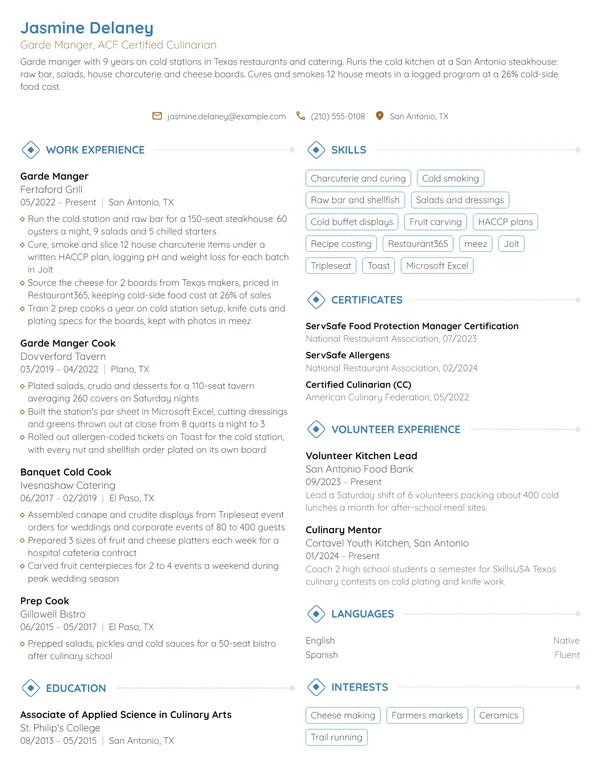
- ServSafe Food Protection Manager Certification, National Restaurant Association, 01/2025
- ServSafe Allergens, National Restaurant Association, 04/2026
- Certified Sous Chef (CSC), American Culinary Federation, 11/2021
Culinary school, apprenticeship or on-the-job training on a chef resume
The BLS says chefs and head cooks typically need a high school diploma to enter the occupation, and many attend programs at community colleges, technical schools, culinary arts schools and 4-year colleges. Some learn in apprenticeships that combine instruction with paid training in a commercial kitchen, and some of those programs are registered with the U.S. Department of Labor. Each route counts: name it under Education with its school or sponsor and the date you finished.
When you list education on a resume, write the credential in full, the school, its city and the month you finished. Most culinary programs, the BLS adds, require experience in a commercial kitchen, so a recent graduate can add the externship's hours and station in 1 line under the degree. Experienced chefs drop that line, and those without a degree can list a completed apprenticeship in the same spot.
Education
Externship: 280 hours on the hot line of a hotel restaurant.
Line cook to chef, entry-level and career-change chef resumes
Chefs often start in other kitchen jobs, such as line cook, and spend years in kitchens before a promotion, the BLS says. If you are at the start of that path, lead with an objective, your culinary training and every hour you have spent on a line, and borrow the layout of an entry-level resume. Once you supervise a station, the sous chef resume is the next step to study. Evidence that counts at this stage:
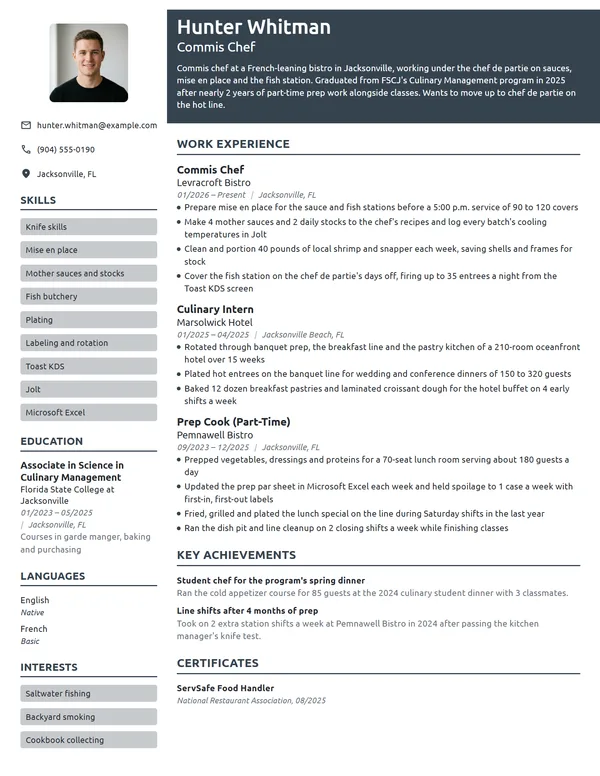
- Externship or practicum: the kitchen, your station, your hours and the covers you cooked for by the end.
- Prep or line cook shifts: a full Work Experience entry with the station, covers a night and what you prepped.
- Catering, banquets or a school cafeteria: the number of guests or meals and your part in the production.
- Community meals or food bank kitchens: under Volunteer Experience, with meals served a week.
Don't
Former server looking to start a culinary career in a professional kitchen.
Do
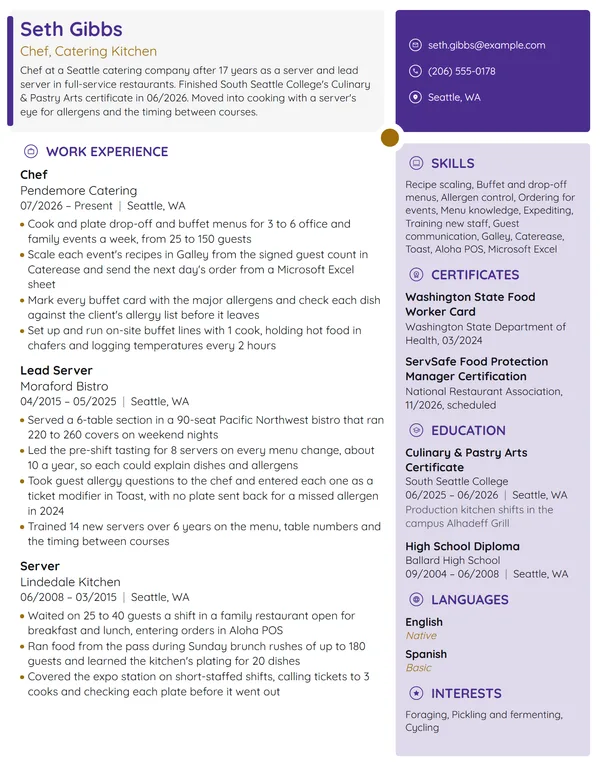
Culinary Arts certificate graduate with a 240-hour externship on the grill and sauté stations, seeking a line cook or commis role. Brings 9 years of front-of-house work, including allergy questions at 200-cover dinners.
Proof belongs in an objective too: the training, the hours and a skill that crosses over.
If you come to the kitchen from another job, such as serving, put your culinary certificate and externship at the top, then keep your earlier jobs in date order with the bullets that cross over: menu knowledge, ticket flow, allergy questions from guests and pace on a full night. Our career-change resume examples show that layout. Use your cover letter to say in 1 short paragraph why you moved into cooking, following the steps in how to write a cover letter.
Chef resume FAQ
Do you need culinary school to become a chef?
No. The BLS says chefs and head cooks typically need a high school diploma to enter the occupation, and many learn on the job or in apprenticeships. Culinary programs at community colleges and culinary schools are common, though, and they add a commercial kitchen externship you can list.
Which food safety certificate should a chef list on a resume?
List the ServSafe Food Protection Manager Certification, or another accredited manager certificate, if you run shifts or a kitchen. The FDA Food Code expects the person in charge to hold one. Cooks and commis chefs list the food handler card their state or county requires, with its month.
Is an ACF certification worth putting on a chef resume?
Yes, if you hold one. American Culinary Federation credentials such as Certified Sous Chef or Certified Executive Chef require written and practical exams and supervisory experience, so they tell a reader your rank was tested. Write the full name with the abbreviation and keep it renewed every 5 years.
How long should a chef resume be?
1 page for most chefs, from commis to chef de cuisine. Move to 2 pages only after 10+ years across several kitchens, openings or banquet programs, and keep your current kitchen and certificates on page 1.
How do I show food cost if I never controlled purchasing?
Show the part you did control. A station chef or sous chef can count waste cut, trim yield improved, prep pars set or plates costed, and a bullet such as reducing weekly waste by a number of pounds proves cost awareness without claiming the purchasing budget.
Should I list short stints and trial shifts on a chef resume?
Leave single trial shifts off. A stint of a few months can stay if it adds a cuisine, a station or a well-known kitchen style, written as a normal entry with its dates; several short stints in a row are better grouped by reason, such as a seasonal resort run.
Should I list every station I worked on a chef resume?
Only the ones that matter to the posting. Put your current or highest station in the job title line and name earlier stations inside that kitchen in 1 bullet, so a reader sees your range without a list of every rotation.
What is the average salary for a chef?
The BLS reports that the median annual wage for chefs and head cooks was $62,470 in May 2025. Your pay depends on the city, the type of kitchen and your rank, so leave salary off the resume and raise it once an offer is on the table.
Next steps
Start from the example nearest your rank, from commis to chef, and swap its kitchen details and figures for your own. Our resume builder and templates handle the layout, so spend your time on the numbers. Then write a short cover letter that names the cuisine you cook best and the result you are proudest of.