
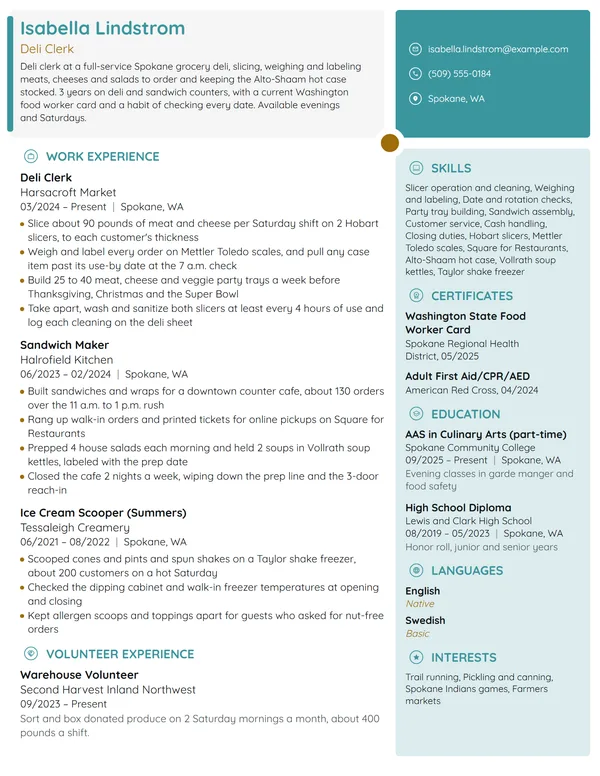
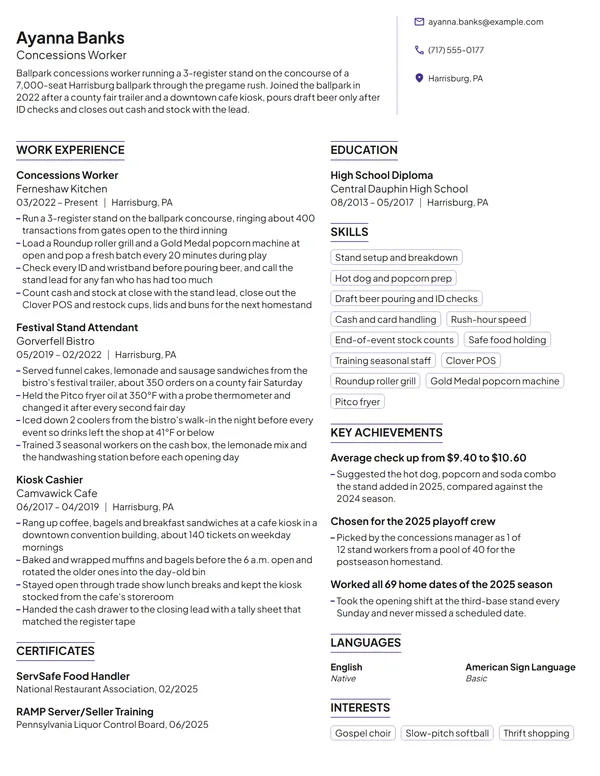
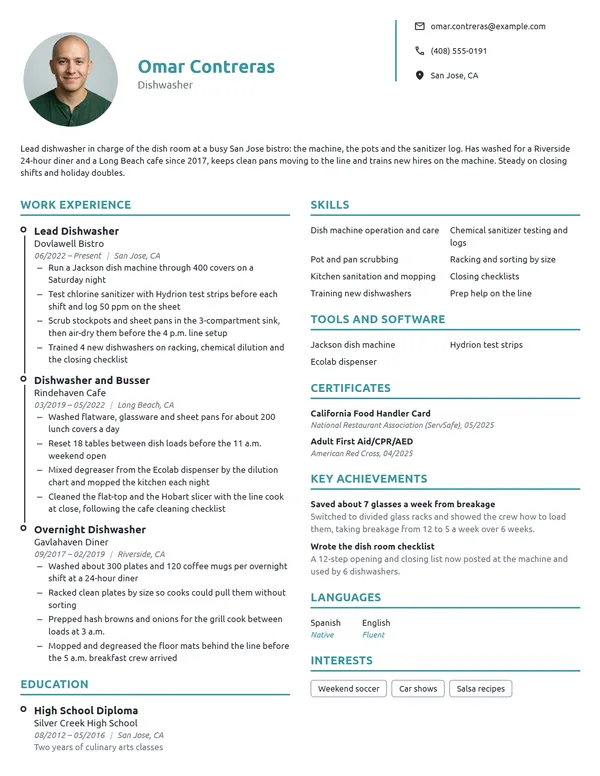
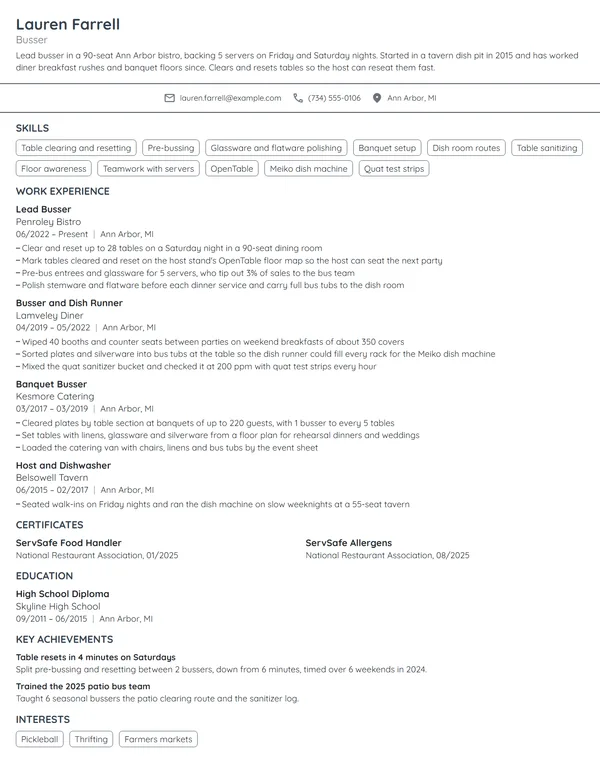
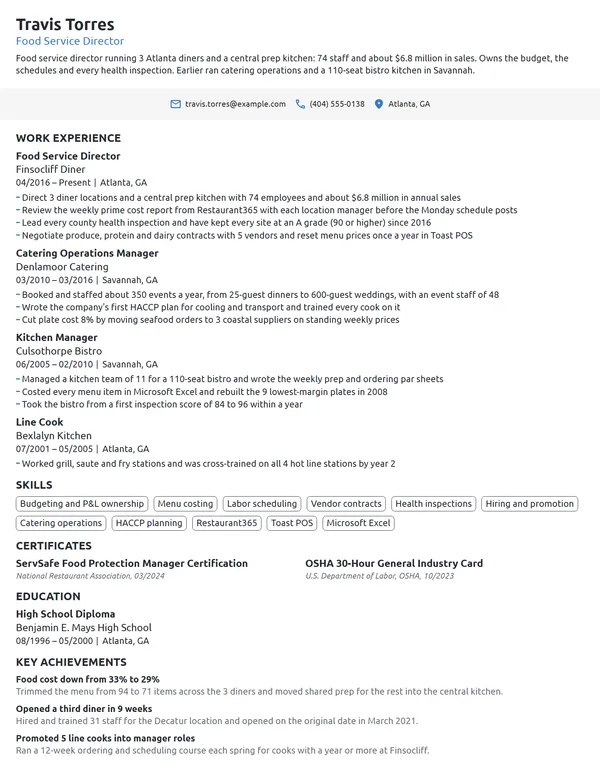
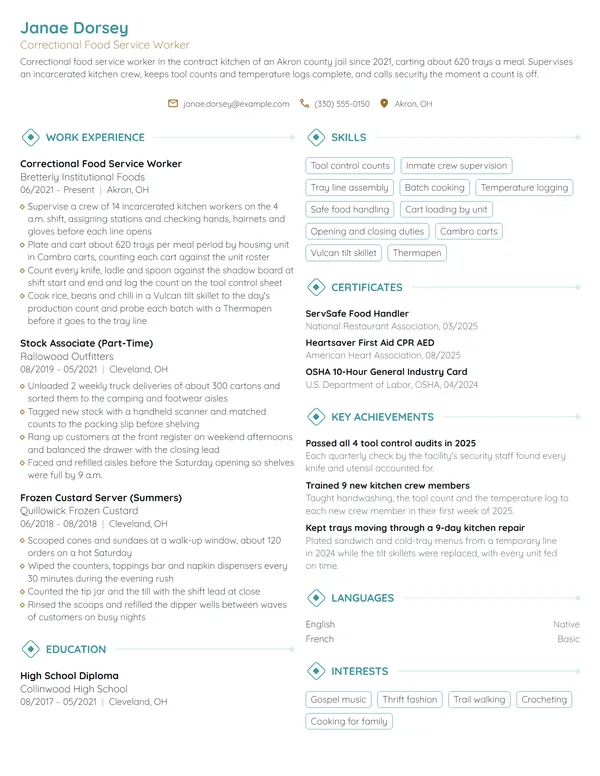
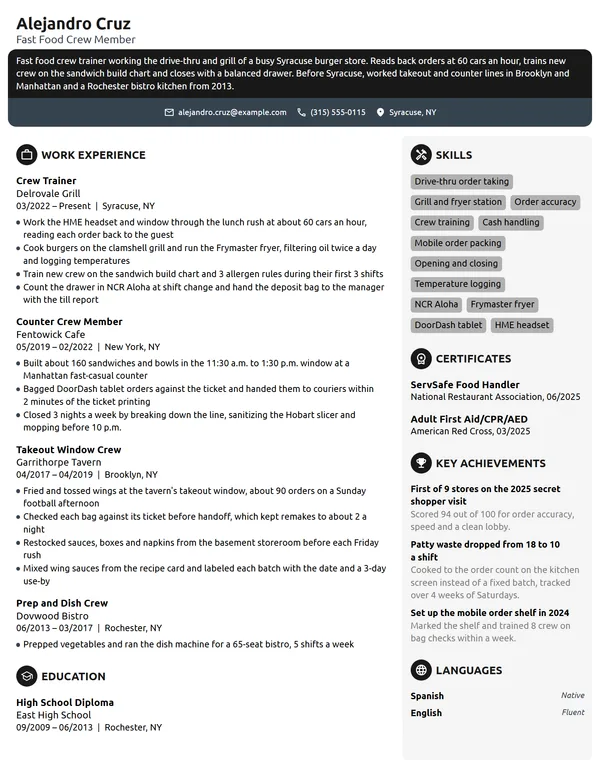
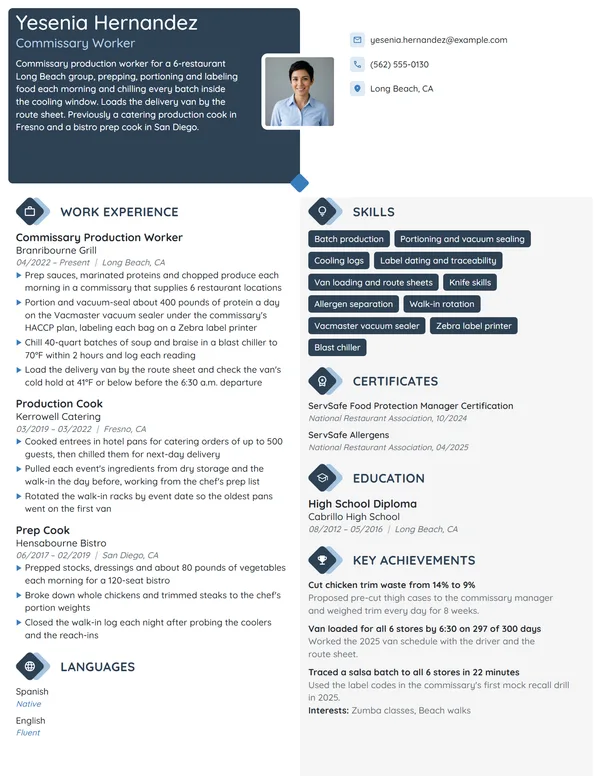
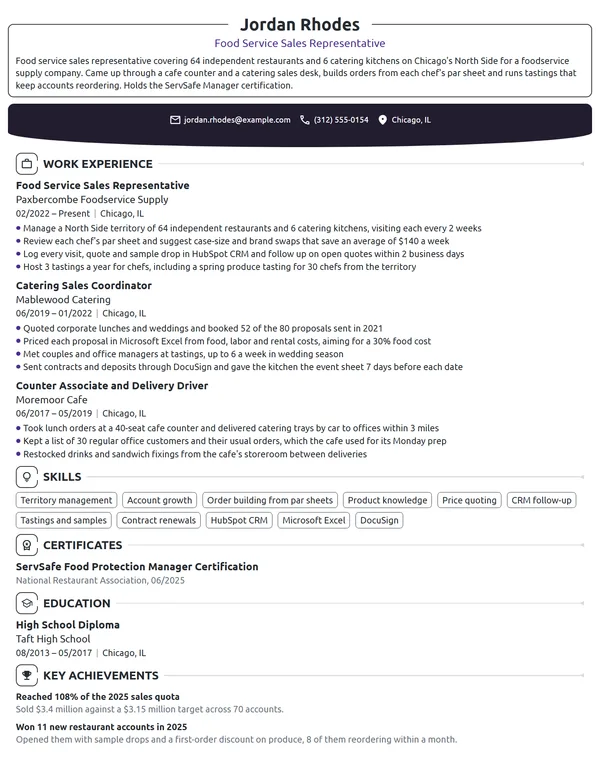
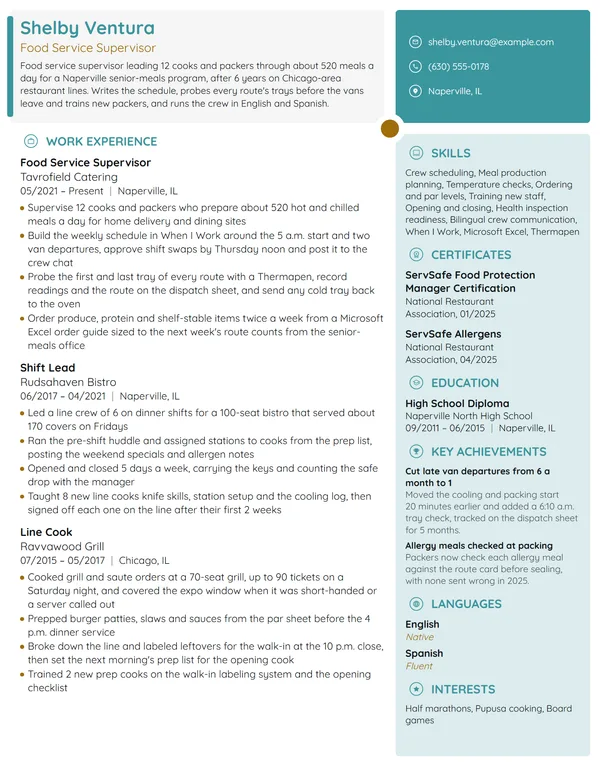
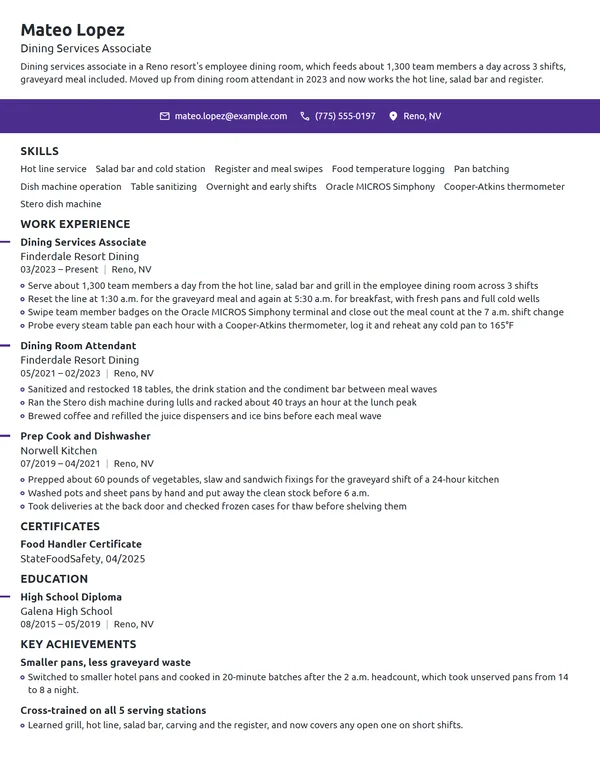
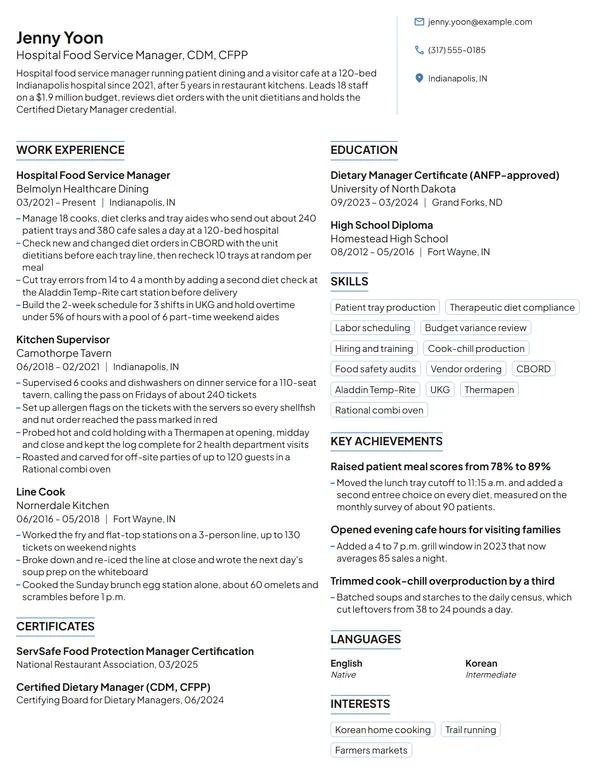
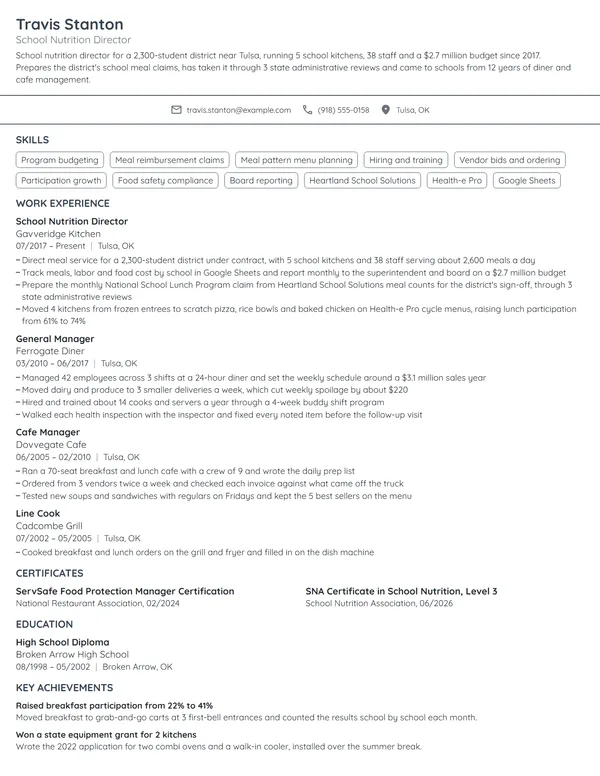
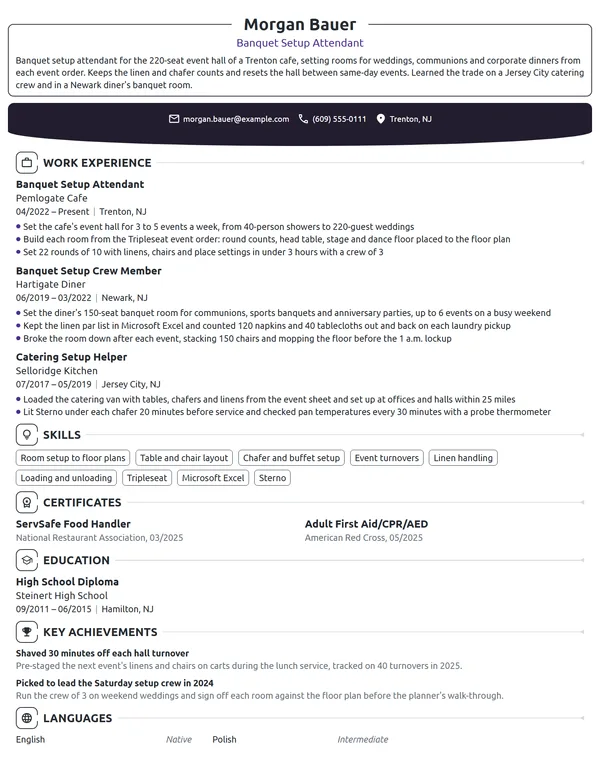
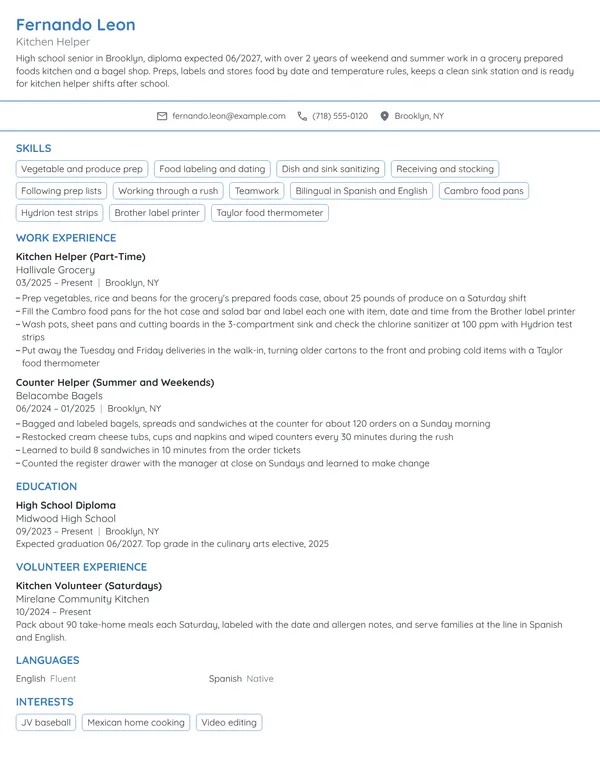
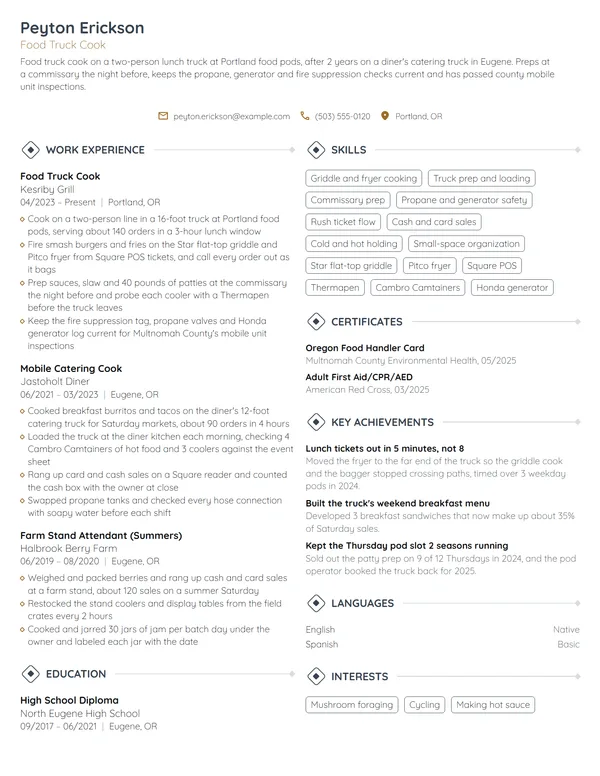
Food service feeds schools, hospitals, offices and neighborhoods, often on a tight schedule. On a cafeteria line, a deli counter or a hospital tray line, managers look for the same things: safe food handling, speed in the rush, accurate orders and someone who shows up for every shift. Serving, cleaning and restocking appear on almost every food service resume, so your details have to do the work: the setting, the volume and the certificate you hold.
How to Write a Food Service Resume - Key Takeaways
- Choose a reverse-chronological layout on 1 page; even 10 years in food service rarely needs a second.
- Open each job's bullets with the kind of operation and its size, such as a 400-student school cafeteria or a 90-bed hospital.
- Count by the meal period: meals per lunch, trays per breakfast, orders per hour or students per line.
- Show food safety with something checkable, such as temperature logs kept, inspection results or the diet orders you matched.
- List a food handler card or a ServSafe manager certification under Certificates, with the issuer and the month you earned it.
- Test your file with an ATS resume checker before you apply to a hospital, school district or contract food company portal.
What hiring managers look for in a food service resume
The BLS Occupational Outlook Handbook lists taking orders, serving food at a counter or a stand, accepting payment, cleaning work areas and stocking service stations as the core of food and beverage serving work. O*NET adds balancing cash registers, ordering and restocking supplies, and training other employees. A hiring manager reads your resume to see how much of that you have done, how fast, and in what kind of operation.
Setting matters more here than in most jobs. A school cafeteria serves hundreds of students within brief lunch periods, a hospital tray line matches every plate to a diet order, and a deli counter runs on slicers, scales and labels. Say which one you worked in, and the rest of your resume reads in the right light. Use these sections:
- Name and headline (Food Service Worker, Dietary Aide), then phone, email and city
- A summary of 2 or 3 lines below your headline; it needs no title
- Work Experience, newest entry on top
- Certificates: your food handler card or manager certification
- Skills, with the POS system and kitchen equipment you use
- Education
- Extras that fit the page: Languages, plus one of Volunteer Experience and Key Achievements
Best format for a food service resume
Pick the reverse-chronological resume format, with your newest job at the top and each entry showing the title, the employer, the city, and the months you began and left as MM/YYYY. Food service careers often move from crew member or line worker to lead, supervisor and assistant manager, and this order makes those steps easy to follow. If you worked several stations for one employer, keep it as 1 entry and name the stations in your bullets.
- Best for most food service workersReverse-chronologicalYour jobs, newest first, with your results under each one.Best for: A steady work history in your field
- FunctionalSkills grouped up top, with a short work history below.Best for: Gaps or very little experience
- CombinationA skills section first, then your full work history.Best for: A career change with strong skills
One page is enough for nearly every food service resume, including supervisors with a decade of shifts behind them. Drop jobs older than about 10 years unless they are your only management experience, and fold short seasonal jobs into 1 line instead of giving each its own entry.
| Setting | What to use |
|---|---|
| Length | 1 page for line, counter and lead roles; 2 only for a director with a long management record |
| Dates | Month and year (MM/YYYY), with Present on your current job |
| Employer line | Employer name and city, with the kind of operation in your first bullet |
| Availability | Shifts you can cover, such as early breakfast or weekends, at the end of your summary |
| Photo, age and ID numbers | No photo unless an employer requests one; leave off your birth year, family status and SSN too |
| File type | PDF, or a Word file when a school district or hospital portal asks for one |
Most US and Canadian resumes carry no photo. Large employers in this field, such as school districts, health systems and contract food companies, usually take applications through an online portal, so plain headings and a simple layout help your details land in the right fields.
Food service resume summary or objective: which to use
Use one test: if you have held a paid food service job for 6 months or more, write a resume summary with your years, your setting, your volume and 1 result. If this is your first job, or you are coming from another field, write a resume objective that names the role you want, the shifts you can work and the training you already have.
Food service resume summary formula
Title with X years in setting, serving meals, trays or orders per day. 1 measured result: speed, accuracy, waste or inspections. Food safety credential and shifts you can cover.
Example
Food service lead with 7 years in senior living and cafe kitchens, serving about 420 meals a day. Kept tray accuracy above 99% across 3 meal periods while training 6 new hires. ServSafe Manager certified and available for early breakfast shifts.
Don't
Hardworking food service worker with great customer service skills looking to contribute to a team.
Do
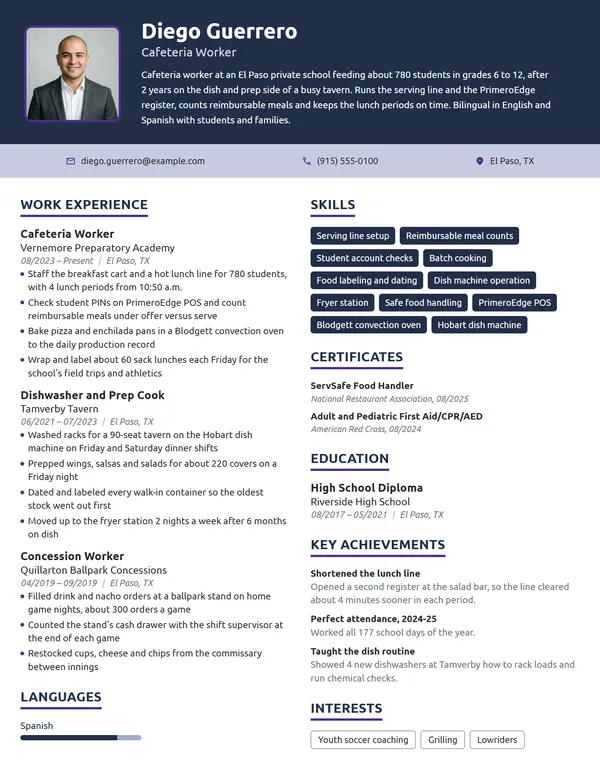
School cafeteria worker with 4 years on the breakfast and lunch lines for 900 students a day. Food handler card holder, cross-trained on the dish machine and the register.
The second version gives the setting, the volume and the stations a manager can schedule you on.
How to write food service work experience bullets with numbers
List 3 to 4 bullets under the job you hold now and 1 to 4 under each earlier one, fewer as the jobs get older. Open with the operation and your volume, then add achievements your manager already tracks: ticket times, tray errors, waste, inspection results or cash variance. Each bullet starts with a verb and carries a number with its base.
| Area | What to count | Example bullet |
|---|---|---|
| Meal volume | Meals per period, students or residents served, covers | Served lunch to 650 students across 3 lunch periods, each with a 32-minute window. |
| Speed | Ticket times, line wait, drive-thru order times | Brought average drive-thru order time from 4 minutes 10 seconds to 3 minutes 25 seconds in 1 quarter. |
| Accuracy | Tray errors, diet order checks, order remakes | Checked 180 patient trays a day against diet orders, with 2 tray errors reported in 6 months. |
| Food safety | Temperature logs, date labels, inspection results | Kept every cooler and hot-holding log complete for 12 months ahead of a state inspection. |
| Waste and inventory | Spoilage in dollars or pounds, par levels, orders placed | Set par levels for 40 deli items and cut weekly spoilage from $310 to $140. |
| Cash and service | Transactions a shift, drawer variance, complaints resolved | Balanced a drawer of 250 transactions a shift with no variance over $1 in 8 months. |
Here is how those numbers read in one worker's entry, with the older job cut to a single line.
Work Experience
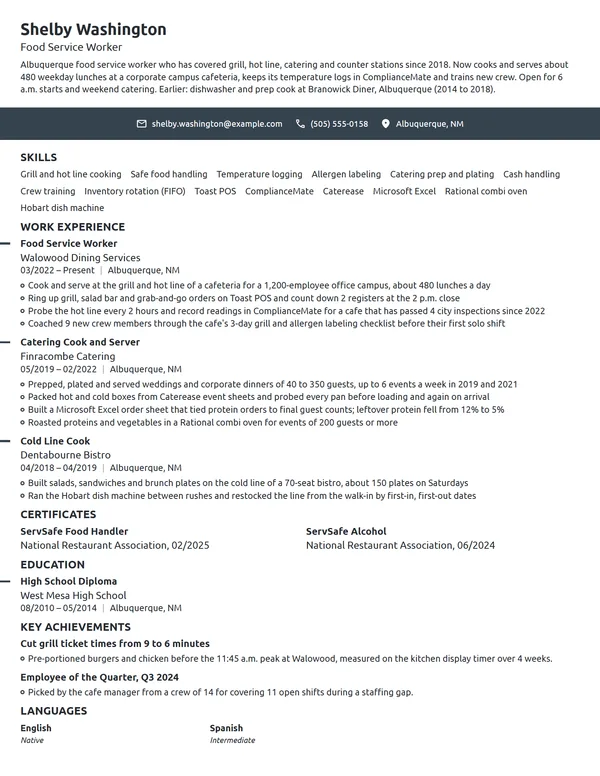
- Plate and serve 3 meals a day for 140 residents in 2 dining rooms, including 9 texture-modified and 22 diabetic diet orders on an average day.
- Log hot and cold holding temperatures 6 times a day; every log was complete for the community's last 2 county inspections, which found no priority violations.
- Replaced plated desserts with a choice cart, cutting dessert waste from 11 to 4 pounds a day.
- Trained 6 new hires on the tray line and the diet card system in 2025.
- Ran the register and the grill station for a 60-seat cafe, averaging 180 orders on weekday lunches.
Don't
Served food to customers.
Do
Served hot entrees from a 6-well steam table to about 300 diners each lunch, holding every pan at 135°F or above.
The rewrite adds the station, the volume and the food safety rule you followed.
Don't
Responsible for cleaning the kitchen.
Do
Closed the dish room and 3 prep stations each night on a written checklist; the kitchen passed 3 inspections in a row without a cleaning violation.
Food service skills, kitchen equipment and POS systems
Pick 6 to 8 skills from the job posting and keep only the ones a bullet already proves. Food safety and portion control belong on almost every food service resume; slicers, steam tables and diet cards only where you used them. For the people side of the job, the customer service skills that matter most are speed under pressure, calm with complaints and clear answers about ingredients.
Hard skills for food service workers
- Safe food handling
- Temperature logging
- Portion control
- Diet order and allergen checks
- Steam table and tray line service
- Deli slicer and scale operation
- Cash handling and POS
- Dish machine operation
- Inventory and restocking
- Opening and closing checklists
Soft skills food service managers value
- Steady pace during the rush
- Reliability on every shift
- Friendly service
- Teamwork across stations
- Handling complaints calmly
- Attention to detail
Name your register system the way the employer does. O*NET lists point-of-sale software such as MICROS, NCR and Aldelo for fast food and counter workers, along with menu and nutrition database software, and it flags Microsoft Excel as a hot technology. Write the exact product in your Skills section and once in a bullet, such as the POS you closed out each night or the diet office system you printed tray tickets from.
Food handler card, ServSafe Manager and CDM on a food service resume
Food service training, per the BLS, covers safe food handling and sanitation, and some states, counties and cities make it mandatory. Kitchens also need a certified leader: under the FDA Food Code 2022, the person in charge of a food establishment is a certified food protection manager who passed a test from an accredited program. Put certifications on your resume under Certificates, each with its issuer and the month you earned it.
| Credential | Issued by | What it takes |
|---|---|---|
| Food handler card | An accredited training provider, such as ServSafe, or a local health department | A short course and test. Required in some states and cities; California's card must come from an ANSI-accredited provider and is valid for 3 years. |
| ServSafe Food Protection Manager Certification | National Restaurant Association (ServSafe) | An exam taken under a registered ServSafe proctor; the certification is accredited by the ANSI National Accreditation Board. |
| Certified Dietary Manager, Certified Food Protection Professional (CDM, CFPP) | Certifying Board for Dietary Managers (CBDM) | An exam after one of 6 eligibility pathways, such as an ANFP-approved foodservice manager training program, or a 90-hour course plus 2 years of non-commercial foodservice management. |
| Allergen awareness training | Your employer, or a course such as ServSafe Allergens | The Food Code requires employees to be trained in food allergy awareness for their duties; it lists 9 major food allergens, sesame among them. |
Food handler card or manager certification: which to list
Line, counter and dietary aide jobs usually ask for a food handler card; lead, supervisor and assistant manager jobs often ask for a manager certification. If you hold both, list the manager certification first. Once it is in place, an old handler card adds little, so drop it if space is short. Write the full name the issuer uses, since an applicant tracking system may search for ServSafe Food Protection Manager rather than the shorthand.
Certificates
- ServSafe Food Protection Manager Certification, National Restaurant Association, 04/2024
- ServSafe Allergens, National Restaurant Association, 09/2025
High school diploma, GED or culinary training on a food service resume
Most food service jobs are learned at work: the BLS says training on the job lasts from a few days to several weeks. Even food service managers typically start with a high school education and several years in the industry, often as cooks, servers or supervisors first. So keep Education brief when you list education on your resume: diploma or GED, school name, town and graduation year.
Add a line only when it relates to the job. ProStart, the National Restaurant Association Educational Foundation's 2-year culinary arts and restaurant management program for high school students, belongs under your diploma. So does a culinary certificate, or a dietary manager course if you are working toward the CDM, CFPP for a hospital or senior living kitchen.
Education
2 years of culinary classes; served at 14 school catering events.
Food service resumes for a first job, a promotion or a career change
For a first job, lead with an objective and then put any work that looks like food service where a manager can find it. Our entry-level resume and high school student resume examples show how a short page still fills up. These count as evidence:
- School and team events: concession stands, bake sales or catering, with the number of people served or dollars raised.
- ProStart or culinary classes: 1 line under Education with any events you cooked or served for.
- Food banks and community meals: under Volunteer Experience, with meals packed or served per shift.
- Retail or cashier jobs: a full Work Experience entry with transactions a shift and how you handled the drawer.
Don't
Looking for a job in food service where I can learn and grow.
Do
High school senior seeking a part-time cafeteria or counter job on weekday evenings and weekends. Food handler card holder with 2 years of ProStart and 120 hours plating and serving at school catering events.
Even a first-job objective needs proof: the shifts you can work, a credential and hours you can count.
Moving up to lead, supervisor or assistant manager, put the management work you already do into bullets: shifts you ran, people you trained, orders you placed and schedules you built. Our food service manager resume examples show where that leads. Coming from another field, stay with newest-first order and keep the bullets that carry over, such as cash handling, customer contact or physical work, as our career-change resume examples do. Your cover letter explains the move, and the customer service cover letter examples show how to keep that to a few sentences.
Food Service resume FAQ
Do I need a food handler card to work in food service?
Only if your state, county, city or employer requires one, and many do. California, for example, requires a card from an ANSI-accredited provider, valid for 3 years. If you already hold one, list it under Certificates with its issue month so a manager can see you can start right away.
Should I put ServSafe on my food service resume?
Yes, if you hold it. Write the exact name, such as ServSafe Food Protection Manager Certification or ServSafe Food Handler, with the National Restaurant Association as the issuer and the month you earned it. For lead and assistant manager jobs, put it in your summary too.
How do I describe a school cafeteria job on my resume?
Give the school level, the students served per lunch and the number of lunch periods, then the stations you worked, such as the serving line, the register or the dish room. If you counted reimbursable meals or checked student accounts at the register, say so in a bullet.
What goes on a dietary aide resume that a restaurant resume leaves out?
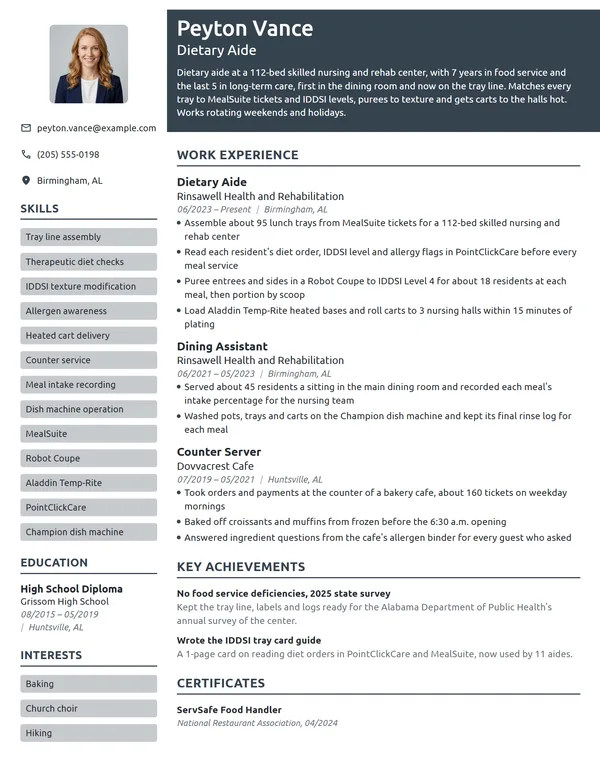
Diet orders. A hospital or senior living kitchen wants to see that you matched trays to diet cards, handled texture-modified and allergen-restricted meals, and logged temperatures. Name the number of residents or patients, the meal periods you covered and any tray accuracy result.
How do I show I am ready for a food service supervisor or assistant manager job?
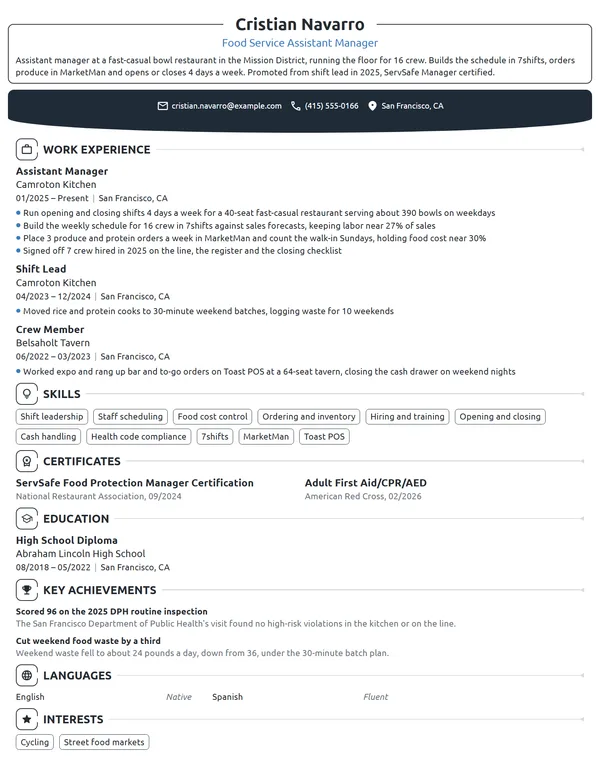
Write the supervisory work you already do as bullets with numbers: shifts you led, staff you trained, food orders you placed and schedules you built. Add a food protection manager certification under Certificates, since the person in charge of a kitchen usually needs one.
What skills should I put on a food service resume?
Pick 6 to 8 that match the posting and that your bullets prove: safe food handling, temperature logging, portion control, cash handling, your POS system and the equipment you run, such as a slicer or dish machine. Add 2 or 3 soft skills, such as a steady pace during the rush.
How far back should a food service resume go?
About 10 years. Older jobs can go unless they hold your only supervisory experience. Short seasonal jobs, such as a summer at a camp kitchen or a stadium stand, fit into 1 line rather than each taking a full entry.
How long should a food service resume be?
1 page. That covers line, counter, dietary and lead roles, and most supervisors too. A second page only makes sense for a food service director with many years of management, budgets and multiple sites to show.
How much do food service workers make?
BLS figures for May 2025 put the median hourly wage for fast food and counter workers at $15.00. Pay varies by state, employer type and shift, and hospital or school jobs may differ from restaurants. Leave pay off your resume and discuss it once you have an offer.
Next steps
Pick the example closest to your setting, whether a cafeteria, a deli, a hospital kitchen or a counter, and swap in your own meal counts, food safety record, credentials and shifts. Our resume builder and templates give you a clean layout to start from. Add a cover letter of a few lines that names the role you want.