
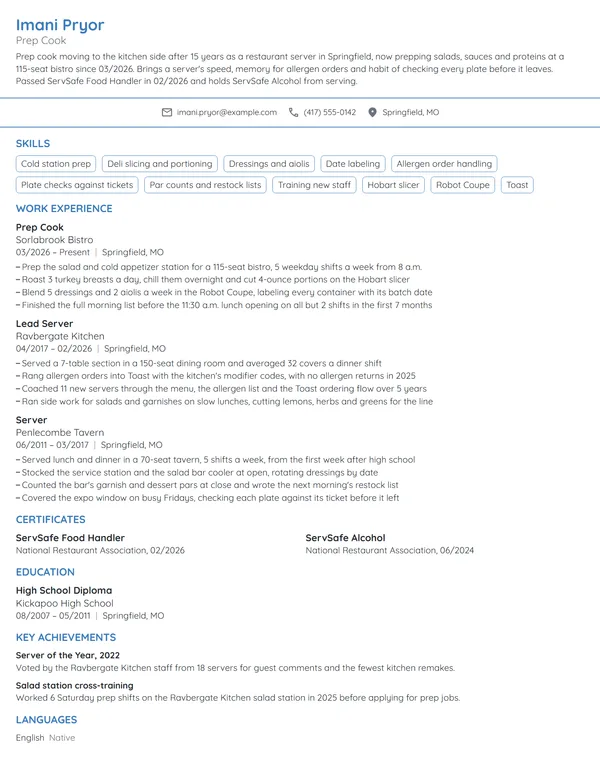
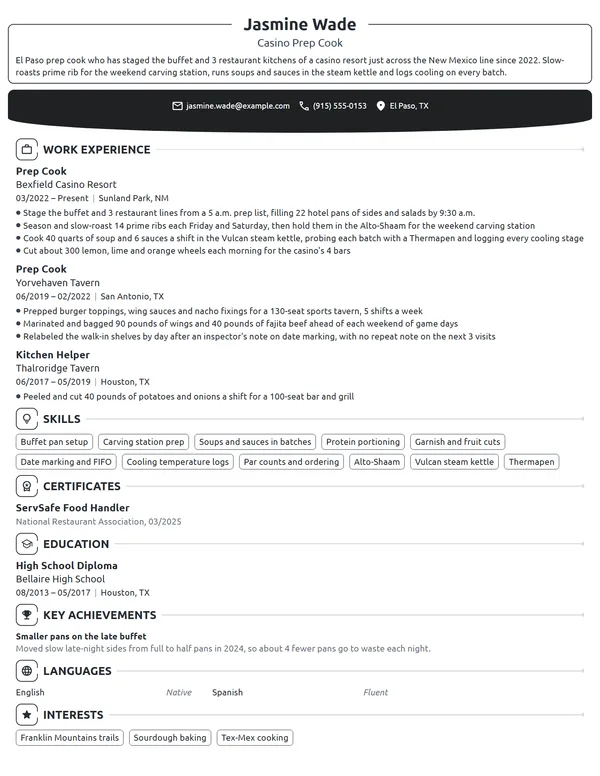
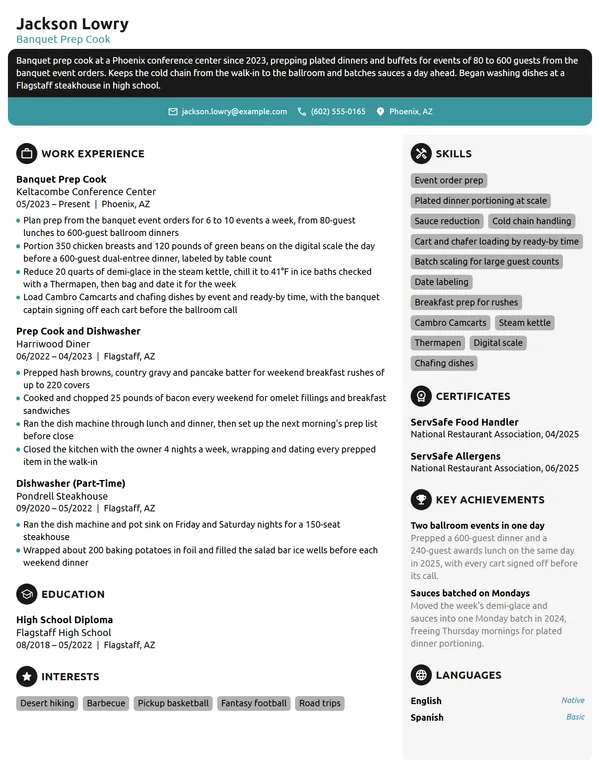
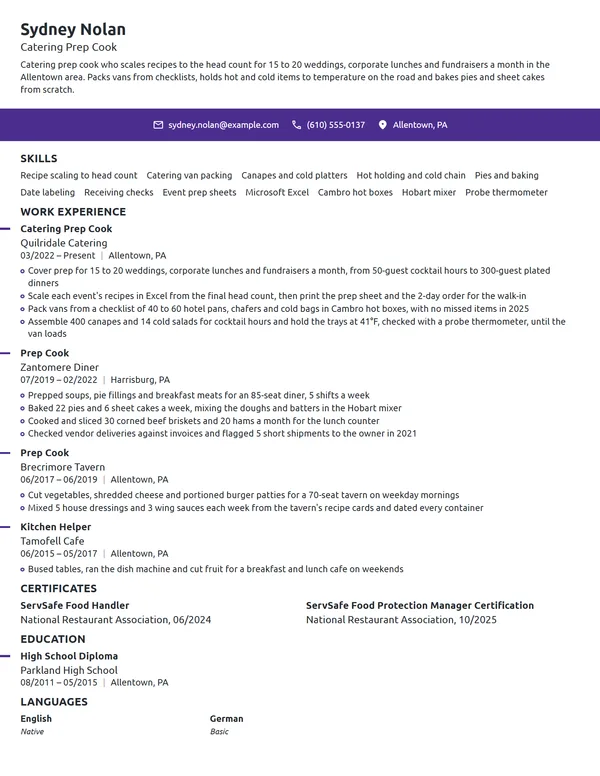
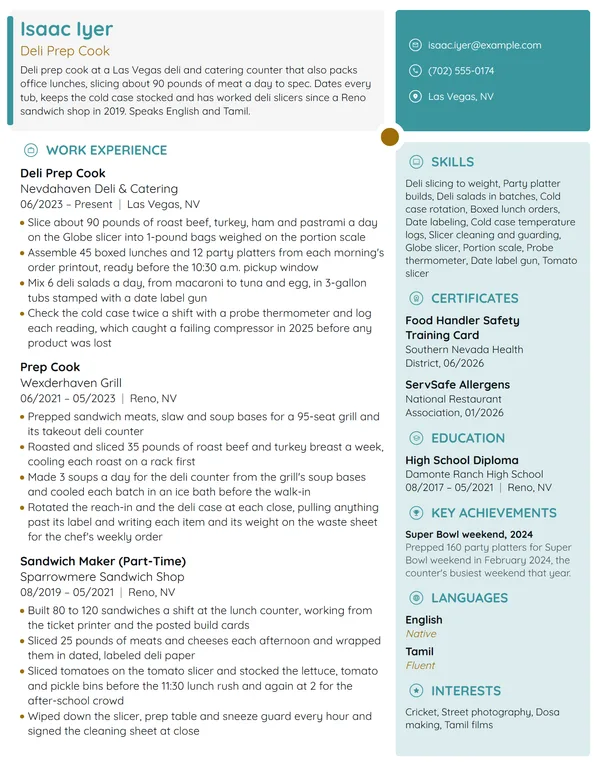
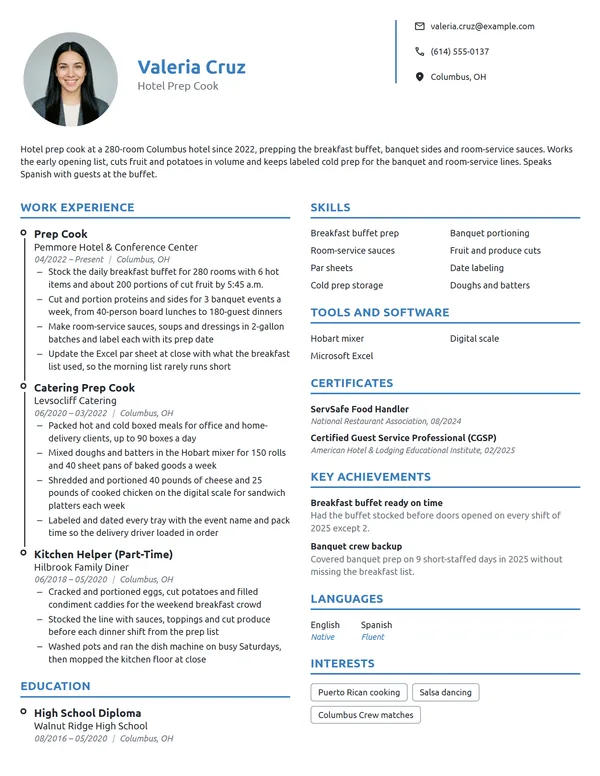
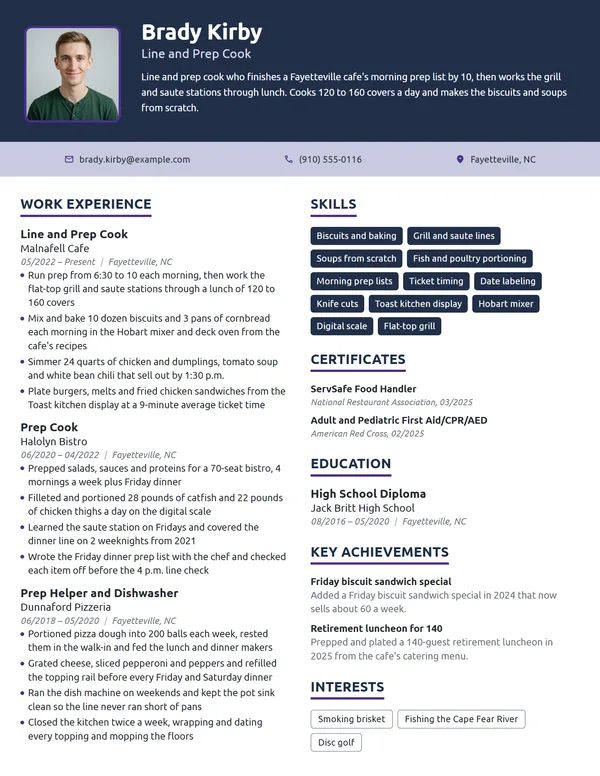
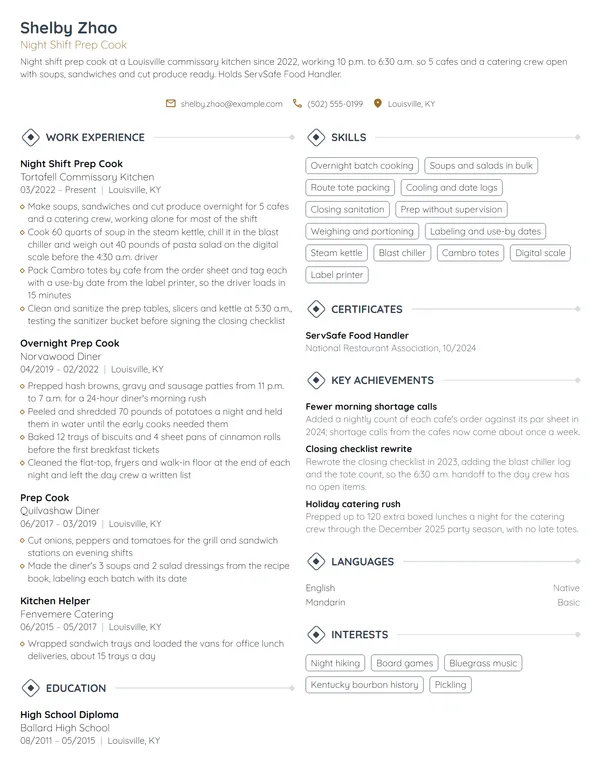
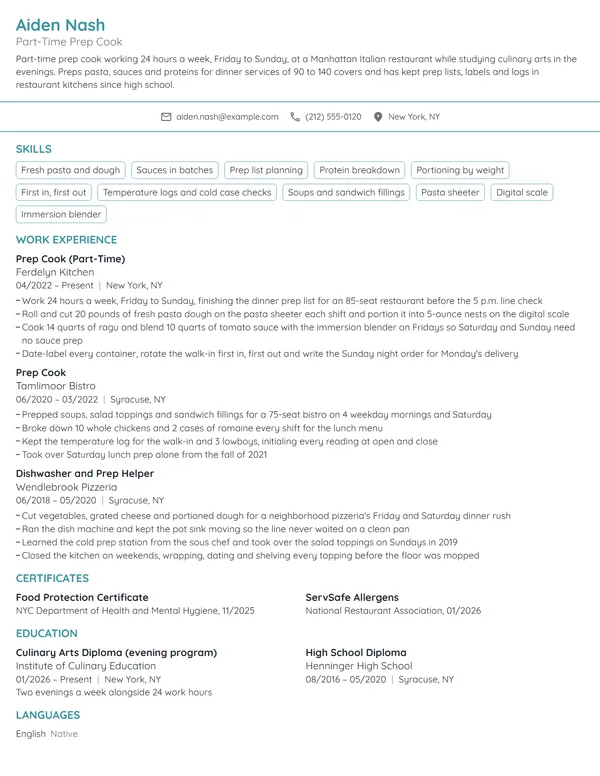
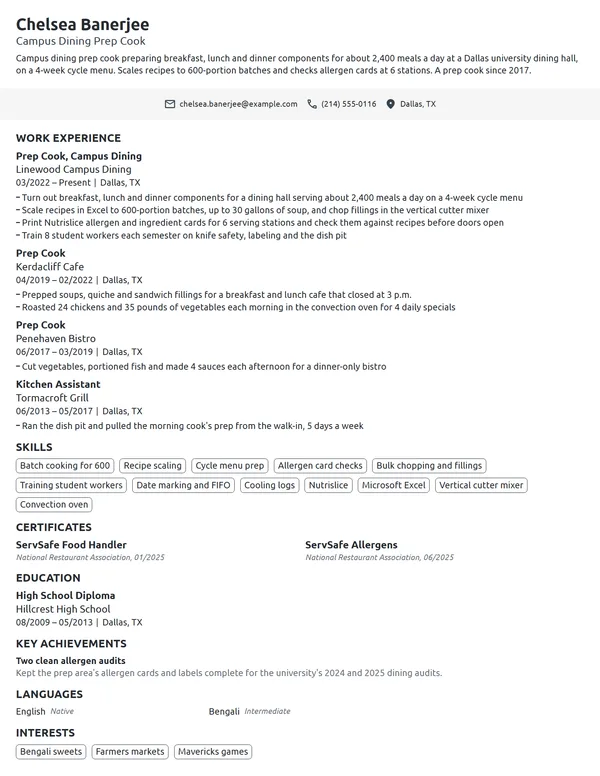
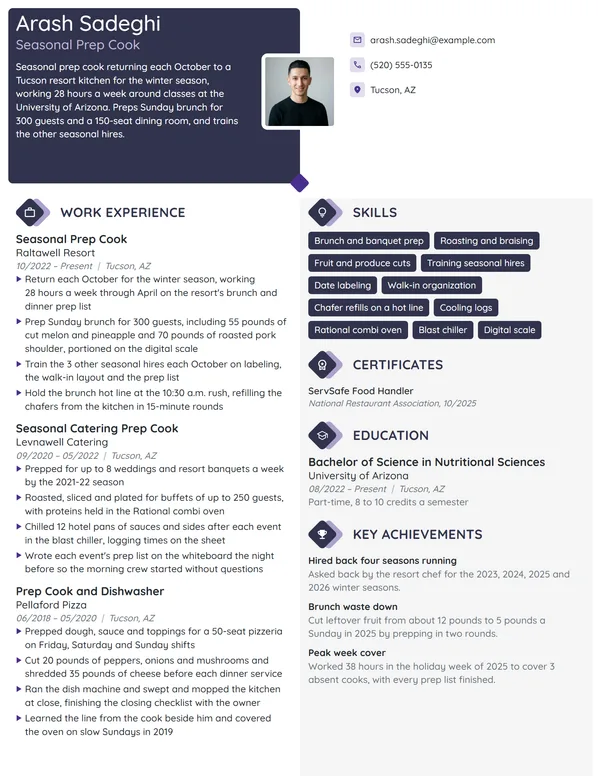
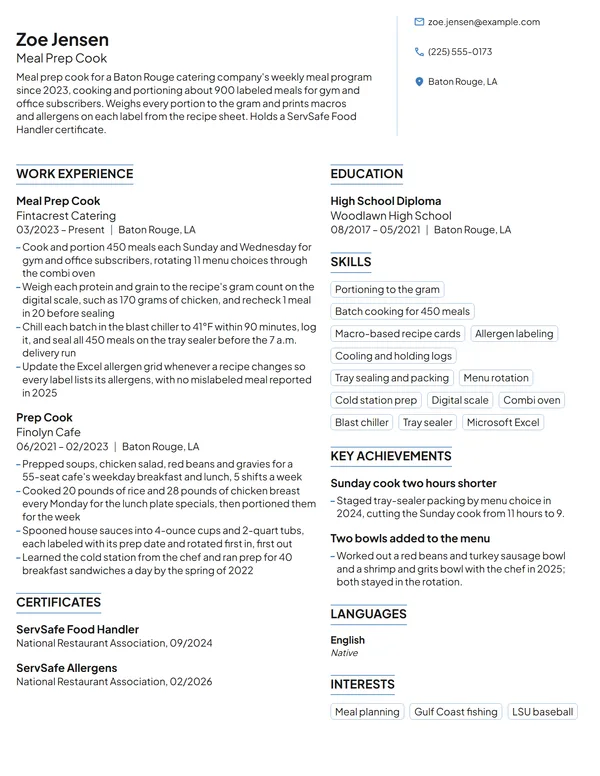
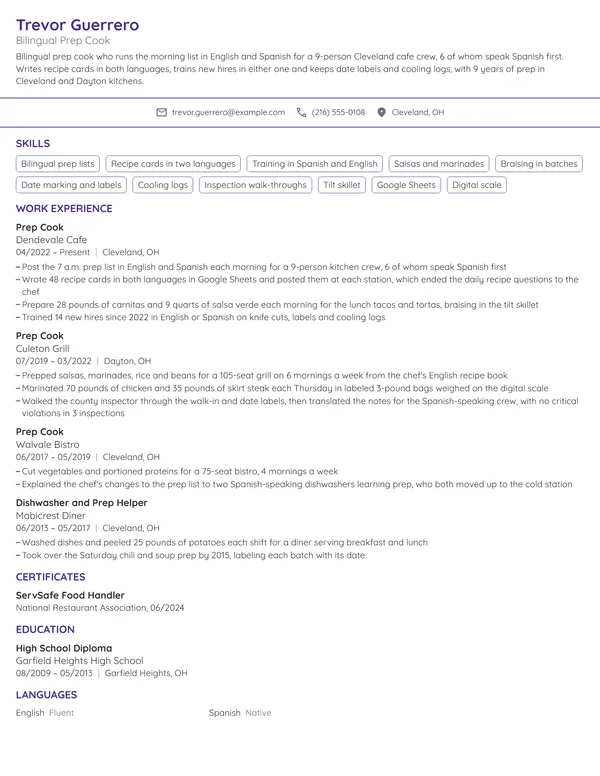
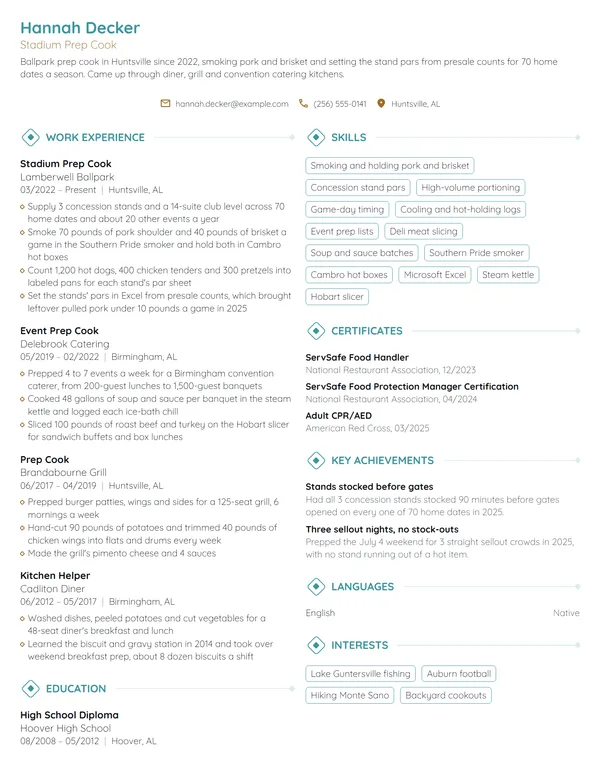
A prep cook gets the food ready that every station cooks from during service: the cut vegetables, portioned proteins, stocks, sauces and dressings. The job rewards speed and consistency: a long prep list finished before the doors open, recipes followed exactly, everything labeled and rotated, and cooling and temperature logs kept complete. Each of those can be counted in quarts and pounds per batch, items on the list, and the time it was all done.
How to Write a Prep Cook Resume - Key Takeaways
- List your kitchens newest first on 1 page, and open each job with the size of the kitchen and the stations you prep for.
- Write 2 to 3 opening lines with your years, the kind of kitchen, your biggest batch or prep list and your food safety card.
- Give every batch a unit, such as quarts, gallons, pounds or cases, and give every prep list a ready-by time.
- Show food safety with what you actually did: date marking, FIFO rotation, cooling logs and inspection results.
- Put your food worker card or food handler certificate first under Certificates, by the name your state or county gives it, with its issue month.
- Keep pay and personal details off the page, then check the file with an ATS resume checker before you apply through a hotel, hospital or restaurant group portal.
What chefs look for in a prep cook resume
The person hiring a prep cook, usually a chef, sous chef or kitchen manager, needs someone who has the line stocked before the first ticket and who does it the same way every day. The BLS describes food preparation work as the tasks other than cooking, such as weighing ingredients, preparing produce, cutting meat, poultry and seafood, storing food so it does not spoil, and recording food temperatures. O*NET, which files prep cooks with restaurant cooks, adds rotating stock and keeping prep areas sanitary to the core tasks.
So each job on your resume should say how much you prepped, for whom, and how safely. Set the page up in these sections:
- Name, headline (for example, Prep Cook, Banquets and Catering) and contact details
- Opening lines: 2 or 3 sentences at the top, with no heading above them
- Work Experience, current kitchen on top
- Skills, with the kitchen equipment and software you can run
- Certificates, your food worker card or food handler certificate listed first
- Education: your diploma, GED or culinary certificate
- Space permitting: Languages, plus Volunteer Experience or Key Achievements
Best format for a prep cook resume
Go with the reverse-chronological resume format: your current kitchen first, then each earlier job with your title, the restaurant or facility, its city and the months you started and left, as MM/YYYY. Prep work often leads to a station on the line, and listing the newest job first shows that step at the top of the page. A skills-first layout hides how long you worked in each kitchen, which is the first thing a chef wants to check.
- Best for most prep cooksReverse-chronologicalYour jobs, newest first, with your results under each one.Best for: A steady work history in your field
- FunctionalSkills grouped up top, with a short work history below.Best for: Gaps or very little experience
- CombinationA skills section first, then your full work history.Best for: A career change with strong skills
One page holds a prep cook career, even with 3 or 4 kitchens. If you have more jobs than that, keep the last 10 years and fold shorter, older jobs into 1 line each, so your current kitchen and your certificates stay easy to find.
| Setting | What to use |
|---|---|
| Length | 1 page; drop jobs older than 10 years before you shrink the font |
| Dates | Month and year as MM/YYYY, and Present for your current kitchen |
| Job title line | Prep Cook, plus the kind of work when it helps: Prep Cook, Banquets and Catering |
| Start time | 1 short line in your opening lines when the posting lists 5 a.m. or 6 a.m. starts |
| Font | Arial, Calibri or a similar clean font, 11 or 12 pt in the bullets |
| Headshot and personal data | No photo for most US and Canadian applications; age, marital status and SSN stay off the page too |
| File type | PDF; Word only if a hospital or hotel portal requests it |
Most US and Canadian resumes carry no photo. A chef judges a prep cook on a working interview or a trial morning, so space spent on a headshot is better given to your batch sizes and your card.
Prep cook resume summary vs. objective
The test is simple: have you been paid to prep food in a commercial kitchen? If so, write a resume summary that names your years, the kind of kitchen, what you prep for and your strongest result. If not, write a resume objective that names the prep cook job you want and the closest food work you have done. Keep either one to 2 or 3 lines, and take its number from a bullet below it.
Prep cook resume summary formula
Title with X years in type of kitchen, prepping for stations or guests a day. Your best batch, prep list or waste result, in numbers. Food safety card or certificate.
Example
Prep cook with 5 years in a taproom and a breakfast cafe, prepping for 3 stations and up to 400 guests a day. Reset pars for 18 items and trimmed weekly produce waste by 19 pounds. Holds a Washington Food Worker Card and ServSafe Allergens.
Don't
Reliable prep cook with excellent knife skills and a strong work ethic, looking to join a great team.
Do
Prep cook with 3 years at a 90-seat brewpub, prepping for the grill, fry and salad stations on 6 a.m. starts. Breaks down about 50 pounds of produce a shift and holds a current food handler card.
The stronger version names the kitchen, the stations, the volume and the card, and a chef can check each one.
How to write prep cook bullets with batch sizes and ready-by times
Give your current kitchen 3 to 4 bullets and each earlier job 1 to 3. Prep work comes with its own numbers, from the items on the list and the time it was done to quarts, pounds and portion weights, so nearly every bullet can carry one. Focus on achievements on your resume, such as a list finished earlier or less food thrown out, rather than a copy of the duties in the job ad.
| Area | What to count | Example bullet |
|---|---|---|
| Batch volume | Quarts, gallons, pounds or cases per shift | Made 12 quarts of salsa and 8 quarts of pico de gallo from scratch each morning. |
| Knife work and portions | Pounds broken down, portion weights, accuracy | Portioned 60 pounds of salmon a week into 6-ounce fillets, each within a quarter ounce. |
| Prep timing | Items on the list, stations stocked, minutes before service | Stocked a 4-station line with 36 prep items by 3:30 p.m., 30 minutes before dinner. |
| Labeling and rotation | Containers dated, coolers managed, inspection results | Labeled and rotated stock in 3 reach-ins and a walk-in by FIFO, with no expired items found in 5 inspections. |
| Cooling and temperature logs | Batches logged, logs kept, gaps | Logged 2-stage cooling for 9 to 12 batches of soups and sauces a day. |
| Diet orders | Diet types, patient or resident trays, menu cycle | Prepped 4 texture-modified diets for 210 patient trays at lunch, from the dietitian's diet list. |
| Training | New hires trained, equipment taught | Trained 4 new prep cooks on the slicer and the kitchen's labeling system. |
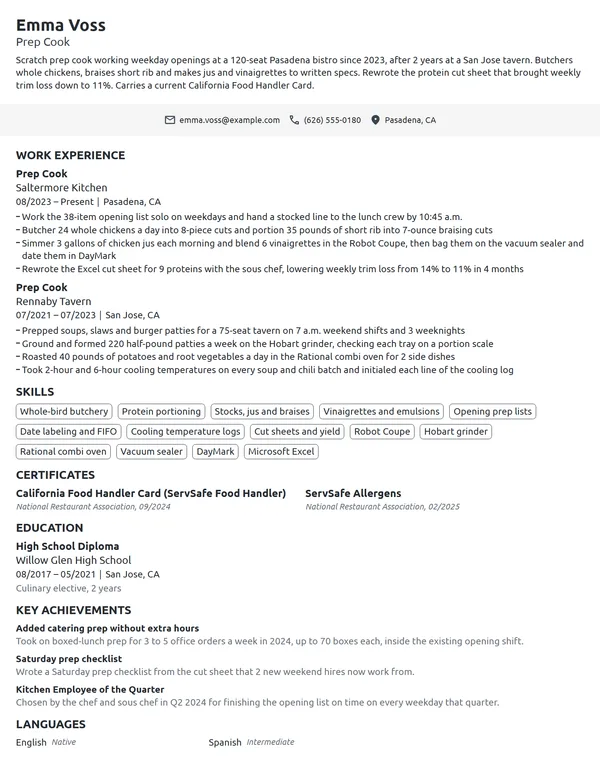
This entry puts those numbers to work. Its opening bullet gives the kitchen's size, the next ones carry batches and a food safety log, and the older job keeps 2 lines.
Work Experience
- Prep for 3 stations in a 140-seat taproom from a 42-item list, 5 mornings a week, with every station stocked before the 11 a.m. opening.
- Break down 6 cases of produce and 80 pounds of chicken thighs a day into portioned, labeled hotel pans.
- Cook 5 gallons of stock and 3 sauces daily and log each batch cooling from 135°F to 70°F within 2 hours.
- Reset par levels for 18 prep items against 6 weeks of sales, trimming weekly produce waste by 19 pounds.
- Prepped 15 pounds of potatoes and 4 quarts of dressings each morning for a 60-seat breakfast cafe.
- Date-marked every ready-to-eat container in 2 walk-ins, with no date-marking violations in 4 health inspections.
Don't
Prepped vegetables and meats.
Do
Diced, sliced and portioned 45 pounds of vegetables and 30 pounds of beef a shift, all to the kitchen's cut sheet.
The rewrite adds the volume and the standard the work was held to.
Don't
Followed all food safety procedures.
Do
Kept cooling logs for 8 batches a day and date-marked and rotated every container in 2 walk-ins, with no missed log entries in 18 months.
Hospital, cafeteria and lead prep cook bullets
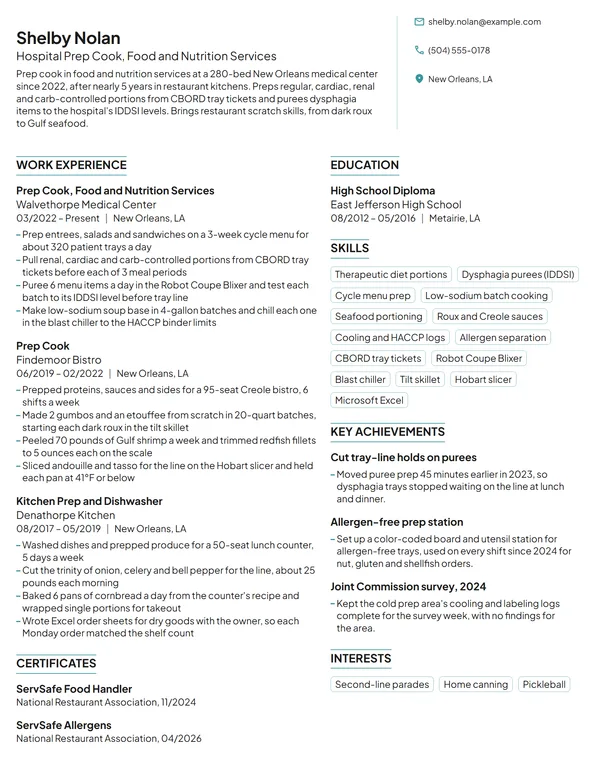
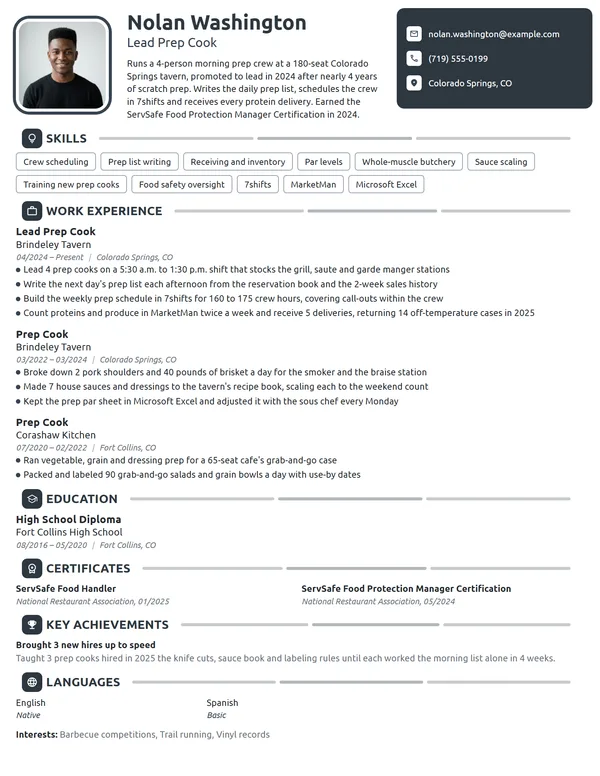
In hospitals, schools and other institutions, the BLS says, cooks prepare large quantities of food to preset menus, and O*NET adds cooking to special dietary or nutritional restrictions and set portion counts. So a hospital prep cook's bullets name the diet types, the trays or meals a day and the menu cycle, using the diet names the facility uses. A lead prep cook adds the crew: prep cooks scheduled, new hires trained, deliveries received and the prep list you write for the next shift.
Prep cook skills, equipment and software for your resume
Choose 6 to 8 hard skills for your resume that the job listing requests and that a bullet already backs up. Knife cuts, recipe scaling and labeling fit almost every prep job; butchery, baking or diet-order prep belong only where you have done them at work.
Hard skills for prep cooks
- Knife cuts (dice, julienne, chiffonade)
- Recipe scaling and measuring
- Stocks, soups and sauces in batches
- Meat, poultry and fish portioning
- Prep lists and par levels
- Date marking and labeling
- FIFO stock rotation
- Cooling and temperature logs
- Allergen separation
- Receiving and checking deliveries
Soft skills chefs want in a prep cook
- Working to a ready-by time
- Following recipes exactly
- A steady pace on early shifts
- Clean, organized work areas
- Clear handoffs to the line
- Taking correction from the chef
Name the equipment you can run safely without help, such as a meat slicer, food processor, vertical cutter mixer, vacuum sealer, tilt skillet or blast chiller, and put at least 1 piece into a bullet. For software, O*NET lists food safety labeling systems, recipe cost control software and point-of-sale restaurant software among the tools of restaurant cooks, and flags Microsoft Excel as hot technology. If the posting names its label printer or inventory app, write that exact name.
Food worker cards, ServSafe and allergen training on a prep cook resume
Many states do not require any certification for cooks, the BLS reports, while some states and localities require a food handler's certification. Find out which card applies where you will work, then list certifications on your resume under Certificates in this order: your food safety card, allergen training, then any manager or culinary credential, each with the issuer and the month.
| Credential | Issued by | What it takes |
|---|---|---|
| Washington Food Worker Card (state example) | Local health departments, under Washington State Department of Health rules | Required for food workers in Washington; you may work up to 14 days first if your employer gives food safety training. The first card lasts 2 years and renewals 3 or 5. |
| ServSafe Food Handler | National Restaurant Association | A food handler certificate the issuer recognizes for 3 years; your state, county or employer may set different rules. |
| ServSafe Allergens | National Restaurant Association | Recognized for 3 years; worth adding where you prep allergen-free items or separate allergen batches. |
| ServSafe Food Protection Manager Certification | National Restaurant Association | Recognized by the issuer for 5 years; most useful when you move toward a lead prep cook or kitchen manager role. |
Washington also shows the kind of rule worth writing into a bullet. Its food code, built on the FDA Food Code, requires cooked food to cool from 135°F to 70°F within 2 hours and to 41°F within 6 hours in total, and limits ready-to-eat food that needs refrigeration, held at 41°F or below, to 7 days, counting the day of preparation as day 1. Write the cooling and date-marking rule your own kitchen follows, and list your card by the name it carries where you earned it.
Certificates
- Washington Food Worker Card, Yakima Health District, renewed 03/2025
- ServSafe Allergens, National Restaurant Association, 08/2025
High school, GED or culinary program: education on a prep cook resume
There are typically no formal education requirements for food preparation workers, the BLS says, and most get short-term on-the-job training that lasts several weeks. That makes your kitchen hours the main proof on the page, with Education kept to 1 or 2 lines below Work Experience.
When listing education on a resume, write the diploma, GED or certificate, then the school, where it is and your graduation month. A culinary certificate or a high school culinary program goes on the same line with its full name; skip GPA and coursework after a year of kitchen work.
Education
Entry-level and career-change prep cook resumes
Food preparation workers may move up to assistant cook or line cook as they learn to cook, per the BLS; the cook page shows that next resume. For your first prep job, use an entry-level resume layout: a short objective, your food safety card near the top, then any work that put you near food, each with a number.
- Dishwashing shifts: their own Work Experience entry, with the prep tasks you took on and the size of the kitchen.
- Fast-food or deli counter work: slicing, portioning or batch prep, with pounds or orders a shift.
- School cafeteria, camp or catering jobs: meals a day and the part of the prep you handled.
- Meal programs and food banks: under Volunteer Experience, with meals prepped a week.
Don't
Hard worker looking for a prep cook job to start my career in the kitchen.
Do
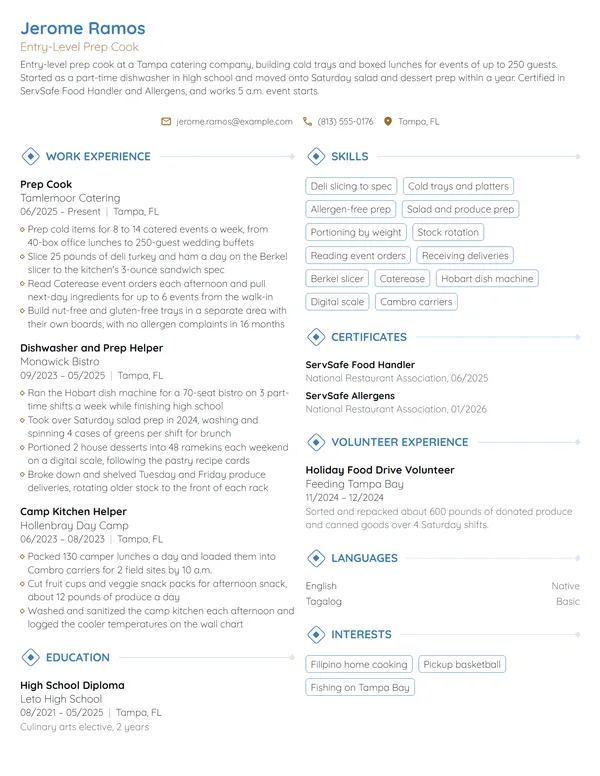
High school graduate with 14 months as a dishwasher at a 110-seat diner, seeking a prep cook role. Already preps salads and slices deli meat on weekend mornings, and holds a food handler card.
Even a first-job objective needs proof: time in a kitchen, prep you were trusted with and a card.
Moving into prep from a warehouse, retail, caregiving or another job, keep newest-first order and use the opening lines to name the prep job you want and your food safety card. A career-change resume works when the top bullets of each job show habits a kitchen needs, such as working to a deadline, following written steps or counting stock. Save the reason for the switch for your letter to the chef; the cover letter with no experience approach fits when this is your first kitchen job.
Prep Cook resume FAQ
What is the difference between a prep cook and a line cook resume?
The numbers. A prep cook resume counts batches, portions, prep list items and ready-by times, plus cooling and labeling logs. A line cook resume counts covers and ticket times on a station. If you have done both, list both under 1 job and give each its own bullet.
Do I need a food handler card to work as a prep cook?
Only if your state, county or employer asks for one. The BLS says some states and localities require a food handler's certification and many do not. Washington, for example, requires a food worker card, with up to 14 days of work allowed first if your employer trains you. List whichever card you hold first under Certificates.
How long should a prep cook resume be?
1 page. Even after 3 or 4 kitchens, a prep cook resume fits on 1 sheet if you keep the last 10 years and give older jobs 1 bullet each.
What should a hospital prep cook put on a resume?
The diet types you prep, the trays or meals a day, the menu cycle and your food safety card. Use the diet names the hospital's diet list uses, and add allergen training if you prepare allergen-free trays.
Can I get a prep cook job with no kitchen experience?
Yes. The BLS says food preparation workers usually have no formal education requirements and learn through a few weeks of on-the-job training. Lead with an objective, a food handler card if your state offers one, and any work near food, such as dishwashing, a deli counter or a meal program.
Should I list knife skills on a prep cook resume?
Yes, but name the cuts and prove them. Write "Knife cuts (dice, julienne, chiffonade)" under Skills, then add a bullet with pounds cut a shift or a portion weight you hit, so the chef sees the speed and accuracy behind the skill.
How much do prep cooks make, and should pay go on the resume?
Keep pay off your resume. For a benchmark, BLS OEWS data put the median for restaurant cooks, the group O*NET files prep cooks under, at $17.98 an hour or $37,390 a year in May 2025. The BLS puts food preparation workers at $16.98 an hour for the same month.
Next steps
Pick the example that matches your kitchen and level, copy how it is laid out, and replace its figures with your own batches, prep list and ready-by times. Our resume builder and resume templates put it on the page fast; then take your food worker card, with its date, to the trial shift.