
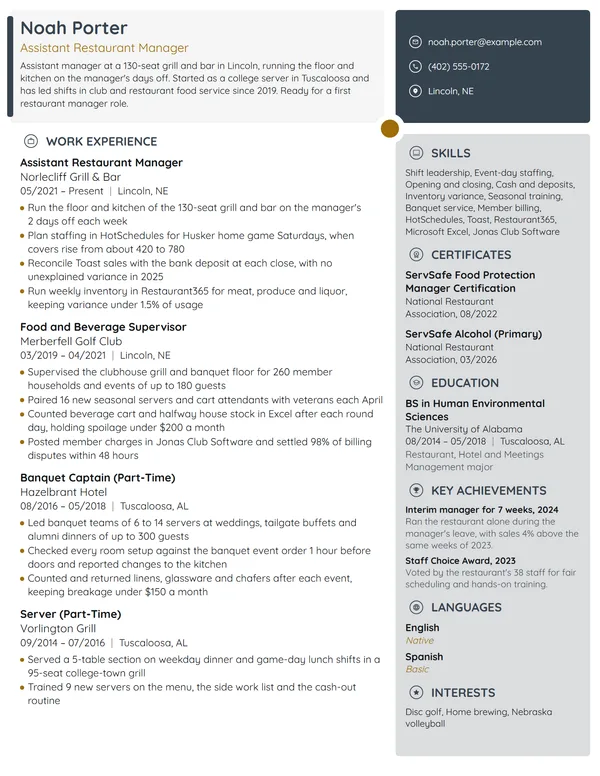
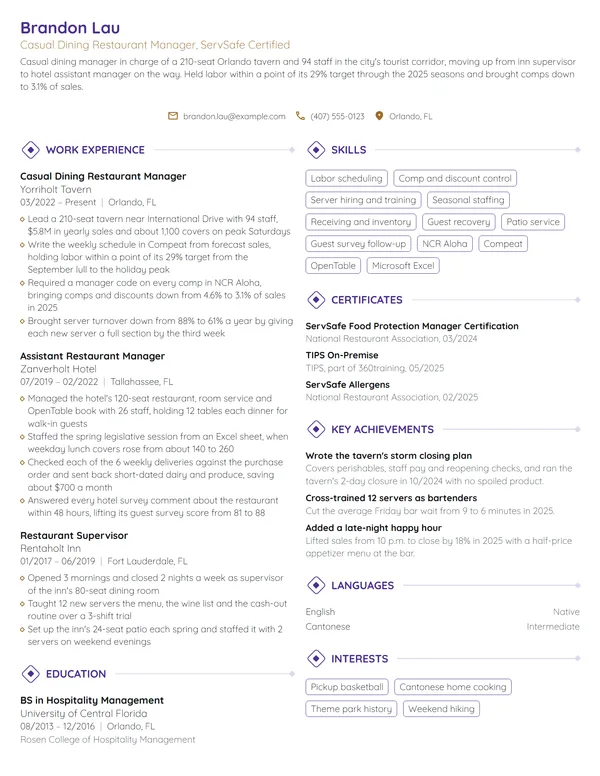
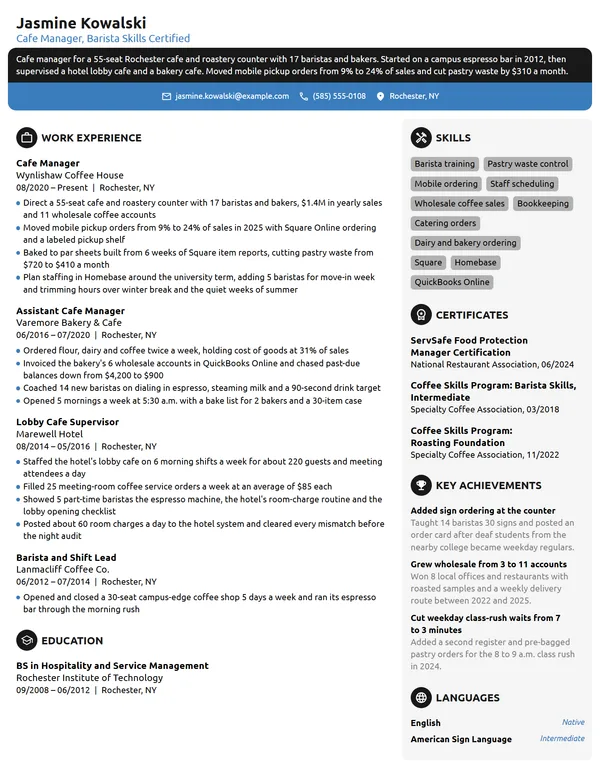
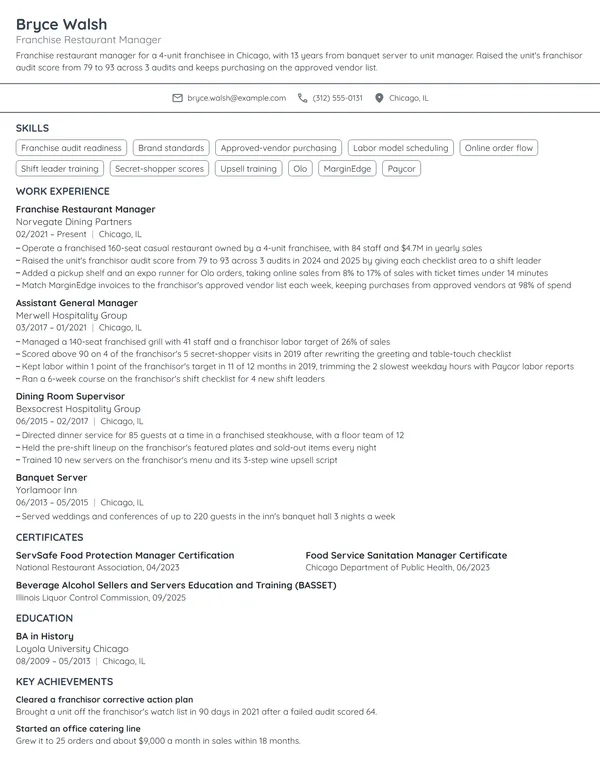
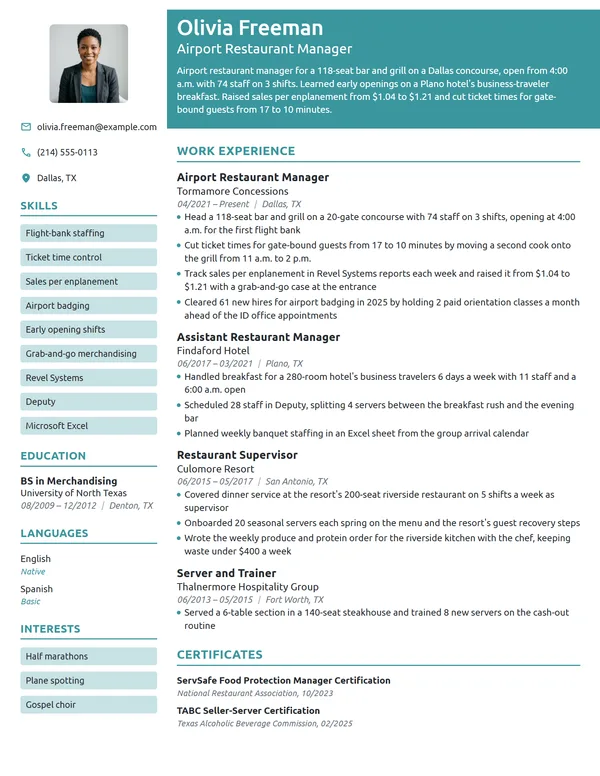
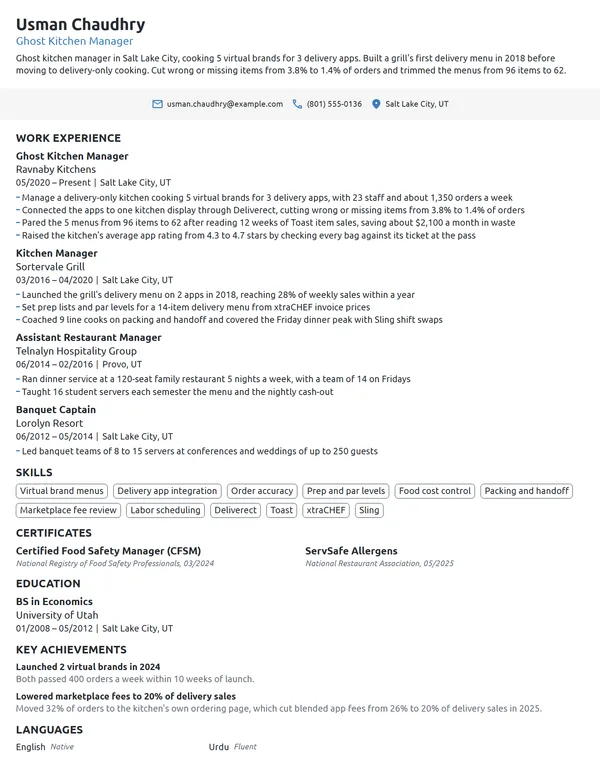
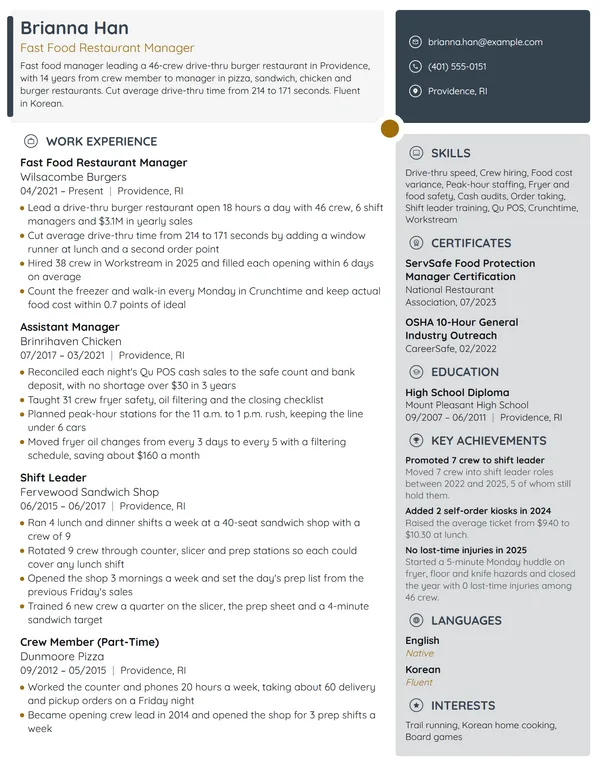
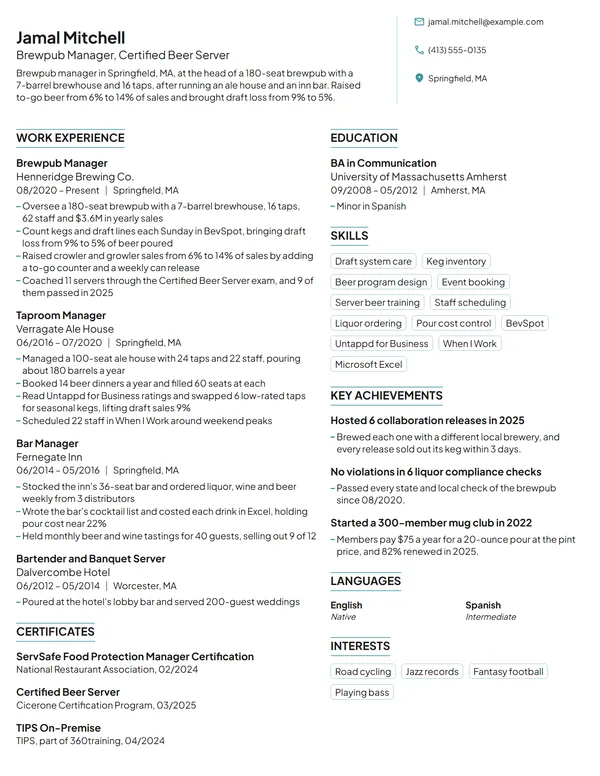
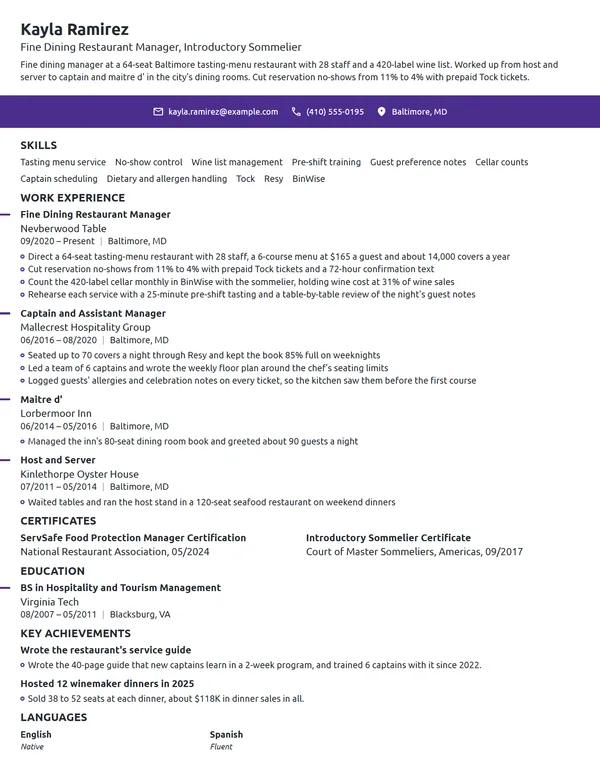
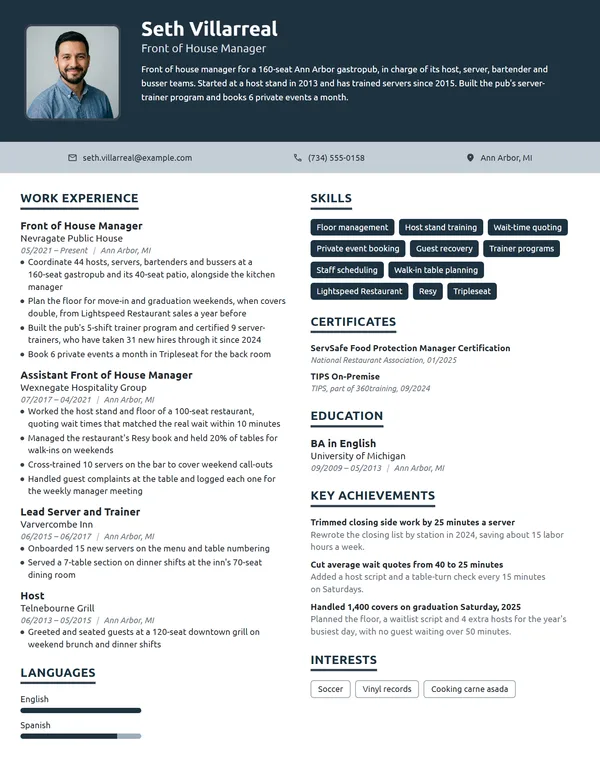
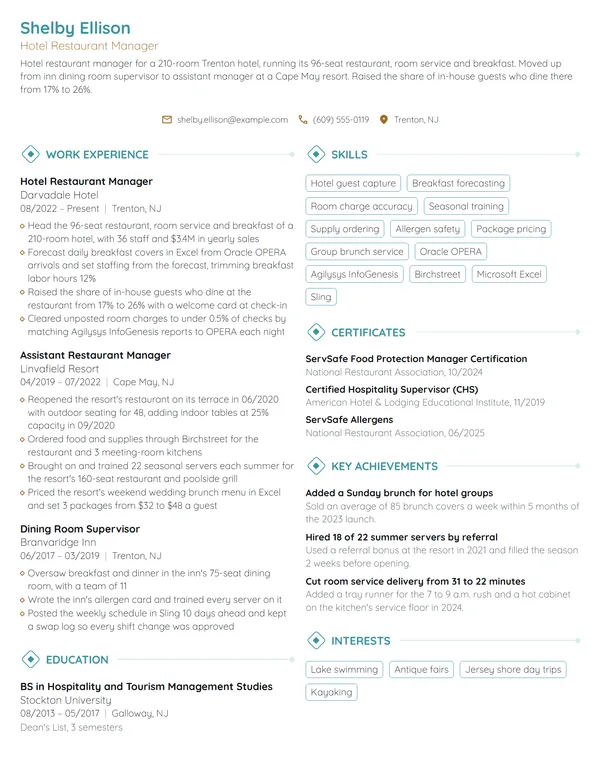
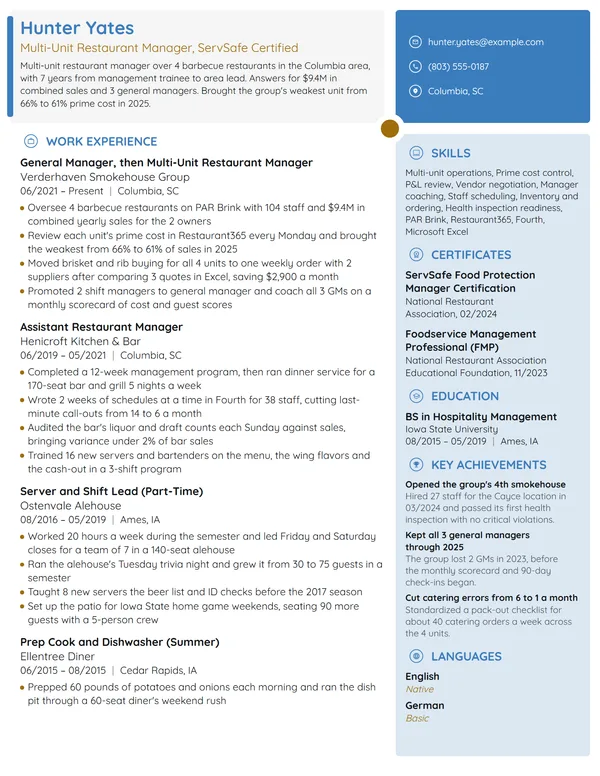
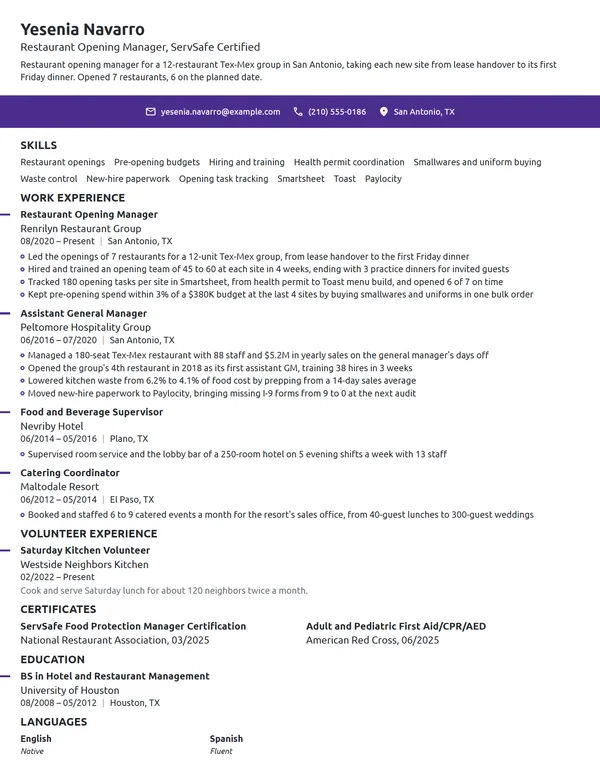
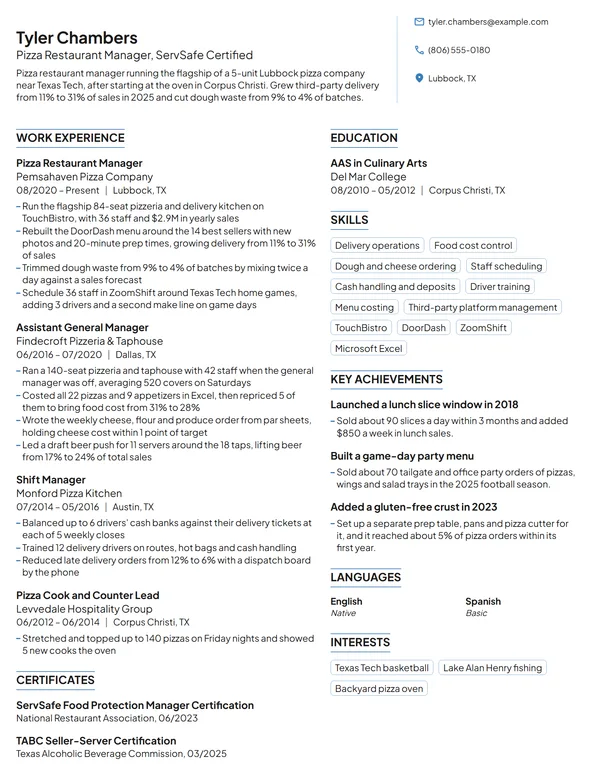
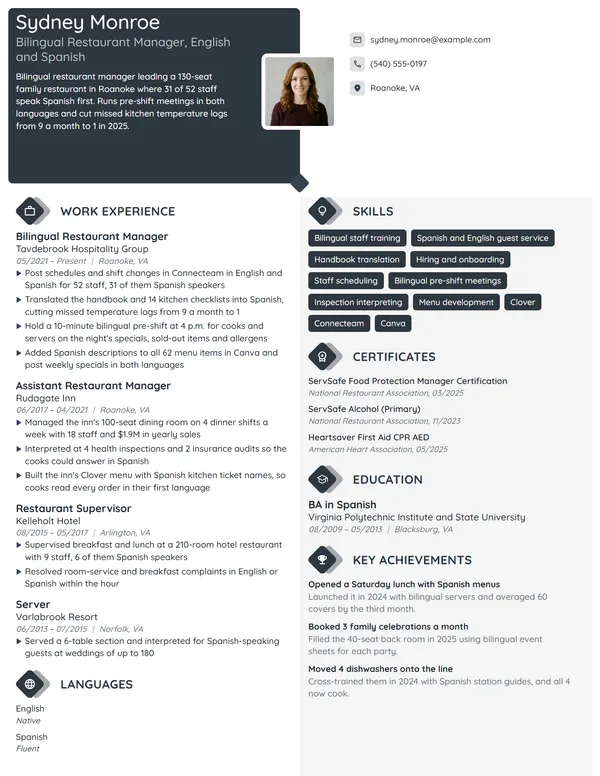
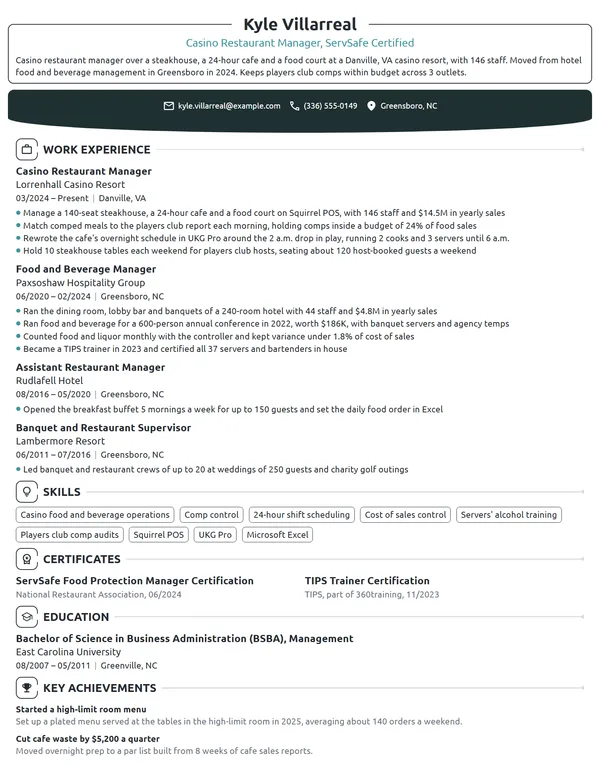
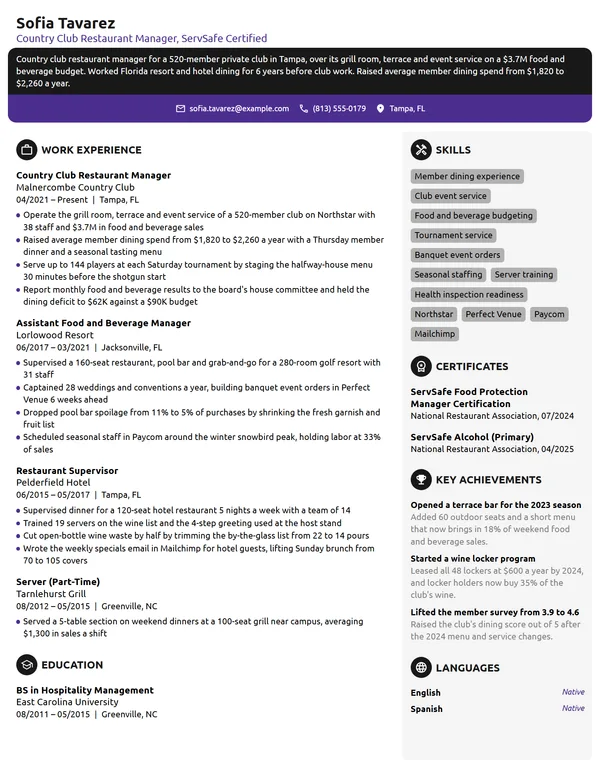
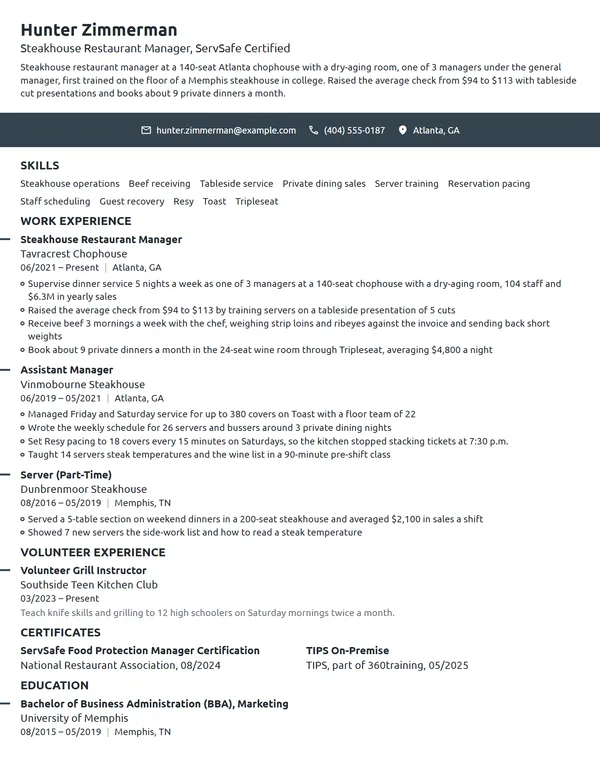
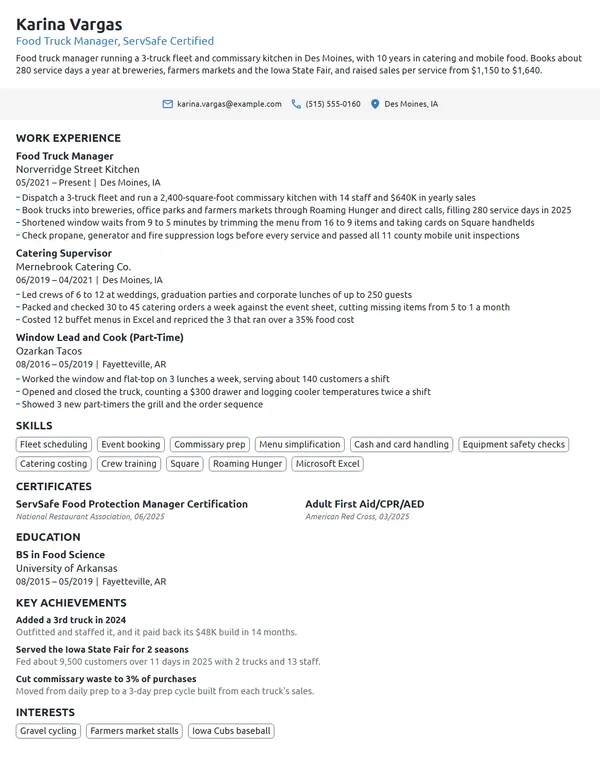
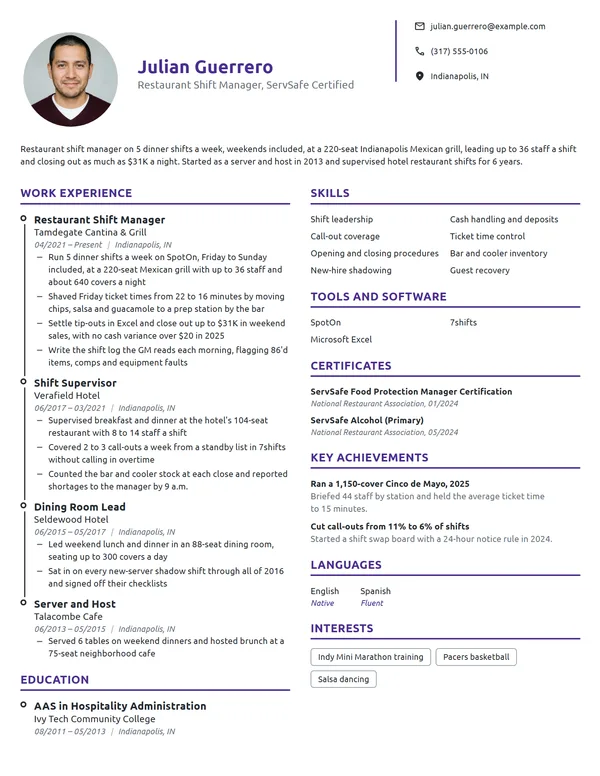
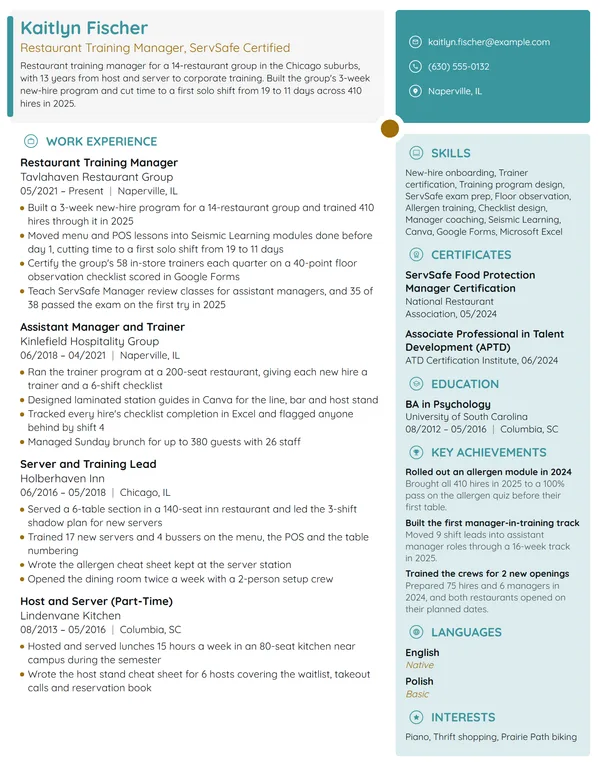
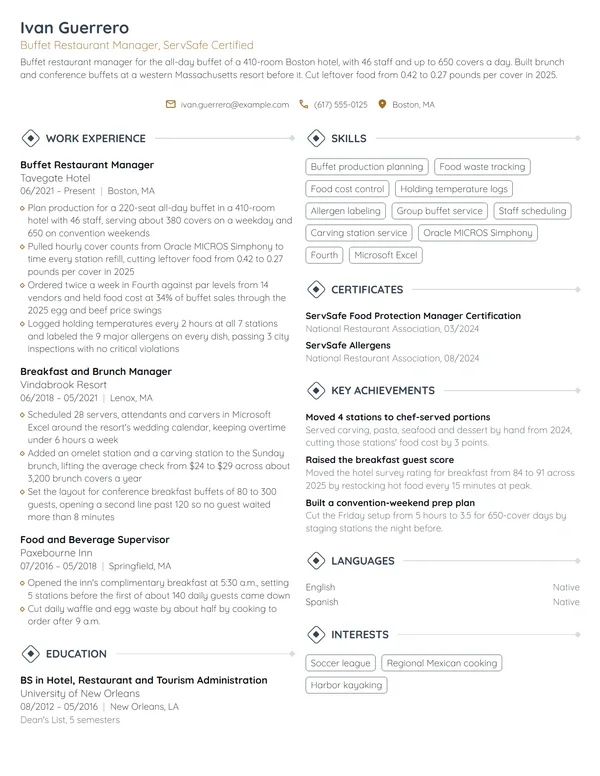
Running a restaurant means looking after guests, staff and the numbers at the same time. An owner hiring a manager wants to know the team you led, the sales and cost targets you answered for and how your restaurant did at health inspections. Most of those figures already sit in your POS and inventory reports. The work is choosing the ones that show what changed because you were in charge, and putting each next to the size of the restaurant.
How to Write a Restaurant Manager Resume - Key Takeaways
- Use the reverse-chronological format on 1 page, moving to 2 only for general manager or multi-unit roles.
- Open your current job with its scale: seats, annual sales and the number of staff you led.
- Back your bullets with the figures your POS and inventory already track: food cost, labor cost, sales growth, ticket times and turnover.
- Name the exact POS and scheduling systems from the job ad, such as Toast or 7shifts, in your skills and in a bullet.
- List your ServSafe Food Protection Manager certificate first under Certificates, with its issuer and date, then any alcohol certificate.
- Leave off pay history and personal details, then test the file with an ATS resume checker before you apply.
What owners and GMs look for in a restaurant manager resume
Whoever hires a restaurant manager checks how large an operation you have run, whether you kept its costs in line, and whether guests and inspectors left satisfied. The BLS lists hiring and training staff, scheduling hours, managing budgets and payroll records, keeping employees compliant with health and food safety standards and handling complaints about food or service as core duties. O*NET adds keeping food and equipment inventories and counting money for bank deposits.
Arrange your resume under headings any hiring portal can read:
- Name, headline (for example, Restaurant Manager, ServSafe Certified) and contact details
- A short summary at the top, 2 to 3 lines long and printed without a heading
- Work Experience, starting with your current restaurant
- Skills, with your POS, scheduling and inventory systems among them
- Certificates: ServSafe Food Protection Manager first
- Education
- Optional extras: Languages, Interests, plus a Key Achievements section or a Volunteer Experience section, never both
Best format for a restaurant manager resume
Use the reverse-chronological resume format: your current restaurant first, each job with its title, the restaurant's name and city, and MM/YYYY start and end dates. Restaurant careers tend to climb from server or line cook to shift lead, assistant manager, manager and general manager, and this layout lets a reader follow each step. A combination format, with a skills section ahead of your history, helps only when you are coming in from outside hospitality.
- Best for most restaurant managersReverse-chronologicalYour jobs, newest first, with your results under each one.Best for: A steady work history in your field
- FunctionalSkills grouped up top, with a short work history below.Best for: Gaps or very little experience
- CombinationA skills section first, then your full work history.Best for: A career change with strong skills
One page covers most restaurant managers, even with 10 years on the floor, because older serving and hosting jobs can shrink to 1 line each. Go to 2 pages only when you have run several locations or held a general manager title, and keep your current restaurant on page 1.
| Setting | What to use |
|---|---|
| Length | 1 page; 2 for multi-unit or general manager experience |
| Dates | Month and year as MM/YYYY; Present on the current job |
| Employer line | Restaurant name and city, with the concept and seat count in the first bullet |
| Font | One readable font, body text between 10 and 12 pt |
| Photo | Leave it off for most US and Canadian employers; never add a birth date or marital status |
| File type | PDF, unless the restaurant group's hiring portal asks for Word |
Most US and Canadian resumes carry no photo. Restaurant groups and hotel chains often collect applications through an online portal that pulls your text into its own fields, so plain headings and a single column of dates help it read you correctly.
Restaurant manager resume summary vs. objective
Once you have managed shifts or a location, write a resume summary: your years, the kind of restaurant, its size and 1 result. If you are stepping up from server or shift lead, or arriving from another industry, a resume objective fits better: the role you are after, the shifts you already run and your food safety certificate. Write it after your bullets so you can reuse your strongest number.
Restaurant manager resume summary formula
Title with X years in type of restaurant, running a seats or sales operation on POS. A cost, sales or guest figure you moved. Food safety or alcohol certificate.
Example
Restaurant manager with 14 years in full-service restaurants, 8 of them in management, running a 110-seat bistro on Toast. Lowered food cost from 32% to 28.5% of sales in 10 months. ServSafe Food Protection Manager certified.
Don't
Results-driven restaurant manager with a passion for hospitality and a proven track record of success.
Do
Restaurant manager with 6 years at a 90-seat neighborhood Italian restaurant, leading 25 staff on Square for Restaurants. Raised the average check from $31 to $36 with a server wine-pairing program. ServSafe Manager and TIPS certified.
Now the reader sees the room size, the team, the system, a sales gain and both certificates.
How to write restaurant manager bullets with numbers
Give your current job 3 to 4 bullets and older ones 2 to 4, cutting early serving or hosting jobs to 1 or 2, each opening with a verb. Restaurants already measure much of what a manager touches in the POS, the schedule and the inventory sheet, so pull your figures from there and show achievements on your resume instead of the duties every manager shares. A percentage needs its base: food cost as a share of sales, turnover over 90 days or a year.
| Area | What to count | Example bullet |
|---|---|---|
| Sales | Year-over-year growth, average check, covers | Grew weekday dinner sales 14% year over year with a $25 prix fixe Tuesday. |
| Food cost | Food cost as a share of sales, waste, vendor pricing | Held food cost at 30% across 3 menu changes by costing every plate before launch. |
| Labor | Labor as a share of sales, overtime hours, schedule accuracy | Lowered labor from 31% to 27% of sales by moving 2 shifts to a 3 p.m. start. |
| Guests | Online ratings, complaints, comps and voids | Raised the average online rating from 4.1 to 4.6 stars across 900 reviews in a year. |
| Speed | Ticket times, table turns, wait times | Cut average ticket time from 19 to 13 minutes at a 200-cover lunch. |
| Team | Hires, promotions, turnover, staff trained | Promoted 5 servers to shift lead in 2 years as 90-day turnover fell from 60% to 35%. |
| Food safety | Health inspections, critical violations, temperature logs | Passed 6 health inspections in a row with 0 critical violations. |
Below is how one manager's last 2 jobs read with those numbers in place. The first bullet sets the scale, and the assistant role keeps only 2 lines.
Work Experience
- Lead 34 front- and back-of-house staff in a 110-seat full-service restaurant with $2.6M in annual sales.
- Lowered food cost from 32% to 28.5% of sales in 10 months by moving to weekly inventory counts and renegotiating 3 produce contracts.
- Build weekly schedules in 7shifts against Toast sales forecasts, keeping labor at 27% of sales through 2 menu changes.
- Kept 4 straight health inspections free of critical violations as the certified person in charge.
- Opened and closed the restaurant 4 nights a week, balancing $6K to $9K in cash and card deposits a shift.
- Trained 22 servers and hosts and brought 90-day turnover from 45% to 30%.
Don't
Responsible for scheduling and managing staff.
Do
Wrote weekly schedules for 40 staff in HotSchedules and cut overtime from 60 to 15 hours a week.
Scheduling becomes a result once it carries the team size, the system and the hours saved.
Don't
Handled customer complaints.
Do
Resolved guest complaints at the table and reduced comps from 2.1% to 1.2% of sales in 6 months.
Restaurant management skills and POS software for your resume
Pick 6 to 8 hard skills for your resume that appear in the posting and that your bullets back up. Cost control, scheduling and food safety belong on nearly every restaurant manager resume; catering, bar programs or menu development only where you have run them. Leadership and composure show best through results, so let the bullets carry the soft skills below.
Hard skills for restaurant managers
- Food and labor cost control
- P&L review
- Inventory and ordering
- Staff scheduling
- Hiring and training
- Food safety and sanitation
- Health inspection readiness
- Responsible alcohol service
- Cash handling and deposits
- Menu costing
- Vendor negotiation
Soft skills owners and GMs value
- Composure during a rush
- Clear direction on the floor
- Coaching new staff
- Guest recovery
- Fair scheduling
- Dependability
Put your systems with your skills and mention each one again in a bullet that shows what you did with it. O*NET marks Microsoft Office in-demand for food service managers and flags Intuit QuickBooks and Microsoft Excel as hot technology. Restaurant job ads usually add a POS such as Toast, Square for Restaurants or Oracle MICROS Simphony, and a scheduling tool such as 7shifts or HotSchedules; write the exact names you have used, not a vague phrase such as POS experience.
ServSafe and alcohol certifications on a restaurant manager resume
Some states and localities require food service managers to hold food safety certification, the BLS says, and managers may earn the Food Protection Manager Certification by passing a food safety exam; your state or local health department sets the rule where you work. Put certifications on your resume in a Certificates section, each with its issuer and date, so a reader checking for ServSafe finds it at once. Add an alcohol certificate if your restaurant serves drinks.
| Certificate | Issued by | What it takes |
|---|---|---|
| ServSafe Food Protection Manager Certification | National Restaurant Association | Pass the ServSafe Manager exam, which is accredited by the ANSI National Accreditation Board (ANAB) under Conference for Food Protection standards. |
| ServSafe Alcohol | National Restaurant Association | Complete the training and pass the Primary exam online without a proctor, or the Advanced exam with one. Some states add their own material to the class. |
| TIPS On-Premise | TIPS, part of 360training | Complete the training for servers, bartenders and staff at venues where alcohol is consumed on site. |
| Food handler or local manager card | Your state or local health department | Rules differ by state and city, so check the health department where the restaurant operates. |
Which food safety certificate to list first
Put the manager-level food safety certificate at the top of Certificates and in your headline, since it is the one a manager role calls for. A food handler card adds little once you hold the manager certificate, so drop the card unless the job ad asks for one. Alcohol certificates come next, then anything else, such as first aid.
Certificates
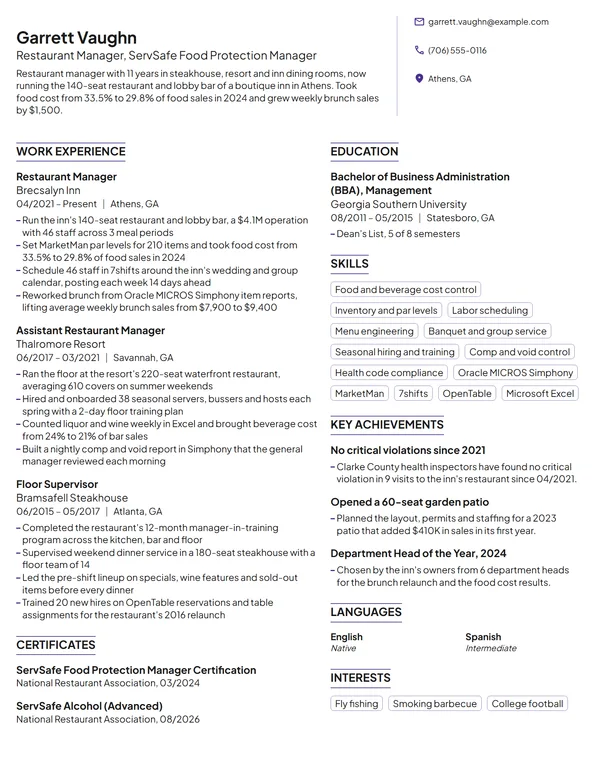
- ServSafe Food Protection Manager Certification, National Restaurant Association, 04/2024
- ServSafe Alcohol (Advanced), National Restaurant Association, 09/2025
Education on a restaurant manager resume, with or without a degree
The BLS says food service managers typically need a high school diploma, though some positions ask for nothing formal and others for a college degree. Employers may prefer postsecondary education for upscale restaurants and hotels, and some chains and hotels recruit management trainees from hospitality programs. With a hospitality or business degree, list it with the school, city and graduation date; without one, a diploma line is enough, and your Certificates section carries the weight.
Follow the standard rules for listing education on a resume: Education goes below Work Experience once you have managed a shift, and a GPA appears only in your first 2 to 3 years out of school when it is 3.5 or higher. A management training program at a restaurant group belongs in Work Experience, as its own entry with dates.
Education
Moving up from server or shift lead, or changing careers
Per the BLS, most food service managers start as cooks, servers or supervisors and spend years in the industry before a manager title. If you are going for your first assistant manager or manager job, show the parts of the role you already do, each with a number:
- Shift lead work: how many shifts a week you ran and how many staff were on them.
- Opening and closing: cash counts, deposits and closing checklists you were trusted with.
- Training: new hires you trained, and any you later saw promoted.
- Inventory and ordering: weekly counts, par levels or the orders you placed.
- Certificates: ServSafe Food Protection Manager, earned before you apply.
Don't
Hardworking server looking for a management opportunity to grow my career.
Do
Server and shift lead with 5 years at a 150-seat steakhouse, seeking an assistant restaurant manager role. Run 2 closing shifts a week with up to 12 staff and hold the ServSafe Food Protection Manager Certification.
Even a first manager objective needs proof: the room, the shifts and the certificate.
Coming from sales, retail or another management job, keep reverse-chronological order and open with an objective that names what carries over: a team you led, a budget or P&L you owned, targets you hit, vendors you negotiated with. Name your ServSafe certificate and any hospitality coursework in that objective, and make the first bullets of your first restaurant job its most hands-on work. A career-change resume leaves the reason for the move to the cover letter, and these management cover letter examples show how to say it in a few lines.
Restaurant Manager resume FAQ
Do I need ServSafe certification to be a restaurant manager?
Not in every state or city. The BLS says some states and localities require food service managers to hold food safety certification, earned by passing an exam. Check your state or local health department, and list the certificate first under Certificates once you have it.
How long should a restaurant manager resume be?
One page for most managers, with older serving or hosting jobs cut to 1 line each. Use 2 pages only if you have run several locations or worked as a general manager, and keep your current restaurant on page 1.
Which POS and scheduling systems should I list on a restaurant manager resume?
List the systems you have actually used that the job ad names, such as Toast, Square for Restaurants, 7shifts or HotSchedules, by their exact names. Add Excel or QuickBooks if you built schedules, cost sheets or reports in them, and show each tool in at least 1 bullet.
Can I become a restaurant manager without a degree?
Yes. The BLS says food service managers typically need a high school diploma and that most start in jobs such as cook, server or supervisor before being promoted. A degree helps more at upscale restaurants and hotels; elsewhere your experience and ServSafe certificate count most.
How much do restaurant managers make?
Food service managers, the BLS occupation that covers restaurant managers, earned a median of $69,390 a year in May 2025. Leave pay off your resume and discuss it in the interview; offers vary with the city, the concept and bonus structure.
Should I mention night and weekend availability on my resume?
Only in a word or two, and only if the posting stresses it. Evenings, weekends and holidays are routine for food service managers in BLS data, so most employers assume you can cover them. A bullet about the closing shifts you ran says more than a line about availability.
How do I show both front-of-house and back-of-house experience?
Keep 1 entry per job and split the bullets: a floor result, such as guest ratings or table turns, and a kitchen result, such as ticket times, food cost or inspections. If you held separate front and back titles at one restaurant, list each title with its own dates.
Next steps
Pick the example closest to your concept and level, keep its order of sections, and swap in your own seats, sales, food cost and labor figures. Put it together in our resume builder, or pick one of our resume templates as a base, then write a cover letter that opens with the result you are proudest of.