
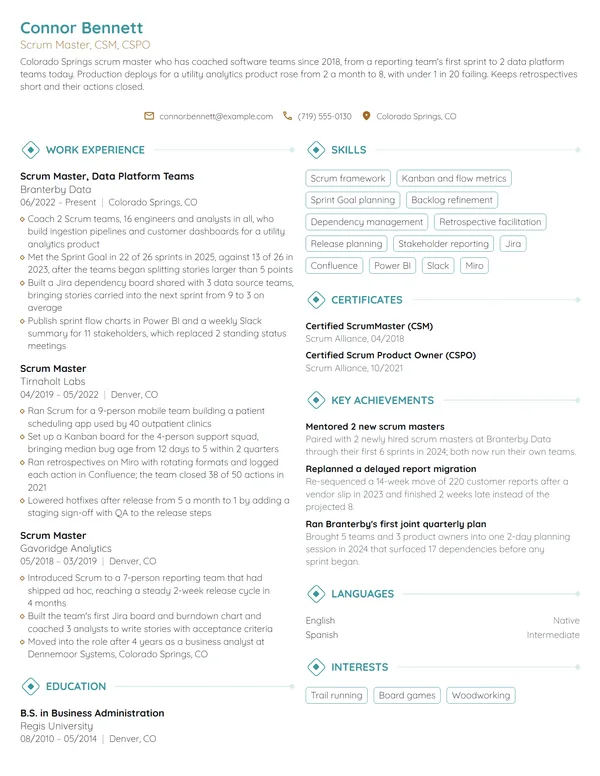
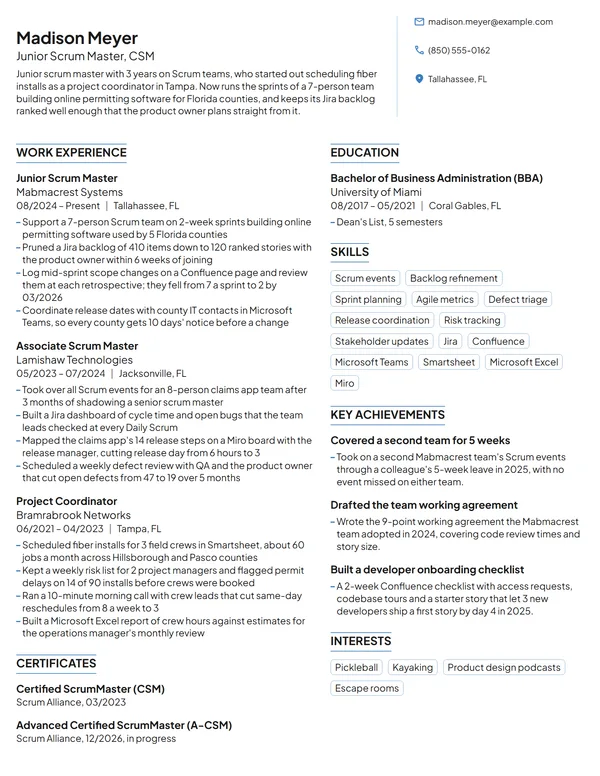
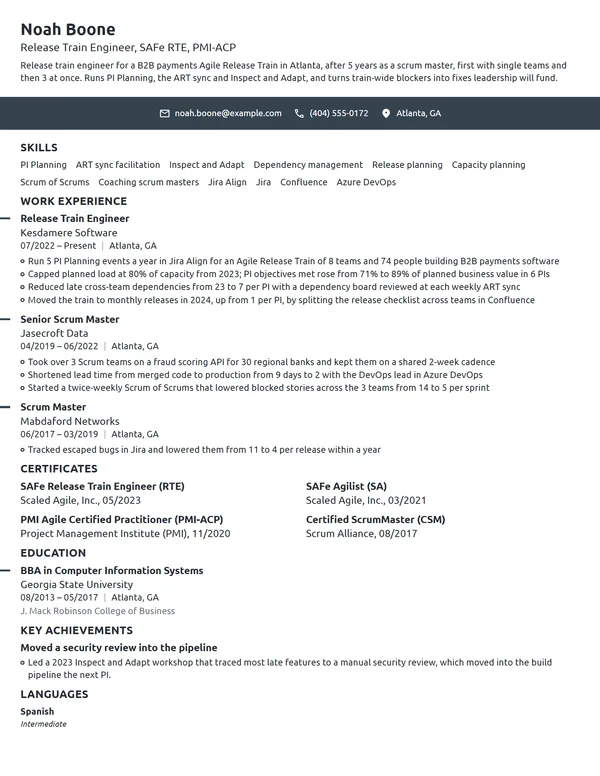
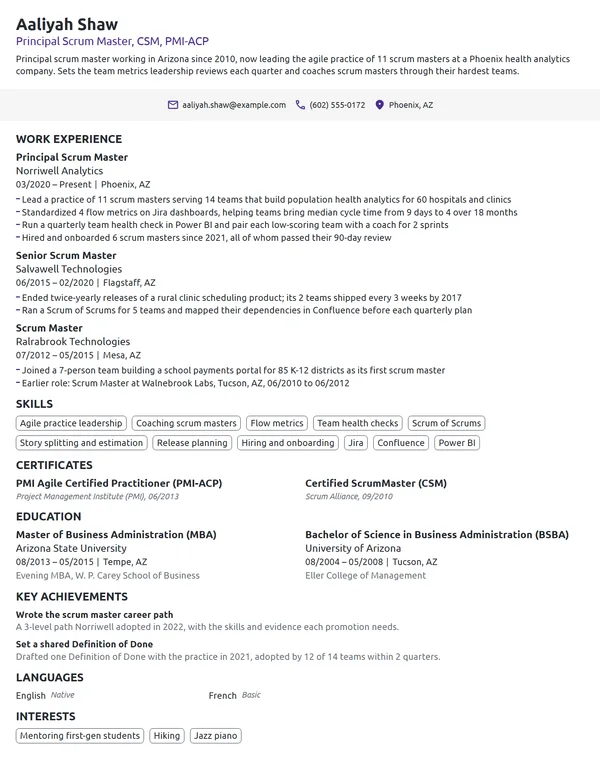
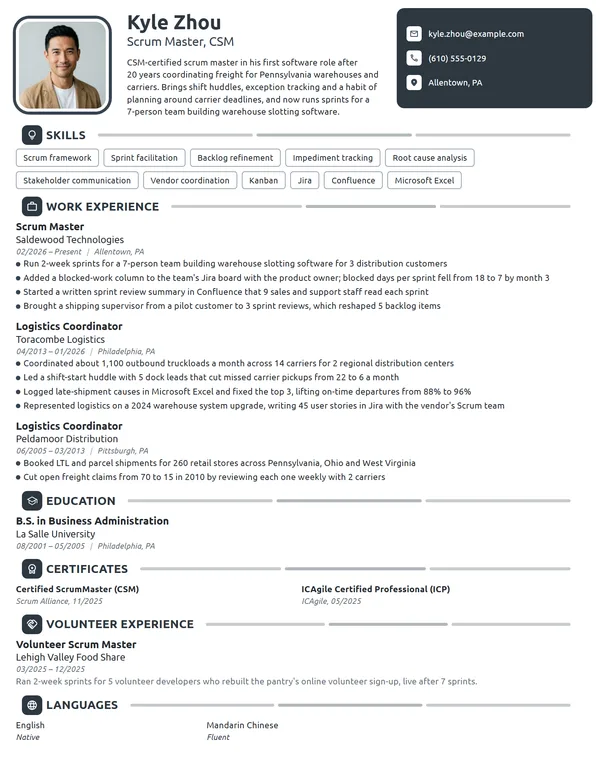
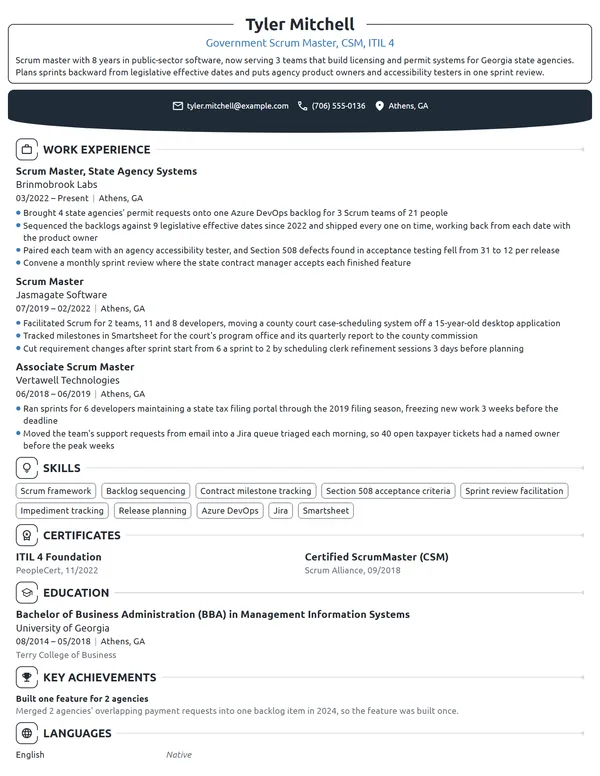
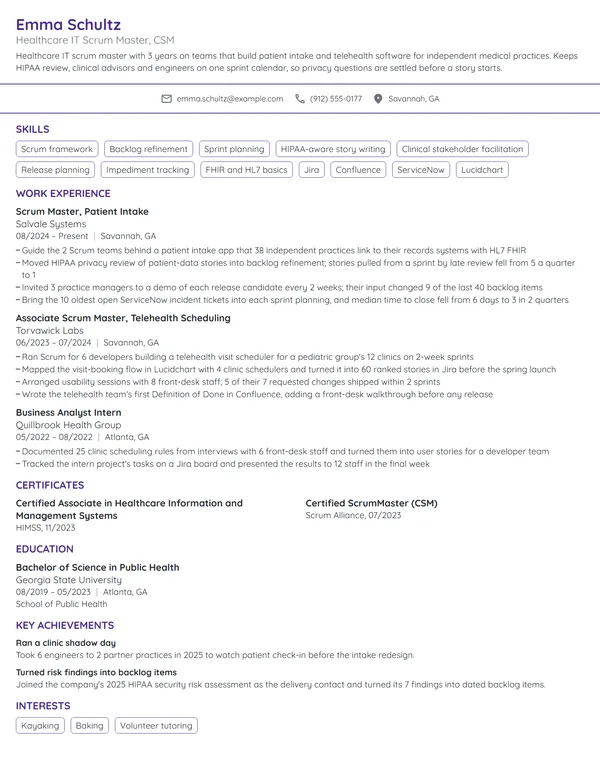
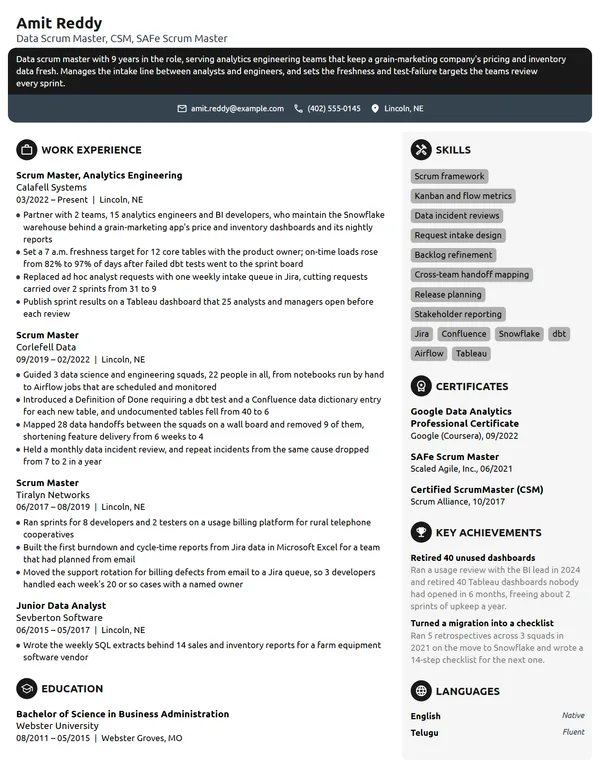
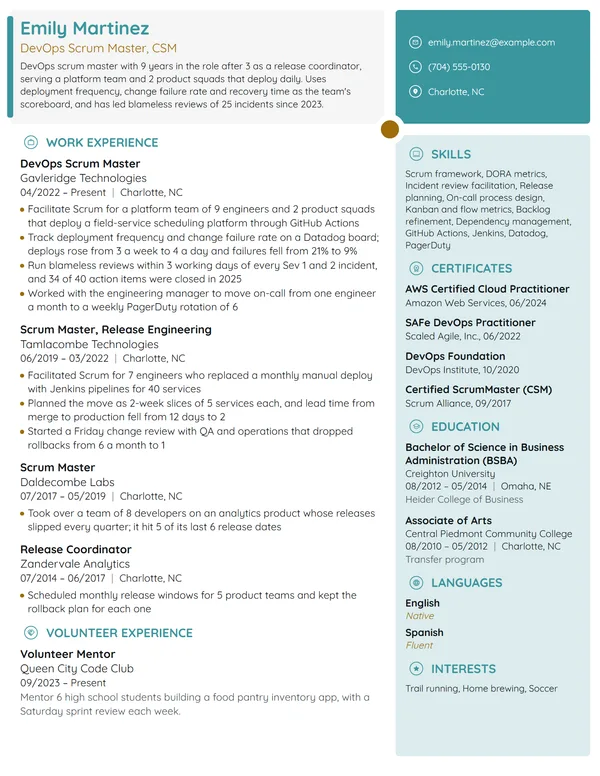
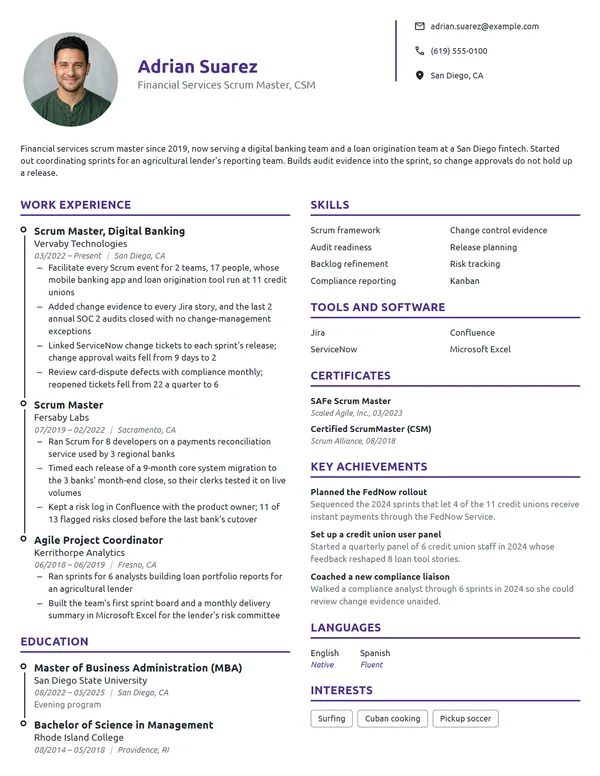
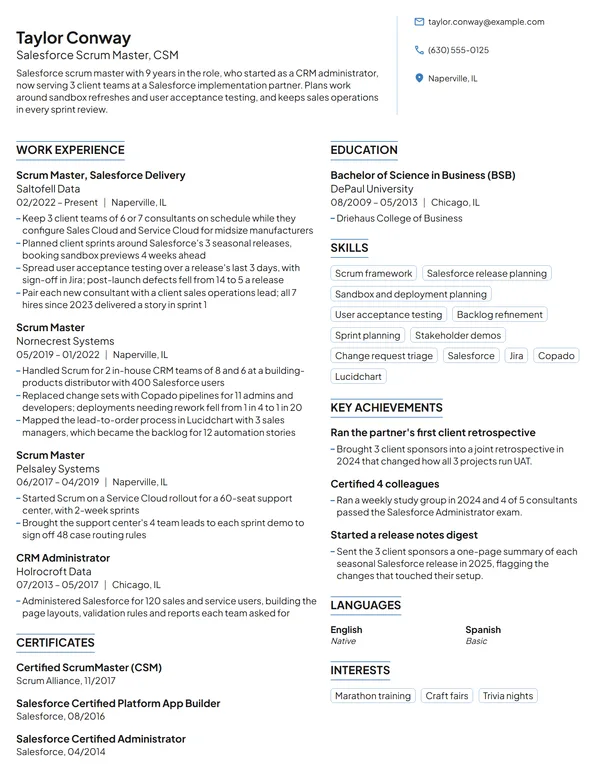
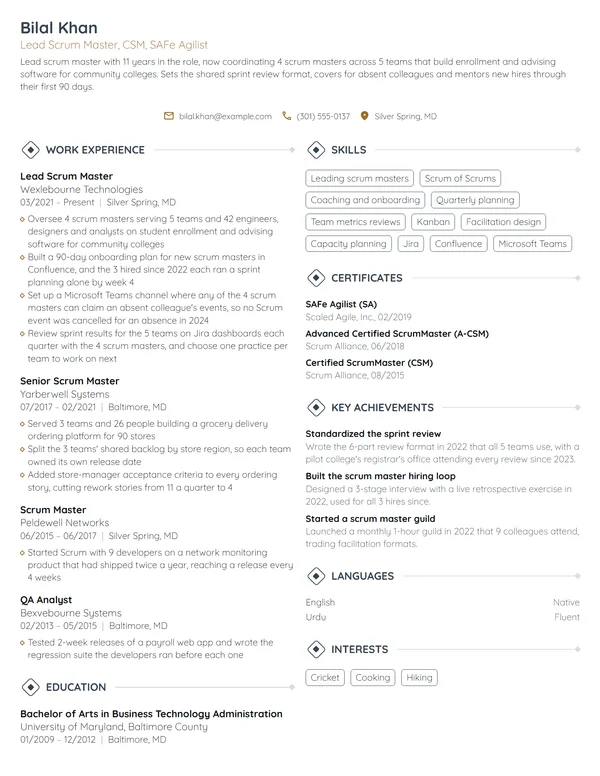
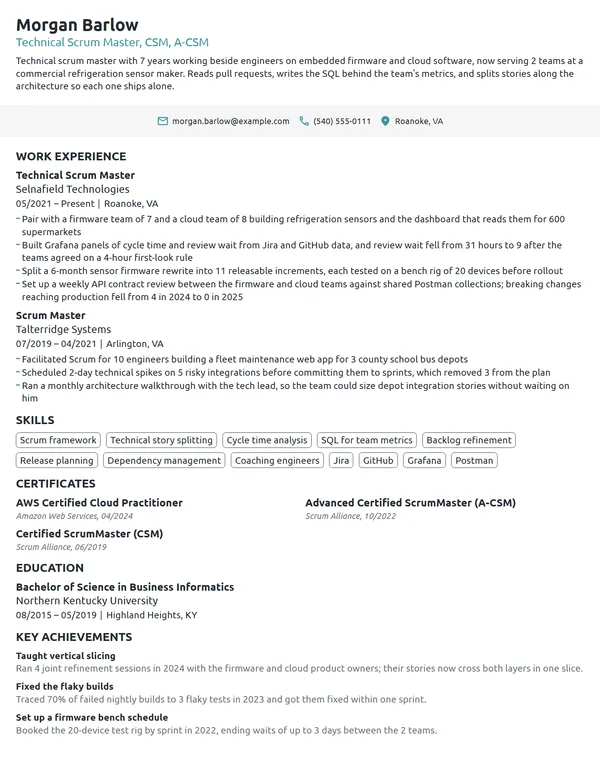
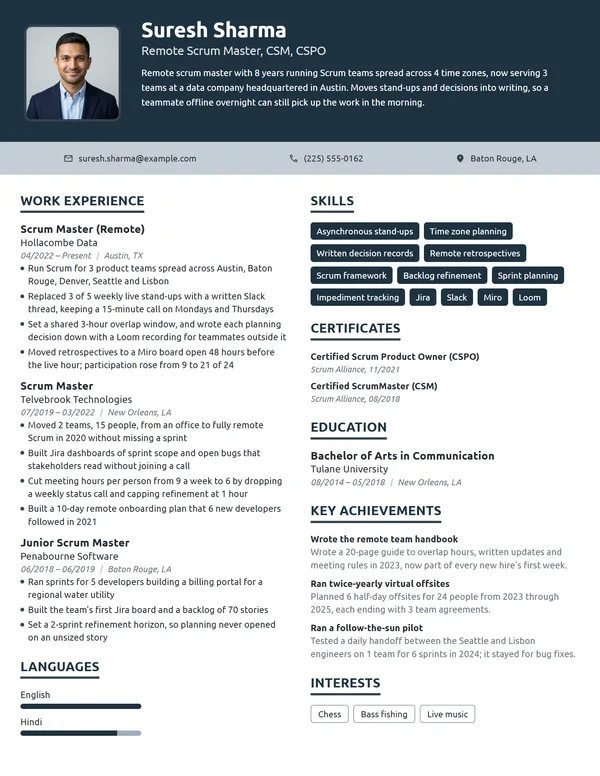
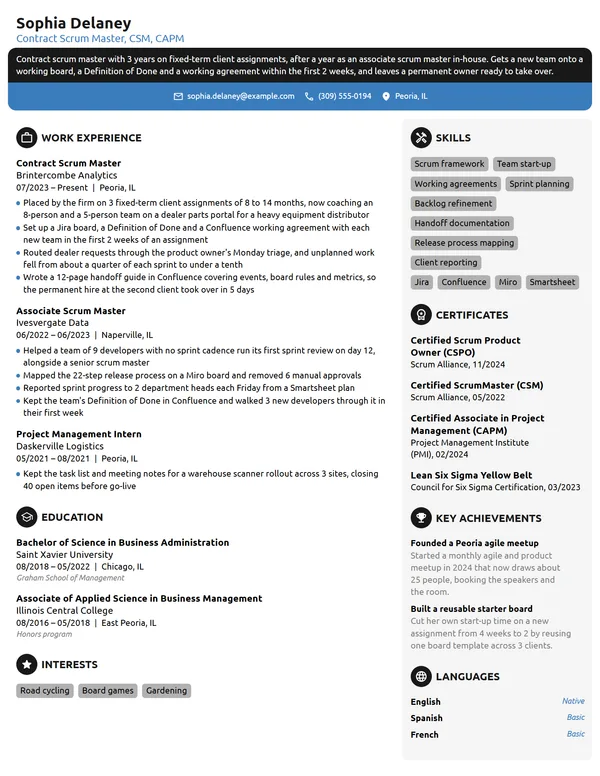
A scrum master helps a team deliver steadily, sprint after sprint, and get better at it over time. The people hiring for the role check how many teams you have supported, which framework you ran and which certifications you hold. Tie facilitation and coaching to results the team or the business can see: goals met more often, faster work from idea to release, more frequent releases and fewer bugs reaching customers.
How to Write a Scrum Master Resume - Key Takeaways
- List jobs newest first (reverse-chronological) and fit them on 1 page, moving to 2 only once you have 10+ years or several agile release trains behind you.
- Open with a 2- to 3-line summary naming how many teams you serve, the product they build, your tools and 1 delivery result.
- Tie every bullet to a team outcome with a figure: Sprint Goals met, cycle time, release frequency, escaped defects or impediments cleared.
- Spell each tool as the job ad does, such as Jira, Confluence or Azure DevOps, and prove each one inside a bullet.
- Put your top certification in the headline (Scrum Master, CSM) and list each active one under Certificates with its issuer and month earned.
- Keep the file plain and readable, then test it with an ATS resume checker before you apply.
What hiring managers look for in a scrum master resume
The 2020 Scrum Guide makes the scrum master accountable for establishing Scrum and for the Scrum Team's effectiveness. It lists coaching team members in self-management, causing the removal of impediments and keeping every Scrum event within its timebox. O*NET's closest match, Information Technology Project Managers, adds facilitating meetings and conferring with project staff to resolve problems. An engineering or delivery manager wants to see those duties turn into results.
Build the page from these sections, named the way applicant tracking systems expect:
- Name, headline with your top certification (for example, Scrum Master, CSM) and contact details
- Summary of 2 or 3 lines under the headline, with no heading of its own
- Work Experience, current role first
- Skills, with your tools such as Jira and Confluence
- Certificates, active credentials first
- Education
- Where they add something: Key Achievements (or Volunteer Experience instead), Languages, Interests
Best format for a scrum master resume
Pick the reverse-chronological resume format, with your current role first and MM/YYYY dates on every job. Scrum master careers often grow in scale, from 1 team to several, then to a release train or an organization's agile coaching, and this order makes that growth easy to follow. If you are moving in from QA, development or project management, keep this format and let your summary carry the switch.
- Best for most scrum mastersReverse-chronologicalYour jobs, newest first, with your results under each one.Best for: A steady work history in your field
- FunctionalSkills grouped up top, with a short work history below.Best for: Gaps or very little experience
- CombinationA skills section first, then your full work history.Best for: A career change with strong skills
With fewer than 10 years behind you, fit everything on 1 page. A senior scrum master who has run several teams, a scaled framework or an agile rollout can use 2 pages, provided the first page holds the 2 latest roles and the certifications.
| Setting | What to use |
|---|---|
| Length | 1 page under 10 years; 2 for multi-team or release-train careers |
| Headline | Target title plus top credential: Scrum Master, CSM |
| Job title line | Title plus the teams you serve: Scrum Master, Payments Teams |
| Dates | MM/YYYY on each role, Present on the current one |
| Body text | A clean sans serif between 10.5 and 12 pt |
| Photo and personal data | Photos are uncommon in the US and Canada; no age, no family details, no SSN |
Most US and Canadian resumes carry no photo. A plain layout with text-based headings is also what ATS software parses most cleanly.
Scrum master resume summary vs. objective
Decide by your title history. If you have held a scrum master role, write a resume summary that names your teams, your tools and 1 delivery result. If you are applying for your first scrum master job, a resume objective works better: the role you want, the Scrum work you have already done and your certification. Both run 2 or 3 lines.
Scrum master resume summary formula
Title with X years supporting number Scrum teams on product or domain, working in tools. Your biggest delivery or quality gain, as a figure. Certifications.
Example
Scrum master with 5 years supporting 3 Scrum teams on freight logistics software, working in Jira and Confluence. Moved the teams from monthly to weekly production releases while escaped defects fell by a third. CSM and A-CSM certified.
Don't
Passionate Scrum Master and servant leader with a proven track record of agile transformation and continuous improvement.
Do
Scrum master for 2 mobile app teams at a regional bank, working in Azure DevOps. Took the teams from 1 release a quarter to 2 a month in a year, with on-call pages down from 30 to 12 a month. PSM I and CSM.
Now the reader sees the teams, the tool, a cadence change and the credentials, each one something to ask about in an interview.
How to write scrum master work experience bullets with numbers
Write 3 to 4 bullets for your current role and 1 to 3 for each older one, every line opening on an action verb. Since the team does the building, credit the result to the change you made: the working agreement, the board, the dependency meeting, the coaching. Beyond the basics of listing work experience on a resume, each bullet here should answer what got better for the team.
| Area | What to count | Example bullet |
|---|---|---|
| Predictability | Sprint Goals met, committed work finished | Raised the share of committed stories finished each sprint from 64% to 88% in 3 quarters. |
| Flow | Cycle time, blocked days, work in progress | Cut average blocked time per story from 4 days to 1.5 by raising dependencies at the Daily Scrum. |
| Release cadence | Releases per month, lead time to production | Helped 2 teams go from quarterly releases to a release every 2 weeks within 9 months. |
| Quality | Escaped defects, rollbacks, incidents | Brought escaped defects from 18 to 9 a quarter after the team added test criteria to its Definition of Done. |
| Coaching and training | Teams coached, people trained, workshops run | Trained 45 staff in Scrum basics through 6 workshops during a department's first agile year. |
| Scale | Teams, people, trains, PI Planning events | Facilitated PI Planning for a 9-team, 110-person Agile Release Train. |
Below, a scrum master's entry uses those measures. Its opening line gives team count and size, and the earlier analyst role shows the Scrum work that led to the title.
Work Experience
- Serve 3 Scrum teams of 7 to 9 people building route-planning and carrier billing software in Jira.
- Lifted the Sprint Goal hit rate from 58% to 84% over 4 quarters by capping sprint scope at the team's recent average.
- Cut average story cycle time from 11 to 6 days after adding work-in-progress limits to 2 teams' boards.
- Cleared 40 cross-team blockers in 2025 through a weekly 30-minute dependency sync with 2 platform teams.
- Wrote and refined 300+ user stories for a claims portal rebuild, each with acceptance criteria the testers signed off.
- Ran daily stand-ups for a 6-person team during a 4-month scrum master vacancy.
Don't
Facilitated daily stand-ups, sprint planning, reviews and retrospectives.
Do
Shortened sprint planning for 2 teams from 4 hours to 90 minutes by getting stories refined 2 days ahead.
Running the events is the job; the rewrite shows what running them well changed.
Don't
Removed impediments for the team.
Do
Logged 62 impediments in 2025 and cleared 41 within 2 days, including a test-environment shortage that had stalled 3 teams.
Scrum master skills and tools for your resume
Out of the posting, take 6 to 8 hard skills for your resume that your bullets back with evidence. Facilitation, conflict resolution and influence without authority are the soft skills this job runs on, and they read best as results inside your bullets rather than as a list of adjectives.
Hard skills for scrum masters
- Scrum framework
- Kanban and flow metrics
- Sprint Planning and Sprint Review facilitation
- Retrospective facilitation
- Backlog refinement support
- Impediment and dependency management
- Agile metrics and reporting
- SAFe and PI Planning
- Team coaching
- Release planning
Soft skills delivery leaders value
- Facilitation
- Conflict resolution
- Active listening
- Influence without authority
- Patience with change
- Clear written updates
Tools sit inside your Skills section, and each one should also turn up in a Work Experience line. For Information Technology Project Managers, O*NET flags Atlassian JIRA, Atlassian Confluence, ServiceNow and Microsoft Excel as in-demand technology, and Microsoft Team Foundation Server as hot technology. Where an ad asks for Azure DevOps, Rally, Jira Align or Miro and you have used it, write that exact name, and say what you built in it: a board, a dashboard, a dependency map.
CSM, PSM, SAFe and PMI-ACP: how to list scrum master certifications
Put certifications on your resume in the Certificates section, each with its issuer and the month and year earned, and repeat your top one in the headline. Scrum Alliance's Certified ScrumMaster (CSM) and Scrum.org's Professional Scrum Master I (PSM I) are both entry-level scrum master credentials, so put first whichever one the ad you are answering lists. SAFe credentials matter where a company runs the Scaled Agile Framework, and the PMI-ACP suits roles that sit close to project management.
| Credential | Issued by | What it takes |
|---|---|---|
| CSM (Certified ScrumMaster) | Scrum Alliance | A 16-hour course, then a 1-hour, 50-question test with 37 correct answers to pass; renew every 2 years with Scrum Education Units. |
| A-CSM (Advanced Certified ScrumMaster) | Scrum Alliance | A CSM, 12 months of scrum master work in the last 5 years and an approved A-CSM course. |
| CSP-SM (Certified Scrum Professional ScrumMaster) | Scrum Alliance | An A-CSM, at least 24 months of scrum master work in the last 5 years and the CSP-SM course. |
| SAFe Scrum Master | Scaled Agile | A 90-minute, 45-question exam with 80% to pass; 24 continuing education units every 2 years. |
| SAFe Release Train Engineer (RTE) | Scaled Agile | An advanced-level, 120-minute, 60-question exam with 82% to pass. |
| PMI-ACP (PMI Agile Certified Practitioner) | Project Management Institute (PMI) | A secondary diploma, 2 years of agile experience in the past 5 (or 1 year with another agile certification), 21 hours of agile training and a 120-question exam. |
How to list a certification in progress or one that has lapsed
A course you are taking goes under Certificates with the word in progress and an expected date, never as if it were earned. Scrum Alliance credentials renew every 2 years, so check your status before you apply: renew a lapsed CSM or leave it off, because a recruiter can look it up. Keep the CSM listed after you earn the A-CSM or CSP-SM: those build on it, and a recruiter may search for CSM by name.
Certificates
- Certified ScrumMaster (CSM), Scrum Alliance, 03/2019
- Advanced Certified ScrumMaster (A-CSM), Scrum Alliance, 09/2022
- Certified Scrum Professional ScrumMaster (CSP-SM), Scrum Alliance, course in progress, expected 03/2027
How to list education on a scrum master resume
O*NET places its closest occupation, Information Technology Project Managers, in Job Zone Four, Considerable Preparation Needed, so list your degree if you have one. When listing education on a resume, a scrum master needs only the degree name, the university with its town, and an MM/YYYY graduation date. A business, information systems or computer science degree fits well, though any field works once your bullets show the Scrum experience.
Put Education below Work Experience once you have held a scrum master role. Add a GPA only if it is 3.5 or above and you graduated within the last 2 or 3 years, and leave out coursework unless it involved real Scrum teams.
Education
Junior and career-change scrum master resumes
If you are moving up from development, QA, business analysis or project coordination, show the Scrum work you already did on a team, even without the title. With no role on a Scrum team yet, an entry-level resume layout with your certification near the top fits better.
- Backup facilitation: stand-ups, planning sessions or retrospectives you ran when the scrum master was away, with how many and for how big a team.
- Board and reporting work: a Jira board, burndown or dashboard you built and how many people used it.
- Process changes you led: a Definition of Done, a triage routine or a working agreement, with what changed after.
- Agile work for a nonprofit or student group: listed under Volunteer Experience, with the team size and what got delivered.
Don't
Motivated professional seeking a Scrum Master role to grow my agile skills.
Do
CSM-certified QA analyst with 4 years on Scrum teams, seeking a first scrum master role. Ran 30+ retrospectives as the backup facilitator and set up a bug triage board 2 teams still use.
Even a 2-line objective needs evidence: years on Scrum teams, events run and a change that stuck.
Changing careers from teaching, operations or customer service, hold on to reverse-chronological dates and build your objective around what carries over: facilitating groups, coaching people and running a schedule. A career-change resume lands better once the top lines of your current job are the most Scrum-like ones, such as a team you coordinated or a process you improved. Save the story of why you switched for your cover letter; the project manager cover letter examples show how to frame delivery experience in a few sentences.
Scrum Master resume FAQ
Do I need a CSM to get a scrum master job?
Not always. A certification shows you know the framework, and Scrum Alliance's CSM takes a 16-hour course and a 50-question test. If a posting lists one as required, earn it before you apply; without one, put your record of running Scrum events for a team at the top.
Should I list CSM or PSM I on my scrum master resume?
List whichever you hold, and both if you have both. Put the one the posting names in your headline and first under Certificates, each with its issuer, Scrum Alliance or Scrum.org, and the month and year you earned it.
How long should a scrum master resume be?
1 page, unless you have 10+ years. 2 pages suit scrum masters who have served several teams, run a release train or led an agile rollout, as long as page 1 holds the 2 latest roles and your certifications.
What metrics should a scrum master put on a resume?
Team outcomes you helped change: Sprint Goals met, committed work finished, cycle time, release frequency, escaped defects and impediments cleared. Add the scale too, meaning the number of teams and people you served, so a reader can judge the size of each result.
Should I put velocity on a scrum master resume?
Rarely. Story points mean something different on every team, so a rising velocity number tells an outside reader little. Use outcomes that compare across teams instead, such as release frequency, cycle time or the share of Sprint Goals met.
How do I show scrum master experience if my title was something else?
Keep your real title, then lead that entry with the Scrum work: events you facilitated, the team size and what improved. Add your CSM or PSM I under Certificates and say in your summary that you are moving into a scrum master role.
Is a release train engineer resume different from a scrum master resume?
Yes, mainly in scale. A release train engineer resume shows several teams working as an Agile Release Train, so its bullets count teams, people and PI Planning events. Scaled Agile describes the RTE as facilitating large-scale events and resolving systemic impediments, and its RTE certification is an advanced-level exam.
Should a scrum master resume list Jira?
Yes, if you have used it, since O*NET marks Atlassian JIRA In Demand for the closest occupation. Add it to Skills, then show in a Work Experience line what you did with it, such as a board with work-in-progress limits or a release dashboard.
Next steps
Find the example nearest your level and framework, mirror its section order, then replace its teams, tools and figures with yours. Lay yours out in our resume builder or on one of the resume templates, and lead your application letter with the delivery result you are proudest of.